Showing posts with label Cory Doctorow. Show all posts

Sunday, May 26, 2013

Cory Doctorow's "Pirate Cinema" (novel, free): Political campaign against a "bad" law

Cover of the novel Pirate Cinema by Cory DoctorowThis is the story of a political campaign in UK to make the parliament repeal a bad law. Point of the story seems to be: the disproportionately high influence a few Hollywood companies seem to have on legal aspects of internet use is very bad for society. Because their side effects have crippling effect on everything we do on the net.

I didn't find it always believable, but it's by & large readable. A penniless runaway kid in London, with a taste for remixing movies, will lead a revolt against 3-strikes law - if you're caught illegally downloading movies up to 3 times, you & your family lose internet connectivity for a year.

Story takes its time to really get started, so you'll need a bit of patience.

Fact sheet.

First published: 2012.
Download full text from author's website.
Rating: B.
Related: Stories of Cory Doctorow.

Thursday, October 27, 2011

Cory Doctorow's "I, Robot" (novelette, free): When North America was a police state

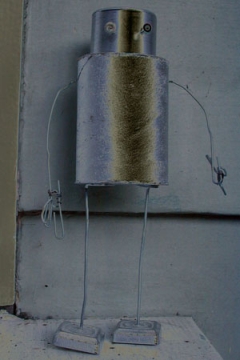
Illustration accompanying the original publication of the short story I Robot by Cory Doctorow. Picture shows a robot sculpture in metal by Howard Waldrop, photographed by Eileen Gunn.
This is may be the most readable short fiction I've seen from author so far. Suspension of belief becomes much harder towards later parts of the story, but first two thirds is great.

Story summary.

This is the story of Arturo, a policeman in North America ("UNATS"), & his difficult relationship with his teenager daughter Ada. As a consequence of their conflict, we get to see the police state of "UNATS" (North America).

Fact sheet.

First published: The Infinite Matrix, 15 February 2005.
Download full text from publisher's site, Feedbooks. [via John@ClassicScienceFiction]
Rating: A.
Nominated for Hugo Award 2006 in novelette category.
Nominated for BSFA Award 2005 in novelette category.
Related: Stories of Cory Doctorow.

Sunday, July 25, 2010

For authors: Heinlein on his story writing technique

Relavant quote by Cory Doctorow at Boing Boing.

Related: Stories of Robert Heinlein, Cory Doctorow.

Sunday, April 11, 2010

Cory Doctorow on "itch to copy is in human genes"

Link.

"Three or four billion years ago, by some process that we don't understand, molecules began to copy themselves. We are the distant descendants of those early copyists - copying is in our genes. We have a word for things that don't copy: 'dead'."

Related: Stories of Cory Doctorow.

Tuesday, June 30, 2009

Cory Doctorow's "Little Brother" (novel, revolution, free): Anti-terror cops run amok

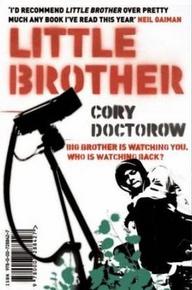
Cover image of the 2008 novel titled Little Brother by Cory DoctorowThere are at least 3 parts to this novel: main story, propaganda, & an overview of the currently available computer privacy technology.

Main story is common enough, but very well told: A teenager in San Francisco is among the many innocents brutally abused by US anti-terror police. He leads a revolution that promises to fix things by the end of the story.

I guess I could identify with the story because of parallels with what I've read of Indira Gandhi's notorious "Emergency" in India during 1975-1977.

Caution: Main story sometimes runs along tracks that will befuddle readers in many countries. E.g., I found nothing to connect with in the sequence that runs several pages & describes teenagers vampire games at some sort of school camp; it was just bloat, though a variation is used later during a political protest.

Propaganda is interwoven throughout the story, & occasionally goes on totally irrelevant tracks. I recall at least one occasion where the author launches into a criticism of British government's citizen tracking systems in an utterly irrelevant context.

Computer privacy technology overview is generally good, but then I'm a programmer & the stuff was generally familiar. Readers from other backgrounds might see these as info dumps.

Caution: Author doesn't always include the all important caveats with privacy technology he advocates (e.g., using TOR to connect to a site that requires a password & communicates the password unencrypted is usually worse than not using it; or that Windows version of TOR might sometimes make you think you are anonymous when you are not). Also there is very good reason much of this tech is not in widespread use - using a lot of it requires the outlook of a computer nerd, & sometimes even that is not enough. But they all have their uses - in specific contexts.

Fact sheet.

First published: 2008.
Rating: A.
Download full text in multiple formats from author's site.
Nominated for Hugo Award 2009 in novel category.
Nominated for Nebula Award 2009 in novel category.
Related: Stories of Cory Doctorow; revolution in fiction

Sunday, March 1, 2009

Cory Doctorow on a key defining attribute of steampunk

In a post titled "Love the Machine, Hate the Factory", at Make, #17.

Saturday, February 28, 2009

Amazon "Kindle 2"'s text-to-speech features

Cory Doctorow answers some recent blabbering of a gentleman named Roy Blount, Jr, president of (US-based?) Author's Guild. In language far more civilized than I would have used.

Wednesday, February 18, 2009

Off topic: How to click on "I Agree" button of EULA agreements of software without responsibility for the contract!

Funny & cool. By Cory Doctorow at Boing Boing.

Tuesday, June 24, 2008

Cory Doctorow's "After the Siege" (novella, free): Citizens' pain - in a city under military siege

It's a well written story, if you are into stories about human misery; I gave up about a quarter of the way through.

It's said to be based on the 2 year siege of Leningrad by German forces during World War II. You will probably like this story more than I did if you are emotionally close to the event.

And except for a sprinkling of things like robots, printed cloths, & a wizard - all of them peripheral to story - it's really a non-genre story.

Story so far.

An unnamed city doesn't care much about patents; there's a flourishing industry in generics based on patented designs from abroad. This has made the US & EU support the unnamed enemy of the city to lay siege upon it.

Story is told from the perspective of Valentine, a 13 year old girl from the city under siege. Her happy world is turning more & more hopeless with every page - her dad is killed in a bomb attack; her mom is out fighting on the front; she was initially made to do menial jobs in the city - & is now digging trenches at the front in return for minuscule quantity of bread; her well loved younger brother, Trover, is distraught at the creche he's forced to live in.

Last sentence where I gave up: "the chit could be redeemed for bread. If she left Trover in the creche they would feed him. If Mata didn't come home from the fighting again tonight, the bread would be hers, and the cabbage, too." She got this chit after a hard day's labor digging trenches, & has been so dehumanized she would rather not share the little food she's got with her mom & little brother!

Fact sheet.

First published: The Infinite Matrix, January 2007.
Rating: B
Winner of Locus Award 2008 in novella category.
Download full text.
Related: All stories of Cory Doctorow.

Friday, May 2, 2008

* Cory Doctorow's "Truncat" (short story)

Sequel to novel "Down and Out in the Magic Kingdom". Jargon filled utopia of a future world where people live very long; can go to sleep for long in a kind of stasis; can backup the contents of their brain so even in the worst accident, the old backup can be downloaded into their clone to ensure continued existence. And most importantly, young people share these brain backups over a kind of file sharing network (usually without owner's consent), & get a kind of psychological boost out of it! This sharing is supposed to be fun & hep.

Fact sheet.

First published: salon.com, August 2003.
Rating: C
Download full text.

Note: Why is this post so short?

** Cory Doctorow's "Printcrime" (short story, science fiction)

An extreme case of Hollywood's persecution of file sharers. This future world has printers that can print anything (presumably given the description in a file) - an expensive medicine, jewelery, etc. Lobbying of design owners have ensured that these machines are outlawed in this dystopic society.

A man using it illegally is caught & severally punished. When he returns after spending a decade in prison, he is determined to ensure that when he next goes to prison, it's something worthy of imprisonment! He will now be printing these printers themselves, & flooding the society with them.

This sentiment - of unjust punishment for minor crime, & of protagonist's retaliation by actually doing something worthy of punishment, is also found in Larry Niven's "The Jigsaw Man".

See also the fanfic rejoinder to Printcrime - Peter Anderson's "The Copper Responds".

Fact sheet.

First published: Nature Magazine, January 2006.
Rating: B
Download full text.

Note: Why is this post so short?

* Cory Doctorow's "Other People’s Money" (short story)

In the year 2027, venture capitalists in Silicon Vally have funds of the order of half trillion dollars to deploy. And go to desperate lengths to try finding investment opportunities.

Fact sheet.

First published: Forbes, 15 October 2007.
Rating: C
Download full text.

Note: Why is this post so short?

Friday, April 18, 2008

Cory Doctorow's "Anda's Game" (novelette, science fiction): Description of an online multi-player computer game

While the story obviously gets inspiration for the title as well as ideas of using kids as main protagonists & game sessions to discuss larger themes, from Orson Scott Card's much better known "Ender's Game", it's a very different story.

It's also among the Cory's more accessible stories. There is some jargon, but far less than I've seen in some of his other stories. Focus is on telling the story with generally no distractions.

Full text of this story is available for download.

Story summary.

There are actually 2 intertwined stories here:
  1. Description of a multi-player online computer game & the virtual world it's played in. I have never played such a game, & read this part as a decent tutorial on the subject. Yes - actual playing is more enlightening, but...

    This is the part that makes me rate this story A.

    Anda of title is a 10 year old girl in London & the main protagonist.
  2. Some commentary on interaction of the economy of sweat-shops in low-wage countries with the economy of better off countries. I found this part naive & completely contrary to my experiences.

    His core thesis seems to be that of pity. Poor guys earn so little compared to their richer counterparts; let's ensure their sweat-shop is not harmed.

Fact sheet.

First published: salon.com, 15 November 2004.
Rating: A
Related: All stories of Cory Doctorow.

Saturday, October 27, 2007

Cory Doctorow's "0wnz0red": Software to tone up your body!!

My first impression on reading this novelette was - "insane"! Even if it were made technologically feasible, no way I am going to trust software running on my Windows notebook for anything life critical.

It has been about 2 weeks since I read it, & it no longer appears as crazy - who knows if far off in future, it won't be possible.

The unspellable title is meant as programmer-speak. When troubleshooting or (less often) trying to understand, a program, programmers often edit, midway through the program run, some aspect of program's state via a piece of software called "debugger". Many of these changes involve numbers - e.g., a code that means "enable a certain feature of command X". Programmers that learned their art before GUIs became popular often prefer hex numbers, an arcane looking representation of ordinary numbers that is a bridge between human way of thinking about numbers, & that of computers.

While I don't recognize the specific character sequence used in title, & it's not a hex number, the spirit appears to be the same. Forcibly edit some aspect of system state through means not available in normal user interface. It also reads like "zeroed" - which often means "set the system's state to default" or "to forget the current state".

The story involves software running on ordinary PCs that can edit the state of your brain, e.g., to make the body burn fat!!

There is a separate thread early in the story explaining technicalities of IT industry's efforts to build a "foolproof" copy-prevention system to appease Hollywood.

Full text of this story is available for download.

Story summary.

Two friends - Liam & Murray Swain. They both work as programmers for Global Semiconductor, Mountain View, CA, USA. They have also worked on military contracts in the past for the same firm.

Liam is very sick - in a vegetable state at some hospital. Murray goes into depression, loses touch, begins losing interest in job, ... Everyone at office comes to believe Liam is dead.

One fine day, Murray finds Liam near his car at office parking lot. Alive & very healthy! How did the miracle happen?

Looks like military have found a way of directly interfacing the human brainstem to a PC, & taking over the vital bodily functions performed there via software running on external PC!!! "we give you a bug. It's a controlled mutagen that prepares your brainstem so that it can emit and receive weak electromagnetic fields that can be manipulated with an external microcontroller... There's no surgery involved. The interface regulates immunoresponse in the region ... to prevent rejection. The controller has a serial connector that connects to a PC that instructs it in respect of the governance of most bodily functions."

Actually, there is at least one scene where the subject requires medical treatment of the region where the interface gear contacts body surface; but let's ignore the process of its implant - surgical vs simply worn as headphones.

Anyway, the effect is - for almost any injury, you no loner need surgery; just tell the body to heal itself! Ditto for pretty much anything - ask dying heart to regrow the tissue, regrow the tooth ready for root canal, tone up the muscles, burn body fat, ...! Never mind what happens when software or hardware misbehaves. In fact, no subject has survives the equipment to-date. Military apparently wants to built super-soldiers.

Liam, on his deathbed, is offered the treatment. He accepts, & sees a fellow patient die. Figures out a way of getting into the software, tinkers with it, & ends up healing himself in double quick time - without any help from hospital staff!

He steals the software source code, & hardware that connect his head to computer's data port. That is when he goes to meet his friend - a criminal on the run.

Liam has quietly infected his friend Murray with a a viral strain - in anticipation of tone up the the friend, but without his permission!

He finds refuge in friend's home. There is some fight when Murray discovers his infection. But obvious & quick improvements to body render all arguments futile.

They both hack the software, fix bugs here & there, make additional interfacing hardware from easily available components by hacking the old one - so both friends have their separate head gear.

The plan is get out of the country & startup a company for this business. Who will not want to become a superman? Software, including source code, will be put on the internet for free - so military cannot put the genie back in the bottle. They will be making the head gear, probably bundled with their build of software.

Only they get caught by authorities before escape. Liam breaks down, & will work for military. Murray refuses, & is eventually released. In the end, we see him stealthily moving out of country to do the startup.

Fact sheet.

"0wnz0red", short story, review
First published: salon.com, 28 August 2002.
Rating: Time well spent A
Nominated for Nebula Award 2003 in novelette category.

Short stories, novels, & fan fiction of Cory Doctorow: A reading guide by quality

List below was originally seeded from ISFDB, Wikipedia, Cory's website, some other sources, & my own reading. It's neither complete, nor intended to be, nor will be kept up to date.

I got interested in him after reading 3 of his stories. He seems to be one of the few popular authors dealing in comprehensible stories about modern & relevant technology, & its near term impact.

I am not really a fan of his writing style. Also, information his stories are based on is usually well hashed. But someone thinking about current technology will likely come up with something I can use! Expect more posts about his stories in days ahead.

Stories I have read come first, ranked on quality - best first. Followed by unread stories, listed in no particular order.

Link to downloadable stories is provided here as well as in review articles linked from story title. My ratings are in brackets.

  1. [novelette] "0wnz0red" (A); download; salon.com, 28 August 2002; science fiction: Nebula Award 2003 nominee in novelette category. Software that takes over your body's maintenance functions from your brain - e.g., to tone up your muscles, or to heal a sickness!
  2. [novelette] "Anda's Game" (A); download; salon.com, 15 November 2004; science fiction: Interesting story is the description of a multi-player online computer game & associated virtual world. Much less interesting parallel thread is some commentary on the economy of sweat-shops in low wage countries.
  3. [ss] "Scroogled" (A); download; Radar magazine, 12 September 2007; science fiction: It pays to care about the data Google is collecting about you.
  4. [ss] "Printcrime" (B); download; Nature Magazine, January 2006; science fiction; my-url: An extreme case of Hollywood's persecution of file sharers. This future world has printers that can print anything (presumably given the description in a file) - an expensive medicine, jewelery, etc. Lobbying of design owners have ensured that these machines are outlawed in this dystopia society. A man using it illegally is caught & severally punished. When he returns after spending a decade in prison, he is determined to ensure that when he next goes to prison, it's something worthy of imprisonment! He will now be printing these printers themselves, & flooding the society with them. This sentiment - of unjust punishment for minor crime, & of protagonist's retaliation by actually doing something worthy of punishment, is also found in Larry Niven's "The Jigsaw Man". See also the fanfic rejoinder to Printcrime - Peter Anderson's "The Copper Responds".
  5. [ss] Peter Anderson's "The Copper Responds" (B); download; 2 December 2007: While not by Cory, this is a kind of fanfic rejoinder to Cory's "Printcrime". Dark, but good read. Narrated by a sadist cop in the employ of this dystopic government. I found it a better read than Cory's original, but you need to read original for it to make much sense.
  6. [novella] "After the Siege" (B); download; The Infinite Matrix, January 2007: I gave up after a quarter or so. Based on the 2 year siege of Leningrad by German forces during World War II, it's a story of great human misery.
  7. [ss] "Other People’s Money" (C); download; Forbes, 15 October 2007: In the year 2027, venture capitalists in Silicon Vally have funds of the order of half trillion dollars to deploy. And go to desperate lengths to try finding investment opportunities.
  8. [novelette] "When Sysadmins Ruled the Earth" (C); download; Jim Baen's Universe, Aug 2006: A pretty mundane doomsday story. World goes down suddenly to multiple simultaneous terrorist attacks without a hint of protest or resistance from governments!
  9. [ss] "Truncat" (C); download; salon.com, August 2003: Sequel to novel "Down and Out in the Magic Kingdom". Jargon filled utopia of a future world where people live very long; can go to sleep for long in a kind of stasis; can backup the contents of their brain so even in the worst accident, the old backup can be downloaded into their clone to ensure continued existence. And most importantly, young people share these brain backups over a kind of file sharing network (usually without owner's consent), & get a kind of psychological boost out of it! This sharing is supposed to be fun & hep.
  10. [ss] "The Right Book" (C); download page 1 & page 2; The Bookseller, 20 June 2008: A collection of 3 related stories titled "Now (ish)", "75 Years From Now (Or So)", & "150 Years From Now (ish)".

    Supposedly about the future of book selling, but I just cannot make out the head or tail of it. Something to do with kids in a neighborhood doing their own books from a continuing community game, or writing project, or ... something.

    This also happens to be among the most difficult to get online stories of Doctorow. Tough luck trying to read online!
  11. [novel, CC] "Down and Out in the Magic Kingdom" (2003); download: Nebula 2004 nominee. Not read.
  12. [novel, CC] "Eastern Standard Tribe" (2004); download: Not read.
  13. [novel, CC] "Someone Comes to Town, Someone Leaves Town" (2005); download: Not read.
  14. [ss] "2,000 Year Check-up" (1990): Not read.
  15. [ss] "Hell: A Cautionary Tale" (1992): Not read.
  16. [ss] "Cars Swing" (1993): Not read.
  17. [ss] "The Adventures of Ma N Pa Frigidaire" (1993): Not read.
  18. [ss] "Resume" (1994): Not read.
  19. [ss] "Jaime Spanglish in the Nile" (1997): Not read.
  20. [ss] "Fall from Grace" (1998); Asimov's: Not read.
  21. [ss] "Craphound" (1998); download: Not read.
  22. [novelette] "Home Again, Home Again" (1999); download: Not read.
  23. [ss] "Visit the Sins" (1999); download; Asimov's: Not read.
  24. [ss] "Shadow of the Mothaship" (2000); download: Not read.
  25. [ss] "Foreign" (2000): Not read.
  26. [novella] "A Place So Foreign" (2000); download: Not read.
  27. [ss] "At Lightspeed, Slowing" (2000): Not read.
  28. [novelette] "Return to Pleasure Island" (2000) download: Not read.
  29. [ss] "The Rebranding of Billy Bailey" (2000); Interzone: Not read.
  30. [ss] With Michael Skeet: "I Love Paree" (2000); Asimov's: Not read.
  31. [novelette] "The Super-Man and the Bugout" (2001); download: Not read.
  32. [ss] With Charles Stross: "Jury Service" (2002); download; scifi.com: Not read.
  33. [ss] "Nimby and the Dimension Hoppers" (2003): Not read.
  34. [ss] With Charles Stross: "Flowers from Alice" (2003): Not read.
  35. [ss] "Pathological Instrumentation Disorder" (2003): Not read.
  36. [ss] "All Day Sucker" (2003): Not read.
  37. [ss] With Charles Stross: "Unwirer" (2004): Not read.

  38. [novelette] "I, Robot" (2005); download: Not read.
  39. [novelette] "I, Row-Boat" (2006): Not read.
  40. [ss] "After the Siege" (2007); download: Not read.
  41. [ss] Human Readable: Not read.
  42. [ss] With Charles Stross: "Appeals Court"; download: Not read.
  43. [ss] "Pathological Instrumentation Disorder": Not read.
  44. [ss] "Flowers from Al": Not read.
  45. [ss] NIMBY and the D-Hoppers; download audio: Not read.
  46. [ss] "Printed Meat and Nattering Packages": Not read.
  47. [ss] "Liberation Spectrum"; download; salon.com: Not read.
  48. [ss] Road Calls Me Dear: Not read.
  49. [ss] "Beat me Daddy (Eight to the Bar)": Not read.
  50. [ss] "Power Punctuation!": Not read.
  51. [ss] "Abbat01r": Not read.
  52. [ss] "At Lightspeed, Slowing"; Asimov's: Not read.
  53. [ss] "The Fundamental Unit of Memory": Not read.
  54. [ss] "Overture, Curtain Lights": Not read.
  55. [ss] "Song of Solomon": Not read.

Legend.

  1. ss means "short story".
  2. CC means released under Creative Commons license.

Saturday, September 29, 2007

Cory Doctorow's "Scroogled": Screwed by Google

This very dark, very readable tale is the modern & very plausible near-future version of George Orwell's "1984" nightmare world.

Story doesn't really cover new ground; everything it talks about has been discussed thousands of times. But the presentation is good. And to me at least, it contains the germs of a promising business idea - a replacement of Google that is as effective but guarantees that personal data of large populations cannot, by system design, be mined by any kind of central agency. Tall order, but tall orders have been met in the past.

I picked up this story based on Blue Tyson's recommendation. Full text of the story can be downloaded here.

Story summary.
US Department of Homeland Security has contracted Google for help in screening international arrivals at airports. Since they cannot legally obtain access to all details of data fed by a user to Google, they get it indirectly from Google - by asking it to provide all contextual ads it has shown to a certain individual!

Greg Lupinski is an ex-Google employee returning from vacation, & the new system has made him interesting to immigration security:

"I see a heavy spike in ads for rocketry supplies showing up alongside your search results and Google mail."
"But the ads don't mean anything... I get ads for Ann Coulter ring tones whenever I get e-mail from my friend in Coulter, Iowa!"
"I understand, sir... Why do you suppose model rocket ads show up so frequently?"
"Search for 'coffee fanatics.'" He'd been very active in the group, helping them build out the site for their coffee-of-the-month subscription service. The blend they were going to launch with was called Jet Fuel. "Jet Fuel" and "Launch"—that would probably make Google barf up some model rocket ads.

Anyway, it takes him a lot of time getting out of airport. Later, he talks to Maya, a Google colleague, & gets some dark insights. We also learn that Google security cameras at public places are used by security agencies to track suspects. Including suspects tagged on flimsy criteria like above airport dialog.

But Maya can help. She has built a kind of underground program (Googlecleaner) within Google. It normalizes the profile of an individual in various Google databases - basically tinkers data Google has been collecting about you over the years from your searches, visits to sites that show Google Ads, Orkut activity, & other Google properties. When done, you look like an angel of virtue!

Some days later, a very worried Maya visits Greg. She is leaving the country & wants Greg to come. Looks like someone has found her underground program, has cleaned profiles of some elected officials in Washington, & she is now a marked woman. Greg wishes her luck; he himself will stay.

Some days later, he gets visitors late at night - threatening him. Turns out they are not cops, but from Google's lobby firm. He has options - either go to jail for 10 years for tinkering with Google's data! Or cooperate & again become & employee of Google, & help turn Googlecleaner into something security people will be using more often!

Fact sheet.
"Scroogled", short story, review
First published: Radar magazine, 12 September 2007.
Rating: A

See also.

  1. This Montreal Mirror story talks of US immigration already using Google searches on visitor name to deny entry to some!

Friday, August 17, 2007

Cory Doctorow's "When Sysadmins Ruled the Earth": Pretty mundane doomsday story

This one reminded me of the dozens of nuclear holocaust novels during the cold war period - only this is not a particularly good one.

Story sometimes contains language that some will find offensive. Also contains computer jargon.

Full text of this story is available online.

Story summary.
Felix Tremont is a sysadmin (computer systems maintenance engineer). He lives in Toronto with his wife Kelly & baby son William (aka 2.0 - inspired from common software version numbering schemes!). He works for Ardent Financial LLC; job is to ensure that their data center keeps running.

He gets a system trouble call in the middle of the night. Goes to data center, & finds a lot of chaos. Looks like a major internet-based worm attack - lots of sysadmins in data center, including his deputy Van.

They work all night. Early morning, he gets a call from wife that their child has died. While getting out of building, he sees a nearby tower collapse. Goes back in. Slowly, it is revealed that there have been concerted attacks the world over on all cities - nuclear, biological, ... His son died of biological attack; he wife will also die of it. Data center is sealed, & those inside will live.

Over the following days, we learn that all governments in world have collapsed, except China. Zero response from military or security forces. Apparently, China survived by acting fast & ruthlessly against attackers.

We never learn who the attackers were or what they wanted. Only conjectures that they were all different organizations working to different purposes, & they probably used internet to coordinate the attacks.

Rest is the story of living through the next few days quarantined in data center with dwindling supplies. When they emerge, the world is gone. Only a few survivors. They try to make the best of this bad world.

Fact sheet.
When Sysadmins Ruled the Earth, short story, review
First published: Jim Baen's Universe, August 2006
Rating: C

Included in these anthologies.

  1. David Hartwell & Kathryn Cramer (Ed)'s "Year's Best SF 12".