Showing posts with label John Joseph Adams. Show all posts

Saturday, March 3, 2012

"Lightspeed", February 2012 (ed John Joseph Adams) (magazine, free): Annotated table of contents & review

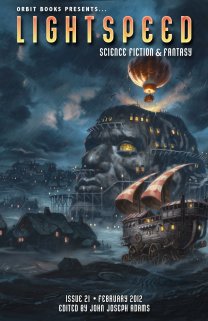
Cover of Lightspeed magazine, February 2012 issue
Whole issue.

Has 4 science fiction stories, including 2 reprints. I didn't find any really interesting, though Vaughn's is action packed.

List below is in order of my preference - best first.
  1. [reprint] [ss] Gregory Benford's "Dark Sanctuary" (B); download; Omni, May 1979: A lone asteroid miner is "attacked" & chased by an alien craft. Story is mostly deductions by miner based on very little information.
  2. [ss] Carrie Vaughn's "Harry & Marlowe & the Talisman of the Cult of Egil" (B); download; steampunk: Two Britishers, a princess & a soldier, steal an alien artifact from a temple in Iceland. Then they cross a blockade of British isles by Germans in an airship. Set in late 19th century.

    While the language is modern, the sentiments are from a century ago; not sure if it's intentional. First half could have been from an Argosy issue - "civilized" white man vs barbaric savage natives.
  3. [reprint] [ss] Kristine Kathryn Rusch's "Craters" (B); download; Future Weapons of War/Baen, March 2007: Two stories, actually, & dark - terrorists using bombs implanted in babies, & using engineered viruses to prevent wars.
  4. [ss] Keith Brook's "War 3.01" (B); download: Description of a world where geolocation-sensing augmented reality is common. We already have some of it in phones; this one adds a version of it using spectacles or contact lenses' based mobile displays.

Sunday, July 25, 2010

"Lightspeed", #1 (June 2010) (ed John Joseph Adams) (magazine, free): Annotated table of contents & review

Cover image of Lightspeed magazine, June 2010 issue
Whole magazine is online - 4 stories + some other stuff. ToC below only includes fiction, & links online copies of individual stories.

Kirtley's story is pretty good. McDevitt's develops suspense well but has a dud ending. Vaughn's is a decent enough read, particularly later parts, if you like emotional stories. Last one is readable, but I would rather skip it.

Table of contents (4 stories, best first).

My rating is in brackets. Link on author yields more of author's fiction. Link on story title goes to my post on individual story, if there is one.
  1. David Barr Kirtley's "Cats in Victory" (A); download: Religious crusaders spare world's last living "animals" lives.
  2. Jack McDevitt's "The Cassandra Project" (B); download: Discovery of an alien artifact on moon.
  3. Carrie Vaughn's "Amaryllis" (B); download: New kind of family arrangements in a scarcity society, & where bearing a child without permit is a very serious crime.
  4. Vylar Kaftan's "I'm Alive, I Love You, I'll See You in Reno" (B); download: A love story that's a bit too science fictional for my taste.
    A man & a woman. Next door neighbors. Forever in love, never really meeting. A lot of cosmic & relativity adjectives thrown in in the descriptions.

    In some ways, it's just a review of many popular sf tropes - time dilation during near
    light speed travel, & what the traveler will find back on earth on return, hibernation to survive to medical treatment in far future, mind uploading, ...
Related: Fiction originally published in 2010; best of 2010.

Tuesday, August 11, 2009

Free fiction: From two anthologies edited by John Joseph Adams

Some stories from The Improbable Adventures of Sherlock Holmes & some vampire stories (cheeee!) from By Blood We Live.

ToC of even the former has some sf authors among the contributors.

[via SF Signal]

Saturday, April 4, 2009

Free fiction: A few stories from John Joseph Adam's "Federations" anthology

Link. [via SF Signal & Boing Boing]

Friday, January 9, 2009

Quotes: What's in an anthology?

A panel of well known sf Anthologists Discuss Their Craft with Jeremy L C Jones in Clarkesworld, January 2009. Some highlights:

  1. Jonathan Strahan, & John Joseph Adams: An ideal anthology has 3 "really good" stories. Rest presumably of varying quality.

    Crappy stuff I keep finding in even anthologies whose title includes "best of" is filler.
  2. Editor's credo: Jonathan Strahan: "be honest.

    Ultimately you're acting as an agent for the reader so you need to be as straightforward and as honest with your reader as you can. Title a book clearly. Write an introduction that actually describes the book you've edited. Buy stories that fit the title and the idea. Encourage the publisher, as much as you can, to put a cover on it that fits... If you do that, then a reader can pick up a book and feel they're going to get what they expect."
  3. John Joseph Adams: "In the case of a reprint anthology, I think it's also important to include a large number of stories from disparate sources so that any one reader is unlikely to have read them all and will find many new discoveries, even if they voraciously read short fiction."
  4. John Joseph Adams: "the anthologist does have some obligation to the publisher to include a sufficient number of brand name authors in order to help market the anthology."
  5. Ellen Datlow: "I pay as much as I can from the advance on signature of the contract, so the early birds don't have to wait until I hand in the book to get paid."

    May be one of the reasons many authors love to work with her.
  6. Ellen Datlow: "For original anthologies I request stories from at least a third over the number I need because not everyone I approach will submit her story in the time required and at least a few of the stories won't be right for the anthology and will be rejected."
  7. Ellen Datlow: "be strong and reject stories that don't work, even if I really want that author in my book."
  8. Classical way of sequencing the ToC: Jonathan Strahan: "open with your strongest story, second strongest goes last, third strongest in the middle, then shuffle from there."

More on sequencing the ToC.

Ann VanderMeer: "because we know that the typical reader will read the anthology from beginning to end."

John Joseph Adams takes a more reasonable stand, in my book anyway: "that's assuming the stories are read in the order the anthologist chooses, of which there is no guarantee."

I'm among those who never read an anthology in order. I mean - I personally look at familiar authors, catchy titles, story sizes, & fame of an individual story to determine reading order:
  1. Editor's introductions to all stories first.
  2. Next the really famous ones - rarely more than a very few, if at all, in a specific anthology.
  3. Smallest stories next, except for those by a personal list of "banned authors".
  4. Next either very familiar authors or completely unknown ones - depending on mood, impulsively mixing with catchy titles.
  5. Then the rest, often skipping the "banned authors".
How do you choose your reading order?