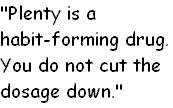
 I liked it when I read it a few days back. I seem to think less highly of it now because the premise seems so contrived. Except that it's not - exaggerated, but not entirely contrived.
If you are lucky enough to have decent self-earned income, remember the first time you noticed your normal spending was only a fraction of your income tax outgo? I know many people go through it. Sleepless nights wondering why the hell can I not spend at least as much as I pay the government, until peace is made with the situation - often with some lifestyle changes. This story is a far more drastic version of it.
Story summary.
It's set in a post-scarcity society in the US. But to create tension, it adds constraints that are way too contrived.
Society, with primarily robot labor, produces so much that anyone can have anything. Fine. But to keep robot factories busy, the government produces far more than society
can consume! So you get quotas. Everyone
must consume a certain amount of this & that!
Currency is in the form of "ration stamps". You pay these stamps not to buy food in a restaurant, but to notify the government that you have consumed a certain amount! Since the quotas are far more than people can consume, there is fraud & elaborate bureaucracy to catch fraudsters!
Your status in society is determined by how much you are
required to consume.
Poor have to consume more; as you rise up the social ladder, your consumption requirements reduce. This social promotion is done by government bureaucracy - often in recognition of you consistently meeting or exceeding your consumption quota, or helping others do it.
In their leisure time, people undertake activities that we normally call productive - like designing a machine! But lower strata of society is so busy consuming, they've no leisure time. Lower middle classes can afford no more than a few hours of such
leisure time each week - they've to spend so much time consuming!
When you are rich & get sick, you can afford a doctor. If you are poor, you must suffer a team of doctors!
This is the story of Morey, a young man still way down in social hierarchy. He spends a day's leisure each week at Bradmoor Amusements Company designing gambling machines that help society consume more! During the course of the story, he will invent a new "K-50 Spin-a-Game" gambling machine.
He's just married Cherry - Judge Eton's daughter. She's from a much "richer" family. After marriage, this relentless consumption requirement is driving Cherry crazy - because she's from a background with less consumption pressure. So poor Morey is basically going to consume for two!
There is much unhappiness & warnings from government about not meeting his consumption quota. In a drunken moment, Morey will do something that will eventually turn out to be a winning idea: move his robots to a basement room, & make them consume things like furniture, cloths, shoes, etc - wear shoes, then keep moving around the room till they are worn, etc! He will be contrite when he discovers this in a sober moment, but it's helping solve a problem. He has already been not only meeting his consumption quota, but exceeding it; he's now got social status promotion too.
In a weak moment, he hands out his secret to someone he should not have shared it with. So it's going to spread. Panicky, he tells his shocked family. Judge father-in-law consults his robot clerk: "No precedent. No laws prohibiting. Therefore no crime." But he should confess to "Ration Board".
Goes to meet government official. Finds they already know about it. We learn the robots don't have a local brain, but share a big central one ("Master Control") over a radio communications network; so government has known about his robot-based consumption all along.
But they are actually happy! He's found a way to cut down the social pain. He'll be taken to Washington to meet bigwigs. When officials are congratulating him, he drops a dilemma: it's immoral to waste stuff!
But he has a way out. Install the "adjustable" "satisfaction circuits" in a robot, & you can configure the robot to
want to wear a hat; with another config, gloves; etc! Moral dilemma gone. People can henceforth consume what they can; when something is being overproduced, robots will be configured to want to consume it!
In the end, we see the beginning of this social change. Individual quotas are not gone, but people get consumption robots to help consume stuff!
See also.
- Peter Sasdy's movie "Out of the Unknown" is an adaptation of this story. I've not seen the movie.
Collected in.
- Ben Bova (Ed)'s "The Science Fiction Hall of Fame, Volume Two B".
Fact sheet.
First published:
Galaxy Science Fiction, April 1954.
Rating: B
Related:
Stories of Frederik Pohl;
stories about consumerism.

 Reason for this post is the source: genre fiction is not too common at The New Yorker; I would not have posted it otherwise. This story didn't work for me - but then most fantasy fiction doesn't work for me. Your take will likely vary if you like fantasy.





