Showing posts with label novel. Show all posts

Monday, October 27, 2014

Jules Verne's "Ticket No '9672'" aka "The Lottery Ticket" (novel, non-genre, free): Introducing idyllic Norwegian countryside

Cover of novel Ticket No 9672 by Jules VerneI actually picked it up expecting an adventure, & got disappointed. It's readable enough, if you are in mood for a slow moving story in scenic locations with far too much descriptions & far too little dialogs or action.

Story summary.

Story is mostly set in Dal, a small town in Norway. A family of 3 Hansens - mother, daughter, & son, running an inn. Daughter's fiance has gone on a fishing expedition to Newfoundland, & the marriage is expected on his return; only his ship gets wrecked at sea, with all presumed dead.

Eventually, a bottle is found at sea, containing a lottery ticket bearing the number of story's title, & a farewell message at its back for the girl from fiance. News spreads, people get superstitious about the number, & begin sending bids to buy it. Add an influential man who'll get fond of the family & will move mountains to get positive proof of the sailor's death.

Eventually happy ending.

Fact sheet.

First published: 1886.
Download full text from Project Gutenberg, Feedbooks.
Rating: B.
Related: Stories of Jules Verne.

Friday, October 3, 2014

Anand Neelakantan's "Asura" (novel): Retelling Ramayan from the point of view of Ravan!

Cover of the novel Asura by Anand Neelakantan. Shows the picture of 10 headed Ravan.This post may not make a lot of sense for readers outside South Asia. Ramayan is a well known epic here, & my commentary below assumes familiarity with it.

While there have been many retellings of Ramayan, they mostly don't question its premises, heroes & villains. This one is unusual in that it tells Ramayan from the point of view of Ravan, & from the point of view of an ordinary Asura citizen of the period. Apart from questioning a lot of premises of Ramayan, it uses the opportunity to make commentary on modern India - high growth rate that is invisible to poorer & less skilled sections of society, skin color prejudices, politicians claiming & appropriating far more resources & rights compared to ordinary citizens, ... It also devotes a lot of space to caste system, though I find its rigidity completely unfamiliar; may be times have changed!

A few noteworthy departures from conventional Ramayan:
  1. 10 heads of Ravan represent him as a complete man, as against a saint. I don't remember the list of 10 attributes he lists, but they're like one head for lust, another for wisdom, another for greed, ... Ravan is a man, with all the failings it implies, & doesn't aspire to be a God by overcoming what are claimed to be human "shortcomings".
  2. Sita is Ravan & Mandodari's eldest child! Someone foretells that she will bring destruction to the family & clan, so a lot of people want her killed when she's a baby. To protect her, Ravan takes her with him during a campaign north. But those fearful of future conspire to plan her killed even here; only the man charged with disposing her off doesn't have heart to murder a helpless baby & manages to have her found by Janak. Ravan kidnapped her later to protect her from Ram, whom he thinks is unworthy of his daughter.
  3. It sets up the stage as a conflict between Devas & Asuras. India is initially owned by native tribes of Asuras, Kinnars, Nagas, etc. Deva invaders have come from Central Asia, & Indra is the first of the successful raiders. Asuras are a casteless society; Devas have brought casteism with them.
  4. Vanars are half castes - mix of Devas & Asuras, unwanted by both. They inhabit central India, acting mostly as a buffer zone between Asuras & Devas.
  5. Brahma is not a god but a clan of teachers, one of whom will teach Ravan in his young years.
Story isn't always consistent, though. It takes pains to tell us Vanars are nothing but ordinary human half castes, & yet they move up trees & buildings far more nimbly than most men, & are often referred to as "monkey men". I think there is a place before Lanka Dehan where Hanumanji's tail is referred to! And there is reference to steel somewhere during fighting in Lanka; did steel even exist in the period the story is set in?

I found some of the takeaways of the book disturbing:
  1. Dashahara: (Incidentally, today is Dashahara.) What does it tell us about Indians as human beings? That we are a vengeful unforgiving lot? Even assuming everything in classical Ramayan is true, Ravan got death as his punishment. Why do we still keep taking revenge by burning his effigies?
  2. Lanka Dehan: Assume that the Prime Minister does something stupid. As a revenge & to put pressure on him, someone comes & bombs your neighborhood. What would you call this avenger? A lot of innocents must have died when Lanka was set on fire! Why do we never discuss it?
  3. Disfigurement of Soorpnakha at the hands of Lakshman: Why do we simply brush it aside? OK - so she was promiscuous & was trying to entice Lakshman. Does that justify cutting off her nose?
  4. Agni Pareeksha & the exile of a pregnant Sita: I've heard pious explanations for it but never found them convincing. This book imagines the dirty details to make you squirm.
It did however took me a long time to finish - well over a month. I didn't normally get bored reading it, but once I put it down, I usually had to make an effort pick it up again. May be because it's rambling ... or too long ...

Fact sheet.

First published: 2012.
Rating: A.

Sunday, August 3, 2014

Edgar Rice Burroughs' "Carson of Venus" (novel, adventure, free): Hero helps win a war

Cover of Argosy magazine issue where the story originally began publishing - first of the 6 parts.This is #3 in author's Venus series. I've not read the earlier books, but it's pretty much an independent adventure. And very readable if you can keep plausibility aside.

Story summary.

Carson Napier, hero of the story, along with his ladylove Duare, is homeless & wanted in many jurisdictions on Venus. But he has an airplane he built that can stay up in the air without maintenance or refueling for 50 years! But he needs to land for food. The duo are seeking a home where they will be wanted.

They'll end up on a large island (Korva) with war going on - a common soldier has usurped power & has imprisoned the king. All of Korva has fallen except one holdout, the walled city of Sanara. The city is now under seize.

Carson will end up befriending the holdouts, & help them win the war by bombing enemy from his plane & by playing a spy in usurper's city.

Notes.

There is also an unrelated short story length adventure at the beginning of the novel - tribals kidnap Duare & Carson will rescue her.

Fact sheet.

First published: As a serial in 6 parts in Argosy, Jan 8, 15, 22, 29, & Feb 5 & 12 issues, 1938.
Download full text from Project Gutenberg of Australia or Feedbooks.
Rating: A.
Nominated for Retro Hugo Awards 1939 in novel category.

Tuesday, December 10, 2013

Robert A Heinlein's "Double Star" (novel, politics): When an imposter became the ruler

Cover of the novel Double Star by Robert A HeinleinThis is a fast paced action story with a lot of election politics. I didn't like it as much as I wanted to because at some places the world view is too provincially Western; the thing that irritated me most was a small passage on the classification of world's languages - confidently told & totally bogus.

Story summary.

Here is a solar Empire spanning many worlds, dominated by humans though there are aliens on other worlds. It's a monarchy similar to British one - emperor is supreme but is a rubberstamp, & sits in a city on the moon. The parliament has the power & is elected; aliens can vote but must choose a human representative. Head of government is the "Supreme Minister", probably majority leader in Parliament.

Current ruling party has arranged the kidnapping of the leader of opposition at a time where he's absolutely required to be present at a Martian ceremony. So his underlings will recruit an actor, Lawrence Smith aka Lorenzo Smythe, to act as an imposter at the function. One thing will lead to another & new situations will keep coming up & the imposter will end up becoming the politician he's impersonating.

The story is, first & foremost, the character study of this actor, & evolution of his personality.

Fact sheet.

First published: Astounding, Feb/Mar/Apr 1956.
Rating: A.
Among the stories from Astounding/Analog issues edited by John Campbell.
Winner of Hugo Award 1957 in novel category.
Related: Stories of Robert Heinlein.

Friday, November 29, 2013

Hal Clement's "The Nitrogen Fix" (novel, apocalypse)

Cover of the novel The Nitrogen Fix by Hal ClementThis is an action packed adventure. Like many other stories of author, it's set on a world with atmosphere toxic to humans but not to their alien friends, only the world is earth! And unlike vast majority of stories of author, this one has real villains, in addition to his standard "nature is adversary enough".

This also has an apocalypse setting common to many modern stories: "a closed human habitat has limited oxygen & if you have a third child, someone from family will have to be thrown out ('nomaded')". Only it's far more readable than almost everything I've seen with this setting.

Story summary.

A couple of thousands years into future, much of the oxygen has vanished from earth's atmosphere, all large animals except humans are dead, even humans are very few & dwindling, nitric acid pollutes all open water sources, & there are violent nitrate based plants prone to explosion.

People live in "closed" cities, with water-pool based airlocks. There also are some hardy nomads, folks who were thrown out of cities because of overpopulation but survived. You cannot venture outside without breathing mask & oxygen tank.

There are also "natives" or "Invadors" or "Observers" - curious galaxy-traveling aliens well suited to this earth atmosphere.

This is the story of a nomad couple, their 5 year old daughter, & their alien friend, who arrive at a city somewhere near Boston coast with supplies of salvaged glass & copper nuggets produced from ocean by "pseudu-life" that still survives. Only the customers have some deadly ideas & all hell breaks loose soon after their arrival...

Fact sheet.

First published: 1980.
Rating: A.
Related: Stories of Hal Clement.

Tuesday, November 26, 2013

Arkady Strugatsky & Boris Strugatsky's "Roadside Picnic" (novel, first contact): Aliens are to us what we are to ants!

Cover the Roadside Picnic, a novel by Arkady and Boris Strugatsky.While I didn't dislike it, there are long scenes of the kind you've probably read dozens of times: a band of hardy people on treasure hunt in a jungle full of dangers.

I think its classic status probably has to do with the central thesis: aliens so advanced they won't even notice us if they ever came to earth.

Story summary.

This is a first contact story, but we never actually see aliens. What we see are signs of their Visitation at 6 different locations on earth. "Imagine that you spin a huge globe & you start firing bullets into it. The bullet holes would lie on the surface in a smooth curve... all six Visitation Zones are situated on the surface of our planet as though someone had taken six shots at Earth from a pistol located somewhere along the Earth-Deneb line. Deneb is the alpha star in Cygnus."

Zones where they visited are dead places. And deadly ones. And contain a lot of alien stuff. Why did they visit? Why did they turn these places into ruins? Why did they leave all those artifacts behind? Many explanations are offered, but one is a particularly special one - the roadside picnic theory: "Picture a forest, a country road, a meadow. A car drives off the country road into the meadow, a group of young people get out of the car carrying bottles, baskets of food, transistor radios & cameras. They light fires, pitch tents, turn on the music. In the morning they leave. The animals, the birds, & insects that watched in horror through the long night creep out from their hiding places. And what do they see? Gas & oil spilled on the grass. Old spark plugs & old filters strewn around. Rags, burnt out bulbs, & a monkey wrench left behind. Oil slicks on the pond. And of course the usual mess--apple cores, candy wrappers, charred remains of the campfire, cans, bottles, somebody's handkerchief, somebody's pen knife, torn newspapers, coins, faded flowers picked in another meadow... A roadside picnic, on some road in the cosmos."

So the Visitation Zones contain litter from their "picnic". I could not find a satisfactory answer to why 6 parties would almost simultaneously decide to come for picnic on earth?

Story is mostly an adventure. Government claims to own the stuff left behind by aliens. But "stalkers" illegally smuggle a lot of stuff out.

Fact sheet.

First published: "Avrora literary magazine in 1972, issues 7-10."
Rating: B.

Thursday, November 21, 2013

Henry Kuttner & C L Moore's "The Mask of Circe" (novel, supermen, free): Gods of Greek mythology are actually mutants & machines!

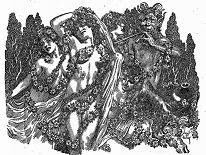
One of the illustrations accompanying the original publication in Startling Stories magazine of the the novel The Mask of Circe by Henry Kuttner and C L Moore.This is an adventure - a science fictional retelling of some Greek legends. But an adventure more in line with "doc" Smith's soap opera - enjoy the unbelievable fun ride but don't think much, please. I didn't enjoy first half - there is just too much unfamiliar Greek mythology, but second half was easy to follow.

Story summary.

A modern man, while playing subject for a new sedative drug, ends up importing the memories of a long dead ancestor from 3000 years ago! And through much of the story, he is magically transported back 3000 years, to the time of this ancestor - to have adventures in time of Greek legend.

Notes.

  1. Some commentators have noted that this story is a tribute to Abraham Merritt's "Ship of Ishtar". I haven't personally read this Merritt story.
  2. "Mask" of title refers to a machine that holds the brain dump of someone long dead; its wearer assumes the personality of that long dead individual. "Circe" of title is a women who fell in love with the hero, hero who won't be born for another 3000 years! "Mask" is to help her meet him when he's eventually born!

Fact sheet.

First published: Startling Stories, May 1948.
Read online at UNZ.
Rating: B.
Related: Stories of Henry Kuttner, C L Moore.

Monday, September 2, 2013

Hugo awards 2013 winners

[via Twitter]. All stories originally published during 2012.
  1. [ss] Ken Liu's "Mono No Aware"; download: A Japanese town reacts in a very orderly manner to news that earth is soon to be destroyed by an asteroid impact.
  2. [novelette] Pat Cadigan's "The Girl-Thing Who Went Out for Sushi".
  3. [novella] Brandon Sanderson's "The Emperor's Soul".
  4. [novel] John Scalzi's "Redshirts".
And among friends, SF Signal gets it for "Best Fanzine".

For other categories, see the twitter feed.

Related: Past & current nominees & winners.

Saturday, June 29, 2013

Jack Finney's "The Body Snatchers" aka "The Invasion of Body Snatchers" (novel, alien invasion)

Cover of the novel The Body Snatchers by Jack FinneyI'm actually puzzled by the fame of this much filmed story. It's a very ordinary novel, action packed but often illogical, sometimes outright illogical. It touches upon two themes - human tendency to destroy the environment while exploiting resources & then move on to newer pastures for more exploitation, & the idea of not remaining ourselves but becoming something else as a result of some kind of foreign invasion. Former occupies so little time in the story as to be irrelevant. Becoming something else pervades the book, but in a form that left me untouched.

Then there is the issue of style. Use a dozen paragraphs where one would do. Tell us the life on the street below is ordinary today, & then get into painful detail of who is doing what for may be 2 dozen people none of which is really in the story. Tendency to tell rather than show...

I might have explained it away as a classic whose key ideas have been so well absorbed in subsequent literature they're no longer novel. Only that is not the case - the idea of foreign imposters slowly substituting local populations has been around in sf much longer. Some commentators seem to think it captures the paranoia about communist invasion in the US during 1950s, which might explain its appeal to an earlier generation of Americans. I finished it, but in a very unsatisfied way.

Story summary.

A local doctor in a small town is suddenly seeing a lot of cases where patients are exhibiting a strange delusion: they claim that someone they've long known is an imposter, though the "imposters" look & behave identically to their former selves!

Things will get horrifying when he discovers enormous alien plant "pods", recently arrived from space, are capable of turning into any kind of nearby life, including vegetable or animal, destroying the original...

Fact sheet.

First published: "as a three-part serial in Collier's Magazine (November 26 - December 24, 1954). Rewritten in 1978 as Invasion of the Body Snatchers."
Rating: B.

Monday, May 27, 2013

Free fiction: Murray Leinster's "Creatures of the Abyss" (novel, 1961)

@Internet Archive. [via Greg Weeks @pbscans]

Related: Stories of Murray Leinster.

Sunday, May 26, 2013

Cory Doctorow's "Pirate Cinema" (novel, free): Political campaign against a "bad" law

Cover of the novel Pirate Cinema by Cory DoctorowThis is the story of a political campaign in UK to make the parliament repeal a bad law. Point of the story seems to be: the disproportionately high influence a few Hollywood companies seem to have on legal aspects of internet use is very bad for society. Because their side effects have crippling effect on everything we do on the net.

I didn't find it always believable, but it's by & large readable. A penniless runaway kid in London, with a taste for remixing movies, will lead a revolt against 3-strikes law - if you're caught illegally downloading movies up to 3 times, you & your family lose internet connectivity for a year.

Story takes its time to really get started, so you'll need a bit of patience.

Fact sheet.

First published: 2012.
Download full text from author's website.
Rating: B.
Related: Stories of Cory Doctorow.

Nebula Awards 2012: Winners announced

@SFWA.

PS: I wonder if I'm making mistakes or Blogger has started behaving in a weird way. I'd posted this several days back, but just noticed it was marked "Draft!"

Wednesday, May 8, 2013

C J Cherryh's "The Pride Of Chanur" (novel, space opera): What if lions evolved into intelligence?

Cover of the novel The Pride Of Chanur by C J Cherryh. Image shows the sole human fugitive among five lion-like aliens of hani species.I won't call it a bad read, but I seem to no longer enjoy most space opera now-a-days. But this may be the first space opera I've seen that is almost entirely from aliens' point of view; humans play a very minor & junior role.

Story summary.

There is something called Compact - a region of space somewhere on the edge of human space. Many alien space traveling species live here, cooperating & fighting. One of the more villainous of them, "kif", had got hold of some human spacemen, whom they tortured to presumably get the coordinates of human homeworld. Three prisoners died, one escaped. The escaped one found sanctuary in a "hani" ship. Much of the story is the chase & fights across star systems to get hold of this human prisoner, sucking in other alien races in the fight too.

Hani look like intelligent lions. Through the story, I got an impression this was a feminist work because gender roles among Hani are reversed relative humans - females do outside work & earning, men keep homes. But a discussion at ClassicScienceFiction points out similarity of Hani culture with that of lions. In fact, the "Pride" of title might be a pun on pride of lions; "Chanur" is the hani clan to which the heroine, Pyanfar, belongs. Officially, "Pride of Chanur" is the name of the hani spaceship in the story.

Fact sheet.

First published: 1982.
Rating: B.
Nominated for Hugo Award 1983 in novel category.

Tuesday, April 30, 2013

"Astounding Science Fiction" (British edition), August 1958 (magazine, free) (ed John W Campbell): Annotated table of contents

Cover by Van Dongen of Astounding Science Fiction magazine, British edition, August 1958 issue. Image illustrate the novel Close to Critical by Hal Clement.Links on author fetch more fiction by author. Where I've read the story, my rating appears in brackets. If I have a separate post on a story, link on its title goes there.

Table of contents (best first, unread last).

  1. [novel - 1/3] Hal Clement's "Close to Critical" (A): "Meet Tenebra, the planet where raindrops are fifty feet through ... & hard quartz rocks dissolve away like salt. Under three gravities, & a monstrously deep atmosphere, with oily seas of sulphuric acid, two children touch off a political situation that is ... close to critical".
  2. [ss] Frank Herbert's "You Take the High Road" (A); detective: Is this village really of peaceful people?
  3. [ss] Stanley Mullen's "Fool Killer" (A): What if law allowed you one murder!
  4. [ss] John Rackham's "One-Eye" (B): A man has an unusual gift - he "sees" bad things happen just before they do happen. And figuring out the nature of this "gift" gets him in trouble.

    Title is from the story about a one-eyed man among the blind ones. As is the man with the gift among the ordinary humans.
  5. [novelette] Charles V de Vet's "Special Feature": "What constitutes public entertainment changes with the mores of a society. The Romans liked the circuses ... but the feline devil loose in their city might have been a bit too stimulating for them..."
  6. [ss] Gordon R Dickson's "The Question": "It wasn't too surprising that aliens couldn't answer the Question. After all, we've been trying for millenia ourselves!"

Fact sheet.

Labeled: Vol XIV No 8.
Download scans as a CBR file. [via Bob@pulpscans]
Note: Link points to a RAR file that contains target CBR, probably to work around some hosting service file naming constraints.
Related: Stories from the Astounding/Analog issues edited by John Campbell, old "pulps", 1950s.

Wednesday, April 17, 2013

Amitav Ghosh's "The Calcutta Chromosome" (novel, immortality)

Cover of the novel The Calcutta Chromosome by Amitav Ghosh. Image shows a fish, perhaps referring to a rotten fish in the story that sets a woman journalist protagonist on her strange quest.This was disappointing in a way that many bestsellers are - quick page turner, great mystery build up, some interesting characters, but a dull ending. Ending was very confusing, & for a story that is mostly quite logical, there is an ghost story as one of the chapters!

A note for Indian readers: I picked up the story seeing an Indian author's name on cover. But while reading, I kept getting the impression that it's primarily targeted at western audiences, even though much of the story is set in Calcutta.

Story summary.

Story starts off with a historical fact - Ronald Ross, an Englishman born in India who made a medical discovery that won him a Nobel prize: that malaria is transmitted to humans via mosquitoes. Most of his research was done as a colonial officer in India, last part of it in Calcutta.

The story treats this medical discovery as part of a conspiracy. There is a secret sect of "Silence" worshipers in India who've already discovered some things about malaria & mosquitoes. But their main interest is immortality: there is a generally unknown human chromosome, the "Calcutta chromosome", that is found only in brain cells & that encodes whatever makes you you.

And these guys are trying to figure out a way of transmitting this identity so you can continue living in another body by consciously infecting that body (with a variant of malaria). And they kept nudging Ross in the right direction at critical points because, unknowingly, he was solving one of their immortality problems.

Fact sheet.

First published: 1995.
Rating: B.

Thursday, March 28, 2013

James E Gunn's "The Listeners" (fix up novel, hard sf, first contact): Just what does SETI do?

Cover of The Listeners, a first contact fix-up novel by James E Gunn.
Another important classic that doesn't get included in many classics lists of genre. While a fix up novel constructed from stories published earlier, it doesn't really feel like a disjointed one.

It gives a realistic view of how impossible a task SETI has set for itself (but I found it occasionally over-dramatic, predictable & sometimes boring).

Listeners of title are scientists on "The Project", funded by US government, to listen to signals from the stars - hoping there are intelligent aliens out there broadcasting. It brings out starkly how remote are the odds of catching alien signals even if there are a lot of aliens out there. And how much patience & perseverance is required for the task.

Fact sheet.

First published: 1972.
Rating: A.
Related: Stories of James E Gunn, first contact fiction.

Monday, March 25, 2013

Karel Capek's "War wih the Newts" (novel, satire, free): Man is the lord of Earth. Or is he?

Cover of a collection of two stories of Karel Capek - RUR and War wih the Newts. Image illustrates RUR.
I wonder why this epic doesn't get listed in many classics lists. In my book, it's among the very best of science fiction.

It's a satire on human folly, mostly from the point of view of colonial Europe. There were places that made me wince, but author appears to be only satirizing certain views. It's sometimes very funny, but is occasionally a bit draggy too.

Story summary.

Newts are prehistoric animals living in shallow salt water, unknown so far because the sole small group that survived since prehistoric times lived in a salt water lake on an isolated island. They're intellectually man's equal, but are far behind technologically.

When a group of colonials discover them, they are mercilessly hunted & killed. Only two who survived are being transported back to Europe, but escape en route.

They multiply & thrive in shallow waters near an island. So, of course, when they're rediscovered by the European man, they're fair game for hunting, slavery & worse. Tables will eventually turn, however...

Fact sheet.

First published: 1936 (original Czech).
Download full text from Project Gutenberg of Australia or eBooks@Adelaide.
Rating: A.
Related: Stories of Karel Capek.

Monday, February 25, 2013

Fred Hoyle & John Elliot's "Andromeda Breakthrough" (novel): A shadowy European trading syndicate dreams of creating another East India Company

Cover of Andromeda Breakthrough, a novel by Fred Hoyle and John Elliot.
This is a sequel to the authors' excellent novel "A for Andromeda". While this too is a fast moving adventure, it's much less interesting than original:
  1. It appears to be penned mostly by Elliot. None of Hoyle's characteristic humor, leg pulling of politicians, or a central cool idea here.
  2. It appears to be an unplanned for sequel. Characters that died or were otherwise removed at the end of the first book are resurrected, in rather questionable ways, so they can be part of this adventure.
A shadowy European multinational trading outfit ("Intel") working towards world control, an imaginary non-functional middle eastern country ("Azaran"), synthetic fast-breeding sea-based bacteria that suck up nitrogen from atmosphere leading to disastrous weather, are all part of the canvas. Plus some characters from first book, including the hero.

Intel now controls, or thinks it does, the "alien in the computer" & intends world domination via stuff the alien will invent. Hero, will, of course, save the world from them.

Fact sheet.

First published: 1965.
Rating: B.
Related: Stories of Fred Hoyle, John Elliot.

Sunday, February 17, 2013

"Astounding Science Fiction" (British edition), April 1957 (ed John Campbell) (magazine, free): Annotated table of contents

Cover by Van Dongen of British edition of Astounding Science Fiction magazine, April 1957 issue.
I think I've read "2066: Election Day" in one of the "Issac Asimov Presents Great SF Stories" books. An unusual "election" for a US President, an election where people don't vote at all, & one that was actually rigged by a small coterie. I don't think I came back happy with it, & the ending invoked in me an angry reaction - "how could the author propose this to be a good outcome?" type of reaction.

Links on author fetches more fiction by author. Where I have a separate post on a story, link on story title goes there. For stories I've read, my rating is in brackets.

Table of contents.

  1. [novelette] Robert Silverberg & Randall Garrett's "False Prophet" (as by Robert Randall): "There are times when it is exceedingly unwise to tell the truth--& the Nidorian was dedicated to truth. The Earthmen were wiser; they lied about him."
  2. [ss] Michael Shaara's "2066: Election Day": "There is a limit to any process you can name ... & sooner or later that limit will be reached. Then ... somehow you have to fumble togeather a new thing..."
  3. [ss] Algis Budrys' "Look on My Works" (B): Tourist guides milking a tourist from Centaurus with fakes, in a far future New York city...
  4. [ss] Robert Silverberg's "To Be Continued" (A): Slow life is frustrating!
  5. [serial - 3/3] Isaac Asimov's "The Naked Sun": "Lije Baley had a triple-decker problem to solve--& solved it only because a robot tried to give him a hand. And thereby taught him to define his terms with a new exactness!"

Fact sheet.

Labeled: "Vol XIII No 4 (British Edition)".
Download scans as a CBR file [via Bob@pulpscans]
Note: The link fetches a RAR file that contains the target CBR, probably to work around hosting service's file naming constraints.
Related: Stories from the Astounding/Analog issues edited by John Campbell, old "pulps", 1950s.

Wednesday, January 23, 2013

"Astounding Science Fiction" (British Edition), August 1956 (ed John Campbell) (magazine, free): Annotated table of contents

Cover by Ed Emshwiller of Astounding Science Fiction magazine, August 1956 issue, British edition. Cover illustrates the story Exploration Team by Murray Leinster.
I've read "Exploration Team" & "Minor Ingradient" elsewhere before, but don't recall much of them now.

Links on author fetch more fiction by author. Where I have a separate post on a story, link on story title goes there. For read stories, my rating appears in brackets.

Table of contents (best first, unread last).

  1. [ss] Herbert L Cooper's "A Nice Little Niche" (B): When vitamin K craving alien bacteria invaded human guts...
  2. [ss] Algis Budrys' "Man in the Sky" (B): Cold engineering vs public opinion.

    It's a story about early spaceflight, before there was space flight.
  3. [novelette] Murray Leinster's "Exploration Team": "The perfect machine for exploring a new plant would, of course, be self-repairing, self-maintaining, able to construct its own repair parts from local materials, & even able to replace itself with a new unit..."
  4. [ss] Eric Frank Russell's "Minor Ingradient": "A critically necessary lesson any true officer must learn is the crushing burden it is to be Master of a slave..."
  5. [serial - 2/3] Robert Heinlein's "Double Star": "Lorenzo, the conceited pipsqueak, was stretched & inflated to fill a mold. But Lorenzo, while conceited beyond question--was not a fool!"

Fact sheet.

Labeled: "Vol XII No 8 (British Edition)".
Download scans as a CBR file. [via Bob@pulpscans]
Note: Link points to a RAR file that contains target CBR, probably to work around some hosting service file naming constraints.
Related: Stories from the Astounding/Analog issues edited by John Campbell, old "pulps", 1950s.