Showing posts with label Michael Shaara. Show all posts

Sunday, February 17, 2013

"Astounding Science Fiction" (British edition), April 1957 (ed John Campbell) (magazine, free): Annotated table of contents

Cover by Van Dongen of British edition of Astounding Science Fiction magazine, April 1957 issue.
I think I've read "2066: Election Day" in one of the "Issac Asimov Presents Great SF Stories" books. An unusual "election" for a US President, an election where people don't vote at all, & one that was actually rigged by a small coterie. I don't think I came back happy with it, & the ending invoked in me an angry reaction - "how could the author propose this to be a good outcome?" type of reaction.

Links on author fetches more fiction by author. Where I have a separate post on a story, link on story title goes there. For stories I've read, my rating is in brackets.

Table of contents.

  1. [novelette] Robert Silverberg & Randall Garrett's "False Prophet" (as by Robert Randall): "There are times when it is exceedingly unwise to tell the truth--& the Nidorian was dedicated to truth. The Earthmen were wiser; they lied about him."
  2. [ss] Michael Shaara's "2066: Election Day": "There is a limit to any process you can name ... & sooner or later that limit will be reached. Then ... somehow you have to fumble togeather a new thing..."
  3. [ss] Algis Budrys' "Look on My Works" (B): Tourist guides milking a tourist from Centaurus with fakes, in a far future New York city...
  4. [ss] Robert Silverberg's "To Be Continued" (A): Slow life is frustrating!
  5. [serial - 3/3] Isaac Asimov's "The Naked Sun": "Lije Baley had a triple-decker problem to solve--& solved it only because a robot tried to give him a hand. And thereby taught him to define his terms with a new exactness!"

Fact sheet.

Labeled: "Vol XIII No 4 (British Edition)".
Download scans as a CBR file [via Bob@pulpscans]
Note: The link fetches a RAR file that contains the target CBR, probably to work around hosting service's file naming constraints.
Related: Stories from the Astounding/Analog issues edited by John Campbell, old "pulps", 1950s.

Monday, September 27, 2010

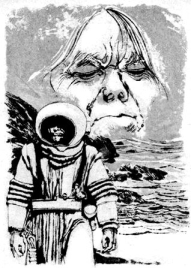
Michael Shaara's "Wainer" (short story, evolution, free): What's it like to be an evolutionary link!

Illustration accompanying the original publication in Galaxy magazine of short story Wainer by Michael Shaara
This is one of the "first man in the next evolution of humanity" stories.

Caution: A small part of the story deals with a man falling in love with his own mother (mother has received rejuvenation treatment, child hasn't).

Story summary.

In 25th century, electronic "brain" implants are common: a medical procedure attaches the implant to your mind, & you have access to all the memory of mankind. You are also suddenly more rational, hence the recipients called "Rashes" or "lumpheads" (lump formed by implant on the head).

But one in a thousand humans brains rejects the implant, & nothing further can be done. These are Rejects, condemned to lead the life away from trades in demand. But they've a compensation - they can see the world in ways logical Rashes cannot.

And a few among the Rejects have changes not only in brain but elsewhere in the body - a change that makes them a link to next step in the evolution of humanity. This is the sorry story of such a man, William Wainer, who will learn of his great role in progress of humanity only near his last days.

Fact sheet.

First published: Galaxy, April 1954.
Download full text from Project Gutenberg, Manybooks, Feedbooks.
Rating: B.
Related: Stories of Michael Shaara.

Tuesday, May 11, 2010

New at Project Gutenberg (11 May 2010)

Links on author, publisher, or year fetch more matching fiction.

  1. Edmond Hamilton's "The World with a Thousand Moons"; download; Amazing Stories, December 1942.
  2. Poul Anderson's "The Escape"; download; Space Science Fiction, September 1953.
  3. Michael Shaara's "The Book"; download; Galaxy, November 1953.
  4. William E Bentley's "The Honored Prophet"; download; If, November 1954.
  5. Murray Leinster's "Sam, This is You"; download; Galaxy, May 1955.

    Free SF Reader links MP3 of an old radio adaptation too.
Related: Fiction from old "pulps".

Sunday, July 13, 2008

Michael Shaara's "All the Way Back" (short story, first contact, free): An answer to Fermi's Paradox

If the theory says galaxy must be full of habitable worlds & intelligent life, why haven't we met aliens yet? Light read, occasionally amusing, but with a dark ending.

Story summary.

300 years after setting foot on Mars, & 200 years after exploration of neighboring stars began, humans have found only 4 dead & unusable worlds in all the nearly 1000 star systems they've explored. Fifth one, discovered during the course of this story, is achingly earth-like & spells doom for explorers & may be humanity too!

Jansen & Cohn are in a scout starship. They've been off earth for 11 years, & have examined a lot of star systems - none with a planet, let alone a habitable one. They go into cold sleep during the long ride between stars.

Next one they're about to examine, the star Mina, is the last before they head back home. It's here that they find an earth-like world. It appears devoid of animal, or even insect, life, but it is full of plants. And parts show signs of old intelligent construction & radiation. We will later learn it was wrecked in a nuclear war. But that is long past; they touch down in a radiation free area.

Their entry into Mina system was noted by a patrol of Galactic Scouts; looks like there is of government covering large areas of galaxy - the "Galactic Federation". The aliens we meet are not only humanoid, but physically indistinguishable from humans! And these Scouts employ a "Mind-Search" staff that can telepathically do a lot of things to sentient beings at distances as great as a light year! Amusing parts are where aliens are tracking the human ship.

Anyway, after the humans touch down, the representatives of Scouts come to make contact. Communications is no problem because of telepathy. They tell humans about the already claimed status of this world, the terrible reason the star systems around Sol are void of not only life but worlds, & the unhappy fate of humanity...

Collected in.

  1. David Drake, Jim Baen, & Eric Flint (Ed)'s "The World Turned Upside Down".

Fact sheet.

First published: Astounding Science Fiction, July 1952.
Rating: A
Download full text.
Related: All first contact stories.
