Showing posts with label 1942. Show all posts

Thursday, October 31, 2013

Half a dozen new entries in

Astounding, July 1942 post. Nearly all of them forgettable ones.

Going by experience of several issues now, flash fiction in Astounding, as a rule, appears to be very weak.

David V Reed's "Penance Cruise" (novella, adventure, humor, free)

One of the illustrations by Orban accompanying the original publication in Astounding magazine of novella Penance Cruise by David V Reed. Image shows the Exotica general with the two heroes in control room of their spaceship.Two young soldiers, off duty & drunk in an alien land, misbehave with local high officials. Resulting court martial hands them a sentence to go on a mission under a witless local official - a mission to catch a dangerous brigand. This is the funny story of their adventure to catch the brigand.

Fact sheet.

First published: Astounding, July 1942.
Download full text as part of the scans of the magazine it originally appeared in.
Rating: B.
Among the stories from Analog/Astounding issues edited by John Campbell.

Wednesday, October 23, 2013

Clifford D Simak's "Tools" (novelette, free): Introducing very weird radioactive gaseous aliens

One of the illustrations by Kramer accompanying the original publication in Astounding magazine of short story Tools by Clifford D Simak. Image shows the human researcher, tricked by bottled gaseous alien, releasing it.Key parts of this story involve Radon-222 gas, a natural radioactive decay product of radium, & the biggest cause of lung cancer among non smokers on earth. It also is the heaviest gas on earth, though its own decay products aren't gaseous. It's highly toxic.

Story summary.

Humans have been mining radium on Venus, where it's available in vast quantities. It's a key source of energy, & this mining business is a monopoly of Radium, Inc.

Someone discovered strange life-like properties in radon gas found there. In a lab, they've succeed, via special electrical sensors, to communicate with a bottled concentration of it. They've robotic mining devices whose brains are small confined concentrations of gas.

When the bottled gas intelligence in lab that has learned a lot about the human civilization leaks, gas all across Venus learns the things we know. So we have an adventure fighting an elusive omnipresent alien with completely unfamiliar thought processes.

Fact sheet.

First published: Astounding, July 1942.
Download full text as part of the scans of the magazine it originally appeared in.
Rating: B.
Among the stories from Analog/Astounding issues edited by John Campbell.
Related: Stories of Clifford D Simak.

Saturday, October 19, 2013

Malcolm Jameson's "Brimstone Bill" (novelette, humor, free): Crooks are useful too!

Illustration by Orban accompanying the original publication in Astounding magazine of short story Brimstone Bill by Malcolm Jameson. Image shows the false preacher preaching his congregation.A part of the story deals with sound engineering - how high frequency, inaudible, sounds affect us. I've no idea if there is any truth in that part.

Story summary.

A corrupt politician in high office collects protection money from a little world called Juno in asteroid belt. He maneuvers a spaceship returning home, with a lot of unspent sailors' salary, to land here for hull cleaning, a process that will ground the ship for a month, giving town ample time to clean the purses of the crew.

But ship captain has a weapon up his sleeve...

Fact sheet.

First published: Astounding, July 1942.
Download full text as part of the scans of the magazine it originally appeared in.
Rating: A.
Among the stories from Analog/Astounding issues edited by John Campbell.
Related: Stories of Malcolm Jameson.

Thursday, October 17, 2013

A E van Vogt's "Secret Unattainable" (novella, teleporting gadget, free)

One of the illustrations by Kramer accompanying the original publication in Astounding magazine of the novella Secret Unattainable by A E van Vogt. Image shows the scenario where military troops can teleport behind enemy lines using the gadget in the story.
This is van Vogt at his best. Far off concept, but very entertaining story.

Story summary.

Early in the beginning of WWII, a great German scientist is working on a cool gadget: you "focus" it anywhere in the universe, &, through an "orifice" that is part of the gadget, you can directly reach that location.
  1. Want crude? Focus it inside an oil well anywhere, & help yourself!
  2. Want to attack London? Focus it on someplace in the city you want your tanks in, & just drive through the "orifice"!
  3. Want to put an enemy ship out of action at sea? Just drain its fuel tank!
  4. ...
Scientist comes to the notice of establishment. Establishment wants his gadget, but the man cannot be trusted - his brother was executed by Nazis for political reasons sometime back. So they get him working on the gadget under careful watch, & arrest him as soon as the gadget is finished. Only the gadget is not going to do them any good, because the scientist indeed was using it as a tool for revenge...

Fact sheet.

First published: Astounding, July 1942.
Download full text as part of the scans of the magazine it originally appeared in.
Rating: A.
Among the stories from Analog/Astounding issues edited by John Campbell.
Related: Stories of A E van Vogt.

Saturday, October 12, 2013

Jack Williamson's "Collision Orbit" (as by Will Stewart) (novella, antimatter, free)

One of the illustrations by Orban accompanying the original publication in Astounding magazine of short story Collision Orbit by Jack Williamson.
This story is supposed to have invented the term "terraforming".

While there is a lot of action, I found it generally boring because of length & too much contrived jargon.

Story summary.

Eons ago, asteroid belt was created by the impact of an "contraterrene" celestial body with the now lost planet at that orbit. Asteroid belt now includes contraterrene debris ("seetee"), in addition to ordinary matter. This makes it extremely dangerous because impact means complete annihilation.

The mad scientist hero of the story will tame this contraterrene matter for human use, in spite of major opposition from all quarters.

Fact sheet.

First published: Astounding, July 1942.
Download full text as part of the scans of the magazine it originally appeared in.
Rating: B.
Among the stories from Analog/Astounding issues edited by John Campbell.
Related: Stories of Jack Williamson.

Friday, October 11, 2013

Ray Bradbury's "Eat, Drink and Be Wary" (flash fiction, humor, free)

A "Venusian banquet lasts a week or ten days, sometimes more, with eight meals a day & twenty courses to a meal." That's normal for Venusians with their ultra-fast metabolism.

But when a human diplomat is invited to one of these banquets, saying no is not an option & going there is death sentence. So our diplomat will seek some scientific help...

Fact sheet.

First published: Astounding, July 1942.
Download full text as part of the scans of the magazine it originally appeared in.
Rating: B.
Among the stories from Analog/Astounding issues edited by John Campbell.
Related: Stories of Ray Bradbury.

Thursday, October 3, 2013

"Astounding Science-Fiction", July 1942 (ed John Campbell) (magazine, free): Annotated table of contents & review

Link on an author fetches more fiction of the author. Where I have a separate post on a story, link on story title goes there. For read stories, my rating appears in brackets.

Note: The flash fiction pieces don't have their own entry in ToC; they are all clubbed under the heading "Probability Zero". And nearly all of them are rather forgettable.

Table of contents (best first).

  1. [novella] A E van Vogt's "Secret Unattainable" (A): Revenge of a scientist against Nazi establishment. 
  2. [novelette] Malcolm Jameson's "Brimstone Bill" (A): Crooks are useful too! 
  3. [novelette] Clifford D Simak's "Tools" (B): Introducing very weird radioactive gaseous aliens... 
  4. [novella] David V Reed's "Penance Cruise" (B); space opera: A ragtag group goes out to catch a dangerous brigand...
  5. [novella] Jack Williamson's "Collision Orbit" (as by Will Stewart) (B): Mad scientist tames antimatter.

    This story is supposed to have invented the term "terraforming", which really makes it a classic.
  6. [ff] Ray Bradbury's "Eat, Drink, and Be Wary" (B); humor: How to eat librally without upsetting your stomach! 
  7. [ff] Frank Holby's '"The Strange Case of the Missing Hero"' (B); grandfather paradox: A man traveling to past discovers he is his own father!
  8. [ff] Wilson Tucker's "The Mysterious Bomb Raid" (as by Bob Tucker) (B); time travel: To remove Japan from equation in WWII, a couple of Americans have dropped a drum full of incendiary oil on Tokyo around the year 1900 using their time machine; but a delay in drop has put it in a later year - so now, in 1942, they're expecting Tokyo to go up in flames any time for reasons the world will see a mysterious.
  9. [ff] Selden G Thomas' "The Floater"  (B): A group is discussing modern fighter aircraft vs vintage ones. One of them tells a tall tale of how he fought with a far superior vintage one & how it kept floating in ocean till he was rescued many days after crash, in spite of being riddled with bullet holes because of fighting, because "It was made of pure potassian, which is lighter than water."
  10. [ff] R Creighton Buck's "The Querty of Hrothgar"(C): An extremely implausible hunting story. Querty, a huge beast with 4 foot thick armor, on its native world of Hrothgar, is chasing a man. Man survives & eventually kills the beast using a totally crazy device.
  11. [ss] L Sprague de Camp's "The Contraband Cow" (C): One of the most forgettable stories of de Camp.

    In an international Federation, there is a ban on cow slaughter. I'm not sure where the story is set - in US or in Mexico?

    Some confrontation between artificial in-lab steak makers, smugglers, cops & politicians. Hero will eventually get the ban lifted by threatening with a politician with something totally silly.
  12. [ss] L Ron Hubbard's "Space Can" (C); space opera: Description of a space battle where a lone US warship beats two better armed "saturnian" warships. Much of the text of the story went over my head.
  13. [ff] Randall Hale's "De Gustibus" (C): A man on Mercury without food for 50 days, has survived on water & potassium cyanide!
  14. [ff] John Pierce's "About Quarrels, About the Past" (C); time travel: "Quarrels" of title is the name of a person. He's gone time traveling to a past Egypt, & is currently is in some, but not ours, past Egypt.

Fact sheet.

Labeled: "Vol XXIX No 5".
Download the scans as a CBR file. [via David T @pulpscans]
Caution: This is a very large file - nearly 195 MB & without resume. I had the connection broken twice near 90% & could download it only on the third attempt.
ISFDB notes: 'Cover illustration, untitled, by William Timmins, not Rogers as credited in the table of contents. Correction "In Times to Come," September 1942.'
Same ISFDB page also corrects some of the novelette/ss classifications on the ToC page; I've preferred ISFDB label above, whenever it contracts ToC.
Related: Stories from Analog/Astounding (whole issues only) (only issues edited by John Campbell); old "pulps".

Wednesday, July 31, 2013

Cleve Cartmill's "Some Day We'll Find You" (novelette, free)

One of the illustrations by Orban accompanying the original publication in Astounding magazine of short story Some Day Well Find You by Cleve CartmillSpacetrades, Ltd originally invented space propulsion, & has deep contacts among the politicians, hence continues to be a monopoly controlling space travel among human colonies in Sol.

Now a broke engineer with no capital has invented an alternate & cheaper method of spaceship propulsion, & colonies see a way of ending the monopoly of Spacetrades. As does an enemy of Spacetrades on earth, hoping to replace Spacetrades monopoly with his own.

So three parties want the engineer & want to fund his venture - colonies to break the monopoly, Spacetrades to preserve the monopoly, & Spacetrades' enemy to establish another monopoly. Engineer wants to go with colonies, but a bunch of toughs are out to grab him...

Fact sheet.

First published: Astounding, December 1942.
Download full text as part of the scans of the magazine it originally appeared in.
Rating: B.
Among the stories from Astounding/Analog issues edited by John Campbell.
Related: Stories of Cleve Cartmill.

Saturday, July 6, 2013

A E van Vogt & E Mayne Hull's "The Flight That Failed" aka "Rebirth: Earth" (as by E M Hull) (short story, weird, free): Making a future happen where Germany loses in WWII

illustration by Orban accompanying the original publication in Astounding of short story The Flight That Failed by E M Hull. Image shows the US military plane mid flight over Atlantic en route to London during World War II a few minutes before German attack. Most action in the story happens in this plane.This is a crazy story & I didn't really want to write this post, but have you ever heard of a "moon ray time reflector machine"?

Story summary.

Pilot of secret flight of a US military plane carrying some extremely valuable, but unspecified, cargo & some military, technical & diplomatic personnel, to London during WWII discovers a stowaway, presumed a German spy.

All attempts to arrest & confine him fail in a bizarre way. He claims to be an illusion, projected there by a "moon ray time reflector machine" from an alternate future in which Germany is defeated in this war. And nobody believes him when he tells them the success of this flight is crucial to the future where US wins, & this flight is doomed unless they let the stranger man one of the machine guns of the plane in a German attack to come in a few minutes...

Fact sheet.

First published: Astounding, December 1942.
Download full text as part of the scans of the magazine it originally appeared in.
Rating: C.
Among the stories from Astounding/Analog issues edited by John Campbell.
Related: Stories of A E van Vogt.

Thursday, July 4, 2013

Ross Rocklynne's "Interlude" (short story, time travel, free): When a caveman freed an advanced civilization of a dictator

Sole illustration by Fax accompanying the original publication in Astounding of short story Interlude by Ross Rocklynne. Image shows the Neanderthal cavemen, transported from his time 100000 years ago into 25th century,physically throwing away the dictator this advanced era.In the 25th century, there is a dictator ruling the earth for a decade. A former scientist who invented a machine to enslave others by making them wear a collar & a "bell shirt", but good enough to give them 3 hours a day to be free & be themselves.

Two of the ruled plot his overthrow. If only they could bring a 20th century uncollared (hence unslaved) man (why of 20th century?) who will overthrow the dictator. Their experimental time machine instead will bring back a caveman from 100,000 years ago. A man who craves to be a tribal chief.

Some unlikely adventures follow & the world is freed of the dictator.

Fact sheet.

First published: Astounding, December 1942.
Download full text as part of the scans of the magazine it originally appeared in.
Rating: B.
Among the stories from Astounding/Analog issues edited by John Campbell.
Related: Stories of Ross Rocklynne.

Sunday, June 2, 2013

"Astounding Science Fiction", December 1942 (ed John W Campbell, Jr) (magazine, free): Annotated table of contents

Cover by William Timmins of Astounding Science Fiction magazine, December 1942 issue"The Weapon Shop" is among the best known stories of the genre. "Piggy Bank" is among the more pulpish stories of Kuttner/Moore, but features a very curious robot.

Where I have a separate post on a story, link on its title goes there. Link on author's name fetches more fiction of author.

Note: Flash fiction pieces in this issue don't have their individual entries in table of contents, but are bunched together in a single entry called "Probability Zero".

Table of contents.

  1. [novelette] A E van Vogt's "The Weapon Shop": "The shop was small--a little place that materialized out of nowhere. Yet, though the old man didn't realize--all the power of a world empire could not break it!"
  2. [novelette] Cleve Cartmill's "Some Day We'll Find You" (B): Three groups of capitalists want to fund the commercialization of a certain invention by a broke engineer...
  3. [novelette] Henry Kuttner & C L Moore's "Piggy Bank" (as by Lewis Padgett) (B): "The robot was a rabbit--or had that psychology. He had a diamond-studded body, & was trained to be untouchable. Even his owner could not touch him--without giving information that was suicide!"
  4. [ss] A E van Vogt & E Mayne Hull's "The Flight That Failed" (as by E M Hull) (C): Making a future happen where Germany loses the WWII!
  5. [ss] Ross Rocklynne's "Interlude" (B): When a caveman freed an advanced civilization of a dictator...
  6. [ss] Frank Belknap Long's "To Follow Knowledge": "A strange tale of pluralities of worlds, of a theory based on the hypothesis that, in infinity, everything must happen not once, but many times."
  7. [ss] Robert Moore Williams' "Johny Had a Gun": "Johny was a gangster, a small-time punk. But Johny showed up with a gun one night, in an alley fight, that was not small-time stuff--"
  8. [ff] William M Danner's "True Fidelity".
  9. [ff] Stanley Woolston's "The Human Bomb".
  10. [ff] Jack Bivins' "Valadusia".
  11. [ff] T D Whitenack, Jr's "O'Ryan, the Invincible".
  12. [ff] Frank J Smythe's "My Word!".
  13. [ff] L M Jensen's "Take-Off".

Fact sheet.

Labeled: Vol XXX No 4.
Download scans as a CBR file. [via David T @pulpscans]
Related: Fiction from Astounding/Analog (only from issues edited by John Campbell) (whole issues only); old pulps; 1940s.

Saturday, February 16, 2013

Hal Clement's "Impediment" (novelette, communications): Telepathy considered impossible among humans

I must have read the "Best of Hal Clement" earlier. I don't remember many of its stories' titles, but as I begin reading a story, I discover I'd read it before. This one too is a reread, but one I'd forgotten so thoroughly I ended up finishing again.

Story summary.

This is a first contact story that focuses on possible difficulties in communicating with aliens. In this case, aliens are telepathic & can read imagery in your brain. And while they cannot speak audibly, they are not deaf; they can hear sounds of our speech.

And yet the communications are so hard as to be impossible. The difficulty lies in human comfort, rather need, to communicate in code - what our brain thinks, we must mostly code in symbols of speech. It's ok if the actual brainwaves generated by two individuals with the same thought differ, since they'll both render it in common code. Aliens don't understand this idea of translating to code, since they're used to direct communication of thoughts.

Giant insect-like alien visitors themselves are space pirates out of ammunition, & want arsenic here to make poison gas. A human insect researcher doing some field work north of Arctic Circle runs into them.

Fact sheet.

First published: Astounding, August 1942.
Among the stories from Astounding/Analog issues edited by John Campbell.
Rating: A.
Related: Stories of Hal Clement; fiction about language issues.

Friday, January 21, 2011

Cleve Cartmill's "The Link" (short story, mutant): Story of the down of man

Lok, the first hairless ape, expelled by his tribe for being a mutant that looks so different from rest of them, begins exercising his brain, finds the use of a club as weapon, & begins his arduous & difficult journey as ruler of earth. He will later rescue a damsel in distress, & we're all set to be eventually born.

Collected in.

  1. Raymond J Healy & J Francis McComas (eds)' "Adventures in Time & Space".

Fact sheet.

First published: Astounding, August 1942.
Rating: B.
Among the stories from Astounding/Analog issues edited by John Campbell.

Sunday, December 19, 2010

Hal Clement's "Proof" (short story, weird life): Solarians baffled by strange earth-matter!

This is the first published story of Hal Clement.

Story summary.

Imagine that life evolved inside the Sun's core - life made of densely packed elementary particles to which that is the normal temperature. Some of these beings evolved enough to have cities floating in higher reaches of sun & to have space travel in their "neutronium" hulled ships.

They've found life in many stars' cores; even contact with intelligent beings. A Sirian scientist is currently on sun, testing a weird & totally crazy hypothesis: that matter like iron & calcium can potentially exist in a solid state!

That's when Kron, his Solarian host & a veteran star traveler, tells him the story of an unlikely & impossible shipwreck he was a witness to - one of the neutronium ships crashed in a "trapping field" of hypothesized solid matter that is Earth.

Collected in.

  1. David Hartwell & Kathryn Cramer (ed)'s "The Ascent of Wonder: The Evolution of Hard SF".

See also.

  1. Arthur Clarke's "Castaway": Another story of a Sun-being accidentally landing on earth.
  2. Hal Clement's "Iceworld": Human first contact with high temperature aliens.
  3. Hal Clement's "Longline": Another weird physics story of author that's among the weirdest I've seen - what if speed of light is only a divider rather than a barrier? So we have first contact of humans with beings comprising of matter that cannot move slower than light!

Fact sheet.

First published: Astounding, June 1942.
Rating: B.
Among the stories edited by John Campbell for Astounding/Analog.
Related: Stories of Hal Clement (some of his "good" stories); shipwreck fiction.

Friday, June 11, 2010

New at Project Gutenberg (10 June 2010)

Links on author, publisher, or year fetch more matching fiction.

  1. Robert E Howard's "Red Nails"; download; Weird Tales, July-October 1936: "a barbarian adventurer, a woman pirate, and a weird roofed city inhabited by the most peculiar race of men ever spawned".
  2. Leroy Yerxa's "One-Way Ticket to Nowhere"; download; Amazing Stories, December 1942: "Like a ghost in the night a whole Mono train vanished. And it was up to Jeff Blake to find out where it had gone..."
  3. Chester S Geier's "The Sphere of Sleep"; download; Amazing Stories, December 1942: "Brad Nelson had a perfect way to kill Big Tim without any danger of being accused. Then his foot slipped and he was hurled into an unknown world."
  4. Mari Wolf's "The First Day of Spring"; download; If, June 1954: "a love story of two young people who met under the magic of festival time. One was Trina, whose world was a gentle make-believe Earth. The other was Max, handsome spaceman, whose world was the infinite universe of space..."
  5. Jack Taylor's "The Moralist"; download; Galaxy, June 1956: "Aye, 'tis a difficult thing to be a lady on a far world--but who needs them there?"
Related: Fiction from old "pulp" magazines.

Sunday, June 6, 2010

New at Project Gutenberg (6 June 2010)

Links on author, publisher, or year fetch more matching fiction.

  1. Robert Moore Williams' "Planet of the Gods"; download; Amazing Stories, December 1942: "Two planets circling Vega! But a more amazing discovery waited the explorers when they landed!"
  2. [novel] E E Smith's "Triplanetary"; download; 1948: This is chronologically the first book in author's well-known "Lensman" series of space opera.

    Original shorter version of this story that appeared in Amazing Stories in 1934 is already online at Project Gutenberg; newly posted version appears to be a later novelization.
  3. Frank Quattrocchi's "The Sword"; download; If, March 1953: "There were but three days in which to decipher the most cryptic message ever delivered to earth."
  4. Paul W Fairman's "Deadly City"; download; If, March 1953: "You're all alone in a deserted city. You walk down an empty street, yearning for the sight of one living face--one moving figure. Then you see a man on a corner and you know your terror has only begun."
Related: Fiction from old "pulp" magazines.

Saturday, June 5, 2010

Short fiction from old pulps, posted to Project Gutenberg today (4 June 2010)

Links on author, publisher, or year fetch more matching fiction.

  1. Arthur B Waltermire's "The Doors of Death"; download; Weird Tales, October 1936: "a banker whose only fear was that he might be buried alive, like his grandfather before him".
  2. Clark South's "The Time Mirror"; download; Amazing Stories, December 1942: "Here was a strange mirror indeed! It reflected an image all right, but not an image from the same era in history!"
  3. Clee Garson's "Direct Wire"; download; Amazing Stories, January 1943: "Mort and Mike got strange calls on this phone; they didn't come through Central!"
  4. Frank M Robinson's "The Worlds of Joe Shannon"; download; If, March 1954: "Strumming a harp while floating on a white cloud might be Paradise for some people, but it would bore others stiff. Given an unlimited chance to choose your ideal world, what would you specify--palaces or log cabins?"
  5. Edward W Ludwig's "The Holes and John Smith"; download; If, June 1954: "He was something out of a nightmare but his music was straight from heaven. He was a ragged little man out of a hole but he was money in the bank to Stanley's four-piece combo."
  6. Winston K Marks' "The Test Colony"; download; If, September 1954: "Benson did his best to keep his colony from going native, but what can you do when the Natives have a rare human intelligence and know all about the facts of life?"
Related: Fiction from old "pulp" magazines.

Sunday, May 30, 2010

New at Project Gutenberg (30 May 2010)

Links on author, publisher, or year fetch more matching fiction.

  1. Henry Kuttner's "The Secret of Kralitz"; download; Weird Tales, October 1936: "the shocking revelation that came to the twenty-first Baron Kralitz".
  2. Dwight V Swain's "Henry Horn's X-Ray Eye Glasses"; download; Amazing Stories, December 1942: "Henry Horn had a new invention; a pair of glasses that worked on the x-ray principle. But he didn't expect them to reveal Nazi secret agents and their works of sabotage!"
  3. Roger Phillips Graham's "The Old Martians"; download; If, March 1952: "They opened the ruins to tourists at a dollar a head but they reckoned without The OLD MARTIANS".
  4. Horace Brown Fyfe's "Let There Be Light"; download; If, November 1952: "No matter what the future, one factor must always be reckoned with--the ingenuity of the human animal."
  5. Tom Leahy's "Tape Jockey"; download; If, March 1954: "Pettigill was, you might say, in tune with the world. It wouldn't even have been an exaggeration to say the world was in tune with Pettigill. Then somebody struck a sour note..."
  6. Sam Merwin's "The Ambassador"; download; If, March 1954: 'All Earth needed was a good stiff dose of common sense, but its rulers preferred to depend on the highly fallible computers instead. As a consequence, interplanetary diplomatic relations were somewhat strained--until a nimble-witted young man from Mars came up with the answer to the "sixty-four dollar" question.'
  7. Basil Wells' "Stalemate"; download; If, November 1954: "The rules of a duel between gentlemen are quite different from the rules of war between nations. Is it because gentlemen do not fight wars, or is it that men in war cease to be gentlemen?"
Related: Fiction from old "pulp" magazines.

Tuesday, May 11, 2010

New at Project Gutenberg (11 May 2010)

Links on author, publisher, or year fetch more matching fiction.

  1. Edmond Hamilton's "The World with a Thousand Moons"; download; Amazing Stories, December 1942.
  2. Poul Anderson's "The Escape"; download; Space Science Fiction, September 1953.
  3. Michael Shaara's "The Book"; download; Galaxy, November 1953.
  4. William E Bentley's "The Honored Prophet"; download; If, November 1954.
  5. Murray Leinster's "Sam, This is You"; download; Galaxy, May 1955.

    Free SF Reader links MP3 of an old radio adaptation too.
Related: Fiction from old "pulps".

Friday, May 7, 2010

"Astounding Science-Fiction", January 1942 (ed John W Campbell, Jr) (magazine, free): Annotated table of contents

Cover by Rogers of Astounding Science-Fiction magazine, January 1942 issueScans of this magazine in CBR format are online as part of a larger package.

Table of contents (6 stories, best first, unread last).

My rating is in brackets. Where I have a separate post on a story, link on story title goes there. Link on author fetches more fiction by author.
  1. [novelette] Eric Frank Russell's "Mechanistria" (B): Adventure on planet Mechanistria, a world ruled by very hostile robots.


    Collected in author's "Men, Martians and Machines".
  2. [novelette] Jack Williamson's "Breakdown": "A city is an instrument - built, albeit unconsciously, for a purpose. When that purpose dies - the city dies!"
  3. [novelette] L Ron Hubbard's "The Invaders": "The Post Commander was proud of his station - of its importance - of his importance. The technician sent to aid him made a discovery -"
  4. [ss] Kolin Keith's "Soup King": "The cook fell in the soup; the crew fell in a gold mine. But the crew was broke & the cook a millionaire. Which was logical, on Venus!"
  5. [ss] Normab L Knight's "Fugitive from Vangard": "He came to an ultramodern world with cloths a thousand years out of date, & no memory of where or when - or even whether! - he had been born!"
  6. [serial - part 3/4] E E "doc" Smith's "Second Stage Lensmen": "Kimball Kinnison starts a new line of attack - as an officer in the Royal Guard of the zwilnik overlord!"

See also.

  1. Fiction from Analog/Astounding (only issues edited by Harry Bates, John Campbell).
  2. Stories written by John Campbell.
  3. Old "pulp" magazines.
  4. Fiction from 1940s.

Thursday, April 22, 2010

Henry Kuttner's "We Guard the Black Planet!" (novelette, adventure, free): Some North Europeans are actually aliens!

James Beale, an evil archeologist, along with Captain Morse Damon, has setup an expedition in search of the Black Planet that is supposed to exist beyond the orbit of Pluto. A planet that is not actually black but invisible, covered as it is in an artificial "negasphere"; it doesn't occlude any starfield. On Mars, they'll force the spaceman Nils Esterling to go with them.

The Black Planet is the world of winged people - men & women who fly, the "Valkyries" of the (Norse?) legend. People who once had advanced technology that's now forgotten. A world that once revolved around another sun, but was moved as a ship by its inhabitants to escape a war, & finally parked on the outskirts of Sol.

Here Nils will find his own roots & his lady love. And their tragic end that will leave them wingless & earth bound, after he's forced to kill the two crooks.

Fact sheet.

First published: Super Science Stories, November 1942.
Download full text.
Rating: B.
Related: Stories of Henry Kuttner, from 1940s.

Friday, April 16, 2010

"Astounding Science-Fiction", February 1942 (ed John W Campbell, Jr) (magazine, free): Annotated table of contents

Cover by Rogers of Astounding Science-Fiction magazine, February 1942 issueScans of this magazine in CBR format are online as part of a larger package.

Table of contents

  1. [novelette] C L Moore's "There Shall be Darkness": "The last commander of Earth's legions on Venus is called home - back to a failing, dying empire. Should he go & die with the empire - or stay, trying to start a new upward surge -"
  2. [novelette] Kurt von Rachen's "The Rebels": "The Kilkenny Cats had not succeeded in killing themselves; Colonel Gailbraith prevented that. So now they would kill Gailbraith -"
  3. [ss] Leigh Brackett's "The Sorcerer of Rhiannon": "The Martians had survival power - power to survive in their own way, until a new race reached their planet -"
  4. [ss] Raymond F Jones' "Starting Point": When textbook formulas begin to work in spaceship flight, men tend to forget pioneering, forget there are other ways of doing things than the textbook ways -"
  5. [ss] Theodore Sturgeon's "Medusa": "Nice way to start off a voyage - have the glad news that every man on your ship has been successfully & carefully turned into a madman, & that you alone will be sane -"
  6. [serial - part 4/4] E E "doc" Smith's "Second Stage Lensmen".

See also.

  1. Fiction from Analog/Astounding (only issues edited by Harry Bates, John Campbell).
  2. Stories written by John Campbell.
  3. Old "pulp" magazines.
  4. Fiction from 1940s.

Friday, March 5, 2010

"Startling Stories", Vol 7 No 1 (January 1942) (ed Oscar J Friend) (magazine, free): Annotated table of contents

Cover Painting by Rudolph Belarslci of Startling Stories magazine, January 1942 issue. Cover illustrates the story Devils Planet by Manly Wade Wellman.Available online at Internet Archive in multiple formats.

Table of contents.

  1. [novel] Manly Wade Wellman's "Devil's Planet": "Fresh from Earth, Young Dillon Stover is plunged into a mystery on Mars! Tour Pulambar, the Martian Pleasure City, with this intrepid Earthman as your guide".
  2. [ss] Isaac Asimov's "Christmas on Ganymede" (A); humor: "The Yuletide season brings turmoil on Jupiter's moon".

    Features in my Tuesday Classics.
  3. [ss] Dr Miles J Breuer's "The Fitzgerald Contraction": "An outstanding classic from scientifiction's hall of fame".
  4. [ss] Raymond Z Gallun's "Gears for Nemesis": "There was only one way to save the day for the Trail Blazer's passengers".
Credits: I could not find editor's name on cover or ToC page. This information is from ISFDB.

Related: Fiction from Startling Stories, 1940s; old "pulp" magazines.

Tuesday, December 22, 2009

Isaac Asimov's "Christmas on Ganymede" (short story, humor, free): Even fairy tales can have serious side effects!

Illustration accompanying the short story Christmas on Ganymede by Isaac Asimov in the anthology in 1953 anthology Wonder Story Annual, Vol 2 No 1, edited by Samuel Mines. Image shows human Santa Claus giving Christmas presents to Ossies, the Ganymedean nativesOssies (short for "ostrich" which they resemble), intelligent natives of Ganymede, have given strike notice to the management of Ganymedean Product Corporation, Inc, the human mining company that employs them there.

Their demand: Santa Claus should visit them too this Christmas now just a couple of days away, & then on an annual schedule as he does on earth! Only the Ganemedean year equals a week on earth! And they don't want just any visit - they want him to come in style the way a company employee told them he comes on earth - in a flying sleigh driven by 8 reindeer, & in full dress too!

How is the management going to handle this?

Ultimately a silly story, but made a light fun read.

Collected in.

  1. Samuel Mines (ed)'s "Wonder Story Annual, Vol 2 No 1 (1953 Edition)".

Fact sheet.

First published: Startling Stories, January 1942.
Download full text as part of a larger package.
Rating: A.
Related: Works of Isaac Asimov; Christmas fiction; Stories set in the Jupiter system.

Sunday, March 8, 2009

Fredric Brown's "The Star Mouse" (novelette, humor): When "Mitkey" mouse represented earth during first contact with aliens!

Quote from short story titled The Star Mouse by Fredric BrownThis is my fourth or fifth story by Brown - many of them first rate. Time to look for "Best of Fredric Brown", assuming such a book exists.

Story summary.

When Herr Professor Oberburger, "formerly of Vienna & Heidelberg" & now of Connecticut, built & sent the first rocketship to moon - with "Mitkey" mouse as a passenger, little did he suspect the ship will intersect the trajectory of a hidden alien world! Mitkey, of course, is named in honor of the "original Mitkey Mouse, by Valt Dissney."

You see, unknown to humans, there is "the 3/8-mile asteroid Prxl" that "frequently comes within a mere hundred thousand miles" of earth. It's inhabited by an elder race of tiny telepathic half-inch beings. Prxlians will pick the ship up with a tractor beam.

Mitkey will spend 15 months there. He'll be uplifted to human level of intelligence - so he can interpret the things he'd seen on earth, & brief aliens about the state of human civilization. Intelligence uplift has one caveat, though: contact with electricity is harmful to uplift.

He will be finally returned near the place of launch on earth - with two gifts: human-like speech, & designs of a machine that can uplift other mice. Aliens are hoping earth won't be a threat to them longer if it has two warring species at similar intelligence levels.

Some adventures of Mitkey on earth, & he's making a proposal to Herr Professor. Rename Australia as "Moustralia", & leave it to upliftd mice. In return, mice will help humans get rid of rats everywhere.

Professor is skeptical but promises to represent mice. Oh, and Prof had caged Mitkey's "vife" too - creatively named Minnie. Open cage with electric fencing. As Mitkey rushes to meet her, & touches electric fence... Gone is the uplift - he's back to being a normal mouse, & Australians get to keep their land!

Collected in.

  1. Raymond J Healy & J Francis McComas (Eds)' "Adventures in Time and Space".

See also.

  1. Murray Leinster's "Propagandist": First contact between humans & aliens is cordial rather than hostile because aliens can capture a pet dog first, & probe his mind with their machines, & learn enough about humans to inspire confidence in contact.

Fact sheet.

First published: Planet Stories, Spring 1942.
Rating: A.
Related: Stories of Fredric Brown; uplift stories; first contact stories (partial annotated list).

Saturday, May 3, 2008

** Lester del Rey's "Nerves" (novella, science fiction)

Description of a serious accident at a facility manufacturing radioactive products. Story is primarily about relief & containing the damage. There is a super hero too. My only gripe is - it's much too long.

Collected in.

  1. Ben Bova (Ed)'s "The Science Fiction Hall of Fame, Volume Two A".
  2. Raymond J Healy & J Francis McComas (Eds)' "Adventures in Time and Space".

Fact sheet.

First published: Astounding, September 1942.
Rating: A

Note: Why is this post so short?

** A E van Vogt's "The Weapon Shop" aka "Weapon Shops of Isher" (novelette, science fiction)

In a future dystopia where the rulers squeeze the subject every way they can, & common people have been brainwashed with government propaganda all their life to believe in benign rulers, an organization called "The Weapon Shop" is serving the role of Robin Hood - they have power & muscle to restore government wrongs for specific individuals.

Collected in.

  1. Robert Silverberg (Ed)'s "The Science Fiction Hall of Fame: Volume One, 1929-1964".
  2. Raymond J Healy & J Francis McComas (Eds)' "Adventures in Time and Space".

Fact sheet.

First published: Astounding, December 1942.
Rating: B
Listed among the stories from John Campbell's Astounding/Analog.
Related: Stories of A E van Vogt.

Note: Why is this post so short?

Thursday, May 1, 2008

* Arthur Clarke's "Whacky" (short story)

The single worst story by Clarke I've read yet - over the 100 odd by now. Could not make out the head or tail of it. Some conversation among characters that obviously are not real - may be they are in heaven, may be in a computer simulation, ... something.

Fact sheet.

First published: The Fantast, July 1942.
Rating: C

Note: Why is this post so short?

Friday, February 1, 2008

Henry Kuttner & C L Moore's "The Twonky" (short story, science fiction): A cocktail of humor & horror

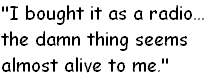
Short story titled The Twonky by Henry Kuttner & C L Moore, original published under their joint pseudonym Lewis Padgett.This one made me smile most of the way through, though I've seen its plot idea in at least 3 other stories - Kuttner/Moore's "Mimsy Were the Borogoves", Russell/Hugi's "Mechanical Mice", & C M Kornbluth's "The Little Black Bag": a very minor toy of an advanced civilization ends up in human space, causing major upheaval.

Story summary. Act 1.

Mickey Lloyd of Mideastern Radio (a maker of consumer audio equipment) is having attrition problems - lot of employee turnover. "So when the big-headed little man in overalls wandered vaguely out of a storeroom", Lloyd put him to work on assembly floor.

The "little man" "Joe" is a bit dazed. He looks around - "Men in overalls were doing things. Simple, obvious things... Perhaps this was a kindergarten"! Of course he could do it; he was a trained "twonky" maker. "He began to build a Twonky... when he couldn't locate any tungsten, he hastily built a small gadget and made it"! He finished it, & gave it the external appearance of typical "console radio-phonograph combination" being assembled there. And being tired, he went to sleep in the shop.

When he wakes up, the mists have cleared. Realized he "ran into a temporal snag!... went over to a corner, felt around in the air, nodded with satisfaction and seated himself on nothing, three feet above the floor. Then Joe vanished."

OK - so this is how the "twonky" ended up in human space. It looks like a typical "console radio-phonograph combination", & is mixed up among other similar units.

Act 2.

Second part of the story is of Kerry Westerfield, a teacher at a university. He lives somewhere with his wife Martha. And has just brought the new console - of course, the disguised twonky. He will soon discover the surprises.

He is about to try the new console. He 'opened the doors ... A beam of bluish light shot out and hit him in the eyes. From the depths of the console a faint, thoughtful clicking proceeded. Abruptly it stopped... The radio said, ... "Psychology pattern checked and recorded."' Kerry thought he had tuned some funny radio station, & forgot about it.

Thinks of picking up a cigarette. Lights, but first match stick went out. Is about to light another "when a faint noise caught his attention. The radio was walking across the room toward him. A whiplike tendril flicked out from somewhere, picked up a match, scratched it beneath the table top - as Kerry had done - and held the flame to the man's cigarette... When he could see again, the radio was back in its accustomed place."

This walk of radio had pulled out the electric cord from wall socket; so he replaces it. He will soon find it's not necessary. The machine has some built in power source.

Martha is to go out for a few days. Kerry drops her off, not knowing what ordeal he has in store.

Over the next few days of living alone, he will discover that radio walks over to kitchen to do his dishes, doesn't let him read certain books (physically snatches books it considers naughty from him), won't let him have more than one cup of coffee, will play some music but not other, ...!!! Looks like the twonky is some kind of a nursemaid & a censor. It can also manipulate his mind - e.g., to temporarily kill curiosity or initiative!

As a reader, we need to remember twonky is kindergarten stuff - it's treating the subject as a child. Except for the gruesome ending.

Kerry consults a friend & psychology teacher Mike Fitzgerald. Over the next few days, they will try all kinds of things & keep getting more & more puzzled.

Eventually Martha is back. Kerry's initiative has been killed to the extent that he's behaving like a zombie. Martha calls Mike over. Learns the whole story. Mike has plans of wrecking the dangerous gadget. But gadget is far smarter - telepathically makes him forget the whole episode!

Martha goes bonkers. Picks up a "hatchet" to destroy the radio. 'a beam of light shot out, and Martha vanished. A little dust floated up in the afternoon sunlight... "Destruction of life form threatening attack," the radio said'!

By now Kerry is sober & has seen her death. Tries the same stunt. Gets killed the same way. And the machines says "Subject basically unsuitable... Elimination has been necessary... Preparation for next subject completed"!

Act 3.

We see a new couple have brought the Westerfields place. And the estate agent seems to have some curiosity examining the radio...

Related.

  1. All stories by Lewis Padgett (Henry Kuttner & C L Moore).

Collected in.

  1. "The Best of Henry Kuttner".
  2. Raymond J Healy & J Francis McComas (Eds)' "Adventures in Time and Space".

Fact sheet.

First published: Astounding Science Fiction, September 1942. Under the joint pseudonym of the two authors - "Lewis Padgett".
Rating: A
This story was turned into a 1953 movie of the same title.

Thursday, September 13, 2007

Eric Frank Russell's "Mechanistria": Adventure on a planet of hostile alien robots

Quote from the story titled Mechanistria by Eric Frank RussellThis story is far less coupled with "Jay Score" than with rest of the series - "Symbiotica" & "Mesmerica". It includes most of the cast of "Jay Score", plus some more - but rest of the story is very different.

You need to drop credulity when reading it; just look for fun, & you might find some.

Story summary.
While the narrator, the sergeant-at-arms of Upsydaisy (the ship on earth/Venus run) is waiting with crew for their next trip, Captain McNulty comes & announces another adventure.

Professor Flettner has invented a new drive that enables faster-than-light travel, & "is seeking a crew for his extra-solarian vessel, the Marathon". McNulty will lead it, & it will include Jay Score & a few of older staff - all of whom have been trained on the new ship while rest of crew were vacationing.

McNulty has given the option to his old Upsydaisy crew to sign up for Marathon, or stick to Upsydaisy with its new team. All of them sign up, including the ten-tentacled martians. "Four government experts" will also join the first voyage of Marathon.

Destination star is "a minor luminary in the region of Bootes". The adventurers will examine one of the planets of this system.

OK - they land at their destination: "The world ... was little bigger than Terra. Its sunlit face had a mixture of blacks, reds and silvers rather than the old familiar browns, blues and greens. It was one of five planets circling a sun smaller and whiter than our own. A small, insignificant group of asteroids shared this grouping but we had no difficulty in cutting through their orbits... air was twelve pounds and breathable".

A party is enlisted to tentatively examine the immediate area. They reach a nearby river on foot. "After a while a headless body came floating and bobbing along. The mutilated corpse vaguely resembled that of an enormous lobster. It had a hard, crimson, chitinous shell, four crablike legs, two lobsterish pincers & was half as big again as a man. Its neck was a raw, bloodless gash from which white strings dangled."

A little later, a big lizard comes to drink water. And talks to them telepathically! It invites them to "stick around... But not around my burrow. I don't like publicity. It's dangerous."

Well - introductions over, they head back to ship. That is when they discover their radio has failed. A check at ship discovers the local airwaves are "alive from two hundred meters right down into the ultra short wave band. There is not room to get a word in edge ways ... There are whistles of a steady and sustained type that might be direction signals. There are eight different waterfalls of considerable intensity. I reckon they are power broadcasts. In between all these is an orgy of gabbling which suggests this place is fairly crawling with life."

Now 3 men in a lifeboat will fly around for half an hour. They radio seeing a couple of roads, & some moving things. And then their radio goes dead. Nothing will be ever heard from them again!

A little later, the spaceship is surrounded by robots of many kinds. A little fight later, most of the crew has been forcibly captured by locals.

Some of the terrestrials, but no martians, soon find themselves in a prison. On taking stock, "McNulty found seven dead, five missing, not counting the Martians".

Soon they are joined by a couple of lobsters - the kind they found beheaded. They are also prisoners, & can talk to our friends telepathically! During this conversation, we learn that this planet is ruled by robots, but the lobster things are from a nearby watery world called Varga. These robots have been fighting Vargans for domination, & the ones now in prison are PoWs. Also, that the robots intend to dissect them all - lobsters & terrans alike! "They dissect all the individualistic. They've been doing it for years, centuries, trying to discover the cause of personal independence. They are intelligent machines, but their intelligence is completely communal."

Anyway, Martians come to rescue the friend in the pinnace - a kind of short range flier. Lobsters refuse to be rescued because "Even a child knows that a prisoner must maintain honor by uncomplainingly accepting his fate."

Pinnace will have to make two trips to Marathan to transport the rescued. While waiting on prison roof for it to return, some of the rescued figure some structures around them are beaming power on different bands to the machines - kind of Tesla's wireless power transmitters. They destroy one; will bomb more on return trip. But for locals, it will be only a temporary setback, because there are repair machines with their own power sources.

A discussion at ship later will reveal that martians survived by sitting "on the ceilings where they couldn't get at us. We picked them up, dropped them and left the rest to nature. They can't climb." Also, "it looks rather as if mere motion is their definition of sentient life. It moves, therefore it lives."

This hypothesis will be tested in another town, where the adventurers capture a local robot before returning to earth.

Fact sheet.
Mechanistria, short story, review
First published: Astounding Science Fiction, January 1942
Rating: B
Series: Jay Score (A), Mechanistria (B), Symbiotica (B), Mesmerica (B)
Related: All stories of Eric Frank Russell.
Listed among the stories from John Campbell's Astounding/Analog.

Wednesday, August 29, 2007

Robert Heinlein's "Beyond This Horizon" (novel): A society of supermen

Quote from the novel titled Beyond This Horizon by Robert HeinleinMain thread of the story is plausible enough, if psychologically extremely uncomfortable: a couple can choose to have the best child they can possibly have by carefully selecting a specific egg/sperm pair over their productive life, rather than an average child they normally have by random egg/sperm combination.

While the story treads on much darker things possible with genetics, I find even the apparently sensible thread extremely troublesome. While Heinlein's advocacy is generally limited to sane things like choosing children less immune to diseases, couples will eventually apply their own (obviously) definition of best. Results, even of a simple application like sex selection, can be extremely dangerous - as is currently happening in the Indian state of Punjab - the worst sex ratio in India, & still worsening.

Since such selection & more is going to be possible in days ahead, we might as well begin getting uncomfortable today - for whatever good it will do!

Even apart from the dark subject, this is not quite a normal Heinlein story. His political & economic views are muddled here, & the story keeps going on many irrelevant tangents.

Main thread of the story reads somewhat like Aldous Huxley's "Brave New World". I collect the quotes here.

Story summary.
I think the story is set 100 or 200 years in future; I don't remember the dateline - it's provided indirectly. Place is the Capital of a Republic - some future version of some place in the US; and it appears to be part of some larger worldwide political grouping.

Gene selection is common in this society, though you can choose to stay natural. Naturals are the lower caste.

There is a benign government, "Policy Board" at highest level we meet in the story. They maintain the various gene lines; they advise who will mate whom; they choose the best kids; they raise most kids in well run nurseries. Too much wishful thinking, if you ask me.

The economic system has a very substantial communist tilt - something very unlike every Heinlein story I've read to-date.

Hamilton Felix is a man derived from the best genetic stock. His marriage to Longcourt Phyllis is being pushed for by Claude Mordan, a government bureaucrat who will eventually become a good friend. Longcourt is a "fifth cousin" of Hamilton, is also derived from the best stock, & they together have promising gene combinations.

Hamilton is resisting; girl is willing; eventually they will marry & have two kids - Theobald, a boy, & younger Justina. Turns out Theobald is telepathic! But that is a different thread.

This whole arrangement sounded like a very typical Suraj Barajatya film - replace horoscope match with gene compatibility, old friend of the dad that does marriage fixing with government bureaucrat, & minus a lot of color that makes these movies lovable - at least for first viewing.

Then there are villains. Very Hitlerian right-wingers. Want to keep the best genetic stock; breed people to meet government's needs; & kill off the inferiors. There are some ugly scenes, but they don't last long. They are led by McFee Norbert. When the revolution comes, it is quickly crushed.

And that is where the story should have ended. But it continues for half as long again, & this remaining part is very lame. Main thread is about the joys of parenting. A second thread is a governmental project to "enumerate and investigate all of the problems of philosophy", enlarged from originally proposed & simpler "effort to investigate the question of survival after death"! Third thread is the telepathic ability of Theobald.

All through the story, yet another lame thread is also running: life of Hamilton's close friend Monroe-Alpha Clifford (code number 32-847-106 B62!); his divorce with his orthowife Larsen Hazel; his erratic love affair & eventual marriage to Hartnett Marion; & his adventures with revolutionaries.

There is yet another significant thread through the story: a young man named John Smith Darlington was conned (when drunk) in the year 1926 to enter a stasis machine, & he ends up arriving in the time of this story! We see his confusion adjusting to this world. Best part of this thread is a humorous description of the game of US football; see near the end of quotes.

Fact sheet.
Beyond This Horizon, novel, review
First published: Originally published as 2-part serial in Astounding Science Fiction, April/May 1942, under the pseudonym Anson MacDonald
Rating: B

See also.

  1. All stories about technology assisted human baby making.
  2. This story ranked (by quality) among all stories.

Quotes from Robert Heinlein's "Beyond This Horizon" (novel)

Here are the quotes I marked in the novel; particularly interesting is the one near end - a humorous description of US game of football.

  1. "Easy times for individuals are bad times for the race."
  2. "Man is an unspecialized animal. His body, except for its enormous brain case, is primitive. He can't dig; he can't run very fast; he can't fly. But he can eat anything and he can stay alive where a goat would starve, a lizard would fry, a bird freeze. Instead of special adaptations he has general adaptability".
  3. "strongest of social motivations, the desire to be appreciated".
  4. "scientific research, no matter how pure and useless it may seem, has an annoying habit of paying for itself many times, in the long run, in the form of greatly increased productivity."
  5. "police of a state should never be stronger or better armed than the citizenry".
  6. "disobedience was more often a virtue than a sin".
  7. "it's perfectly natural that blood relatives should dislike each other."
Description of US game of football.
"It's a silly business, at best. Twenty-two men get out on a large open place and battle with their bare hands."

"Why?"

"The excuse is to move a little plastic spheroid from one end of the place to the other."

"What difference does it make which end it's on?"

"None, really - but it's as reasonable as any other game."

"I don't get it," Phyllis decided. "Why should anyone fight unless he wants to kill someone?"

"You have to see it to understand it. It's exciting. I even found myself shouting."
...
"We'll sell permissions to view it physically and then all sorts of lesser rights - direct pickup, recording, and so forth. Smith has a lot of ideas about identifying various combinations with cities and organizations and attaching color symbols to them and songs and things."
