Showing posts with label Fredric Brown. Show all posts

Tuesday, March 11, 2014

Fredric Brown's "Knock" (short story, alien invasion, free)

Going by the comments online, it appears to be among the better known stories of Brown. Not a very believable conclusion, but light fun read.

Story summary.

Aliens called "Zan" have raided earth. They took a few hundred animal specimen alive - among them a man & a woman, & killed off all other life on earth. These specimen, including the humans, have now been put as exhibits in a zoo on earth, & this advanced raiding party of aliens is preparing to claim earth as permanent residence.

The man will pull off a coup of sorts, scaring aliens enough with his
ingenuity to make them leave earth...

Collected in.

  1. Everett F Bleiler & T E Dikty (eds)' "The Best Science Fiction Stories: 1949".

Fact sheet.

First published: Thrilling Wonder Stories, December 1948.
Download full text.
Download audio of X Minus One radio adaptation of this story from Internet Archive. (alt MP3 link)
Rating: A.
Related: Stories of Fredric Brown.

Monday, August 26, 2013

Fredric Brown's "Sentry" (flash fiction, war, free)

In a long drawn galactic war, the "good" side is still not used to the sight of ugly monsters that comprise the enemy.

Fact sheet.

First published: Galaxy, February 1954.
Download full text & audio from SFFAudio. [via QuasarDragon]
Rating: B.
Related: Stories of Fredric Brown.

Thursday, September 27, 2012

Fredric Brown & Mack Reynolds' "The Switcheroo" (short story, body snatching, humor, free)

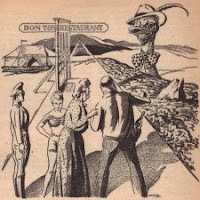
Illustration by Bill Terry accompanying the original publication in Other Worlds Science Stories magazine of the short story The Switcheroo by Fredric Brown and Mack Reynolds. Picture shows a man with a gadget that lets you switch consciousness with another person's body.
Title refers to a gadget. Inventor's "pet name for it, of course. Actually it is a psychoreversamentatron." It helps you snatch bodies. You point it at yourself, think hard of someone, & flick a switch. And your consciousness moves into the body of the person you were thinking of, & his consciousness moves into the body you have. Other person need not be close to you at the time of using the gadget.

Inventor of the gadget & a press reporter privy to its secret both want to get rid of someone - inventor of his nagging wife, reporter of his unbearable boss. And then there are the desirable bodies of the state governor & of the President (both of US). Some fun the duo will have switching bodies.

Fact sheet.

First published: Other Worlds, March 1951.
Download full text as part of the scans of the magazine it originally appeared in.
Rating: B.
Related: Stories of Fredric Brown, Mack Reynolds.

Monday, February 27, 2012

Fredric Brown's "Pi in the Sky" (novelette, humor)

Very funny ending, of an apparently serious story told with a straight face.

Astronomers the worlds over suddenly start observing extremely unusual motions of far away stars. Physics seems to be up for some serious revision. And then, a few days later, they as suddenly stop moving, basically relocating to new positions, relative earth, that serve a grand end...

Fact sheet.

First published: Thrilling Wonder Stories, Winter 1945.
Rating: A.Related: Stories of Fredric Brown.

Thursday, April 14, 2011

Fredric Brown's "The Waveries" (short story, alien invasion, free)

I'd read it long ago, in one of the "Isaac Asimov Presents Great SF Stories" books (I think), but found the online copy only recently.

It's supposed to be one of the better known stories of Brown. A light-hearted "apocalypse" where it has suddenly become impossible to use electricity in any kind of application!

Fact sheet.

First published: Astounding, January 1945.
Download full text from Grey Lodge Occult Review. [via David Mitchell @rasfw]
Rating: B.
Among the stories from Astounding/Analog issues edited by John Campbell.
Nominated for Retro Hugo Award 1996 in short story category.
Related: Stories of Fredric Brown.

Sunday, December 12, 2010

"Worlds Beyond", Vol 1 No 1 (December 1950) (ed Damon Knight) (magazine, free): Annotated table of contents

Cover by Paul Calle of inaugural issue of Worlds Beyond magazine - December 1950, edited by Damon Knight
Scans of this magazine in CBR format are online as part of a larger package, or as a standalone copy.

At least some of the stories are reprints.

Table of contents. 

Links on author or year fetch more matching fiction.
  1. [novelette] [reprint] William F Temple's "The Smile of the Sphinx": "What do cats do with their spare time? ... Rule the world, perhaps?"
  2. [ss] Mack Reynolds & Fredric Brown's "Six-legged Svengali": "All the explorer had to do was prove that he was smarter than a mud turtle--but on Venus that's not so easy!"
  3. [ss] Philip Wylie's "An Epistle to the Thessalonions": "He was incredible; ominous; indubitable; a giant one thousand miles high!"
  4. [ss] Larry Shaw's "Simworthy's Circus": "It was the genuine article--the real, 100-proof, universal elixir of love. Just the same, applied to the ugliest human in the universe, it produced some pretty dubious results..."
  5. [ss] [reprint] Graham Greene's "The End of the Party"; The London Mercury, January 1932: "The adult world is a tissue of lies, as any child knows. But what adult knows the dark truths of a child's world?"
  6. [ss] John D MacDonald's "The Big Contest": "Now, forty years after the contest, we can figure out a few things about the little guy who won it. He had a terrible task here on this Earth; he must have been very lonely..."
  7. [ss] [reprint] Franz Kafka's "The Hunter Gracchus": '"Even if all the people were commanded to help me, every door would remain shut, everybody would take to bed & draw the bedclothes over his head, the whole earth would become an inn for the night."'
  8. [ss] C M Kornbluth's "The Mindworm": "You might think of him as an ascetic, for he lived on nothing more substantial than human emotion. Or you might call him a sadist, for the deaths of other men were his life. The coal-town Slavs he despised had another, simpler name for him; & a very simple, very ancient remedy for the terror he brought."
  9. [ss] Battell Loomis' "Invasion Squad": "They were three casual travelers from Somewhere, en route to Somewhere Else. We're lucky to have this brief record of their stop-over, for it's doubtful that they'll ever return..."
  10. [ss] [reprint] William Seabrook's "Wow": '"Abolish language," said the vizier, "& man will return to primal simplicity & happiness." ...'
  11. [ss] Jack Vance's "The Loom of Darkness": "An old, an ageless tale: the story of a golden woman & a golden tapestry, & of the slender threads of darkness that bound them eternally together..."

    There is an editor's note on the back cover, along with an ad for author's well known novel "The Dying Earth", that says this story is "one episode" from "The Dying Earth".

See also.

  1. Fiction from Worlds Beyond.
  2. Fiction from old "pulp" magazines.
  3. Fiction from 1950s.

Thursday, October 14, 2010

"Startling Stories", Vol 24 No 2 (November 1951) (ed Samuel Mines) (magazine, free): Annotated table of contents

Cover image of Startling Stories magazine, November 1951 issue
Scans of this magazine in CBR format are online as part of a larger package.

Table of contents. 

Links on authors fetch more fiction by author.

  1. [novel] Eric Frank Russell's "The Star Watchers" (B): "Posted on every life-bearing planet are these oddly selfless guardians--amiable, but vengeful & merciless in striking down any who menace man's long agonizing climb to the stars".
  2. [novelet] Mack Reynolds & Fredric Brown's "The Gamblers": "Bob Thayer was no card sharp, but he managed to get into a poker game on the Moon--with the fate of the Earth at stake".
  3. [ss] Sam Merwin, Jr's "Grease in the Pan": "This was their purpose--to discover new planets to populate".
  4. [ss] William Morrison's "The Cupids of Venus": "Couples for colonizing Cygnus were selected scientifically!"

See also.

  1. Fiction from Startling Stories.
  2. Fiction from old "pulp" magazines.
  3. Fiction from 1950s.

Wednesday, February 17, 2010

Fredric Brown's "Nothing Sirius" (short story, first contact, free): Adventure on an alien world

Illustration accompanying the short story Nothing Sirius by Fredric Brown in 1953 anthology Wonder Story Annual, Vol 2 No 1, edited by Samuel MinesA family of 4 in small time gambling business are returning to Earth from their business visit to two human colony worlds orbiting Sirius - Thor & Freda, only two worlds known in that system. And then they discover a third world - the innermost; they land & name it "Sirius 0. Which means it's Nothing Sirius."

Story is of their strange adventures on this world where what the senses believe need not be true! And of their hurried escape.

See also.

  1. Ray Bradbury's "Mars is Heaven!" (download MP3 of an old radio adaptation), Eric Frank Russell's "Mesmerica", & John Campbell's "The Brain Stealers of Mars": Other stories with similar themes.

Collected in.

  1. Samuel Mines (ed)'s "Wonder Story Annual, Vol 2 No 1 (1953 Edition)".

Fact sheet.

First published: Captain Future, Spring 1944.
Full text of this story is included in the online scans of this anthology.
Rating: B.
Related: Stories of Fredric Brown; fiction from 1940s.

Friday, September 18, 2009

Frederic Brown's "Daymare" (novelette, murder mystery)

Quote from short story titled Daymare by Frederic BrownThere has been a murder in town. Circumstances warranted quick cremation; only 5 men saw the corpse - among them a medico & the police investing officer. Cop saw a big wound on corpse's forehead - as if hit by an axe, medico saw a major wound on shoulder & says the victim died of shock, another cop who originally discovered the dead body says it was a bullet wound on his chest, ... Five witnesses of the dead body, each adamant the victim died a different way!
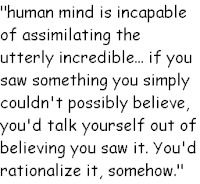
During investigations, there is another murder. A man dies due to a fall, but there is no injury! What is more, the dead man is the same as the one who recently died 5 different ways!

In the meantime, curious things have been happening around town.

Solving the case, after many twists & turns, will end up uncovering a conspiracy much bigger than 2 murders.

Story is set on Callisto, one of the moon of Jupiter, far in future.

Notes.

  1. Story has a major thread on governments banning books, with author justifying the idea in certain cases.

    I personally find the idea abhorrent. In virtually every single case of a book ban I've seen in India, it has been a case of abuse of government power. I personally cannot see a case where trusting men in power to tell us what we ought to know & what not is justified - if for no other reason than because it's impossible to ensure that men in authority will also be men of integrity.

    This story would have worked very differently if author didn't see justification in banning books.

Collected in.

  1. Isaac Asimov & Martin H Greenberg (Eds)' "Isaac Asimov Presents the Great SF Stories 5 (1943)".

Fact sheet.

First published: Thrilling Wonder Stories, Fall 1943.
Rating: A.
Related: Stories of Fredric Brown.

Friday, August 7, 2009

Fredric Brown's "Keep Out" (short story, racism, free)

First batch of 20 year olds, humans adapted for Martian conditions by giving their volunteer parents a drug called "daptine" before conception & then by raising them in gradually changing environmental conditions that are now nearly Martian, have reached their graduation day: tomorrow, they will be released unprotected into Martian wilderness - to make the world their own.

What their older handlers haven't accounted for, however, is what the story says is a key human attribute: hating others that don't look like us.

See also.

Changing human anatomy physically to colonize other worlds or to inhabit greatly changed living conditions is an old trope. Some other famous stories of the kind:
  1. Poul Anderson's "Call Me Joe" (download comic book adaptation as part of a larger package), Clifford D Simak's "Desertion": Human colonists ... kind of ... mind dump themselves into animals especially created to live on the solid surface of Jupiter.
  2. James Blish's "Surface Tension" (download MP3): Stranded humans on an alien world are about to die, & must create humans in new microscopic bodies where they can not only survive, but eventually discover their human roots.

    Among the most famous stories of this kind.
  3. Murray Leinster's "The Mad Planet" (download): Major changes in oxygen/carbon dioxide ratio of earth's atmosphere means only the tiny fraction of those humans with bodies substantially changed to withstand this atmosphere can live.

Fact sheet.

First published: Amazing Stories, March 1954.
Rating: B.
Download full text from Project Gutenberg or Manybooks. [via QuasarDragon & Marooned]
Related: Stories of Fredric Brown.

Monday, June 29, 2009

Fredric Brown's "The Little Lamb" (short story, horror, free)

Mostly a slightly creepy story - of a man worried because it's night & his wife hasn't returned home, & his search for her. With a horrific surprise ending.

Fact sheet.

First published: Manhunt, August 1953.
Rating: B.
Download full text from Internet Archive.
Included in Ellen Datlow's SciFiction's classics. (Personally, I couldn't see anything classic-worthy here.)
Related: Stories of Fredric Brown.

Tuesday, June 16, 2009

Fredric Brown's "The Geezenstacks" (short story, mysterious gadget, free)

Uncle Richard gave the package containing the 4 wax dolls to his nine-year old niece Aubrey Walters; he'd found the package under strange circumstances.

Over the following days, the child's dad will discover strange things apparently linked to dolls. Child has associated her own family members with each doll - Papa Geezenstack, Mama Geezenstack, Aubrey Geezenstack, & Uncle. Whatever she makes her dolls do during a play actually happens to corresponding member of the family soon!

Notes.

  1. I didn't quite follow the ending.

Fact sheet.

First published: Weird Tales, September 1943.
Rating: B.
Download full text from Internet Archive.
Included in SciFiction's classics archives.
Related: Stories of Fredric Brown; Mysterious gadget stories.

Wednesday, June 10, 2009

Tony Daniel recommends some short fiction

In this chart (JPG image) as part of SF Signal's weekly panel called "MIND MELD".
Caution: Depending on browser settings, image text may be difficult to read in browser; might need to save to disk & use an image viewer.

I won't always call the stories on his list good, but they're famous ones. Includes several I haven't read but might now look up.

Of the very famous ones on the list that I personally didn't find good:

  1. Damon Knight's "The Country of the Kind"; download MP3.
  2. Fredric Brown's "Arena"; download text or comic book adaptation.
  3. Arthur Clarke's "The Nine Billion Names of God"; download text/MP3: But it's worth seeking out for those interested in ancient history of computers.
Also, many people will likely find Joseph E Kelleam's "Rust" a far better read than Ray Bradbury's much better known "There Will Come Soft Rains" (download text/MP3). Both are essentially on the same subject. Arthur Clarke too has two famous stories on the same subject (neither suitable for those seeking entertainment or for genre newbies) - "The Curse" (download text), & "If I Forget Thee, Oh Earth ...".

One story particularly worth looking out for on his list is Jack Vance's "The Moon Moth". Light fun read in a colorful setting.

Related: "best of" lists.

Sunday, May 10, 2009

Fredric Brown's "The Hat Trick" (as by Felix Graham) (short story, free)

Quote from short story titled The Hat Trick by Fredric BrownNot a bad read, except for ending that escaped me. I'm not sure I see what makes it a supposedly famous story.

Story summary.

Four teenagers - 2 boys & 2 girls - are having a little party, with boys showing magic tricks. Girls are appropriately impressed but the other guy must spoil the magician's trick. Until one of them pulls up the really convincing trick...

Fact sheet.

First published: Unknown Worlds, February 1943.
Rating: B.
Download full text from Internet Archive.
Included in Ellen Datlow's Sci Fiction classics.
Related: Stories of Fredric Brown.

Thursday, May 7, 2009

Free fiction: Comic book adaptation of Fredric Brown's "Arena"

At The Bronze Age of Blogs. [via QuasarDragon]

Text version of this story is already online.

Related: Stories of Fredric Brown.

Thursday, April 23, 2009

Fredric Brown's "Mouse" (short story, alien invasion, free)

A few days after the little alien ship with a dead mouse as the sole passenger landed in the middle of a city, widespread destruction began happening world over - assassinations of heads of governments, bombings of population centers, ...

Bill Wheeler has an idea that landing of the ship is somehow linked to increasing chaos. In fact, he seems to have an idea of how exactly...

See also.

  1. Key plot element of the story is similar to John W Campbell, Jr's "Who Goes There?" But Campbell's version is both longer & more of a thriller (or horror, depending on tastes).

Fact sheet.

First published: Thrilling Wonder Stories, June 1949.
Rating: A.
Download full text from Internet Archive.
Included in Ellen Datlow's Sci Fiction Classics.
Related: Stories of Fredric Brown.

Sunday, March 8, 2009

Fredric Brown's "The Star Mouse" (novelette, humor): When "Mitkey" mouse represented earth during first contact with aliens!

Quote from short story titled The Star Mouse by Fredric BrownThis is my fourth or fifth story by Brown - many of them first rate. Time to look for "Best of Fredric Brown", assuming such a book exists.

Story summary.

When Herr Professor Oberburger, "formerly of Vienna & Heidelberg" & now of Connecticut, built & sent the first rocketship to moon - with "Mitkey" mouse as a passenger, little did he suspect the ship will intersect the trajectory of a hidden alien world! Mitkey, of course, is named in honor of the "original Mitkey Mouse, by Valt Dissney."

You see, unknown to humans, there is "the 3/8-mile asteroid Prxl" that "frequently comes within a mere hundred thousand miles" of earth. It's inhabited by an elder race of tiny telepathic half-inch beings. Prxlians will pick the ship up with a tractor beam.

Mitkey will spend 15 months there. He'll be uplifted to human level of intelligence - so he can interpret the things he'd seen on earth, & brief aliens about the state of human civilization. Intelligence uplift has one caveat, though: contact with electricity is harmful to uplift.

He will be finally returned near the place of launch on earth - with two gifts: human-like speech, & designs of a machine that can uplift other mice. Aliens are hoping earth won't be a threat to them longer if it has two warring species at similar intelligence levels.

Some adventures of Mitkey on earth, & he's making a proposal to Herr Professor. Rename Australia as "Moustralia", & leave it to upliftd mice. In return, mice will help humans get rid of rats everywhere.

Professor is skeptical but promises to represent mice. Oh, and Prof had caged Mitkey's "vife" too - creatively named Minnie. Open cage with electric fencing. As Mitkey rushes to meet her, & touches electric fence... Gone is the uplift - he's back to being a normal mouse, & Australians get to keep their land!

Collected in.

  1. Raymond J Healy & J Francis McComas (Eds)' "Adventures in Time and Space".

See also.

  1. Murray Leinster's "Propagandist": First contact between humans & aliens is cordial rather than hostile because aliens can capture a pet dog first, & probe his mind with their machines, & learn enough about humans to inspire confidence in contact.

Fact sheet.

First published: Planet Stories, Spring 1942.
Rating: A.
Related: Stories of Fredric Brown; uplift stories; first contact stories (partial annotated list).

Friday, September 19, 2008

Fredric Brown's "Answer" (flash fiction, AI, humor, free)

Essentially a much shorter version of Arthur Clarke's oft quoted "Dial F for Frankenstein".

A newly born AI is already more than its creators can handle!

Collected in.

  1. David Drake, Jim Baen, & Eric Flint (Ed)'s "The World Turned Upside Down".
  2. Isaac Asimov & Martin H Greenberg (Eds)' "Isaac Asimov Presents the Great SF Stories 16 (1954)".

Fact sheet.

First published: Angels and Spaceships (anthology), ed Fredric Brown, 1954.
Rating: A
Download full text from Webscription.

Saturday, September 6, 2008

Fredric Brown's "Earthmen Bearing Gifts" (flash fiction, first contact, free): First contact that never happened!

A bit bizarre & extreme "irresponsible scientists" story. But among the better flash fictions by anyone.

Story summary.

Ancient dying race of Martians is down to 900 people living in a single city. Among their unusual abilities is telepathy - they can remotely sense human minds on earth, but not powerful enough to make earthmen recognize of their existence or communicate back. They've been sensing human plans for Mars, & welcome it - seeing their own salvation in contact.

Earthmen's plans involve initially a probe in the form of a rocket equipped with a bomb. Analysis of light from this explosion will provide human scientists on earth with atmosphere & soil data. Manned landings will come later.

Not hard to imagine the results of explosion!

Fact sheet.

First published: Galaxy magazine, June 1960.
Download full text from Project Gutenberg/Manybooks (via QuasarDragon).
Rating: A
Related: All first contact stories/annotated list/first contact stories' feed.

Friday, July 4, 2008

Fredric Brown's "Arena" is online

Today, manybooks posted this online copy of Fredric Brown's novelette "Arena" (from Astounding, June 1944).

While not high on my list of great stories, it features in the original Science Fiction Hall of Fame, & also in Contento's list of Top 10 Most Reprinted Stories.

Saturday, May 3, 2008

** Fredric Brown's "Arena" (novelette, free)

A rather complicated version of gladiators' fight to death for amusement of onlookers in ancient Rome.

A decisive war is about to be fought between humans invading aliens from another galaxy beyond the orbit of Pluto. But god-like aliens with powers similar to Arisians & Eddorians of E E Smith's Lensman series have intervened: a single human soldier & a single soldier of invaders, stripped of their weapons, must fight to death in an "arena" - a very exotic environment. Winner's race will live; other's will be destroyed by these gods!

Collected in.

  1. Robert Silverberg (Ed)'s "The Science Fiction Hall of Fame: Volume One, 1929-1964".
  2. Isaac Asimov & Martin H Greenberg (Eds)' "Isaac Asimov Presents the Great SF Stories 6 (1944)".

Fact sheet.

First published: Astounding, June 1944.
Rating: B.
Download full text, or comic book adaptation.

Note: Why is this post so short?