Showing posts with label Arthur Clarke. Show all posts

Monday, July 22, 2013

Some online fiction by well known authors

Most are courtesy of Free Speculative Fiction Online. Where I have a post on a story, link on title goes there. Link labeled "download" fetches the actual story. Link on author fetches more fiction by author.

Among the ones I've read, my favorite is "Two Yards of Dragon".
  1. Arthur Clarke's "A Walk in the Dark"; download text/audio; horror: Our primeval fears...
  2. L Sprague de Camp's "Nothing in the Rules; download; humor: What if mermaids were allowed in women's swimming competitions?
  3. L Sprage de Camp's "Two Yards of Dragon" (A); download: Adventures dragon hunting...
  4. Fritz Leiber's "The Bleak Shore"; download.
  5. Murray Leinster's "Nightmare Planet"; download: I don't recollect this title but it appears to be yet another variant of "The Mad Planet".
  6. Frederik Pohl's "The Kindly Isle"; download.
  7. Manly Wade Wellman's "O Ugly Bird!"; download.
  8. Alice Sheldon's "The Man Who Walked Home" (as by James Tiptree, Jr); download.
  9. John Varley's "Air Raid"; download.
Saturday, October 30, 2010

"Venture Science Fiction", #9 (Vol 2 No 3) (May 1958) (ed Robert P Mills) (magazine, free): Annotated table of contents

Cover of Venture Science Fiction magazine, May 1958 issue. Artist M S Dollens, showing Night on Titan from story The Comedians Children by Theodore Sturgeon
Scans of this magazine in CBR format are online as part of a larger package.

Table of contents. 

Links on authors fetch more fiction by author. Where I have a separate post on a story, link on story title goes there.

  1. Edmond Hamilton's "The Dark Backward": "In winter, on an island off New England coast, you get used to wind-lashed surf, to hardship & struggle, to the cold, lonely life. May be you get so used to it that you don't want to hear when the bright future calls..."
  2. [non fiction] Isaac Asimov's "The Big Bang": "Neutronium, as everybody knows, is heavier than anything...& doesn't exist. Dr Asimov here gives details of what it would be--& what it might actually have been!"
  3. Arthur C Clarke's "Cosmic Casanova" (A): "I was two months out on solo galaxy scouting trip, & I was ... restless. And then I contacted an unknown planet that might be one of Earth's lost colonies... Could be a date was closer than I thought."
  4. [novelet] Rog Phillips' "Ground Leave Incident": "To a young country couple on an isolated, hardship planet, a spaceship visit is a special event. There is the trip to town, new clothes, the smell of fresh food & spices... There are also the hot, demanding eyes of women-hungry crew."
  5. [non fiction] Theodore Sturgeon's "On Hand...Offhand".
  6. Gordon R Dickson's "Fleegl of Fleegl": "Fleegl was a rabbity-looking sort, with four arms, a force field, & a conviction that people were demented. He also had an extraordinary space tube a missionary's zeal, & a regrettable resistance to fission bombs & reason..."
  7. Algis Budrys' "A World Named Mary" (as by Robert Marner): "Bill & Mary found the planet, & it was beautiful. Which pleased Mary, but didn't surprise her--she was accustomed to getting what she wanted. Then Bill named the planet after her--& everything changed..."
  8. Isaac Asimov's "Buy Jupiter!": "The aliens were strong enough simply to take Jupiter, but for some reason they wanted it all legal. And the price they offered was fine. Thing was--why did they want the gassy old thing...?"
  9. [novelette] Theodore Sturgeon's "The Comedian's Children": "Everybody--almost everybody--loved unsmiling Heri Gonza, the world's funniest man. Look how he took over when that frightening children's disease was brought back from Iapetus. He gave wholly of himself, gave his money, his love, his talent... The one thing he didn't give was a cure. That seemed to be locked in the mind of Gonza's most dedicated enemy--& on the frozen surface of Saturn's eighth satellite..."
  10. [non fiction] Robert P Mills & Judith Merril's "Venturings".

See also.

  1. Fiction from old "pulp" magazines.
  2. Fiction from 1950s.

Friday, September 24, 2010

"Fantastic Universe", Vol 1 No 1 (June-July 1953) (ed Sam Merwin, Jr) (magazine, free): Annotated table of contents

Cover image by Alex Schomburg of Fantastic Universe magazine, June-July 1953 issue
Inaugural issue of the magazine. Going by sheer number of stories, this looks more like an anthology than a magazine! Its scans in CBR format are online as part of a larger package.

Table of contents. 

Links on authors fetch more fiction by author. Where I have a separate post on a story, link on story title goes there.

  1. [novella] Sam Merwin, Jr's "Nightmare Tower" (as by Jacques Jean Ferrat): "Lynne disliked the man from Mars on sight. Yet drawn by forces beyond her control she let him carry her off to the Red Planet."
  2. [novelette] A Bertram Chandler's "Vicious Circle": "It's bad to be trapped in a time warp with anyone. And when anyone is Malaprop Jenkins it can adder a man's wits peppermintly."
  3. [ss] Frank Belknap Long's "Little Men of Space": "The Children were very young--& the crisis they were called upon to face would have driven most adults into a straitjacket."
  4. [novelette] E Hoffmann Price's "The Fire and the Flesh": "Was Agni Deva flame? Or was she flesh? In either case, the woman of volcano was irresistible."

    Note: I wonder whatever made the author make "Agni Deva" female? In Hindu mythology, it's a male. Also, "Deva" (also written "Dev" in English) literally means "god" & is clearly male; "Devi" is "goddess" & female.
  5. [ss] August Derleth's "The Maugham Obsession": "All inventors seek success. Some few achieve it. And now & then, a Quintus Maugham is a bit too successful for his own health."

    From editor's introduction to story: author was the owner of Arkham press at the time the story was published.
  6. [ss] Arthur C Clarke's "The Other Tiger": "When a pair of strollers begin to ponder parallel worlds just about anything can happen. And this time about anything does."

    From Clarke's introduction to this story in his "Collected Stories": "Originally entitled 'Refutation', this story was retitled by Sam Merwin, editor of Fantastic Universe, as a nod to Frank Stockton's classic but now forgotten 'The Lady or the Tiger'".

    For me, it's among the forgettable stories of Clarke. It's very small though, probably just above the boundary of flash fiction.
  7. [ss] Gene L Henderson's "The Small Bears": "The aliens looked cute as Koalas. But there was a little matter of a graveyard of dead spaceships."
  8. [ss] Philip K Dick's "Martians Come in Clouds": "Among Man's noblest dreams is that of making friendly contact with other world creatures. But dreams may become nightmares..."
  9. [ss] Roger Dee's "The Minister Had To Wait": 'The Brass said, "Turn it on!" So Doc Maxey could but obey--which created one hell of a big mess.'
  10. [ss] Milton Lesser's "Finders Keepers": "Amhurst wanted to get married. But then an invisible ingenue moved in on his wedding day..."
  11. [ss] Ray Bradbury's "Time in Thy Flight": "The circus, Hallowe'en, the Glorious Fourth may go--yet eternal is their pull on a child's heart."
  12. [ss] Eric Frank Russell's "It's in the Blood" (B): "Space may flow in a young man's veins. But at times the laws of heredity can take tragic twists."
  13. [ss, reprint] Francis G Rayer's "Of Those Who Came" (as by George Longdon); New Worlds, November 1952: "The alien scheme was perfect--a night landing, infiltration, human disguises. Fortunately for us the Policeman was awaiting them."

See also.

  1. Fiction from Fantastic Universe.
  2. Fiction from old "pulp" magazines.
  3. Fiction from 1950s.

Friday, June 11, 2010

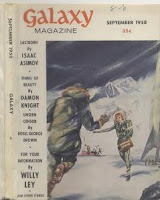
"Galaxy Magazine", Vol 16 No 5 (September 1958) (ed H L Gold) (magazine, free): Annotated table of contents & review

Cover by DEMBER showing Preparing Antarctica for Solar Conference of Galaxy Magazine, September 1958 issue
This magazine is online at Internet Archive in multiple formats.
Caution: I've linked it in the past, but without ToC. Regulars might already have a local copy.
Note: Galaxy seems to have changed its name from "Galaxy Science Fiction" to "Galaxy Magazine" some time in 1958. But the transition month listed by ISFDB is wrong.

Two very well known stories here - "The Ugly Little Boy" & "A Slight Case of Sunstroke", but both appear here under their less well known alternate titles. "Thing of Beauty" also seems to be widely anthologized, but I haven't personally read it yet.

Table of contents (6 stories, best first, unread last).

Links on author fetch more fiction by author. For read stories, my rating is in brackets. For stories that have their own post, link on story title goes there.
  1. [novella] Isaac Asimov's "Lastborn" aka "The Ugly Little Boy" (A): "A scientific experiment or not, the patient was her responsibility ... and all the more so for having died so many centuries ago!"
  2. [ss] Arthur C Clarke's "The Stroke of the Sun" aka "A Slight Case of Sunstroke" (A): '"Kill the umpire!" the audience cried—and why shouldn't they? He was on the ball, wasn't he?'
  3. [novelet] Rosel George Brown's "From an Unseen Censor": "You can't beat my Uncle Isadora—he's dead but he's quick — yet that is just what he was daring me to try and do!"
  4. [novelet] Damon Knight's "Thing of Beauty": "There was the gizmo that could put Gordon Fish in the chips — or right in the soup — and he didn't know which he was ordering!"
  5. [ss] Lloyd Biggle, Jr's "On the Double": "Failure was impossible — they had the one true formula: the victor belongs to the spoils!"
  6. [ss] H L Gold's "Personnel Problem": "Mng engnr wanted: duties it, gravity ditto, unitd opptnty advcmt—as anythg but engnr!"

Related.

  1. Fiction from Galaxy.
  2. "Pulp" magazines.
  3. Works of H L Gold.
  4. Fiction from 1950s.

Sunday, May 16, 2010

Free fiction: Galaxy, September 1958

At Internet Archive in multiple formats.

Editor: H L Gold.
Among the authors: Isaac Asimov, Damon Knight, Arthur Clarke (his funny & very well known story about the crazy football match in South America, "A Slight Case of Sunstroke", but under a different title - "The Stroke of the Sun"), H L Gold.

Related: Fiction from Galaxy, old "pulps", 1950s.

Sunday, March 21, 2010

Arthur Clarke's interview with Ken Kelley for Playboy, July 1986

Link. [via Free SF Reader]

Interview spanned a fortnight the interviewer spent in Lanka.

  1. From introduction to interview: "There are some places over the equator where the earth's gravity is so strong that satellites placed there don't need fuel, because they never drift out of position. It turns out that one of the most stable places on the planet is directly above the piece of property that Arthur bought in Sri Lanka. It makes you wonder where this man came from."
  2. On Neil Armstrong's statement, "That's one small step for man, one giant step for mankind"?: 'I took him up on that statement afterward, because he dropped out the "A." It was supposed to be "That's one small step for a man." He just fluffed it. When I talked with him about it later, he said, "That's what I thought I said, and that's what I meant to say."'
  3. "I write science fiction only about things I know are reasonably true, even though the extrapolations may not be known."
  4. "I like to think of the monolith as a sort of cosmic Swiss army knife—it does whatever it wants to do."
  5. On space elevators:

    "Is anything as outlandish as that even remotely possible?"

    "Almost anything you can imagine that's feasible that is likely to be done is going to happen."
  6. 'In several of your books—Childhood's End comes to mind—you bring up the idea of "nonmaterial minds"——'

    'That comes from William Olaf Stapledon's Last and First Men. He's a science-fiction writer from the Thirties who's most influenced all my writing, when you come down to it.'
  7. "One of my problems now is that I'm not just a private citizen anymore. I have to keep up certain standards, or at least pretend to, so that I don't shock too many people."
Related: Stories of Arthur Clarke; from Playboy magazine.

Sunday, February 21, 2010

Free fiction: Arthur Clarke's "Superiority", plus Eric Frank Russell, Murray Leinster, & Keith Laumer

4 old stories at Webscription, 3 of them among the most famous of science fiction: Keith Laumer's "Field Test" (download), Eric Frank Russell's "Allamagoosa" (download), Murray Leinster's "Exploration Team" (download), & Arthur Clarke's "Superiority" (download).

Two of these are among the very best of science fiction: "Superiority" & "Allamagoosa". Former is very hard to find online, & has so far been available only to US readers via Google Books. Later has been online a long time at scifi.com, but has been going on/off since they switched domain to syfy.com.

"Exploration Team" is the other very well known story.

[via Free Speculative Fiction Online]

Saturday, December 26, 2009

Frederik Pohl on the last days of Arthur Clarke, & their joint novel "The Last Theorem"

Link.

PS: I finished "The Last Theorem" last week; should have a post soon - whenever "soon" happens. It's the fourth or fifth novel waiting a post - in company with one by Jack Vance & another by Hal Clement!

Related: Stories of Arthur Clarke, Frederik Pohl.

Wednesday, December 23, 2009

Robert Silverberg critiques Arthur Clarke's fiction

At Asimov's.

Related: Fiction from Asimov's; fiction of Robert Silverberg/Arthur Clarke.

Saturday, December 12, 2009

Arthur Clarke's "Sunjammer" aka "The Wind from the Sun" (novelette, racing): Solar sail power interstellar vehicle!

Illustration accompanying a 9 November 2009 story titled _Setting Sail Into Space, Propelled by Sunshine_ by Dennis Overbye in The New York Times. Story is about a series of forthcoming launches of solar sail powered experimental spacecraft dubbed LightSail, a project of Planetary Society.About a month ago, there was a news item in The New York Times [via Brenda Clough] about a series of forthcoming experiments in solar sail powered vehicles. This story is one of the best pieces of hard sf from Clarke, & among the most exotic racing stories by anyone.

Note: Idea of a solar sail is to use the "pressure" of sunlight - not like solar energy but like particles of light that aren't quite particles though they have momentum - as the motive power. No other energy source is necessary, except for steering.

Story summary.

Seven solar sail powered vehicles of different designs from "four inhabited worlds" will compete in the race from earth to moon. Eventually, of course, it will be fight between US & Russian vehicles!

Beginning point is "twenty-two thousand miles above the [earth's] equator" where the vehicles are anchored to normal ships in a certain formation. At T0, the anchor lines are cut, & the race is on.

At moon, other vehicles will pick up the crew capsules. "the winner will be the one that first drifted past the Moon."

Story is mostly told from the point of view of US participant - John Merton, "Chief Designer of Cosmodyne Corporation", riding the sail ship Diana. He's the only one flying solo; everyone else has a crew of two. He thinks the reduced mass will work in his favor.

They will make two rounds around earth, picking speed during the "powered half of the orbit", before reaching escape velocity. We go through the maneuvers needed when vehicles
  1. pass through earth's shadow ("The shroud lines were slackening, & must be wound in lest they become entangled.")
  2. when moving the unpowered half of orbit (towards Sun) (need to sail "edge-on" to sun, or you're thrown back).
  3. when transitioning to powered part of orbit from unpowered.
We also see a competitive practice where one vehicle tries to cast shadow on another to cut its supply of sunlight, & how the victim escapes.

Participants keep falling off the race till only US & Russia are left: two to collision when passing through earth's shadow, another who could not turn the sail edge-on during unpowered half, another who could not transition from unpowered to powered half, & another where the lines rigging crew capsule to sail gave way.

Neck-to-neck half way to moon a day after reaching escape velocity, the last two participants will also have to abandon their vehicles because of a solar flare (their tiny capsules are unshielded). But Merton had rigged his machine to sail unaided too - so when he jumps, the vehicle is on its way to moon & beyond - eventually attaining solar escape velocity.

Quotes.

  1. Diana: "fifty million square feet of sail, linked to his capsule by almost a hundred miles of rigging... Yet it was little more substantial than a soap bubble; that two square miles of aluminised plastic was only a few millionths of an inch thick."
  2. How much is the pressure of sunlight on Earth? "Hold your hands out to the sun... Over the area of your hands, it comes to only about a millionth of an ounce.

    But out in space, even a pressure as small as that can be important, for it's acting all the time, hour after hour, day after day. Unlike rocket fuel, it's free & unlimited."
  3. Solar sail: "A square mile weighs only a ton, & can collect five pounds of radiation pressure. So it will start moving - & we can let it tow us along, if we attach rigging to it.

    Of course, it's acceleration would be tiny - about a thousandth of a g. That doesn't seem much, but let's see what it means.

    It means that in the first second, we'll move about a fifth of an inch. I suppose a healthy snail could do better. But after a minute, we've covered sixty feet, & will be doing just over a mile an hour. That's not bad, for something driven by pure sunlight! After an hour, we're forty miles from our starting point, & will be moving at eighty miles an hour... You'll be surprised when I tell you what our one-thousandth-of-a-g sailboat will be doing at the end of a day's run: almost two thousand miles an hour! If it starts from orbit - as it has to, of course - it can reach escape velocity in a couple of days. And all without burning a single drop of fuel!"
  4. On inertia: "another rule that was hard to learn: the very moment you had started something happening in space, it was already time to think about stopping it."
  5. Food "crumbs were a greater danger to space vehicles than meteorites; they could drift into the most unlikely places, causing short circuits, blocking vital jets, & getting into instruments that were supposed to be hermetically sealed."
  6. "Those two square miles [of sail] produce a maximum pull of just ten pounds. I can exert more force by my little finger."
  7. "It was hard to keep a good watch on that 60 million square feet of dim plastic out there in the darkness, illuminated only by his narrow spotlight & the rays of the still distant Moon."
  8. By the time of second lap around earth, while "the two square miles of plastic sheet must have been riddled by hundreds of micrometeorites, the pinhead-sized punctures had produced no falling off of thrust."
  9. Diana, after jettisoning: "Two days from now, she would flash past the Moon; but the Moon, like the Earth, could never catch her. Without his mass to slow her down, she would gain two thousand miles an hour in every day of sailing. In a month, she would be traveling faster than any ship that man had ever built.

    As the Sun's rays weakened with distance, so her acceleration would fall. But even at the orbit of Mars, should would be gaining a thousand miles an hour in a day. Long before than, she would be moving too swiftly for the Sun itself to hold her. Faster than a comet had ever streaked in from the stars, she would be heading out into the abyss."

Collected in.

  1. "The Collected Stories of Arthur C Clarke".
  2. Arthur Clarke's "The Wind from the Sun" (coll).
  3. Arthur Clarke's "The Sentinel" (coll).

Fact sheet.

First published: Boy's Life, March 1964 as "Sunjammer".
From author's note, introducing this story in Collected Stories: "The story's original title was 'Sunjammer' but as Poul Anderson had the same idea almost simultaneously, I was obliged to make a quick change of name."
Rating: A.
Related: Stories of Arthur Clarke (only his short fiction/novels).

Tuesday, December 1, 2009

Real science: A first step towards "Ambrosia Plus"!

Arthur Clarke has written a famous farce called "The Food of Gods". A reader reports a real-life lab version of the edible at the heart of this story.

Wednesday, October 28, 2009

Arthur C Clarke's "Hate" aka "At the End of Orbit" (novelette, revenge): This Hungarian man hates Russians

Quote from short story titled Hate aka At the End of Orbit by Arthur C ClarkeI've a feeling the impact this story will have on a reader will depend on opinions reader holds about Russia - story takes essentially an anti-Russia stand, particularly about some sort of Russian interference in Hungary. I'm not familiar with relevant political situation, & I grew up at a place where there was essentially no Russian propaganda - pro or anti. So I take political opinions here as just another story teller's version.

Story summary.

"Szabo Tibor, late of Budapest" is the man assigned the job of tying a rope (cable?) to a Russian space capsule that has "been round the moon a couple of times" & has now on return crashed near New Guinea in the Pacific, so pearl mining ship Arafura (of which he's crew member) can drag it to a nearby island to claim bounty. They don't report the location of find immediately to protect the location of their pearl mining patch from other miners.

But Tibor has a grudge against Russians - his brother Theo had died stepping on a Russian mine. While setting up the capsule for under sea ride, he will learn the capsule has a live occupant with 5 hours oxygen supply. He will learn this by getting in conversation where (I think) Tibor touches his helmet to hull & is heard inside, but response from inside is yes/no via taps on hull. Finally he will tell the astronaut about his revenge plan - how he will make sure the rope keeps breaking on the way so capsule won't surface for over 5 hours.

Well, eventually it will take even longer to reach for safety than planned, as the wreck gets stuck in sand near shore. And his shipmates find to their horror the nature of the wreck - none other than Tibor knew of human occupant - a tiny woman. And the dead astronaut will get her revenge too - she has prepared a spool of tape that apparently has a record of her conversations with Tibor during "rescue".

Note.

I'd read it a while back, & might have confused an occasional detail.

Collected in.

  1. "The Collected Stories of Arthur C Clarke".
  2. Arthur Clarke's "Tales of Ten Worlds".

Fact sheet.

First published: If, November 1961 as "At the End of Orbit".
Rating: B.
Author's introduction to the story in Collected Stories: "In 1960, William MacQitty (A Night to Remember) ... asked me to write a movie treatment entitled 'The Sea & the Stars'. Nothing came of the film so I turned it into a short story, entitled 'Hate'. If magazine retitled it, but I prefer the original: more punch."
Related: Stories of Arthur C Clarke.

Friday, June 19, 2009

Free fiction: Audio: Huffduffer

Link. [via Free SF Reader]

Many desperate things, but a few interesting ones too. Audio links below are probably all radio adaptations.

  1. Arthur Clarke's "Rendezvous With Rama"; download MP3 - part 01, 02: I'm not sure the two parts cover the whole novel, but if they do, it's a big catch.

    One of the most important novels of the genre, but only for readers with a taste for hard sf (that would be very small percentage of sf readers, though).

    There is also a very good 3 minute movie online, showing the approach & landing of human spacecraft on Rama, & entry of human explorers through airlock into the ship. Or was, when I last played it over a year ago.
  2. Philip K Dick's "Beyond Lies The Wub"; download MP3: Not read. I think its text version is already online, probably at Project Gutenberg.
  3. Murray Leinster's "A Logic Named Joe"; download text/MP3: Fun early story about interconnected computers. I've linked both versions in the past.
  4. Orson Welles' famous radio show inspired by H G Wells' "War of the Worlds" that caused panic in the US when first broadcast in 1938.

    Arthur Clarke's humorous apocalypse story, "Publicity Campaign", is apparently a reaction to the panic this broadcast caused.

Free fiction: Audio: Arthur Clarke's "Childhood's End" & Robert Heinlein's "Methuselah's Children"

Huge collection of desperate stuff, including science fiction, at Internet Archives' Audios, Movies, & Books collections. But even browsing to figure out interesting will be substantial effort - its very big.

Blue Tyson seems to have browsed at least part of the audio collection & has identified some things worth looking up:

  1. Robert Heinlein's "Methuselah's Children"; download audio: Not read.
  2. Arthur Clarke's "Childhood's End"; download audio: One of the most famous novels of Clarke, though I found it among his worst (its original short story version with James Blish, "Guardian Angel", is a far better read that cuts out the crap). Later parts are essentially a religious story - a retelling of one of the Hindu beliefs.

Wednesday, June 10, 2009

Tony Daniel recommends some short fiction

In this chart (JPG image) as part of SF Signal's weekly panel called "MIND MELD".
Caution: Depending on browser settings, image text may be difficult to read in browser; might need to save to disk & use an image viewer.

I won't always call the stories on his list good, but they're famous ones. Includes several I haven't read but might now look up.

Of the very famous ones on the list that I personally didn't find good:

  1. Damon Knight's "The Country of the Kind"; download MP3.
  2. Fredric Brown's "Arena"; download text or comic book adaptation.
  3. Arthur Clarke's "The Nine Billion Names of God"; download text/MP3: But it's worth seeking out for those interested in ancient history of computers.
Also, many people will likely find Joseph E Kelleam's "Rust" a far better read than Ray Bradbury's much better known "There Will Come Soft Rains" (download text/MP3). Both are essentially on the same subject. Arthur Clarke too has two famous stories on the same subject (neither suitable for those seeking entertainment or for genre newbies) - "The Curse" (download text), & "If I Forget Thee, Oh Earth ...".

One story particularly worth looking out for on his list is Jack Vance's "The Moon Moth". Light fun read in a colorful setting.

Related: "best of" lists.

Saturday, June 6, 2009

Kim Stanley Robinson recommends some Mars fiction

At IEEE Spectrum: "My 10 Favorite Mars Novels". [via SF Signal & Marooned]

It's actually 11 books - 8 novels, 2 short story collections, & 1 poetry book.

I've read only 2 from the lot:

  1. Arthur Clarke's "The Sands of Mars": First human cities on Mars, including an adventure involving a surface journey from one city to another, getting lost & rescued on the way, & picking up a native animal pet.
  2. Ray Bradbury's "The Martian Chronicles": I've read only part of it. A retelling of European colonization of Americas in a fantasy setting - read Europeans for humans & Martians for native Americans. In at least one story, "And the Moon be Still as Bright", author makes this connection explicit.

    Later stories apparently deal with nuclear dystopia, but I haven't read most of them.
Related: Fiction set on Mars or its moons; "best of" lists.

Wednesday, May 27, 2009

Free fiction: A few more short stories of Arthur Clarke (but accessible only in some countries)

Rusty reports he's able to read a few more stories from Clarke's Collected Stories at Google Book Search, but with caveats. I have some brief notes on these stories here. My Collected Stories page has alternate download links for some of the stories too, apart from more specific notes.

Among the ones I've not linked before, "Loophole" is good humor - serious consequences of bureaucratic paper shuffling, in the backdrop of a human/Martian war.

Monday, May 25, 2009

Free fiction: Audio of Arthur Clarke's "Summertime on Icarus" & "Before Eden"

Both as BBC radio dramatizations. Can only play from browser; no download. Both are included in his Collected Stories.

  1. "Before Eden"; play audio: This may be the classic story of the kind where earth bacteria infect an alien virgin world; at least it's the oldest I've read of the type. In this case, Venus is not quite virgin & has primitive native life in high elevations at certain places where temperature & pressure are relatively saner; but natives doomed because earth bacteria have arrived.

    I read a flash fiction variation of this story a few weeks back - Ian Rennie's "Eden". Far less rigorous than Clarke's, but it's text is online.
  2. "Summertime on Icarus"; play audio: Shipwreck & rescue aboard an asteroid rather close to Sun.

    Its downloadable MP3 has already been online for a while - so the BBC version may not be so interesting.
[via SF Signal]

Related: Arthur Clarke's short fiction, novels, collections.

Sunday, May 24, 2009

Free fiction: Arthur Clarke's "Superiority"

Among the very best of science fiction - how not to go about deploying new technology.

According to Best Science Fiction Stories, it can be read online at Google Book Search as part of the preview of Clarke's Collected Stories. I cannot even see the Preview tab of the book at the Google link from India, so may be its access is country-locked. Depending on your geographical location, you may be able to see it - watch for Preview tab near the top of the Google page. Good luck.

A request: In case you are able to see the preview, can you please note in comments below which individual stories have their full text (full, not partial) available in Preview (besides Superiority), so I can add this online presence information to individual stories. Thank you.

Related: Arthur Clarke's short fiction, novels, collections.

Arthur Clarke's "The Other Side of the Sky": Series of 6 linked short stories

This post is currently a placeholder; will fill it up as I read individual stories. This series originally appeared in Infinity Science Fiction Magazine, September & October 1957 - 3 stories in each of the 2 issues.

  1. "Special Delivery": Not read.
  2. "Feathered Friend": Not read.
  3. "Take a Deep Breath": Not read.
  4. "Freedom of Space": Not read.
  5. "Passer-by": Not read.
  6. "The Call of the Stars": Not read.

Series collected in.

  1. "The Collected Stories of Arthur C Clarke".
Related: Arthur Clarke's short fiction, novels, collections.

Sunday, May 17, 2009

Free fiction: Arthur Clarke's "Travel By Wire!" & "How We Went to Mars"

Both are early fun stories of Clarke, both among his good ones.

  1. "Travel by Wire!"; download: A materialization/dematerialization device that transports things & people over telephone wires! This is, I think, his first published story.
  2. "How We Went to Mars"; download (need to scroll down the page): Teen adventurers "accidentally" end up on Mars rather than having just a local trip in their neighborhood (in their home-built rocket)!
[via Free SF Reader]

Related: Arthur Clarke's short fiction, novels, collections.

Saturday, February 14, 2009

Free fiction: Arthur Clarke's humorous flash fiction piece "Quarantine"

At IBM, of all places! And from the first issue of Asimov's!

Related: My old post on the story.

Sunday, January 25, 2009

Terra Incognito on proto-SF stories of Edgar Allan Poe

Terra Incognito lists some of these. Without online links, but most Poe fiction should be available at Project Gutenberg.

  1. "Poe´s ballooning stories are The Unparalleled Adventure of One Hans Pfaall, The Balloon-Hoax and Mellonta Tauta." "The Balloon-Hoax [is] the description of a trans-Atlantic balloon travel." "Mellonta Tauta is the only far future story written by Poe... it takes place in the 25th Century, Poe simply criticizes human nature".
  2. "The Conversation of Eiros and Charmion".
But he doesn't list one of the most important science fiction stories of Poe - "A Descent into the Maelstrom". To me, this reads as very much normal hard-sf - nothing proto about it, though the language & telling style is kind of old. Arthur Clarke wrote a space age sequel to it - "Maelstrom II", of which a 3-minute movie version & a set of graphic slides are online.

Wednesday, January 21, 2009

Arthur Clarke's "Death and the Senator" (short story, space hospitals, free): Certain heart ailments may be best treated in a zero gravity environment

Quote from short story titled Death and the Senator by Arthur C ClarkeThis is a bit unusual among Clarke's stories in that a lot of text goes into human relationships that don't have anything to do with science fictional aspects of the story.

Story summary.

When Martin Steelman, long-term US senator & likely candidate for next presidential elections in 1976, learned he was suffering from a fatal heart disease & had only months to live, he finally began paying attention to his family - daughter's family including grandchildren, & estranged wife. And began preparing for the end.

When the news got out, he was approached by Dr Harkness, Technical Director of NASA. Soviets apparently have a small treatment facility up in orbit as part of research laboratory called Mechnikov Station, & probably magic can happen when his heart doesn't have to work against earth's gravity during treatment. Russians are also willing to help.

Turns out, it was primarily opposition from Steelman as a member of US Senate Committee on Astronautics that had killed NASA's efforts at setting up an Astrobiology Lab in space that might have given US a similar capability. Part out of guilt, & part out of altruism, senator will refuse treatment & die quietly.

Collected in.

  1. "The Collected Stories of Arthur C Clarke".
  2. Arthur Clarke's "More Than One Universe" (collection).
  3. Arthur Clarke's "Tales of Ten Worlds" (collection).

Fact sheet.

First published: Analog, May 1961.
Rating: A.
Read online at wowio (no free download). Note their interface requires more than a half dozen clicks before the story text shows up.
Listed among the stories from John Campbell's Astounding/Analog.
Related: Arthur Clarke's short stories, novels, collections, best of.

Friday, October 31, 2008

Free fiction: Audio of "The Forgotten Enemy" by Arthur Clarke

Freaky Trigger links the MP3 audio of Arthur Clarke's short story "The Forgotten Enemy," read by Elisha Sessions.

Not quite among the better Clarke stories from an entertainment point-of-view. It's description of the return of ice age. A man who refused to evacuate the town with others is living through the horrors of returning glaciers.

Disclaimer: I've neither downloaded nor heard this audio version. I've only read the written version of this story.

[via QuasarDragon]

Tuesday, September 16, 2008

Hindi audio of Arthur Clarke's The Star

Unmukt links this Hindi audio (Ogg/Vorbis) of Arthur Clarke's short story "The Star".

His post (in Hindi) also reviews the story, & links to a translation service that can render it in most Indian languages. Oh - actually, it's a transliteration service, but since a lot of Indian languages share grammar with Hindi even when the script & words are different, I would expect decent text quality in target language.
Disclaimer: I've not used this service.

Friday, June 27, 2008

Arthur C. Clarke's "Playback" (short story, science fiction): Reincarnation not possible with a corrupt mind dump

Quote from short story titled Playback by Arthur C ClarkeThis is not the first mind dump story I've read of Clarke - there's much better known novel "The City and the Stars". "Patent Pending" has a device that lets specific experiences of one individual to be recorded to a storage device & played back directly into the mind of someone else! Even "The Lion of Comarre" has a variation of this.

But this is the first exclusively mind dump story I've seen from Clarke that has a modern feel. Ignore a single reference to tape as a storage device & a space-based theme, & this 1966 story can be confused with a 2007 or a 2008 story! And it's among the best mind dump stories I've seen.

There is a part of the story that has the terror like in Harlan Ellison's "I Have No Mouth, and I Must Scream". But there is no sadistic external entity doing the torturing here; it's a natural part of the story.

Story summary.

40 year old William Vincent Neuberg, "a master pilot of the Galactic Survey... born in Port Lowell, Mars, on August 21, 2095", had an accident somewhere in deep space. His ship blown away, vaporizing him along with it. We don't know if there were any other crew or passengers.

But some aliens, obviously far off from the location of accident, did his mind dump during these last moments. They were competent enough to have created his body & complete with its memories from this dump, only they have no idea of what kind of body he had; nothing from the body was saved.

Story is narrated by a simulation ("playback") of William's mind dump record. He is initially trying to feel his body parts, panicky when cannot find, ... eventually realizing he's just a simulation!

He begins communicating with the aliens via the playback machine's interface, describing what his body looked like so they can reincarnate him. Only it's an incomplete recording - something vital seems to have been missed when they made the record - his memory is confused, fading...

Collected in.

  1. "The Collected Stories of Arthur C Clarke"
  2. Arthur Clarke's "More Than One Universe"
  3. Arthur Clarke's "The Wind From the Sun"

Fact sheet.

First published: Playboy, December 1966.
Rating: A

Wednesday, June 25, 2008

Arthur C. Clarke's "A Meeting With Medusa" (novella, hard sf): Exploring the upper atmosphere of Jupiter in a manned vehicle

Quote from short story titled A Meeting With Medusa by Arthur C ClarkeIn spite of some fantastic elements, I think it would be best described as a hard sf story. Balloons (eventually, hot hydrogen balloon on Jupiter), airships, & rockets - to eventually get to a vehicle suitable for exploring the upper atmosphere of Jupiter near its less violent equatorial regions.

Reading it brought out strong association with another story I read not too long back - David Moles' "Finisterra", one of the Hugo Award 2008 nominees. Cut the rigor out of Clarke's story & take only the more fantastic elements, & replace the cautious exploration story with a poachers' story - & you pretty much have the plot of "Finisterra".

While generally quite readable, it suffers from a flaw that keeps creeping into many Clarke stories - tendency to include many tangent threads (but less so than in some of his other stories).

  1. We have an airship ("Queen Elizabeth IV") crash during its testing somewhere near Grand Canyon in US - it was "the largest single space ever enclosed by man": "three-tenths of a mile long". We will learn a lot of its design & operations details.
  2. "Superchimps" serving as technical handymen.
  3. Potential life-threatening effects of satellite communications' half-second time lag: Airship accident was triggered by its collision with a remote controlled flying "camera platform". A manoeuvre required entry of this smaller vehicle into the hold of airship, & it was turbulent weather. Around the time of mating, the remote controller was using satellite communications rather than radio - this affected in split-second response time required during mating.
  4. The cyborg hero: The airship Commander, Howard Falcon, was among the badly hurt during the crash (a lot of others died). He was saved, but only as a cyborg. He will be the one physically exploring Jupiter's upper atmosphere later in the story: "He alone could travel unprotected on lunar surface. The life-support system inside the metal cylinder that had replaced his fragile body functioned equally well in space or under water. Gravity fields ten times that of Earth were an inconvenience, but nothing more."
  5. A balloon trip across Gangetic plains in northern India.

Story summary.

Main story is about the Jupiter exploration mission sometime late twenty-first century (story spans a few years - about 150 years after the Hindenburg accident).

Mothership will park in the "radiation shadow" of Jupiter V (one of its tiny moons), while Howard goes down solo for a 3 (local) days adventure in Jupiter's upper atmosphere. He will be moving in a radiation-shielded vehicle ("Kon-Tiki")whose design draws inspiration from many kinds of air vehicles.

He will observe many kinds of phenomena - including effects of the atmospheric shock waves & massive electrical discharges triggered by the equivalent of volcanic eruption on its surface ("or whatever passed for a surface on Jupiter") lying far below the human accessible regions, & a massive whirlpool ("some six hundred miles across"). It's the second time I've seen Clarke dwell on the maelstrom theme; "Maelstrom II" didn't involve a whirlpool, but is inspired from Edgar Allan Poe's "A Descent in the Maelstrom".

He will also observe two kinds of local creatures - a bunch of pack hunters, & a supermassive hunted creature ("more than a mile across" & "with scores of dangling tentacles" - "about a hundred thousand times as large as the biggest whale"). He dubs the former "mantas", & later "Medusa". Among other things, Medusa have radio senses! We will see an unsuccessful local hunting event.

He will eventually escape in a hurry on the third day when a Medusa gets too curious about his vehicle - puny compared to size of Medusa.

Collected in.

  1. "The Collected Stories of Arthur C Clarke"
  2. Arthur Clarke's "More Than One Universe"
  3. Arthur Clarke's "The Sentinel"
  4. Arthur Clarke's "The Wind From the Sun"

Fact sheet.

First published: Playboy, December 1971.
Rating: A
Winner of Nebula Award 1971 in novella category.

Thursday, May 1, 2008

** Arthur Clarke's "Holiday on the Moon" (as by Charles Willis) (short story)

Among the most accessible moon travel stories by Clarke for non-technical audience. Seasoned science fiction readers will find the fare familiar. Told from the perspective of an 18 year old girl generally disinterested in technical stuff.

Fact sheet.

First published: as a four part serial in Heiress magazine during January to April 1951, under the pen name of Charles Willis.
Rating: A

Note: Why is this post so short?

** Arthur Clarke's "Retreat from Earth" (short story)

An alien conspiracy story.

Eons past, an agreement between two alien races that visited earth has allowed humans to flourish. One of these alien races still has active machines on earth hidden from humans, & working to unknown ends via termites. When Martians get too interested in earth, these dormant alien artifacts force them to retreat & leave earth to humans.

Collected in.

  1. "The Collected Stories of Arthur C Clarke".

Fact sheet.

First published: Amateur Science Fiction Stories, March 1938.
Rating: B
Related: Stories of Arthur Clarke.

Note: Why is this post so short?

** Arthur Clarke's "How We Went to Mars" (short story, humor)

Light hearted adventure of a group of young boys' accident - their fun rocket took them to Mars! They meet English speaking natives! Spend a while, are refueled by aliens, & return home happy & safe.

Fact sheet.

First published: Amateur Science Fiction Stories, March 1938
Rating: B

Note: Why is this post so short?

* Arthur Clarke's "Whacky" (short story)

The single worst story by Clarke I've read yet - over the 100 odd by now. Could not make out the head or tail of it. Some conversation among characters that obviously are not real - may be they are in heaven, may be in a computer simulation, ... something.

Fact sheet.

First published: The Fantast, July 1942.
Rating: C

Note: Why is this post so short?

** Arthur Clarke's "The Wall of Darkness" (short story)

Description of life in a strange alternate universe where a single sun shines on a single planet of sentient beings, & where time behaves in a weird way. I didn't find it unreadable, but the core technical concept of the story escaped me.

Fact sheet.

First published: Super Science Stories, July 1949.
Rating: B

Note: Why is this post so short?

** Arthur Clarke's "The Road to the Sea" (short story)

One of the more muddled stories by Clarke, with many threads that are only loosely linked. A prosperous future where humans are divided by those who wish to live on earth, & those who seek out the stars.

Fact sheet.

First published: in Two Complete Science-Adventure Books, Spring 1951, under the title "Seeker of the Sphinx".
Rating: B

Note: Why is this post so short?

* Arthur Clarke's "The Lost Worlds of 2001"

Main post. Why this dummy post?

* Arthur Clarke & Michael Kube-McDowell's "The Trigger" (novel)

Main post. Why this dummy post?

* Arthur Clarke & Stephen Baxter's "The Light of Other Days" (novel)

Main post. Why this dummy post?

* Arthur Clarke's "Islands in the Sky" (novel)

Main post. Why this dummy post?

* Arthur Clarke's "The Sands of Mars" (novel)

Main post. Why this dummy post?

* Arthur Clarke's "Imperial Earth" (novel)

Main post. Why this dummy post?

* Arthur Clarke's "The Ghost from Grand Banks" (novel)

Main post. Why this dummy post?

* Arthur Clarke & Mike McQuay's "Richter 10" (novel)

Main post. Why this dummy post?

* Arthur Clarke's "Exile of the Eons" aka "Nemesis" (short story)

Main post. Why this dummy post?

* Arthur Clarke's "Loophole" (short story)

Main post. Why this dummy post?

* Arthur Clarke's "The City and the Stars" (novel)

Main post. Why this dummy post?

* Arthur Clarke's "The Fountains of Paradise" (novel)

Main post. Why this dummy post?

* Arthur Clarke's "sisineG" (flash fiction)

Main post. Why this dummy post?

* Arthur Clarke's "Second Down" (short story)

Main post. Why this dummy post?

* Arthur Clarke's "Moving Spirit" (short story)

Main post. Why this dummy post?

* Arthur Clarke's 'The Man Who Ploughed the Sea" (short story)

Main post. Why this dummy post?

* Arthur Clarke's "What Goes Up" (short story)

Main post. Why this dummy post?

* Arthur Clarke's "Big Game Hunt" (short story)

Main post. Why this dummy post?

* Arthur Clarke's "Critical Mass" (short story)

Main post. Why this dummy post?

* Arthur Clarke's "Cold War" (short story)

Main post. Why this dummy post?

* Arthur Clarke's "The Ultimate Melody" (short story)

Main post. Why this dummy post?

* Arthur Clarke's "Sleeping Beauty" (short story)

Main post. Why this dummy post?

* Arthur Clarke's "The Possessed" (short story)

Main post. Why this dummy post?

* Arthur Clarke's "The Defenestration of Ermintrude Inch" (short story)

Main post. Why this dummy post?

* Arthur Clarke's "The Awakening" (short story)

Main post. Why this dummy post?

* Arthur Clarke's "Jupiter Five" (short story)

Main post. Why this dummy post?

* Arthur Clarke's "Time's Arrow" (short story)

Main post. Why this dummy post?

* Arthur Clarke's "The Curse" aka "Nightfall" (short story)

Main post. Why this dummy post?

* Arthur Clarke's "The Forgotten Enemy" (short story)

Main post. Why this dummy post?

* Arthur Clarke's "The Fires Within" (short story)

Main post. Why this dummy post?

* Arthur Clarke's "Trouble with the Natives" (short story)

Main post. Why this dummy post?

* Arthur Clarke's "A Walk in the Dark" (short story)

Main post. Why this dummy post?

* Arthur Clarke's "The Parasite" (short story)

Main post. Why this dummy post?

* Arthur Clarke's "Technical Error" (short story)

Main post. Why this dummy post?

* Arthur Clarke's "Rescue Party" (short story)

Main post. Why this dummy post?

* Arthur Clarke's "3001 The Final Odyssey" (novel)

Main post. Why this dummy post?

* Arthur Clarke's "2061 Odyssey Three" (novel)

Main post. Why this dummy post?

* Arthur Clarke's "Silence Please" (short story"

Main post. Why this dummy post?

* Arthur Clarke's "The Pacifist" (short story)

Main post. Why this dummy post?

* Arthur Clarke's "History Lesson" (short story)

Main post. Why this dummy post?

* Arthur Clarke's "Hide-and-Seek" (short story)

Main post. Why this dummy post?

* Arthur Clarke's "2010 Odyssey Two" (novel)

Main post. Why this dummy post?

* Arthur Clarke's "Transience" (short story)

Main post. Why this dummy post?

* Arthur Clarke's "Superiority" (short story)

Main post. Why this dummy post?

* Arthur Clarke's "Encounter at Down" (short story)

Main post. Why this dummy post?

* Arthur Clarke's "The Star" (short story)

Main post. Why this dummy post?

* Arthur Clarke's "Inheritance" (short story)

Main post. Why this dummy post?

* Arthur Clarke's "Breaking Strain" (short story)

Main post. Why this dummy post?

* Arthur Clarke's "If I Forget Thee, Oh Earth ..." (short story)

Main post. Why this dummy post?

* Arthur Clarke's "The Sentinel" (short story)

Main post. Why this dummy post?

* Arthur Clarke's "The Reluctant Orchid" (short story)

Main post. Why this dummy post?

* Arthur Clarke's "Armaments Race" (short story)

Main post. Why this dummy post?

* Arthur Clarke's "The Nine Billion Names of God" (short story)

Main post. Why this dummy post?

* Arthur Clarke's "The Next Tenants" (short story)

Main post. Why this dummy post?

[dummy post] Arthur C. Clarke - "Patent Pending" (short story)

Main post. Why this dummy post?

[dummy post] Arthur Clarke's "Rendezvous with Rama" (novel)

Main post. Why this dummy post?

[dummy post] Arthur C. Clarke's "2001 A Space Odyssey" (novel)

Main post. Why this dummy post?

[dummy post] Arthur C. Clarke & Gentry Lee's "Garden of Rama" (novel)

Main post. Why this dummy post?

* Arthur Clarke & Gentry Lee - "Rama Revealed" (novel)

Main post. Why this dummy post?

* Arthur Clarke & Gentry Lee's "Rama II" (novel)

Main post. Why this dummy post?

[dummy post] Arthur C. Clarke's "A Fall of Moondust" (novel)

Main post. Why this dummy post?

[dummy post] Arthur C. Clarke's "The Songs of Distant Earth" (novel)

Main post. Why this dummy post?

[dummy post] Arthur C. Clarke's "The Deep Range" (novel)

Main post. Why this dummy post?

[dummy post] Arthur C. Clarke's "Childhood's End" (novel)

Main post. Why this dummy post?

Monday, April 14, 2008

Arthur C. Clarke's "Crime on Mars" aka "Trouble With Time" (short story, science fiction): A thief gets caught due to unusual circumstances

Among the forgettable stories of Clarke.

Story summary.

Main plot involves a foiled theft attempt of a valuable museum piece in the generally crime free human colony on Mars. Thief wanted to take "Siren Godess" from the Museum in Meridian City on Mars.

This Siren Godess is sort of an enigma. It's the "head of a young woman, with slightly oriental features, elongated earlobes, hair curled in tight ringlets close to the scalp, lips half parted in an expression of pleasure or surprise". It's "eight or nine inches high". It was "discovered in the Mare Sirenium by the Third Expedition, AD 2012 (AM 23)." Baffling aspect - thing that makes it so valuable - is that it's very old & of Martian origins!!

Punchline of the story is the reason thief, Danny Weaver, gets caught. It's curious, but I had difficulty buying it. You see - he thought he had all night after Saturday closing & all of Sunday to do the stealing; museum is empty during this period, & city deserted.

Now this Meridian City "gets its name because it's exactly on the longitude one hundred & eighty degrees" - this line sort of divides the city into East & West. And the administrators of this city, in their infinite wisdom, have allowed the little covered city to have two time zones - across this diving line! OK, crazy, but I'll accept it. So the time difference between the two halves should be 30 minutes or at most 1 hour. But we are told the difference is an entire day! When it's morning Sunday in one half, it's only Saturday morning in the other half!
Update, 15 August 2008: An anonymous guest clarifies in this comment how the two sides can be on different days - 7 am in the eastern half, & 6:30 am the previous day in the western half. Thanks friend.

It's this confusion that made the thief - a visitor from earth - get caught. On the day of theft, if was a Sunday in his hotel & only Saturday in the museum! Rather than expected empty museum, thief saw the staff entering in the morning while he was still inside!

Story itself is told as conversation in the "main observation lounge" of "Phobos Spaceport" - among 3 passengers headed to earth: Detective Inspector Rawlings - Martian cop on transfer to the "Yard" (Scotland Yard? I don't know) on earth; Mr Maccar, a terran art dealer, & the narrator. Near end, we will learn, obliquely, that Inspector suspects Maccar funded the theft, & Maccar knows he is under suspicion.

Collected in.

  1. "The Collected Stories of Arthur C Clarke"
  2. "More Than One Universe"
  3. "Tales of Ten Worlds"

Fact sheet.

First published: Ellery Queen's Mystery Magazine, July 1960 as "Crime on Mars".
Rating: B

Thursday, March 20, 2008

The Best short stories, novels, & collections of Arthur C Clarke

Note: If you ended up here via a route other than Arthur Clarke Fansite, & are looking for best short stories or novels but not necessarily of Clarke, you might want to try these lists: short stories, novels. "Short novels" are sometimes (but not always) marked novella & are normally (but not always) clubbed with short stories; a search for "novella" via box at top should yield more entries - some free online. You might also want to look at best of the year lists: 2008, 2007, 2006.

Summary of contents of some short story collections (single author) & anthologies (multi-author) is also available - including download URLs of some of the included stories.
----

During the last year, I've posted on 23 novels & nearly 75 short stories of Mr Clarke, plus some collections - mostly on my older Arthur Clarke Fansite. This note is written in the hope it can help some people find the best of his stories.

Table of contents.

  1. A caveat.
  2. If I want to buy only one book of Clarke, can you name it?
  3. The very best of Clarke.
  4. "Childhood's End".
  5. The various series.
  6. Hard sf novels.
  7. Other top league novels (science fiction, but not hard sf).
  8. Selected humorous short stories for general audiences.
  9. Other good short stories (generally need a taste for sf).
  10. A few free stories of Mr Clarke.

A caveat.

My recommendations are colored by lack of knowledge of Christianity, tendency to compare things with familiar from India, outlook of someone with English as third language, & outlook of an engineer. Some of Clarke's stories assume familiarity with Christianity.

Each of these affect the perceptions in subtle ways; please apply your corrections as appropriate.

If I want to buy only one book of Clarke, can you name it?

"The Collected Stories of Arthur C Clarke". I've zero hesitation naming it. This is a value book - whether you look for value for money, or value for time. Follow the link to know why.

A note for readers from India: This wasn't an easy book to buy in Bombay. Few shop owners keep it - probably because it kills the sales of so many other books. But it's worth the trouble. In the worst case, you can try sify.com (never pay them up front, only against delivery - they are among the worst online stores in India; but ok if you don't have any other option).

The very best of Clarke.

These stories don't require a taste for science fiction. And they can stand among the best stories by anyone - in genre, or outside of it.
  1. "Superiority": How not to go about deploying new technology.
  2. First of the 4 stories in "2001 A Space Odyssey". It's about transformation of apes into humans. Very beautiful. I'm aware of at least 2 variants of it: "Encounter at Down", & "First Encounter".

    "First Encounter" combines the 2001 version with "Encounter at Down". In my book, it's at least as good or better than 2001 version. But it's not easily accessible. I've seen it collected only in the generally non-fiction "The Lost Worlds of 2001".

    "Encounter at Down", by comparison, is second rung.
  3. "Rescue Party": How can a doomsday story be optimistic? This one shows the way.

"Childhood's End".

Among the most overrated novels of the genre. It's not uncommon to find it rated the best of Clarke; I obviously disagree.

If you must read it, "Guardian Angel" (with James Blish) is a better choice. It's the original that was expanded to make "Childhood's End"; first third of the novel is nearly identical with the shorter version.

The various series.

I'm aware of 3 different series of novels by Clarke: Rama, Space Odyssey, & Time Odyssey.

Time Odyssey is actually penned by Stephen Baxter - not exactly my favorite author. I've not read any of the 3 books.

Space Odyssey series is 4 books, all by Clarke alone. About the only outstanding feature of the series is the first of the 4 stories in the first book ("2001 A Space Odyssey") - already mentioned above. Rest is not the worst I've read - but you can spend your time reading better stories.

Rama series is 4 books: original "Rendezvous with Rama" by Clarke, & 3 sequels by Gentry Lee. Original is a hard sf classic; but hard sf is not for everyone - see hard sf section below. Sequels are lousy to merely forgettable.

Hard sf novels.

If you haven't read a hard sf story before, here is a key characteristic: dry narrative with virtually no interesting characters. Focus is on some scientific or engineering aspect. It's sort of between non-fiction & fiction. If you are from a technical background, you may or may not like it; others - forget it.

If you know what you are getting into, here is the best of Clarke's hard sf:
  1. "Rendezvous with Rama": Description of a super-massive deep-space starship/habitat capable of multi-year/decade/century journeys without giving the feel of limited space to travelers. Has its own sea, vast green spaces, cities, day/night cycles, winds, ...

    Here is a 3-minute movie on You Tube, based on the initial parts of this story. Gives a feel of the space, & just barely a sense of the size of the space habitat.
  2. "The Deep Range": Taking the farming to the seas. This story is about using whales as cattle for meat. In spite of being a vegetarian, I liked the idea of farming the seas.
  3. "A Fall of Moondust": A shipwreck & rescue drama in very exotic locale.
Second rung hard sf stories:
  1. "The Fountains of Paradise": Construction of a "space elevator" - a tower more than three times earth's diameter! Idea is to make the space travel accessible to masses. The bane of this story is the large number of tangent threads. Linked page contains links to some pictures - artist's impressions of space elevator ground- & sky-terminals.
  2. "Islands in the Sky": Description of a massive futuristic space station in orbit around earth. To act as service & launch pad for space vehicles.

Other top league novels (science fiction, but not hard sf).

  1. "The Songs of Distant Earth": One of the most optimistic treatments of doomsday in fiction. One way of looking at it is as a longer version of "Rescue Party". A shorter version, also titled "The Songs of Distant Earth", is included in Collected Stories. I've only read the full length novel.
  2. "The City & the Stars": Very enjoyable roller coaster of an adventure. This is a rewrite of an older work - "Against the Fall of the Night" - but I've not read this earlier version.

Selected humorous short stories for general audiences.

Stories vary in quality, but you don't need a taste for science fiction to enjoy them.
  1. "Superiority": Already mentioned.
  2. "The Defenestration of Ermintrude Inch": Help for men whose wives speak too much!
  3. "Sleeping Beauty": Help for woman with snoring husbands.
  4. "Silence Please": A machine to shut up social loudmouths.
  5. "Travel by Wire!": Adventures building a star-trek style material transporter.
  6. "Moving Spirit": How to cheat the government on sin taxes!
  7. "A Slight Case of Sunstroke": An unconventional toppling of a government.
  8. "Loophole": Serious consequences of governmental paper shuffling.
  9. "Trouble with the Natives": When aliens landed in an English village... I've seen movies that have variants on this theme, but I still liked this story.
  10. "How We Went to Mars": Roller coaster juvenile adventure.
Other good humorous stories, but these require a taste for sf:
  1. "Cosmic Casanova": A playboy meets his match!

Other good short stories (generally need a taste for sf).

  1. "Maelstrom II": First rate space rescue adventure. Takes a cue from Edgar Allen Poe's "A Descent into the Maelstrom" for concept; hence "II". Here is also a short You Tube movie version. Here is a picture slide show.
  2. "Holiday on the Moon": Perhaps the most accessible moon travel story for general audiences. Written from the perspective of a teenage girl interested in boys but not in technology or space.
  3. "Breaking Strain": Another space accident & survival drama, based on traditional sea-based accident stories.
  4. "Crusade", "Castaway", "The Possessed": How will aliens look like & behave when we meet them? Some crazy & interesting ideas.
  5. "Second Down": Probably the only story that made me wish there were a longer version. A symbiosis of intelligent hominids & cattle, where hominids play second fiddle. Very imaginative.
  6. "The Reluctant Orchid": A very unconventional murder weapon. Story is also interesting for its human elements.
  7. "Patent Pending": The ultimate porn distribution machine. Story itself is ok, but not great. But the central idea, also found in some other Clarke stories, is often seen in modern cyberpunk.
  8. "The Hammer of God": There is also a longer novel version with the same title; I've only read the shorter one. If you've seen the Hollywood movie Armageddon, you already know its story.
  9. "The Star": Much anthologized. I liked it, but not as much as many others. It's a variant of "Rescue Party" & "The Songs of Distant Earth".

A few free stories of Mr Clarke.

SF Signal posted this list of links to some free online versions of Clarke stories - mostly MP3 audio, a few in text format. List includes "Rescue Party" & "The Star".