Looking for free fiction, good stories, funny stories, recent fiction, or best of 2013? More options on side bar.
Found a broken link? May be the story can still be found.
Monday, May 27, 2013
Saturday, November 17, 2012
Isaac Asimov's "Playboy and the Slime God" aka "What Is This Thing Called Love?" (short story, parody)
The moment I read the first line, I knew I'd read the story before. But it's been some years, so I read it again. And wasn't disappointed.
This is a hilarious parody of bug-eyed monsters from outer spaces coming to earth to kidnap girls to satisfy their sexual urges. Plus there is a ... sort of critique of Playboy magazine.
Story summary.
Slimy alien scientist from far off part of galaxy kidnaps a man & a woman to demonstrate to his boss that earth is a major danger to galaxy & must be destroyed. Danger because its creatures don't "bud" singly to produce the young as is the norm everywhere, but reproduce by combining genes from two separate individuals, thus significantly accelerating the evolution. Only problem is: his knowledge of human reproduction & anatomy is limited to Playboy magazine & bug-eyed monster kind of sf literature.Hilarity ensues as the two aliens coax the man & the woman to couple & produce a child...
Notes.
From editor's introduction to this story in "Great Science Fiction from Amazing", #1:'Several months ago a magazine named Playboy, which concentrates editorially on girls, books, girls, art, music, fashion, girls & girls, published an article about old-time science-fiction. Called "Girls for the Slime God," it was illustrated with synthetic covers of non-existent sf magazines, each replete with bug-eyed monster, mad scientist, & partially naked, nubile girl.'
'We commissioned one of sf's most sex-appealing writers to create a story especially for the insatiable Playboy, & to prove to him that sf has not forgotten that S-X is the most important thing in the Universe.'
Fact sheet.
First published: Amazing Stories, March 1961.Rating: A.
Related: Stories of Isaac Asimov.
Friday, May 18, 2012
James H Schmitz's "The Star Hyacinths" (novelette, space opera, free): A detective solves a robbery case
But detective Wellan Dasinger of "Kyth detective agency in Orado" is now on the tail of a bunch of crooks that will eventually help solve the case.
Fact sheet.
First published: Amazing Stories, December 1961.Download full text from Project Gutenberg, Manybooks, Baen Books.
Rating: B.
Related: Stories of James H Schmitz.
Thursday, April 12, 2012
My "best of the year" picks: 1961
- It won't have a "Top 11" or any numerical limit. If I liked a story, or find it noteworthy, it gets included.
- It's not restricted to novels & includes short fiction too.
- It's a mix of online & offline stuff; links included for online stories.
- It's taking too long. I've spent over an hour, & am still just covered 1963.
- List itself is growing too big. Small bites will probably be more palatable.
List below is in order of publication - earliest first, unknown dated last. All stories originally published during 1961.
- [ss] Arthur Clarke's "Death & the Senator"; Analog, May: Certain heart ailments may be best treated in a zero gravity environment.
- [novelette] Lloyd Biggle, Jr's "Monument"; download; Analog, June: Non-violent, non-Gandhian, resistance against colonialism.
- [ss] Arthur Clarke's "Before Eden"; Amazing Stories, June: A human expedition to Venus finds something that could be prelife - but its chances of survival are ruined by innocently careless actions of man, in spite of all precautions of the expedition...
- [ss] Kurt Vonnegut's "Harrison Bergeron"; download; F&SF, October: An extreme version of the idea of "equal opportunity"
- [novel] Arthur Clarke's "A Fall of Moondust": Shipwreck & rescue set in an extremely exotic locale - neither land nor water, neither air nor space!
Saturday, January 29, 2011
Lloyd Biggle, Jr's "Monument" (novelette, colonialism, free): Non-violent, non-Gandhian, resistance against colonialism
Story summary.
An unnamed alien world, later in the story named Langri - after the local name of a human who foresaw their doom & gave them tools to fight it. An idyllic world human colonists want to grab. A lot of things happen, many of them familiar ones, until the natives throw their masterstroke.Fact sheet.
First published: Analog, June 1961.Download full text from Webscription. [via Bill Garthright @ ClassicScienceFiction Yahoo group].
Rating: A.
Among the stories from Astounding/Analog issues edited by John Campbell.
Nominated for Hugo Award 1962.
Related: Stories of Lloyd Biggle.
Monday, May 17, 2010
Free fiction: Fantastic Stories of Imagination, June 1961
At Internet Archive in multiple formats.
Editor: Cele Goldsmith.
Among the authors: ToC includes a story of Eric Frank Russell, but the pages of his story are missing.
Related: Fiction from old "pulps", 1960s.
Sunday, May 16, 2010
New at Project Gutenberg (16 May 2010)
Links on author, publisher, or year yield more matching fiction.
- Mack Reynolds' "Black Man's Burden"; download; Analog, December 1961 & January 1962: "The turmoil in Africa is only beginning--and it must grow worse before it's better. Not until the people of Africa know they are Africans--not warring tribesmen--will there be peace..."
Wednesday, October 28, 2009
Arthur C Clarke's "Hate" aka "At the End of Orbit" (novelette, revenge): This Hungarian man hates Russians
I've a feeling the impact this story will have on a reader will depend on opinions reader holds about Russia - story takes essentially an anti-Russia stand, particularly about some sort of Russian interference in Hungary. I'm not familiar with relevant political situation, & I grew up at a place where there was essentially no Russian propaganda - pro or anti. So I take political opinions here as just another story teller's version.
Story summary.
"Szabo Tibor, late of Budapest" is the man assigned the job of tying a rope (cable?) to a Russian space capsule that has "been round the moon a couple of times" & has now on return crashed near New Guinea in the Pacific, so pearl mining ship Arafura (of which he's crew member) can drag it to a nearby island to claim bounty. They don't report the location of find immediately to protect the location of their pearl mining patch from other miners.But Tibor has a grudge against Russians - his brother Theo had died stepping on a Russian mine. While setting up the capsule for under sea ride, he will learn the capsule has a live occupant with 5 hours oxygen supply. He will learn this by getting in conversation where (I think) Tibor touches his helmet to hull & is heard inside, but response from inside is yes/no via taps on hull. Finally he will tell the astronaut about his revenge plan - how he will make sure the rope keeps breaking on the way so capsule won't surface for over 5 hours.
Well, eventually it will take even longer to reach for safety than planned, as the wreck gets stuck in sand near shore. And his shipmates find to their horror the nature of the wreck - none other than Tibor knew of human occupant - a tiny woman. And the dead astronaut will get her revenge too - she has prepared a spool of tape that apparently has a record of her conversations with Tibor during "rescue".
Note.
I'd read it a while back, & might have confused an occasional detail.Collected in.
- "The Collected Stories of Arthur C Clarke".
- Arthur Clarke's "Tales of Ten Worlds".
Fact sheet.
First published: If, November 1961 as "At the End of Orbit".Rating: B.
Author's introduction to the story in Collected Stories: "In 1960, William MacQitty (A Night to Remember) ... asked me to write a movie treatment entitled 'The Sea & the Stars'. Nothing came of the film so I turned it into a short story, entitled 'Hate'. If magazine retitled it, but I prefer the original: more punch."
Related: Stories of Arthur C Clarke.
Tuesday, September 8, 2009
Poul Anderson's "Hiding Place" (novelette, space opera): Best place to hide ... is in plain sight!
Neat concept, but less fun than it could have been. May be shorter text would have worked better.
Story summary.
You are in a zoo that has collected animals from multiple worlds - each in a cage with its own air, temperature, & other environmental aspects; many with completely different body chemistry. You know exactly one of these is not only a sentient species, but are crew of a spaceship only they can pilot & on which you must have a ride. Story is primarily about unraveling the puzzle to identify the sentients.Zoo in question is inside a spaceship - an alien spaceship going home after capturing or otherwise collecting animals from many worlds.
This alien ship was forcibly boarded by the crew of a far more technologically advanced human ship with a wrecked FTL engine. Aliens have no desire to meet humans, let alone give them a ride - hence forcible boarding. Because a human pirate gang ("Adderkops") had been wrecking worlds around aliens' home, though they'd never before directly met pirates.
OK - so aliens recognize humans, but not the other way round. Before humans could board, aliens destroyed all clues to their shape - like furniture, drained their ship's atmosphere, set autopilot on course to their world, & have put themselves in one of many zoo cages (which retain world specific atmospheres)! Ship's instrument panels do contain clues, but none of the animals in the zoo seem fit to operate these controls!
Nicholas van Rijn, the brainy playboy merchant owner of human boarding ship will eventually solve the puzzle & work out an amiable deal with aliens.
See also.
- Jack Vance's "Meet Miss Universe": Another, & funny, story that features a veritable zoo of many kinds of aliens - only it's not a zoo, but beauty contest! Cross-galaxy beauty contest among species that don't even necessarily share the idea of "female", let alone agree on the what is beautiful!
Fact sheet.
First published: Analog, March 1961.Rating: B.
Listed among the stories from John Campbell's Astounding/Analog.
Related: Stories of Poul Anderson.
Thursday, June 18, 2009
Kurt Vonnegut's "Harrison Bergeron" (short story, satire, free): An extreme version of the idea of "equal opportunity"
What if everyone was made equal by
- Dumbing down the smart,
- Weakening the strong,
- Uglifying the beautiful,
- ... ?
I can see something familiar in this very beautiful dark satire. And I guess readers from other countries will, too.
See also.
- William Tenn's "Null-P": Another political satire where everyone is an intellectual equal.
- Ted Chiang's "Liking What You See: A Documentary": What if you can no longer see either beauty or ugliness in a human face?
Fact sheet.
First published: F&SF, October 1961.Rating: A.
Download full text from West Valley College, or from ToDay's MeNu. [first link via Best Science Fiction Stories]
Movie adaptations: Chandler Tuttle's "2081" (2009); Bruce Pittman's "Harrison Bergeron" (1995, TV); Patrick Horne's "Harrison Bergeron" (2006, short film).
Related: Stories of Kurt Vonnegut.
Monday, June 8, 2009
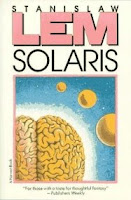
Stanislaw Lem's "Solaris" (novel, first contact): Communicating with aliens can be REALLY hard, if at all possible
My first impression was a bit of let down - because I'd been led to believe it's "linguistic sf" (via an article in, I think, Routledge(?) Companion to Science Fiction - could have been my misunderstanding). It's nothing of the sort. While communications with an alien is a central theme, it's not about language as we normally understand it.
But once I got out of initial bias, it was generally a good read. But there are many tedious paragraphs & descriptions. At least some of the tediousness could be because of double translation - original Polish to French to English - something must have been lost in these translations.
Story summary.
Solaris is a water world somewhere out there, in a binary star system. Physics suggests its orbit should be unstable; reality is otherwise. This leads to suggestion of intelligent orbit correction.Solarian exploration has been going on for some 200 odd years, & it's ocean is now definitely known to be sentient. No progress has been made at contact though, in spite of minor incidents.
This story mostly happens at the (human research) Station, floating a bit above the Solarian ocean via some anti-gravity device; the station is capable of horizontal flight too.
Frustrated with inability to communicate with the ocean, the crew recently did high-energy X-ray bombardment of some parts of ocean. And it looks like the ocean has now noticed the puny humans.
Ocean is reacting in ways humans find creepy & impossible to comprehend. Ocean reads their
deepest repressed thoughts during their sleep, & has created actual in-flesh people in
those dreams & presented them to members! Crew members know these are ocean's creations, but find it impossible to rid them.
That's where we find the only really interesting human story: beginning of a real love affair between Dr Kris Kelvin (narrator) & his replica of his long dead wife Rheya. Both realize Rheya is unreal, but cannot help. Affair will have a tragic end - death of Rheya.
By the end, there is definitely a communication between humans & ocean - but what it means is anybody's guess! A parting conjecture of human party that stayed with me: can we look at the ocean as an "imperfect" baby god, still only learning its tricks; that's why it's been distracted & inconsistent during interactions with humans! What will it look like when it grows up? Humans "will have been the baby's toys for a while."
Notes.
- I didn't quite catch the details of the orbit of Solaris about its two stars. At one place, its orbiting them both (!); elsewhere it's between them. But through the story, we see one sun or the other rising. I guess it's rotating about one sun, & other is just destabilizing the orbit (which planet seems to counteract).
See also.
- Arthur Clarke's "Crusade": A world got sentient in dark interstellar depths & it's unusual reactions to presence of certain kind of beings in galaxy.
- Murray Leinster's "The Lonely Planet": Sentient planet wants humans for company because it's lonely!
- Alastair Reynolds' "Turquoise Days": Much of the colorful background in this story appears to be borrowed from Solaris.
Fact sheet.
First published: 1961 (in Polish). English translation by Joanna Kilmartin & Steve Cox in 1970 via the French translation.Rating: B.
Movie adaptations: Andrei Tarkovsky's "Solyaris" (1972) (in Russian); Steven Soderbergh's "Solaris" (2002) (in English).
TV film adaptation: (in Russian) Boris Nirenburg's "Solaris" (1968).
Related: First contact stories.
Wednesday, January 21, 2009
Arthur Clarke's "Death and the Senator" (short story, space hospitals, free): Certain heart ailments may be best treated in a zero gravity environment
This is a bit unusual among Clarke's stories in that a lot of text goes into human relationships that don't have anything to do with science fictional aspects of the story.
Story summary.
When Martin Steelman, long-term US senator & likely candidate for next presidential elections in 1976, learned he was suffering from a fatal heart disease & had only months to live, he finally began paying attention to his family - daughter's family including grandchildren, & estranged wife. And began preparing for the end.When the news got out, he was approached by Dr Harkness, Technical Director of NASA. Soviets apparently have a small treatment facility up in orbit as part of research laboratory called Mechnikov Station, & probably magic can happen when his heart doesn't have to work against earth's gravity during treatment. Russians are also willing to help.
Turns out, it was primarily opposition from Steelman as a member of US Senate Committee on Astronautics that had killed NASA's efforts at setting up an Astrobiology Lab in space that might have given US a similar capability. Part out of guilt, & part out of altruism, senator will refuse treatment & die quietly.
Collected in.
- "The Collected Stories of Arthur C Clarke".
- Arthur Clarke's "More Than One Universe" (collection).
- Arthur Clarke's "Tales of Ten Worlds" (collection).
Fact sheet.
First published: Analog, May 1961.Rating: A.
Read online at wowio (no free download). Note their interface requires more than a half dozen clicks before the story text shows up.
Listed among the stories from John Campbell's Astounding/Analog.
Related: Arthur Clarke's short stories, novels, collections, best of.
Monday, December 17, 2007
Arthur C. Clarke's "Love That Universe": When humans wanted to make first contact with aliens
This story starts off well, but I found the ending too tame. And it's a fantasy kind of story.
Story summary.
A "Black Dwarf" was discovered 10 years ago in outer solar system. "Only ninety years from now, it will make its perihelion passage and swing around the Sun as it heads once more into the depths of space - leaving a shattered solar system behind." There is nothing humans can do to change its path.But humans know of the existence of unnatural "stellar structures". Only immensely advanced creatures could have made them, & deflecting the current peril of humanity should be child's play for them.
But how to contact them? Nearest super-civilization is 7,000 light years away! Well, a human research station called "Antigeos" - on the side of Sun opposite earth - has discovered a new kinds of signals - "radiations of mentality", some sort of telepathy. These signals travel at "a speed that cannot yet be measured". We can contact the aliens.
But there is a glitch. You need strong emotions to generate such signals. And for signals to be strong enough for current need, a significant fraction of humanity has to experience this emotion simultaneously! Panic & fear are useful, but not good enough. Love is the only emotion that gives us a chance! "WE MUST LOVE ONE ANOTHER OR DIE."
Fact sheet.
"Love That Universe", short story, reviewFirst published: Escapade, 1961.
Rating: B
Monday, August 6, 2007
Robert Heinlein's "Stranger in a Strange Land" (novel): An overhyped satire!
First half of the book is quite readable, sometimes outstanding. Some very funny scenes when the hero is part of the scene; a tired but readable government conspiracy, when he is not.
Second part is a bore. A bad religious cult is dissected; a good one is founded advocating utopia. Except that good one also advocates killing of people in which the hero detects "wrongness"! Apart from advocating communal marriage & sex - an idea that might have been scandalous in 1960s & probably accounts for its fame (notoriety?).
I could sometimes identify with Heinlein's philosophy, but very often, his own thoughts are muddled. Occasionally, he comments on things he doesn't understand. But worst part is long religious & philosophical discourses that go on & on. Among these discourses are some quotations that might be worth pondering over, depending on your mood & inclination.
There are places, particularly in later half, that have a writing style very similar to Ayn Rand's Atlas Shrugged. Particularly when preparing ground for a major scene, or when describing social impact of an action.
In the end, I came back dissatisfied - in a way reminiscent of Clarke's "Childhood's End". Both books are heavily hyped by publishers, but don't quite live up to it.
Names in the story are supposed to have meaning. But I guess you need a background in Christianity to appreciate them. For me, they were just sounds.
Story summary.
Valentine Michael Smith aka Mike is a child born on Mars to parents that were part of an early exploration mission aboard spaceship "Envoy". And he is the only survivor; all mission members died.
Mars is inhibited by an intelligent race that predates humans as intelligent species by half a million years. These extremely long lived aliens are not quite benign - for art's sake, they destroyed the fifth planet, once inhabited by intelligent beings; they had turned it into asteroid belt it is now - eons back. Earth is not safe. But all this will become known to humans much later in the story.
Mike was raised by aliens till about 25 years of age. And he learned some really amazing things from them - including telepathy, destroying arbitrary material including people without obvious weapons, moving things without touching them, ... Aliens actually appear in this story to provide this superman; no other role for them except hints of future aggression.
A second mission to Mars, aboard spaceship "Champion", finds this boy who considers himself Martian rather than human, & is ordered by Martian "Old Ones" to accompany the human explorers on return journey. It will be revealed slowly that he was sent as a spy - to learn things human.
On earth, Mike has a huge inheritance. His mom, Dr. Mary Jane Lyle Smith, had invented "Lyle Drive" that now powers all spacecraft, & has been effectively under government control in absence of heirs. His dad also left substantial property. And through a contractual deed, all crew members left their property to survivors - now Mike alone. But even more importantly, through a precedent set by "Larkin Decision" with reference to colonization of moon, Mike is now legally the sovereign owner of Mars - never mind the local Martians; human colonizers can legally acquire property there only at his pleasure.
All this property has set bells ringing in the government of the "World Federation of Free States" (aka "Federation") - a kind of semi "world government" comprising apparently of former NATO nations including US, & many other nations too, including Pakistan. Government CEO, Secretory General Joseph Edgerton Douglas, is a worried man, & will go to any extent to get control of Mike's property.
Hence begins the tale of adventure, government power misuse, & thankfully, humor.
This part of the story ends with Mike's escape from government captivity, in Bethesda Medical Center, with the help of nurse Gillian Boardman aka Jill, & prompted by well meaning newspaper reporter & Jill's boyfriend Ben Caxton. Eventually Jill & Mike will find safe shelter at the home of Dr Jubal E Harshaw, an eccentric old millionaire, a friend of Ben, a medical doctor, & a story writer. But Ben will be captured by cops & held illegally & without charge.
Mike quickly recovers at Jubal's place, shows some of his magical powers, Jubal cracks a deal with Douglas that takes the government monkey off Mike's back without compromising his inheritance; Ben is freed as part of the deal.
Then begins the second part; it could have used a lot of editing. Mike discovers the world with Jill. First we are introduced to "Archangel Foster Tabernacle of the New Revelation", a commercial religious cult of the kind that pop up every week somewhere in India - nothing new here; its followers are called Fosterites. Mike kills the head of the cult in circumstances that are not explained - without any impact on either cult or Mike.
Then there are adventures of Mike & Jill - doing odd jobs. Eventually, Mike founds his own cult, "Church of All Worlds, Inc". A commune sold as church whose key highlight is communal marriage & free sex. Explained purpose is to eventually transfer the alien knowledge Mike has learned to followers - to help humans live in peace.
End of the story is Mike's voluntary death by public lynching - to a cause I could not understand. Perhaps Heinlein wanted to evoke the emotions of Jesus's killing. To me, this act felt unnecessary.
Notes.
- Idea of being able to perform impossible feats if you are trained in alien ways of thinking is central to the plot of the classic "Mimsy Were the Borogoves" by Lewis Padgett.
- The idea of "grokking" in this story - completely understanding something in all its ramifications - is also found in Ted Chiang's "Story Of Your Life". Also shared is the idea of a language unlike any human language that makes such understanding possible.
- Somewhere in the middle, the book also makes an insignificant reference to Clarks's "Nine Billion Names of God" in passing.
- Mike's cult adopts ancient Sanskrit phrase "Aham Brahmasmi" (I am God) as its official greeting (normally “Thou art God!”, but sometimes literal English translation). They use it in the sense that God comprises of all sentient beings - something often preached in India without understanding. Am not sure of the context or meaning of the Sanskrit phrase in Indian philosophy (they taught it in school, but I wasn't paying attention).
- This story share a very minor plot detail with "Ordeal in Space": That story also has Mars inhabited with intelligent natives, & the few characteristics described of those natives generally match those in Stranger.
- In this story, Mike can make people or things disappear by just thinking about them. A less magical technology for making people or things vanish, by accident, is found in Arthur Clarke's "Travel by Wire!" (1937) - published over 2 decades before Stranger.
- Captain Willem van Tromp - Captain of spaceship "Champion" that brought Mike back.
- Dr Sven Nelson - Part of "Champion" crew, & doctor who cared for Mike on return trip.
- Doctor Mahmoud - A "semantics" expert on board "Champion".
- Madame Alexandra Vesant - astrologer adviser to Secretary General's wife, & later a disciple of Mike.
- Anne, Miriam, Dorcas, Larry, Dukes - part of Jubal's household. First three are secretaries; Dukes is the man who can fix any machine; Larry is kind of majordomo.
- Patty - First disciple of Mike's cult, & a significant driver.
Stranger in a Strange Land (uncut version), novel, review
Author: Robert A Heinlein
First published: 1961 in 160 thousand words; republished posthumously in 1991 as uncut version with some 220 thousand words.
Awards: Hugo 1962
Rating: B
Bibliography.
Hugo Award winner in novel category in 1962
See also.
- All Hugo Award stories.
- All stories with religion as a theme.
Quotes from Robert Heinlein's "Stranger in a Strange Land" (novel)
Robert Heinlein loves to provide lot of soundbytes - even in stories that are not so good. Here is my collection from "Stranger in a Strange Land" - generally in order in which they appear in the uncut version (1991) of the novel. Collection may not be complete - I marked them only when in mood! All need not be pearls of wisdom; they are the ones that held my attention when I first saw them.
- "a government is a living organism. Like every living thing its prime characteristic is a blind, unreasoned instinct to survive."
- 'There comes a time in the life of every human when he or she must decide to risk "his life, his fortune, and his sacred honor" on an outcome dubious. Those who fail the challenge are merely overgrown children, can never be anything else.'
- "the only true science is astrology.”
- "men should rule the world and women should rule men."
- "humanity does not want to be served; on the contrary it resents any attempt to serve it."
- "he, Jubal Harshaw, would have to make decisions and take action. Since he was philosophically convinced that all action was futile, the prospect irritated him."
- "Human bipolarity was both the binding force and the driving energy for all human behavior, from sonnets to nuclear equations. If any being thinks that human psychologists exaggerate on this point, let it search Terran patent offices, libraries, and art galleries for creations of eunuchs."
- "he took a dim view of males being reared by females."
- "quit trying to be as nasty as I am; you don't have my years of practice."
- "you are not in my debt. You can't be. Impossible - because I never do anything I don't want to do. Nor does anyone, but in my case I am always aware of it."
- 'The importance of a public personage could be estimated by the number of layers of flappers cutting him off from ready congress with the plebeian mob. They were not called "flappers", but were known as executive assistants, private secretaries, secretaries to private secretaries, press secretaries, receptionists, appointment clerks, et cetera. In fact the titles could be anything or ... no title at all, but they could all be identified as "flappers" by function: each one held arbitrary and concatenative veto over any attempted communication from the outside world to the Great Man who was the nominal superior of the flapper.'
- "long human words (the longer the better) were easy, unmistakable, and rarely changed their meanings ... but short words were slippery, unpredictable, changing their meanings without any pattern."
- "A desire not to butt into other people's business is at least eighty percent of all human wisdom ... and the other twenty percent isn’t very important.”
- "Democracy is a poor system of government at best; the only thing that can honestly be said in its favor is that it is about eight times as good as any other method the human race has ever tried. Democracy's worst faults is that its leaders are likely to reflect the faults and virtues of their constituents - a depressingly low level, but what else can you expect?"
- "human mind's ability to rationalize its own shortcomings into virtues is unlimited".
- "In the Tennessee legislature a bill was again introduced to make the ratio pi exactly equal to three".
- "The way to do anything under the guise of religion that would otherwise be suppressed is to do it in the inner sanctum and keep the gentiles out."
- "Public exhibition of lust I would find most distasteful, either as participant or spectator ... but I grok this reflects my early indoctrination, nothing more."
- 'Most moral philosophies consciously or unconsciously assume the essential correctness of our cultural sexual code - family, monogamy, continence, the postulate of privacy that troubled you so, restriction of intercourse to the marriage bed, etc. Having stipulated our cultural code as a whole, they fiddle with details - even such piffle as solemnly discussing whether or not the female breast is an "obscene" sight! But mostly they debate how the human animal can be induced or forced to obey this code, blandly ignoring the high probability that the heartaches and tragedies they see all around them originate in the code itself rather than failure to abide by the code.'
- "sex is a way to be happy together."
- “The code says, 'Thou shalt not covet thy neighbor’s wife' - and the result? Reluctant chastity, adultery, jealousy, bitter family fights, blows and sometimes murder, broken homes and twisted children ... and furtive, dirty little passes at country club dances and the like, degrading to both man and woman whether consummated or not. Is this injunction ever obeyed? The Commandment not to 'covet' I mean; I’m not referring to any physical act."
- "Any male virile enough to sire a child is almost certainly so virile that he has coveted many, many women - whether he takes action in the matter or not."
- "the slickest way in the world to lie is to tell the right amount of truth at the right time - and then shut up."
- "you have to charge 'em, Jubal. The marks won't pay serious attention to anything that's free.” [Note: The word "marks" is used here as a euphemism for "crowds".]