Showing posts with label 1962. Show all posts

Friday, September 27, 2013

Robert F Young's "The Servant Problem" (novelette, first contact, free): When servants thought they were masters!

Illustration by Schoenherr accompanying the original publication in Analog magazine of short story The Servant Problem by Robert F Young. Image shows the puzzled village idiot looking at his statue not know why he is a celebrity.Village idiot is also the village inventor. When he mysteriously received plans for a knot-tying machine on an April Fool's Day, he had to build that machine. And what kind of knots did it tie!

Fact sheet.

First published: Analog, November 1962.
Download full text from Project Gutenberg.
Download audio from LibriVox.
Rating: B.
Among the stories from Astounding/Analog issues edited by John Campbell.
Related: Stories of Robert F Young.

Sunday, July 21, 2013

Murray Leinster's "Planet of Dread" (novelette, free): Adventure on a world of giant insects & fungi

One of the illustrations by Adkins accompanying the original publication in Fantastic Stories magazine of the short story Planet of Dread by Murray Leinster. Image shows adventurers fighting a giant ant on a far off world.How many variants of the excellent "The Mad Planet" (download) did Leinster pen? I know of at least two novelette or novella length sequels, plus a fix-up novel, besides the current one.

May be I've read too much of the series. It's readable & fast moving - among my faster finishes of a story of this length. But it's very pulpy & with sensibilities of a different era.

Story summary.

With mankind spanning the galaxy, a group of revolutionaries escape their world, & intend to lie low elsewhere for a while. During a port, their ship is hijacked by a local fugitive - the hero of the story who's eventually overpowered. For complicated reasons, they land of an uninhabited world to maroon the hijacker - only this world turns out to be a forgotten & unfinished terraforming job of mankind, & a nightmare world now.

They'll have adventure there, & strike treasure left by a shipwreck 150 years old, & finally all will end well.

Fact sheet.

First published: Fantastic Stories of Imagination, May 1962.
Download full text from Project Gutenberg.
Download audio read by Phil Chenevert from LibriVox. [via QuasarDragon]
Rating: B.

Saturday, June 29, 2013

Jack Sharkey's "Double or Nothing" (short story, mad scientist, humor, free)

Illustration accompanying the original publication in Fantastic Stories of Imagination magazine of short story Double or Nothing by Jack Sharkey. Image shows the two bewildered inventors bombarded with breakfast items their invention has unexpectedly produced.
This is silly. And funny.

A crazy serial inventor is onto his new invention - an anti-gravity machine.

After many bugs, the machine flies but with a crazy side effect...

Fact sheet.

First published: Fantastic Stories of Imagination, May 1962.
Download full text from Project Gutenberg. [via QuasarDragon]
Rating: B.

Wednesday, February 13, 2013

Fritz Leiber's "The Creature from Cleveland Depths" aka "The Lone Wolf" (novella, gadgets, free): Who could imagine mobile phones would be so evil?

One of the illustrations by Wally Wood accompanying the original publication in Galaxy magazine of short story The Creature from Cleveland Depths by Fritz Leiber. Image shows a man wearing an early version of Tickler on his shoulder.
Well, the story is from long before mobile phones were around, so the gadget (the "tickler") here looks different & works differently.

It begins as an organizer - you tell it to remind you of certain events, & it will at the right time. Reminding is by telling about the event in your ear via an in-ear headphone, plus an insistent "tickling" using two rollers mounted on your shoulder. It runs a very long (audio) magnetic tape - one run lasts a week, with buttons to forward quickly to a certain time. To set an event, you move it specific date/time next week, then speak of the event into it. After you've set the events, the device runs the tape continuously. But most of it is blank, so you don't hear anything till an event is due.

Soon improvements in upgraded versions give it a life all its own, threatening the very human existence...

Very funny early parts & ending, but I thought it was draggy in the middle as the mood begin to set for impending disaster.

Notes.

  1. "Depths" of the title has cold war linkage - "Free World" vs Soviet Union. Because of bomb scare most people live in massive underground caverns that double as bomb shelters. Only a few "outers" live on the surface.
  2. "Creature" of the title is an advanced form of the tickler gadget.

See also.

  1. L Sprague de Camp's "Alanias" (download as part of a larger package): Another story where a voice whispers propaganda into your ear without your conscious self realizing you are being manipulated.

Fact sheet.

First published: Galaxy, December 1962.
Download full text from Project Gutenberg, Manybooks, Feedbooks. [via Becky@ClassicScienceFiction]
Download audio version read by Gregg Margarite from LibriVox.
Alternate audio link at Internet Archive.
Rating: A.
Related: Stories of Fritz Leiber.

Monday, April 16, 2012

My "best of the year" picks: 1962

For background of this list, see opening remarks of my best of 1961 list. List below is in order of publication - earliest first, unknown dated last. All stories, of course, were first published in 1962. Download links are included where I'm aware of an online copy.
  1. [novelette] James White's "Christmas Treason"; F&SF, January: When little kids brought about global nuclear disarmament! Very funny.
  2. [ss] Kurt Vonnegut's "2 B R 0 2 B"; download; If, January: Drastic population control in a society of long lived people.
  3. [ss] Arthur Clarke's "Maelstrom II"; Playboy, April: Totally crazy but effective rescue operation...
  4. [novella] Jack Vance's "The Dragon Masters"; Galaxy, August: Masters are also the slaves!
  5. [novel] Fred Hoyle & John Elliot's "A For Andromeda": One of the most gripping alien invasion stories I've seen.
Related: "Best of" lists; fiction from 1962, 1960s.

Sunday, April 15, 2012

Murray Leinster's "Operation Terror" (novel, alien invasion, free)

Cover of the novel Operation Terror by Murray Leinster
Good paced action adventure, but with a farcical & utterly unbelievable ending.

It features a softer version of a death ray, & a ray to explode gunpowder at a distance.

Story summary.

An alien ship has landed in a lake at the heart of a what is being developed as a national park in the US. Creatures come out of it, explore around. They have a "terror beam" weapon: a searchlight like thing. Whenever the beam touches anyone, it excites all sorts of nerve endings in a way so confusing the person eventually paralyzes - temporarily, till the beam is shut off. Immediate vicinity of landing is evacuated; military cordons off the region.

But among the trapped are a man named Lockley rescuing a stranded girl Jill. Story unfolds from Lockley's perspective, as the couple try getting out of region & make guesses about the nature of aliens & their weapons.

See also.

  1. Arthur Clarke & Michael Kube-McDowell's "The Trigger": What would the society be like if we had a weapon that could remotely trigger gunpowder explosion?
  2. Murray Leinster's "Invasion" (download): Another similar "Martian" invasion of US.

Fact sheet.

First published: 1962.
Download full text from Project Gutenberg, Feedbooks.
Download audiobook from LibriVox.
Rating: B.
Related: Stories of Murray Leinster.

Saturday, March 17, 2012

James H Schmitz's "Legacy" aka "A Tale of Two Clocks" (novel, space opera, free): Many groups are after the ancient treasures

Cover of the novel Legacy by James H Schmitz.
One of the more mundane works of Schmitz, though an action packed one.

Story summary.

A star-traveling humanity has discovered a treasure left on some world by long gone "Old Galactics". Treasure comprises of a number of "plasmoids" - a kind of artificial-life agricultural robots. They can produce so much food, we'll never have to worry about it, etc. But the process of human acquisition of them had shut them off, & no one knows how to turn them on again.

Currently they're in custody of the government, but sundry other groups want them too. And what will happen when varied groups begin doing their own underground tinkering to revive these ancient living machines...

See also.

  1. James H Schmitz's "Harvest Time" (download): The story where "plasmoids" were first discovered.

Fact sheet.

First published: 1962.
Download full text from Baen Books, Project Gutenberg, Manybooks.
Download audiobook from Internet Archive, LibriVox.
Rating: B.
Related: Stories of James H Schmitz.

Friday, March 2, 2012

Jack Vance's "The Dragon Masters" (novella, alien invasion): Masters are also the slaves!

border:none
This is a fast-paced very-readable action story. I have a couple of nits, though:
  1. Why would aliens bother to make interstellar raids to carry off a few humans each time as slaves? Particularly when they already have a large stock of human slaves, bred as beasts for specific desirable traits.
  2. Aliens travel interstellar distances & have death rays, but bring with them beasts of burden for local land transport, rather than powered machinery!

Story summary.

Most of the story is about three human communities, living in close proximity, on a world called Aerlith. This world has long since lost all contact with rest of humanity. In fact, they may be the last remnants of humanity.

Two of the three communities are feudal: Banbeck Vale is ruled by Joaz Banbeck, & Happy Valley is ruled by Ervis Carcolo. Former is smart, progressive, & technically savvy. Later is a barbarian, never looking beyond the immediate. They also have a variety of pet "dragons" - used as beasts of burden & war animals.

Third community is "sacerdotes", mysterious hermits living in subterranean caves below the two feudals' lands. They appear to be technologically very competent, but they're secretive.

Much of the story is about interactions of these 3 communities. In the background of periodic raids, every few generations, of lizard-like aliens called "Basics" or "grephs". Joaz has recently discovered that these raids occur whenever a star called Coralyne of their local cluster makes the nearest approach. And it's approaching now...; alien slave takers could be
arriving any time.

Later parts are, of course, arrival of aliens. Only they'll meet resistance this time - all 3 human communities coming together will beat them.

See also.

  1. Eric Frank Russell's "Diabologic": Only thing I remember about this story is that it's about carefully using language to drive other people nuts, & using it as a political tool. One of the interviews of Joaz & a sacerdote had this feel too.

Fact sheet.

First published: Galaxy, August 1962.
Rating: A.
Winner of Hugo award 1963 in short fiction category.
Related: Stories of Jack Vance.

Thursday, February 23, 2012

Ed M Clinton's "Untechnological Employment" (flash fiction, humor, free)

How the political considerations affect engineering decisions...

Fact sheet.

First published: Analog, November 1962.
Download full text from Project Gutenberg.
Rating: B.
Among the stories from Astounding/Analog issues edited by John Campbell.

Friday, January 6, 2012

3 stories of James H Schmitz

All are colorful in their own way (but "Balanced Ecology" is more colorful than others). List is in order of my preference, best first.
  1. [ss] "Balanced Ecology" (B); download; Analog, March 1965: A jungle world knows how to defend itself against greedy humans.
    Nominated for Nebula Award 1966 in short story category.
  2. [novelette] "The Winds of Time" (B); download; Analog, September 1962: A man & a woman are trapped, kidnapped, & ... harassed ... by ... aliens.
  3. [ss] "A Nice Day for Screaming" (B); download; Analog, January 1965: One of the early exploration ships in "pseudospace", a kind of parallel space, is chased by ... something.
Among the stories from Astounding/Analog issues edited by John Campbell.
Related: Stories of James H Schmitz.

Friday, November 18, 2011

James H Schmitz's "Novice" (novelette, free): Your pet could be smarter than you think

Young Telzey Amberdon with her pet Tick-Tock is sent with her evil Aunt Halet to the human park world Jontarou. Now there is a history behind Tick-Tock: no one knows what kind of cat it is or which world it is the inhabitant of.

Here Telzey will meet intelligent natives humans are unaware of, & will help their civilization integrate into human one.

Fact sheet.

First published: Analog, June 1962.
Download full text from Project Gutenberg, Manybooks, Webscription. [via someone at ClassicScienceFiction]
Rating: A.
Among the stories from Astounding/Analog issues edited by John Campbell.
Related: Stories of James H Schmitz.

Sunday, August 14, 2011

Fred Hoyle & John Elliot's "A For Andromeda" (novel, alien invasion)

Cover image of the novel A For Andromeda by Fred Hoyle and John Elliot
One of the most gripping alien invasion stories I've seen, though its tropes are now well hashed.

Story summary.

World's largest radio telescope, newly built at Bouldershaw Fell, England, started receiving digital radio signals almost as soon as it was switched on. Signals originating somewhere in Andromeda galaxy!

Signals turn out to be a very long message, repeated over & over again. Message describes how to build a certain computer with memory & speed way beyond contemporary machines, a program to run on it, & some data to feed this program.

Computer is built. Program is run. And what do we get? We get an alien inside the computer! Alien is querying about what kind of life form we are, details of our biology & environment, ... Alien will then handout a procedure to build a biological being out of ordinary elements in a lab. Researchers & government controlling them are fool enough to build it - after a false start, they end up building a fast growing & super-intelligent "girl" that's actually an extension of alien in the computer.

Dr John Fleming, hero of the story, the man who originally detected & decoded alien signals & built the computer, will have to fight against all establishment to destroy the alien.

Fact sheet.

First published: 1962. (as a novel adaptation of an earlier TV series).
Rating: A. 
Related: Stories of Fred Hoyle.

Friday, January 14, 2011

Robert J Martin's "Beyond Pandora" (flash fiction, tissue regeneration, free): From fear to control to harnessing a dangerous "thing"

Idea is interesting: "Take 'fire' for example: Man lived in fear of fire for a good many hundred-thousand years--and rightly so, because he hadn't learned to control it. The principle's the same; First you learn to protect yourself from a thing; then control it; and, eventually, we learn to 'harness' it for a useful purpose."

But the story didn't really work for me. In this future world with easily available tissue regeneration, the miracle came about by harnessing a most dreaded disease of the past...

Fact sheet.

First published: Analog, September 1962.
Download full text from Project Gutenberg, Manybooks, Feedbooks.
Download audio read by Jerome Lawsen from LibriVox "Short Science Fiction Collection Vol. 004".
Rating: B.
Among the stories from Astounding/Analog issues edited by John Campbell.

Sunday, May 16, 2010

New at Project Gutenberg (16 May 2010)

Links on author, publisher, or year yield more matching fiction.

  1. Mack Reynolds' "Black Man's Burden"; download; Analog, December 1961 & January 1962: "The turmoil in Africa is only beginning--and it must grow worse before it's better. Not until the people of Africa know they are Africans--not warring tribesmen--will there be peace..."
Related: Fiction from old "pulps", 1960s.

Monday, May 10, 2010

Robin Sturgeon's "Martian Mouse"

Paul@Marooned links this flash fiction piece by the 10 year old son of Theodore Sturgeon.

Kid stuff. Linking only because of author.

Wednesday, January 6, 2010

Terry Carr's "Hop-Friend" (short story, first contact, free)

10 years after the arrival of human colonists on Mars, we we are beginning to see the start of the extinction of the natives ("Marshies") - though there are oddballs on both sides that believe the two species can coexist.

Fact sheet.

First published: F&SF, November 1962.
Download full text from Internet Archive.
Rating: B.
Included in Ellen Datlow's SciFiction's classics.
Related: Martian fiction.

Sunday, November 8, 2009

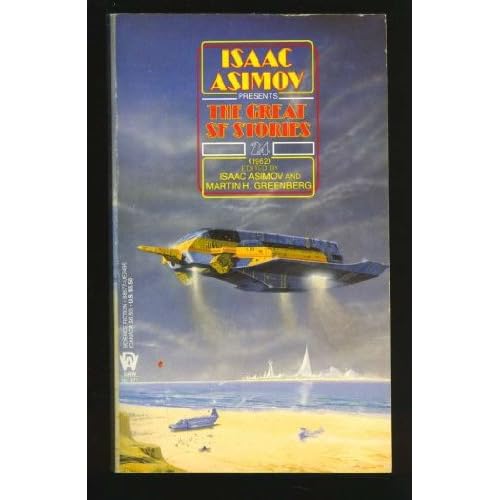
Isaac Asimov & Martin H Greenberg (Eds)' "Isaac Asimov Presents the Great SF Stories 24 (1962)" (anthology): Annotated table of contents & review

Cover image of anthology titled Isaac Asimov Presents the Great SF Stories 24 1962, edited by Isaac Asimov and Martin H GreenbergThis is #24 of a series of 25 anthologies by these editors. This book collects stories first published during the year 1962.

Where I'm aware of online copies, I provide download links. My rating is in brackets. Where I've a separate post on a the story, link on story title goes there. Link on author or publisher yields more of stories from the source.

Table of contents (13 stories, best first, unread last).

  1. [novelette] James White's "Christmas Treason" (A); F&SF, January 1962; humor: When little kids brought about global nuclear disarmament!
  2. [ss] Harry Harrison's "The Streets of Ashkelon" aka "An Alien Agony" (A); download; New Worlds Science Fiction, September 1962; religion: Religion creates sinners!
  3. [ss] Christopher Anvil's "Gadget vs Trend" (A); download; Analog, October 1962: Little Brother gets a weapon to fight the Big Brother.
  4. [novelette] Cordwainer Smith's "The Ballad of Lost C'Mell" (B); Galaxy, October 1962; politics: This society's underprivileged are fighting for civil liberties.

    It's been a while since I read it. I've a feeling US readers might see more here than I could see. Probably inspired by some episodes of US history - I'm not sure.
  5. [ss] J G Ballard's "The Insane Ones"; Amazing Stories, January 1962: Not read.
  6. [ss] R A Lafferty's "Seven-Day Terror"; If, March 1962: Not read.
  7. [novelette] Poul Anderson's "Kings Who Die"; If, March 1962: Not read.
  8. [ss] Fritz Leiber's "The Man Who Made Friends with Electricity"; F&SF, March 1962: Not read.
  9. [ss] Mark Clifton's "Hang Head, Vandal!"; Amazing Stories, April 1962: Not read.
  10. [novella] Theodore L Thomas' "The Weather Man"; Analog, June 1962: Not read.
  11. [ss] Mack Reynolds' "Earthlings Go Home!"; Rogue, August 1962: Not read.
  12. [novella] Theodore Sturgeon's "When You Care, When You Love"; F&SF, September 1962: Not read.
  13. [novelette] Gordon R Dickson's "Roofs of Silver"; F&SF, December 1962: Not read.

Fact sheet.

First published: 1992 (DAW).
Relevant entries have been added to the list of stories from John Campbell's Astounding/Analog.
Some of the bibliographical information here comes from ISFDB.
Legend: ss = short story.

Wednesday, November 4, 2009

Harry Harrison's "The Streets of Ashkalon" aka "An Alien Agony" aka "The Streets of Askelon" (short story, religion, free): Religion creates sinners!

Color illustration of short story titled The Streets of Ashkalon aka An Alien Agony by Harry Harrison, from a Greek translationAmong the better stories I've seen so far from Harrison.

Readers familiar with Christianity will likely see nuances I could not see.

Story summary.

John Garth is a human trader who has been for the past year living among intelligent alien aborigines, amphibians called Weskers - the only human on this "Wesker's World". Then, one fine day, a Christian missionary arrives - one Father Mark of the Missionary Society of Brothers.

So we see the willing students that these aliens are torn between rational John & fanatic Mark. Since the aliens are intelligent & have learnt scientific method from John, they decide to give Mark's teachings an empirical test: he gets the Jesus Christ treatment on a cross! And now aliens are awaiting his resurrection...

Quotes.

  1. "In Trader Garth's books there is the universe which we have not seen, & it goes on without God, for he is mentioned nowhere... In Father Mark's books He is everywhere & nothing can go without Him. One of these must be right & the other must be wrong."
  2. "Nothing created God, since He is the Creator. He always was ..."

    "If He always was in existence - why cannot the universe have always been in existence? Without having had a Creator?"
  3. "Have faith, that is all you need. Just believe."

    "How can we believe without proof?"

Notes.

  1. Wikipedia has this to say on the "The Streets of Ashkalon" title of this story: 'Its name is a reference to a passage from the Biblical 2 Samuel 1:20, which says "...proclaim it not in the streets of Ashkelon..." In the original context it was a part of a story in which Hebrews were instructed to try to keep the defeat of a couple of their war heroes from their enemies' knowledge'.

See also.

  1. Couple of illustrations for this story.

Collected in.

  1. Isaac Asimov & Martin H Greenberg (Eds)' "Isaac Asimov Presents the Great SF Stories 24 (1962)".

Fact sheet.

First published: New Worlds Science Fiction, September 1962.
Rating: A.
Download full text from Shortcovers.
Credits: Shortcovers download link is via Free SF Reader; I haven't read this online version, however. Some of the bibliographic information here comes from ISFDB.
Related: Stories of Harry Harrison.

Saturday, August 15, 2009

James White's "Christmas Treason" (novelette, humor): When little kids brought about global nuclear disarmament!

Lord Shri Krishna, depicted as a childToday was Janmashtami (oops - day has changed! but no matter). Since I don't have an appropriate story about Lord Krishna's birthday, I thought may be I'll post about another holy birthday - even if from another religion, born on a different date, & according to a different calender at that! Picture alongside is, however, an artist's impression of Lord Krishna - the naughtiest & one of the most widely worshiped Hindu gods who has inspired so much art, philosophy & politics.

This story is a hilarious variant of Theodore Sturgeon's grim novel "More Than Human".

Story summary.

6 kids & friends - 2 from US, 1 each from UK & USSR, & 2 from Japan (Is Christmas as big an even in Japan as in other 3 countries?) Between them, they are capable of telepathy, teleporting, & telekinesis. So when the Japanese mom thinks the kids are playing in their room, they're in fact with their friends in US! Of course, they'll be back where mom expects them at dinner time!

Their unusually active imagination has them worried: how to guarantee that they'll get their gifts during Christmas a few days hence? You see, there is only one Santa Clause - & an old man at that. He comes on that sled & from some cavern in far North. And there are so many kids. How can he deliver them all their gifts during a single night? Of course, some kids are going to be missed. They just want to ensure they won't be the ones missed.

What follows are incidents that drive US & Soviet military commanders nuts: little kids querying about Santa Claus in underground missile facilities in the north! During their "Investigation" & with peculiar child logic, kids conclude that
  1. Santa has long since given up sled & delivers toys in rockets now.
  2. Bad guys have driven Santa's men out from these toy storage facilities & have put shiny green things in these rockets.
  3. "Thieves" that neighborhood store owners become during festival season (according a child's mom) are the ones who've stolen Santa's toys.
Next thing the adult world knows & is still scratching its head in puzzlement is: nuclear missiles have been launched by both sides, but what came out of their noses at attack locations are kids' toys rather than nuclear bombs! And then there are those reports of large number of toys stolen from stores...

Collected in.

  1. Isaac Asimov & Martin H Greenberg (Eds)' "Isaac Asimov Presents the Great SF Stories 24 (1962)".

Fact sheet.

First published: F&SF, January 1962.
Rating: A.

Tuesday, July 14, 2009

Mack Reynolds' "Subversive" (short story, economy, free): A case against white collar jobs!

Illustration accompanying the HTML version of Project Gutenberg copy of short story titled Subversive by Mack ReynoldsLater parts are basically Cold War propaganda on US' behalf, but I found the rest of it a good read.

Story summary.

Freer Enterprises is a recently setup direct sales company that threatens to bring down prices of consumer goods to a fraction of those currently prevailing - by cutting out all sorts of intermediaries & fancy packaging.

This has a shady group alarmed...

Fact sheet.

First published: Analog, December 1962.
Rating: A.
Download full text from Project Gutenberg, Manybooks, or Feedbooks.
Listed among the stories from John Campbell's Astounding/Analog.
Related: Stories of Mack Reynolds.

Tuesday, June 2, 2009

Kurt Vonnegut's "2 B R 0 2 B" (short story, free): Drastic population control in a society of long lived people

Quote from short story titled 2 B R 0 2 B by Kurt VonnegutSuch a dark plot. And such a light read!

No solutions here. But a problem highlight & dilemma in a very dark scenario.

Story summary.

Two centuries hence, life expectancy is several hundred years, but available space is still just the earth. Two key characteristics of this society:
  1. Sometimes people choose to die. This act is considered a public service. Government will help you out by cleanly killing you in a gas chamber & honor you before killing!

    That's where the title comes from: "2 B R 0 2 B" is a local telephone number in X. Number of Federal Bureau of Termination! You call them when you want to get yourself killed!

    For Indian readers (since phone numbers with letters are unknown here): Number above is the same as 227022 (but reads better in English - "to be or not to be"). You can read the number corresponding to letters on most cell phones in India (because letters are needed for text messages), but landline instruments typically will have only digits & no letters. For a text labeled instrument, common even for landline phones in some countries, it's just another number.
  2. To have a baby, you must make someone agree to die!!! In the story, Edward K Wehling, Jr, ends up having triplets. He had arranged his maternal grandfather to die expecting a single baby, & was feeling very guilty about it. He will now have to choose a single baby from among the 3; other two will be killed, according to law!

    He chooses a rather drastic solution that will let all three babies & grandpa live.

See also.

  1. Clifford D Simak's "Eternity Lost": Another strong story that deals with population issue aggravated by long lifespans. But this has happy future, even if protagonist won't get it.
  2. A very dark subject brought up near end has an idea similarity with Larry Niven's "The Jigsaw Man".

Fact sheet.

First published: Worlds of If, January 1962.
Rating: A.
Download full text from Project Gutenberg, Manybooks, Feedbooks, or Scribd. Or audio at LibriVox.
Related: Stories of Kurt Vonnegut; stories about immortality or very long life spans.

Thursday, May 14, 2009

Christopher Anvil's "Gadget vs Trend" (short story, humor, free): Small Brother get a weapon to fight the Big Brother

Interesting illustration of the classic formula for a good science fiction short story - take a simple idea, & keep beating it to get the last drop of juice you can get out of it.

Story summary.

An apparently innocuous invention - a soundproofing device - seems to have such wide ranging applications that it's causing major social upheaval...

Device in question is an electrically powered gadget called "QuietWall": attach it to a surface like a wall or door, & it will act as an impenetrable barrier to sound. Except that it's an impenetrable barrier to other things too...

See also.

  1. Arthur Clarke's "Silence Please": Another piece of humor set around a sound proofing device, but with a very different plot.
  2. Arthur Clarke's "What Goes Up": Another story with a device that has erected a practically impenetrable barrier to some volume of space. But this "barrier" has interesting properties, among them - it behaves differently on the two sides.

Collected in.

  1. Isaac Asimov & Martin H Greenberg (Eds)' "Isaac Asimov Presents the Great SF Stories 24 (1962)".

Fact sheet.

First published: Analog, October 1962.
Rating: A.
Download full text from Webscription.
Listed among the stories from John Campbell's Astounding/Analog.
Related: Stories of Christopher Anvil.

Wednesday, April 15, 2009

William M Lee's "Junior Achievement" (short story, humor, free): When a bunch of superkids had an entrepreneurial dream...

Illustration by Schoenherr of the fantastic kite the kids invented in the story Junior Achievement by William M LeeDefinition: "a junior achievement group is a bunch of kids who get together to manufacture and sell things, and maybe make some money."

Five boys & girls, aged 10-12, want to start a junior achievement group during school vacations. Their teacher, Donald Henderson, has agreed to guide them. Only, these kids move rather fast for their teacher...

Notes.

  1. I've sometimes heard a saying in Bombay, not sure how common it is across India. Something to the effect: couples that have been married a while begin looking alike!

    This story gives an explanation for the phenomenon, real or imaginary: "Perhaps from association, for they were close friends, they had just come to have a certain similarity of restrained gesture and of modulated voice."

Fact sheet.

First published: Analog, July 1962.
Rating: A.
Download full text from Project Gutenberg/Manybooks/Feedbooks.
Listed among the stories from John Campbell's Astounding/Analog.

Sunday, February 15, 2009

Ben Bova's "The Next Logical Step" (short story, virtual reality, free): Serious implications of the ability to realistically simulate war games

Quote from short story titled The Next Logical Step by Ben BovaUS military has built a great computer to simulate war games - with an immersive VR-based interface, & with ability to simulate actions of all sides of war very realistically & in great detail.

Then they run into a problem. All military men who've used the machine have either quit their job or have gone insane!

General LeRoy has an idea to fix the situation. He's called the "CIA man" for help...

Fact sheet.

First published: Analog Science Fact & Fiction, May 1962.
Rating: A.
Download full text from Project Gutenberg, or Manybooks. [via QuasarDragon]
Listed among the stories from John Campbell's Astounding/Analog.
Related: Stories of Ben Bova.

Saturday, August 30, 2008

Tom Godwin's "--And Devious the Line of Duty" (short story, diplomacy, romance, free): A young man gets his heart broken as part of his work

Quote from short story titled --And Devious the Line of Duty by Tom GodwinThis is the lightest read I've seen yet from the author of "The Cold Equations". Mildly humorous. No great ideas - just a love quadrangle & a bit of diplomacy; good enough for a lazy Sunday afternoon.

While the story has a space theme, plot would have been no different in any essential way had it been set on earth.

Story summary.

Humans are spread through stars. Story involves two major powers - Terran Republic & Verdam People's Worlds. Terrans are influential & good (because protagonists are from here). Verdam are bad guys from opposite faction, out to grab some of the power Terrans currently wield.

Jardeen is a neutral power. Not important in itself, but swaying it either way will substantially add to the cause of Terrans or Verdam. This story is about a meeting among the various parties involved - on a third neutral world called Vesta.

Terran Republic is represented by a veteran diplomat George Rockford, & an inexperienced & expendable young military Lieutenant Dale Hunter. Others include "Val Boran, Jardeen's Secretary of Foreign Relations", "Verdam's Special Envoy Sonig; a wily little man". Plus two Vestans - Princess Lyla & Lord Narf.

Lyla is the sweet girl everyone wants to fall in love with. Narf is the evil man she is currently engaged to because of court reasons. Dale's job will require him to fall in love with Lyla, nearly die, & get his heart broken. Val will eventually win her over.

Through the story, bad men (Sonig & Narf) will plot evil deeds which will be eventually foiled by good ones. Ultimately a happy resolution, except for Dale.

Fact sheet.

First published: Analog Science Fact and Fiction, December 1962.
Download full text from Project Gutenberg.
Rating: A
Listed among the stories from Campbell's Astounding/Analog.
Related: All stories of Tom Godwin.

Saturday, May 3, 2008

** Cordwainer Smith's "The Ballad of Lost C'Mell" (novelette, science fiction)

A political story - probably modeled after the slavery years in the US, but told symbolically. A society where some have normal citizen rights; others are treated as disposable animals. A man from privileged group helps the underprivileged fight for their civil liberties.

Collected in.

  1. Ben Bova (Ed)'s "The Science Fiction Hall of Fame, Volume Two A".
  2. Isaac Asimov & Martin H Greenberg (Eds)' "Isaac Asimov Presents the Great SF Stories 24 (1962)".

Fact sheet.

First published: Galaxy, October 1962.
Rating: B

Note: Why is this post so short?

Saturday, October 6, 2007

Arthur C. Clarke's "Dog Star" aka "Moondog": A man feels guilty after preferring career to dog

This is primarily a dog story - joys of owning one. sf content is peripheral. I found it very readable, even though I have never had a dog.

Story summary.
Narrator works at some astronomical observatory. He had found the little she-dog Laika abandoned, & cared for & kept her. They grow very close. Once she even saved his life during an earthquake.

When time came to take new job at an observatory on Luner Farside, option to take her simply did not exist. He left her with a colleague. And she died heartbroken within a month of his leaving.

Now, 5 years later, in the aftermath of a moonquake, he is remembering her & feeling sad.

Fact sheet.
"Dog Star", short story, review
First published: Galaxy, April 1962, as "Moondog"
Rating: B

See also.

  1. Robert Reed's "Roxie": Another primarily a dog story. But I find Clarke's version far more interesting.
  2. Eric Frank Russell's "Allamagoosa": A hilarious story where dog plays a crucial role.
This story is included in following collections.
  1. "The Collected Stories of Arthur C Clarke"
  2. "More Than One Universe"

Thursday, September 20, 2007

Arthur C. Clarke's "Maelstrom II": A totally crazy but effective rescue operation

Quote from Maelstrom II by Arthur ClarkeThis would easily class as among Clarke's best. An outstanding shipwreck & rescue story in space.

As far as I know, there is no other Clarke story called "Maelstrom" or "Maelstrom I". "II" comes from looking at the plot as a space age variant or sequel of a very similar survival story at the sea - Edger Allen Poe's "A Descent into the Maelstrom".

Story summary.
Cliff Leyland is an African farmer trying his luck in a lunar colony, & is now returning back to earth. He buys a return ticket on an unusual flyer to save some money - a freight capsule launched by an electric catapult; he is the sole passenger on board.

Only there is a launch fault because of a 1 second electric supply failure on launch rail. Result is - his capsule doesn't get moon escape velocity. It will go to a certain height; then moon's gravitation will pull it back, & there will be a mighty crash!

There are small steering jets on capsule, but they are also destroyed. I could not follow how the accident destroyed them.

Anyway, now he is awaiting certain death. A lot of space is devoted to his ruminations on this.

Part way through his elliptic crash orbit, he gets a call from Van Kessel, Chief of Maintenance, Space Vehicles Division. Ground staff have worked out a totally crazy & frightening way to save him.

While a ship will eventually pick him up, it cannot get to him in time before impending crash. He is advised to don the space suite, & at the moment Launch Control will advice, to manually jump off the ship into space with all the force he can muster! This advice will be given when his capsule is at its highest point in orbit, & airlock is facing away from moon; hopefully, this will put him in a non-crash orbit - & give rescue ship, Callisto, time to finally fetch him.

Of course, the story has a happy ending.

Fact sheet.
Maelstrom II, short story, review
First published: Playboy, April 1962
Rating: A

See also.

  1. A 3-minute movie showing the launch, its going wrong, & realization that things have gone wrong, but not the most interesting rescue routine. I saw this version; the version at YouTube appears identical but I haven't played it. Not very good quality, but not bad either. Makers of this movie also put together this slide show that explains the essentials of the story with pictures.
  2. Arthur Clarke's novel "A Fall of Moondust": Very good shipwreck & rescue story on moon. But set on (or rather, in) lunar surface rather than in space.
  3. Robert Heinlein's short story "Searchlight": Shipwreck at an isolated place on lunar surface, & an ingenious technique to locate the stranded during rescue.
  4. Robert Heinlein's short story "Ordeal in Space": In some ways, similar to this story. A spaceman falls off ship, ends up spending sometime away from anything, & becomes a psychological wreck. Story is of his eventual rehabilitation. This same story is also found as a small subplot in Arthur Clarke's novel, "The Deep Range".
  5. Arthur Clark's novel "2001 A Space Odyssey" has a space man ejected off a deep space ship because of sabotage. Another novel, "3001 The Final Odyssey" will have him recovered in a very improbable rescue operation 1000 years later! And with his sanity intact.
  6. Robert Heinlein's novel "Moon is a Harsh Mistress" features electromagnetic catapults for normal freight delivery from moon to earth. In one episode, it also transports 2 passengers. It is also eventually used as a weapon on a war against earth.
  7. Arthur Clarke's novel "Islands in the Sky" features a short subplot where an electric catapult based on rails is used for emergency launch - I think of people, don't recall well. The mechanism is very similar to that in current story.

Thursday, August 30, 2007

Arthur C. Clarke's "An Ape About the House": A famous painter, to be

This is the story of Dorcas, a genetically engineered chimpanzee designed & trained for household chores & for baby sitting. She is sold by Biological Engineering Corporation; they apparantly are also the patent holders & manufacturers.

Story summary.
Unnamed woman narrator has purchased (or is it rented?) Dorcas, after some fighting at home. Dorcas quickly adjusts well, & is loved by all.

Action happens when the narrator, wife of a spaceman, gets bugged by Christine Swanson, the wife of the Commodore of the Space Service & the first citizen of Port Goddard somewhere in the Pacific.

Christine is a bad painter, but others cannot say so because of her social position. So the narrator, herself an amateur painter, sets out to wreck Christine's forthcoming exhibition.

Narrator will paint, & make Dorcas do a bit of touching, & work will be advertized as of Dorcas! You see, even Dorcas can paint better than Christine! Many paintings are made, some good, & shown privately in social circuit.

Christine ends up cancelling her exhibition, & tries for revenge. The end result is unexpected by all - Dorcas turns out to be a really good painter, & will be eventually famous. But only after relieved by Christine of a human constraint narrator had put on her - to make her fit better in human society. Good ending.

Fact sheet.
An Ape About the House, short story, review
First published: Dude, May 1962
Rating: B

This story is included in the following collection.

  1. "The Collected Stories of Arthur C Clarke"
  2. "More Than One Universe"
  3. "Tales of Ten Worlds"
  4. "Of Time and Stars"
See also.
  1. Michael Crichton's "Next": One of the stories in this collection (advertised as novel) is of an engineered baby with chimpanzee mother & human father. Eventually adopted by his human father. And his difficulties living in human society.

Monday, August 6, 2007

Robert Heinlein's "Searchlight": Shipwreck & rescue on moon

It's a really short & generally readable adventure drama with a happy ending.

Story summary.
Betsy Barnes is a little blind girl, & a very good piano player. She has gone to moon to to entertain men at the military bases. While going from Tycho Base to Farside Hardbase, her rocket crashes. She was the only passenger, apart from pilot - Major Peters. Major is not dead, but is indisposed enough that Betsy is essentially on her own.

When the traffic control realizes they are lost, there is a rather vast geographical area that needs searching. sf element of the story is in the rather complicated device rigged to get the wreck's approximate location; search technique is classical divide & conquer.

The search device will scan the appropriate part of lunar surface with a laser "like radar". This will be modulated into a "carrier wave in radio frequency", then modulating that "into audio frequency-and controlling that by a piano"! I have no clue to mechanics of this, but I am not an expert on the subject - so let's assume it can work.

The idea is to repeatedly transmit a message hoping she hears it via her space suite radio. The message asks here to acknowledge that she has heard it - again via her space suite radio. This acknowledgment apparently is not enough to locate her. So she will be told that the search area is being divided such that different piano tones will be heard in different areas. She will identify the tone she hears - reducing the search area. This smaller area will now be divided up, & the process repeated - till the area is small enough to manually locate the wreck.

Fact sheet.
Searchlight, short story, review
Author: Robert A Heinlein
First published: 1962
Rating: B
Bibliography.

See also.

  1. Arthur Clarke's short story, "Maelstrom II", is another shipwreck & rescue story on moon, but with a very different twist.
  2. Arthur Clarke's "A Fall of Moondust": Good novel length shipwreck-on-moon story. Some of the plot elements related to locating the victims are similar.
  3. Arthur Clarke's "The Sands of Mars": This novel has a short story length subplot of a shipwreck & rescue of Mars that again has some plot elements similar to this story. But the victims here are competent spacemen, have a powerful camera flash that they use to signal their locating to satellite involved in search.
Note: Moved here from original location on Aug 6, 2007. Reason.