Showing posts with label 1965. Show all posts

Friday, August 23, 2013

"Fantastic Stories of Imagination", February 1965 (ed Cele G Lalli) (magazine): Annotated table of contents

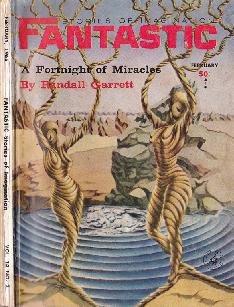
Cover by Heidi Coquette of Fantastic Stories of Imagination magazine, February 1965 issue, illustrating the story A Fortnight of Miracles by Randall Garrett
Another one whose download link I seem to have lost.

While I haven't read any of the stories yet, descriptions suggest these are mostly fantasy.

Table of contents.

  1. [novelet] Randall Garrett's "A Fortnight of Miracles": "It is hard on a man to have not one ... nor two ... but three vexish spells upon him. Such a man has need of a worthy mage & a goodly goblin ... & an author like this one who can get him out of black magic trouble without leaving any loose ends about."
  2. [ss] Roger Zelazny's "Passage to Dilfar": "A day & a night had Dilvish ridden to warn of the coming slaughter, for all hope now rested with Dilfar--& with the horse that carried him there."
  3. [ss] Ron Goulart's "Winterness": "When dealing with the spirit world, you can do things three ways: rarely, well-done, or medium. When a vanished judge & a buxom columnist are involved, it is perhaps better to settle for the medium."
  4. [ss] Thomas M Disch's "The Vamp": "Once you marry a Transylvanian count, things are never what they used to be. Not even a good steak."
  5. [serial - 2/2] John Brunner's "The Repairman of Cyclops".

Fact sheet.

Labeled: Vol 14 No 2.
Related: Fiction from old pulps; 1960s.

Thursday, August 1, 2013

Christopher Anvil's "Positive Feedback" (short story, humor, free): How inflation works, & a remedy

This is hilarious stuff. And while the story is about car repair rather than programming, if you are a programmer who grew up writing C code in vi & handcrafting makefiles, & lived through the transition to Visual Studio, you'll likely find bits of it very familiar.

Story summary.

A company called Superdee Equipment has invented a new "Automated Car Service Handling Machine" but is unable to sell it to garages. So the managers figure out a way to push the machines through...

Fact sheet.

First published: Analog, August 1965.
Download full text from an archived copy of what used to be Baen Free Library. [via Stephen Harker @rasfw]
Rating: A.
Among the stories from Astounding/Analog issues edited by John Campbell.
Related: Stories of Christopher Anvil.

Monday, February 25, 2013

Fred Hoyle & John Elliot's "Andromeda Breakthrough" (novel): A shadowy European trading syndicate dreams of creating another East India Company

Cover of Andromeda Breakthrough, a novel by Fred Hoyle and John Elliot.
This is a sequel to the authors' excellent novel "A for Andromeda". While this too is a fast moving adventure, it's much less interesting than original:
  1. It appears to be penned mostly by Elliot. None of Hoyle's characteristic humor, leg pulling of politicians, or a central cool idea here.
  2. It appears to be an unplanned for sequel. Characters that died or were otherwise removed at the end of the first book are resurrected, in rather questionable ways, so they can be part of this adventure.
A shadowy European multinational trading outfit ("Intel") working towards world control, an imaginary non-functional middle eastern country ("Azaran"), synthetic fast-breeding sea-based bacteria that suck up nitrogen from atmosphere leading to disastrous weather, are all part of the canvas. Plus some characters from first book, including the hero.

Intel now controls, or thinks it does, the "alien in the computer" & intends world domination via stuff the alien will invent. Hero, will, of course, save the world from them.

Fact sheet.

First published: 1965.
Rating: B.
Related: Stories of Fred Hoyle, John Elliot.

Sunday, October 7, 2012

Frank Herbert's "Dune" (novel): Life on a parched desert world

Cover of the novel Dune by Frank Herbert
This was my third attempt at reading this book. I distinctly remember that on each of the two earlier occasions, I gave up within first few dozen pages -  because I found names in the story impossible to spell! This time I had no such difficulty. Only difference between then & now is: I now have some experience reading sf; then I was new to the genre. So if you are a genre novice who discovered sf relatively late in life & cannot relate to the book everyone praises, may be try it a few years down the line. This also makes me wonder if I'll still like the stories I then loved!

While the story has a couple of scenes I found very silly (a completely unnecessary knife duel near the end, a 3-4 year old supremely endowed girl happily fighting on the battlefront of a dirty war), I generally liked the book.

While there are a lot of issues this book of epic scope deals with, one of the most memorable, if macabre, part for me was: the water is so precious & scarce on this desert world of Arrakis that a part of the funeral rituals for the dead involves extracting the water from the dead body for later community use!

There are any number of summaries of this book on the net; so I'll skip that part.

Fact sheet.

First published: (as novel) 1965.
This is a fix up novel, based on author's 2 earlier works: "Dune World" (Analog, December 1963 - February 1964 in 3 parts) & "The Prophet of Dune" (Analog, January-May 1965 in 5 parts).
Rating: A. 
Winner of Hugo Award 1966 in novel category.
Winner of Nebula Award 1965 in novel category.
Among the stories from Astounding/Analog issues edited by John Campbell.
Related: Stories of Frank Herbert.

Thursday, March 8, 2012

Eric Frank Russell's "Somewhere a Voice" (collection): Annotated table of contents & review

Cover image of short story collection Somewhere a Voice by Eric Frank Russell
I've not read all stories yet. Will fill up entries as I read.

"Dear Devil" is one of the most loved stories of the genre.

ToC below is in order of my preference, best first. Where I have a separate post on a story, link on title goes there. Where I'm aware of an online copy of the story, I include the link. Links on publisher or year fetch more matching fiction.
  1. [novelette] "Dear Devil" (A); download scans as part of a larger package; Other Worlds, May 1950: Humanity rises from post-nuclear-war apocalypse - with some external help.
  2. [ss] "U-Turn" (as by Duncan H Munro) (B); Astounding, April 1950: State helps a bored man commit "suicide"...  
  3. [novelette] "I Am Nothing" (B); Astounding, July 1952: A ruthless dictator has a change of heart...
  4. [novella] "Somewhere a Voice" (B); Other Worlds, January 1953: Unsuccessful hike to rescue by the stranded.
  5. [ss] "Tieline" (as by Duncan H Munro) (B); Astounding, July 1955: A man alone on an entire planet that houses a space lighthouse is very lonely.
  6. [novelette] "Seat of Oblivion" (B); Astounding, November 1941: What's the best place to hide for a runaway death row convict? In another man's body! 
  7. [ss] "Displaced Person" (B); Weird Tales, September 1948; religion: Some revolutionaries aren't welcome anywhere.

Fact sheet.

First published: 1965.
Related: Stories of Eric Frank Russell.

Tuesday, March 6, 2012

James H Schmitz's "Forget It" aka "Planet of Forgetting" (novelette, free): An unusual animal defense against predators

An intelligence agent, carrying a secret coded (paper?) file to another world, is captured by the enemy on the way. Story is of him outwitting the entire enemy ship taking him to their world. Features telepathic plants capable of moving around.

Fact sheet.

First published: Galaxy, February 1965.
Note: "this cover story was mistakenly listed as "Planet of Forge" on Galaxy's TOC."
Eric Flint on online version I've linked in download link below: 'we changed the name of the hero, did some rearranging of paragraphs in the early sections of the story, somewhat modified a few paragraphs of background material to make it fit the Hub setting, and cut a short "trick ending" that wasn't really part of the story itself and wouldn't fit the Hub setting.'
Download full text from BaenCD.
Rating: B.
Nominated for Nebula Award 1966 in novelette category.
Related: Stories of James H Schmitz.

Friday, January 20, 2012

James H Schmitz's "Trouble Tide" (novelette, smuggling, free)

Last third is action packed, but first two thirds is a much better read - a detective story that pieces together several apparently disjointed data sets on a human settled non-earth world:
  1. A sea animal herd ("frayas") suddenly dies during its annual migration.
  2. A coastal sea animal herd ("sea beefs") is behaving in a very weird way - a lot of animals have simply vanished; others that need to come up to surface for breathing every few minutes now seem to have developed some equivalent of gills.
  3. Flow rate of a sea current somehow ties up the relative times of the two events.
  4. ... 

Collected in.

  1. James H Schmitz's "The Hub: Dangerous Territory".

See also.

  1. L Sprague de Camp's "The Merman": Another story where mammals transform into fish.

Fact sheet.

First published: Analog, May 1965.
Download full text from Baen Books.
Caution: This is a long novelette - nearly novella length.
Rating: A.
Among the stories from Astounding/Analog issues edited by John Campbell.
Related: Stories of James H Schmitz.

Friday, January 6, 2012

3 stories of James H Schmitz

All are colorful in their own way (but "Balanced Ecology" is more colorful than others). List is in order of my preference, best first.
  1. [ss] "Balanced Ecology" (B); download; Analog, March 1965: A jungle world knows how to defend itself against greedy humans.
    Nominated for Nebula Award 1966 in short story category.
  2. [novelette] "The Winds of Time" (B); download; Analog, September 1962: A man & a woman are trapped, kidnapped, & ... harassed ... by ... aliens.
  3. [ss] "A Nice Day for Screaming" (B); download; Analog, January 1965: One of the early exploration ships in "pseudospace", a kind of parallel space, is chased by ... something.
Among the stories from Astounding/Analog issues edited by John Campbell.
Related: Stories of James H Schmitz.

Tuesday, February 22, 2011

Hal Clement's "Raindrop" (novella, farming): Exploring a weird artificial world

Background is an over populated earth; even the seas are mostly occupied by floating artificial cities. So little sunlight reaches the surface - even at sea. Too many people, too few farms. So, why not build farms in the sky! Raindrop, of title, is the first such experimental farm in the earth orbit.

Farm itself is a huge globe of water, collected from ... asteroids? ... I forget; one of those heavenly bodies. Initially contained in an artificial skin; later replaced with genetically engineered algae that love the sunny surface & quickly heal any tears created by micro-meteors.

A lot of genetically engineered weeds & microbes have been introduced here; & they keep quickly evolving. A little station exists just below surface, entered through an airlock, that also has entry into water below. Silbert is the only permanently resident employee, & he tries to spend most of his time up in a space station in a geosynchronous orbit a half mile above Raindrop.

Adventure in the story is provided by Aino Weisanen, one of the private owners of the Company that recently purchased Raindrop from government, & wants to convert it into a city from original farm. He's here with his pregnant wife Brenda, & an assistant Bresnahan.

These 3, accompanied by Silbert, will go exploring the dark interior of Raindrop in a specially built vehicle; that's where they intend to build their home. An altercation & we have stranded people in core & a hopeless rescue effort. Of course, all ends well.

Notes.

Story features two curious gadgets I've not seen in fiction before:
  1. Adventurers are stranded deep inside the dark Raindrop interior, with no clue of direction towards surface. How to they go? They throw a bubble; because of low gravity, it moves slowly, but still surely towards to surface where pressure is less!
  2. Transport from Raindrop to orbiting station is unusual. While going from station to raindrop, they just jump (I think, but am not sure). While returning, jump is still possible because of very low gravity, but station presents a very tiny target; if you miss it, you'll go out to empty space. So men on surface can ask the station to deploy a sort of foldable net-cum-ladder; you jump towards the net, & then do some gymnastics to reach the station.

Fact sheet.

First published: If, May 1965.
Rating: A. 
Related: Stories of Hal Clement.

Monday, February 1, 2010

R A Lafferty's "Slow Tuesday Night" (short story, humor, free)

Quote from short story Slow Tuesday Night by R A LaffertyWhat if we were speeded up a lot - so you could found a company, become a billionaire, & finally go bankrupt all in may be 2 hours! A world where everyone is ... kind of ... a superman. Many episodes brought me smiles.

I got a feeling it's probably social commentary on US of its times - 1960s. Readers familiar with those issues will likely read more here. For others, it's just a lighthearted satire on fast life.

See also.

  1. I recall at least one story, probably by Ted Kosmakta or may be in one of the "Isaac Asimov Presents Great SF Stories" books, where humans slow down instead, to the speed of plants - so humans & plants can literally fight each other! I'll fill in the title here if I can remember; I'm not able to recollect it right now.
  2. At idea level, there is a parallel with relative evolution of created beings vs their creators. E.g., Theodore Sturgeon's "Microcosmic God" (download comic book adaptation), Greg Egan's "Crystal Nights" (download), & Paul Carlson's "Mirror Girl" (download).

Fact sheet.

First published: Galaxy, April 1965.
Download full text from Internet Archive, or briarpig. Or read online at Google Books (see note below)
Update: I just noticed Google Books link no longer works! Am keeping it in the hope it will still work at least in some countries, as a lot of Google Books content does. It did work here in India when I originally put it.
Rating: B.
Nominated for Nebula Award 1966 in short story category.
Among the Classics of Ellen Datlow's SciFiction.

Monday, February 16, 2009

Free Fiction: Christopher Anvil

These are 2 or 3 months old links that were lost in my bookmarks.

Via Free SF Reader: 4 stories from Christopher Anvil's collection "The Trouble with Humans" (ed Eric Flint) at Webscription:

  1. "We From Arcturus"; download; Worlds of Tomorrow, August 1964.
  2. "The Underhandler"; download; Analog, November 1990.
  3. "Duel to the Death"; download; Analog, June 1965.
  4. "Shotgun Wedding"; download; Astounding, March 1960.

Thursday, November 1, 2007

Arthur C. Clarke's "The Last Command": Cold war superpower story - with US as clear winner

I found this an utterly unbelievable story.

Story summary.

USSR has been completely decimated in nuclear attacks by US.

But there still is a space based USSR fighting unit called Fort Lenin, on a "secret orbit beyond the moon", capable of completely wrecking the US.

Story is in the form of a recorded message from the President of Supreme Soviet, now dead, to this unit. Message tells them that they were meant as a deterrent, & obviously the deterrent hasn't worked. Now rather than a counter attack, they should quietly destroy their weapons & put themselves "at the disposal of the United States"!

Fact sheet.

"The Last Command", short story, review
First published: "Bizarre! Mystery Magazine", November 1965.
Rating: Time waster C

This story is included in the following collections.

  1. "The Collected Stories of Arthur C Clarke"
  2. "More Than One Universe"
  3. "The Wind from the Sun"

Saturday, September 15, 2007

Larry Niven's "Becalmed in Hell": An accident on Venus

Quote from short story titled Becalmed in Hell by Larry NivenStory summary.
Narrator Howie & cyborg Eric Donovan make the entire crew of a team exploring the thick atmosphere of Venus.

They need 3 kinds of propulsion to get back to earth: a pair of ramjets to go to a certain height where atmosphere is thin enough to use rockets; rockets take them to "atomic ion engine" that will take the ship back home to earth.

Deep in atmosphere, Eric loses control of ramjets. They are hooked directly into his nervous system, as is much of the rest of the ship. He can no longer feel ramjets - it's a kind of paralysis.

Tests cannot locate the fault. They go all the way down to surface where Howie goes out to check some connections, but air pressure is too high. They rise a bit, & Howie goes out again to physically pour ice on some electronics accessible only from outside. No luck.

Eventually, Howie presents a hypothesis: "I think you've got a case of what used to be called trigger anesthesia. A soldier who kills too often sometimes finds that his right index finger or even his whole hand has gone numb, as if it were no longer a part of him... Subconsciously you've stopped believing that the rams can feel like a part of you, which they were designed to do. So you've persuaded yourself that you don't feel anything."

Eric doesn't see it that way, but agrees to think it over. Later, he can intermittently feel ramjets, & is able to get them high enough up after some drama.

Real cause of loss of sensation will be revealed only near end of the story - after they land at earth, & experts can examine the problem.

Fact sheet.
Becalmed in Hell, short story, review
First published: F&SF, July 1965
Rating: B
Series: "The Coldest Place" (B), "Becalmed in Hell".

Friday, September 14, 2007

Eric Frank Russell's "Mindwarpers" aka "With a Strange Device" (novel): Cold War spy thriller

Quote from the novel titled With a Strange Device aka Mindwarpers by Eric Frank RussellThis is not quite a typical Russell - at least when compared to his other stories I have read.

It has a somewhat tedious beginning; I actually used to avoid picking it up - though when in hand, it was easy enough to read. Story really picks up about half way through, & the rest is unputdownable. But even the later half is not very original - at least not now. You must have read innumerable spy stories of the ilk.

This story also has a lot in common with Ayn Rand's "Atlas Shrugged": men of brains keep retiring or vanishing, making authorities nervous. There is a man named Reardon. The hero of the story is a metallurgist. Though the government is good here, unlike in Rand's. Note that Rand's book came a decade before Russell's.

Story summary.
I don't recall the countries named, but it's obvious the story is US vs USSR. And especially near end, it is obvious that US is good & USSR is bad!

Story begins in a US government weapons research facility. Russell must be a prophet - for I see some of the most annoying parts of this establishment in some modern software companies in Bangalore: color coded interiors (though they don't convey status or access control hierarchy in software companies); heavily segmented interiors with strict access barriers for employees (in software companies, barriors usually are to meet intellectual property protection needs when the same company services multiple clients - but they always tend to annoy employees).

Anyway, one fine day, an otherwise stable employee quits for no reason. He has no alternate job, & doesn't have a plan. He refuses to give any reasons.

Soon, there is a flood. From this facility, as well as many others across the country. Usually, the quitters are highly skilled & emotionally stable specialists. Some simply fail to turn up, others formally quit. Most soon leave the country; some start a new life in isolated small towns doing inconspicuous things like running a hardware store or tending to land.

Government is worried, & is convinced their is a plan behind this: "there are two ways of weakening the enemy. You can acquire his brains for your own use or, if that proves impossible, you can deprive him of the use of them."

That is when Richard Bransome, a metallurgist at the facility, with a wife & kids, begins to behave oddly. Government puts an agent on his tail - one Joseph Reardon, of Military Intelligence.

Richard has been having nightmares. After overhearing a conversation of two men in a coffee shop, he remembers a crime he committed 2 decades ago; he had ruthlessly killed a woman named Arline Lafarge in a tiny town called Burleston - though he will recall the details over a period of time. The overheard conversation conveyed a piece of gossip that the bones of the woman had been accidentally discovered recently at the place Richard had buried her.

Richard has a feeling he will soon be arrested as investigation proceeds. Other odd events have been happening around him - like a man who looks like plainclothes cop tailing him.

Eventually, he cannot take it anymore. Gives a story to office, another at home, & vanishes. Only, Reardon is still on his tail.

He spends a while in Burleston trying to discretely dig the level of police investigation. Over a large part of the story, he will discover that there was no murder, nor any bones discovered. He has been chasing ghosts of his own mind.

Anger makes him go for some amateur sleuthing - to discover the culprits who planted the ghosts in his mind. He will eventually lead the tailing Reardon to enemy spy ring & their ingenious weapon - a hypnosis machine that can plant chosen memories in the brain of a doped man. Turns out, Burleston was kidnapped, drugged, & given the treatment in a way he could discover only much later - even now, he has his memory blank for some 2 hours on a particular day.

Fact sheet.
"With a Strange Device" aka "Mindwarpers", novel, review
First published: 1965
Rating: A
Related: All stories of Eric Frank Russell.