Showing posts with label FnSF. Show all posts

Tuesday, August 13, 2013

Joe Haldeman's "Doing Emily" (short story, virtual reality)

A virtual reality machine that let's you become, in your mind, a character in machine's database, a database that includes simulations of many historical characters.

The story is about a man becoming Emily Dickinson... rather too realistically...

Fact sheet.

First published: F&SF, May/June 2013.
Rating: B.
Related: Stories of Joe Haldeman; virtual reality fiction.

Wednesday, July 24, 2013

Manly Wade Wellman's "O Ugly Bird!" (short story, free): Hero frees a town of a curse

This is not science fiction; it's witchcraft. I loved it because of beautiful language - content didn't really matter!

Story summary.

Penniless hero is taking a long walk along a trail. On the way he sees & hears stories about the evil Mr Onselm & his Ugly Bird. Mr Onselm can hex anyone, & whole town is scared of him.

Of course, by the end of the story, hero will vanquish the villain.

Fact sheet.

First published: F&SF, December 1951.
Download full text from Baen Ebooks or Oregon Literary Review.
This is the first of the author's "Silver John" series.
Rating: A.

Wednesday, May 9, 2012

Clifford D Simak's "Final Gentleman" (novelette, illusion)

Quote from short story Final Gentleman by Clifford D Simak
This is the kind of plot normally associated with PKD now-a-days: which of the two equally vivid realities experienced by a man is the real one?

I didn't really like it, though I didn't find it boring either.

Story summary.

A very successful writer suddenly has a feeling there is no more writing left in him. And the world he knew all his life is no longer there: university he went to has no record of him; the house his mother lives in & he frequently visits no longer houses his mother & never has; the grave of the woman he once loved & now often visits exists but is someone else's grave; the fancy restaurant in the neighborhood he frequented is a very ordinary dump; ...

Story is of him slowly unraveling the puzzle.

Collected in.

  1. Groff Conklin (ed)'s "Six Great Short Science Fiction Novels".

Fact sheet.

First published: F&SF, January 1960.
Rating: B.   
Related: Stories of Clifford D Simak.

Tuesday, April 24, 2012

Judith Merril's "Project Nursemaid" (novella): Government's difficulties enrolling unwanted babies

I cannot point to any clear flaws in the story, but I kept putting it down frequently. Took me over a dozen sittings to finish it.

Story summary.

Set up is: For space exploration, babies raised in special low gravity environments are necessary, low-gravity environments not being very conducive for ordinary earth-raised adults.

So government has a program where it creates orphans to raise (on moon)! Because of moral issues involved, the program is a secret one.

So a certain military camp in the US has certain targets: so many babies to deliver (means recruiting young mothers of unwanted pregnancies), & so many "foster parents" to deliver (older women to nurse the babies).

Story is from the point of view of Colonel Edgerly whose job it is recruit both babies & their nursemaids.

Collected in.

  1. Groff Conklin (ed)'s "Six Great Short Science Fiction Novels".

Fact sheet.

First published: F&SF, October 1955.
Rating: B. 
Related: Stories of Judith Merril.

Wednesday, February 22, 2012

Ken Liu's "The Paper Menagerie" (short story, fantasy, free)

This may not be a bad read, provided you have a taste for emotional tearjerkers.

It's the sad story of a Chinese peasant girl - losing her parents to lawlessness during Cultural Revolution, being sold as a slave to a Hong Kong household, being sold as a "wife" to an American man, & finally being rejected by her American son who dislikes his Chinese origins.

Fact sheet.

First published: F&SF, March/April 2011.
Download full text from Random House.
Rating: B.
Nominated for Nebula Award 2011 in short story category.
Related: Stories of Ken Liu.

Tuesday, January 31, 2012

James H Schmitz's "The Hub: Dangerous Territory" (ed Eric Flint) (collection, free): Annotated table of contents & review

Cover image of fiction collection The Hub, Dangerous Territory by James H Schmitz, edited by Eric Flint. Image shows a scene from the novel The Demon Breed - heroine with her two otter helpers, planning next action against invading aliens.
Whole book is online at Baen Books. Includes one novel & nine short stories.

Table of contents (10 stories, best first).

  1. [novel] "The Demon Breed" aka "The Tuvela" (A); download; Analog, September/October 1968: Humanity has secret super-human rulers!
  2. [novelette] "Grandpa" (A); download; Analog, February 1955: A group of early explorers on a newly opened world is trapped by a local lifeform. Only the ingenuity of our teenage hero can save the group's life...
  3. [novelette] "Trouble Tide" (A); download; Analog, May 1965: Detectives burst a smuggling operation.
  4. [novella] "The Searcher" (B); download; Analog, February 1966: Human heroes fight off an evil alien.
  5. [ss] "Balanced Ecology" (B); download; Analog, March 1965: A jungle world knows how to defend itself against greedy humans.
  6. "The Other Likeness" (B); download; Analog, July 1962: A small band of humans thinks redesigned, human-looking, aliens have penetrated the human worlds - to destroy the human civilization. So they're doing what they can to catch the aliens...
  7. "Attitudes" (B); download; F&SF, February 1969: Sole survivor of an accidentally destroyed human world has has come to civilization seeking help - he's carrying brain dumps of a lot of his dead compatriots. He wants Federation to supply him with many artificially created human bodies which he will animate with his dead friends. He also wants help colonizing a new world with this crowd. Federation helps, but someone is wondering...
  8. "The Machmen" (B); download; Analog, September 1964: "Machmen" are machine-men, some medically-induced transformation that turns them into "Homo
    Superior". Only, it's illegal & unsafe. One of the would-be victims being chased for forcible transformation into machman turns out to be someone more capable than strongmen expected.
  9. [novelette] "The Winds of Time" (B); download; Analog, September 1962: A man & a woman are trapped, kidnapped, & ... harassed ... by ... aliens.
  10. [ss] "A Nice Day for Screaming" (B); download; Analog, January 1965: One of the early exploration ships in "pseudospace", a kind of parallel space, is chased by ... something.
Related: Stories of James H Schmitz.

Friday, August 5, 2011

Free fiction: Two Robert Reed stories from F&SF, May-June 2011

"Stock Photos" (download) & "The Road Ahead" (download) at Suvudu.

Related: Fiction from F&SF; of Robert Reed.

Friday, July 15, 2011

Peter David's "Bronsky's Dates With Death" (novelette, free): A man's death-wish is fulfilled

Much of it is actually humor - an old man's obsession with his impending death, & the exasperation of his family members with it. But it has a grim & somewhat longish ending.

Fact sheet.

First published: F&SF, July/August 2011.
Download full text from Suvudu. (Note: Recent fiction  from F&SF tends to be online only for a couple of months. Save it locally if you intend to read it later.)
Rating: B.

Wednesday, January 26, 2011

Couple of 2011 stories

Neither particularly impressive. None crappy either. Both dark.

Note that recent F&SF fiction tends to be online only for a couple of months. Save it locally if you want to read it later.
  1. [ss] Chris Lawson's "Canterbury Hollow"; download; F&SF, January/February 2011: Love story of a "balloted" couple - in world with too much population & too few resources; so periodically, ballots are drawn to decide who is to be prematurely killed!

    Kurt Vonnegut's "2 B R 0 2 B" (download) is a much crisper variant on essentially the same theme.
  2. [ff] JR Hume's "The Last Station"; download; Every Day Fiction, 18 January 2011: Humanity has achieved immortality by getting transformed in to androids. But some people remain the original organics ("folks"). This is the story of the last days of one of the last "folks".

Monday, August 30, 2010

Reginald Bretnor's "Bug-Getter" (flash fiction, humor, free)

Ambrosius Goshawk, an unsuccessful painter, makes a trade with an alien: in exchange for some of his paintings no one wants, alien will get rid of the pest bothering the painter. Only, alien misheard a minor word...

See also.

  1. Isaac Asimov's "Two-Centimeter Demon"; download: Similar misunderstanding in another funny story.

Fact sheet.

First published: F&SF, January 1960.
Download full text.
Rating: B.
Related: Stories of  Reginald Bretnor.

Sunday, August 22, 2010

Sean McMullen's "The Precedent" (novelette, environmental dystopia, free): "Victims" of global warming witch-hunt its culprits

It's an easy read, but is very dark. Modeled after any number of class-persecutions in history.

Story summary.

In the year 2035, the world has turned green, everyone born before 2000 is automatically a "climate criminal", those born after the tipping year are the "victims" & current rulers. To keep their conscience clear, the current rulers don't summarily execute the older folk; they instead hold monkey courts that sentence most to death with trials sometimes lasting just a minute.

This story is narrated by Dr Jason Hall, an 80 year old climatologist facing such a court. Through his eyes, we will see the horror of concentration camps. He will be the first individual pardoned by such a court, but will discover that this is not a happy outcome...

Fact sheet.

First published: F&SF, July/August 2010.
Download full text from Suvudu.
Caution: Recent F&SF fiction tends to be online only for a couple of months. Save it to a local file if you want to read it later.
Rating: B.

Monday, August 9, 2010

"The Magazine of Fantasy", Vol 1 No 1 (Fall 1949) (eds Anthony Boucher & J Francis McComas) (magazine, free): Annotated table of contents

Cover image titled Codachrome by Bill Stone of the inaugural issue Fall 1949 of The Magazine of Fantasy and Science Fiction
This is the inaugural issue of F&SF, subtitled "An Anthology of the Best Fantasy Stories, Old and New", & the only issue that carries this title. Next issue will be named "The Magazine of Fantasy and Science Fiction".

Scans of the magazine in the form of a CBR file are available online as part of a larger package.

Publisher, Lawrence E Spivak, in his introduction tells us of the magazine's focus: "whatever our senses may reject, but our imagination logically accepts." His invitation to authors solicits material "sufficiently out of this world to contradict the laws of man's logic -- while adhering firmly to a freshly created logic of their own."

Note that this is not all-original; it includes reprints, in addition to original fiction.

In the past, I've read at least two of the stories - "Private--Keep Out!" & "The Hurkle is a Happy Beast" - but don't remember much of the either. Later, I think, is widely anthologized.

Table of contents (11 stories).

Where I'm aware of alternate download links for individual stories, I include that too. Links on author, publisher, or year fetch more matching fiction.
  1. [original] Cleve Cartmill's "Bells on His Toes": "broad farce-fantasy".
  2. [reprint] Perceval Landon's "Thurnley Abbey"; download; Raw Edges (collection), 1908: "plausible cold terror". "merely one of the three most terrifying stories in the English language." "in the supernatural field, things are not always what they seem ... or even what they seem not to be."
  3. [original] Philip MacDonald's "Private--Keep Out!".
  4. [reprint] Fitz-James O'Brian's "The Lost Room"; download; Harper's Magazine, September 1858.
  5. [original] Theodore Sturgeon's "The Hurkle is a Happy Beast".
  6. [original] Anthony Boucher' "Review Copy" (as by H H Holmes): "supernatural vengeance".
  7. [reprint] Guy Endore's "Men of Iron"; 1940 (where?): "social irony". "the implications of the machine age".
  8. [reprint] Stuart Palmer's "A Bride for the Devil"; 1940 (where?): "horrible hilarity".
  9. [reprint] Oliver Onions' "Rooum"; download; The Fortnightly Review, December 1910: "the story of the craneman Rooum, the lone wolf of the construction world who was never quite alone."
  10. [reprint] Richard Sale's "Perseus Had a Helmet"; Argosy, 5 February 1938: "border-line humor". "somewhere on the borderline between logical crime & a world gone mad."
  11. [original] Winona McClintic's "In the Days of Our Fathers": First published story of the author.
Related: Fiction from F&SF/1940s.

Sunday, July 11, 2010

Ian R MacLeod's "Recrossing the Styx" (short story, immortality, free): A machine that forces your partner to love you!

Mostly an average read, but gets more interesting & Kuttnerish near end.

Story summary.

Frank Onions is a tour operator aboard Glorious Nomad, a tourist ship currently sailing the Mediterranean. Guests are mostly zombies, rich old men resurrected from dead but still frail, along with their "minders".

Warren & Dottie Hastings are among the guests. Warren is the zombie who was seriously rich when living, & Dottie is his young, beautiful & still loving wife he married just a short while before his death.

As Frank gets attracted to Dottie, he will learn that she cannot love anyone while Warren is around - her mind was "imprinted" by a machine in the marriage deal she cut with Warren before he agreed to marry her.

So we get a murder motive. Together, Frank & Dottie will kill Warren & will happily ever after. Murder goes well, & they live happily ever after too - both of them, but ... here comes a Kuttnerish twist...

Fact sheet.

First published: F&SF, May/June 2010.
Download full text from Suvudu Free Library.
Caution:  Recent F&SF fiction tends to be online only for a couple of months. Save it to local disk if you want to read it later.
Rating: A.
Related: Stories of Ian R MacLeod.

Sunday, May 16, 2010

Some recent B-fiction (16 May 2010)

I've dropped very crappy stuff, but there is nothing excellent here either; all B-stories, & on the lower side of my B-pile. Better reads tend to come early in list below.

  1. Dagoberto Gilb's "Uncle Rock"; download; The New Yorker, 10 May 2010; non-genre: A poor Mexican woman in US receives passes from all kinds of men. Told from the perspective of her 11 year old son.
  2. Denise McCune's "Shuffle Up and Deal"; download; JBU, #23 (February 2010); humor: This plot probably has been done 10,000 times in various garbs.

    Aliens have landed & one of them requested the government to let him play an about to begin

    Poker tournament. Someone overhears an alien delegate as saying the winner takes Earth! So panic sets in, & everyone must ensure the alien loses the tournament!
  3. [ff] Duncan Shields' "Shuffler"; download; 365tomorrows, 10 May 2010: Using a teleporting device to make humanity more tolerant of interracial differences!
  4. Steven Popkes' "Crocodiles"; download (online only for a couple of months); F&SF, May/June 2010; zombie: Germans, during World War II, have created zombie soldiers that can turn enemy into zombies by biting.

    Very nasty & dark story. European & US readers might identify with it in ways I cannot.

    Also included are standard prejudices of many US sources: Americans are smart, Germans are evil, Russians couldn't care less for their own.
  5. Jacqueline Rochow's "The Truth Will Out"; download; 365tomorrows, 5 May 2010; fanfic: Effectively retells an episode from Pierre Poulle's "Planet of the Apes", but without explicitly naming the original: A few scientists have evidence that their ancestors were merely lab animals of humans, & are debating the social implications of making the information public.
Related: Fiction from 2010.

Thursday, April 29, 2010

Henry Kuttner & C L Moore's "Android" (as by C H Liddell) (novelette, paranoia, free): Androids are quietly replacing humans!

The idea is not new - a conspiracy of things non-human to quietly impersonate humans, sometimes killing the originals they're replacing; see, e.g., John Campbell's "The Brain Stealers of Mars" (read online), or Philip K Dick's "The Father-Thing" (read online). Stylistically, there is some similarity with Kuttner's own "Don't Look Now" (download) about a man's paranoia that Martian imposters among humanity are driving our destiny.

We also see here a favorite theme of Kuttner: children think in ways that are fundamentally different from adults.

Story summary.

James Philips Bradley has incontrovertible evidence that his boss, Arthur Court, is an android rather than human! In fact, his work has convinced him that a sizable number of people he sees around are actually androids. And he thinks they're working towards eventually replacing humanity, though their numbers may not be that big today.

This is the story of his quest (to save humanity). And its strange climax.

Fact sheet.

First published: F&SF, June 1951,
Download full text.
Rating: B.
Related: Stories of Henry Kuttner, C L Moore (as by C H Liddell); fiction from 1950s.

Wednesday, February 24, 2010

Free fiction: F&SF's two Nebula 2009 nominees

  1. [novella] Carolyn Ives Gilman's excellent under water adventure "Arkfall" (download) has been available elsewhere for reading online for almost a year now; now it's also available as can-save-to-local-disk HTML from F&SF.
  2. [novelette] Richard Bowes' "I Needs Must Part, the Policeman Said" (download): I gave it up within first 15% - a sick old man is having strange dreams.
[via Gordon Van Gelder]

Saturday, January 23, 2010

Gordon Van Gelder lists all anthologies that collect fiction from F&SF magazine

At F&SF Forum. All anthologies issued so far, from various editors.

"eholst" adds an additional entry via two separate posts.

Related: Fiction from F&SF.

Wednesday, January 20, 2010

Marc Laidlaw's "Dankden" (novelette, fantasy, racism, free)

A swampy town called Dankden, peopled by amphibians called "phibs". Humans come, hunting phibs for their hides. Overtime, there is a group of half-breeds too - partly human, partly phib. And some humans hunt the half-breeds' children too. So we have a conflict, eventually resulting in division among humans & burning of a half-breeds' township.

Not exactly my kind of story, but not boring either.

Fact sheet.

First published: F&SF, October/November 1995.
Download full text from publisher's site (I think this link won't work after a month or so).
Rating: B.
Related: Stories about racism.

Thursday, January 14, 2010

F&SF's online reprints

A few days back, I noted that F&SF's occasional reprint posts at their site are now replaced with new fiction posts at Suvudu. Looks like I was wrong.

New fiction posts at Suvudu are in addition to reprint posts at their own site. Bot SF feed picked up the latest reprint at their site today - Marc Laidlaw's "Dankden" (download). If history is any indication, this too will be online only for a couple of months.

Saturday, January 9, 2010

F&SF's monthly online short fiction moves to Suvudu

A while back, F&SF used to post 1 story each month (or was it alternate month?) on their site - the story that stayed online for a while, & then was taken down. These used to be reprints.

They've now made them from current issue, & moved them to Suvudu Free Library - but still the story won't be online forever (so any links to it will break after a couple of months). Currently online is John Langan's "City of the Dog" (download) from January/February 2010 issue.
Update: Oops - I seem to have linked their icon as "download" link! Fixed now.
Update 13 January 2009: I've now read "City of the Dog". Mostly the story of a man's troubled love life - girl he loves also loves another man & he knows it. There is a small sf thread beginning about half way through the text - an underground city of tunnels exists under the city where the story is set - an ancient underground city of dog-like creatures who hunt humans, keep human women, & have a human priest who can turn ordinary humans into these Hounds by doing something to their soul. To me, it was a waste of time.

Note: My Bot SF feed used to pick up these stories from F&SF site. This feed also picks up fiction from Suvudu's fiction feed - so unless the posting method for these stories changes at Suvudu, Bot SF subscribers should continue getting these occasional stories in their inbox (I label them "[limited time]" because they'll soon go offline).

[via Grasping for the Wind]

Wednesday, January 6, 2010

Terry Carr's "Hop-Friend" (short story, first contact, free)

10 years after the arrival of human colonists on Mars, we we are beginning to see the start of the extinction of the natives ("Marshies") - though there are oddballs on both sides that believe the two species can coexist.

Fact sheet.

First published: F&SF, November 1962.
Download full text from Internet Archive.
Rating: B.
Included in Ellen Datlow's SciFiction's classics.
Related: Martian fiction.

Wednesday, November 18, 2009

"Favorite Sea Stories from F&SF"

F&SF Forum is enumerating the stories from the magazine "that takes place primarily on or within the ocean".

Related: "best of" lists; fiction from F&SF magazine.

Monday, October 12, 2009

Howard L Myers' "Fit For a Dog" (short story, horror, free): When humans were dog food

I might have called it chilling, but it cheats - killing much of the effect. But it's action packed.

Story summary.

Some sort of catastrophe moved humans into closed cities because air had become unbreathable. Dogs have since had a field day in rest of the world.

Now dogs are the dominant species & use humans for food - with humans generally content with their fate as dog food!! In spite of the fact that dogs must use muscle power like they always did, & humans still have both the brains & technology - airplanes, helicopters, machine guns, ...!

Much of the action is of a single hunt. An airplane has crashed in open country, & dogs are hunting humans.

Fact sheet.

First published: F&SF, September 1971.
Rating: B.
Download full text from Baen CD or Webscription.
Related: Stories of Howard L Myers; Dog stories.

Sunday, September 13, 2009

J Francis McComas' "Brave New World" (short story, prehistoric fiction): When warriors became traders

Quote from short story titled Brave New World by J Francis McComasAuthor is the founding coeditor of F&SF. And is probably equally well known as the coeditor of the iconic "Adventures in Time and Space" - said to be among the books that helped sf win recognition as a separate genre.

No time is mentioned, but the story appears to be set in about the same world as Jean Auel's "Earth's Children" series; that would place it some 30,000 odd years in the past. Mankind had then been around less than 10,000 years in its current avatar.

Story summary.

A party of youngsters from tribe of "The People" are on a short journey - on foot, of course - to raid a camp of a substantially more civilized tribe "Mud Dwellers" for women! There is another nearby tribe "Dwellers-in-Caves", but raids to them are avoided because they retaliate in kind; Mud Dwellers are considered to be soft targets.

They'll be found by men of Mud Dwellers & cornered on a mountain ledge shortly before they were to raid. There is a deadlock - neither party can clearly win a fight here; a deadlock eventually resolved by trading their possessions, an event that will seed many future trading expeditions rather than normal women kidnapping expeditions.

Fact sheet.

First published: F&SF, September 1954.
Rating: A.

Saturday, August 15, 2009

James White's "Christmas Treason" (novelette, humor): When little kids brought about global nuclear disarmament!

Lord Shri Krishna, depicted as a childToday was Janmashtami (oops - day has changed! but no matter). Since I don't have an appropriate story about Lord Krishna's birthday, I thought may be I'll post about another holy birthday - even if from another religion, born on a different date, & according to a different calender at that! Picture alongside is, however, an artist's impression of Lord Krishna - the naughtiest & one of the most widely worshiped Hindu gods who has inspired so much art, philosophy & politics.

This story is a hilarious variant of Theodore Sturgeon's grim novel "More Than Human".

Story summary.

6 kids & friends - 2 from US, 1 each from UK & USSR, & 2 from Japan (Is Christmas as big an even in Japan as in other 3 countries?) Between them, they are capable of telepathy, teleporting, & telekinesis. So when the Japanese mom thinks the kids are playing in their room, they're in fact with their friends in US! Of course, they'll be back where mom expects them at dinner time!

Their unusually active imagination has them worried: how to guarantee that they'll get their gifts during Christmas a few days hence? You see, there is only one Santa Clause - & an old man at that. He comes on that sled & from some cavern in far North. And there are so many kids. How can he deliver them all their gifts during a single night? Of course, some kids are going to be missed. They just want to ensure they won't be the ones missed.

What follows are incidents that drive US & Soviet military commanders nuts: little kids querying about Santa Claus in underground missile facilities in the north! During their "Investigation" & with peculiar child logic, kids conclude that
  1. Santa has long since given up sled & delivers toys in rockets now.
  2. Bad guys have driven Santa's men out from these toy storage facilities & have put shiny green things in these rockets.
  3. "Thieves" that neighborhood store owners become during festival season (according a child's mom) are the ones who've stolen Santa's toys.
Next thing the adult world knows & is still scratching its head in puzzlement is: nuclear missiles have been launched by both sides, but what came out of their noses at attack locations are kids' toys rather than nuclear bombs! And then there are those reports of large number of toys stolen from stores...

Collected in.

  1. Isaac Asimov & Martin H Greenberg (Eds)' "Isaac Asimov Presents the Great SF Stories 24 (1962)".

Fact sheet.

First published: F&SF, January 1962.
Rating: A.

Monday, July 13, 2009

M Rickert's "Traitor" (short story)

Could not really make sense of it.

A girl was the sole survivor of a disaster that killed a lot of people, including her dad & brother, & has lived with the stigma of survivor - hence the title.

She gets recruited by ... what? Military? Or may be some kind of terrorist organization. Where she sends innocent unknowing little girls on suicide bombing missions... or something.

Collected in.

  1. David Hartwell & Kathryn Cramer (Ed)'s "Year's Best SF 14" (2009).

Fact sheet.

First published: F&SF, May 2008.
Rating: C.

Sunday, July 12, 2009

Carolyn Ives Gilman's "Arkfall" (novella, adventure, free)

Quote from short story titled Arkfall by Carolyn Ives GilmanVery good adventure story; later parts are too much like pulp era adventure, but I didn't mind.
Going by my experience with Western stories dealing with India, I guess Japanese readers will likely find some of the treatment too much of a caricature. But rest of us can have fun in an exotic setting.
PS: Actually, Japan is nowhere explicitly named. I just ended up making the association. I wonder if author actually intended that readers make the association.

Story summary.

A Japanese frontier underwater colony called Golconda Station, on an icy waterworld call Ben. They've spent several generations terraforming this world; many more generations are still needed. It continues to be a very unfriendly world.

Circumstances will put a native Osaji, her dying & senile grandmother Mota, & a brash male visitor Jack on an "ark" - a kind of submarine vehicle that has severe navigational restrictions but can otherwise sustain its occupants forever. So off we go, on an adventure to uncharted parts of this world...

Collected in.

  1. David Hartwell & Kathryn Cramer (Ed)'s "Year's Best SF 14" (2009).

Fact sheet.

First published: F&SF, September 2008.
Read online at HarperCollins (no download).
Rating: A.
Added to my "best of the year 2008" list.
Author talks about the roots of the story with John Joseph Adams at F&SF.

Thursday, June 18, 2009

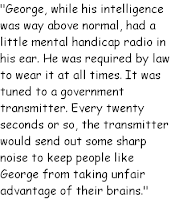
Kurt Vonnegut's "Harrison Bergeron" (short story, satire, free): An extreme version of the idea of "equal opportunity"

Quote from short story titled Harrison Bergeron by Kurt VonnegutWhat if everyone was made equal by

  1. Dumbing down the smart,
  2. Weakening the strong,
  3. Uglifying the beautiful,
  4. ... ?
In this story, this is done forcibly, via the office of "United States Handicapper General", until people have come to accept the idea as normal! Title is the name of a teenage rebel who will meet a sad end.

I can see something familiar in this very beautiful dark satire. And I guess readers from other countries will, too.

See also.

  1. William Tenn's "Null-P": Another political satire where everyone is an intellectual equal.
  2. Ted Chiang's "Liking What You See: A Documentary": What if you can no longer see either beauty or ugliness in a human face?
Both these have far less drastic impact than Vonnegut's version.

Fact sheet.

First published: F&SF, October 1961.
Rating: A.
Download full text from West Valley College, or from ToDay's MeNu. [first link via Best Science Fiction Stories]
Movie adaptations: Chandler Tuttle's "2081" (2009); Bruce Pittman's "Harrison Bergeron" (1995, TV); Patrick Horne's "Harrison Bergeron" (2006, short film).
Related: Stories of Kurt Vonnegut.

Friday, April 24, 2009

Avram Davidson's "Dr Bhumbo Singh" (short story, humor)

Sick of paying maintenance to his divorced wife, Underhand Effendi has contracted Dr Bhumbo Singh - proprietor of an expensive shop that sells "spells, smells, & shrunken heads" - to prepare him a smell so vile it drives anyone around mad!

With the help of his wife's domestic help, he will smuggle the little bottle of smelly concoction in her kitchen, with very desirable results.

But the fate is conniving against Underhand too...

Fact sheet.

First published: F&SF, October 1982.
Rating: A.

Thursday, March 26, 2009

Free fiction: F&SF

M. Rickert's "Evidence of Love in a Case of Abandonment: One Daughter's Personal Account".

[via Gordan Van Gelder]

PS: This is going to be the only post tonight. I'm busy with other things. Sorry.

Wednesday, March 18, 2009

Ward Moore's "The Fellow Who Married the Maxill Girl" (novelette, first contact, free)

Quote from the short story titled The Fellow Who Married the Maxill Girl by Ward MooreIdeas aren't new, but very good light read.

A hominid alien is stranded in a farm somewhere. And magic begins to transform the farm, its owners, & the neighborhood...

Fact sheet.

First published: F&SF, February 1960.
Rating: A.
Download full text from Internet Archive.
Related: Sci Fiction's annotated Classics; First contact stories (partial annotated list).

Tuesday, March 10, 2009

Charles Coleman Finlay's "The Political Prisoner" (novella, free): Description of a violent political purge

Think one of the Hitler's campaigns against Jews. Only, in this story, perpetrators are Jews. Victims are mostly Jews, though some especially hard treatment is reserved for visiting aliens called Adareans. There appears to be no effective government; it's a purge by the power seekers of "Intelligence".

Violence all through the story. Sometimes graphic violence.

I'm not familiar enough with Israel to say if any allusion is intended, though I suspect there might be.

Collected in.

  1. Gardner Dozois (Ed)'s "The Year's Best Science Fiction: Twenty-Sixth Annual Collection" (2009).

Fact sheet.

First published: F&SF, August 2008.
Rating: B.
Download full text from publisher's site.
Nominated for Nebula Award 2008 in novella category.
Nominated for Hugo Award 2009 in novella category.
Related: Stories of Charles Coleman Finlay.

Friday, March 6, 2009

Free fiction: F&SF's short fiction nominees for Nebula Awards 2008 are now online

Link.

Relevant links have been added to appropriate pages: short stories, novelettes, & novellas.

Of the 6 stories put online in this batch, 2 are already online via authors. Another one has been briefly online in the past. Remaining 3 make their first appearance online, AFAIK.

[via Gordon Van Gelder (link in his post has a typo)]

Friday, February 13, 2009

Free Fiction: Jerry Pournelle, Tom Godwin

These are 2 or 3 months old links that were lost in my bookmarks.

Via Free SF Reader: 6 stories from Jerry Pournelle's collection "High Justice" at Webscription. Some of these stories have already been online for a while. Some of the links below aren't visible from ToC, but they work anyway (or did when I checked them some months back).

  1. "A Matter of Sovereignty" (as by Wade Curtis); download; Analog, January 1972.
  2. "Power to the People" (as by Wade Curtis); download; Analog, August 1972.
  3. "Enforcer"; download; F&SF, June 1974.
  4. "High Justice"; download; Analog, March 1974.
  5. "Extreme Prejudice"; download; Analog, July 1974: Nominated for Hugo Award 1975 in novelette category.
  6. "Consort"; download; Analog, August 1975.
Tom Godwin's short novel "The Survivors" at the Webscription.

Monday, February 2, 2009

For authors: F&SF is promoting newbie women writers

Gordon Van Gelder at F&SF Forum: "we currently have an extra $100.00 on offer to the first newbie woman writer who sells us a story."

Monday, January 19, 2009

Robert A Heinlein's "Have Space Suit - Will Travel" (novel, space opera): Two teenagers defending earth in a multi-galaxy courtroom!

Cover image of the first edition of the novel titled Have Spacesuit - Will Travel by Robert A HeinleinThe most interesting parts of this novel are first 3 chapters before the space opera really begins - a critique of US school system that probably applies to schools everywhere, what constitutes ideal parenting, & some other similar issues.

There is another chapter near end - kids defending humans in a multi-racial alien court where the decision is going to be either to exterminate humanity or let is live. Conceptually, this part of the plot is similar to Fredric Brown's "Arena". Not exactly my favorite plot line & it's clear Heinlein is exploiting the reader emotionally; but I still ended up liking it.

Rest of the story is ok, but ... I mean - most space opera sounds the same, & this is no exception. But there are quite a few good quotes; I collect them in a separate post.

This is the second Heinlein story I've seen that spends considerable text describing the technicalities of a space suit - mostly spread through (I think) 3 chapters. Other story is "Misfit" (space suit parts not as detailed because it's short fiction). More space suit stories.

Story summary.

Two US teenagers - a boy & narrator named Clifford Russell ("Kip") & a girl Patricia Wynant Reisfeld ("Peewee"). Both super-competent. They get kidnapped by bad aliens ("wormfaces"). This leads to adventure on moon, Pluto, Vega Five, & a world called Lanador somewhere in Lesser Magellanic Cloud!

Wormfaces are from an earthlike world somewhere, & are now laying claims to earth since it's "unoccupied" (animals like humans don't count). They've a forward base at moon & a supply depot at Pluto.

Then there are good aliens - "Mother Thing" & her people from Vega 5. Mother Thing, a galactic cop, is also a prisoner of wormfaces because she's been trying to foil their plans. She will destroy the Pluto base of wormfaces. Resulting rescue by her people will lead to kids' adventures on Vega 5 (27(?) light years from Sol) & Lanador (167,000 light-years from Sol!).

Lanador is the headquarters of Three Galaxies, a UN-like organization of elder races from Lesser & Greater Magellanic Cloud & the Milky Way. Humanity is about to be judged there in a court room - whether it is likely to pose a threat to them in days ahead & hence should be terminated now, or there is some hope it can coexist. Kids are taken there as human "samples" from which the judging entity can form opinions of the whole of humanity - current & future!!! In the courtroom, we also get a conjecture that may be humanity is descended from "Old Race, allowing for mutation" - one of the oldest elder races, via crew of a ship that once was wrecked somewhere near earth!

There is some emotional drama, & earth will be put on watch rather than destroyed right away.

Notes.

  1. Near end, the story has a brief reference to Edwin Abbott's novel "Flatland".

Fact sheet.

First published: As a 3-part serial in F&SF, August/September/October 1958.
Rating: A.
Nominated for Hugo Award in 1959 in novel category.
Related: Stories of Robert Heinlein (a few online).

Thursday, January 15, 2009

F&SF magazine's all time best stories

An ongoing discussion at F&SF forum.

Many familiar ones are mentioned, but list below is of the ones I'd not even heard of (& may now try locating). In many cases, even author names aren't mentioned - so I suppose these must be very famous stories, & Google should be able to easily locate the author.

From Rich Horton.

Links on decade fetch my posts on stories from that period (from all sources - not just F&SF).
  1. 1950s: "5,271,009", "The Man Who Lost the Sea", "... and Now the News".
  2. 1960s: "The Sources of the Nile".
  3. 1970s: "Sooner or Later or Never Never", "And I Awoke and Found Me Here on the Cold Hill's Side", "Ill Met in Lankhmar", "I See You".
  4. 1980s: "Out of All Them Bright Stars", "Rat", "The Autopsy", "In the Western Tradition".
  5. 1990s: "Suicide Coast", "Gone", "Guide Dog".
  6. 2000s: "Magic for Beginners", "Fidelity: A Primer", "Journey Into the Kingdom". He actually spoils this list by adding "Finisterra" - so may be I should look at his recommendations with a bit of skepticism - at least the 2000s!

From Jeff Smith.

"Slow Birds".

From Marc L.

The Hospice by Robert Aickman, Twilla by Tom Reamy, The Rest is Silence by Charles L. Grant, The Mars Ship by Robert Thurston, Cathadonian Odyssey by Michael Bishop, Little Goethe by M. Mendelsohn, A Collector of Ambroses by Arthur Jean Cox.

Updated 16 January 2009: A few more entries:
  1. From Hillro: "The Deathbird" by Harlan Ellison; "The Hertford Manuscript" by Richard Cowper; "Pale Brown Thing" by Fritz Leiber.
  2. From MarcL: "Pohl/Kornbluth (the unforgettable "Mute Inglorious Tam" which I cannot find anthologized anywhere damn it)"
Related: Stories from F&SF.

Monday, January 5, 2009

F&SF cutting down size

While the writing has been on the wall a while, I just noticed this couple of days old announcement from Gordon Van Gelder, Editor of the magazine. Going 6 larger-sized issues a year (effective April) from 11 today - resulting in a word count cut of 10%.

Note Analog & Asimov's too had cut down on content last month.

[via SF Signal]

Thursday, September 4, 2008

Jack Vance's "Green Magic" (short story, philosophy, free): It's natural to long for a lost innocence?

This is a philosophical story, told as fantasy. Makes important points, even if I don't buy them all. Note the important parts of the story start about half way through.

Main point is: Personal growth means better ability to see the muck around us. This ability to see the muck can make us so miserable that we will long to go back to good old days of innocence & ignorance! I can see the first part. And I've met people claiming the sentiments similar to second part. But I personally have never had longings like the second part. So may be the story will work better for some people than others. Or may be multiple readings over a period can make me see the point?

Story has other themes too, in minor roles.

  1. Ever hit upon a ceiling on personal growth, where there are at least some around who still have vistas open? Can lead to pangs of misery, & expedite exit from this environment to retain sanity.
  2. Ever migrated across cities & countries - looking for better opportunities, or forced by circumstances? Felt the shortcomings of the place that is still sentimentally home, years later during trips back home?

Story summary.

Howard Fair, expert in "white" & "black" magic, & with some expertise in "purple" magic, has found 60 year old diary of "his great-uncle Gerald McIntyre". Diary talks of "green" magic, something unknown to him, & raises curiosity.

Over a period of time, he will convince two sprites (magical creatures) - Jaadian & Misthemar - from this "green realm" that is outside of normal human perception to teach him its secrets.

So he goes to green realm to learn. He does learn. And discovers that he will always be an inferior to residents of the realm; he simply doesn't have their grace or competence. Inferiority complex makes him return back to normal human realm on earth.

But to his heightened perceptions, earth is no longer the same. It has too many short comings. Rest of the story is of his attempts to come to terms with this no longer acceptable human world.

He actually does get an opportunity to lose his learning & go back to innocent days. But he cannot do that either. This is something I find resonating with my experience - I've seen innumerable idle arguments of why poverty is better than wealth so far as peace of mind is concerned, but no arguer is willing to drop money to go back to a poorer station to gain peace of mind!!

Fact sheet.

First published: F&SF, June 1963.
Download full text from Infinity Plus.
Rating: B
Credits: I found this story via Best SF Gateway.

Tuesday, July 22, 2008

Robert Heinlein's "All You Zombies" (short story, grandfather paradox, humor, free)

Who is whose mother, father, lover, child, kidnapper, employer, ...? Solid confusion.

Very amusing & totally crazy tale of convoluted relationships. Rusty has more to say at Best Science Fiction Stories.

Glenn Davies' "In His Image" is a simpler & less interesting variation published a few months back.

Fact sheet.

First published: F&SF, March 1959.
Rating: A
Download full text, or MP3 audio.
Related: Stories of Robert Heinlein; time travel stories.

Sunday, June 29, 2008

Mark Clifton's "What Now, Little Man?" (novelette, science fiction, free): On racial superiority prejudices

Quote from short story titled What Now, Little Man by Mark CliftonDuring the last month or two, I've sampled may be a dozen authors I'd not read before from scifi.com classics section. Two have been good finds - Bertram Chandler & Clifton; I'm ready to consume more of their stories.
While Clifton's endings don't really have great resolutions, he appears to address rather big subjects - sometimes without easy answers. I liked both his stories while I was reading, though their details were easy to forget afterward.

Story summary.

When humans colonized a new world Libo, they found "goonies" among its natives. Goonies have body structure rather similar to humans, though they're not humanoid. And they are in some kind of symbiosis with a local tree called "pal"; each goonie is attached to its own pal tree, & would rather die than eat the fruits of any other tree. And their newborn numbers are automatically regulated to available pal tree population.

Humans consider them animals. This is the story of slow downing on humans of their true nature, & the innate human nature to stubbornly refuse to accept things that violate established prejudices in spite of hard evidence.

There is a thin thread based on Mahatma Gandhi's non-violent protests - a rather passive form of Mahatma's methods. Goonies submit to every cruelty humans have afflicted on them - they just stand & get slaughtered when hunted, they meekly & cheerfully submit to hard labor or physical abuse, ...

Story is narrated by Jim MacPherson, a human colonist & a goonie "farmer". He began by planting pal trees, hence making goonie breed. And using goonies as meat animals. He slowly found they can be trained for virtually any task - in the end, tasks that even many humans are bad at - & their full potential nowhere in sight. This leads to ill will among people, & tension in the story.

In the end, there is wild speculation by Jim - may be goonies are aliens at a post-human stage of development, ... I found the arguments in this part unsatisfactory. That's where the title comes from - human nature has not outgrown its earth bound complexes even after going out to stars:

"Go out to the stars, young man, and grow up with the universe!

All right! We're out there!

What now, little man?"

Fact sheet.

First published: F&SF, December 1959.
Rating: A
Download full text from Internet Archive.
Included in Ellen Datlow's Sci Fiction classics.
Related: All stories of Mark Clifton.

Saturday, June 14, 2008

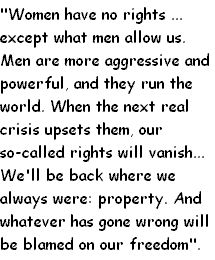
Alice Sheldon's "The Women Men Don't See" (as by James Tiptree, Jr) (novelette, free): A woman is very unhappy in a male dominated society

Quote from short story titled The Women Men Don't See by James Tiptree, JrThis might have been ok (if not great) non-genre story, but the completely unnecessary introduction of aliens near end & bizarre ending ruined it for me.

Story summary.

Much of it is an adventure story. A woman, Ruth Parsons, has hired a private plane piloted by Captain Estéban, & is taking a trip to somewhere in South America with her daughter Althea. She will also take a hitchhiker, Don Fenton (the narrator), on board.

On the way, there is plane crash, & the four are stranded in a small wet place with no freshwater & no hope of early rescue.

Ruth & Don will go looking for fresh water, & end up spending a couple of nights away from crash site. That's where we get the background of Ruth filled up. She never married, nor did her mother, & hopefully her daughter too will not marry - though the daughter hopefully have bear the child of Captain Estéban, now that she's alone with him. We learn that Ruth is carrying major rage inside her against a male dominated society.

While on their camping site beside a river when out looking for fresh water, she'll find a curious object, & instantly know it's an alien artifact. Aliens - students on earth! - come looking for it in the morning in their boat. She successfully bargains with them to be taken to their world, away from this male dominated world, along with her daughter - never to return!

Fact sheet.

First published: F&SF, December 1973.
Rating: B
Download full text from Internet Archive.
Included in Ellen Datlow's Sci Fiction classics.
Related: All stories as by James Tiptree, Jr.

Wednesday, June 4, 2008

A Bertram Chandler's "The Cage" (short story, science fiction): A shorter version of Pierre Boulle's "Planet of the Apes"

Quote from short story titled The Cage by A Bertram ChandlerWhile there are many stories with "men as zoo animals" theme, these two are the only ones I've read where this is the main theme.

Because of shorter length, this is a simpler & less nuanced story than "Planet of the Apes". But plot idea is the same: A group of humans happen to be in a condition where they are mistaken as non-sentient animals by beings that are otherwise intellectual & technological peers. The humans get hunted, caught, & put in zoo & laboratory cages.

Problem for these zoo animals is to convince their captors that they are sentient & deserve better treatment.

Story summary.

About half the story is about how this group of humans ended up in the unfortunate situation; later half is about their capture by an alien "survey ship", life as zoo animals, & eventual release.

"At least two hundred days had passed since their landing on the planet without a name" - these human "survivors from the interstellar liner Lode Star". Ship had to make emergency landing. There was something wrong with its atomic "Ehrenhaft generators"; they had landed on a world in an unexplored region of galaxy & had only chance to send SOS (but not receive acknowledgment).

50 odd passengers were parceled off to a place somewhat away from wrecked ship while Captain & a small crew tried fixing things. They failed; the explosion destroyed both the ship & crew, & left a crater where ship stood. Survivors were stranded on this unfriendly world - always hot, always drizzling, though no hostile local animals, ample local food & water, & breathable air.

They have degenerated into a primitive existence in this period. And there is very skewed sex ratio. "There are fifty-three of us here, men & women. There are ten married couples... That leaves thirty-three people, of whom twenty are men. Twenty men to thirteen ... women... What sort of marriage set-up do we have?" They choose monogamy. If two men want the same woman, they must fight it out; winner takes the woman!

It's during one such fight with the crowd cheering that 6 of them are picked up by an alien hunting helicopter; alien spaceship is parked a little distance away.

"The world to which they were taken would have been a marked improvement on the world they had left, had it not been for the mistaken kindness of their captors. The cage in which the three men were housed duplicated ... the climatic condition of the planet upon which Lode Star had been lost." So hot atmosphere & constant drizzle, & same boring fungi as food that they had adapted to on the world they were taken from!

Of the 6 humans captured, 3 men in this cage are "Hawkins, Boyle, & Fennet". In a nearby cage is "Mary Hart". Remaining two - "Clemens & Miss Taylor" - probably ended up on the vivisection table.

Their captors "aren't the same shape.. And we, were the situations reversed, would take some convincing that three six-legged beer barrels were men & brothers." They try Pythagoras's Theorem with pictures made from twigs to interest their captors, without luck.

They try showing their "manual dexterity by the weaving of baskets" from stuff within their cage. Captors think its a mating ritual - like beaver's dams! So "Mary Hart was taken from her cage and put in with the three men"!

It's during the night of her stay in men's cage that Mary made a racket - when Joe, a little local mouse-sized animal, passed over her when she was asleep. Men consider Joe a kind of friendly pet. She insists men kill Joe; they instead make a basket type cage & put Joe there after trapping it.

It's this trapping & caging of Joe that reaches out to captors. They will be recognized as sentients & gain their freedom because "Only rational beings ... put other beings in cages"!

Collected in.

  1. Isaac Asimov & Martin H Greenberg (Eds)' "Isaac Asimov Presents the Great SF Stories 19 (1957)".

Fact sheet.

First published: F&SF, June 1957.
Rating: A

Saturday, May 3, 2008

** Damon Knight's "The Country of the Kind" (short story, fantasy)

In a future materially very well off & non-violent society, a monster of a man is born - monster because he's prone to violence. But this kind society cannot kill him; they just boycott him. And he is looking for a child who will be his heir in violence - for he has learned a useful lesson: you can snatch anything from anyone if you are violent, & no one will oppose you.

Collected in.

  1. Robert Silverberg (Ed)'s "The Science Fiction Hall of Fame: Volume One, 1929-1964".

Fact sheet.

First published: F&SF, February 1956.
Rating: C

Note: Why is this post so short?

** Richard Matheson's "Born of Man and Woman" (short story, fantasy)

A child, heavily abused because he's a giant, has decided to get back at his tormentors. Very dark story.

Collected in.

  1. Robert Silverberg (Ed)'s "The Science Fiction Hall of Fame: Volume One, 1929-1964".

Fact sheet.

First published: F&SF, Summer 1950.
Rating: C

Note: Why is this post so short?

** Roger Zelazny's "A Rose for Ecclesiastes" (novelette, science fiction)

Intelligent long-lived race of Mars is dying because their men have been sterilized by a curious rain. A human visitor will offer them a way out.

Collected in.

  1. Robert Silverberg (Ed)'s "The Science Fiction Hall of Fame: Volume One, 1929-1964".

Fact sheet.

First published: F&SF, November 1963.
Rating: A

Note: Why is this post so short?

* Matt Hughes' "The Helper and His Hero" (novella, fantasy)

The great no-content story. Great language, beautiful imagery, epic scope - only weak point is the story. It has evil aliens that can survive imprisonment in a "gravitational cyst(?)" through geological ages to come bug humans again, medieval society, chants that summon magical powers, mystical places called "Commons", ... Summarizing this story is not easy. If you prefer package to content, you may like this story.

Fact sheet.

First published: F&SF, February/March 2007.
Rating: C
Download full text.
Was in finals of Nebula Awards 2007 in novella category.

Note: Why is this post so short?

Monday, April 28, 2008

Walter M Miller, Jr's "Fiat Homo" (novella, non-genre): Part 1 of 3 of "A Canticle for Leibowitz" (fix-up novel)

Quote from novella titled Fiat Homo, included in the fix-up novel titled A Canticle for Leibowitz by Walter M Miller, JrSad story of an honest man in a perverted world, told in a generally humorous way but with a sad ending.

You will likely get more out of it than me if you are familiar with Christianity; I liked the story but sometimes found it tedious - there is too much religion based on Christianity here.

Note there are two different things called "A Canticle for Leibowitz":

  1. Original 1955 novella of this title.
  2. Much better known 1960 fix-up novel of this title. "Novel" is really a collection of 3 previously published shorter works - revised as part of fix up. First of these 3 parts is "Fiat Homo", revised & rename version of the 1955 novella titled "A Canticle for Leibowitz". This post is based on a reading of "Fiat Homo".
1955 novella version is one of the two stories that qualified for SF Hall of Fame series but could not be included in published anthologies because copyright owners didn't want, according to Ben Bova's introduction to Volume 2A. (Other was Bradbury's "The Fireman"; the well known novel "Fahrenheit 451" is a fix-up version of this story).

It was this HoF inclusion that made me look out for this work. Since 1960 novel is much easier to get, that's what this post is based on - first of the 3 stories in the "novel".

Note that "Fiat Homo" is much longer than a typical novella - about the length of 2 novella. I'm not calling it novel only because it's part of a larger work also called novel.

Executive summary.

Story begins about 600 years after 1950s or 1960s - say 2550s/60s. It covers about 23 years of the life of "Brother Francis Gerard of Utah". He is 17 at the beginning of the story, & an apprentice monk at a monastery called "Leibowitz Abbey". His murder at the hands of highway thugs closes the story logically, but it lingers awhile after that. The story really ends in the year 3174 AD - nearly 600 years after the death of Francis, with a war looming. I suppose this extension is to better link it up with second story in this novel - "Fiat Lux" (but I haven't read that yet).

The background.

In 1950s or 60s, there is a world war with extensive use of nuclear weapons (known as "Flame Deluge" in later eras) - pretty much destroying civilization. Radiation poisoning of air hasn't spared even uninvolved nations. And radiation-induced mutations have ensured too many mutilated children yet to be born.

Shortly after the end of war - lasting weeks or days - there is a kind of mob frenzy later to be dubbed "Simplification". Mobs blame the government leaders that caused havoc, educated people who helped build these weapons of mass destruction, etc. The Simplification crusades will last 4 generations, will kill pretty much everyone educated or even literate, destroy all surviving machinery/books/documents. This world bears "Simpleton" as a badge of honor - at least they don't help destroy the world.

Isaac Edward Leibowitz, an ordinary electronics technician, is a survivor of the holocaust. But his wife Emily died - he will learn of it 6 years later. That was apparently the only bond he had; we aren't told of any other relation.

After seeing dead Emily, & the madness of the world around, he decided to do something positive. He thinks the Simplification madness will be gone in a few generations - so current human knowledge will be looked up eagerly when sanity returns. He decides to ensure books & other documents - whatever he can locate - are persevered in a cache for future generations.

Since this is not the job of one man, he decides to create an institution. He 'went back to the Cistercians, took their habit, & after more years became a priest. He gathered a few companions about him & made some quiet proposals. After a few more years, the proposals filtered to "Rome," which was no longer Rome (which was no longer a city), having moved elsewhere, moved again, and still again - in less than two decades, after staying in one place for two millennia. Twelve years after the proposals were made, Father Isaac Edward Leibowitz had won permission from the Holy See to found a new community of religious, to be named after Albertus Magnus, teacher of Saint Thomas, & patron of men of science. Its task, unannounced & at first only vaguely defined, was to preserve human history for the great-great-great-grandchildren of the children of the simpletons who wanted it destroyed... Its members were either "bookleggers" or "memorizers," according to the tasks assigned. The bookleggers smuggled books to the southwest desert & buried them there in kegs. The memorizers committed to rote memory entire volumes of history, sacred writings, literature, & science, in case some unfortunate book smuggler was caught, tortured, & forced to reveal the location of the kegs. Meanwhile, other members of the new Order ... began the building of a monastery. The project, aimed at saving a small remnant of human culture from the remnant of humanity who wanted it destroyed, was then underway.'

Leibowitz himself would later be killed by mob, as will be several of his associates & much of their book collections burnt. But bits survived. And now we have this remote monastery in desert, dedicated to the task of collecting & preserving whatever little it can of "Memorabilia" - without understanding the contents of preserved documents. Everyone who can make sense of preserved work is dead, but there is a hope someday someone will be able to get sense out of them.

Story summary

Francis, 17, is at monastery because he doesn't have any other options. He was sold as a slave to someone in his community, & ran away - if he goes back, he will be killed. He has been learning at monastery for a while - mostly Latin, & some bits of "ancient English". Through out the story, we will see his honesty pitted against a world that doesn't deserve him.

He, along with some other "novices", is doing some kind of monastic living ("Lent") in the desert - several miles from monastery. Each novice is alone, cannot talk to others, & must survive among desert wolves - in his own "hermitage". A priest ("Prior Cheroki") visits weekly; so does "Brother Fingo" with minimal rations & water.

Opening episode plays a very important role in the story. Francis has been digging a hole & making some kind of cover with locally available stones as protection against night wolves, but he's not finished. That's when an old man ("pilgrim") with a leg missing & obviously lettered comes towards him - via a trail that rarely sees a visitor.

There will be initial misgivings between the two, then cautious trust on the part of visitor. Eventually, visitor decides to help him find a stone of a shape that will complete his shelter - but Francis is not yet trusting. Pilgrim will locate a stone nearby, mark it with some symbols, tell Francis of it & go towards monastery seeking shelter. We will later learn that monastery has no record of his visit - either no one noticed, or he skipped the visit.

Later, when getting the stone, Francis will be puzzled by incomprehensible mark pilgrim made on stone. Removing stone reveals an underground cavern - a "Fallout Survival Shelter". He will spend a while, discover a tool box with some papers, & skull of someone long dead. Some of these papers are signed "Isaac Edward Leibowitz"; there is also a mention of "Em" - presumably short for Emily Leibowitz. In a shock, he will simply use the stone for shelter & sleep.

All hell breaks lose when Francis' discovery becomes known - but for the wrong reasons. Someone will suggest the marks made on stone by pilgrim can be interpreted as "Leibo" in Hebrew! Some people will look at his find as "miracle" - Leibowitz visiting him & pointing to cavern holding the holy skull of Emily etc. Others - particularly his superiors - will call him a crank. He will get many beatings & hardships, even though he never said anything about miracles.

Now the bosses of monastery are very insecure folks. And they have been lobbing "Vatican" for years to get Leibowitz recognized as a Saint! Rumor mills in the light of Francis' finds is making them feel even more threatened - that they will become laughing stock for declaring a false miracle.

For 7 years, Francis will live through hell for his find. That's when "New Rome" sends a messenger informing the monastery the case of Leibowitz's sainthood is being reopened, thanks to rumors triggered by Francis' finds. Only then he will be recognized as something his peers got years ago - allowed "to profess your vows", & became a "monk of the Albertian Order of Leibowitz". He is assigned to department that copies documents (by hand). Here he will make a beautiful & stylized copy of one of the circuit diagrams of Leibowitz included in his find - without slightest clue to what the picture represents, over a 15 year period (in his spare time) beginning a year after starting as "apprentice copyist".

11 years after Francis' discovery of relics, Vatican will end up sending two teams - one to argue for sainthood of Leibowitz (headed by Malfreddo Aguerra), other to argue against it (headed by Monsignor Flaught). Both will be won over by honesty of Francis.

It'll be 23 years after Francis' discovery when Vatican is finally ready to recognize Leibowitz as saint! Francis has been invited for the ceremony, & will travel alone - along with original relic (circuit diagram), & its beautiful copy as present for Pope.

He will be waylaid by robbers on the way who will take everything on his person, but spare his life. On much persuasion, he will be returned the original ugly relic - robbers want a ransom for the beautiful copy, mistaking copy for original!

Well - Pope will gift him ransom money along with certificate of Leibowitz's sainthood. When waiting where he was waylaid with ransom money, he will be killed by the same gang of robbers - presumably to take his current possessions.

Rest of narrative - a couple of paragraphs - tells us of the birth of city-state in this new world, & the looming war - in the year 3174 AD. We will likely learn the details in next story.

Fact sheet.

First published: F&SF, April 1955 under the title "A Canticle for Leibowitz". Revised & renamed to "Fiat Homo" for inclusion as first of 3 novellas in 1960 book also titled "A Canticle for Leibowitz". This post is based on book version of the story.
Rating: A