Showing posts with label 1970s. Show all posts

Sunday, April 13, 2014

Pierre Barbet's "A Problem in Bionics" (short story, detective)

A group of scientists are working on a bunch of green technologies inspired by the workings of animals & insects. To get noticed by a wider audience, they move to live on an island using only the green tech - no petroleum, no CO2, ... The idea is to demonstrate that living in an environmentally sane way is possible.

But a thief among them has been selling the technology to unscrupulous elements outside, who intend to patent them; hence hinder their widespread adoption.

So a detective is hired to catch the thief...

Notes.

I'm not convinced of the ending. I've never seen a microfilm, but can you attach one to a wing of a butterfly & have the poor thing still fly?

Collected in.

  1. Donald A Wollheim (ed)'s "The Best from the Rest of the World: European Science Fiction".

Fact sheet.

First published: Horizons du Fantastique (French), sometime in 1974. This post is based on an English translation by Stanley Hochman included in Wollheim's anthology.
Rating: B.

Wednesday, December 18, 2013

Alice Sheldon's "The Man Who Walked Home" (as by James Tiptree, Jr) (short story, post apocalypse, free)

Apocalypse here results as a side effect of a time travel experiment. While I found the time travel part positively incomprehensible & boring, the rest of it is very readable - a dead world in the process of rebuilding itself.

Story summary.

At the site of the time travel experiment, there was an explosion, a crater, & the side effects that killed much life of earth. But there is also a curious physical phenomenon that is a side effect of original experiment: once a day, every year, at the same time, at a place in the original crater, a "monster" appears for a few seconds - a monster that appears to be moving but is not, it leaves bad smell after it's gone, & any attempt to touch it tends to cost you your limbs.

Story is mostly a view of this curious phenomenon, & eventually an explanation, from the point of view of sundry people who'll watch it over the centuries as the dead place keeps slowly getting inhabited.

Fact sheet.

First published: Amazing Science Fiction, November 1972.
Download full text from Baen eBooks.
Rating: A.
Related: Stories of Alice Sheldon (as by James Tiptree, Jr).

Tuesday, November 26, 2013

Arkady Strugatsky & Boris Strugatsky's "Roadside Picnic" (novel, first contact): Aliens are to us what we are to ants!

Cover the Roadside Picnic, a novel by Arkady and Boris Strugatsky.While I didn't dislike it, there are long scenes of the kind you've probably read dozens of times: a band of hardy people on treasure hunt in a jungle full of dangers.

I think its classic status probably has to do with the central thesis: aliens so advanced they won't even notice us if they ever came to earth.

Story summary.

This is a first contact story, but we never actually see aliens. What we see are signs of their Visitation at 6 different locations on earth. "Imagine that you spin a huge globe & you start firing bullets into it. The bullet holes would lie on the surface in a smooth curve... all six Visitation Zones are situated on the surface of our planet as though someone had taken six shots at Earth from a pistol located somewhere along the Earth-Deneb line. Deneb is the alpha star in Cygnus."

Zones where they visited are dead places. And deadly ones. And contain a lot of alien stuff. Why did they visit? Why did they turn these places into ruins? Why did they leave all those artifacts behind? Many explanations are offered, but one is a particularly special one - the roadside picnic theory: "Picture a forest, a country road, a meadow. A car drives off the country road into the meadow, a group of young people get out of the car carrying bottles, baskets of food, transistor radios & cameras. They light fires, pitch tents, turn on the music. In the morning they leave. The animals, the birds, & insects that watched in horror through the long night creep out from their hiding places. And what do they see? Gas & oil spilled on the grass. Old spark plugs & old filters strewn around. Rags, burnt out bulbs, & a monkey wrench left behind. Oil slicks on the pond. And of course the usual mess--apple cores, candy wrappers, charred remains of the campfire, cans, bottles, somebody's handkerchief, somebody's pen knife, torn newspapers, coins, faded flowers picked in another meadow... A roadside picnic, on some road in the cosmos."

So the Visitation Zones contain litter from their "picnic". I could not find a satisfactory answer to why 6 parties would almost simultaneously decide to come for picnic on earth?

Story is mostly an adventure. Government claims to own the stuff left behind by aliens. But "stalkers" illegally smuggle a lot of stuff out.

Fact sheet.

First published: "Avrora literary magazine in 1972, issues 7-10."
Rating: B.

Monday, November 4, 2013

Alice Munro's "The Stone in the Field" (novelette, non-genre)

This is a sequel to author's "Connection". In "Connection", we meet the girl's several single aunts on the maternal side; here we meet her several single aunts on father's site. While the maternal aunts are outgoing, paternal ones live too much in their own world. In fact, the central theme in this story seems to the extreme to which some people go to protect themselves in a constantly changing, & hence threatening, world.

Collected in.

  1. Alice Munro's "The Moons of Jupiter".

Fact sheet.

First published: Saturday Night, sometime in 1979.
Rating: A. 
Related: Stories of Alice Munro.

Alice Munro's "Connection" (novelette, non-genre)

This is mostly colorful character portraits - her mother & mother's several single cousin sisters, seen from the eyes of a girl.

One theme keeps recurring through the story - how we go about protecting our sense of pride. Some very common situations, but we all seem to engage in this behavior.

Collected in.

  1. Alice Munro's "The Moons of Jupiter".

Fact sheet.

First published: Chatelaine, sometime in 1979.
Rating: A.
Related: Stories of Alice Munro.

Tuesday, October 15, 2013

Alice Munro's "The Moons of Jupiter" (short story, non-genre)

I'd not heard the name of the author until a few days back - when the announcement that she'd won this year's Literature Nobel Prize came. When I looked around for her works, a short story collection with the title "The Moons of Jupiter" sounded like sf - so I picked it up. But at least this title story is not sf.

Story summary.

Story is mostly about a woman's relationship with her father & her two grown up daughters, but mostly father who's about to undergo heart surgery. Nice language & some very interesting observations on everyday life.

Title comes from some small talk she's having with her father in hospital about her visit to a local planetarium, a game where dad is going to name the moons of Jupiter.

Fact sheet.

First published: The New Yorker, 22 May 1978?
Rating: A.

Monday, July 22, 2013

John Varley's "Air Raid" (short story, doomsday, free)

I found it mostly uninteresting to wade through, & you will notice that author has consciously made it difficult for you to comprehend what is going on. But nice positive ending.

Story summary.

In a future where a deadly airborne virus has made earth uninhabitable & the few survivors immune to it have a highly withered body. But a group of these men of the future, with advanced technology including time travel, seem to be up to something nasty.

Much of the story appears to be body snatching raid of an airplane in the past, an airplane about to crash. But their intentions are honorable, as we'll discover in the end...

Fact sheet.

First published: Asimov's, Spring 1977.
Download full text from Baen eBooks.
This story was later expanded into a novel, a screenplay, & a movie, all titled "Millenium".
Nominated for Hugo Award 1978 in short story category.
Nominated for Nebula Award 1978 (or was it 1977) in short story category.

Monday, April 15, 2013

Herbert W Franke's "Paradise 3000" (short story, overpopulation dystopia)

While there are many overpopulation dystopias in fiction, there are two things here that I've not seen often (ok - I've seen some that can be called variants of the second but not in this form):
  1. Why overpopulation? Well, in this future, you have a welfare society that won't let anyone die, & refuses to accept birth control. Because human life is sacred.
  2. To cope with the overpopulation, the society practices "Reduction". Reduction in living space per person, reduction in allowed rations per person, reduction in normal life expectancy, ... And woe be on you ("OrdCit", short for ordinary citizen) if you're over 16 & you manage to get yourself hurt in an accident - you'll be "recalled". As is everyone over 30.

    What's "recall"? It's cold storage hibernation, in completely unreasonable hope that a future will discover how to cope with the huge population & revive those hibernating. I was a bit confused with the ending; may be nice dreams are piped directly into the brains of the hibernating?
It's told as a love story with a confused ending for protagonists who've been indoctrinated since childhood to not get emotionally involved with their partners.

Collected in.

  1. Donald A Wollheim (ed)'s "The Best from the Rest of the World: European Science Fiction".

Fact sheet.

First published: 1975? (in German) (where?)
This post is based on the translation from German by Christine Priest.
Rating: B.

Thursday, March 28, 2013

James E Gunn's "The Listeners" (fix up novel, hard sf, first contact): Just what does SETI do?

Cover of The Listeners, a first contact fix-up novel by James E Gunn.
Another important classic that doesn't get included in many classics lists of genre. While a fix up novel constructed from stories published earlier, it doesn't really feel like a disjointed one.

It gives a realistic view of how impossible a task SETI has set for itself (but I found it occasionally over-dramatic, predictable & sometimes boring).

Listeners of title are scientists on "The Project", funded by US government, to listen to signals from the stars - hoping there are intelligent aliens out there broadcasting. It brings out starkly how remote are the odds of catching alien signals even if there are a lot of aliens out there. And how much patience & perseverance is required for the task.

Fact sheet.

First published: 1972.
Rating: A.
Related: Stories of James E Gunn, first contact fiction.

Saturday, March 9, 2013

Jon Bing's "A Whiter Shade of Pale" (short story, color blindness): When men refused to see colors!

The key idea is an unusual form of conjectured color blindness: humans living for generations on a cold, always snowy, world with no colors have their vision changed to the extent that they can no longer see bright colors! At least their brains don't register them anymore.

Story summary.

This is a shipwreck story. A star faring humanity, spread across many worlds. A shipwreck forces an unscheduled landing on the barren snowy world of its small crew. A world that was colonized by humans generations ago, but was forgotten.

But all attempts of the stranded travelers to get the attention of natives fail, until a man finally gets the idea...

Fact sheet.

First published: in English translation in Donald A Wollheim (ed)'s "The Best from the Rest of the World: European Science Fiction" (1976). Translated from the original the Norwegian by Steven T Murray.
Rating: B.

Friday, March 8, 2013

Donald A Wollheim (ed)'s "The Best from the Rest of the World: European Science Fiction" (anthology): Annotated table of contents & review

Cover of the 1976 science fiction short story anthology The Best from the Rest of the World, European Science Fiction edited by Donald A Wollheim
This book collects representative pieces from Western Europe - mostly from 1960s & 1970s, I think. Eastern Europe & Russia are specifically excluded.

Actually, I didn't find the editor's introduction very encouraging - he seemed to be effectively saying that Western European sf is mostly a copy of English one, except for French & pre-war German flavors. But since I have it, I'm going to give it a try.

None of the authors here are familiar to me.

My rating for read stories appears in brackets. Where I have a separate post on a story, link on story title goes there.

PS: If you are familiar with the works of some of the authors & have fond memories of some stories, please share in comments. I would be particularly interested in any works that might be available in English translation - especially online, but a book form collection will also do. And would you have chosen a different work of an author, or a different author from a country, for representation here? Thank you.

Table of contents (best first, unread last).

  1. [ss, Holland] Manuel van Loggem's "Pairpuppets" (A); Luitingh SF Verhalen, #6 (1974) (as "Paarpoppen"): Speculating on the future of love & sex...
  2. [ss, Norway] Jon Bing's "A Whiter Shade of Pale" (B); first published in this English translation by Steven T Murray: When men refused to see colors! 
  3. [ss, France] Pierre Barbet's "A Problem in Bionics" (trans Stanley Hochman) (B); Horizons du Fantastique, sometime in 1974. : Catching an intellectual property thief...
  4. [novelette, France] Gerard Klein's "Party Line": Not read.
  5. [ss, Italy] Sandro Sandrelli's "The Scythe": Not read.
  6. [ss, Germany] Herbert W Franke's "Paradise 3000": Not read.
  7. [novelette, Belgium] Eddy C Bertin's "My Eyes, They Burn!": Not read.
  8. [novella, Germany] Wolfgang Jeschke's "The King & the Dollmaker": Not read.
  9. [ss, Norway] Tor Age Bringsvaerd's "Codemus": Not read.
  10. [ss, Italy] Luigi Cozzi's "Rainy Day Revolution No 39": Not read.
  11. [ss, Sweden] Sam Lundwall's "Nobody Here But Us Shadows": Not read.
  12. [novelette, Spain] Domingo Santos's "Round & Round & Round Again": Not read.
  13. [ss, Denmark] Niels E Nielsen's "Planet for Sale": Not read.
  14. [ss, France] Charles Henneberg & Nathalie Henneberg's "Ysolde" (as by Nathalie-Charles Henneberg): Not read.

Fact sheet.

First published: 1976.
Related: Works of Donald A Wollheim.

Thursday, March 7, 2013

Manuel Van Loggem's "Pairpuppets" (short story): Speculating on the future of love & sex

Skip it if the discussion of explicit sex & lust bothers you.

This one, like one more I've read so far from the anthology "The Best from the Rest of the World: European Science Fiction", gives the impression of an imperfect translation. But it's translated by the author himself; so the warts all really belong to him!

While the story is an ordinary one, what makes it notable is the shock value. Plus the surprise ending made me laugh out loud.

Story summary.

A future that has solved the problem of our imperfect love & lust that results today in so many unhappy or broken hearts & homes. A computer can now find you the perfect love of today from your neighborhood. Early cultural indoctrination of children includes detailed instructions on how to behave correctly during intercourse & foreplay. Then there are "pairpuppets" (androids) produced specifically to satisfy the lust of men & women of all kinds of sexual preferences.

But is the human heart ever satisfied? The search for fulfilment will lead our protagonist to...

Fact sheet.

First published: in Dutch as "Paarpoppen" in Luitingh SF Verhalen, #6 (1974). [via ISFDB]
This post is based on the English translation by author himself.
Rating: A.

Wednesday, May 16, 2012

Barry B Longyear's "Enemy Mine" (novella): They're only different, not evil!

This often well regarded & widely anthologized story didn't work as well for me. It does have its moments, however.

Story is of two fighter pilots from a space war between humans & Dracs - one of each crash on a harsh uninhabited world, & are thus stranded. Initial hate soon gives way to friendship that will outlast even the death of one of them, even after their rescue at the end of war & the continuing mutual antagonism of two societies even in peacetime...

Notes.

* This story "seems likely to have a source from a late 1960s screenplay, this time the 1968 John Boorman film Hell in the Pacific, which starred Lee Marvin and Toshirô Mifune as two WW2 pilots, one American and one Japanese, crashed on a Pacific island, who have to co-operate to survive."

Fact sheet.

First published: Asimov's, September 1979.
[via Bill Garthright @ClassicScienceFiction]
Rating: B. 
Winner of Hugo award 1980 in novella category.
Winner of Nebula award 1979 in novella category.
Movie of the same titled, directed by Wolfgang Petersen, is based on this story.

Thursday, April 26, 2012

James H Schmitz's "Poltergeist" (short story, free): Exorcising an unusual ghost

This ghost haunts not a place but a man, & has made his life miserable. Telzy Amberdon, budding telepath, will help him get rid of it...

See also.

  1. James Schmitz's "Sour Note on Palayata" (download). Similar idea in a more colorful setting.

Fact sheet.

First published: Analog, July 1971.
Download full text from Baen Books.
Rating: B. 
Among the stories edited by John Campbell for Astounding/Analog.
Related: Stories of James H Schmitz.

Sunday, April 8, 2012

L Sprague de Camp's "Emperor's Fan" (short story, magic, humor): Emperor's ultimate defense against potential assassins!

Quote from short story Emperors Fan by L Sprague de Camp
Emperor, always fearful of assassination, has finally got the ultimate weapon against the potential assassins: an old magical fan. You open it, & fan it on someone; the one fanned at vanishes! Where do they vanish? "One theory ... is that they are translated to a higher dimension, coexistent with this one. Another holds that they are dispersed into constituent atoms, which, however, retain such mutual affinities that they can be reassembled when the signal for recall" is given.

This recall signal is in the form of a code. You fold the fan, & tap your left wrist, right wrist, & forehead in a certain sequence & a certain number of times. One code recalls the vanished kings, another vanished prime ministers, another vanished dragons, another vanished beggars, ... A little code book documents "all the categories of organic beings subject to the fan's power."

So we have fun as the king & sundry power usurpers use the fan, & adventures of one of them trying to reconstruct the lost code book experimentally.

Collected in.

  1. "The Best of L Sprague de Camp".

Fact sheet.

First published: Harry Harrison (ed)'s "Astounding: John W Campbell Memorial Anthology" (1973)
Rating: B.
Related: Stories of L Sprague de Camp.

Wednesday, March 28, 2012

L Sprague de Camp's "Two Yards of Dragon" (novelette, fantasy, humor): Adventures dragon hunting

Among the best of de Camp, & one of the more entertaining stories by anyone.

Note: Dialogues are in funny English: E.g., "an ye were Emmerhard's son-in-law, he'd use his influence to get you your spurs. Here ye be, a strapping youth of three-and-twenty, not yet knighted. 'Tis a disgrace to our lineage."
I didn't follow every word, but there was no difficulty following the intent.

Story summary.

Enchanter Baldonius has promised the hand of his daughter Lusina to Eudoric Dambertson, esquire, provided the young man can bring him two square yards of dragon hide! Story is mostly adventures of Eudoric on this dragon hunt.

Collected in.

  1. "The Best of L Sprague de Camp".

Fact sheet.

First published: Lin Carter (ed)'s "Flashing Swords! #3: Warriors and Wizards" (1976).
Rating: A.
Related: Stories of L Sprague de Camp.

Wednesday, February 29, 2012

James H Schmitz's "Aura of Immortality" (short story, mad scientist, free)

Prof Mantelish, well known inventor, has just returned to Maccadon after a research stint to Tang among its native hominid aliens. He's returned with several liters of their immortality potion, & is careless enough to mention it on TV immediately on landing. So, of course, criminals want it...

Fact sheet.

First published: If, May/June 1974.
Download full text from Baen CD.
Rating: B.
Related: Stories of James H Schmitz.

Monday, January 30, 2012

Larry Niven & Jerry Pournelle' "The Mote in God's Eye" (novel, space opera): Star-faring humans blockade "Moties" to their home star system

Cover image of the novel The Mote in Gods Eye by Larry Niven and Jerry Pournelle.
Fast moving story, & among the most famous novels of the genre. But way too long, consequently has occasional boring stretches.

Story summary.

A clearly alien probe is detected in a far-off human ruled star system. Trapping it yields a dead alien who obviously traveled 35 light years in a solar sail powered slower-than-light craft from a certain star system. So two human warships, one with a lot of civilian crew, go to investigate the system. System is "Mote" & natives are "Moties" to humans.

At the heart of the story is the complex FTL technology the humans use, the peculiar biology of Moties, & the peculiar nature of space near Moties' home world:
  1. FTL travel is possible only between "Alderson Points", small regions of space near star systems. Some stars have no such point, others have more than one. Travel between points is instantaneous; elsewhere it slower than light.  Each point leads to a specific pre-determined point in another system.
  2. Moties are specialized at birth: "Masters" give orders, "Engineers" are good at tinkering with gadgets, "Mediators" specialize in communications, ... And while two individuals of different sexes must mate to produce an offspring, each individual spends part of its life as female & part as male, periodically switching between the two. And while female, it must quickly become pregnant, or the internal hormonal imbalances will kill it. This means practically uncontrollable birth rate. Which leads to a cyclical civilization: rise, fall to primitive level, rise, ... Moties are close to the point where fall must soon occur when humans arrive.
  3. Alderson point after the first jump from Moties home system lies in the corona of a star. Human ships can survive here because of a certain shield; unshielded, you get instantly cooked.
Contact is peaceful, with both sides apparently very open, & obviously hiding a lot. Lot of action. Humans will return with three alien ambassadors & still apparently friendly aliens, but only after violently losing one of the ships. Post return analysis will show Moties as a potential serious threat, so human warships will be placed to permanently guard the Anderson Point of first jump off Motie homeworld; if Moties ever discover FTL & don't get cooked in the star's corona where they'll emerge, human warships will destroy them.

Notes.

  1. Some reviewers classify it as a first contact story. To me, it read more as space opera than first contact.
  2. Moties of different castes - functions - have differently colored fur. I wonder if some of the colors reflect one of the author's personal prejudices: Whites on top, then White+Browns, then Browns.

See also.

  1. L Sprague de Camp's "Finished" (download scans as part of a larger package): While Mote ends with a total blockade as the solution to alien threat lest they acquire human technology, Finished offers a glimpse of what can happen after a technology blockade is imposed.

Fact sheet.

First published: 1974.
Rating: A.
Related: Stories of Larry Niven, Jerry Pournelle.

Wednesday, January 11, 2012

Hal Clement's "Planetfall" (novella, first contact): A hard-sf look at the problem of first contact

Note there are at least 2 versions of this story: original novella Hal Clement wrote, & longer "novel" that's the original story extensively padded by Sam Mervin. This post is based on Clement's solo novella.

This may be among the most weird first contact stories I've seen so far. With sufficiently different body chemistry & evolutionary environment, how hard can it get to recognize alien life & communicate with it, even if you notice there is (alien) intelligence somewhere around? This is actually a failed contact story, in spite of much effort from both sides.

Story summary.

A sessile, long-lived, technologically far in advance of us, star faring race of aliens extensively mines metals off all sorts of worlds. A "Conservationist", a sort of policeman to prevent unauthorized mining, has noticed some "poachers" attempting to steal metals off earth. His approach makes them run away, but they've left behind "mole robots", bombs that will cause much upheaval in earth's crust to turn its metals-denuded surface into a metals-rich surface again in a few million years. Which means death for much of local life.

He'll land here, & notice obvious signs of intelligence. But all through his attempts to communicate with humans, he won't even realize they're the ones he's trying to help.

Fact sheet.

First published: As a novel with additional material by Sam Merwin in Satellite Science Fiction, February 1957 as "Planet for Plunder". I'm not sure when the pure original novella version first saw the light of the day - probably 1972 in Robert Hoskins's anthology "Strange Tomorrows".
Rating: A. 
Related: Stories of Hal Clement.

Tuesday, December 6, 2011

Christopher Anvil's "The Operator" (novelette, free): A colony short on women contrives to get them

A small community on a rough frontier world. There are some women, but far fewer than men. Then someone spots some off-world picnickers not far from their camp - many girls. One thing leads to another, until the girls eventually join the local community...

Later parts are somewhat humorous.

Fact sheet.

First published: Analog, March 1971.
Download full text from Baen CD. [via Bill Garthright @ ClassicScienceFiction]
Rating: B.
Among the stories from Astounding/Analog issues edited by John Campbell.
Related: Stories of Christopher Anvil.

Saturday, December 3, 2011

"The Best of L Sprague de Camp" (collection): Annotated table of contents & review

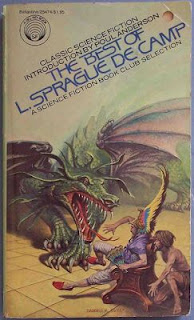
Cover of the short story collection The Best of L Sprague de Camp. Image shows a scene from short story Emperors Fan.
Book collects short stories, poems, & some non-fiction of de Camp. This post is only about short stories; I've dropped poems & non-fiction from ToC below.

Table of contents (only fiction, best first, unread last).

Link on title goes to my post on the story, if there is one. Where I'm aware of an online copy, I provide a separate download link. Links on publisher, editor or year fetch more matching fiction. My rating for individual stories is in brackets.

While there are not many really exceptional stories here, most are quite decent. Only a couple of stories near the end of this list didn't work for me as well.

Most stories are light hearted fun read, often with a cool idea. There are only two dark stories - "The Gnarly Man" & "Judgement Day".
  1. [novelette] "Two Yards of Dragon" (A); Lin Carter (ed)'s "Flashing Swords! #3:Warriors & Wizards" (1976): Adventures dragon hunting.
  2. [novelette] "A Gun for Dinosaur" (A); download; Galaxy, March 1956: Description of flora & fauna of Cretaceous period.
  3.  [ss] "Hyperpilocity" (A); Astounding, April 1938; humor: What if humans started growing hairy pelts?
  4. [novelette] "Employment" (B); Astounding, May 1939: Recreating prehistoric animals from their fossils... 
  5. [ss] "The Command" (B); Astounding, October 1938: An aspiring world dictator is infecting the world with his free will killing mold spores. It's now up to the intelligent laboratory bear to locate the antidote & give it to someone in his lab so the world can be saved... 
  6. [ss] "The Merman" (B); Astounding, December 1938; humor When a man became a fish... 
  7. [novelette] "The Hardwood Pile" (B); Unknown, September 1940: Never pick a fight with a "Norway maple" sprite!
  8. [novelette] "Nothing in the Rules" (B); Unknown, July 1939: What if mermaids were allowed in women's swimming competitions? 
  9. [novelette] "The Guided Man" (B); Startling Stories, October 1952; humor: Call center to help the socially awkward. 
  10. [ss] "The Inspector's Teeth" (B); Astounding, April 1950; humor: Life of a baby-dinosaur like alien as a student at a US university.
  11. [novelette] "The Emperor's Fan" (B); Harry Harrison (ed)'s "Astounding: John W Campbell Memorial Anthology" (1973); humor: Emperor's ultimate defense against potential assassins!
  12. [ss] "The Reluctant Shaman" (B); Thrilling Wonder Stories, April 1947; humor: Some "stone throwing" sprites normally found near some native American tribes are "helping" a businessman & his neighbors. Chaos reins.
  13. [novelette] "The Gnarly Man" (B); Unknown, June 1939: A very long lived pre-human (Neanderthal?) has survived to our times & is living among us!
  14. [ss] "Judgement Day" (B); Astounding, August 1955: A man's ultimate revenge against school bullies.

Fact sheet.

First published: 1978.
Related: Stories of L Sprague de Camp.

Sunday, September 25, 2011

Bob Shaw's "A Full Member of the Club" (novelette, free): Great gadgets whose side effect is to make you avoid most people!

Philip Connor is a wheeler-dealer in all sorts of things. Now, suddenly, his love Angela is no longer interested in him, having become extremely wealthy via an inheritance. During their break up session, he notices she has a curious cigarette lighter - a lighter she doesn't want him to see.

His attempts at patch up later will make him notice more such gadgets. His curiosity to know more about them will lead him to...

Fact sheet.

First published: Galaxy, July 1974.
Download full text from Lexal.
Rating: B.
Among the classics of SCI FICTION edited by Ellen Datlow.
Related: Stories of Bob Shaw.

Saturday, February 12, 2011

Jerry Pournelle's "Extreme Prejudice" (novelette, extreme engineering, free): An ocean-based permanent habitat

What I read here is the description of a huge water-based human habitat. A little portion of it above surface, most of it subsurface. Located somewhere in the Pacific. Sea farming, sea-bed mining, generating electricity by exploiting the ocean's vertical thermal gradient, tame & talking dolphins, ...

What some others at ClassicScienceFiction seem to have read into it are contradictory & unsatisfactory behavior of key actors & background events. I liked it because I only noticed the engineering aspects; if you're more into characters, your mileage might well vary.

See also.

  1. Arthur Clarke's "The Deep Range": Similar sea-based setup.

    The novel is primarily about using whales as cattle - herding, pasturing, milking, & not insubstantial parts about butchering them for meat. Plus bits about deep-sea monster hunting & a bit of Buddhist ideology.

Fact sheet.

First published: Analog, September 1974.
Download full text from Webscription.
Rating: A.
Nominated for Hugo Award 1975 in novelette category.
Related: Stories of Jerry Pournelle.

Wednesday, November 17, 2010

John Varley's "The Persistence of Vision" (novella, utopia, free): Physical misfits create a society where they're the norm

Quote from short story The Persistence of Vision by John Varley
While there are multiple themes here, a substantial part of the story is devoted to language & communications. Say no one had eyes & ears. How would you communicate?

Ending is very abrupt & arbitrary.

Caution: Story includes some sexually explicit scenes.

Story summary.

An epidemic ("German measles, or rubella") left some 5000 children born blind & deaf in its wake. Society is generally caring - in its own way, but they'll always be misfits, & objects of pity. On reaching adulthood, a few dozen of them set out to build a community custom-built for them; one where being deaf & blind is the natural state of being.

Story is the description of their commune, seen from the eyes of a drifter who'll be a drifter no more.

Quotes.

  1. "To protest, one must be aware of the possibility of something better. It helps to have a language, too."
  2. "nothing is moral always, & anything is moral under the right circumstances."
  3. "Why is it that once having decided what I must do, I'm afraid to reexamine my decision? Maybe because the original decision cost me so much that I didn't want to go through it again."

Fact sheet.

First published: F&SF, March 1978.
Download MP3 podcast of the story, read by Spider Robinson. [via Boing Boing]
Note: I've'nt personally heard this MP3; I've only read the original text version.
Rating: A.
Winner of Hugo Award 1979 in novella category.
Winner of Nebula Award 1978 in novella category.
Related: Stories of John Varley.

Tuesday, September 21, 2010

George R R Martin's "... for a single yesterday" (novelette, free): Some choices can be so hard

This is an intensely emotional story - later half of it.

Story summary.

A small group of survivors in a post-apocalypse world has a small quantity of "chronine", a memory drug that makes you remember things with vividness not otherwise possible. Keith, who missed his girlfriend so much, had taken possession of the drug - to time trip to his Sandi. No one minded, seeing his condition.

Now the group has a new, practical, leader who sees a survival value in the drug: to access possibly useful but forgotten information in the heads of the group members. Which side would you vote for - leave it with Keith who obviously needs it so badly, or put it to more practical uses?

Fact sheet.

First published: Roger Elwood & Robert Silverberg (eds)' "Epoch" (anthology, 1975).
Download full text from Lightspeed.
Rating: A.

Wednesday, August 18, 2010

Piers Anthony's "In the Barn" (novelette, animal rights, free): What if humans were cattle?

Touch it only if you can stand fiction that has extreme brutality & porn, & is primarily intended to shock. I'll not be surprised if reactions to it vary greatly - great to one person, hopeless to another.

In a way, this is more brutal variant of Pierre Boulle's "Planet of the Apes". Remove apes from the scene - both sentients & animals are human. And the "animals" have a far worse existence.

Story summary.

Imagine a parallel earth ("Counter-Earth #772") where there are no mammals save humans. Add slavery to the picture - some humans are the property of others. Now distort slavery to a point where slaves become truly animal:
  1. Newborn babies are immediately separated from their mothers, have the use of thumb of their hands physically curtailed, tongue surgically cut off to ensure they will never speak, deprived of all sensory experience during their development years by being confined to a tank where they cannot sense anything & to a dark cell in older years, consciously malnourished so they will develop as mental retards, ...
  2. Females are grown as "cows" in barns, & are used primarily as milk animals. With living conditions similar to those we see in cow sheds here.
  3. Most male newborns are killed because they're useless. Only a few potential "studs" are saved for breeding.
The whole setup is to contrast the situation of these "animals" with the treatment cattle receive in our cowsheds.

Story is from the point of view of Hitch, an investigator from "Earth-Prime" (presumably our earth) to a newly discovered parallel one. He's out to discover why this world is overrun with barns, when there are no cattle. He will spend a day as a barn-hand there.

Fact sheet.

First published: Harlan Ellison (ed)'s "Again, Dangerous Visions" (anthology, 1972).
Download full text from Lycaeum. (Note the linked HTML page has multiple stories; "In the Barn" is the first.)
Rating: B.
Related: Fiction where humans are zoo/lab animals.

Monday, July 12, 2010

Joanna Russ' "When It Changed" (short story, free): It's a women's world!

Author introduces the key premise of this story in a note at the end of the copies linked below: "almost all the characterological sex differences we take for granted are in fact learned and not innate."

Story summary.

Human colonized world of Whileaway had a plague 600 years ago - an event that killed all men. Only women were spared. They figured out a way of breeding, & now have a normal all-women society.

Then come four men from long forgotten earth. And we get into serious (but sometimes funny) communications issues...

See also.

  1. Alice Sheldon's "Houston, Houston, Do You Read?": Time traveling men who arrived from the past must be killed, but only after harvesting their semen, in the all women society right here on earth (men died out long ago).

Fact sheet.

First published: Harlan Ellison's "Again, Dangerous Visions" (anthology, 1972).
Download full text from Internet Archive or Scribd (both links were very slow when I checked just before posting).
Rating: B.
Winner of Nebula Award 1972 in short story category.
Nominated for Hugo Award 1973 in short story category.
Among the Ellen Datlow's Sci Fiction's Classics.

Monday, June 14, 2010

Ursula K Le Guin's "The Word For World is Forest" (novella): Natives throw out ruthless & evil colonists

Cover image of the novella The Word For World is Forest by Ursula K Le Guin
I'll put it among the essential reads of science fiction on colonialism.

In some sense, this is yet another precursor to Hollywood movie "Avatar". While Alan Dean Foster's "Midworld", often cited as the prototype after which Avatar is modeled, focuses more on world building, Le Guin's version has a more strongly demarcated conflict: human colonists ("yumens" to natives) are far more evil, natives (derisively called "creechies" by colonists) are able to repel them by themselves - making the reader root more strongly for the natives.

Story summary.

Colonists from earth want wood from the forest world of Athshe ("New Tahiti" to colonists). So they set about razing the local forests, destroying native cities & villages inside the
forest. There is general genocide of natives, taking some as slaves, routine rapes of their
women.

Natives finally wake up via the hero, Selver. He & his wife were taken slave, his wife
raped & killed by Captain Don Davidson - official villain & personification of the ultimate evil. From this point on, the days of humans on this world are numbered, with Selver organizing & leading the local military raids against colonist camps.

Another individual that is sketched in some detail is colonists' anthropologist, Captain Raj Lyubov - the "good" human.

Quotes.

  1. "The world is always new, however old its roots."
  2. "For four years they've behaved to us as they do to one another. Despite the physical differences, they recognized us as members of their species, as men. However, we have not responded as members of their species should respond... We have killed, raped, dispersed, & enslaved the native humans, destroyed their communities, and & down their forests. It wouldn't be surprising if they'd decided that we are not human."

    "And therefore can be killed, like animals".
  3. "The Athshean word for world is also the word for forest."
    "Athshe, which meant the Forest, & the World."

    This is where the title comes from.

Fact sheet.

First published: Harlan Ellison (ed)'s "Again, Dangerous Visions" (anthology, 1972).
Rating: A.
Winner of Hugo award 1973 in novella category.
Nominated for Nebula Award 1972 in novella category.
Related: Stories of Ursula K Le Guin.

Sunday, February 7, 2010

Larry Niven's "Plaything" (flash fiction, hard sf): Mars rover meet Martians

Paul@Marooned drew my attention to a comment on publisher's site on "Joyride", the story I wrote about yesterday. Comment says that said story is plagiarized from this Niven original. That's how I looked this up in one of Niven's collections.
Update 8 February 2010: The comment referred to above seems to have been deleted from publisher's site!

Having read it now, I would call "Joyride" inspired by this Niven original but not a work of plagiarism. Niven's version, far more interesting of the two, gives careful attention to some details of putting a rover on Mars decades before NASA actually did it; "Joyride" just tries to bring out smiles.

Story summary.

When ABEL ("Automated Biological Laboratory" - that's the rover) touched down on Mars, it was noticed by a group of Martian children playing nearby. They got interested in the lab; story is mostly of kids antics with the lab.

We also meet a couple of Martian adults who know about earth & humans (though we don't know about them). They can actually see, with naked eye! - human activity "on the inner moon" & are now expecting human visitors anytime.

Fact sheet.

First published: Worlds of If, July/August 1974.
Rating: A.
Related: Stories of Larry Niven; Mars & its moons in fiction; fiction from 1970s.

Friday, October 23, 2009

A Bertram Chander's "With Good Intentions" (short story, uplift, free): Idea of a pecking order is fundamental to all animal groups

Quote from short story titled With Good Intentions by A Bertram ChanderVery similar in idea to the first story in Arthur Clarke's "2001 A Space Odyssey", though far less interesting: Lieutenant Grimes, a human explorer on Delta Sextans IV, a world with some animals in ape-like stage, helps the natives discover a primitive bone tool.

But his boss, Captain Tolliver - from a world called Worrall that was destroyed in a nuclear war, is not happy - perhaps disapproving the spreading of the killing madness of humanity.

Fact sheet.

First published: A Bertram Chandler's collection "The Hard Way Up" (1972), as part of an Ace Double.
Rating: B.
Download full text from Webscription.
Related: Stories of A Bertram Chandler.

Tuesday, October 13, 2009

Howard L Myers' "Omar Olivine" series of short stories

I know of 3 online stories from the series, & they're are the only ones I've read. Not sure if they're are all of series.

Central character in the series is a corrupt cop turned renegade - Omar Olivine. Described as a supercriminal - only he always tends to fall short of cops (or rather, the super AI the cops have).

Series is space opera, though most action in first two stories occurs on a single world.

Nothing particularly strong about the series, though I liked the last story - "Polywater Doodle" - more than the other two.

List below is in chronological order of action in the stories, which is also the order they were published in & the order I read them in. But I think they can be read in any order; each story provides enough background.

  1. [ss] "His Master's Vice" (B) (as by Verge Foray); download; Analog, May 1968: A spaceship that is afraid of heights!

    Olivine, hiding on a world called Roseate, has seriously compromised the local government & collected a lot of loot from treasury. A cop named Elmo Ixton will catch him & recover the loot - thanks in part to the acrophobic ship.
  2. [novelette] "The Pyrophylic Saurian" aka "The Pyrophilic Saurian" (B); download; Analog, January 1970: A parasitic weed (that happens to be a super narcotic substance) grows on the body of some dinosaurs on a Jurassic Park of a world called Dothlit Three.

    Olivine has staged a prison escape with a rag tag group. The group is raiding this world because he believes it contains something very valuable. They'll discover the narcotic, harvest it, but 3 of the group of 6 will become addicts to be left behind & the 3 who run with the harvest will also end up losing it due to an "accident".

    "Pyrophylic" in title probably means "fire loving"; the fire-breathing animals use fire to groom each other! "Saurian", of course, is a class of dinosaurs.
  3. [novelette] "Polywater Doodle" (B); download; Analog, February 1971: An alien life form made entirely of a polymer-form of water!

    Olivine get dumped on Flandna - an uninhabited world with poisonous & carnivorous plants - by the two companions he escaped with narcotics in "The Pyrophylic Saurian". Here he'll be caught by a tenacious local plant that uses its animal catches for fertilizer rather than direct food! He will eventually win his freedom & kill the plant, in the process discovering the curious local life form - an animal composed entirely of polywater & having a metabolism based on a remark of Richard Feynman.
    Note: Polywater, now disproved, was believed to be a polymer state of water in late 1960s & 1970s.

    Olivine will make a pet of this animal, will be arrested by cops again, will manage to "steal" a supership of cops with what he believes is the help of his pet but is perhaps a setup by cops for their own ends...

Notes.

  1. "Proxad" - "proxy admiral" - is a rank of field cops often used in these stories.

Fact sheet.

Related: Stories of Howard L Myers.
Credits: Some of the information here comes from ISFDB.
All entries also appear in the stories from John Campbell's Astounding/Analog..

Monday, October 12, 2009

Howard L Myers' "Fit For a Dog" (short story, horror, free): When humans were dog food

I might have called it chilling, but it cheats - killing much of the effect. But it's action packed.

Story summary.

Some sort of catastrophe moved humans into closed cities because air had become unbreathable. Dogs have since had a field day in rest of the world.

Now dogs are the dominant species & use humans for food - with humans generally content with their fate as dog food!! In spite of the fact that dogs must use muscle power like they always did, & humans still have both the brains & technology - airplanes, helicopters, machine guns, ...!

Much of the action is of a single hunt. An airplane has crashed in open country, & dogs are hunting humans.

Fact sheet.

First published: F&SF, September 1971.
Rating: B.
Download full text from Baen CD or Webscription.
Related: Stories of Howard L Myers; Dog stories.

Sunday, October 4, 2009

Howard L Myers' "Health Hazard" (short story, satire, free): Leave aboriginals alone vs "uplift them" debate

Quote from short story titled Health Hazard by Howard L MyersThis beautiful but complex story describes the contact of a tribe of aboriginals with two groups of "civilized" people - those who don't mind the civilization affecting the locals' way of life, & those who would rather leave the locals to their pristine state of innocence.

Aboriginals are "chimos" & "chimees" of a world called Notcid; "civilized" ones are men & women of earth. Story is described from the point of view of Romee, a chimee. Of course, the civilization begins touching the locals, eventually in a way that is promising to have survival value.

Notes.

Story has some funny jokes on substance abuse & protecting the young from strenuous effort, & the crazy ways States sometimes handle them. I could see some parallels in India - both related to tobacco/alcohol campaigns & the recent efforts of Delhi to "protect" the high school students from board exams.

Fact sheet.

First published: Analog, January 1973.
Rating: A.
Download full text from Baen CD.
Related: Stories of Howard L Myers.

Friday, October 2, 2009

Howard L Myers' "The Other Way Around" (short story, time travel, humor, free): Who really built the Stonehenge?

Quote from short story titled The Other Way Around by Howard L MyersThis story will likely make more sense to readers familiar with European history - conditions following the end of Roman occupation, rigidity of Church beliefs in eighth century, Englishman vs Frenchman jokes, a couple of kings, ... and, of course, the Stonehenge.

I ended up having good fun in spite of lack of familiarity with the above; I just kept ignoring the unfamiliar.

Story summary.

All the action happens in the eighth century England.

A young man named Raedulf of Clerwint, employed by King Lort as "chronicler", has been chasing a powerful & feared magician ("magicker"). King has sent him to query the wise magician whether the king is related by bloodlines to another fabled king, & if yes, how can he locate the empire of the fable & claim it!

Young man will get a lot of education when he meets the magician...

Fact sheet.

First published: Robert Hoskins (Ed)'s "Infinity Two" (anthology). 1971.
Rating: A.
Download full text from Baen CD.
Related: Stories of Howard L Myers.

Thursday, October 1, 2009

Howard L Myers' "Out, Wit!" (short story, irony, free): Wrapper matters more than its contents!

Quote from short story titled Out, Wit by Howard L MyersAmong the best of science fiction.

Story summary.

Jonathan Willis is a brilliant but brash young physicist who's figured out something fundamental about the universe. It's a sad story of his tactlessness hurting the pride of his seniors whose vengeance not only kills his reputation & career but lets someone else take credit for his work.

Fact sheet.

First published: Analog, June 1972.
Rating: A.
Download full text from Baen CD.
Listed among the stories from John Campbell's Astounding/Analog.
Related: Stories of Howard L Myers.

Friday, September 18, 2009

Alice Sheldon's "Love is the Plan the Plan is Death" (as by James Tiptree, Jr) (short story, free): Fighting instincts can be fatal

A species of animals, physically alien but with sexual & reproductive behavior similar to many familiar animals. "Plan" in the title is a substitute for "instinct"; story is of an individual's futile fight against the instinct.

Story summary.

Told from the point of view of Moggadeet, a "male" of the species that hibernate in winter.

Born in winter, chased away with his litter by mother at the end of winter as the litter changed fur color from golden (babies) to black (males) & red (females).

His first summer alone. Instinct that takes him go to caves for hibernation at the beginning of winter. His meeting the "Old One" who instructs him on his species instincts, & whom he will eat for food in winter.

His second summer & coming of age. His killing of his brother Frim for the jointly coveted lady love, Lilliloo. His instinct to keep his lady love bound up in silks his body secretes & his loving care of her. Suspecting he will kill her for food in winter, he begins gathering food - so there will be plenty for both in winter.

Coming of winter & his sexual arousal, & finally impregnation of Lilliloo. Fighting instinct & against protests of Lilliloo, his releasing of her from silken bonds. Only she now is too big, & has the instinct to eat her male partner!

Fact sheet.

First published: Stephen Goldin (Ed)'s "The Alien Condition" (anthology, 1973).
Rating: A.
Download full text from Internet Archive.
Included in Classics section of Ellen Datlow's SciFiction.
Nebula Award 1973 winner in short story category.
Hugo Award 1974 nominee in novelette (?) category.
Related: Stories of Alice Sheldon (as by James Tiptree, Jr).award

Friday, August 14, 2009

Hal Clement's "Star Light" (novel): Exploring a high gravity world with weird atmosphere & hydrosphere

Cover image of the novel titled Star Light by Hal ClementThis is often listed as one of the two sequels to "Mission of Gravity". Other book, "Close to Critical", didn't really read like a sequel to me, but this one has a much better claim to being the sequel to the legendary original (& a very worthy sequel). The story is generally independent of "Mission of Gravity"; so should be comprehensible even to readers who haven't read the better known book.

Caution: Hal Clement is not for everyone (with the exception of "Needle", which should be quite accessible to anyone used to sf). His stories often require a science background at least to the level of 10+2 school, & then some taste for a certain kind of story - in this case, essentially a description of the weird world.

Story summary.

Dhrawn has a weird hydrosphere - rather than mostly water on earth, it's a mixture of water & ammonia. And phase transitions of the mixture are apparently very weird - like when ambient temperature is nearly fixed or is slightly rising, a flowing river can freeze based on evaporation or condensation of ammonia! We see a lot of weird behavior like this.

Action happens primarily in 3 theaters:
  1. Main & the most interesting thread is aboard Kwembly, a huge land based research vehicle with a 100 staff of Mesklinites (from "Mission of Gravity"). Dondragmer, #2 aboard the local ship in "Mission of Gravity", is the captain. Another key character here is Beetchermarlf, a young apprentice.

    Why Mesklinites? This is a huge 40g world & very cold; so they're recruited for surface investigation.

    This vehicle keeps getting in trouble because of the weird atmosphere: frozen ground suddenly turns into liquid after some precipitation, vehicle gets deposited by a flood at a large angle in a flowing river that promises to become far nastier, river suddenly freezes trapping vehicle & maintenance crew underneath, ...
  2. Aboard a space station in geosynchronous orbit is the human team. They operate a bunch of low-orbit remote sensing satellites, & remotely guide Mesklinites on ground.

    Communications with Mesklenites get somewhat complicated because the geosynchronous orbit for this very slow rotation world is 6 million miles from surface - means 64 seconds round trip signal travel time.

    Key characters from among the large staff are: Alan Aucoin, the administrator of project; Elise Hoffman (aka Easy), main non-technical communications contact with Mesklenites on ground & an expert in Stennish, the Mesklinite language; Benj, Easy's teenage son doing apprenticeship who gets deeply involved in some disaster rescues; & Ib, Easy's super smart husband who speaks little & understands a lot.

    We are told two alien species - Drommian & Paneshk - have joined hands with humans in these investigations, but we never meet them. Drommian also appeared in "Close to Critical", but I don't recall Paneshk mentioned in another Clement story.
  3. In Mesklinite "Settlement" on ground - the main local research facility headed by Barlennan, the captain of the ship in "Mission of Gravity". He has an agenda of his own, but as a reader, I found his hidden agenda here as uninteresting as similar one was in "Mission of Gravity".

    50 years have passed since "Mission of Gravity". No humans from the period survive, but we're told Mesklinite have much longer life expectancy. Hence two Mesklinites from old story, but all humans are new.

Fact sheet.

First published: Analog, June/July/August/September 1970 as a 4-part serial.
Rating: A.
Listed among the stories from John Campbell's Astounding/Analog.
Related: Stories of Hal Clement.

Friday, June 26, 2009

Hal Clement's "A Question of Guilt" (novelette, medical research): Dark underbelly of healing profession

Quote from the short story titled A Question of Guilt by Hal ClementThis is noteworthy among Clement's stories for 2 reasons:

  1. It has the darkest ending among all his stories I've read so far. Should be among the darkest by anyone.
  2. It's set in the past - during the time of Roman empire - rather than future. Of course, that doesn't come in the way of it being Clement's hallmark hard sf.

Story summary.

Having lost 3 of his sons to a genetic disorder that made their blood very slow to coagulate (meaning lot of blood loss on minor cuts), Marc of Bistrita is desperate to do whatever it takes to fix the problem that is also affecting his fourth & sole 5 year old surviving son Kyros.

He has tried everywhere & no healer in Roman empire seems to have an idea. During his own efforts to discover a cure, Marc will end up kidnapping & killing a little child from neighboring village.

By the end of the story, his son & wife Judith would be dead. And he would be determined to continue with research, with the support of his slave/maid Elitha - no matter how many more children need to be kidnapped & killed as guinea pigs!!

A curious gadget.

Main idea Marc pursues during the story is a gadget for blood transfusion. Both he & his wife are willing to donate as much blood as necessary to save the bleeding child, but how to transfer this blood?

He cooks up a funnel. Here is how he makes it:
  1. Boil the head of a viper. Then carefully extract a fang. Nature has made its end small enough to enter a human vein!
  2. It's larger end will be connected to the hollow of the stem of a chicken's wing. (I didn't know the stems of birds' wings were hollow!)
  3. A cup of gold will be attacked to the top of the stem. Gold itself is easily available in the form of local currency (gold coins), & is easy enough to melt at home! He will use a clay vessel to shape it.
  4. Joints of cup & feather, & feather & fang - are sealed with some sort of readily available sticky material.
Idea is to make a cut in the arm of donor, pour the blood in the cup with fang end connected to child's vein!

Contraption won't work because both parents have normal blood & it quickly coagulates in the hollow of the fang.

His own son will die when his wife tried donating the blood to bleeding child. Faced with coagulation problem in fang, she simply inserts feather into child's vein - bleeding the child even more. Guilt will make her kill herself.

Fact sheet.

First published: Gerald W Page (Ed)'s "The Year's Best Horror Stories: Series IV" (1976). DAW Books.
Rating: A.
Related: Stories of Hal Clement.

Thursday, May 7, 2009

John Varley's "Bagatelle" (novelette, terrorism, free): Defusing a human bomb

Quote from short story titled Bagatelle by John VarleyIn spite of the subject, it's a very light read - sometimes even funny.

Story summary.

Hans Leiter has agreed to become an unusual kind of suicide bomber - a cyborg bomb. Stripped of body - just his brain & nerves leading to it will go into this bomb. And it is a nuclear bomb - capable of devastating a whole city. The cyborg that is the man + bomb + a vehicle + the sensors that let the cyborg perceive & respond to environment. The bomb has planted itself in the middle of a busy shopping area, & has announced its intention to blast in 4 hours!

This is the story of defusing this complex bomb - Chief of Municipal Police for New Dresden, Anna-Louise Bach, has hired the bomb disposal expert Roger Birkson for the job. New Dresden is a city on moon, where the action happens.

Fact sheet.

First published: Galaxy, October 1976.
Rating: A.
Download full text from Internet Archive.
An audio version of this story is included, among other things, in Aural Delights #32 podcast of StarShipSofa.
Included in Ellen Datlow's SciFiction classics.
Related: Stories about terrorism, cyborgs, or moon.