Showing posts with label 1973. Show all posts

Monday, April 9, 2012

Jack Vance's "Rumfuddle" (novella, mystery): To improve human history, put would-be evildoer babies elsewhere

Quote from short story Rumfuddle by Jack Vance
Couple of caveats first, particularly for readers from the East:
  1. This is the first story of Vance where I found a para obnoxious for racist reasons - Orientals are dirt, filthy; the idiots need to have the superior western world view forced; etc. A character says it, & I understand that may or may not reflect author's views. Still...
  2. Significant parts of the story refer to figures from European history, & parts of Asian history presumably well known in the West. Mostly, but not always, to villains from history. A lot of them were unfamiliar to me; story may mean more to those better familiar with these figures.
  3. There is a sentence in the story that could cause riots in some Muslim countries. I won't quote it.
Key science fictional device in the story is a portal that can instantly convey you to:
  1. another world somewhere in galaxy or outside it, similar to Clifford D Simak's "The Big Front Yard".
  2. to a time & place in earth's past.
  3. Either of the above in a parallel universe. Actually, if I understand correctly, travel to past is always to a parallel earth rather than ours.
"Rumfuddle" is a kind of party; "Rumfuddlers" are party-goers. The origins of Rumfuddlers are pious: do-gooders who travel to the past to remove history's evil doers like Hitler, when they're still babies, to other environments, where they won't grow up to do evil. With time, the execution of the idea degenerates, & has to be eventually stopped.

Story summary.

Gilbert Duray works on earth but lives at Home, a whole world to himself, as many others do in this universe of infinite available worlds. His children go to school on earth too! Transport is easy - you step through the "passway", as you would cross a door.

One fine day, Gilbert finds the portal back home "closed" when returning from work. Checks elsewhere show all portals to his Home are closed. It means his wife & three daughters are now marooned, forever cut off from him & rest of humanity.

Story is of his work on unraveling the mystery. Happy ending, eventually.

Notes.

  1. Story uses the word "cognate" to designate "corresponding" in a parallel universe. A parallel earth is a cognate earth. Gilbert from our earth meets his wife Elizabeth's cognate in a parallel earth. Etc.
  2. Evil-doers are removed as babies, presumably from a parallel earth, to our universe, at least in some cases. Means our own history is unaltered? Only some parallel universes get a better history? Going to so much trouble changing history for betterment in a parallel world! Sounds too idealistic to me.
  3. How come time never comes in the way traveling instantly across worlds? I mean, kids go to school & papa goes to office in the morning - where morning at Home & in office world or school world is always the same?

Collected in.

  1. David G Hartwell (ed)'s "The Science Fiction Century".

Fact sheet.

First published: Robert Silverberg (ed)'s "Three Trips in Time and Space" (1973).
Rating: B.
Related: Stories of Jack Vance.

Sunday, April 8, 2012

L Sprague de Camp's "Emperor's Fan" (short story, magic, humor): Emperor's ultimate defense against potential assassins!

Quote from short story Emperors Fan by L Sprague de Camp
Emperor, always fearful of assassination, has finally got the ultimate weapon against the potential assassins: an old magical fan. You open it, & fan it on someone; the one fanned at vanishes! Where do they vanish? "One theory ... is that they are translated to a higher dimension, coexistent with this one. Another holds that they are dispersed into constituent atoms, which, however, retain such mutual affinities that they can be reassembled when the signal for recall" is given.

This recall signal is in the form of a code. You fold the fan, & tap your left wrist, right wrist, & forehead in a certain sequence & a certain number of times. One code recalls the vanished kings, another vanished prime ministers, another vanished dragons, another vanished beggars, ... A little code book documents "all the categories of organic beings subject to the fan's power."

So we have fun as the king & sundry power usurpers use the fan, & adventures of one of them trying to reconstruct the lost code book experimentally.

Collected in.

  1. "The Best of L Sprague de Camp".

Fact sheet.

First published: Harry Harrison (ed)'s "Astounding: John W Campbell Memorial Anthology" (1973)
Rating: B.
Related: Stories of L Sprague de Camp.

Sunday, October 4, 2009

Howard L Myers' "Health Hazard" (short story, satire, free): Leave aboriginals alone vs "uplift them" debate

Quote from short story titled Health Hazard by Howard L MyersThis beautiful but complex story describes the contact of a tribe of aboriginals with two groups of "civilized" people - those who don't mind the civilization affecting the locals' way of life, & those who would rather leave the locals to their pristine state of innocence.
Aboriginals are "chimos" & "chimees" of a world called Notcid; "civilized" ones are men & women of earth. Story is described from the point of view of Romee, a chimee. Of course, the civilization begins touching the locals, eventually in a way that is promising to have survival value.

Notes.

Story has some funny jokes on substance abuse & protecting the young from strenuous effort, & the crazy ways States sometimes handle them. I could see some parallels in India - both related to tobacco/alcohol campaigns & the recent efforts of Delhi to "protect" the high school students from board exams.

Fact sheet.

First published: Analog, January 1973.
Rating: A.
Download full text from Baen CD.
Related: Stories of Howard L Myers.

Friday, September 18, 2009

Alice Sheldon's "Love is the Plan the Plan is Death" (as by James Tiptree, Jr) (short story, free): Fighting instincts can be fatal

A species of animals, physically alien but with sexual & reproductive behavior similar to many familiar animals. "Plan" in the title is a substitute for "instinct"; story is of an individual's futile fight against the instinct.

Story summary.

Told from the point of view of Moggadeet, a "male" of the species that hibernate in winter.

Born in winter, chased away with his litter by mother at the end of winter as the litter changed fur color from golden (babies) to black (males) & red (females).

His first summer alone. Instinct that takes him go to caves for hibernation at the beginning of winter. His meeting the "Old One" who instructs him on his species instincts, & whom he will eat for food in winter.

His second summer & coming of age. His killing of his brother Frim for the jointly coveted lady love, Lilliloo. His instinct to keep his lady love bound up in silks his body secretes & his loving care of her. Suspecting he will kill her for food in winter, he begins gathering food - so there will be plenty for both in winter.

Coming of winter & his sexual arousal, & finally impregnation of Lilliloo. Fighting instinct & against protests of Lilliloo, his releasing of her from silken bonds. Only she now is too big, & has the instinct to eat her male partner!

Fact sheet.

First published: Stephen Goldin (Ed)'s "The Alien Condition" (anthology, 1973).
Rating: A.
Download full text from Internet Archive.
Included in Classics section of Ellen Datlow's SciFiction.
Nebula Award 1973 winner in short story category.
Hugo Award 1974 nominee in novelette (?) category.
Related: Stories of Alice Sheldon (as by James Tiptree, Jr).award

Saturday, June 14, 2008

Alice Sheldon's "The Women Men Don't See" (as by James Tiptree, Jr) (novelette, free): A woman is very unhappy in a male dominated society

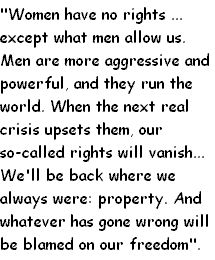
Quote from short story titled The Women Men Don't See by James Tiptree, JrThis might have been ok (if not great) non-genre story, but the completely unnecessary introduction of aliens near end & bizarre ending ruined it for me.

Story summary.

Much of it is an adventure story. A woman, Ruth Parsons, has hired a private plane piloted by Captain Estéban, & is taking a trip to somewhere in South America with her daughter Althea. She will also take a hitchhiker, Don Fenton (the narrator), on board.

On the way, there is plane crash, & the four are stranded in a small wet place with no freshwater & no hope of early rescue.

Ruth & Don will go looking for fresh water, & end up spending a couple of nights away from crash site. That's where we get the background of Ruth filled up. She never married, nor did her mother, & hopefully her daughter too will not marry - though the daughter hopefully have bear the child of Captain Estéban, now that she's alone with him. We learn that Ruth is carrying major rage inside her against a male dominated society.

While on their camping site beside a river when out looking for fresh water, she'll find a curious object, & instantly know it's an alien artifact. Aliens - students on earth! - come looking for it in the morning in their boat. She successfully bargains with them to be taken to their world, away from this male dominated world, along with her daughter - never to return!

Fact sheet.

First published: F&SF, December 1973.
Rating: B
Download full text from Internet Archive.
Included in Ellen Datlow's Sci Fiction classics.
Related: All stories as by James Tiptree, Jr.

Wednesday, April 23, 2008

The Science Fiction Hall of Fame: Series summary

According to Silverberg's introduction to Vol 1, the series was created in early days of the founding of SFWA. While Nebula Awards recognize recent stories each year, the idea of Hall of Fame series was to recognize stories before the founding of Nebula Award - sort of one time equivalent of Retro Hugo.

Process of story selection was similar to that of Nebula Awards; so it's convenient to look at the series as Nebula Awards for stories written before official annual Nebulas.

Voting was in two categories - stories up to 15,000 words (short story & novelette), & those larger in size (novelette, novella, novel). Former went into Volume 1 (1970), edited by Robert Silverberg; later into Volume 2 (1973) edited by Ben Bova. Vol 2 is in turn split into 2 books - 2A & 2B because of too much material. In the entire set, there is only one novel (in Vol 2A); everything else is short fiction.

And, with very few exceptions, the selections are from a period of about 30 years preceding Nebulas. A total of 26 stories in Vol 1, & 11 each in Vol 2A & 2B. Means less than 2 stories for each year - mostly in short fiction category.

According to Ben Bova's introduction to Vol 2A, there were two more stories of larger than 15,000 words that qualified but "were unavailable for this anthology": Walter M Miller, Jr's "A Canticle for Leibowitz", & Ray Bradbury's "The Fireman". Former is now more readily available in an edited & renamed avatar - "Fiat Homo", the first of the 3 stories included in the fix-up novel also called "A Canticle for Leibowitz". According to Wikipedia, Bradbury's novella "The Fireman" was itself an expansion of an earlier short story "Bright Phoenix"; novella was later expanded into the much better known novel "Fahrenheit 451".

Over the years, there seem to have been extensions - sort of milking the "Hall of Fame" brand as a franchise. So there have been Vol 3 (1981) edited by Arthur Clarke & Geo W Proctor, & Vol 4 (1986) edited by Terry Carr - both containing stories that have won normal Nebulas.
Note: If you landed here looking for ToCs of these two volumes, here are external links to them: Vol III & Vol IV.

There are also two Ben Bova volumes from 1975 - "Science Fiction Hall of Fame: The Novellas" - Book 1 & Book 2. I don't really know their rationale. Their contents seem to be subsets of Vol 2A & 2B.

For the moment, I'm only interested in original pre-Nebula content. Hence only 3 links below; links are to detailed reviews of the books.

The Series (3 books).

  1. Robert Silverberg (Ed)'s "The Science Fiction Hall of Fame: Volume One, 1929-1964" (1970): 26 stories, all read.
  2. Ben Bova (Ed)'s "The Science Fiction Hall of Fame: Volume Two A" (1973): 11 stories, all read.
  3. Ben Bova (Ed)'s "The Science Fiction Hall of Fame: Volume Two B" (1973): 11 stories, few read.

[2A] Ben Bova (Ed)'s "The Science Fiction Hall of Fame, Volume Two A": Annotated table of contents

This is actually the first part of the Volume 2 - split into A & B because it's too big, according to editor's note. I recently got it - so "annotated" part of title is rather sparse yet. But it will be filled up - eventually!

Table of contents (11 stories, best first, unread at end).

  1. [novella] Eric Frank Russell's "... And Then There Were None" (A); download; Astounding, June 1951; science fiction, humor; later expanded into the novel "The Great Explosion": A gang of imperialists is frustrated by a planetful of Gandhian natives.
  2. [novel] H G Wells' "The Time Machine" (A); download text, audiobook; 1895; science fiction: Speculations on the twilight of humanity & of earth. Two things about the novel really touched me: first 2 chapters of preparations is among the best time travel stories I've seen; & when looking at humanity's twilight, he uses as model the current social divisions of society - haves & have nots, taken to their extreme conclusion. I've also collected some quotes from this novel.
  3. [novella] Henry Kuttner & C L Moore's "Vintage Season" (as by Lawrence O'Donnell) (A); Astounding, September 1946; science fiction: Uncaring future time travelers visit our time on vacation to enjoy a major disaster!
  4. [novelette] Poul Anderson's "Call Me Joe" (A); Astounding, April 1957; cyberpunk: Help for those with sound minds but with withered bodies - whether withered by an accident, violence, old age or disease.
  5. [novella] John W Campbell, Jr's "Who Goes There?" (as by Don A Stuart) (A); download; Astounding, August 1938; science fiction, thriller: Curious figuratively & inadvertently open the bottle to let the djinn out, & all hell breaks loose.
  6. [novella] Theodore Sturgeon's "Baby Is Three"; Galaxy, October 1952: While I've not read this stand alone version, I have read the fix up novel based on it - "More Than Human". Novelization is really 3 related but independent stories, second of them titled "Baby Is Three". I don't know how closely the version included in novel corresponds to this stand alone version, but novel includes a much better story - "The Fabulous Idiot". My ranking of this story here is based on the assumption that it's close enough to this story in novel version.
  7. [novella] Robert A Heinlein's "Universe" (A); Astounding, May 1941; science fiction: A very well written variation of a technology civilization falling on primitive times, & eventually a hero who sees the possibility of a different future. Story is set on a huge slower-than-light spaceship - originally headed for Centauri on a 60 year journey but now adrift in space for unknown reasons for hundreds of years; descendants of crew form this primitive society & a religion around the ship's documents they've inherited.
  8. [novelette] C M Kornbluth's "The Marching Morons" (A); Galaxy, April 1951; satire: A variation on "selling ice to Eskimos" theme. A no-morals man from our time ends up in a future where average IQ is 45, & there is an exclusive breed of smarter people confined to Antarctica. In a deal that promises to make him the ultimate dictator, this man helps the smart ones kill off rest of humanity by selling them a story that makes them want to march off to their death.
  9. [novelette] Jack Williamson's "With Folded Hands" (A); download MP3; Astounding, July 1947: Benign robots have turned humans into worthless beings with no hope. I actually don't like it's negativity much, but rating it B would have moved it below many stories far less well written!
  10. [novella] Lester del Rey's "Nerves" (A); Astounding, September 1942; science fiction: Description of a serious accident at a facility manufacturing nuclear products - relief & containing the damage. There is a super hero too. My only gripe is - it's much too long.
  11. [novelette] Cordwainer Smith's "The Ballad of Lost C'Mell" (B) Galaxy, October 1962; science fiction: A political story - probably modeled after the slavery years in the US, but told symbolically. A society where some have normal citizen rights; others are treated as disposable animals. A man from privileged group helps the underprivileged fight for their civil liberties.
First published: 1973
Book is subtitled "The Greatest Science Fiction Novellas of All Time Chosen by the Members of The Science Fiction Writers of America".
Note: Terminology seems to have changed since publication of this book. It seems to call everything above 15,000 words "novella".
Related: SFWA's entire Science Fiction Hall of Fame series.

[2B] Ben Bova (Ed)'s "The Science Fiction Hall of Fame, Volume Two B": Annotated table of contents

This is actually the second part of the Volume 2 - split into A & B because it's too big, according to editor's note in 2A. I don't have it; adding now only for completeness' sake. But will get to it.

My rating is in brackets (ABC: A = worth your time; C = don't bother).

Table of contents (11 stories, best first, unread at end).

  1. [novella] Isaac Asimov's "The Martian Way" (A); Galaxy, November 1952: Martian colonists, to get an upper hand in a diplomatic row with earth, have worked out technology to move an iceberg from a ring of Saturn to Mars (to meet their water needs)!
  2. [novella] Clifford D Simak's "The Big Front Yard" (A); Astounding, October 1958; science fiction: When aliens introduced humans into the cosmic community of rational beings.
  3. [novelette] James H Schmitz's "The Witches of Karres" aka "Karres" (A); Astounding, December 1949; space opera: I've only read its longer novelized version; am assuming this original shorter version is similar. It's usual space opera, but features a community of supermen/women ("witches" of title) have unusual mental abilities.
  4. [novelette] Jack Vance's "The Moon Moth" (A); Galaxy, August 1961; science fiction, humor: Hunting a criminal in a society where everyone wears a mask!
  5. [novelette] Wilmar H Shiras's "In Hiding" (A); Astounding, November 1948; science fiction: A child prodigy is forced to perform at the level of his peers.
  6. [novella] Frederik Pohl's "The Midas Plague" (B); Galaxy, April 1954; science fiction, humor: What if law required you to consume at least a certain amount?
  7. [novelette] E M Forster's "The Machine Stops" (B); download; 1909: A future dystopia where intelligent machines are gods to humans.
  8. [novelette] James Blish's "Earthman, Come Home"; Astounding, November 1953: Not read.
  9. [novella] Algis Budrys' "Rogue Moon"; F&SF, December 1960: Not read.
  10. [novella] Theodore R Cogswell's "The Specter General"; Astounding, June 1952: Not read.
  11. [novelette] T L Sherred's "E for Effort"; Astounding, May 1947: Not read.
First published: 1973
Book is subtitled "The Greatest Science Fiction Novellas of All Time Chosen by the Members of The Science Fiction Writers of America".
Note: Terminology seems to have changed since publication of this book. It seems to call everything above 15,000 words "novella".
Related: SFWA's entire Science Fiction Hall of Fame series.