Showing posts with label Thrilling Wonder Stories. Show all posts

Tuesday, March 11, 2014

Fredric Brown's "Knock" (short story, alien invasion, free)

Going by the comments online, it appears to be among the better known stories of Brown. Not a very believable conclusion, but light fun read.

Story summary.

Aliens called "Zan" have raided earth. They took a few hundred animal specimen alive - among them a man & a woman, & killed off all other life on earth. These specimen, including the humans, have now been put as exhibits in a zoo on earth, & this advanced raiding party of aliens is preparing to claim earth as permanent residence.

The man will pull off a coup of sorts, scaring aliens enough with his
ingenuity to make them leave earth...

Collected in.

  1. Everett F Bleiler & T E Dikty (eds)' "The Best Science Fiction Stories: 1949".

Fact sheet.

First published: Thrilling Wonder Stories, December 1948.
Download full text.
Download audio of X Minus One radio adaptation of this story from Internet Archive. (alt MP3 link)
Rating: A.
Related: Stories of Fredric Brown.

Wednesday, October 16, 2013

Henry Kuttner's "Sword of Tomorrow" (novella, adventure, free)

One of the illustrations accompanying the original publication in Thrilling Wonder Stories magazine of novella Sword of Tomorrow by Henry Kuttner
This is a complicated & very pulpish adventure in far future.

Story summary.

A US soldier is a prisoner of war of Japan near the end of WWII, held captive somewhere in China. From a fellow prisoner, he learns Tibetan "self-hypnotism", & goes into hibernation to avoid questioning.

War ends. A bombing raid destroyed his prison, & entombed him. No one finds him. There he lay hibernating for eons.

Eventually, he wakes into a future where continents don't look familiar & stars aren't familiar. Humans have since fallen to savagery, & again built a civilization, but historical trauma has made it impossible for them to conceive weapons, though they can build all other kinds of gadgets.

A would be dictator would see an opportunity when our hero comes into his time...

Fact sheet.

First published: Thrilling Wonder Stories, September 1945.
Read online at UNZ. Or download HTML from Arthur's Bookshelf or BookReader.
Rating: B.
Related: Stories of Henry Kuttner.

Friday, October 11, 2013

Henry Kuttner & C L Moore's "Baby Face" (novelette, body snatching, free): "Baby's Day Out", from many decades earlier

An illustration accompanying the original publication in Thrilling Wonder Stories magazine of short story Baby Face by Henry Kuttner and C L Moore. Image shows the grown up man in baby's body encouraging the gorilla to put on the mind exchange cap.
So now we know the story of the "Baby's Day Out" (1994) is at least this old!

Story summary.

To figure out why a baby is crying, a mad scientist uses his latest invention: to exchange the mind of his friend, minding the baby, with the baby - so friend in baby's mind can find out what is wrong!

That's when Nazi spies steal the brain exchange gadget. So we are left with: the grown up man is in baby's body, baby in grown up man's body, & scientist injured & unconscious. And the man in baby's body overheard the spies will pass on the gadget to a contact on circus that night.

So now it's up to the hero, in baby's body, to ensure the gadget doesn't fall in enemy hands...

Fact sheet.

First published: Thrilling Wonder Stories, March 1945.
Read online at UNZ.
Rating: B.
Related: Stories of Henry Kuttner, C L Moore.

Wednesday, September 18, 2013

Arthur K Barnes & Henry Kuttner's "The Energy Eaters" (novelette, monster, free): When a human city was overrun with electricity eaters!

Picture of Henry Kuttner, included with the original publication in Thrilling Wonder Stories of short story The Energy Eaters by Arthur K Barnes and Henry Kuttner.This is another "Hollywood on the Moon" story. Set mostly in the lunar city of Hollywood on the Moon, but no movie shooting here.

Image on the right is a picture of Henry Kuttner included with the original magazine publication of the story.

Story summary.

Gerry Carlyle, the interplanetary adventurer, is a headache for Nine Planet Films, Inc: whenever they release a movie featuring exotic life forms of other worlds, she goes there & brings back live animals to earth - so people prefer going to zoo rather than movie theater!

Anthony Quade of Nine Planet has an idea: to bribe her with an exotic alien animal no one has seen, in return for promise to not spoil the company's movie releases. To this end, he's captured some "Promethians", little furry-looking creatures from the "day side" of Mercury. Creatures that feed on electricity & radiation.

Before anyone can do anything, the cute little creatures overrun the city of Hollywood on the Moon, threatening the lives of everyone...

See also.

  1. Fredric Brown's "The Waveries": Electricity eating alien invaders make use of electricity impossible on earth.

Fact sheet.

First published: Thrilling Wonder Stories, October 1939.
Read online at UNZ.
Rating: B.
Related: Stories of Henry Kuttner.

Monday, September 16, 2013

Henry Kuttner's "Suicide Squad" (novelette, space stuntmen, free)

One of the illustrations accompanying the original publication in Thrilling Wonder Stories magazine of the short story Suicide Squad by Henry Kuttner.This is the third movie-filming story I've read of Kuttner in a row, though it doesn't mention "Hollywood on the Moon". Its movie studios are located on Callisto, & action scenes are shot presumably in space near it.

Main movie shooting story is framed in another story of a giant, powerful, & corrupt space corporation that ruins careers of its pilots as it finds scapegoats for its own sins. A pilot harmed this way & his friend will go become movie space-stuntmen.

Fact sheet.

First published: Thrilling Wonder Stories, December 1939.
Read online at UNZ.
Rating: B.
Related: Stories of Henry Kuttner.

Saturday, September 14, 2013

Henry Kuttner "Doom World" (novelette, adventure, free): A precursor to Jurassic Park!

This is a sequel to author's "Hollywood on the Moon", & is completely set on moon.

There is too much similarity to Jurassic Park that was still many decades into future. Artificially engineered dangerous beasts at a place that is not their natural habitat. Nature takes over, safeguards break down, & mayhem results.

Story summary.

The story happens on the sets of a movie named "Doom World". Set is in the caverns under the city of "Hollywood on the Moon" on the far side of moon. Set is supposed to model the jungles of radioactive Pluto, with its many dangers!

Beasts on the set are biologically engineered, with radio-controlled electronic implants in their brains to control them. Story calls them robots, but they're not like any robots you've read about.

In the course of the story, nature takes over & the electronic implants serve little more than to irritate the animals. Hell breaks loose in the artificial jungle of the set, & the heroes & the film crew will have to face it...

Fact sheet.

First published: Thrilling Wonder Stories, August 1938.
Read online at UNZ.
Note: I read it on an Android tablet with Firefox, & the document was a rather badly behaved one. Each page would allow only partial reading... until I move tablet to landscape orientation, & then back to portrait! On PC, it seems to display ok.
Rating: B.
Related: Stories of Henry Kuttner.

Thursday, September 12, 2013

Henry Kuttner's "Hollywood on the Moon" (novelette, free): Adventure on an asteroid

Much of it is old fashioned adventure on an alien world with many local dangers - a man & a girl traveling through its many perils. The alien world in question is Ganymede, not the moon of Jupiter but an asteroid.

Other parts are mostly set on moon. Far side of moon is smaller than near side, has a huge crater where a city has been built - "Hollywood on the Moon". And yes, it's a tinsel town. A film director will go for shooting to asteroid & have adventures there.

Note.

There are two curious things here that were popularized by other works later. But this is probably the earliest mention I've seen of these technologies.
  1. James Blish's "Cities in Flight" has New York city uprooted from ground along with its atmosphere & turned into a spaceship & has galactic adventures. In this Kuttner story, the city on moon has a local atmosphere held there by magical hand-wave while rest of the moon has no atmosphere; this is not really a domed city but one like in "Cities in Flight", only grounded.
  2. Inhabitants of lunar city prefer artificial radio-controlled animals for pets to the real thing. Sounds a bit like PKD's "Do Androids Dream of Electric Sheep"?

Fact sheet.

First published: Thrilling Wonder Stories, April 1938.
Read online at UNZ: part 1, part 2, part 3.
Note: These parts links are not natural divisions of the story, but posting mistake. Last page of each part is the same as first page of next part; so begin it at second page for part 2 & 3.
Rating: B.
Related: Stories of Henry Kuttner.

Tuesday, September 10, 2013

Henry Kuttner's "When the Earth Lived" (short story, doomsday, free): When a mad scientist defeated God

This appears to be among the earliest science fiction stories of Kuttner.

Story summary.

Our universe is but an atom in a larger "super-universe". Alien scientists experimenting in one of their labs have been subjecting some matter to the "cosmic ray" generated by a device in their lab - the ray that creates life! "The power of the cosmic ray--the life ray--at first gave life to only those elements which could readily acquire it--organic entities, protoplasm, evolving to man. Now that the cosmic ray is stepped up, the mysterious life force is spreading to all things throughout the Universe."

So the universe has gone bonkers - with rock, sand, metal, & sundry artifacts acquiring a will of their own! Our mad scientist will debug the cause & build a machine to destroy the alien source of cosmic ray. Recently animated matter goes back to its animate state because it hasn't been alive long enough, so life can go on!

Fact sheet.

First published: Thrilling Wonder Stories, October 1937.
Read online at UNZ.
Rating: B.
Related: Stories of Henry Kuttner.

Friday, January 11, 2013

William Morrison's "Bad Medicine" (short story, humor, free)

Part of the illustration accompanying the original publication in Thrilling Wonder Stories magazine of short story Bad Medicine by William Morrison. Image shows two human conmen on Saturn, selling what they think is colored water as a brain-enhancement drug to locals.
Don't look for logic, & it's a light fun read.

Story summary.

A couple of human conmen running their "Gigantic Medicine Show" have landed on Saturn, attracting curious Saturnians to crowd around their ship. So they open shop - selling "The Red Mans' Old-Fashioned Radioactive Herb Remedy, fortified with vitamins A to R inclusive, the latter made with the most recently discovered carbon isotope", with the promise it will "increase your intelligence a thousandfold!" But payment should be in the form of red bead necklaces Saturnians wear - dirt cheap there, very pricey on earth.

Well, both sides will successfully trade what they desire ... to the horror of the sellers...

Fact sheet.

First publishedThrilling Wonder Stories, February 1941.
Download full text from Pulpgen. [via QuasarDragon]
Rating: B.
Related: Stories of William Morrison.

Saturday, May 19, 2012

Henry Kuttner's "Hercules Muscles In" (as by Kelvin Kent) (novelette, time travel, humor, free)

Quote from short story Hercules Muscles In by Henry Kuttner
Two friends in New York end up time traveling to "city of Tiryns ... in the Peloponnesos" in Greece of "Beyond 700 BC. Maybe 800 BC", to possess the body of two locals - one of them Hercules of the legend, other a run-away slave. They must use their wits to survive, & end up bringing bits of American life to Greece & helping write some of the Herculean legends...

Fact sheet.

First published: Thrilling Wonder Stories, February 1941.
Note: ISFDB describes this as an essay, but it's clearly a story.
Download full text from this unnamed site.
Rating: B.
Related: Stories of Henry Kuttner.

Monday, February 27, 2012

Fredric Brown's "Pi in the Sky" (novelette, humor)

Very funny ending, of an apparently serious story told with a straight face.

Astronomers the worlds over suddenly start observing extremely unusual motions of far away stars. Physics seems to be up for some serious revision. And then, a few days later, they as suddenly stop moving, basically relocating to new positions, relative earth, that serve a grand end...

Fact sheet.

First published: Thrilling Wonder Stories, Winter 1945.
Rating: A.Related: Stories of Fredric Brown.

Wednesday, January 25, 2012

3 stories

None particularly strong. I liked "The Beautiful People" best among this lot.
  1. Robert Bloch's "The Beautiful People" (B); download; Best-Seller Mystery Magazine, July 1960; non-genre: An "ugly" but rich woman with serious inferiority complex contrives to get a handsome playboy & childhood love in marriage. But the man cannot stop looking at other women, eventually bringing in the wife's wrath...

    A lot of story text is devoted to the beauty of a human face, & social advantage or disadvantage it brings.

    Among the stories in the classics section of Ellen Datlow's Sci Fiction.
  2. [ss] L Sprague de Camp's "The Reluctant Shaman" (B); Thrilling Wonder Stories, April 1947; humor: Some "stone throwing" sprites normally found near some native American tribes are "helping" a businessman & his neighbors. Chaos reins.

    Collected in: "The Best of L Sprague de Camp".
  3. [novelette] Seth Dickinson's "The Immaculate Conception of Private Ritter" (B); download; Asimov's web site (2012?): A human army unit, on a genocide mission to other human inhabited worlds, comprises of confused zombies. This is the story of one of the zombies, Private Keshaun Ritter, learning some of her personal history.

Friday, July 22, 2011

"Thrilling Wonder Stories", December 1940 (magazine, free): Annotated table of contents

Cover image of the magazine Thrilling Wonder Stories, December 1940 issue. It is a painting by E K Bergey, depicting a scene from the story The Life Machines by Manly Wade Williams.Scans of the magazine are available online as a CBR file as part of a larger package.

Table of contents.

  1. [novel] Edmond Hamilton's "Gift from the Stars": '"Human zero" Padgett never had the nerve to fight for his rights - till the mighty science of Vega showed him how to change a decimal point of a man to an important figure!"
  2. [novelet] Manly Wade Williams' "The Life Machines": "Man's successor follows the path of suicide until the Science Research Battalion steps in to save a robot race from despair & annihilation!"
  3. [novelet] G T Fleming-Roberts' "The Golden Barrier": "Between the hemispheres rises a wall of doom, & Hyatt of International Police tries to beat Earth's solitary confinement!"
  4. [ss] Sam Merwin, Jr's "Exiled from Earth": "The man without a world hated the planet that banished him - but he couldn't let it die!"
  5. [ss] Gordon A Giles' "Via Intelligence": "Stranded, the expedition must buy its way off the Furnace Plant, at the price of death if they win - & death if they lose!"
  6. [ss] Kenneth L Harrison's "The Blond, The Time Machine, & Johny Bell": "Johnny set out to make his fortune in the future - but the payoff was too fast even for a time-traveler!"
  7. [ss] Ray Cummings' "World Upside Down": "The the world doesn't spin fast enough for Tubby, the amateur scientist, he starts his own revolution!"

Related.

  1. Fiction from Thrilling Wonder Stories.
  2. "Pulp" magazines.
  3. Fiction from 1940s.

Sunday, April 3, 2011

"Thrilling Wonder Stories", Vol 8 No 2 (October 1936) (ed Mort Weisinger): Annotated table of contents

Cover image of Thrilling Wonder Stories magazine, October 1936 issue. It shows the climax of the story Man-Jewels for Xothar by Hal K Wells - an earthman against an invader from outer galaxies.
This magazine's scans in CBR format are online at Crosseyed Cyclops.
Caution:  I've linked this magazine without ToC in the past; regulars might already have the CBR on local storage.

Table of contents. 

Links on author fetch more fiction by author.

  1. [novelette] Ray Cummings' "Shadow Gold": "Johnny Hall boards the Transition Express for Bhana, the city beyond space, where treasure is cheap as dirt & enemies lust for power!"
  2. [novelette] Hal K Wells' "Man-Jewels for Xothar": "Giant worm-beings from beyond the solar system descend to earth, armed with death!"
  3. [novelette] Ralph Milne Farley's "Liquid Life": "Bio-chemical science discovers an amazing alien being that thinks, talks--and destroys!"
  4. [novelette] Arthur J Burks' "Dictator of the Atoms": "A fiendish wizard straitjackets the forces of science to wreck a cosmic catastrophe!"
  5. [ss] Edmond Hamilton's "Cosmic Quest": "To save a race from destruction, a star-roving explorer speeds through a boundless universe!"
  6. [ss] Abraham Merritt's "Rhythm of the Spheres": "A world where robots reign--and the last poet strikes out for freedom!"
  7. [ss] Paul Ernst's "The Microscopic Giants": "Men go forty thousand feet below the surface to find copper--and battle with the scurrying, Lilliputian denizens of a strange land of atomic compression!"
  8. [ss] D L James' "Crystals of Madness": "Humanity is menaced by an insidious, sentient life-force on the satellite Deimos!"

See also.

  1. Fiction from Thrilling Wonder Stories
  2. Fiction from old "pulp" magazines.
  3. Fiction from 1930s.
Credits: I found editor's name from ISFDB

Friday, August 20, 2010

Free fiction: Thrilling Wonder Stories, October 1936

Scans in CBR format at Crosseyed Cyclops.

Related: Fiction from Thrilling Wonder Stories, old "pulps", 1930s.

Friday, July 9, 2010

"Startling Stories", "Thrilling Wonder Stories", & "Fantastic Story Magazine" as a single magazine issue - Summer 1955 (magazine, free): Annotated ToC

Cover image of the Summer 1955 combo issue of 3 magazines - Startling Stories, Thrilling Wonder Stories, & Fantastic Story Magazine.This is an unusual "magazine" issue - three magazines combined in a single bound form & a single ToC that for all practical purposes reads like a single magazine! I've no idea how to correctly refer to this issue in other articles - may be by naming any of the 3 included "magazines" should do!

Scans of the magazine are online in CBR format.

Table of contents.

  1. [novelet] Robert F Young's "An Apple for the Teacher": "Her pupils handed in the usual run of compositions - & she never expected to find one that was out of this world".
  2. [novelet] Murray Leinster's "White Spot": "There was only one possible planet to land on, & it had a strange white spot that burst into a flaming blackness!"
  3. [novelet] Bryce Walton's "Awakening": "Perhaps humans cannot live without loving - but Alice, the android, soon found out that she could love without living".
  4. [ss] Gordon R Dickson's "Moon, June, Spoon, Croon": "I love thee with my coils & tubes - & my gamma rays!"
  5. [ss] Richard R Smith's "The Angry House": "The house faced this riddle: When is a guest not a guest?

    I've not read this story, but description sounds too much like last year's "Live and exclusive" (download) by Aditya Sudarshan.
  6. [ss] Alfred Coppel's "Touch the Sky": "The infinite can be beautiful, but it can have its limits".
  7. [ss] Leslie Waltham's "The Thirteen Juror": "From a ship in space, he saw his wife in another man's arms".
  8. [ss] Miriam Allen deFord's "Timeout for Redheads": "It took a trip in time in order to make a man out of Mikel".
  9. [ss] R W Stockheker's "The Rogue Waveform": "Freddy the Wrestler was only happy when everybody hated him".

See also.

  1. Fiction from Startling Stories, Thrilling Wonder Stories.
  2. Fiction from old "pulp" magazines.
  3. Fiction from 1950s.

Thursday, June 24, 2010

Henry Kuttner's "Dark Dawn" (as by Keith Hammond) (short story, adventure, free)

Among the least interesting I've seen from Kuttner so far, & the only one where I've seen him advocating slavery!

Story summary.

A new kind of atom bomb test somewhere in the Pacific changed Daniel Gresham (who was looking at the blast) unusually: he lost his vision, but gained the power to telepathically take over brains of lesser animals like sharks & birds. So, in spite of being now blind, he can still see the world through the eyes of these creatures.

And at the bottom of the sea, two races of intelligent sea animals live - a ruling race called "Swimmers" with their cities, & a slave race of "dark" animals called "Others". Blast disrupted machines that kept Others enslaved, & now a Swimmer has telepathically connected with Gresham, seeking help.

A bit of adventure. Slaves overrun the masters. This gives Gresham a mission in life - to exterminate the former slaves for daring to dream freedom!

See also.

  1. Similar telepathically living in another's mind also occurs in Olaf Stapledon's "Star Maker".
  2. Feeling of exhilaration in a human who can telepathically live inside a stronger animal & explore environments normally inaccessible to him is the main theme in Poul Anderson's "Call Me Joe" (download audio or comic book adaptation.) & Clifford D Simak's "Desertion" (download scans as part of a larger package) too.

Fact sheet.

First published: Thrilling Wonder Stories, August 1947.
Download full text.
Rating: B.
Related: Stories of Henry Kuttner; Telepathy in fiction.

Friday, June 18, 2010

"Thrilling Wonder Stories", Spring 1945 (magazine, free): Annotated table of contents

Cover image of Thrilling Wonder Stories magazine, Spring 1945 issue. It is a painting by Earle Bergey, and depicts a scene in the story Devils from Darkonia by Jerry SheltonScans of this magazine in CBR format are available as part of a larger package.
Caution: CBR probably has a few pages missing; when I renamed it as RAR, I had to extract with WinRAR's extraction dialog's "Keep Broken Files" switch on because of errors.

Table of contents.

  1. [novel] Jerry Shelton's "Devils from Darkonia": When strange demons drive him haywire, Professor Bradley learns that if you advertise for the Devil, that worthy - or a reasonable facsimile of same - is sure to appear!"
  2. [novelette] Ross Rocklynne's "Venus Sky-Trap": "With a girl's life at stake, Reg Mason & Pirate Aarn take a chance to balk a villain!"
  3. [novelette] Henry Kuttner's "Baby Face": "When a tough sergeant reverts to infancy he just won't be weaned from fighting mankind's foes!"
  4. [ss] Arthur G Stangland's "The Plant Man": "Jefferson Smith becomes a most remarkable being".
  5. [ss] Frederic Arnold Kummer, Jr's "Delvers in Destiny": "A conquest-mad dictator flees back into the past".
  6. [ss] Polton Cross' "Mark Grayson Unlimited": " Dr Grayson's image goes marching on!"
  7. [ss] Sam Merwin, Jr's "No Greater Worlds": "Agonto Tenodin's ship roars into outer space".
Related:

Related.

  1. Fiction from Thrilling Wonder Stories.
  2. "Pulp" magazines.
  3. Fiction from 1940s.

Friday, June 4, 2010

Henry Kuttner's "Dr Cyclops" (novelette, mad scientist, free): Revenge of the men reduced to tiny size

Very pulp-era adventure with an oft-used trope.

Story summary.

A mad scientist has reduced unwelcome peeping Toms to tiny size. Then he finds something about these tiny ones that makes him want to kill them immediately.

Story is of the flight & fight of the tiny ones against this monster. Happy ending for 3 of the group; monster & others would be killed.

Notes.

  1. From Answers.com: "Some film sources erroneously describe the story as the genesis for the 1940 Universal movie Dr. Cyclops, directed by Ernest B. Schoedsack, while others correctly identified it as a novelization of the screenplay. A somewhat longer version (which Kuttner denied was his work), credited to the pseudonym Will Garth, appeared at a later date in hardcover (and was reprinted in 1976), also led to some confusion. But because of the movie's enduring appeal as a finely crafted special-effects showcase and a very exciting sci-fi chase thriller, Kuttner's Dr. Cyclops became one of his most well-known and oft-reprinted stories".

    I've seen other online sources calling the movie an adaptation of Kuttner's story. Am not really clear on the correct state of affairs.
    Update 7 June 2010: An editor of Thrilling Wonder Stories clarifies in comments below that the story indeed is based on the movie.

Fact sheet.

First published: Thrilling Wonder Stories, June 1940.
Download full text.
Rating: B.
Related: Stories of Henry Kuttner.

Wednesday, April 21, 2010

Samuel Mines' "Find the Sculptor" (short story, time travel, free): A time travel paradox

Illustration accompanying the short story Find the Sculptor by Samuel Mines in 1953 anthology Wonder Story Annual, Vol 2 No 1, edited by Samuel MinesFor me, the only thing that made this rather ordinary story noticeable was that it's the oldest story I've seen so far that discusses the idea that time travelers need to account for earth's movement through space too. Another more recent story that is actually built around this idea is Gavin Raine's "The Time Traveler" (2008).

Story summary.

Professor Marc Conrad who's a hero in future travels there & brings back a very old bronze statue of his own head in a park there as proof he traveled there, but dies in the process.

Six months from original time, there is the brand new monument with bronze head. But the the bronze head they've put there is the one he'd brought back from future! Who then created the head? Where is the sculptor?

Collected in.

  1. Samuel Mines (ed)'s "Wonder Story Annual, Vol 2 No 1 (1953 Edition)".

Fact sheet.

First published: Thrilling Wonder Stories, Spring 1946.
Download full text as part of a larger package.
Rating: B.
Related: Time travel fiction.

Tuesday, March 30, 2010

Henry Kuttner's "Atomic!" (novelette, mutation, free): Precursor to Stanislaw Lem's "Solaris"?

This one came 14 years before Lem's famous novel. Lem's version is more polished, & gives sentience to an ocean on an alien world - a sentience incomprehensible to humans. This earlier version of Kuttner happens right here on earth - a lake gains sentience in the aftermath of a nuclear war, & behaves in a far more comprehensible manner than Lem's ocean. In both stories, the sentient water body interacts with humans via human dummies it controls.

The sentient lake here has a potentially comprehensible "biology" too, & needs to defend itself against humans who kill any & all mutations arising out of nuclear fallout.

Fact sheet.

First published: Thrilling Wonder Stories, August 1947.
Download full text.
Rating: A.
Related: Stories of Henry Kuttner; Tuesday Classics; Fiction from 1940s.

Tuesday, February 16, 2010

Henry Kuttner's "Happy Ending" (short story, humor, free): When a man got what he "desired"!

While most of the story is mundane - at least for someone who's read a lot of Kuttner - it's the ending that made my day. Rely on Kuttner to turn mundane into extraordinary!

Note: I know of at least one more Kuttner story with this ending - cannot recollect the title, it was in one of the "Isaac Asimov Presents Great SF Stories" books. But that was a dark ending; here, it's a funny one.

Story summary.

James Kelvin, a newspaper reporter, met a very wise robot who gave him an interesting gadget with a button. Press the button & you'll be in rapport with a man from far future; you can then tap his far superior brain to achieve "health, fame and fortune"! Only, beware of that dangerous android Tharn from future. But gadget will protect you from him too.

James will have many adventures & narrow escapes from Tharn in days that follow. He will achieve "health, fame and fortune" too & "he lived happily ever after".

Only if life were so simple...

Fact sheet.

First published: Thrilling Wonder Stories, August 1948.
Download full text.
Rating: A.
Related: Stories of Henry Kuttner; Tuesday Classics; fiction from 1940s.

Tuesday, February 2, 2010

Henry Kuttner's "Beauty and the Beast" (short story, irony, free): Appearance can be deceptive. And dangerous when coupled with prejudice.

Quote from the short story titled Beauty and the Beast by Henry KuttnerTelling style is very pulp-era, but I liked the story as a whole. And there is a distinct similarity with some parts of Mary Shelley's "Frankenstein".

Story summary.

An ordinary farmer has come into possession of a hibernating alien & some seeds of pretty flowers the first human explorer to Venus (who returned dead) brought back. Farmer brought the alien to life & planted the seeds.

Pretty flowers that resulted were very popular & easy to grow, & their cultivation spread throughout earth.

The alien who emerged was actually of the now extinct Venusian dominant race. Huge dinosaur sized reptilian ("Beast" to humans), very intelligent & full of gratitude for humanity. Communicating with humans, however, is tricky because of their prejudices about his appearance, but the warning he must give them is urgent...

Very Kuttnerian ending.

Fact sheet.

First published: Thrilling Wonder Stories, Fall 1940.
Download full text.
Rating: A.
Related: Stories of Henry Kuttner; Tuesday Classics.

Tuesday, January 26, 2010

John W Campbell, Jr's "The Brain Stealers of Mars" (novelette, puzzle, free): Precursor to "Who Goes There?" & "Mars is Heaven"

Quote from short story titled The Brain Stealers of Mars by John W Campbell, JrI know of at least two very famous stories directly descended from it: Campbell's own "Who Goes There?" (download) & Bradbury's "Mars is Heaven" (download MP3). Plus any number of less well known ones, among them Eric Frank Russell's "Mesmerica", Philip K Dick's "The Father-Thing" (read online), & Fredric Brown's "Nothing Sirius" (download as part of a larger package).

Telling style is very pulp-era, but it's not a bad read & an important classic.

Story summary.

Rod Blake & Ted Penton ran away to Mars, after adventures on moon & Venus, when human authorities got hot on them for doing some banned experiments with atomics. So far, they are the only humans capable of interplanetary flight.

They will meet two kinds of natives on Mars: "thushols" & "centaurs".
  1. Thushols are parasites capable of both shape shifting & reading your mind.
  2. Centaurs are local intelligent beings that once had a technological civilization that now lies in ruins. Because they've lost the urge. Because thushols now comprise 31% of centaur population, indistinguishable from normal centaurs. They kill centaur babies & implant themselves in their place - always maintaining the magic ratio. Centaurs cannot kill even the ones they suspect, because, if they're wrong, they'll be killing their own!
Thushols had once visited earth, as centaurs' parasites, when centaurs tried to establish colonies there. That was hundreds of years back, & it didn't work out. But that's the source of centaur legends on earth.

Now that Man has advanced to space travel, thushols have decided he would make a worthy host. So they've put impostors among the two human visitors - there are now 13 Blakes & 12 Pentons! How will the originals distinguish from the fake ones, & ensure not only that thushols don't reach earth but warn the earthmen of danger?

Notes.

  1. "Campbell's interest in the idea of a shape-changing alien can be traced to his early childhood, when his mother and her identical twin frequently put on each other's clothes in order to play a trick on him. "
  2. 'The "Penton and Blake" series impressed a young Isaac Asimov so much that he started his own "Powell and Donovan" stories about two robot-snafu troubleshooters'.
  3. It appears to be a curious feature of many old stories - physical travel is possible to far away places, but not electronic communications!
  4. Another rather common feature of old stories: advanced animal telepaths inhabit Mars, but Venus is a jungle world of "ferocious plants".

Fact sheet.

First published: Thrilling Wonder Stories, December 1936.
Read full text at Scribd.
Rating: A.
According to ISFDB, this story is the first in a series of 6.

Related.

  1. Stories authored/edited by John Campbell.
  2. Stories about Mars or its moons.
  3. Tuesday Classics.
  4. Fiction from 1930s.

Wednesday, December 16, 2009

"Thrilling Wonder Stories", February 1948 (magazine, free): Annotated table of contents

Cover image of the magazine Thrilling Wonder Stories, February 1948 issue. It is a painting by Earle Bergey - illustrating the story The Sleeper is a Rebel by Bryce Walton.Scans of this magazine are available online as a CBR file as part of a larger package.

Table of contents.

  1. [novel] Bryce Walton's "The Sleeper is a Rebel": "Because he is branded a misfit, Deker volunteers for Nirvana - which brings him surcease for aeons - but at each awakening he is again tormented by evil reality!"
  2. [novelet] William Fitzgerald's "The Seven Temporary Moons": "When enemy space-ships ride aloft in menacing arrays, Dr Murfree again calls on the amazing hillbilly genius, Bud Gregory, for help!"
  3. [novelet] Edmond Hamilton's "Transuranic": "Earth's scientists on the moon create a new life form & then must battle to destroy it - or face inhuman elements beyond control".
  4. [ss] Margaret St Clair's "The Dobridust": "This little gadget gave Oona & other folks more than a headache".
  5. [ss] Ray Bradbury's "The Shape of Things": "Peter Horn's child was a small blue pyramid of another dimension!"
  6. [ss] John Barrett's "The Long Way Back": "Carl Reese & Thela Brill dodge the Martian death in their space ship".
Related: Fiction from Thrilling Wonder Stories.

Tuesday, December 15, 2009

"Thrilling Wonder Stories", December 1947 (magazine, free): Annotated table of contents

Cover image of the magazine Thrilling Wonder Stories, December 1947 issue. It is a painting by Earle Bergey illustrating the story The Timeless Tomorrow by Manly Wade Wellman.Scans in CBR format & text as HTML of this magazine are available online as part of a larger package.

Table of contents.

  1. [novel] Henry Kuttner's "The Power & the Glory": "The earthly magic Miller sought in the strange fairyland atop an Alaskan peak turned into nothingness in his hands, but his journey brought him a treasure beyond imagining!"
  2. [novelets] George O Smith's "Quarantine": "Super-hardness in metals promised to be a wonderful boon to all mankind - until it suddenly proved to be contagious!"
  3. [novelets] Manly Wade Wellman's "The Timeless Tomorrow": "In terror & wonder, the seer Nostradamus looked far into the future & inscribed a record of the things that were yet to be!"
  4. [ss] Samuel Mines' "They Wouldn't Dare": "John Bartok had discovered a weapon more deadly than the atom bomb".
  5. [ss] Sam Merwin, Jr's "The Admiral's Walk": "On the eve of Trafalgar, Horatio Nelson is thrust into the coil of Time".
  6. [ss] Margret St Claire's "Piety": "No one ever dies in Vardia, according to the Vardian standard".
  7. [ss] Ray Bradbury's "The Irritated People": "The was war - grim, deadly war - but not a shot was fired".
Related: Fiction from Thrilling Wonder Stories.

Sunday, December 13, 2009

"Thrilling Wonder Stories", June 1939 (magazine, free): Annotated table of contents

Cover image of Thrilling Wonder Stories magazine, June 1939 issueScans of the magazine are available online as a CBR file as part of a larger package.


Table of contents.

  1. [short novel] Stanley G Weinbaum's "Down of Flame": "Immortal Morgot can conquer the world - but not the heart of Hull Tarvish, who defies the Master of the Centuries!"
  2. [novelet] John Taine's "The Ultimate Catalyst": "Kadir rule Amazonia - but the animal & plat kingdoms are beyond his sway."

    I'm not sure, but I've a feeling I've read it in some anthology too.
  3. [novelet] John Coleman & Hulbert Burroughs' "The Man Without a World": "A son of the intersteller void blazes the uncharted space-trails to Nova Terra!"
  4. [novelet] E E "doc" Smith's "Robot Nemesis": "The metal brains of the Ten Thinkers plan for humanity's great armada - but science fights fire with fire!"
  5. [ss] Otis Aldebert Cline's "Stolen Centuries": "Fred Jorgeson, the human fly, could scale anything - even the walls of time!"
  6. [ss] Eando Binder's "Moon of Intoxication": "An Ether-Jag on Io plays tricks with an earthman trader's sulfer-xipho swap".
  7. [ss] Jack Williamson's "Passage to Saturn": "An interplanetary outlaw escapes the death block & heads for the grim Kappa Space - from which there is no escape!"
  8. [ss] Dr David H Keller's "No More Friction": "Timothy Tompkins had an invention that could annihilate all friction - but there was one rub!"
Related: Fiction from Thrilling Wonder Stories.

Tuesday, December 8, 2009

Free fiction: Scans & HTML of 5 issues of "Thrilling Wonder Stories" - June 1939, December 1940, December 1947, February 1948, & Spring 1945

At Crosseyed Cyclops, as CBR files in 3 numbered RAR packs - #1, 2, 3. Numbers, however, do not tell which issues are inside the pack; my list below does (item 1 is the contents of pack numbered 1, etc).
Note: Sole HTML - December 1947 - is also inside its own CBR file. Just change file's extension to RAR & extract. All other issues are as scans only.

Update, 15 December 2009: An additional CBR file from RAR #2 can be extracted by telling WinRAR to "ignore broken files" during extraction. This yields Spring 1945 issue, with errors - means it might have some pages missing.

  1. December 1947 (scans + HTML) & February 1948. Henry Kuttner & Ray Bradbury are among the authors represented.

    This gave me a lot of trouble downloading - apparently heavy server overload. But it did eventually download.
  2. June 1939, & Spring 1945. Stanley Weinbaum, E E "doc" Smith, Eando Binder, & Jack Williamson are among the authors included.

    Note that this RAR - containing more than one CBR files - is corrupt. Tell WinRAR to "ignore broken files" during extraction, & it will get both files; else it will not get Spring 1945 issue. In either case, it issues errors which I ignored.
  3. December 1940.
Related: Fiction from Thrilling Wonder Stories.

Friday, September 18, 2009

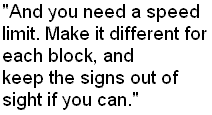
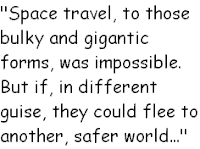
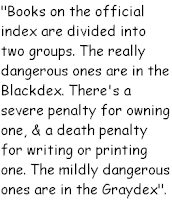
Frederic Brown's "Daymare" (novelette, murder mystery)

Quote from short story titled Daymare by Frederic BrownThere has been a murder in town. Circumstances warranted quick cremation; only 5 men saw the corpse - among them a medico & the police investing officer. Cop saw a big wound on corpse's forehead - as if hit by an axe, medico saw a major wound on shoulder & says the victim died of shock, another cop who originally discovered the dead body says it was a bullet wound on his chest, ... Five witnesses of the dead body, each adamant the victim died a different way!

During investigations, there is another murder. A man dies due to a fall, but there is no injury! What is more, the dead man is the same as the one who recently died 5 different ways!

In the meantime, curious things have been happening around town.

Solving the case, after many twists & turns, will end up uncovering a conspiracy much bigger than 2 murders.

Story is set on Callisto, one of the moon of Jupiter, far in future.

Notes.

  1. Story has a major thread on governments banning books, with author justifying the idea in certain cases.

    I personally find the idea abhorrent. In virtually every single case of a book ban I've seen in India, it has been a case of abuse of government power. I personally cannot see a case where trusting men in power to tell us what we ought to know & what not is justified - if for no other reason than because it's impossible to ensure that men in authority will also be men of integrity.

    This story would have worked very differently if author didn't see justification in banning books.

Collected in.

  1. Isaac Asimov & Martin H Greenberg (Eds)' "Isaac Asimov Presents the Great SF Stories 5 (1943)".

Fact sheet.

First published: Thrilling Wonder Stories, Fall 1943.
Rating: A.
Related: Stories of Fredric Brown.

Wednesday, October 10, 2007

Arthur C. Clarke's "Earthlight" (novella, science fiction): Interplanetary war over energy resources, fought with super-weapons

Quote from the story titled Earthlight by Arthur ClarkeThis novella-size story - almost 40 densely packed larger-than-normal pages in my copy of "Collected Stories" - tackles a subject that is rather rare among Clarke's stories - war. Of the 100 odd Clarke stories & novels I have posted on at this site & older companion site, I can off-hand recall only one other war story - "Superiority".

This is also among the better stories by Clarke. Except fighting scenes near end, & the utopian final peace treaty, this is a hard-sf story in best traditions of the genre. There are a lot of small details about Moon - generally very realistic, considering the year it was published in.

Political background of the story.

Many outer planets have been colonized, as is Venus. Outer planets are very energetic, constantly expanding the frontier outwards. There are three political groupings - governments of Earth, Venus, & the "Federation of the Outer Planets". Earth includes Moon; Federation includes Mars & every colony beyond.

Because of expanding frontier, Federation has been attracting the best brains, & is technologically the most advanced of the three. War will be fought between Earth & Federation over access to energy resources.

The contentious energy supplies.

Earth is unique among the planets in that it has large deposits of uranium - only most of these are buried thousand miles deep, & are pretty much inaccessible. "Johnstone's theory of satellite formation" says the moon broke off earth. Some recent studies have shown that Moon has "enough uranium to make all the deposits on Earth look like very small stuff"; all this easily accessible uranium originally came from deeper recesses inside earth.

Federation wants larger access to this uranium pool: "they had to have the atomic power to open up the cold outer planets and that Earth could manage quite easily with alternative sources of energy". Earth politicians fear Federation's growing clout, want to ration supplies.

The super-weapons of war.

Federation has "Wilson or acceleration less drive": ships fitted with it can start & stop at a million-g without affecting their human cargo! They are confident they can forcibly take all the uranium they need on moon. Three of their ships - "Acheron", "Eridanus", & "Phlegethon" - will come mounting the raid.

Earth has both a defensive & attack weapon Federation doesn't know about. We are not given many details, but it makes use of the knowledge about a new kind of radiation. It can shield an installation - harmlessly destroying any incoming torpedoes in the sky; & it can attack the enemy ships with "polaran beam" - against which they simply have no defense.

At the end of war, earth garrison on moon defending a uranium mine will be completely destroyed. Two of the enemy ships will be destroyed; third so badly hurt, it will have to limp back home.

Plot summary.

Sid Jamieson & Conrad Wheeler are young astronomers at a lunar observatory, & also friends; they will be the characters observing most action. Large parts of the story is about life on moon & at the observatory.

Following an unexplained massive emergency exercise to quickly remove the main reflector, & then to put it back, ordered by observatory Director, Professor Maclaurin, there is some resentment in staff because all work had come to a standstill for no fathomable reason. Dr Robert Molton, an older astronomer, offers his uranium theory & likely conflict over it - while gossiping with the two friends.

Soon afterwards, observatory staff begin observing a lot of rocketship traffic in the vicinity of observatory. During a leisure trip to the country-side, the two friends will bump into the secret military facility newly built over a uranium mine that earth considers a likely candidate of attack. But the local staff easily ward them off, feeding them a false story that it is some kind of a super communications facility.

A few days after their return, during a lunar night, Sid will get a request from Director to drive a visitor - Dr James Alan Fletcher - to that military installation, because Sid is the best driver around. Looks like the visitor's rocket from earth had to make an emergency landing, & dropped him way off target.

Sid & Conrad will drive the visitor. On the way, they will learn about the impending attack, & that visitor is somehow linked to the defense plan. After dropping him, the friends are advised to quickly put as much distance as they can between themselves & the military facilities where the hostilities will soon break.

Hostilities break sooner than expected. The friends observe the entire fight from a secure hiding place in the open country. Their vehicle will be destroyed during the fight. So they will eventually trek back to observatory, 80 miles away, with earth shining bright in the lunar sky - in "earthlight". They will be picked up part way through by an observatory vehicle after their SOS.

End is rather tame. Both earth & Federation politicians become reasonable, & sign a treaty that looks good for mankind!

Trivia.

  1. This story makes a passing reference to H G Wells' "The First Men in the Moon", hinting Wells' story was too imaginative by the time Clarke's own story was written. I haven't read Wells' story.

Fact sheet.

Length: short story
First published: Thrilling Wonder Stories, August 1951.
Rating: Time well spent A
Note: In 1955, an expanded version of this story was published as a novel under the same title. I have not read this novel.

This story appears in the following collections.

  1. "The Collected Stories of Arthur C Clarke"
  2. "Across the Sea of Stars": Contains the 1955 expanded novel version of this story.