Showing posts with label 1940s. Show all posts

Tuesday, February 24, 2015

Robert Moore Williams' "The Sound of Bugles" (short story)

Adventure involving a well intentioned human researcher & a greedy human villain - both trying to figure out how Martians are able to literally create material things out of thin air. Villain will die trying; scientist will learn that their technique cannot be replicated by humans because it involves biological capability we lack, & that he's dealing with super-beings.

Collected in.

  1. Donald A Wollheim (ed)'s "Adventures on Other Planets".

Fact sheet.

First published: Startling Stories, September 1949.
Rating: B.
Related: Stories of Robert Moore Williams.

Thursday, April 10, 2014

John R Pierce's "Period Piece" (as by J J Coupling) (short story)

A modern man finds himself in 31st century, with no recollection of how he got there. He's being treated very well & kindly, but he's smelling something fishy - why's is no one curious about the period he's come from, not even an eminent historian?

Very curious & unexpected ending.

Collected in.

  1. Everett F Bleiler & T E Dikty (eds)' "The Best Science Fiction Stories: 1949".

Fact sheet.

First published: Astounding, November 1948.
Rating: A.
Among the stories from Astounding/Analog issues edited by John Campbell.
Related: Stories of John R Pierce.

Monday, April 7, 2014

Martin Gardner's "Thang" (flash fiction, free): Big fish eats smaller one; & is food to bigger one

This is a very minor story, though apparently a well known one.

A giant, cosmic scale creature called Thang eats up earth for breakfast! And then gets eaten up by something even bigger.

Collected in.

  1. Everett F Bleiler & T E Dikty (eds)' "The Best Science Fiction Stories: 1949".

Fact sheet.

First published: 1948. ("for his college literary magazine").
Download full text.
Rating: C.

Saturday, March 15, 2014

Isaac Asimov's "No Connection" (short story, puzzle, free)

Millions of years into future, man is long extinct. The world has two dominant intelligent races:
  1. Americas dominated with "Gurrows", intelligent descendents of bears;
  2. Rest of the world dominated by "Eekahs", intelligent descendents of chimpanzees.
Eekahs are far more technologically advanced, are aware that Americas are sparsely populated, & are planning raids to claim that land.

This is the story from the point of view of a Gurrow archeologist who knows a bit about the long extinct man (the "Primate Primeval"). And of his seriously incomplete piecing together of the history of the continent & what lays ahead as they come into more frequent contact with Eekahs...

Collected in.

  1. Everett F Bleiler & T E Dikty (eds)' "The Best Science Fiction Stories: 1949".

Fact sheet.

First published: Astounding, June 1948.
Download full text from AlfaLib.
Rating: A.
Related: Stories of Isaac Asimov.

Poul Anderson's "Genius" (novelette, superman): Who is observing whom, in this lab experiment?

Quote from short story Genius by Poul Anderson
This is said to be the "first stand alone piece of short fiction" by Anderson.

I personally found it a somewhat boring read. Content of the story is mostly in the form of infodump - a character lecturing another one, plus description of author's idea of a utopia.

Story summary.

In far future, human empire extends to tens of thousands of planets in galaxy, has some interactions with alien empires, & it is a fairly static society with thought conditioning of populace to ensure they don't think inconvenient thoughts.

And the "psychotechnological" ruling elite conduct laboratory experiments on humans, as one would on rats: dump a couple of thousand men, matching some profile, with their memories wiped out, into some experimental environment, & observe their behavior!

One such experiment has been going on for 1500 years on "Station Seventeen": a virgin earth-like world, complete with a moon, seeded with a few thousand geniuses. And the experiment didn't turn out the way the experimenters expected...

Collected in.

  1. Everett F Bleiler & T E Dikty (eds)' "The Best Science Fiction Stories: 1949".

Fact sheet.

First published: Astounding, December 1948.
Download MP3 of an old time radio drama based on this story titled "Planet of Geniuses". [via SFFaudio]
Rating: B.
Related: Stories of Poul Anderson.

Everett F Bleiler & T E Dikty (eds)' "The Best Science Fiction Stories: 1949" (anthology): Annotatated table of contents & review

Cover of short story anthology The Best Science Fiction Stories 1949, edited by Everett F Bleiler and T E DiktyAccording to Wikipedia, "It was the first published anthology to present the best science fiction stories for a given year. The stories had originally appeared in 1948 in the magazines".

Several well known classics here. I seem to have read several of these years back; currently reading just the half dozen unread ones.

Table of contents.

  1. [ss] Ray Bradbury's "Mars is Heaven!" (A); download radio adaptation; Planet Stories, Fall 1948.
  2. [novelette] Henry Kuttner & C L Moore's "Ex Machina" (as by Lewis Padgett); Astounding, April 1948: One of the funny Galleghar stories. I read it long back; don't recollect much now.
  3. [ss] Murray Leinster's "The Strange Case of John Kingman" (A); Astounding, May 1948: First contact, but no space ships, no space travel, not even any obvious aliens...
  4. [ss] Erik Fennel's "Doughnut Jockey"; Blue Book, May 1948: Don't recollect anything now.
  5. [ss] Martin Gardner's "Thang" (C); download: Big fish eats smaller one; & is food to even bigger one...
  6. [ss] John R Pierce's "Period Piece" (as by J J Coupling) (A); Astounding, November 1948: A modern man in 31st century makes a curious discovery.
  7. [ss] Fredric Brown's "Knock" (A); download text/radio adaptation; Thrilling Wonder Stories, December 1948: A smart man reclaims earth from invincible aliens.
  8. [novelette] Poul Anderson's "Genius" (B); download radio adaptation; Astounding, December 1948: When lab "animals" were observing their experimenters...
  9. [novelette] Ray Bradbury's "And the Moon be Still as Bright" (A); download radio adaptation; Thrilling Wonder Stories, June 1948: Some Mars colonists are feeling guilty...
  10. [ss] Isaac Asimov's "No Connection"; download; Astounding, June 1948: Planning a second taking of Americas, from across the pond...
  11. [novelette] Wilmar H Shiras' "In Hiding" (A); Astounding, November 1948: A young boy who's "different" is forced to conform...
  12. [novelette] Henry Kuttner's "Happy Ending" (A); Thrilling Wonder Stories, August 1948; humor: When a man got what he "desired"!

Fact sheet.

First published: 1949.
Related: Works of Everett F Bleiler; anothologies & collections; fiction from 1940s.

Tuesday, March 11, 2014

Fredric Brown's "Knock" (short story, alien invasion, free)

Going by the comments online, it appears to be among the better known stories of Brown. Not a very believable conclusion, but light fun read.

Story summary.

Aliens called "Zan" have raided earth. They took a few hundred animal specimen alive - among them a man & a woman, & killed off all other life on earth. These specimen, including the humans, have now been put as exhibits in a zoo on earth, & this advanced raiding party of aliens is preparing to claim earth as permanent residence.

The man will pull off a coup of sorts, scaring aliens enough with his
ingenuity to make them leave earth...

Collected in.

  1. Everett F Bleiler & T E Dikty (eds)' "The Best Science Fiction Stories: 1949".

Fact sheet.

First published: Thrilling Wonder Stories, December 1948.
Download full text.
Download audio of X Minus One radio adaptation of this story from Internet Archive. (alt MP3 link)
Rating: A.
Related: Stories of Fredric Brown.

Tuesday, February 25, 2014

Donald B Day's "Jaephus" (short story, humor, free)

Illustration accompanying the original publication in Fanscient magazine of short story Jaephus by Donald B Day. Image shows the lobbly Jaephus with a glass of beer.Adventures of a man with a "lobbly" named Jaephus - a naughty invisible, presumably intelligent, creature with wings, tentacles & other unusual anatomical features.

Fact sheet.

First published: Fanscient, Fall 1948.
Download full text as part of the magazine it originally appeared in, or read online as HTML.
Rating: B.

Sunday, February 23, 2014

Henry Kuttner's "Extrapolation" (short story, satire, free): Science fiction vs fantasy wars in fandom

One of the illustrations by John Grossman accompanying the original publication in Fanscient magazine of short story Extrapolation by Henry Kuttner. Image shows the cover of Geared Tales, an imaginary science fiction magazine in future.Author tells us why there won't be any science fiction or fantasy magazines after 1958, a decade after this story was published.

He's using some sort of prescience to find this, but no details are given. And there is suggestion it's not humans doing the editing in 1958, just before the end of the genre.

Fact sheet.

First published: Fanscient, Fall 1948.
Download full text as part of the magazine it originally appeared in, or read online as HTML.
Rating: B.
Related: Stories of Henry Kuttner.

"Fanscient", Fall 1948 (ed Donald B Day) (magazine, free): Annotated table of contents & review

Cover of fanzine Fanscient, Fall 1948 issue. Uncredited image shows a photograph of JaephusLink on author fetches more of his fiction. Where I have a separate post on a story, link on story title goes there. Where I've read a story, my rating appears in brackets.

Table of contents (best first).

  1. [ss] Henry Kuttner's "Extrapolation" (B); satire: Science fiction vs fantasy wars in fandom.
  2. [ss] Donald B Day's "Jaephus" (B); humor.
  3. [ss] Miles Eaton's "The Watcher in the Snow" (C); fantasy: Snowclad approach to a beautiful & mysterious city is infested with ferocious & strange "beasts", with upper part human female & lower part a giant centipede.

Fact sheet.

Labeled: "Vol 2 No 3 (Whole No 5)".
Download scans as a cbz file or pdf. (I haven't tried pdf) [via judgemagney@pbscans]
Or read online as HTML.
Related: Fiction from 1940s; old pulps.

Monday, December 16, 2013

Fritz Leiber's "The Bleak Shore" (short story, fantasy, free)

My first story from author's famous "Fafhrd & the Gray Mouser" series. And I'll say a disappointing introduction to the series.

Story summary.

In a world not yet well explored, two adventurer friends - Fafhrd & Mouser - have a reputation of defying death in difficult situations. And suddenly a curse is placed on them - to sail to a far off "Bleak Shore", where we'll witness a scene that will be filmed decades later in "Godzilla": the two are in the midst of hatching reptilian monster eggs...

Of course, there will be happy ending for our heroes.

Fact sheet.

First published: Unknown, November 1940.
Download full text from Baen eBooks.
Rating: B.
Related: Stories of Fritz Leiber.

Thursday, November 21, 2013

Henry Kuttner & C L Moore's "The Mask of Circe" (novel, supermen, free): Gods of Greek mythology are actually mutants & machines!

One of the illustrations accompanying the original publication in Startling Stories magazine of the the novel The Mask of Circe by Henry Kuttner and C L Moore.This is an adventure - a science fictional retelling of some Greek legends. But an adventure more in line with "doc" Smith's soap opera - enjoy the unbelievable fun ride but don't think much, please. I didn't enjoy first half - there is just too much unfamiliar Greek mythology, but second half was easy to follow.

Story summary.

A modern man, while playing subject for a new sedative drug, ends up importing the memories of a long dead ancestor from 3000 years ago! And through much of the story, he is magically transported back 3000 years, to the time of this ancestor - to have adventures in time of Greek legend.

Notes.

  1. Some commentators have noted that this story is a tribute to Abraham Merritt's "Ship of Ishtar". I haven't personally read this Merritt story.
  2. "Mask" of title refers to a machine that holds the brain dump of someone long dead; its wearer assumes the personality of that long dead individual. "Circe" of title is a women who fell in love with the hero, hero who won't be born for another 3000 years! "Mask" is to help her meet him when he's eventually born!

Fact sheet.

First published: Startling Stories, May 1948.
Read online at UNZ.
Rating: B.
Related: Stories of Henry Kuttner, C L Moore.

Saturday, November 16, 2013

"Astounding Science Fiction", November 1943 (ed John W Campbell, Jr) (magazine, free): Annotated table of contents

Cover by Timmins of Astounding Science Fiction magazine, November 1943 issue.Links on author fetch more fiction by author. Where I have a separate post on a story, link on story title goes there. For read stories, my rating appears in brackets.

Table of contents.

  1. [novelette] George O Smith's "Recoil": "The near impossibility of hitting a spaceship with a shell has been discussed. But even an electron gun would, curiously, tend to defeat itself! The weapon protects the target!"
  2. [novelette] A E van Vogt's "The Beast": "Given time, even a fumblewitted Neanderthal could learn to be sly & deadly opponent. And The Beast had time--& was master over a long forgotten power--"
  3. [novelette] Henry Kuttner & C L Moore's "Gallegher Plus" (as by Lewis Padgett) (A); humor: "Galleger, as usual, was in  a jam. It wasn't his fault; It was due to Galleger-Plus, the highly successful, if sufficiently high!--other self."
  4. [ss] Isaac Asimov's "Death Sentence": "Our psychologists of today have set up colonies of monkeys & other animals as experiments. On a larger scale, with larger means, a greater experiment could be undertaken--"
  5. [ss] Murray Leinster's "--If You Can Get It": "The formula was was wonderful, & worked every time--unless someone said it couldn't! And working in that world was nice work--"

Fact sheet.

Labeled: "Vol XXXII No 3".
Download scans as a cbr file. [via David T @pulpscans]
Related: Stories from Astounding/Analog (only issues edited by John Campbell) (whole issues only); old "pulps"; 1940s.

Saturday, November 9, 2013

Henry Kuttner & C L Moore's "Dream's End" (short story, recursive dreaming, free)

Illustration accompanying the original publication in Startling Stories magazine of short story Dreams End by Henry Kuttner and C L Moore. Image shows the doctor hallucinating or dreaming.It has at least one episode of recursive dreaming - dream within a dream. I'm not sure of the other episodes - they're either independent hallucinations, or even deeper dream in a dream in a dream...

I'll put it among the less interesting stories of authors.

Story summary.

A doctor in a sanatorium has found what he thinks is a cure for most forms of insanity - what he call "empathy surrogate therapy". It involves a device whose electrodes are put on the head of the sane doctor & of insane patient. And something happens involving empathy. Only the first experiment seems to have gone seriously wrong - for the doctor, at least...

See also.

  1. Henry Kuttner's "All is Illusion" (read online): A much better story about dreaming.

Fact sheet.

First published: Startling Stories, March 1947.
Read online at UNZ.
Rating: B.
Related: Stories of Henry Kuttner, C L Moore.

Thursday, October 31, 2013

Half a dozen new entries in

Astounding, July 1942 post. Nearly all of them forgettable ones.

Going by experience of several issues now, flash fiction in Astounding, as a rule, appears to be very weak.

David V Reed's "Penance Cruise" (novella, adventure, humor, free)

One of the illustrations by Orban accompanying the original publication in Astounding magazine of novella Penance Cruise by David V Reed. Image shows the Exotica general with the two heroes in control room of their spaceship.Two young soldiers, off duty & drunk in an alien land, misbehave with local high officials. Resulting court martial hands them a sentence to go on a mission under a witless local official - a mission to catch a dangerous brigand. This is the funny story of their adventure to catch the brigand.

Fact sheet.

First published: Astounding, July 1942.
Download full text as part of the scans of the magazine it originally appeared in.
Rating: B.
Among the stories from Analog/Astounding issues edited by John Campbell.

Friday, October 25, 2013

Henry Kuttner & C L Moore's "The Dark Angel" (short story, superman, free)

Illustration accompanying the original publication in Startling Stories of short story The Dark Angel by Henry Kuttner and C L Moore. Image shows the superwoman animating a doll to test her newly discovered supernatural abilities when her husband spied it.What happens when one member of a couple is a prodigy? In this case, the wife is superhuman - first of the new species of homo superior. Story is about the reactions of the couple to this realization.

Fact sheet.

First published: Startling Stories, March 1946.
Read online at UNZ: part 1 & part 2.
Note: Story begins several pages down on part 1; last page of part 1 is the same as first page of part 2.
Rating: B.
Related: Stories of Henry Kuttner, C L Moore.

Wednesday, October 23, 2013

Clifford D Simak's "Tools" (novelette, free): Introducing very weird radioactive gaseous aliens

One of the illustrations by Kramer accompanying the original publication in Astounding magazine of short story Tools by Clifford D Simak. Image shows the human researcher, tricked by bottled gaseous alien, releasing it.Key parts of this story involve Radon-222 gas, a natural radioactive decay product of radium, & the biggest cause of lung cancer among non smokers on earth. It also is the heaviest gas on earth, though its own decay products aren't gaseous. It's highly toxic.

Story summary.

Humans have been mining radium on Venus, where it's available in vast quantities. It's a key source of energy, & this mining business is a monopoly of Radium, Inc.

Someone discovered strange life-like properties in radon gas found there. In a lab, they've succeed, via special electrical sensors, to communicate with a bottled concentration of it. They've robotic mining devices whose brains are small confined concentrations of gas.

When the bottled gas intelligence in lab that has learned a lot about the human civilization leaks, gas all across Venus learns the things we know. So we have an adventure fighting an elusive omnipresent alien with completely unfamiliar thought processes.

Fact sheet.

First published: Astounding, July 1942.
Download full text as part of the scans of the magazine it originally appeared in.
Rating: B.
Among the stories from Analog/Astounding issues edited by John Campbell.
Related: Stories of Clifford D Simak.

Saturday, October 19, 2013

Malcolm Jameson's "Brimstone Bill" (novelette, humor, free): Crooks are useful too!

Illustration by Orban accompanying the original publication in Astounding magazine of short story Brimstone Bill by Malcolm Jameson. Image shows the false preacher preaching his congregation.A part of the story deals with sound engineering - how high frequency, inaudible, sounds affect us. I've no idea if there is any truth in that part.

Story summary.

A corrupt politician in high office collects protection money from a little world called Juno in asteroid belt. He maneuvers a spaceship returning home, with a lot of unspent sailors' salary, to land here for hull cleaning, a process that will ground the ship for a month, giving town ample time to clean the purses of the crew.

But ship captain has a weapon up his sleeve...

Fact sheet.

First published: Astounding, July 1942.
Download full text as part of the scans of the magazine it originally appeared in.
Rating: A.
Among the stories from Analog/Astounding issues edited by John Campbell.
Related: Stories of Malcolm Jameson.

Thursday, October 17, 2013

A E van Vogt's "Secret Unattainable" (novella, teleporting gadget, free)

One of the illustrations by Kramer accompanying the original publication in Astounding magazine of the novella Secret Unattainable by A E van Vogt. Image shows the scenario where military troops can teleport behind enemy lines using the gadget in the story.
This is van Vogt at his best. Far off concept, but very entertaining story.

Story summary.

Early in the beginning of WWII, a great German scientist is working on a cool gadget: you "focus" it anywhere in the universe, &, through an "orifice" that is part of the gadget, you can directly reach that location.
  1. Want crude? Focus it inside an oil well anywhere, & help yourself!
  2. Want to attack London? Focus it on someplace in the city you want your tanks in, & just drive through the "orifice"!
  3. Want to put an enemy ship out of action at sea? Just drain its fuel tank!
  4. ...
Scientist comes to the notice of establishment. Establishment wants his gadget, but the man cannot be trusted - his brother was executed by Nazis for political reasons sometime back. So they get him working on the gadget under careful watch, & arrest him as soon as the gadget is finished. Only the gadget is not going to do them any good, because the scientist indeed was using it as a tool for revenge...

Fact sheet.

First published: Astounding, July 1942.
Download full text as part of the scans of the magazine it originally appeared in.
Rating: A.
Among the stories from Analog/Astounding issues edited by John Campbell.
Related: Stories of A E van Vogt.

Wednesday, October 16, 2013

Henry Kuttner's "Sword of Tomorrow" (novella, adventure, free)

One of the illustrations accompanying the original publication in Thrilling Wonder Stories magazine of novella Sword of Tomorrow by Henry Kuttner
This is a complicated & very pulpish adventure in far future.

Story summary.

A US soldier is a prisoner of war of Japan near the end of WWII, held captive somewhere in China. From a fellow prisoner, he learns Tibetan "self-hypnotism", & goes into hibernation to avoid questioning.

War ends. A bombing raid destroyed his prison, & entombed him. No one finds him. There he lay hibernating for eons.

Eventually, he wakes into a future where continents don't look familiar & stars aren't familiar. Humans have since fallen to savagery, & again built a civilization, but historical trauma has made it impossible for them to conceive weapons, though they can build all other kinds of gadgets.

A would be dictator would see an opportunity when our hero comes into his time...

Fact sheet.

First published: Thrilling Wonder Stories, September 1945.
Read online at UNZ. Or download HTML from Arthur's Bookshelf or BookReader.
Rating: B.
Related: Stories of Henry Kuttner.

Monday, October 14, 2013

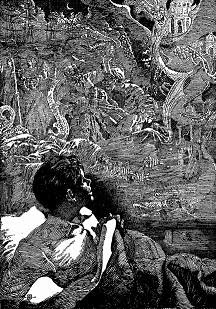
Henry Kuttner's "Before I Wake..." (short story, dreaming, free)

Illustration accompanying the original publication in Famous Fantastic Mysteries magazine of short story Before I Wake by Henry KuttnerWhat is more real - conscious or unconscious, waking state or dreaming state? In this story, the distinction is blurred.

Story summary.

A young boy, somewhere on Florida coast in the US, has read too many fairy tales & believes them in all innocence. He dreams of sailing to places with magical & colorful characters & things. Until his the world of imagination begins to appear far more desirable than the real world...

Fact sheet.

First published: Famous Fantastic Mysteries, March 1945.
Read online at UNZ.
Note: The text at the link above appears to end abruptly. Story appears complete, but the link has a lot more text beyond the end of the story, with no clear marker to end the story, leading to feeling of abrupt ending.
Rating: A.
Related: Stories of Henry Kuttner.

Saturday, October 12, 2013

Jack Williamson's "Collision Orbit" (as by Will Stewart) (novella, antimatter, free)

One of the illustrations by Orban accompanying the original publication in Astounding magazine of short story Collision Orbit by Jack Williamson.
This story is supposed to have invented the term "terraforming".

While there is a lot of action, I found it generally boring because of length & too much contrived jargon.

Story summary.

Eons ago, asteroid belt was created by the impact of an "contraterrene" celestial body with the now lost planet at that orbit. Asteroid belt now includes contraterrene debris ("seetee"), in addition to ordinary matter. This makes it extremely dangerous because impact means complete annihilation.

The mad scientist hero of the story will tame this contraterrene matter for human use, in spite of major opposition from all quarters.

Fact sheet.

First published: Astounding, July 1942.
Download full text as part of the scans of the magazine it originally appeared in.
Rating: B.
Among the stories from Analog/Astounding issues edited by John Campbell.
Related: Stories of Jack Williamson.

Friday, October 11, 2013

Ray Bradbury's "Eat, Drink and Be Wary" (flash fiction, humor, free)

A "Venusian banquet lasts a week or ten days, sometimes more, with eight meals a day & twenty courses to a meal." That's normal for Venusians with their ultra-fast metabolism.

But when a human diplomat is invited to one of these banquets, saying no is not an option & going there is death sentence. So our diplomat will seek some scientific help...

Fact sheet.

First published: Astounding, July 1942.
Download full text as part of the scans of the magazine it originally appeared in.
Rating: B.
Among the stories from Analog/Astounding issues edited by John Campbell.
Related: Stories of Ray Bradbury.

Henry Kuttner & C L Moore's "Baby Face" (novelette, body snatching, free): "Baby's Day Out", from many decades earlier

An illustration accompanying the original publication in Thrilling Wonder Stories magazine of short story Baby Face by Henry Kuttner and C L Moore. Image shows the grown up man in baby's body encouraging the gorilla to put on the mind exchange cap.
So now we know the story of the "Baby's Day Out" (1994) is at least this old!

Story summary.

To figure out why a baby is crying, a mad scientist uses his latest invention: to exchange the mind of his friend, minding the baby, with the baby - so friend in baby's mind can find out what is wrong!

That's when Nazi spies steal the brain exchange gadget. So we are left with: the grown up man is in baby's body, baby in grown up man's body, & scientist injured & unconscious. And the man in baby's body overheard the spies will pass on the gadget to a contact on circus that night.

So now it's up to the hero, in baby's body, to ensure the gadget doesn't fall in enemy hands...

Fact sheet.

First published: Thrilling Wonder Stories, March 1945.
Read online at UNZ.
Rating: B.
Related: Stories of Henry Kuttner, C L Moore.

Tuesday, October 8, 2013

Henry Kuttner's "Music Hath Charms" (short story, detective, free)

Illustration accompanying the original publication in Startling Stories magazine of short story Music Hath Charms by Henry Kuttner. Image shows gun fight scene near end of story, before the culprit is nabbed by the cop.An ace detective solves a complex murder attempt at Sky City, a city hollowed into an asteroid. A rather colorful murder attempt: some animals escape from a zoo, a virus on a far off world to which locals are immune, a business where one partner is trying to swindle the other, ...

Fact sheet.

First published: Startling Stories, December 1943.
Read online at UNZ.
Rating: B.
Related: Stories of Henry Kuttner.

Saturday, October 5, 2013

Henry Kuttner's "No Greater Love" (novelette, fantasy, free): Too much love can kill!

One of the illustrations by Orban accompanying the original publication in Unknown magazine of short story No Greater Love by Henry Kuttner. Image shows pixies threatening the human thief who stole their Love sigil.A man with no morals comes to possess a charm, built for a pixie, that makes everything around love you. Everything, i.e., including stray sparrows, dogs, people, pixies, ...! Pixie owner of the charm is after the man to get it back.

Eventually, getting in a tight corner, man will invade the pixie charm shop again, & take charge of another charm too - the one that grants 3 wishes everyday. And will quickly discover how deadly a combination the wish charm makes when combined with the love charm...

Fact sheet.

First published: Unknown, April 1943.
Read online at UNZ.
Rating: A.
Related: Stories of Henry Kuttner.

Thursday, October 3, 2013

"Astounding Science-Fiction", July 1942 (ed John Campbell) (magazine, free): Annotated table of contents & review

Link on an author fetches more fiction of the author. Where I have a separate post on a story, link on story title goes there. For read stories, my rating appears in brackets.

Note: The flash fiction pieces don't have their own entry in ToC; they are all clubbed under the heading "Probability Zero". And nearly all of them are rather forgettable.

Table of contents (best first).

  1. [novella] A E van Vogt's "Secret Unattainable" (A): Revenge of a scientist against Nazi establishment. 
  2. [novelette] Malcolm Jameson's "Brimstone Bill" (A): Crooks are useful too! 
  3. [novelette] Clifford D Simak's "Tools" (B): Introducing very weird radioactive gaseous aliens... 
  4. [novella] David V Reed's "Penance Cruise" (B); space opera: A ragtag group goes out to catch a dangerous brigand...
  5. [novella] Jack Williamson's "Collision Orbit" (as by Will Stewart) (B): Mad scientist tames antimatter.

    This story is supposed to have invented the term "terraforming", which really makes it a classic.
  6. [ff] Ray Bradbury's "Eat, Drink, and Be Wary" (B); humor: How to eat librally without upsetting your stomach! 
  7. [ff] Frank Holby's '"The Strange Case of the Missing Hero"' (B); grandfather paradox: A man traveling to past discovers he is his own father!
  8. [ff] Wilson Tucker's "The Mysterious Bomb Raid" (as by Bob Tucker) (B); time travel: To remove Japan from equation in WWII, a couple of Americans have dropped a drum full of incendiary oil on Tokyo around the year 1900 using their time machine; but a delay in drop has put it in a later year - so now, in 1942, they're expecting Tokyo to go up in flames any time for reasons the world will see a mysterious.
  9. [ff] Selden G Thomas' "The Floater"  (B): A group is discussing modern fighter aircraft vs vintage ones. One of them tells a tall tale of how he fought with a far superior vintage one & how it kept floating in ocean till he was rescued many days after crash, in spite of being riddled with bullet holes because of fighting, because "It was made of pure potassian, which is lighter than water."
  10. [ff] R Creighton Buck's "The Querty of Hrothgar"(C): An extremely implausible hunting story. Querty, a huge beast with 4 foot thick armor, on its native world of Hrothgar, is chasing a man. Man survives & eventually kills the beast using a totally crazy device.
  11. [ss] L Sprague de Camp's "The Contraband Cow" (C): One of the most forgettable stories of de Camp.

    In an international Federation, there is a ban on cow slaughter. I'm not sure where the story is set - in US or in Mexico?

    Some confrontation between artificial in-lab steak makers, smugglers, cops & politicians. Hero will eventually get the ban lifted by threatening with a politician with something totally silly.
  12. [ss] L Ron Hubbard's "Space Can" (C); space opera: Description of a space battle where a lone US warship beats two better armed "saturnian" warships. Much of the text of the story went over my head.
  13. [ff] Randall Hale's "De Gustibus" (C): A man on Mercury without food for 50 days, has survived on water & potassium cyanide!
  14. [ff] John Pierce's "About Quarrels, About the Past" (C); time travel: "Quarrels" of title is the name of a person. He's gone time traveling to a past Egypt, & is currently is in some, but not ours, past Egypt.

Fact sheet.

Labeled: "Vol XXIX No 5".
Download the scans as a CBR file. [via David T @pulpscans]
Caution: This is a very large file - nearly 195 MB & without resume. I had the connection broken twice near 90% & could download it only on the third attempt.
ISFDB notes: 'Cover illustration, untitled, by William Timmins, not Rogers as credited in the table of contents. Correction "In Times to Come," September 1942.'
Same ISFDB page also corrects some of the novelette/ss classifications on the ToC page; I've preferred ISFDB label above, whenever it contracts ToC.
Related: Stories from Analog/Astounding (whole issues only) (only issues edited by John Campbell); old "pulps".

Tuesday, October 1, 2013

Henry Kuttner's "The Uncanny Power of Edwin Cobalt" (as by Noel Gardner) (short story, weird, free)

"It seemed if I doubted the existence of anything, that thing ceased to exist. And the power was retroactive. The thing never had existed."

That is the basic conceit of the story: when narrator begins to doubt the existence of something, that thing not only ceases to exist, but had never existed in the first place! This is the story of him realizing his power, & eventually beginning to doubt if he himself existed...

Fact sheet.

First published: Fantastic Adventures, October 1940.
Read online at UNZ.
Rating: B.
Related: Stories of Henry Kuttner.

Saturday, September 28, 2013

Henry Kuttner's "The Elixir of Invisibility" (short story, free)

An illustration accompanying the original publication in Fantastic Adventures magazine of short story The Elixir of Invisibility by Henry Kuttner. Image shows public reactions when a man is walking with an invisible dog on the leash.This is a mad adventure using invisibility & visibility potions. Drink from the red labeled vial, & you become invisible; drink from green, to become visible again.

A whole lot of crazy things happen. Reporters disbelieving the inventor receive parcels containing invisible frogs! A thief steals a couple of vials, uses it for a bank robbery. An invisible dog, & sundry other invisible people at public places cause chaos, etc.

Fact sheet.

First published: Fantastic Adventures, October 1940.
Read online at UNZ: part 1, part 2, & part 3.
Rating: B.
Related: Stories of Henry Kuttner.

Wednesday, September 25, 2013

Henry Kuttner's "Pegasus" (short story, fantasy, free)

Illustration accompanying the original publication in Famous Fantastic Mysteries magazine of short story Pegasus by Henry Kuttner. Image show the farmboy riding his flying horse.
This is a very minor story.

A farm boy believes flying horses exist, & will find one with the help of a stranger dwarf. When his dad finds out, he wants to milk it for money - to clip its wings & use it as a race horse. Boy will eventually save horse.

Fact sheet.

First published: Famous Fantastic Mysteries, May/June 1940.
Read online at UNZ.
Rating: B.
Related: Stories of Henry Kuttner.

Friday, September 20, 2013

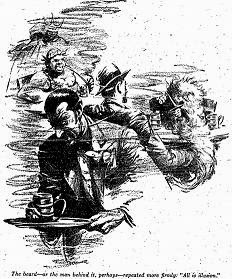
Henry Kuttner & C L Moore's "All is Illusion" (short story, humor, free): Never pick up a fight with a magician...

One of the illustrations by F Kramer, accompanying the original publication in Unknown magazine of short story All is Illusion by Henry Kuttner and C L Moore. Image shows the scene in the bar where the protagonist will fight with the midget magician.A man picks up a fight with a midget magician in a bar, & gets cursed: "I lay on you the curse of illusion. The blight of the five senses! I put upon you the veil of Proteus!"

And the fun begins... others sometime get a foul smell out of him but he himself cannot smell it, others hear funny noises from his stomach when he cannot, other see a duck or a horse where he is, ...

Fact sheet.

First published: Unknown, April 1940.
Read online at UNZ.
Note: If you are using an Android tablet, here is a way to pick up this file as a pdf from Google Drive: note 1 & note 2. This method doesn't, however, work at least in my Firefox on Windows XP, & Android browsers don't let me copy the URL of pdf.
Rating: A.
Related: Stories of Henry Kuttner, C L Moore.

Friday, August 30, 2013

"Astounding Science-Fiction", June 1943 (ed John W Campbell, Jr) (magazine, free): Annotated table of contents & review

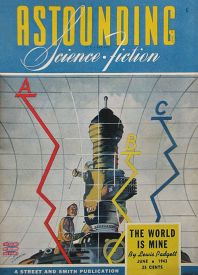
Cover by Timmins of Astounding Science-Fiction magazine, June 1943 issueFor stories where I have a separate post, link on story title goes there. Links on authors fetch more fiction by author. For read stories, my rating appears in brackets.

Table of contents (best first, unread last).

  1. [novelette] Henry Kuttner & C L Moore's "The World is Mine" (as by Lewis Padgett) (B): "Galleger, the mad--or at least cockeyed--scientist, really got himself in a jam that time. A plague of corpses, all murdered, descended upon him--"
  2. [novelette] George O Smith's "Calling the Empress": 'Physics says that a thing which cannot be detected by any means does not exist. So their problem was to make a "nonexistent" spaceship somewhere between Mars & Venus change it course--'
  3. [ss] Anthony Boucher's "Pelagic Spark": "One man, to prove a point, cooked up a phony prophecy. And other men, believing it implicitly, made it come true!"
  4. [ss] E M Hull's "Competition": "Artur Blord backed down like a scared cur when faced with real danger. But it so happened he was backing rapidly in a direction he'd never have been able to go face forward!"
  5. [ss] Lester del Rey's "Whom the Gods Love": "The Japs murdered his personality; their terrible error was that they didn't murder him. They gave him something that was a magnificent antithesis of Death--for him. For them it was Death."
  6. [ss] Anthony Boucher's "Sanctury" (as by H H Holmes): "The commondoman knew the Nazis were close on his heels; his one though was to get to some other place in a hurry. The professor had another idea--& the Villa had a ghost that haunted parties!"
  7. [serial - 2/2] Fritz Leiber, Jr's "Gather, Darkness!": "The Hierarchy was a phony religion based on super-scientific "miracles" & rigid tyranny. And the revolution was a magnificent buffoonery of super-scientific witchcraft based on military tactics!"

Fact sheet.

Labeled: "Vol XXXI No 4"
Download scans as a cbr file. [via David T @pubscans]
Alternate, supposedly better version, of scan. [via ka280al@pbscans]
Note: I have personally seen only the first (original) version.
Related: Fiction from Astounding/Analog, whole issues only, only issues edited by John Campbell; 1940s; old pulps.

Thursday, August 29, 2013

Henry Kuttner & C L Moore's "The World is Mine" (as by Lewis Padgett) (novelette, humor, free)

One of the illustrations by Williams accompanying the original publication in Astounding magazine of short story The World is Mine by Henry Kuttner and C L Moore. Image shows 3 rabbit-like Martians from future who want to conquer earth.This is part of authors' well known series featuring Gallagher, the mad scientist. I used to love these stories when I first encountered them; I'm no longer as much a fan, but this is still a light fun read.

Story summary.

Gallaghar wakes up from his yet another drinking bout to find a series of curiosities - 3 rabbit-like Martians ("Lybblas") from 500 years into future who want to conquer earth, a time machine focused on his backyard that cannot be turned off & that he apparently invented when his genius unconscious was in control, & a series of corpses of himself from future each with a ray gun hole through his chest.

The story is about putting the puzzle together, inventing a couple of other gadgets along the way.

Fact sheet.

First published: Astounding, June 1943.
Download full text as part of the scans of the magazine it originally appeared in.
Among the stories from Astounding/Analog issues edited by John Campbell.
Rating: B.
Related: Stories of Henry Kuttner, C L Moore (as by Lewis Padgett).

Wednesday, July 31, 2013

Cleve Cartmill's "Some Day We'll Find You" (novelette, free)

One of the illustrations by Orban accompanying the original publication in Astounding magazine of short story Some Day Well Find You by Cleve CartmillSpacetrades, Ltd originally invented space propulsion, & has deep contacts among the politicians, hence continues to be a monopoly controlling space travel among human colonies in Sol.

Now a broke engineer with no capital has invented an alternate & cheaper method of spaceship propulsion, & colonies see a way of ending the monopoly of Spacetrades. As does an enemy of Spacetrades on earth, hoping to replace Spacetrades monopoly with his own.

So three parties want the engineer & want to fund his venture - colonies to break the monopoly, Spacetrades to preserve the monopoly, & Spacetrades' enemy to establish another monopoly. Engineer wants to go with colonies, but a bunch of toughs are out to grab him...

Fact sheet.

First published: Astounding, December 1942.
Download full text as part of the scans of the magazine it originally appeared in.
Rating: B.
Among the stories from Astounding/Analog issues edited by John Campbell.
Related: Stories of Cleve Cartmill.

Saturday, July 6, 2013

A E van Vogt & E Mayne Hull's "The Flight That Failed" aka "Rebirth: Earth" (as by E M Hull) (short story, weird, free): Making a future happen where Germany loses in WWII

illustration by Orban accompanying the original publication in Astounding of short story The Flight That Failed by E M Hull. Image shows the US military plane mid flight over Atlantic en route to London during World War II a few minutes before German attack. Most action in the story happens in this plane.This is a crazy story & I didn't really want to write this post, but have you ever heard of a "moon ray time reflector machine"?

Story summary.

Pilot of secret flight of a US military plane carrying some extremely valuable, but unspecified, cargo & some military, technical & diplomatic personnel, to London during WWII discovers a stowaway, presumed a German spy.

All attempts to arrest & confine him fail in a bizarre way. He claims to be an illusion, projected there by a "moon ray time reflector machine" from an alternate future in which Germany is defeated in this war. And nobody believes him when he tells them the success of this flight is crucial to the future where US wins, & this flight is doomed unless they let the stranger man one of the machine guns of the plane in a German attack to come in a few minutes...

Fact sheet.

First published: Astounding, December 1942.
Download full text as part of the scans of the magazine it originally appeared in.
Rating: C.
Among the stories from Astounding/Analog issues edited by John Campbell.
Related: Stories of A E van Vogt.

Thursday, July 4, 2013

Ross Rocklynne's "Interlude" (short story, time travel, free): When a caveman freed an advanced civilization of a dictator

Sole illustration by Fax accompanying the original publication in Astounding of short story Interlude by Ross Rocklynne. Image shows the Neanderthal cavemen, transported from his time 100000 years ago into 25th century,physically throwing away the dictator this advanced era.In the 25th century, there is a dictator ruling the earth for a decade. A former scientist who invented a machine to enslave others by making them wear a collar & a "bell shirt", but good enough to give them 3 hours a day to be free & be themselves.

Two of the ruled plot his overthrow. If only they could bring a 20th century uncollared (hence unslaved) man (why of 20th century?) who will overthrow the dictator. Their experimental time machine instead will bring back a caveman from 100,000 years ago. A man who craves to be a tribal chief.

Some unlikely adventures follow & the world is freed of the dictator.

Fact sheet.

First published: Astounding, December 1942.
Download full text as part of the scans of the magazine it originally appeared in.
Rating: B.
Among the stories from Astounding/Analog issues edited by John Campbell.
Related: Stories of Ross Rocklynne.

Sunday, June 2, 2013

"Astounding Science Fiction", December 1942 (ed John W Campbell, Jr) (magazine, free): Annotated table of contents

Cover by William Timmins of Astounding Science Fiction magazine, December 1942 issue"The Weapon Shop" is among the best known stories of the genre. "Piggy Bank" is among the more pulpish stories of Kuttner/Moore, but features a very curious robot.

Where I have a separate post on a story, link on its title goes there. Link on author's name fetches more fiction of author.

Note: Flash fiction pieces in this issue don't have their individual entries in table of contents, but are bunched together in a single entry called "Probability Zero".

Table of contents.

  1. [novelette] A E van Vogt's "The Weapon Shop": "The shop was small--a little place that materialized out of nowhere. Yet, though the old man didn't realize--all the power of a world empire could not break it!"
  2. [novelette] Cleve Cartmill's "Some Day We'll Find You" (B): Three groups of capitalists want to fund the commercialization of a certain invention by a broke engineer...
  3. [novelette] Henry Kuttner & C L Moore's "Piggy Bank" (as by Lewis Padgett) (B): "The robot was a rabbit--or had that psychology. He had a diamond-studded body, & was trained to be untouchable. Even his owner could not touch him--without giving information that was suicide!"
  4. [ss] A E van Vogt & E Mayne Hull's "The Flight That Failed" (as by E M Hull) (C): Making a future happen where Germany loses the WWII!
  5. [ss] Ross Rocklynne's "Interlude" (B): When a caveman freed an advanced civilization of a dictator...
  6. [ss] Frank Belknap Long's "To Follow Knowledge": "A strange tale of pluralities of worlds, of a theory based on the hypothesis that, in infinity, everything must happen not once, but many times."
  7. [ss] Robert Moore Williams' "Johny Had a Gun": "Johny was a gangster, a small-time punk. But Johny showed up with a gun one night, in an alley fight, that was not small-time stuff--"
  8. [ff] William M Danner's "True Fidelity".
  9. [ff] Stanley Woolston's "The Human Bomb".
  10. [ff] Jack Bivins' "Valadusia".
  11. [ff] T D Whitenack, Jr's "O'Ryan, the Invincible".
  12. [ff] Frank J Smythe's "My Word!".
  13. [ff] L M Jensen's "Take-Off".

Fact sheet.

Labeled: Vol XXX No 4.
Download scans as a CBR file. [via David T @pulpscans]
Related: Fiction from Astounding/Analog (only from issues edited by John Campbell) (whole issues only); old pulps; 1940s.

Saturday, February 16, 2013

Hal Clement's "Impediment" (novelette, communications): Telepathy considered impossible among humans

I must have read the "Best of Hal Clement" earlier. I don't remember many of its stories' titles, but as I begin reading a story, I discover I'd read it before. This one too is a reread, but one I'd forgotten so thoroughly I ended up finishing again.

Story summary.

This is a first contact story that focuses on possible difficulties in communicating with aliens. In this case, aliens are telepathic & can read imagery in your brain. And while they cannot speak audibly, they are not deaf; they can hear sounds of our speech.

And yet the communications are so hard as to be impossible. The difficulty lies in human comfort, rather need, to communicate in code - what our brain thinks, we must mostly code in symbols of speech. It's ok if the actual brainwaves generated by two individuals with the same thought differ, since they'll both render it in common code. Aliens don't understand this idea of translating to code, since they're used to direct communication of thoughts.

Giant insect-like alien visitors themselves are space pirates out of ammunition, & want arsenic here to make poison gas. A human insect researcher doing some field work north of Arctic Circle runs into them.

Fact sheet.

First published: Astounding, August 1942.
Among the stories from Astounding/Analog issues edited by John Campbell.
Rating: A.
Related: Stories of Hal Clement; fiction about language issues.

Sunday, February 10, 2013

Harry Walton's "Subcruiser" (short story, action, free): Foiling a warship hijack

Illustration by Schneeman accompanying the original publication in Astounding magazine of short story Subcruiser by Harry Walton. Image shows a scene on board the space ship where the story happens.
This is a "spy aboard a warship" story. Earth & Venus are at war, earth has a new type of space ship whose sample Venusians want for reverse engineering, & they've recruited an officer of earth to help get the ship. Hero, will, of course, foil the conspiracy.

Fact sheet.

First published: Astounding, May 1941.
Download full text as part of the scans of the magazine it originally appeared in.
Rating: B.
Among the stories from Astounding/Analog issues edited by John Campbell.