Showing posts with label 1940. Show all posts

Monday, December 16, 2013

Fritz Leiber's "The Bleak Shore" (short story, fantasy, free)

My first story from author's famous "Fafhrd & the Gray Mouser" series. And I'll say a disappointing introduction to the series.

Story summary.

In a world not yet well explored, two adventurer friends - Fafhrd & Mouser - have a reputation of defying death in difficult situations. And suddenly a curse is placed on them - to sail to a far off "Bleak Shore", where we'll witness a scene that will be filmed decades later in "Godzilla": the two are in the midst of hatching reptilian monster eggs...

Of course, there will be happy ending for our heroes.

Fact sheet.

First published: Unknown, November 1940.
Download full text from Baen eBooks.
Rating: B.
Related: Stories of Fritz Leiber.

Tuesday, October 1, 2013

Henry Kuttner's "The Uncanny Power of Edwin Cobalt" (as by Noel Gardner) (short story, weird, free)

"It seemed if I doubted the existence of anything, that thing ceased to exist. And the power was retroactive. The thing never had existed."

That is the basic conceit of the story: when narrator begins to doubt the existence of something, that thing not only ceases to exist, but had never existed in the first place! This is the story of him realizing his power, & eventually beginning to doubt if he himself existed...

Fact sheet.

First published: Fantastic Adventures, October 1940.
Read online at UNZ.
Rating: B.
Related: Stories of Henry Kuttner.

Saturday, September 28, 2013

Henry Kuttner's "The Elixir of Invisibility" (short story, free)

An illustration accompanying the original publication in Fantastic Adventures magazine of short story The Elixir of Invisibility by Henry Kuttner. Image shows public reactions when a man is walking with an invisible dog on the leash.This is a mad adventure using invisibility & visibility potions. Drink from the red labeled vial, & you become invisible; drink from green, to become visible again.

A whole lot of crazy things happen. Reporters disbelieving the inventor receive parcels containing invisible frogs! A thief steals a couple of vials, uses it for a bank robbery. An invisible dog, & sundry other invisible people at public places cause chaos, etc.

Fact sheet.

First published: Fantastic Adventures, October 1940.
Read online at UNZ: part 1, part 2, & part 3.
Rating: B.
Related: Stories of Henry Kuttner.

Wednesday, September 25, 2013

Henry Kuttner's "Pegasus" (short story, fantasy, free)

Illustration accompanying the original publication in Famous Fantastic Mysteries magazine of short story Pegasus by Henry Kuttner. Image show the farmboy riding his flying horse.
This is a very minor story.

A farm boy believes flying horses exist, & will find one with the help of a stranger dwarf. When his dad finds out, he wants to milk it for money - to clip its wings & use it as a race horse. Boy will eventually save horse.

Fact sheet.

First published: Famous Fantastic Mysteries, May/June 1940.
Read online at UNZ.
Rating: B.
Related: Stories of Henry Kuttner.

Friday, September 20, 2013

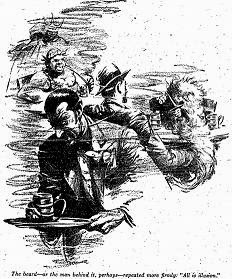
Henry Kuttner & C L Moore's "All is Illusion" (short story, humor, free): Never pick up a fight with a magician...

One of the illustrations by F Kramer, accompanying the original publication in Unknown magazine of short story All is Illusion by Henry Kuttner and C L Moore. Image shows the scene in the bar where the protagonist will fight with the midget magician.A man picks up a fight with a midget magician in a bar, & gets cursed: "I lay on you the curse of illusion. The blight of the five senses! I put upon you the veil of Proteus!"

And the fun begins... others sometime get a foul smell out of him but he himself cannot smell it, others hear funny noises from his stomach when he cannot, other see a duck or a horse where he is, ...

Fact sheet.

First published: Unknown, April 1940.
Read online at UNZ.
Note: If you are using an Android tablet, here is a way to pick up this file as a pdf from Google Drive: note 1 & note 2. This method doesn't, however, work at least in my Firefox on Windows XP, & Android browsers don't let me copy the URL of pdf.
Rating: A.
Related: Stories of Henry Kuttner, C L Moore.

Sunday, December 16, 2012

Free fiction: 3 issues of "Futuria Fantasia" (all edited by Ray Bradbury)

All at Project Gutenberg.
  1. Winter 1940.
  2. Summer 1939 & Fall 1939. [both via QuasarDragon]
These appear to be fanzines, with some fiction. I've not read any yet.

Related: Old "pulps".

Saturday, September 29, 2012

Douglas Drew's The Carbon Eater (novelette, chemical warfare, free): Neutralizing a carbon-eating poison gas

Illustration accompanying the original publication in Astounding Science Fiction magazine of short story The Carbon Eater by Douglas Drew
This appears to be a fairly oft-cited story. And from an author who was far from prolific.

I noticed at least 3 different things here:
  1. Arguments justifying colonialism. Didn't go down very well with me.
  2. A "carbon eating" gas that sounded somewhat like aliens' "iron mining" in one of the "doc" Smith's "Lensman" novels. In this case, it's an extremely active gas & liquid. Martians employ it as a weapon to rid themselves of carbon-based human colonists. A lakeful of this material, with a little electrical stimulation, is producing enough gas to kill all humans on the world. Our chemist hero, of course, will save most humans, except for early casualties.

    I liked this part though the details are hand-wavy.
  3. Hero against the bull-headed establishment, & winning in spite of them. Lot of action in later parts.

See also.

  1. Murray Leinster's "Tallien Three" (download in 4 parts, beginning here): Hero is forced similarly to burn a lot of infrastructure near end, to similarly save a cityful of lives.

Fact sheet.

First published: Astounding, June 1940.
Download full text as part of the scans of Astounding (British Edition), June 1940.
Rating: A. 
Among the stories from Astounding/Analog issues edited by John Campbell.

Friday, September 28, 2012

"Astounding Science-Fiction" (British Edition), June 1940 (magazine, free): Annotated table of contents & review

Cover of British Edition of Astounding Science-Fiction magazine, June 1940 issue. Picture illustrates a scene from the story The Roads Must Roll by Robert Heinlein.
I'd read Heinlein's story long back & liked. I have since read its criticism: that it's an impractical idea. Not only did I like the story for its own sake, but Mumbaikars might see something of Mumbai here: a long city organized along its public transport artery. Even the constraint Mumbai's planners often express in public when the issue of increasing carrying capacity of "locals" is being discussed has something of this story in it: peak hour frequency is determined by minimum safe distance that must be maintained between two trains on the same track. This story removes this minimum distance constraint!

Last two stories - Knight's & Vincent's - are both minor, but with uncommon methods of presentation: Vincent's is told by someone still uncomfortable with English, Knight's is put together as a historical record of dubious authenticity.

Where I have a separate post on a story, link on its title goes there. Link on author fetches more fiction of author. My rating is in brackets. Where I'm aware of a story's availability elsewhere on the internet, I include that link too.

Table of contents (best first).

  1. [novelette] Robert Heinlein's "The Roads Must Roll" (A); download radio adaptation: A world where conveyer type moving "roads" are the norm, & cities are organized along the length of the road. You don't drive your car on the road; you just get on the road & get down at appropriate place, tram like.
  2. [novelette] Douglas Drew's "The Carbon Eater" (A): Neutralizing a carbon-eating poison gas.
  3. [ss] Norman L Knight's "The Testament of Akubii" (B): Adventure on a world where sulfur plays the role that oxygen plays on earth, & has practically no oxygen. Combined with a variation of "two men stranded in a boat with food enough (till rescue) for only one".

    It has unusual presentation, however. Put together from unreliable historical record.
  4. [ss] Harl Vincent's "Deputy Correspondent" (B): Why did the mythical island of Mu vanish, & how to bring it back.

    Told by someone not proficient in English. It didn't come in my way; not sure how native English readers will react to it.

    This story is a precursor to James Blish's oft-cited "Cities in Flight" series of stories. Blish replaces Mu with New York City.

Fact sheet.

Labeled: Vol XXV No 9.
Download scans as a CBR file. [via Bob@pulpscans]
Note: Link fetches a RAR file that contains target CBR, probably to work around file the naming constraints of hosting service.
Related: Fiction from Astounding/Analog (whole issues only); old pulps; 1940s.

Thursday, September 20, 2012

Leigh Brackett's "Martian Quest" (short story, frontier hazards, free)

Fast paced, quick read.

Story summary.

There is a new frontier being opened at the edge of the harsh Martian desert, with settlers that are mostly impoverished from earth & Venus. It's essentially a farming community, with on very big local hazard: "Khom", the "great desert lizard" the size of a small dinosaur that eats crops &, when disturbed, kills people. No one knows how to counter it.

Martin Drake, newly arrived, & prompted by a local beauty, will find a solution to the Khom hazard.

Fact sheet.

First published: Astounding, February 1940.
Download full text from Baen Books.
Rating: B.
Among the stories from Astounding/Analog issues edited by John Campbell.
Related: Stories of Leigh Brackett.

Thursday, August 2, 2012

Jack Williamson's "Hindsight" (short story, space opera, time travel, free)

This widely anthologized story didn't really make much of an impression on me.

This story is from the point of view of a traitor - but one who both remains a traitor & also redeems his loyalty.

Story summary.

Pirates based in asteroid belt control all space lanes & are powerful enough to be overlords of inhabited worlds, including earth. Now that earth is building resistance, one of their space fleets is headed to earth to crush. Only, the pirates' key inventor is earth born. Should he let home world be crushed by his current masters?

Collected in.

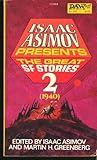
  1. Isaac Asimov & Martin H Greenberg (Eds)' "Isaac Asimov Presents the Great SF Stories 2 (1940)".
  2. John W Campbell, Jr (ed)'s "The Astounding Science Fiction Anthology".

Fact sheet.

First published: Astounding, May 1940.
Download full text from Johns File Shore or Chomikuj.
Rating: B.
Among the stories edited by John Campbell for Astounding/Analog.
Related: Stories of Jack Williamson.

Sunday, April 1, 2012

Leigh Brackett's "The Treasure of Ptakuth" (short story, adventure, treasure hunt, free): Want to trade immortality for sleep?

Imagine a rejuvenation treatment that gives you practical immortality except from violent action. But it has a side effect: it takes away your ability to sleep. With this kind of technology in a story edited by Campbell, I will expect author to examine the implications of it. Not so. This is clearly a pre-Campbell story that somehow slipped through his editing.

Told as an adventure & as a treasure hunt, with a girl added so she can be rescued by hero. Set on Mars.

Fact sheet.

First published: Astounding, April 1940.
Download full text from Baen Books.
Rating: B.
Among the stories in Astounding/Analog issues edited John Campbell.
Related: Stories of Leigh Brackett.

Saturday, March 17, 2012

Harl Vincent's "Neutral Vessel" (novelette, kinetic weapon, free): NY WTC attacks' style plot from several decades before

Bad men don't hijack a plane here. They hijack a spaceship. And target is the destruction of an entire world. Accelerating a huge spaceship to unbelievable speeds & ramming it into a world.

According to Johnny Pez's introduction to the story, this story features "science fiction’s first kinetic weapon". He also talks of parallels of the plot with then about-to-start WWII & popular perceptions in the US then.

Story summary.

Venus & Mars are both inhabited. There is intermarriage across worlds - so presumably both are settled by humans. There has been a war going on between Mars & Venus. Earth has stayed neutral so far.

In this background, the drive & communications systems of a large passenger ship on earth-to-Venus run are sabotaged by Martian agents in a way that makes the ship accelerate uncontrollably to eventually hit Venus.

Can the captain & his crew be able to save themselves & a world...

See also.

  1. Pat Forde's "In Spirit" (download): A collection of 9/11 stories where one of the culprits is forced to experience the event from victims' perspective.

Fact sheet.

First published: Astounding, January 1940.
Download full text from Johnny Pez's blog (story is distributed over 5 pages; links to other pages available with the story).
Rating: B.
Among the stories edited by John Campbell for Astounding/Analog.

Monday, January 9, 2012

L Sprague De Camp's "The Hardwood Pile" (novelette, humor): Never pick a fight with a "Norway maple" sprite!

Someone in the US imported a "Norway maple" sapling, & planted it there. It grew into a tree. It was home to Aceria, a maple spite, but she was happy so long as her tree was safe.

Now, years later, while Aceria was in hibernation, someone cut her tree & its boards are now in Dan Pringle's sawmill, ready for shipment. Aceria is now awake & requests Pringle to please not separate her trees components till she can find another "Norway maple" tree to haunt, but Pringle of course refuses; he has money tied up there. So sprite will need to show her magic to make Pringle fall in line...

Very funny story.

See also.

  1. H L Gold's "Trouble with Water": Never pick a fight with a water gnome!

Collected in.

  1. "The Best of L Sprague de Camp".

Fact sheet.

First published: Unknown, September 1940.
Rating: B.
Related: Stories of L Sprague de Camp.

Friday, November 25, 2011

A E van Vogt's "Slan" (novel, adventure): Supermen hunted by men

Cover image of the novel Slan by A E van Vogt
Leave your brains somewhere, & enjoy a generally gripping adventure on earth & Mars.

Story summary.

Humanity is divided into 3 races: normal humans, "true slans", & "tendrilless slans". "True slans" are carefully bred intellectual & physical supermen from natural human mutations. "Tendrilless slans" are carefully mutated form of "true slans" - they don't have tell-tale "golden" tendrils in their hair that act as telepathic antennae in "true slans", & they're'nt telepathic. It's these tendrils that sets "true slans" visually apart from normal humans, &
makes them easy hate targets - hence "tendrilless slans".

This is the story of Jommy Cross, 9 year old when we first meet him. His mother has just been killed for being a slan; he's being hunted to be killed. We'll see him growing up in a world that hates him for being what he is, but like a true hero, he never stoops to becoming an animal in spite of his superhuman abilities.

We'll also meet Kathleen Layton, a 13 year old who's also on the death row for being a slan; her story will abruptly end partway through & later return in a totally crazy way.

Notes.

  1. The word "slan" is a sort of shortening of "Samuel Lann". He's the semi-mythical man who arranged conditions for first "true slans" to breed in numbers.

See also.

  1. Henry Kuttner & C L Moore's "Mutant" series of short stories (most are online): Far more thoughtful exploration of similar idea & plot.

Fact sheet.

First published: Astounding, Sep/Oct/Nov/Dec 1940.
Rating: B.
Among the stories from Astounding/Analog issues edited by John Campbell.
Related: Stories of A E van Vogt.

Friday, July 22, 2011

"Thrilling Wonder Stories", December 1940 (magazine, free): Annotated table of contents

Cover image of the magazine Thrilling Wonder Stories, December 1940 issue. It is a painting by E K Bergey, depicting a scene from the story The Life Machines by Manly Wade Williams.Scans of the magazine are available online as a CBR file as part of a larger package.

Table of contents.

  1. [novel] Edmond Hamilton's "Gift from the Stars": '"Human zero" Padgett never had the nerve to fight for his rights - till the mighty science of Vega showed him how to change a decimal point of a man to an important figure!"
  2. [novelet] Manly Wade Williams' "The Life Machines": "Man's successor follows the path of suicide until the Science Research Battalion steps in to save a robot race from despair & annihilation!"
  3. [novelet] G T Fleming-Roberts' "The Golden Barrier": "Between the hemispheres rises a wall of doom, & Hyatt of International Police tries to beat Earth's solitary confinement!"
  4. [ss] Sam Merwin, Jr's "Exiled from Earth": "The man without a world hated the planet that banished him - but he couldn't let it die!"
  5. [ss] Gordon A Giles' "Via Intelligence": "Stranded, the expedition must buy its way off the Furnace Plant, at the price of death if they win - & death if they lose!"
  6. [ss] Kenneth L Harrison's "The Blond, The Time Machine, & Johny Bell": "Johnny set out to make his fortune in the future - but the payoff was too fast even for a time-traveler!"
  7. [ss] Ray Cummings' "World Upside Down": "The the world doesn't spin fast enough for Tubby, the amateur scientist, he starts his own revolution!"

Related.

  1. Fiction from Thrilling Wonder Stories.
  2. "Pulp" magazines.
  3. Fiction from 1940s.

Thursday, November 11, 2010

Some short fiction from 1940

Alvaro Zinos-Amaro's review of "Isaac Asimov Presents Great SF Stories 2 (1940)" in Strange Horizons includes links to online copies of a few of the stories from the book near end of his long article - in ToC section. A few more links to some other stories in the volume are in my old post on this book.

Rest of this page is notes to myself from Alvaro's article - stories that might be worth looking up by authors appearing in this book, & later, a list of likely interesting stories from 1940 assembled by Alvaro while preparing his article.

  1. 'Like 1939, 1940 was a strong year for first publications by notable authors: "Martian Quest" by Leigh Brackett, "Emergency Refueling" by James Blish, "Stepsons of Mars" by C. M. Kornbluth, Harry Dockweiler, and Richard Wilson, and "Before the Universe" by Frederik Pohl and Kornbluth. Key stories of 1940 we won't be discussing in detail, but which are often referenced in histories of the field's canon, include "Final Blackout" and "Typewriter in the Sky" by L. Ron Hubbard, the serialized "Slan" by van Vogt, "Darker than You Think" by Jack Williamson, and "The Roads Must Roll," "Blowups Happen," "Requiem" and "If This Goes On—" by Heinlein.'
  2. 'Rocklynne, featured twice in IAPGSFS 2, first appeared in Tremaine's Astounding in 1935, kicking off the popular three-entry Colbie and Deverel series of problem stories in which the two protagonists relied on a scientific principle for rescue. "The Men in the Mirror" (1938) is typically considered the best of these. As far back as 1934, however, Rocklynne had written what would prove to be the first of the more significant Darkness series, "Into the Darkness."'
  3. 'Intelligence on a galactic level was used to dramatic effect in Laurence Manning's "The Living Galaxy," published in 1934—a possible inspiration for Rocklynne?'
  4. 'P. Schuyler Miller's "Old Man Mulligan," which shares its Neanderthal heritage with the last review's "The Gnarly Man" and the more nostalgic "The Day is Done." Miller published popular stories throughout the 1930s and 1940s (Asimov comments that "Old Man Mulligan" may be his most popular) but he is better known as Astounding/Analog's monthly book reviewer from 1951 to his death in 1974. Mulligan is part of a gang stranded on a wild and dangerous Venus, and it is his knowledge of ancient survival techniques, gained throughout millennia of roaming across the Earth, that enable the group to defeat a rival faction. Miller was an amateur archaeologist, and though this interest is perhaps more prominent in earlier stories such "The Chrysalis" (1936), it is evident here as well.'
  5. 'De Camp was a polymath whose nonfiction interests often showed up in his fiction. For instance, in "The Isolinguals" (1937) and "Language for Time Travelers" (1938) he speculated on the relevance of language to speculative scenarios.'
  6. 'de Camp's "The Exalted." This was the fourth and last in the Johnny Black series, featuring a talking bear who has been uplifted to human-level intelligence. This was apparently a popular series: "The first story, 'The Command' (October 1938), in which Johnny has to save a scientific team, came first in reader's ratings."'
Further recommendations (of short fiction from 1940).
'   1. "Twice in Time" by Manly Wade Wellman (Startling Stories, May)
   2. "When It was Moonlight" by Manly Wade Wellman (Unknown Fantasy Fiction, February)
   3. "When New York Vanished" by Henry Kuttner (Startling Stories, March)
   4. "The Roaring Trumpet" by Fletcher Pratt and Sprague de Camp (Unknown Fantasy Fiction, May)
   5. "The Unusual Romance of Ferdinand Pratt" by Nelson Bond (Weird Tales, September)
   6. "Cartwright's Camera" by Nelson Bond (Unknown Fantasy Fiction, November)
   7. "Proxies on Venus" by Nelson Bond (Science Fiction, June)
   8. "The Scientific Pioneer Returns" by Nelson Bond (Amazing Stories, November)
   9. "Trouble in Time" by C. M. Kornbluth and Frederik Pohl as S. D. Gottesman (Astonishing Stories, December)
  10. "Stepsons of Mars" by C. N. Kornbluth as Ivar Towers (Astonishing Stories, April)
  11. "King Cole of Pluto" by C. M. Kornbluth and Frederik Pohl as S. D. Gottesman (Super Science Stories, May)
  12. "The Kraken" by L. Ron Hubbard as Frederick Engelhardt (Unknown Fantasy Fiction, June)
  13. "The Voyage that Lasted 600 Years" by Don Wilcox (Amazing Stories, October)
  14. "Juice" by L. Sprague de Camp (Super Science Stories, May)
  15. "The Hardwood Pile" by L. Sprague de Camp (Unknown Fantasy Fiction, September)
  16. "Asokore Power" by L. Sprague de Camp (Super Science Stories, November)
  17. "'The Mosaic"' by J. B. Ryan (Astounding Science-Fiction, July)
  18. "'A Chapter from the Beginning" by A. M. Phillips (Astounding Science-Fiction, March)
  19. "The Great God Awto"' by Clark Ashton Smith (Thrilling Wonder Stories, February)
  20. "'Men of Iron"' by Guy Endore (The Magazine of Fantasy, Fall)
  21. "The Carbon Eater"' by Douglas Drew (Astounding Science-Fiction, June)
  22. "Crisis in Utopia" by Norman L. Knight (Astounding Science-Fiction, July)
  23. "Reincarnate" by Lester del Rey (Astounding Science-Fiction, April)
  24. "But Without Horns" by Norvell W. Page (Unknown Fantasy Fiction, June)
  25. "The Circular Ruins" (original Spanish title: "Las Ruinas Circulares") by Jorge Luis Borges (El Sur, December)
  26. "The Oversight" by Miles J. Breuer (Comet Stories, December)'

Related: "Isaac Asimov Presents Great SF Stories" series; fiction from 1940; "best of" lists.

Tuesday, October 26, 2010

Eric Frank Russell's "Venturer of the Martian Mimics" aka "I, Spy" aka "Spiro" (novelette, detective, free): Exploits of a Martian spy on earth

An illustration accompanying the original publication in Weird Tales magazine of short story Venturer of the Martian Mimics by Eric Frank Russell
This is a detective story: Chief Inspector McKechnie of Scotland Yard, with help from Dr Lanigan, solving the case of very unusual phenomena happening around London & then in rest of Europe: a man murdered by electrocution several miles from nearest power lines, then he's seen boarding a bus & a train several hours after his death! A shape shifter that gives electric shocks to anyone touching it. Someone breaking into sensitive installations clearly for espionage purposes. They'll eventually kill the uncatchable.

There is no mystery for reader, though. We see the alien land & shapeshift in the first scene itself. Still a good read; I finished it in a single sitting.

Fact sheet.

First published: Tales of Wonder, #12 (Autumn 1940).
Download full text as part of scans of the Weird Tales, May 1947 (Canadian Edition) where it was reprinted.
Rating: A.
Related: Stories of Eric Frank Russell (annotated & ranked list).

Sunday, September 5, 2010

"Astounding Science-Fiction", March 1940 (ed John W Campbell, Jr) (magazine, free): Annotated table of contents

Cover by Gilmore of Astounding Science-Fiction magazine, March 1940 issue
Scans of this magazine in CBR format are online as part of a larger package.

Table of contents. 

Links on author fetch more fiction by author.

  1. [novelette] Nat Schachner's "Cold": Two worlds dependent utterly on one mine--& the mine gives out! The warmth of two worlds' friendship freezes in the cold of a tiny world--"
  2. [novelette] L Sprague de Camp's "The Emancipated": "Johnny Black & Company--& what company! Johnny learns to talk, but when McGinty the ape starts--"
  3. [ss] P Schuyler Miller's "In the Good Old Summertime": "He liked heat--was sure he'd like even the hear of a Venus summer, while he set up his kingdom. But a drying mud-puddle meant--"
  4. [ss] A M Phillips' "Chapter from the Beginning": "Half a jawbone & the end of a tooth are clues to a new pre-man. But how many species have we missed--how many unknown half-men--"
  5. [ss] Willard E Hawkins' "The Dwindling Sphere": "The inventor figured it was a failure. It was an overwhelming success--a success that overwhelmed the Earth--"
  6. [serial - part 2/2] Robert Heinlein's "If This Goes On--": "Astounding's second Nova story--one of the most powerful novels of dictatorship science-fiction has produced."

See also.

  1. Fiction from Analog/Astounding (only issues edited by Harry Bates, John Campbell).
  2. Stories written by John Campbell.
  3. Fiction from old "pulp" magazines.
  4. Fiction from 1940s.

Saturday, September 4, 2010

Henry Kuttner's "The Creature From Beyond Infinity" aka "A Million Years to Conquer" (novel, free): Superfast evolution considered harmful

Cover image of the novel The Creature From Beyond Infinity aka A Million Years to Conquer by Henry Kuttner
This one is for Kuttner fans. If you aren't one already, begin with one of his first rate stories instead (there are several of them). This is among his more pulpy ones.

Story summary.

There are actually two stories here.

First is of Ardath, the sole survivor of a group of super-advanced aliens shipwrecked on a pre-life earth while escaping doom of their own world, Kyria. He's, in fact, the sole survivor of his race. Passing the civilization of their race to something intelligent will become his mission in life. He can already foresee there will be intelligence on earth; his project is to collect individuals with good potential from various eras to eventually build a super-race here.

Over the eons, he will periodically awaken from hibernation - to choose a potential candidate for his future super race. We see three stories here: of a Roman hero, of a pristess from Atlantis, & of a war strategist from somewhere in Asia.

Second is of a plague. Sol is apparantly passing through some weird part of space, & a strange & highly contagious disease has began affecting individuals - their bodies go through future evolution at a superfast pace. Only, there is no time for them to mentally mature with their advanced body; they've become ... kind of ... monsters.

Stephen Court, a genius scientist will identify the disease & work towards eradicating it. Of course, he will be eventually helped by the alien guardian angel of earth.

Fact sheet.

First published: Startling Stories, November 1940.
Download full text from Manybooks, Feedbooks, or this unnamed site.
Download audio from LibriVox.
Rating: B.
Related: Stories of Henry Kuttner.

Friday, June 4, 2010

Henry Kuttner's "Dr Cyclops" (novelette, mad scientist, free): Revenge of the men reduced to tiny size

Very pulp-era adventure with an oft-used trope.

Story summary.

A mad scientist has reduced unwelcome peeping Toms to tiny size. Then he finds something about these tiny ones that makes him want to kill them immediately.

Story is of the flight & fight of the tiny ones against this monster. Happy ending for 3 of the group; monster & others would be killed.

Notes.

  1. From Answers.com: "Some film sources erroneously describe the story as the genesis for the 1940 Universal movie Dr. Cyclops, directed by Ernest B. Schoedsack, while others correctly identified it as a novelization of the screenplay. A somewhat longer version (which Kuttner denied was his work), credited to the pseudonym Will Garth, appeared at a later date in hardcover (and was reprinted in 1976), also led to some confusion. But because of the movie's enduring appeal as a finely crafted special-effects showcase and a very exciting sci-fi chase thriller, Kuttner's Dr. Cyclops became one of his most well-known and oft-reprinted stories".

    I've seen other online sources calling the movie an adaptation of Kuttner's story. Am not really clear on the correct state of affairs.
    Update 7 June 2010: An editor of Thrilling Wonder Stories clarifies in comments below that the story indeed is based on the movie.

Fact sheet.

First published: Thrilling Wonder Stories, June 1940.
Download full text.
Rating: B.
Related: Stories of Henry Kuttner.

Friday, February 5, 2010

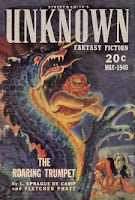
"Unknown Fantasy Fiction", Vol 3 No 3 (May 1940) (magazine, free): Annotated table of contents

Cover by M Isip of Unknown Fantasy Fiction magazine, May 1940 issueScans of this magazine are online in CBR format at Crosseyed Cyclops.

I had an understanding that this short lived magazine was edited by John Campbell. But I don't find his name mentioned on cover or ToC page.

Table of contents.

  1. [novel] L Sprague de Camp & Fletcher Pratt's "The Roaring Trumpet": "Shea thought he'd get into the world of Irish Mythology & make himself important - but he landed in the Norse Twilight of the Gods!"
  2. [ss] Winston K Marks' "Mad Hatter": "It sounds like a good theory for the origin of some of those women's hats!"
  3. [ss] E Hoffmann Price's "Well of the Angels": "With the aid of the Two Angels, a man could beat fate - at a price -"
  4. [ss] Lester del Rey's "The Pipes of Pan": "If a god's last worshipper dies, & the god must work like a mortal to live, what would Pan do -"
  5. [serial - conclusion] Jack Williamson's "The Reign of Wizardry": "Ancient Crete's mighty empire falls!"

See also.

  1. Old "pulp" magazines.
  2. Fiction from 1940s.

Tuesday, February 2, 2010

Henry Kuttner's "Beauty and the Beast" (short story, irony, free): Appearance can be deceptive. And dangerous when coupled with prejudice.

Quote from the short story titled Beauty and the Beast by Henry KuttnerTelling style is very pulp-era, but I liked the story as a whole. And there is a distinct similarity with some parts of Mary Shelley's "Frankenstein".

Story summary.

An ordinary farmer has come into possession of a hibernating alien & some seeds of pretty flowers the first human explorer to Venus (who returned dead) brought back. Farmer brought the alien to life & planted the seeds.

Pretty flowers that resulted were very popular & easy to grow, & their cultivation spread throughout earth.

The alien who emerged was actually of the now extinct Venusian dominant race. Huge dinosaur sized reptilian ("Beast" to humans), very intelligent & full of gratitude for humanity. Communicating with humans, however, is tricky because of their prejudices about his appearance, but the warning he must give them is urgent...

Very Kuttnerian ending.

Fact sheet.

First published: Thrilling Wonder Stories, Fall 1940.
Download full text.
Rating: A.
Related: Stories of Henry Kuttner; Tuesday Classics.

Saturday, January 9, 2010

Free fiction: An old magazine & a few novels

All at Internet Archive in multiple formats.

  1. Two novels, both apparently reprints, "selected by the editors of Galaxy Science Fiction Magazine", & published under "Galaxy Science Fiction Novel" series: J Leslie Mitchell's "Three Go Back" (1932) (download) ("A powerful story mixed with science & sex"), & Edmond Hamilton's "City At Worlds End" (1951) (download).
  2. Planet Stories, September 1951; download.
  3. Fantastic Novels, July 1940; download: Includes a novel & a short story. Novel is Austin Hall & Homer Eon Flint's "The Blind Spot".

Monday, January 4, 2010

Free fiction: A few pulp magazines

All at Internet Archive in multiple formats:

  1. Dynamic Science Fiction: January 1954 (download).
  2. Wonder Stories: August 1934 (download).
  3. Planet Stories: Summer 1949 (download), November 1950 (download), Spring 1955 (download).

    November 1950 issue includes a Mitky Mouse story of Fredric Brown. Not the lovely original, though - it appears to be a sequel.
  4. Super Science Stories: May 1940 (download), January 1941 (download).

    January 1941 issue has PDF of nearly 100 MB; I've not checked other formats. All other issues have PDF of reasonable size.
Related: "Pulp" magazines.

Tuesday, December 8, 2009

Free fiction: Scans & HTML of 5 issues of "Thrilling Wonder Stories" - June 1939, December 1940, December 1947, February 1948, & Spring 1945

At Crosseyed Cyclops, as CBR files in 3 numbered RAR packs - #1, 2, 3. Numbers, however, do not tell which issues are inside the pack; my list below does (item 1 is the contents of pack numbered 1, etc).
Note: Sole HTML - December 1947 - is also inside its own CBR file. Just change file's extension to RAR & extract. All other issues are as scans only.

Update, 15 December 2009: An additional CBR file from RAR #2 can be extracted by telling WinRAR to "ignore broken files" during extraction. This yields Spring 1945 issue, with errors - means it might have some pages missing.

  1. December 1947 (scans + HTML) & February 1948. Henry Kuttner & Ray Bradbury are among the authors represented.

    This gave me a lot of trouble downloading - apparently heavy server overload. But it did eventually download.
  2. June 1939, & Spring 1945. Stanley Weinbaum, E E "doc" Smith, Eando Binder, & Jack Williamson are among the authors included.

    Note that this RAR - containing more than one CBR files - is corrupt. Tell WinRAR to "ignore broken files" during extraction, & it will get both files; else it will not get Spring 1945 issue. In either case, it issues errors which I ignored.
  3. December 1940.
Related: Fiction from Thrilling Wonder Stories.

Friday, April 10, 2009

"Amazing Stories", June 1940 (magazine, free): Table of contents & download link

Front cover image of Amazing Stories magazine, June 1940 issue. A painting by Julian S Krupa, depicting a scene from the story Trapped on Titan David Wright OBrien.Scans of this magazine are available online as part of a larger package.

Table of contents.

  1. Don Wilcox's "Slave Raiders from Mercury": "Fate was against Allison in the Rite of the Floating Chop, for only death could save his life!"

    Hmmm... this description sounds a bit like Elizabeth Bear & Sarah Monette's "Boojum" (in more than one "best of 2008" anthologies, including Dozois'.)
  2. Festus Pragnell's "Warlords of Mars": "Usulor's army rolled forward like a juggernaut, then with music of weird flutes came chaos."
  3. David Wright O'Brien's "Trapped on Titan": "For 500 years Titan had been deserted. Yet here was a lovely woman, fascinating - & terrifying."
  4. Ross Rocklynne's "The Mathematical Kid": "He was only a twerp, & they ignored his treble-voiced warnings of disaster - until it came!"
  5. Floyd Gale's "Treachery on Planetoid 41": "Only one man could live - the best man. So why shouldn't the one most worthy of life plan murder?"
  6. Ed Earl Repp's "Planet of Black Terror": "Clark Erick followed Hillyer to Shasta's peak; a trail that led to an incredible goal in space."

Thursday, April 9, 2009

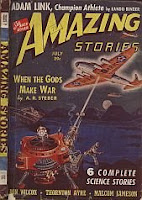
"Amazing Stories", July 1940 (magazine, free): Table of contents & download link

Front cover image of Amazing Stories magazine, July 1940 issue. A painting by Robert Fuqua, depicting a scene from the story When the Gods Make War by A R Steber.Scans of this magazine are available online as part of a larger package.

Table of contents.

  1. A R Steber's "When the Gods Make War": "What was the weird mystery of Vally of Fools & the Talking God in this world of the future?"
  2. Eando Binder's "Adam Link, Champian Athlete": '"I want to be your equal," said Adam Link. But how could he prove his right to be a citizen?'
  3. Don Wilcox's "Mirrors of Madness": "Everywhere in the Baffler Tower mirrors swayed maddeningly, & because of them tragedy struck."
  4. Malcolm Jameson's "The Monster Out of Space": "Walter Berol had to fight even his own fellow-men to find a way to destroy the monstrous Mooneater."
  5. Milton Kaletsky's "The Ray of Hypnosis": "Higginbottom's inventions never had worked out. But this one was different. It worked too well!"
  6. Thornton Ayre's "Secret of the Moon Treasure": "Why were these pallid moonweeds so important that cruel murder was necessary to recover them?"

Tuesday, April 7, 2009

"Amazing Stories", April 1940 (magazine, free): Table of contents & download link

Front cover image of Amazing Stories magazine, April 1940 issue. A painting by H R Hammond, depicting a scene from the story Fish Men of Venus by David Wright OBrien.Scans of this magazine are available online as part of a larger package.

Table of contents.

  1. Thornton Ayre's "The case of the Murdered Savants": Something was queer about these corpses & Brutus Llloyd determined to solve the mystery."
  2. David Wright O'Brien's "Fish Men of Venus": "Carter had to fight both Fish Men & earth Men to clear his name on the Venus Sea Bottom."
  3. John Russell Fearn's "War of the Scientists": "When two scientific factions take to war there's bound to be plenty of hell breaking all around."
  4. Milton Kaletsky's "Revolt of the Ants": '"We want suffrage!" cried the ants. "We have the right to vote!" So they came to Washington.'
  5. [serial, concluding installment] A R Steber's "Black World": "John Carver discovers the secret of the Black World & battles to prevent a great tragedy."
  6. Kack West's "When the Ice Terror Came": "Utter horror struck into Claude Harper's brain as a whole continent of people froze in their tracks."

Saturday, April 4, 2009

"Amazing Stories", August 1940 (magazine, free): Table of contents & download link

Front cover image of Amazing Stories magazine, August 1940 issue. A painting by Leo Morey and Julian S Krupa, depicting a scene from the story Suicide Squadrons of Space by David Wright O Brien.Scans of this magazine are available online as part of a larger package.

Table of contents.

  1. David Wright O'Brien's "Suicide Squadrons of Space": "Craig Starke got the shock of his life when his kid brother turned up in his own suicide squad."
  2. Richard O Lewis' "The Incredible Theory of Dr Penwing": "Down into earth went Pendwing's machine & emerged in a fantastic world beyond the universe."
  3. Ralph Milne Farley's "The Living Mist": "There was something terrifying in the swamps - a mist that engulfed a prison in a reign of terror."
  4. Edmond Hamilton's "Lost Treasure of Mars": "Ages ago the Martians died, but an incredible guardian still protected their greatest treasure."
  5. Malcolm Jameson's "Murder in the Time World": "Karl Tarig committed a perfect crime when he murdered Dr Morrison & sent his body into the future."
  6. Don Wilcox's "Mystery of the Mind Machine": "Not even the victim of the mind machine knew the secrets of the fiendish thing probed from his brain."
  7. Donald Bern's "The Man Who Knew All the Answers": "Scuttlebottom decided to take advantage of his mind reading power, but one answer was wrong."

Saturday, January 31, 2009

Isaac Asimov & Martin H Greenberg (Eds)' "Isaac Asimov Presents the Great SF Stories 2 (1940)" (anthology): Annotated table of contents & review

Cover image of the book titled Isaac Asimov Presents the Great SF Stories 2 1940, edited by Isaac Asimov and Martin H GreenbergThis is the second of a series of 25 anthologies by these editors. This book collects stories first published during the year 1940.

I haven't read many stories yet; will update as I move through the book. Where I'm aware of online copies of stories, I provide download links. My rating is in brackets. Where I've a separate post on a the story, link on story title goes there. Link on a noun yields more of related stories.

Table of contents (16 stories, best first, unread last).

  1. [ss] Ross Rocklynne's "Quietus" (A); download; Astounding, September 1940; first contact: "who we are creates a bias in how we view the world".
  2. [novelette] Harry Bates' "Farewell to the Master" (A); download; Astounding, October 1940; first contact: What we see depends on what we are...
  3. [novelette] L Sprague de Camp's "The Exalted" (A); Astounding, November 1940; humor: An "uplifted to superhuman intelligence" professor loves playing pranks.
  4. [novelette] A E van Vogt's "Vault of the Beast" (B); Astounding, August 1940: Colonists from a parallel universe are defeated by the hero.
  5. [novelette] Theodore Sturgeon's "It!" (B); download comic book adaptation; Unknown, August 1940: I've only read the comic book version yet.

    A zombie is mysteriously born out of a dead man's skeleton that has been lying in the jungle for years - by mixing skeleton with locally available matter like mud & dead vegetation. Unthinking acts of zombie will cause a death & a lot of consternation, till its own death by falling in water that washes away the junk - leaving back the again inert skeleton.

    I cannot really figure out what made the editors include it in this book. It doesn't belong in any list of great sf stories.
  6. [ss] Willard Hawkins' "The Dwindling Sphere"; Astounding, March 1940: Not read.
  7. [ss] Fritz Leiber's "The Automatic Pistol"; Weird Tales, May 1940: Not read.
  8. [ss] Jack Williamson' "Hindsight"; Astounding, May 1940: Not read.
  9. [ss] Robert Arthur's "Postpaid to Paradise"; Argosy, 15 July 1940: Not read.
  10. [novelette] Ross Rocklynne's "Into the Darkness"; Astonishing Stories, June 1940: Not read.
  11. [ss] Lester del Rey's "Dark Mission"; Astounding, July 1940: Not read.
  12. [ss] Oscar J Friend's "The Impossible Highway"; Thrilling Wonder Stories, August 1940: Not read.
  13. [ss] Isaac Asimov's "Strange Playfellow" aka "Robbie"; Super Science Stories, September 1940: I'd read it a long time back. Don't recall many details, but it's probably of a little girl with a play robot. Parents think her affection with robot is unhealthy & its returned back to factory. Girl is unconsolable. On a return to factory for something, the girl is saved by the same robot. Parents finally accept robot.
  14. [ss] L Sprague de Camp's "The Warrior Race"; Astounding, October 1940: Not read.
  15. [novelette] Theodore Sturgeon's "Butyl and the Breather"; Astounding, October 1940: Not read.
  16. [novelette] P Schuyler Miller's "Old Man Mulligan"; Astounding, December 1940: Not read.

Fact sheet.

First published: August 1979 (DAW).
Relevant entries have been added to the list of stories from John Campbell's Astounding.
Some of the bibliographical information here comes from ISFDB.

Monday, November 17, 2008

Harry Bates' "Farewell to the Master" (novelette, first contact, free): What we see depends on what we are

Quote from short story titled Farewell to the Master by Harry BatesAuthor is the first editor of Astounding (now Analog). But this story is from Campbell era.

Effect of the story is a stronger version of Ross Rocklynne's "Quietus". And ending reminded me of some scenes from Pierre Boulle's "Planet of the Apes".

Story features a technique of creating animals, given just the recorded sounds produced by them!! To me, it sounded substantially more mystical than Arthur Clarke's "Playback".

Story summary.

When an alien ship suddenly materialized on the grounds of Smithsonian Institution (in Washington DC, US), it caused much commotion. Two days later, a man who introduced himself as Klaatu emerged with a powerful hominid robot introduced as Gnut. But before the introductions were over, a jittery assassin shot Klaatu dead. Klaatu's death froze Gnut in his then physical position & posture.

A regretful humanity has now made ship & robot exhibits of Smithsonian's museum; Klaatu was buried with state honors. No one has yet been able to figure out even the place in ship's hull where the port is located, let alone any secrets about the aliens worth knowing.

A curious journalist, Cliff Sutherland, wants a story out of it - three months after the aliens' arrival, & a week after their exhibit was opened. He will contrive to stay overnight in the hall containing the exhibits - a place normally left empty at night. And we get a fast moving adventure...

But the real clincher is the ending - when Cliff learns something about his own very human biases...

Collected in.

  1. Raymond J Healy & J Francis McComas (Eds)' "Adventures in Time and Space".

Fact sheet.

First published: Astounding Science Fiction, October 1940.
Rating: A
"filmed in 1951 as The Day the Earth Stood Still" & "its 2008 remake."
Download full text from Real Pulp Weekly.
Listed among the stories from John Campbell's Astounding/Analog.
Related: All stories from Analog/Astounding; Harry Bates' Astounding.

Thursday, July 24, 2008

Robert Heinlein's "Blowups Happen" (novelette, about nuclear power plants, free)

Quote from short story titled Blowups Happen by Robert A HeinleinWhile very readable, substantial parts of it are dated & it sometimes gets too imaginative. Story was written when "there was not a full gram of purified U-235 on this planet".

Story summary.

One single huge nuclear power plant in the US. It meets some 13% of the country's energy needs! This is a world where solar energy is widely used - most households have their energy requirements met by solar panels on roof tops. This is also the worlds where "road cities", built along the length of rolling roads of the "The Roads Must Roll", are common; these rolling roads also primarily run on solar power.

Anyway, because of the possibility that "tons" of uranium core of the plant might blow out at any time, everyone on the plant is constantly on edge. This is the one major thread of the story - frequent nervous breakdown of the technical staff because of onerous responsibility of the safety of the mankind.

Second thread is about the development of atomic rocket fuels that can give a rocket earth escape velocity. Story is apparently older than first space flight. Idea is to somehow make smaller piles than critical mass of nuclear material fissionable in a controlled way. One of the shunted engineers (Calvin Harper, because of imminent nervous breakdown) & his friend (Gus Erickson) do some superheroic work to develop this atomic fuel in days or weeks! But making this small piles requires the big pile! They will later outfit a rocket with engines based on this fuel - again on a schedule that will give creeps to best engineers out there.

Third thread is about how moon got its craters - some imagination run wild. There was once life on it, based on an active gas heavier than oxygen but still dependent on water. And intelligent beings who built atomic power plants that blew up to kill life on the whole world & threw a lot of the crust into space. Craters were formed by those blown blocks of crust that didn't get escape velocity & fell back.

Thomas P Harrington, an astronomer & Director of US Naval Observatory, has developed this lunar thesis. He has convinced both King, General Superintendent of the plant & the local man in charge, & Dr Lentz, a well known psychologist retained by King, that this plant poses a similar scale threat to earth.

That's how we get the final thread. Convincing, even blackmailing, the reluctant Board of Directors of the company that owns the plant to ship it out to space. The big pile will be fitted into a big rocket & sent to an orbit far enough away from earth to avoid danger. Small piles manufactured there will be used to run little & safe plants back on earth.

Notes.

  1. Story features a "telechronometer", a wrist watch "radio-synchronized with the master clock at Washington." Somewhat akin to modern PCs synchronizing time off an internet server. Apparently, such wrist watches are also commercially available now.

Collected in.

  1. John W Campbell, Jr (ed)'s "The Astounding Science Fiction Anthology".

Fact sheet.

First published: Astounding Science-Fiction, September 1940.
Rating: B
Download full text.
Related: All stories of Robert Heinlein.
Note: This post is based on the original 1940 version of the story. There appears to be at least one updated (& edited) later version that I've not read.

Wednesday, July 16, 2008

Ross Rocklynne's "Quietus" (short story, first contact, free): "who we are creates a bias in how we view the world"

Quote from short story titled Quietus by Ross RocklynneConcept is very similar to Eric Frank Russell's "Dear Devil": A post-apocalypse earth, with few remaining humans turned to primitive existence. Well intentioned aliens have come to help the local sentients.

But what a difference in the way the plot develops & ends!

Story summary.

Tommy, 21 year old, is the sole human remaining in a small green patch on an otherwise dead earth. At least he thinks so, till he learns of a very shy girl too. And there is Blacky - Tommy's pet talking crow! Blacky actually behaves like talking parrots we are familiar with, but author tells us it's a crow.

We have a love story here - both Tommy & girl are attracted to each other. But whenever they're about to meet, Backy's speech scares her away.

On a separate thread, we have two alien visitors: Tark & his mate, Vascar. From a world called Alcon. They see signs of existence of sentients once upon this now dead world, & feel sad. Land on the sole green patch with the intention of locating the local sentients, & helping them get back up their old glory.

The rub is: these visitors are sentient birds. There will be some drama, their near conclusion that Blacky is the sentient & Tommy is his draft animal (Blacky often rides on Tommy's shoulder)!

And sad ending - when Blacky has scared away the girl for umpteenth time & Tommy is in the rage & aliens decide to protect the sentient from his gone berserk beast of burden!

Collected in.

  1. David Drake, Jim Baen, & Eric Flint (Ed)'s "The World Turned Upside Down".
  2. Raymond J Healy & J Francis McComas (Eds)' "Adventures in Time and Space".

Fact sheet.

First published: Astounding Science Fiction, September 1940.
Rating: A
Download full text.

Sunday, June 22, 2008

C L Moore's "Fruit of Knowledge" (novelette, religion): First few days of Adam, Eve, & the second woman - in the Garden of Eden

Quote from short story titled Fruit of Knowledge by C L MooreFor someone with only a vague knowledge of the story of Adam, Eve, & their apple eating in the Garden of Eden, it made a fun read. I guess someone with a Biblical background may get a bit more judgmental about this story; but I enjoyed it happily in my lack of knowledge.

Indian readers will feel some familiarity with writing style of Ashok Banker's multi-book retelling of Ramayan. Focus is on devotional interpretation of an old work, rather than more typical rational interpretation.

Story summary.

It's set in the "semi-sentient" Garden of Eden, & begins a day after Adam is created by God out of earth; there is still that naked patch of earth out of which Adam was created, though grass has began encroachments. Adam is the only human around, though Garden is teeming with life.

God ("Jehovah"), living in his heaven "up", can simply come to the edge of heavens & look down into the Garden. He had created Garden as part of a Plan; Plan's details are not provided. Throughout the story, we won't actually see Him; but we will hear His Voice.

In the middle of the Garden are two special trees: "Tree of the Knowledge of Good and Evil" & "Tree of Life". Later gives you immortality, & Adam's attempt to access it will be denied by God near end of story. Tree of the Knowledge is, of course, the familiar apple tree.

A supernatural being other than God also features in the story: Lilith, the "Queen of Air & Darkness". Even God cannot kill her, though He can punish her. This is really her story; she's the main character.

On this second day of Adam ("the first Sabbath"), Lilith has a plan of her own for the Garden. A variation of her plan will appear near end of story - through some magical means I could not follow, she can grab hold of Garden for her exclusive use by making it invisible to God. But that's much later, & it will fail because of lack of cooperation from Adam.

Anyway, Lilith has come down & taken the shape that will later be known as woman's shape. She'll become friends with Adam, & will find strange stirrings in her heart; this supposedly heartless spirit is madly in love, & is effectively Adam's original wife! It's on the "eighth day" (of Adam's life?) when she breaks bonds of her body while Adam is asleep & flies away to sky.

Her bodiless being later returns to complete her unstated mission, & finds her vacated body occupied! Looks like God created Eve in her absence from a rib of Adam, & put her in old body of Lilith's!

Here we have the age old story of jealously - one man & two women.

In the meanwhile, there has been swords fight in heaven! So "the serpent", expelled from heaven by God, makes an unwanted appearance in the Garden. Also, "In those days the serpent went upright like a man, nor was he exactly non-human in shape... He was lithe & gorgeously scaled & by any standards a supremely handsome, supremely male creature."

So Lilith & serpent will plot their revenge. Serpent intends to destroy Adam, & with it the God's plan; Lilith convinces him to instead incite Eve to eat the Fruit of Knowledge that will make God destroy her, leaving Adam for Lilith!

In the meanwhile, Lilith has met Adam & convinced him she & Eve are different. And while Adam has a sense of duty towards Eve, he still has a soft corner for Lilith.

I got a feeling that serpent was able to create strange stirrings of love for him in the heart of Eve when he convinced her to eat the fruit, & near end to "Call your first child Kayn... Cain."

In the aftermath of fruit eating, we will also see the first blame-mongering among Adam & Eve.

Eventual judgment of God, after the act of fruit eating: "Adam, Eve, ... the Garden is not for you... I made your flesh too weak, because your godhood was too strong to trust. You are not to blame for that - the fault was Mine. But ... what power did I put in you, that the very elements of fire & darkness find kinship with you? What flaw is in you, that though you are the only two human things alive, yet you cannot keep faith with one another? ... you are not yet fit for perfect knowledge or immortality. You are not yet fit for trust... now you must go beyond temptation & work your own salvation out in the sweat of your brow, in the lands beyond the Garden. Adam, I dare not trust you any longer in your kinship with the earth I shaped you from. Cursed is the ground for your sake... it shall be one with you no longer. But I promise this... in the end you shall return to it".

Lilith's punishment is also her boon: "Let my children & Adam's haunt hers to their graves, then! ... Mine are the disinherited - let them take vengeance!"

And serpent (aka "Lucifer"), while leaving now as a ground hugging creature, will extract from Eve promise of his vengeance: "Give me my vengeance too - upon the Man... Call your first child Kayn... Call him Kayn the Spear of my vengeance, for he shall set murder loose among Adam’s sons."

See also.

  1. Ted Chiang's "Hell is the Absence of God": Taking parts of Bible literally.

Collected in.

  1. "The Best of C L Moore".

Fact sheet.

First published: Unknown Fantasy Fiction, October 1940.
Rating: A

Monday, August 6, 2007

Robert Heinlein's "Successful Operation" aka "Heil!": Fate of a dictator

This rather short story appears to be modeled after Hitler's Germany.

Dictator at the heart of the story is simply referred to as The Leader. There are concentration camps for people of a certain religious faith - though faith itself is not named. And the country is lovingly referred to as "Fatherland".

Story summary.
The Leader is suffering from a fatal illness of pituitary gland - a pea-sized organ attached to bottom of the brain that is involved in regulation of a variety of biological activities, including growth, water retention, digestion, sexual reproduction, blood pressure, & others.

Technology is available for transplant of the gland from a human donor. Samuel, a concentration camp detainee, is "chosen" as a donor - his healthy gland will be exchanged with Leader's dying one - in exchange for Samuel's freedom.

But there is a glitch. Dr Lans, the only surgeon capable of performing the surgery, is also in concentration camp - along with his wife Emma & daughter Rose. A deal is negotiated: Dr Lans, Emma & Rose will be freed & transported to a foreign land, their money confiscated by state will be returned as gold, & operation will also happen on foreign shores.

Just a little after successful operation, Dr Lans discovers that both Samuel & Leader have been moved to original country. He is feeling sorry that Samuel was cheated.

Last scene is kind of anticlimax that made me recall Arthur Clarke's "Exile of the Eons". Leader opens his eyes & finds himself in a dungeon. Trying to order guards around results in beatings. Looks like someone else has taken over power, & Leader stands deposed!

Fact sheet.
Successful Operation, short story, review
Also published under the title: "Heil!" under pseudonym "Lyle Monroe"
Author: Robert A Heinlein
First published: 1940
Rating: B
List of publications containing this story.

Note: Moved here from original location on Aug 6, 2007. Reason.

Robert Heinlein's "Requiem": A man dies pursuing a dream

This is actually not a bad story. But I don't like stories with sad ending; there is a hint of impending death frequently in the later half of the story.

Also, this story now appears a bit out of date. It talks of private space flight companies, & a city on moon in our present time. But the story was written in 1940 - in another lifetime!

Note: The word "requiem" means "funeral".

Story Summary.
Delos D Harriman is an old millionaire & a major shareholder of the Company. He is a pioneer of space flight, & the Company has a monopoly on exploitation of moon & of earth/moon passenger & freight traffic.

And he has this dream cherished since childhood. He will stand on the surface of moon, looking up at earth in the skies. By the time space flight was perfected, he was too old. He cannot go on his own Company's ships because his weak bones cannot take the heavy acceleration; medical regulations deny him passage.

Then we have two freelancers - rejects of the spaceflight for some misconduct or the other. Captain McIntyre & his technical man, Charles Cummings aka Charlie. They now give joyrides up stratosphere for a fee in their run down flier, Care Free, at Bates County Fair Association.

Harriman enlists the duo to help him get to moon, after much arguments - mostly on grounds of his health. But Care Free is not up to the job. They will buy a stratospheric yacht, & outfit it with additional gear to make it suitable for moon flight - at an isolated place owned by Harriman. Ship will eventually get a rather interesting name, "Lunatic"!

Harriman cashes out of his businesses, sets up trusts for his charities, is sued by nieces & nephews because they are set to lost the fortune they are set to lose, & there is some more drama. Finally, the three fly out.

Rest of the story is about actual flight, view of earth from above, landing on moon, & Harriman's death just after landing there.

Collected in.

  1. Raymond J Healy & J Francis McComas (Eds)' "Adventures in Time and Space".
Fact sheet.
First published: Astounding, January 1940.
Rating: B

Note: Moved here from original location on Aug 6, 2007. Reason.