Showing posts with label 1957. Show all posts

Sunday, October 13, 2013

"Infinity Science Fiction", April 1957 (ed Larry T Shaw) (magazine, free): Annotated table of contents

Cover by Ed Emsh of Infinity Science Fiction, April 1957 issue. Image illustrates the story The Martian Shore by Charles L Fontenay.Where I have a separate post for a story, link on story title goes there. Link on author fetches more fiction by author.

Table of contents.

  1. [novelette] Harlan Ellison's "Deeper than the Darkness": "Controlled, his weird power might have been a blessing--uncontrolled, it made his life a literal, flaming hell!"
  2. [ss] Arthur C Clarke's "The Case of the Snoring Heir" aka "Sleeping Beauty" (A): "Sigmund's problem was simply stated: no sleep, no wife; no wife, no money! But how can a man control his snores?"
  3. [ss] E C Tubb's "The Eyes of Silence": "The choice was his: a solitary cell on Earth, or a solitary cell in space--& both paths led only to madness!"
  4. [ss] Fritz Leiber's "Friends & Enemies": "In a world blasted by super-bombs & run by super-thugs, Art vs Science can be a deadly debate!"
  5. [ss] John Christopher's "The Noon's Repose": "To control genetics, you must control love--& if Cupid is human, will he enjoy slavery?"
  6. [ss] Charles L Fontenay's "The Martian Shore": "Shaan made the longest crawl in history--to avoid crawling before tyrants!"
  7. [ss] John Victor Peterson's "The Gently Orbiting Blonde": "Anti-gravity may be hard to handle--but a woman scorned is still harder!"
  8. [ss] Richard Wilson's "Deny the Slake":
           "Those couplets held
              (unless they lied)
            The reason why
              a world had died!"

Fact sheet.

Labeled: "Vol 2 No 2".
Download the scans as a CBR file. [via Alexander@pbscans]
Note: Link fetches a RAR file that needs to be renamed CBR.
Related: Stories from Infinity SF; 1950s; old "pulps".

Monday, September 30, 2013

Jack Vance's "The Men Return" (short story, weird physics)

This is unlike anything else I've seen of Vance. And pretty near amongst the weirdest stories I've seen.

Story summary.

Earth passes through a peculiar region of space where causelty no longer holds & physics is weird. Earth is not necessarily solid & can randomly change phases. You can pick up a chunk of air & eat it, or ride it! Etc.

Most men died out. Few survivors are in two groups: organisms are thoughtless with random spur of the moment action. Relicts are rational of the old but are fast dying out - since this world has not rationality & doesn't tolerate rationality.

That's when the universe inexplicably returns back to a state where the effect follow the cause & rational men can claim the world again.

Fact sheet.

First published: Infinity Science Fiction, July 1957.
Rating: B.
Related: Stories of Jack Vance.

Monday, September 9, 2013

"Future Science Fiction", Fall 1957 (ed Robert A W Lowndes) (magazine, free): Annotated table of contents

Cover by Emsh of Future Science Fiction magazine, Fall 1957 issue. Picture illustrates the short story The Lonely Stars by Scott Nichols.
I haven't read any story yet. Links on author fetch more fiction by author.

Table of contents.

  1. [novelette] Gordon R Dickson's "Cloak & Stagger": "It would have been hilarious if Earth's acceptance into the Federation hadn't depended on how Torm Lindsay carried out his mission--because no one, particularly Lindsay, had the faintest notion of what he was expected to do, or not do!"
  2. [ss] Margaret St Clair's "Starobin": "They needed a hero like Starobin--but a hero like Starobin was just the kind who didn't care..."
  3. [ss] Scott Nichols' "The Lonely Stars": "Would humanity ever be able to undo that worst of blunders?"
  4. [ss] Robert Silverberg's "Force of Mortality": "The greatest boon can also be the deadliest curse..."
  5. [ss] Thomas N Scortia's "Last Meeting Place": "Garth was one of the few who understood history--but could he avoid repeating it?"
  6. [ss] Bruce Tucker & Irving Cox, Jr's "The Professor from Pyjm": 'Was Mytohell just another "crazy scientist" or ...?'
  7. [ss] F M Busby's "A Gun for Grandfather": "So you have a time machine, so you can go back in time & shoot grandpa? But why bother? Barney had a reason..."
  8. [ss] George R Hahn's "The Round Peg": "Basil Thorpe was the most bizarre of phonies..."

Fact sheet.

Labeled: "No 34". "Published quarterly".
Download scans as a cbr file. [via pulpbox@pulpscans]
Note: Link fetches a RAR file that needs to be renamed CBR.
Related: Old pulps; fiction from Future SF, 1950s.

Friday, August 16, 2013

"Imaginative Tales", July 1957 (ed William M Hamling) (magazine): Annotated table of contents

Cover painting of Imaginative Tales magazine, July 1957 issue, by Malcolm Smith, illustrating the story World of Never-Men by Edmond Hamilton
Oops. I downloaded its CBR a while back but the link seems to have gone dead now. Will post the link separately if I can find it elsewhere.

I haven't read any story yet.

Table of contents.

  1. [novella] Edmond Hamilton's "World of Never-Men": "Barker set out on a trail of vengeance that would lead him to retribution--or death. It would also, inevitably, bind him to Mars' dark secret..."
  2. [ss] Robert Moore Williams' "The Red Rash Deaths": "There wasn't a cure for the sickness that struck humans down in horrible agony. And Keeton lacked any clues to follow in his race to stop..."
  3. [ss] Randall Garrett's "Devil's World": "Every secret agent sent to Mercury turned up dead; now Courtney volunteered for the task of trapping Thurston, the man who ruled this--".
  4. [ss] Robert Silverberg & Randall Garrett's "Hot Trip for Venus" (as by Ralph Burke): (ToC lists Ralph Burke as author; story lists Randall Garrett as author!). Alex Mayne knew somebody wanted to keep him out of the spacelanes. And that could only mean someone was afreaid he'd learn about the--"
  5. [ss] Robert Silverberg & Randall Garrett's "Pirates of the Void" (as by Ivar Jorgensen): "Brant's job was to check the robot relays on tiny stations scattered through space. It was not his job to risk death after an attack from--"
  6. [ss] Robert Silverberg's "The Assassin": "Bigelow had a grand idea; he would travel more than a hundred years through time to Ford's Theatre, see the President, & warn him about--"

Fact sheet.

Related: Old pulps.; fiction from 1950s.

Sunday, June 16, 2013

William Tenn's "Winthrop was Stubborn" aka "Time Waits for Winthrop" (novella, time travel): What will the world look like in 25th century?

This is about as colorful an adventure as you're likely to see in science fiction. And from William Tenn, of all people! Alive sidewalks that help you move & help prevent your fall, "government machine" you can order materialized out of thin air to discuss things governmental, "Shriek Field" where you can play mad (but only in nude!) to relive stress, telepathic semi-sentient food that will work all it can for your enjoyment, "Oracle Machine" that can solve any problem, floor that keeps adjusting to your needs, "jumper" - a cylindrical contraption you can materialize from thin air & get inside to instantly teleport anywhere, ...; it goes on & on!

Story summary.

A group of 5 Americans in 1958 travel to 2458, selected with great fanfare (by government?) on invitation from & with technology of 25th century. The deal is: it's an exchange; when they go to future, simultaneously 5 persons from future will materialize in now. Only way the parties can return to their time is at an appointed time & place, & only if all of them want to return; if even one of them wants to stay, all get stranded in foreign time.

And Winthrop, an old man among the visitors to future, likes it so much here that he's refusing to return, stranding everyone else! Story if of efforts of others in his party to persuade or coarse him to return.

Collected in.

  1.  William Tenn's "Time in Advance".

Fact sheet.

First published: Galaxy, August 1957.
Rating: B.
Related: Stories of William Tenn.

Sunday, February 17, 2013

"Astounding Science Fiction" (British edition), April 1957 (ed John Campbell) (magazine, free): Annotated table of contents

Cover by Van Dongen of British edition of Astounding Science Fiction magazine, April 1957 issue.
I think I've read "2066: Election Day" in one of the "Issac Asimov Presents Great SF Stories" books. An unusual "election" for a US President, an election where people don't vote at all, & one that was actually rigged by a small coterie. I don't think I came back happy with it, & the ending invoked in me an angry reaction - "how could the author propose this to be a good outcome?" type of reaction.

Links on author fetches more fiction by author. Where I have a separate post on a story, link on story title goes there. For stories I've read, my rating is in brackets.

Table of contents.

  1. [novelette] Robert Silverberg & Randall Garrett's "False Prophet" (as by Robert Randall): "There are times when it is exceedingly unwise to tell the truth--& the Nidorian was dedicated to truth. The Earthmen were wiser; they lied about him."
  2. [ss] Michael Shaara's "2066: Election Day": "There is a limit to any process you can name ... & sooner or later that limit will be reached. Then ... somehow you have to fumble togeather a new thing..."
  3. [ss] Algis Budrys' "Look on My Works" (B): Tourist guides milking a tourist from Centaurus with fakes, in a far future New York city...
  4. [ss] Robert Silverberg's "To Be Continued" (A): Slow life is frustrating!
  5. [serial - 3/3] Isaac Asimov's "The Naked Sun": "Lije Baley had a triple-decker problem to solve--& solved it only because a robot tried to give him a hand. And thereby taught him to define his terms with a new exactness!"

Fact sheet.

Labeled: "Vol XIII No 4 (British Edition)".
Download scans as a CBR file [via Bob@pulpscans]
Note: The link fetches a RAR file that contains the target CBR, probably to work around hosting service's file naming constraints.
Related: Stories from the Astounding/Analog issues edited by John Campbell, old "pulps", 1950s.

Friday, August 31, 2012

"Imagination Science Fiction", April 1957 (ed William M Hamling) (magazine, free): Annotated table of contents

Cover painting by Lloyd N Rognan, of Imagination Science Fiction magazine, April 1957 issue, illustrating the story Bring Back My Brain by Dwight V Swain

Table of contents.

  1. [novel] Dwight V Swain's "Bring Back My Brain!": "A man can fight as long as he has the strength--or a mind to command his body!"
  2. [novelette] Robert Moore Williams' "Secret of the Painting": "It wasn't the painting itself men killed for, but the knowledge hidden there..."
  3. [ss] Robert Silverberg's "Harwood's Vortex": "Ever wondered what would happen if the sky fell on you? Harwood found out!"
  4. [ss] Randall Garrett's "Guardians of the Tower": "Legend demanded he guard the strange tower. Was it something worth dying for?"
  5. [ss] Robert Silverberg's "The Old Man" (as by S M Tenneshaw): "The space pilot was a man to be envied. Until the inevitable day of retirement..."
  6. [ss] Robert Silverberg & Randall Garrett's "Slaughter on Dornel IV" (as by Ivar Jorgensen): "Before the fight with the alien champ, Filmore decided to test his own skill..."

Fact sheet.

Labeled: Vol 8 No 2.
Download scans as a CBR file. [via Sea@pulpscans]
Related: Fiction from Imagination; old pulps; fiction from 1950s.

Friday, August 17, 2012

Algis Budrys' "Chain Reaction" (as by John A Sentry) (novelette, freedom): You're free, but live my way!

I intended to write this post on 15 August, India's Independence Day, but have been busy recently. This is an independence day story, but I found the author's idea of freedom somewhat obnoxious, even if well intended.

Story summary.

An alien world where an intelligent species is held enslaved by another with much superior technology. Slaves whose work the owners don't even need anymore; they're held enslaved out of habit, or may be of need to exercise power over others.

A passing human ship discovers the enslavement, & frees the slaves. Only the humans are treating the newly freed as children that need to be taught how to live, & natives naturally resent it.

Collected in.

  1. Groff Conklin (ed)'s "Six Great Short Science Fiction Novels".

Fact sheet.

First published: Astounding, April 1957.
Rating: B. 
Among the stories edited by John Campbell for Astounding/Analog. 
Related: Stories of Algis Budrys.

Thursday, April 19, 2012

Isaac Asimov's "Galley Slave" (novelette): How to make a 3-laws obeying robot harm a human...

Quote from short story Galley Slave by Isaac Asimov
This story pits for-automation folks against those against-automation, because it will result in job losses & loss of human purpose (in remaining busy doing certain occupations?)

Most of the story is a courtroom trial. Prof Simon Ninheimer was against Robot EZ-27's employment by his university from the very beginning; the idea that a new type of robot can take over routine intellectual tasks like proofreading was totally unpalatable. So he set out to destroy the reputation of US Robots, its makers, by an unusual court case...

Collected in.

  1. Groff Conklin (ed)'s "Six Great Short Science Fiction Novels".

Fact sheet.

First published: Galaxy, December 1957.
Rating: A. 
Related: Stories of Isaac Asimov.

Sunday, February 12, 2012

Harry Harrison's "The Stainless Steel Rat" (short story, robbery, free): Crooks wanted!

Only thing that puzzles me is: was this the story that spawned the huge "Stainless Steel Rat" series? This story is decent timepass, but it's not outstanding by any standards.

Story is of a master thief, long on the run from law, the one who always give the cops a slip. Well, there is a last time, & he will be finally caught. But he'd never dreamt of the punishment he'll get...

Fact sheet.

First published: Astounding, August 1957.
Note: There also appears to be a novel of this title. I don't know if that's an expanded version.
Download full text from author's website.
Among the stories from Astounding/Analog issues edited by John Campbell.
Rating: B.
Related: Stories of Harry Harrison.

Wednesday, January 11, 2012

Hal Clement's "Planetfall" (novella, first contact): A hard-sf look at the problem of first contact

Note there are at least 2 versions of this story: original novella Hal Clement wrote, & longer "novel" that's the original story extensively padded by Sam Mervin. This post is based on Clement's solo novella.

This may be among the most weird first contact stories I've seen so far. With sufficiently different body chemistry & evolutionary environment, how hard can it get to recognize alien life & communicate with it, even if you notice there is (alien) intelligence somewhere around? This is actually a failed contact story, in spite of much effort from both sides.

Story summary.

A sessile, long-lived, technologically far in advance of us, star faring race of aliens extensively mines metals off all sorts of worlds. A "Conservationist", a sort of policeman to prevent unauthorized mining, has noticed some "poachers" attempting to steal metals off earth. His approach makes them run away, but they've left behind "mole robots", bombs that will cause much upheaval in earth's crust to turn its metals-denuded surface into a metals-rich surface again in a few million years. Which means death for much of local life.

He'll land here, & notice obvious signs of intelligence. But all through his attempts to communicate with humans, he won't even realize they're the ones he's trying to help.

Fact sheet.

First published: As a novel with additional material by Sam Merwin in Satellite Science Fiction, February 1957 as "Planet for Plunder". I'm not sure when the pure original novella version first saw the light of the day - probably 1972 in Robert Hoskins's anthology "Strange Tomorrows".
Rating: A. 
Related: Stories of Hal Clement.

Friday, July 29, 2011

Eric Frank Russell's "Love Story" (short story): It's easier giving advice than to follow it!

One of the minor stories of Russell.

A military commander is griping about how much worse the current crop of soldiers is compared to when he was young, what with men citing family obligations to avoid difficult assignments. But he himself is not quite immune to a bite of love, even if he doesn't have a family...

Fact sheet.

First published: Astounding, April 1957.
Rating: B.
Among the stories from Astounding/Analog issues edited by John Campbell.
Related: Stories of Eric Frank Russell (annotated list).

Thursday, June 24, 2010

New at Project Gutenberg (24 June 2010)

Links on author, publisher, or year fetch more matching fiction.

  1. Randall Garrett & Stephen Marlowe's "Quest of the Golden Ape"; download; Amazing Stories, January-March 1957: "How could this man awaken with no past--no childhood--no recollection except of a vague world of terror from which his mother cried out for vengeance and the slaughter of his own people stood as a monument of infamy?"
Related: Fiction from old "pulp" magazines.

Saturday, June 5, 2010

New at Project Gutenberg (5 June 2010)

Links on author, publisher, or year fetch more matching fiction.

  1. Chester S Geier's "Cold Ghost"; download; Amazing Stories, November 1948: "All Hager had to do was slow the dogsled to a walk, and his partner died. A perfect crime--no chance to get caught!"
  2. Knut Enferd's "Day of the Druid"; download; Amazing Stories, November 1948: "Be'al, all-powerful god, drank the blood of his victims. Would Gaar be able to save Marna, whom Be'al kept in eternal sleep, and avenge her people?"
  3. Alfred Coppel's "The Invader"; download; Imagination, February 1953: "Invading Earth was going to be a cinch, the Triomed scout decided. But to make certain he must study its inhabitants--as one of them!"
  4. George H Smith's "The Ordeal of Colonel Johns"; download; If, June 1954: "Colonel Johns, that famous Revolutionary War hero, had the unique--and painful--experience of meeting his great-great-great-great granddaughter. Now maybe you can't change history, but what's there to prevent a soldier from changing his mind about the gal he is going to marry?"
  5. Raymond F Jones' "The Colonists"; download; If, June 1954: 'If historical precedent be wrong--what qualities, then, must man possess to successfully colonize new worlds? Doctor Ashby said: "There is no piece of data you cannot find, provided you can devise the proper experimental procedure for turning it up." Now--about the man and the procedure...'
  6. Robert Moore Williams' "The Next Time We Die"; download; Amazing Stories, February 1957: "We journey to far places, driven on by ideals. We fight for lost causes, sacrificing our lives because the things we fight for seem worthwhile. But are we right? Are they worth being killed over? Perhaps. Then again, maybe we'll know better--The Next Time We Die".
Related: Fiction from old "pulp" magazines.

Sunday, April 11, 2010

Free fiction: Galaxy, March 1952 & April 1952, & Amazing Stories, November 1957

All at Internet Archive in multiple formats.

  1. "Galaxy Science Fiction", March 1952; download.

    "The pages for the stories 'The Year of The Jackpot' by Robert A. Heinlein, 'Catch That Martian' by Damon Knight and 'The Demolished Man' by Alfred Bester, have been deleted from the files since the Copyright was renewed".

    That leaves 3 complete stories. "The Demolished Man" was a serial of which last part appeared in this issue.
  2. "Galaxy Science Fiction", April 1952; download.

    "The pages for the story 'Ticket to Anywhere' by Damon Knight have been deleted from the files since the Copyright was renewed".

    Among the authors: Fritz Leiber.
  3. "Amazing Stories", November 1957; download.
Related: Fiction from Galaxy, Amazing, 1950s; Old pulps.

Tuesday, November 10, 2009

A E van Vogt's "Empire of the Atom" (collection, free): Annotated table of contents & review

Cover image of the short story collection titled Empire of the Atom by A E van Vogt. Cover shows Lord Clane of Linn in his temple garb to hide his mutation, symbolically managing the Atom Gods.Two things make the generally sub-par series of stories collected here noteworthy:

  1. It probably inspired Lois McMaster Bujold's "Miles Vorkosigan" series. I've read only one Vorkosigan story - "The Mountains of Mourning", but there is too much similarity in the fictional universes: feudal but space traveling society that is a remnant of old glory days of humanity, & a severely handicapped hero from ruling dynasty who must make a place for himself in a society that is unreasonably prejudiced against his handicap. But "The Mountains of Mourning" is infinitely more interesting than anything in this van Vogt original.
  2. In some sense, this series can probably be considered a precursor to steampunk. At least I'm not aware of anything older that qualifies.
This book collects all stories in "Lord Clane of Linn" series (aka "Atom Gods" series?) of author, except the novel "The Wizard of Linn" that logically follows the last story in this collection.

Background.

Humanity once traveled the stars, but those days are long gone. There was a devastating war with aliens - so now we have small human societies on many worlds of the solar system - including earth (population a few million), Mars, Venus, & "Europa, one of the moons of Jupiter". And a lot of ruins of old cities - though radioactivity on those sites is now on the wane.

Earth is now a feudal society ruled by the mean Linn family whose members are constantly assassinating or otherwise pulling down each other in never ending power struggles. But the society also has access to the remnants of ancient technology like advanced spaceships & some weapons. This old technology is used with ritual rather then understanding; priests that serve the temples dedicated to four Atom Gods handle the ancient technology.

This series is the developing story of Lord Clane, a mutant born into the Linn family. Stories describe his transformation from being a definite case for infanticide for shaming the aristocratic family by being a mutant to the ruler of the universe.

Table of contents.

List below is in order of logical progression of stories. I had a tough time going through first two stories; rest were easier - either because they're better, or because I was getting used to the curious universe of the stories.
  1. [ss] "A Son is Born"; download; Astounding, May 1946: Even Lady Tania, the mother of newborn & daughter-in-law of the current ruler ("Lord Leader"), doesn't expect her mutant son to live, & is puzzled why Scientist Joquin, a priest, is intent on saving him. Child will remain unnamed in this story; first use of his name - Clane - happens only in the next story.
  2. [novelette] "Child of the Gods"; download; Astounding, August 1946: Creg, Clane's father, is commanding the earth army raiding Mars & has been losing so far - thanks to back stabbing of Lydia, his step mother who wants her son Tews to be the next Lord Leader.

    Brilliant teenager Clane, protected & educated so far by Joquin, will help his father win the losing war by offering a valuable advise. Though his father will be later assassinated by hired killers of Tews, who will then run to exile fearing Lord Leader's punishment.
  3. [novelette] "Hand of the Gods"; download; Astounding, December 1946: Lydia manages to convince her husband Lord Leader to name her son Tews, in exile since his part in assassination of Creg, the successor before Lord Leader's death. Tews will assume the title of "Lord Adviser".

    But she has also learnt of the growing power of Clane, & will go to any length to have him assassinated. Only Clane is way too powerful, & Lydia will eventually be humbled.
  4. [novelette] "Home of the Gods"; download; Astounding, April 1947: Jerrin, Clane's elder brother, is about to win his military campaign against Venusian rebels but is being thwarted by "Lord Adviser" Tews, the current ruler of Linn. Clane will play the diplomat & military leader, & will have each of the 3 parties to war eventually obliged to him - his brother, Tews, & rebels.
  5. [novelette] "The Barbarian"; download; Astounding, December 1947: Czinczar, leader of the barbarian hoard from Europa, is finding earth easy to conquer. Lord Adviser Tews has been beheaded, & there is little resistance to Czinczar. Of course, Clane will eventually humble Czinczar, & reclaim the empire for Linn family.

Fact sheet.

First published in book form: 1957.
Stories here are also listed among the stories from John Campbell's Astounding/Analog.
Related: Stories of A E van Vogt; mutants in fiction.
Legend: ss = short story.

Sunday, September 6, 2009

Murray Leinster's "The Machine That Saved The World" (novelette, free): Human descendants from future want to help us!

Illustration accompanying the Project Gutenberg version of the short story titled The Machine That Saved The World by Murray LeinsterYear 2180 wants to discuss (via a temporal broadcast) a doom about to visit 1972: a widespread & currently harmless germ is about to mutate into something fatal. They have a plan to contain the disaster, but need two way communications to thrash out details. Hence they send out design of transmitter Now should build to talk to Future.

But one man is smelling something fishy. With the help of electronic geniuses, he will transform the received designs into functionally equivalent but visually unrecognizable alternates. And convince the Future to build this first.

Results turn out to be very interesting.

Fact sheet.

First published: Amazing Stories, December 1957.
Rating: B.
Download full text from Project Gutenberg, Manybooks, or Feedbooks.
Related: Stories of Murray Leinster.

Wednesday, August 5, 2009

Fritz Leiber's "What's He Doing in There?" (short story, humor, free)

Illustration accompanying the short story titled Whats He Doing in There by Fritz Leiber. It shows anxious human family trying to find of if their Martian visitor is safe inside the bathroom.First contact the first Martian visitor to earth made was with a professor of cultural anthropology at his home. He soon asked to visit bathroom. But it's been hours since he's been there, & the question everyone in the family is asking is: "What's he doing in there?"

Answer, when they finally discover it, is of course funny.

Fact sheet.

First published: Galaxy Science Fiction, December 1957.
Rating: B.
Download full text from Project Gutenberg, Manybooks, or Feedbooks. [via QuasarDragon]
Related: Stories of Fritz Leiber.

Saturday, August 1, 2009

Isaac Asimov & Martin H Greenberg (Eds)' "Isaac Asimov Presents the Great SF Stories 19 (1957)" (anthology): Annotated table of contents & review

This is #19 of a series of 25 anthologies by these editors. This book collects stories first published during the year 1957.

Where I'm aware of online copies, I provide download links. My rating is in brackets. Where I've a separate post on a the story, link on story title goes there. Link on author or publisher yields more of stories from the source.

Table of contents (15 stories, best first, unread last).

Among the 7 stories I've read so far, first 3 are very good. And "The Cage" has a cool idea near end.
  1. [novelette] Poul Anderson's "Call Me Joe" (A); download audio or comic book adaptation; Astounding, April 1957: Human operator (via directly linked mind-to-mind interface) of an artificial animal adapted to live on Jupiter's "surface" becomes one with him, & would rather live in that healthy body on Jupiter rather than in his own withered human body.
  2. [novelette] H Beam Piper's "Omnilingual" (A); download text from Project Gutenberg, Manybooks, or Feedbooks, or audio from LibriVox; Astounding, February 1957: A universal rosetta stone to decode the writings of a long dead civilization known to be at about our level of technological ability.
  3. [ss] C M Kornbluth's "The Education of Tigress McCardle" (A); Venture Science Fiction, July 1957; humor: An unusual population control program!
  4. [ss] Isaac Asimov's "Strikebreaker" aka "Male Strikebreaker"; Science Fiction Stories, January 1957: I'd read a long time back. Not sure, but I think it's something about a society treating sanitary workers as untouchables, who've a gone on a strike. A visitor breaks the strike by either talking to untouchables or doing their work, & himself becomes untouchable by doing this act.
  5. [ss] A Bertram Chandler's "The Cage" (A); F&SF, June 1957: A shorter version of Pierre Boulle's "Planet of the Apes".

    The Crotchety Old Fan gives a hint on how to find the audio of an (unofficial) radio adaptation of this story online.
  6. [ss] Brian W Aldiss' "Let's Be Frank" (B); download; Science-Fantasy, #23 (June 1957): How humanity became a hive intelligence.
  7. [ss] C M Kornbluth's The Last Man Left in the Bar (C); Infinity Science Fiction, October 1957: Trivia in a bar.
  8. [ss] Kate Wilhelm's "The Mile-Long Spaceship"; Astounding, April 1957: Not read.
  9. [ss] Theodore R Cogswell's "You Know Willie"; F&SF, May 1957: Not read.
  10. [ss] Carol Emshwiller's "Hunting Machine"; Science Fiction Stories, May 1957: Not read.
  11. [ss] Robert Silverberg's "World of a Thousand Colors"; Super-Science Fiction, June 1957: Not read.
  12. [novella] Lloyd Biggle, Jr's "The Tunesmith"; If, August 1957: Not read.
  13. [ss] Isaac Asimov's "A Loint of Paw"; F&SF, August 1957: Not read.
  14. [ss] Rog Phillips' "Game Preserve"; If, October 1957: Not read.
  15. [novelette] Harlan Ellison's "Soldier" aka "Soldier from Tomorrow"; Fantastic Universe, October 1957: Not read.

Fact sheet.

First published: 1989 (DAW).
Relevant entries have been added to the list of stories from John Campbell's Astounding.
Some of the bibliographical information here comes from ISFDB.
Legend: ss = short story.

C M Kornbluth's "The Last Man Left in the Bar" (short story)

Cannot make out the head or tail of it.

An ordinary man & two mysterious individuals; the two seem to have some sort of magical powers & aren't from our world or universe or ... something.

The man had stolen "the Seal" that the two visitors want. They eventually get it, & "The Century of Flame" (whatever the heck that is) begins!

Through most of the story, we see the man getting drunk in a bar & watching trivia going on around the place.

Collected in.

  1. Isaac Asimov & Martin H Greenberg (Eds)' "Isaac Asimov Presents the Great SF Stories 19 (1957)".

Fact sheet.

First published: Infinity Science Fiction, October 1957.
Rating: C.
Related: Stories of C M Kornbluth.

Friday, July 31, 2009

C M Kornbluth's "The Education of Tigress McCardle" (short story, humor): An unusual population control program

This is a frame story. Frame is of an unarmed unopposed leisurely US invasion by China; a wily Chinese man has sold the US government an unusual & all too effective population control idea!

But the really interesting & very funny story is the one within the frame - the population control story. Very beautiful.

Story summary.

In this era of "Parental Qualifications Program" ("PQP"), George McCardle & his wife Tigress have decided to have a baby.

PQP regulations require them to get a breeding permit from government. To get the permit, they need to care for the "Toddler", a robot baby the government gave them on application, for 3 months.

Looks easy enough; prove that you can live with the demands of a baby. Only this is a super-cranky baby, designed to ensure the aspiring parents will give up the idea in days...

Notes.

  1. I suspect frame part satirizes a specific US President of the period. But I'm not familiar with issues locals had with their Presidents to figure it out.

Collected in.

  1. Isaac Asimov & Martin H Greenberg (Eds)' "Isaac Asimov Presents the Great SF Stories 19 (1957)".

Fact sheet.

First published: Venture Science Fiction, July 1957.
Rating: A.
Related: Stories of C M Kornbluth.

Wednesday, July 29, 2009

Brian W Aldiss' "Let's Be Frank" (short story, free): How humanity became a hive intelligence

Once upon a time, a man called Frank Gladwebb lived in England. He carried a weird chromosome that manifested in some of his progeny of both sexes. When it did, the individual became essentially Frank in a different body - Frank 2, Frank 3, etc! Over the centuries, it spread across the world - so humanity became a single hive entity.

OK - not one but two hive entities; a mutation happened early during the spread. No prizes for guessing the people included in the two hives - Americans vs everybody else.

Notes.

  1. Story is narrated by a Venusian, whose presence in the story is completely unnecessary.
  2. Story references history of English royalty at many places; so should hopefully be more interesting read to English readers, assuming they know more of their country's history than I do of mine.
  3. Going by references at a couple of places to war, I guess the motivation might be to present a method of avoiding war - something shared by many stories. A hive cannot fight itself. Two hives in the story also don't seem to be fight each other; may be hive is supposed to make the entity wiser.

Collected in.

  1. Isaac Asimov & Martin H Greenberg (Eds)' "Issac Asimov Presents Great SF Stories 19 (1957)".

Fact sheet.

First published: Science-Fantasy, #23 (June 1957).
Rating: B.
Download full text from Internet Archive.
Included in Ellen Datlow's SciFiction's Classics.
Related: Stories of Brian Aldiss.

Tuesday, July 21, 2009

Murray Leinster's "The Grandfathers' War" (novella, family dispute, free): When kids won't talk to parents...

Quote from short story titled The Grandfathers War by Murray LeinsterConsider this scenario in the context of a family:

  1. Family is going through an economically bad patch; so a child goes to work at an early age.
  2. Parents begin to expect more & more from the working child.
  3. At some stage, years later, child realizes the missed fun & begins to resent.
  4. A significant event, & the child drifts away from family.
I've seen it played out more than once. This story is a drastic variation of it, & on a much larger scale.

Story summary.

Phaedra II is a human colony world, & its sun is showing signs of going nova - only it's difficult to say in how many years.

Its folks locate an alternate uninhabited world Canis III, & begin shipping the population there. Since there is not enough transport to move everyone together, & the new world needs to be prepared, they begin with shipment of young people of working age - both male & female. Then younger children - who obviously need to be cared for by original load; then even younger; then babies; ...

Original shipload have now had enough, & have decided their parents are simply exploiting them & that they don't want to deal with their parents anymore. So attempt to ship older women is blocked - kids refusing to allow them on their world so they won't have additional mouths to feed, parents getting desperate as the old sun shows of going nova any time. There is a stalemate.

An external agency, in the form of a supremely capable man named Calhoun, will finally force the beginning of a patch up process..

Fact sheet.

First published: Astounding, October 1957.
Rating: A.
Download full text from Webscription.
Listed among the stories from John Campbell's Astounding/Analog.
Related: Stories of Murray Leinster.

Wednesday, June 24, 2009

Murray Leinster's "The Mutant Weapon" (novella, biological warfare, free): Catching thieves out to steal a world

Quote from short story titled The Mutant Weapon by Murray LeinsterAmong the better stories of Leinster, but apparently not as widely read as some of his other works.

Alice Sheldon ("James Tiptree, Jr")'s excellent Hugo winner, "The Screwfly Solution", is essentially this story, with barely enough changes to avoid the charge of plagiarism.

Idea of unusual prison in James P Hogan's "Jailhouse Rock" also appears in this much older story. I'm not aware if the idea is even older.

Story summary.

Crooks have practically taken over a newly terraformed world, Maris III, from people who did the hard work & own the place - by infecting the atmosphere with an unusual & deadly organism, but for which they themselves have an antidote.

Hero, the med ship man Calhoun, will help foil their plans & restore the world to its rightful owners.

Quotes.

  1. "Paradoxes don't turn up in nature. Things that happen naturally never contradict each other. You only get such things when men try to do things that don't fit together."
  2. "no human action is without consequences to the man who acts... A violent action, for example, has a strong probability of violent consequences".
  3. "Children and barbarians have clear ideas of justice due to them, but no idea at all of justice due from them."
  4. "it is singularly stupid—but amazingly common—for an individual to assume human society to be passive and unreactive. He may assume that he can do what he pleases, but inevitably there is a reaction as energetic as his action, and as well-directed."

Fact sheet.

First published: Astounding, August 1957.
Rating: A.
Download full text from Webscription.
Related: Stories of Murray Leinster.
Listed among the stories from John Campbell's Astounding/Analog.

Thursday, April 9, 2009

Fred Hoyle's "The Black Cloud" (novel, first contact): Sol gets an unusual visitor

Cover of the 1957 novel titled The Black Cloud by Fred HoyleThere are two closely linked but generally independent stories of about equal size here - both based on very familiar plots, but very well told:

  1. A planet or star-sized galactic wanderer comes close to or inside Sol, wrecking havoc on earth. The story it most reminded me of was Edgar Allan Poe's "The Conversation of Eiros and Charmion".
  2. First contact with an alien sentient being. While there are a lot of difference, the story it most reminded me of was Voltaire's "Micromegas".
Story spends quite some time on descriptions of digital computers & radio communications networks that now are quite dated, but make a fun read. I'll hopefully collect quotes in a separate post.

Tone is hard sf, but not the dry sort. There is a lot of humor here. And for a grim hard sf plot, it makes a rather light reading.

Part 1: Celestial wanderer wrecks havoc on earth.

Circumstances & luck conspire to make two separate groups of astronomers in US & UK come together & discover that Sol has a celestial visitor: A cloud with dimensions about the size of earth's orbit around the sun, with density much higher than usual for interstellar clouds, with a mass two thirds Jupiter, currently in outer solar system, & headed straight for earth & Sun. Earth has 16 months to prepare - if it can.

Top scientific men involved inform politicians, hoping they will do the needful.

Politicians controlling the government in both US & UK do the following:
  1. Hide the facts from public.
  2. Practically arrest the men bringing in the bad news - so news cannot leak!
  3. There are hints that since only a few can be saved, it will be mostly the rulers!
But one man among the original discoverers - Chris Kingsley, 38 & a Professor of Astronomy in the University of Cambridge, who figured out the expected location, mass, etc of foreign body based on unusual observed perturbations of outer planets - knows the political class too well. He maneuvers things in such a way that he ends up being in charge of a rather well equipped lab & emergency shelter in Nortonstowe, a place in "Cotswolds, on high ground to the north-west of Cirencester", UK - while making the politicians thing they are driving him around. In days ahead, this lab will play a key part in the unfolding drama.

A substantial part of this first part is a kind of satirical look at British politicians occupying high offices.

Usual apocalypse scenario plays out eventually, with a lot of people killed all over the world - because of major weather changes as the clouds hides the Sun for a while, & because of effects of friction as earth's outer atmosphere & cloud come in contact.

Part 2: First contact.

In the post-apocalypse world, Nortonstowe is a central communications facility in the world because Kingsley had the foresight to build radio equipment with high bandwidth & able to operate over a larger range of frequencies.

Funny things were observed as the cloud neared earth: It slowed down rather than continuing acceleration because of Sun's gravity. It eventually settled in a kind of broad disk around Sun inside of earth's orbit, but at a high inclination to the plane of earth's orbit.

Then radio anomalies begin. Communications keep getting interrupted or blocked at specific frequencies, while other frequencies go through. When radio broadcasts happen at certain frequencies, stratospheric ionization increases tremendously; it goes down when broadcasts are stopped!

These & other observations lead Kingsley to infer that cloud is alive. Hypothesis is tested; communications are established. We learn that life of this kind has always existed in interstellar space, that Cloud has come here to get some food - in the form of Solar energy, how it reproduces, etc. It also learns much of earth life.

In a separate drama, trigger-happy US & USSR are insecure that UK group is in contact & they're out of loop. Nuclear missiles are launched to poison the Cloud's "brain" - using information Cloud itself provided. But the Nortonstowe group sees only disaster; even if attacks are successful, death throes of the Cloud will sterilize earth. And what about its revenge, if unsuccessful. They inform the Cloud of attack, & result is disaster for US & USSR - Cloud reroutes the missiles at places near their point of origin, annihilating whole cities.

Eventually, Cloud figures it need to move out sooner than intended because one of its brotheren seems to be dying in circumstances that promise to uncover the mystery of God, ... or something.

As parting gift, Cloud agrees to teach some of the things it knows to the contact group at Nortonstowe. A hypnosis machine is built, to Cloud's specifications. First man receiving instructions dies. Second one is Kingsley; he will die too! We will learn that Cloud is imparting so much information so fast that brain muscles of mere humans tire out.

See also.

  1. '"It might be life Jim...", physicists discover inorganic dust with life-like qualities':

    "under the right conditions, particles of inorganic dust can become organised into helical structures. These structures can then interact with each other in ways that are usually
    associated with organic compounds and life itself."

    "they also undergo changes that are normally associated with biological molecules, such as DNA and proteins, say the researchers. They can, for instance, divide, or bifurcate, to form two copies of the original structure."

    'could helical clusters formed from interstellar dust be somehow alive? "These complex, self-organized plasma structures exhibit all the necessary properties to qualify them as candidates for inorganic living matter," says Tsytovich, "they are autonomous, they reproduce and they evolve".'

    "the plasma conditions needed to form these helical structures are common in outer space."

    [via Wikipedia]

Fact sheet.

First published: 1957.
Rating: A.
Related: Stories of Fred Hoyle.

Tuesday, February 10, 2009

Henry Slesar's "Reluctant Genius" (flash fiction, uplift, free): How aliens aided the beginning of modern physics!

Buos & Laloi are aliens - on earth an an assignment. Their own world is dying, & they need help. Man looks like a promising creature that might be able to help in centuries ahead, but he needs to go a long way before he can help them. They decide to help uplift man.

Only, their bodies aren't physical - they're vaporish. They've selected a man worthy of imparting inspiration, but how do they communicate? Until inspiration strikes one of them...

Fact sheet.

First published: Amazing Stories, January 1957.
Rating: B.
Download full text from Project Gutenberg, or Manybooks. [via QuasarDragon]

Wednesday, July 23, 2008

Christopher Anvil's "The Gentle Earth" (novella, alien invasion, free): Alien attackers are bothered by terran weather

Quote from short story titled The Gentle Earth by Christopher AnvilNo big idea here, but an enjoyable story.

It's not always logical - e.g., star faring aliens surprised at things about earth that you won't expect them to be surprised at. But a lot of action & many funny situations.

Story summary.

Technologically advanced aliens have been watching earth for a while. And are alarmed at the rate of human progress. Sooner or later, humans are going to raid their world. Why not nip the trouble in the bud, & don't allow the bad situation to arise?

While there are dissensions - punishment without actual crime - the threat is too big, & decision to militarily attack earth is taken. Much of the story is of actual attack, & eventual peace treaty that is supposed to save both aliens & humans (& which I found wishful).

Tlasht Bade is the very competent leader of invasion force, & was actually against the invasion. Sission Runckel, second rate chief of his staff, is a hawk & was on the side of attack.

Much of the story is set in the US; some in Caribbean & a few bits near end in Indonesia. Attackers have quickly occupied much of the middle US - cutting off east & west coast. They'll also occupy lot of places on east coast during the story. They'll set up factories, material transfer gates, ... Many humorous situations as they encounter specific features of earth's weather & of local culture.

What makes them retreat is winter! They're cold blooded, & tend to hibernate when temperature drops below a certain level. It's during their winter retreat to Indonesia that the silly peace treaty will be signed.

Collected in.

  1. David Drake, Jim Baen, & Eric Flint (Ed)'s "The World Turned Upside Down".

Fact sheet.

First published: Astounding Science Fiction, November 1957.
Rating: A
Download full text.

Friday, June 20, 2008

Robert Sheckley's "A Wind Is Rising" (as by Finn O'Donnevan) (short story, science fiction, free): Camping on a world with constant hurricanes

I guess this would have been a much more interesting story in the hands of Hal Clement - life on a world with wind speeds that make the worst hurricanes on earth look like mild breeze. But I wasn't bored, though occasionally I found it a bit draggy.

I'm a bit skeptical about the plausibility of some of the wind effects described. That was what made me compare it with Hal Clement stories.

Story summary.

Carella I is a planet somewhere, already inhabited by intelligent beings. Early surveys of Advance Exploration Corps have found it potentially human inhabitable. So they set up an observation station there with 2 "observers" - Clayton & Nerishev. An observer's "job was to sit tight on a planet newly opened .. & checked out by a drone camera crew. All he had to do on this planet was stoically endure discomfort & skillfully keep himself alive. After a year of this, the relief ship would remove him & note his report. On the basis of the report, further action would or would not be taken."

Station also employs several native Carellans. We aren't told if there was any native opposition to human station; natives seem quite cooperative. Human/native interactions in the story sometimes made me smile - their worldviews on weather are rather different.

Eight months of the observers' 1 year have gone by (earth year rather than local year?). Much of the story is about a particular storm currently raging, heaviest since the two humans landed there. Nerishev was inside the station, Clayton outside in an armored vehicle that was no match for local 190+ miles/hour winds. Both eventually survive, but Clayton is rather battered. Station building is also badly damaged after being hit by boulders dislodged by the wind.

After surviving this worst-yet storm, humans learn this is just the beginning of the really bad storm season when even the wind hardened natives seek out protected shelters!

Fact sheet.

First published: Galaxy Science Fiction, July 1957.
Rating: B
Download full text from Internet Archive.
Included in Ellen Datlow's Sci Fiction classics.
Related: All stories of Robert Sheckley.

Wednesday, June 4, 2008

A Bertram Chandler's "The Cage" (short story, science fiction): A shorter version of Pierre Boulle's "Planet of the Apes"

Quote from short story titled The Cage by A Bertram ChandlerWhile there are many stories with "men as zoo animals" theme, these two are the only ones I've read where this is the main theme.

Because of shorter length, this is a simpler & less nuanced story than "Planet of the Apes". But plot idea is the same: A group of humans happen to be in a condition where they are mistaken as non-sentient animals by beings that are otherwise intellectual & technological peers. The humans get hunted, caught, & put in zoo & laboratory cages.

Problem for these zoo animals is to convince their captors that they are sentient & deserve better treatment.

Story summary.

About half the story is about how this group of humans ended up in the unfortunate situation; later half is about their capture by an alien "survey ship", life as zoo animals, & eventual release.

"At least two hundred days had passed since their landing on the planet without a name" - these human "survivors from the interstellar liner Lode Star". Ship had to make emergency landing. There was something wrong with its atomic "Ehrenhaft generators"; they had landed on a world in an unexplored region of galaxy & had only chance to send SOS (but not receive acknowledgment).

50 odd passengers were parceled off to a place somewhat away from wrecked ship while Captain & a small crew tried fixing things. They failed; the explosion destroyed both the ship & crew, & left a crater where ship stood. Survivors were stranded on this unfriendly world - always hot, always drizzling, though no hostile local animals, ample local food & water, & breathable air.

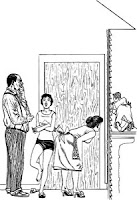
They have degenerated into a primitive existence in this period. And there is very skewed sex ratio. "There are fifty-three of us here, men & women. There are ten married couples... That leaves thirty-three people, of whom twenty are men. Twenty men to thirteen ... women... What sort of marriage set-up do we have?" They choose monogamy. If two men want the same woman, they must fight it out; winner takes the woman!

It's during one such fight with the crowd cheering that 6 of them are picked up by an alien hunting helicopter; alien spaceship is parked a little distance away.

"The world to which they were taken would have been a marked improvement on the world they had left, had it not been for the mistaken kindness of their captors. The cage in which the three men were housed duplicated ... the climatic condition of the planet upon which Lode Star had been lost." So hot atmosphere & constant drizzle, & same boring fungi as food that they had adapted to on the world they were taken from!

Of the 6 humans captured, 3 men in this cage are "Hawkins, Boyle, & Fennet". In a nearby cage is "Mary Hart". Remaining two - "Clemens & Miss Taylor" - probably ended up on the vivisection table.

Their captors "aren't the same shape.. And we, were the situations reversed, would take some convincing that three six-legged beer barrels were men & brothers." They try Pythagoras's Theorem with pictures made from twigs to interest their captors, without luck.

They try showing their "manual dexterity by the weaving of baskets" from stuff within their cage. Captors think its a mating ritual - like beaver's dams! So "Mary Hart was taken from her cage and put in with the three men"!

It's during the night of her stay in men's cage that Mary made a racket - when Joe, a little local mouse-sized animal, passed over her when she was asleep. Men consider Joe a kind of friendly pet. She insists men kill Joe; they instead make a basket type cage & put Joe there after trapping it.

It's this trapping & caging of Joe that reaches out to captors. They will be recognized as sentients & gain their freedom because "Only rational beings ... put other beings in cages"!

Collected in.

  1. Isaac Asimov & Martin H Greenberg (Eds)' "Isaac Asimov Presents the Great SF Stories 19 (1957)".

Fact sheet.

First published: F&SF, June 1957.
Rating: A

Friday, May 30, 2008

Tom Godwin's "The Nothing Equation" (short story, science fiction, free): Loneliness can drive people nuts!

Quote from short story titled The Nothing Equation by Tom GodwinCouple of days back, Project Gutenberg posted this story along with 2 Silverberg oldies ("The Hunted Heroes", & "Postmark Ganymede"). I normally don't jump into the story so soon after seeing it, but one from the author of "The Cold Equations" warranted a different treatment.

This story has rigged premises, but I still liked it. Parts of it are meant to be creepy, but I didn't get any creeps.

Story summary.

"Earth's Galactic Observation Bureau" has installed an "observation bubble, ten thousand light-years beyond the galaxy's outermost sun." This bubble is a very small spherical structure with "hypersensitive instruments" outside the hull. It must be manned by someone but cannot support more than one person. And the lone human crew cannot communicate with outside universe because radiation used by communications devices interferes with delicate instruments.

A man is posted there on a 6 months' duty. First man posted, Horne, committed suicide after 3 months - a fact discovered only after the originally scheduled 6 months lapsed & the ship arrived with replacement. Last entry in his diary read: "it hates us and doesn't want us here. It hates me the most of all and keeps trying to get into the bubble to kill me." "No sign of any inimical entity or force could be found."

Second man, Silverman, was found alive but crazy after his 6 months; he kept blabbering about something that was trying to get inside the bubble to kill him. Investigations found no evidence of any entity.

This is the story of third man, Green. We see him deposited in the bubble. Bubble is such a tiny structure among the immense nothingness around, & it's very thin - about the thickness of cardboard (but very strong material). And it has 6 windows that cannot be closed or curtained off; through them, you look at the immense Nothing surrounding you.

Green soon starts getting frightened. He sees the beginning of little cracks in the walls of the inner wall of bubble (where there are none). What happens if even a tiny crack appears? The big Nothing outside will creep in! He begins having hallucinations - the Nothing is staring at him through the windows he cannot close! He builds a little tent inside the structure with available bedding & cloths - so the Nothing cannot look at him!

Six months later, the visiting ship will find him a mad man, babbling about "Nothing" that was attempting to kill him! And we see the ship install yet another guinea pig there was 6 more months!!!

See also.

  1. Eric Frank Russell's "Tieline": Another loneliness story that is driving the protagonist crazy. Only person on an entire planet doing a fixed time duty - planet acts as a space lighthouse.

Fact sheet.

First published: Amazing Stories, December 1957.
Rating: A
Download full text from Project Gutenberg.

END.

Thursday, May 1, 2008

** Eric Frank Russell's "Into Your Tent I'll Creep" (short story, science fiction)

Humans are slaves of a master race unknown to them - the dogs! And now this master race has used humans to spawn itself as masters of an alien race too - aliens that are friendly to humans.

Collected in.

  1. "Major Ingredients" (ed Rick Katze). 

Fact sheet.

First published: Astounding, September 1957.
Rating: C
Related: All stories of Eric Frank Russell.
Listed among the stories from John Campbell's Astounding/Analog.

Note: Why is this post so short?

Friday, November 23, 2007

H Beam Piper's "Omnilingual": A technique to decode unknown written language of an industrial society

Quote from the novella titled Omnilingual by H Beam PiperImagine a replica of European culture at roughly the level of its development in early twentieth century. Assume the people of this replica had died out thousands of years ago. And archaeologists of about mid twentieth century Europe discover their long lost city.

This is a novella length story of archeology field-work of this nature. Running through the narrative is the apparently central thread about how to make sense of their books found during the digging - of which a large quantity is available. Their scripts appears to follow the general principles of European written languages, but the problem is - there is no Rosetta Stone to establish a reference for translation.

The story poses this problem in a very colorful but ridiculous way - the digging is really happening on Mars. Sentient Martians apparently died out 50,000 years ago, leaving behind buried cities at about the level of development of Europe in early twentieth century. Also, they look very human, have customs rather similar to Europeans of the era, etc.

In spite of this, I never got bored. It's action packed - something or the other is always happening.

Story summary.

Martha Dane is part of a large contingent of archaeological diggers on Mars; the team includes a lot of military staff too. Martha is spending a lot of time trying to figure out the ancients' written script, & is generally tolerated or ridiculed by others because there is no Rosetta Stone for reference.

That is when they end up digging a multi-story tower that apparently was a university. While Martha will work out a few words while looking at murals at the walls in the university, real breakthrough will come when a group that includes her comes across the equivalent of Dmitri Mendeleev's Periodic Table of elements on a chemistry classroom wall. Table includes several pieces of information about elements including their atomic weight & their name in local script.

That's the Eureka moment. To decode the text of a culture that has discovered physical sciences familiar to us, you look for their scientific tables of physical facts - properties of elements, astronomical facts, ... That is the Rosetta Stone.

Throughout the story, I was somewhat bothered with the attitude that it's ok to defile the environment in science's cause - e.g., on a planet with few animals, the moment you see one, you have to shoot it down so you can analyze its tissue in lab!!

May be it was the attitude of Piper's times, may be it is still widespread in places I've not been to. Michael Crichton discusses this attitude at some length in his "Jurassic Park". Arthur Clarke also highlighted the issue of defiling environment in the cause of "development" briefly in his "Islands in the Sky"; but he didn't seem to see anything wrong with it.

See also.

  1. Ted Chiang's "The Story of Your Life": A much more realistic example of difficulties & issues in decoding a truly alien language.

Collected in.

  1. David Drake, Jim Baen, & Eric Flint (Ed)'s "The World Turned Upside Down".
  2. Isaac Asimov & Martin H Greenberg (Eds)' "Isaac Asimov Presents the Great SF Stories 19 (1957)".

Fact sheet.

First published: Astoundin Science Fiction, February 1957.
Rating: A
Download full text from Project Gutenberg, Manybooks, or Feedbooks. Or LibriVox audio read by Mark Nelson.