Showing posts with label US. Show all posts

Wednesday, June 12, 2013

William Tenn's "The Sickness" (novelette): A cure for cold war mistrust between US & USSR

This is a story of two epidemics caused by bugs - one physical & literal, other metaphorical as in US/USSR standoff. Knowing Tenn, I won't be surprised if he intended it as a satire on cold war war-mongering at both ends.

Story summary.

US & USSR not only are constantly at each other's throat, they also have independent programs to send people to Mars. An India-mediated joint expedition to Mars might hopefully help understanding & ease tensions - so the ship that goes there contains an equal number of Americans & Russians but with the condition that Americans will only speak Russian & Russians only English during the expedition.

On Mars, they'll find a vast & ancient underground city - still kept alive by machines though its inhabitants are long dead. Human explorer to the city will return infected with a highly contagious (via breathing) bug, & quickly infect the whole expedition. They'll nearly die out, but there is a miracle waiting - both for their personal sickness, & of humanity's sickness back on earth...

Collected in.

  1.  William Tenn's "Time in Advance".

Fact sheet.

First published: Infinity Science Fiction, November 1955.
Rating: B.
Related: Stories of William Tenn.

Tuesday, January 8, 2013

Brad R Torgersen's "The Exchange Officers" (novelette): An episode in a US/China war

The specific episode involves an attempt to hijack a military space station of US in an earth orbit by a Chinese commando team. The US hero will, of course, foil the attempt.

US side employs "proxies" - robots controlled remotely by military personnel wearing virtual reality kits. It's the proxies that actually do the fighting for US, vs real soldiers Chinese use.

Fact sheet.

First published: Analog, January/February 2013.
Rating: B.

Sunday, November 28, 2010

Irving W Lande's "Slingshot" (short story, cold war, free): Description of fighter-plane combat equivalent in near-earth space

Illustration by Emsh accompanying the original publication in Astounding Science Fiction of short story Slingshot by Irving W Lande. Picture shows near earth combat of two rocketships.
It's a US/USSR cold war story where there are military bases in space stations around earth. Story is mostly a description of a single "dogfight" between two fighter spaceships, with the US both the good side & the winner.

Near the end of the story, an idea is thrown around - idea of an air-to-air automatic target-locking missile that sounded as if it was from before there were such missiles. Title apparently refers to that. But no missiles are actually used in the story; only manually operated guns mounted on the sides of spaceships.

Fact sheet.

First published: Astounding, November 1955.
Download full text from Project Gutenberg, Manybooks, Feedbooks.
Rating: B.
Among the stories edited by John Campbell for Astounding/Analog.
Related: Cold war fiction.

Wednesday, August 11, 2010

Derrick Bell's "The Space Traders" (novelette, racism, free): US sells its black citizens to aliens!

Quote from short story The Space Traders by Derrick Bell
This appears to be a very famous story, though I'd not heard of it so far.

While I cannot read it with the meaning it will have for US readers, because of background differences, I do see some parallels with caste politics in India.

Story summary.

On 1 January 2000, US government gets an offer from aliens: sell us your black citizens! Offer is good for 15 days, & aliens are willing to pay enormous sums of money.

Resulting public debate provides much of the content of the story.

Fact sheet.

First published: Derrick Bell's "Faces at the Bottom of the Well: The Permanence of Racism" (collection) (1992).
Download full text. [via Torque Control]
Rating: B.
Related: Fiction on racism.

Wednesday, March 31, 2010

Real science: Firewall of China briefly controlling computers in US & Chile!

This is very curious.

Recently, for a brief period, internet users in US & Chile too were being filtered by the censorship firewall of Chinese government!

Apparently, TLD DNS tables were polluted by a hacker.

Saturday, March 20, 2010

Jury finds Peter Watts guilty

Watts himself describes the event.

Update 21 March 2010: Cory Doctorow reflects on Peter Watts verdict.

Related: Fiction of Peter Watts.

Monday, October 26, 2009

James Blish's "Tomb Tapper" (novelette, war, free)

It reminded me of Arthur Clarke's "Hate". In both stories, the victim is an innocent young Russian girl. In this story, she's killed by evil Soviet government that could not care less about its citizens; Clarke's version is stronger, & has the girl killed by a man from another European country who has a personal grudge against Russia & Russians. Near end, both evoke sentiments somewhat like Tom Godwin's "The Cold Equations", though neither comes anywhere close to Godwin's classic in emotional power.

Story summary.

During US/Russia war, a very unusual flying vehicle seems to have entered a railway tunnel in US with great precision, getting stuck half way through the tunnel. US officials examining what they believe is a wreck discover something unusual...

Notes.

Story features a device that can pick memories from the brains of the recently dead, & is used as an espionage aid. This is I think the first story I've seen with such a device, though Isaac Asimov's novel "Fantastic Voyage II: Destination Brain" tried to achieve a similar effect with a man not quite dead yet.

Fact sheet.

First published: Astounding, July 1956.
Rating: B.
Download full text from Internet Archive.
Included in Ellen Datlow's SciFiction's Classics section.
Listed among the stories from John Campbell's Astounding/Analog.
Related: Stories of James Blish.

Friday, July 31, 2009

C M Kornbluth's "The Education of Tigress McCardle" (short story, humor): An unusual population control program

This is a frame story. Frame is of an unarmed unopposed leisurely US invasion by China; a wily Chinese man has sold the US government an unusual & all too effective population control idea!

But the really interesting & very funny story is the one within the frame - the population control story. Very beautiful.

Story summary.

In this era of "Parental Qualifications Program" ("PQP"), George McCardle & his wife Tigress have decided to have a baby.

PQP regulations require them to get a breeding permit from government. To get the permit, they need to care for the "Toddler", a robot baby the government gave them on application, for 3 months.

Looks easy enough; prove that you can live with the demands of a baby. Only this is a super-cranky baby, designed to ensure the aspiring parents will give up the idea in days...

Notes.

  1. I suspect frame part satirizes a specific US President of the period. But I'm not familiar with issues locals had with their Presidents to figure it out.

Collected in.

  1. Isaac Asimov & Martin H Greenberg (Eds)' "Isaac Asimov Presents the Great SF Stories 19 (1957)".

Fact sheet.

First published: Venture Science Fiction, July 1957.
Rating: A.
Related: Stories of C M Kornbluth.

Thursday, July 30, 2009

James P Hogan's "Murphy's War" (novelette, humor, free): When computer hackers rendered a nuclear war harmless!

Illustration accompanying an online copy at Webscription of the short story titled Murphys War by James P HoganUS & China have began the process of launching nuclear bomb armed missiles at each other over a silly & minor tiff. Then things begin to go wrong ... er, right! ... in a hilarious & very familiar way...

Notes.

  1. Fun really begins about half way through, in the US war room scene.
  2. Early parts will likely be more accessible to US readers; but it gets internationally accessible soon enough.
  3. Links above on country fetch more stories set in that country.

See also.

  1. Arthur Clarke's "The Pacifist" (1956): Another funny story of a naughty computer, but ... in a different way.

Fact sheet.

First published: Jim Baen's Universe, #8 (August 2007).
Rating: A.
Download full text from Webscription: Link1, or Link2.
Added to my "best of the year 2007" list.
Related: Stories of James P Hogan.

Friday, July 24, 2009

Murray Leinster's "Invasion" (novelette, war, free): When a "Martian" spaceship landed in Colorado, US!

Illustration accompanying the Project Gutenberg copy of the short story titled Invasion by Murray LeinsterThis is the third Leinster story I've seen about pre cold war US/Russia stand-off. In each of them, Russia builds some sort of superweapon & attacks US; then a lone US hero creates a happy ending for US.

Two of these stories - this one & "The Machine That Saved The World" - involve a hoax; so it takes a while for US to realize that it has been attacked! In "Morale", Russia is not explicitly named.

In this story, there is hero's girlfriend too - to make Russian lust after & for hero to save!

Story summary.

Two warring sides are renamed here: "United Nations" is a country that includes US; "Com-Pub" is the "Union of Communist Republics" that includes Russia.

An apparently Martian spaceship has landed in US; hero, a US military man named Thorn Hard & his girlfriend Sylva West, happen to be nearby.

Immediately on landing, "Martian" ship has erected an impenetrable & invisible 6 mile hemispherical barrier made up of some sort of magical force field around it. So the ship, hero, & his girlfriend are inside the dome; nothing can enter the dome nor exit it.

In the following days, while US military has been examining the strange dome & trying to communicate with the "Martians", it's also collecting much of its air force near dome. And our friendly "Martian" springs the trap - erecting another bigger impenetrable dome around original - so most US air forces are trapped between the two domes. That's when the main Com-Pub fleet attacks.

So it's up to the hero to now save the US. Which he will, of course.

Curios.

In 2037
  1. "Televisors were still monochromatic."
  2. "Newspapers were printing flat pictures in three colors only".
  3. There is something interesting about the speed of fast planes too; I cannot locate the quote.

See also.

An invisible impenetrable spherical barrier appears in several stories, but this is the oldest I've seen with this structure. Some other stories that feature it:
  1. David Brin's "The Crystal Spheres" where they bar access to a solar system unless those inside open it.
  2. Arthur Clarke's "The Sentinel" where it protects the alien listening device on moon.
  3. Arthur Clarke's "What Goes Up" where a nuclear accident in Australia creates it as an unexplainable phenomenon around the site.

Fact sheet.

First published: Astounding Stories, March 1933.
Rating: B.
Download full text from Project Gutenberg or Manybooks. [via QuasarDragon]
Related: Stories of Murray Leinster.

Monday, July 13, 2009

Mary Rosenblum's "The Egg Man" (novelette, dystopia)

This will likely make more sense to readers from US & Mexico than elsewhere; it's at least partially about their countries' relations, particularly as they relate to immigration.

A future US that is no longer a big power, with parts of the country in anarchy & outside of national administration. A Mexican charity is providing medical help to some of these anarchies. Story is of such a medical help trip of a man named Zipakna, a representative of charity, to one of these anarchies - a trip that later turns into a horrific adventure.

Collected in.

  1. David Hartwell & Kathryn Cramer (Ed)'s "Year's Best SF 14" (2009).

Fact sheet.

First published: Asimov's, February 2008.
Rating: B.

Saturday, November 22, 2008

James A Michener's "Space" (novel), Chapter 2: "Four Women" (part 2 of 2)

Quote from chapter titled Four Women of novel titled Space by James A MichenerContext: novel main page; part 1 of this chapter.

This is the story US taking charge of the spoils of war: German engineers transferred to US as prisoners, along with German weapons design documents & actual physical missile hardware. Initially to Fort Bliss in El Paso, Texas; later to Huntsville, Alabama, where they will begin settling down.

A lot of text is devoted to prisoners' hardships because (apart from their status as prisoners):

  1. They were brought without any documentation but 'With the knowledge of the President.' To get the paperwork straightened, they will eventually be driven in a bus to Mexico without exit formalities, & immediately reenter on temporary permits - to be regularized in 3 months!
  2. Their wives are still in Germany. This will let the story wander for a while over ruined Germany immediately after war - a lot of broken families & misery.
This part will also see the beginning of US Army's interest in German missiles. Initial tests are with looted hardware. Original US work begins in ch 3 - that's past 1950.

There are 6 major characters that we'll likely see more of in later chapters:
  1. Prof Stanley Mott & his wife Rachel Lindquist. We meet Rachel for the first time in this chapter. We're also told Mott is "a genius in aviation" & "he wasn’t a real professor, only an assistant". The couple will help German prisoners settle down.
  2. Dieter Kolff, the brilliant German mechanical genius captured in ch 1, & his wife Liesl Koenig. We met both in ch 1; here they will be reunited after much drama.
  3. General Helmut Funkhauser, one of the more brutal Hitler men we met in ch 1, & among the prisoners. He will be a man to reckon with in US aviation industry by the end of this chapter - "a troubleshooter for Allied Aviation, specializing in their rocket and space ventures".
  4. von Braun, the brilliant German ideas man whose fate was indeterminate at the end of ch 1 is among the prisoners.
There are two male babies born among them, first of which will have a distracting role in next chapter: Millard of Motts & Magnus of Kolffs.

Notes.

  1. Union of Dieter & Liesl drags on for a while because she doesn't have marriage papers. "Marriage papers"! Sounds weird in India where hardly anyone has marriage papers. In fact, court registration is looked down upon & signifies rebellion.
  2. Once US Army decides to get into rockets in a big way, they choose Huntsville, Alabama, for building their big facility.

    "Why there?"

    "Because Senator John Sparkman lives in Huntsville."

    I thought this happened only in India!

Quotes.

  1. "Hitler appreciated me for the same reason your people do. I can fix rockets, that's all."
  2. "We are all Americans now, even General Funkhauser, and I want to hear no more about the past... Now we must occupy ourselves with other matters."

Related.

  1. Novel main post.
  2. All posts about this novel on a single page.
  3. Feed that collects only posts about this novel.

Friday, November 21, 2008

James A Michener's "Space" (novel), Chapter 2: "Four Women" (part 1 of 2)

Quote from chapter titled Four Women of novel titled Space by James A MichenerThis post is about the second chapter, titled "Four Women", of this novel. Novel page gives overall background, links to other chapters, & gives very short chapter overviews.

I'm splitting this ch 2 post into 2 because there is some material here worth commenting on. Contents that went into my 2 parts are actually intermingled in the novel text. This is the first part - story of two couples: Norman Grant & Elinor Stidham, & John Pope & Penny Hardesty. All except Elinor were introduced in ch 1. Second part is here.

This chapter advances the story on one crucial front: the promise that Grant will get involved in legislative affairs that will eventually affect space travel.

Story summary.

Norman Grant will be elected to US Senate from Fremont, an imaginary state in western US, in 1946. USP of his electoral campaign will be his war-hero role.

He will bring to Washington two key characters who ran his election campaign: Tim Finnerty & Penny Hardesty. Penny will be the cause of Norman's friction with his jealous wife Elinor. This will ensure she moves from Senator Norman's office to Senator Glancey's.

Penny, a lawyer, will be married to John Pope, just qualified as a Navy aviation man, by the end of this chapter. That's about 1950.

By the end of this chapter, Norman will get advise on choosing a specialty in the Senate if he wants to make a mark - getting involved in the just emerging fields of "advanced aviation and rockets and what they're calling space".

Quotes.

  1. "an election between honest men is like a battle between sovereign nations. You better win."
  2. "Norman has a fighting chance to be a fine senator, but I expect he’ll turn out to be only average. Never a distinction, never a scandal."

    I once saw a comparison between Heinlein & Poul Anderson using very similar words. Both started about the same time, & were equally prolific; yet Heinlein is considered a different class. Probably applies to all sorts of professions.
  3. On the career of a US Senator: "When a freshman comes in here, he's wise to keep his mouth shut. Norman's done that. But he's also wise to start chopping out a niche for himself. And you haven't done that, Norman.

    ... men seem to attain stature in this body not by attending to the issues that please the people in their home state. We're all obliged to do that. What counts is the way a man tackles the big issues, the ones that affect us all."
  4. "Can you keep getting him elected?"

    "There's not a cloud on the horizon."

    "There's always a cloud on the horizon... It's just that sometimes we don't recognize it."

Notes.

  1. Details of US electoral system: it's sufficiently different from India that substantial parts went over my head. Basics of getting elected & running the campaign, of course, are the same.
  2. For Indian readers: Parts of Grant's election campaign sounded like a variation of the fantastic Hindi movie "Aaandhi" that was based on a hypothetical election campaign of a fictionalized Indira Gandhi. I personally prefer "Aaandhi" because it was more colorful & comprehensible.
  3. I noticed a funny thing about the US election system - a Senator can be there for life, if he can keep on getting elected! And many apparently do. This is the case in India too, & is sometimes considered one of the major flaws of our system.

Related.

  1. Novel main post.
  2. All posts about this novel on a single page.
  3. Feed that collects only posts about this novel.

Saturday, November 15, 2008

James A Michener's "Space" (novel): Fictionalized history of US space program till about 1980

Cover image of the novel titled Space by James A MichenerThis post begins an experiment. During the last few months, I've abandoned a lot of novels half way through - just don't have patience to finish. Where I have finished them, I don't feel like writing about them - takes too long. So I keep posting about short works, but keep avoiding posts of longer ones. May be doing it in small units will help.

I'll be posting on this novel a chapter at a time, & link specific chapter posts from here. Chapters themselves are big - probably more than novella length each.

From the look of it till the end of first chapter, it promises to be a hard sf book - even if by a man without science background!

Chapters.

  1. Four men: Introduces Prof Stanley Mott, Norman Grant (a US WWII hero), John Pope (a young prodigy), & Dieter Kolff (a maverick with the gadgets). They're presumably key characters in rest of the story.
  2. Four women - part 1 & part 2: Part 1 is about Grant getting elected to US Senate, & suggests that he will specialize in legislative affairs of aviation. Part 2 is about absorption of German engineers & missile technology by US. Title comes from their wives, two of whom we meet for the first time: Elinor Stidham is wife of Grant & a woman of low self esteem; Rachel Lindquist is Mott's wife. Other two women were already seen in ch 1: Penny Hardesty will not only marry Pope & become a lawyer, she'll get involved in US Senate offices in Washington; Liesl Koenig will join Dieter in US & will lead the Germans establish a settlement in Huntsville, Alabama.
  3. Korea: Not read.
  4. Pax river: Not read.
  5. Intellectual decisions: Not read.
  6. Twins: Not read.
  7. The moon: Not read.
  8. Real time: Not read.
  9. Dark side of the moon: Not read.
  10. Mars: Not read.
  11. The rings of Saturn: Not read.

Fact sheet.

First published: 1983.
Related: All posts about this novel on a single page; feed that collects only posts about this novel.

James A Michener's "Space" (novel), Chapter 1: "Four Men"

This post is about the first chapter, titled "Four Men", of this novel. Novel page gives overall background, links to other chapters, & very short chapter overviews.

This chapter is really 4 generally independent stories - each introducing a male character that will presumably play a key role later. All stories are set during the fading days of WWII; in fact, all begin about 24 October 1944. All but one are actually set in one of the war theaters.

Since war stories are described from US perspective, I suspect reaction to them will depend reader's home country.

Thread 1: Stanley Mott.

On 24 October 1944, US & British joint operations are planning major attacks during the night on 2 German towns: British will level Wassenaar, & Americans Peenemünde. Wassenaar is residential town that has a missile launch site, Peenemünde has a missile research facility (though Americans suspect it is a nuclear weapons research facility).

Mott is 26, & a professor of aeronautics at Louisiana State (University?) He is one of the 11 men the US President Roosevelt has sent to European front to make sure 3 specific Germans are not killed in Allies attacks:
  1. General Eugen Breutzl is "the managerial genius. We have reason to believe he's not a Nazi, just a technical wizard who could move our program ahead by generations."
  2. "Count Wernher von Braun, a relatively young man who seems to be the genius of the rocket operation."
  3. "Dieter Kolff, if we have it correct. He's about thirty-five years old, and the reason we must get him is that he may prove to be the real genius of the team. He's their expert on the A-10."

    A-10 is still under development German missile with trans-Atlantic range.
US wants to recruit the three for its own military work!

All three are stationed at Peenemünde, & Mott is trying to impress upon the US commander in charge of the night's attacks that he should leave the researchers' living quarters alone.

As things happen, mistake in the field levels the researchers' living quarters. Breutzl dies. von Braun & Kolff are saved by a miracle as they happened to be off site.

Thread 2: Norman Grant.

This is the story of a US/Japan navel battle, again on 24 October 1944. Japanese are trying to evict Americans from Philippines.

There is just too much US patriotism here for my taste. Norman Grant is the captain of DE Lucas Dean, one of the US defending ships. By the end of the story, he will emerge a US national hero.

Thread 3: John Pope.

John is a 17 year old US prodigy. Great football player, & budding astronomer. Story is basically introducing the guy, his girlfriend Penny Hardesty, his parents, & his environment.

A scene here reminded me of something very familiar in India - a politician walking in at an event he's not welcome, & others having to act polite while the proceeding are shut because of this obnoxious visitor.

Thread 4: Dieter Kolff.

This is (or felt like!) the longest of the 4 threads, told from the point of view of Kolff - the mechanical maverick. This story is set around the German missile research facility in Peenemünde, though it moves around other German towns too. We are introduced to German side of war, & obviously very biased accounts. But I liked it because of its colorfulness, though at times it felt draggy.

Breutzl, the superb manager, will be killed in US air attack. By the end of it, we will be uncertain of the fate of von Braun - the brilliant ideas man. Perhaps killed, perhaps not...

Story ends with the Allies walking into Germany. Kolff, with his girl Liesl, is running to defect to Americans - with the German designs for the transcontinental missile A-10! He will run into Mott, & is to now face US military interrogation.

Related.

  1. Novel main post.
  2. All posts about this novel on a single page.
  3. Feed that collects only posts about this novel.
Wednesday, September 10, 2008

Murray Leinster's "Evidence" (short story, non-genre, free): Cars during early twentieth century

Quote from short story titled Evidence by Murray LeinsterWhile there is nothing sf about this story, it has a curios value in ways similar to Arthur Clarke's "The Nine Billion Names of God".
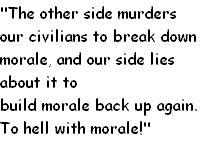
Clarke's story gives us glimpses into early days of digital computing where even minor software tweaks require hardware changes.

Leinster's story gives us a peek into the early days of automobiles. Set in Texas, US, & may be modern for its times. Cars have appeared on the roads, but

  1. they're still owned by minority; majority travels on horses.
  2. automatic ignition has began to appear, but is a luxury. Most people still need a good amount of ceremony with the crank & spark-plugs to start the car.
  3. have 2-speed gears! There is a scene where a horse is tied behind the car, & car is traveling reasonably fast on its second gear, & horse can still comfortably keep up!
  4. roads not quite meant for cars! This story appears to be set in a rural area; may be urban roads would be better.
We also get a glimpse into a law enforcement, justice delivery system, & attitudes towards banking that are now difficult to identify with. I'm not sure of its accuracy, but there was an air of authenticity about it.

Main story is mundane, but readable. "Ol'" Abe Martin has been murdered for money. Everyone has already concluded Harry Temple is the culprit, & he's being tried for murder. Good-hearted Jimmy Calton will enter uninvited for defense, help identify real culprit, & save Harry. Story is narrated by a friend of Jimmy who is a witness to the trial.

Fact sheet.

First published: All-Story Weekly, 12 July 1919.
Download full text from PulpGen.
Rating: B
Related: All stories of Murray Leinster.

Wednesday, September 3, 2008

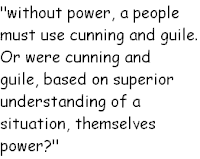
Murray Leinster's "Morale: A Story of the War of 1941-43" (novelette, superweapon, free): There are multiple ways of defining terrorism

Quote from short story titled Morale -- A Story of the War of 1941-43 by Murray LeinsterIn spite of title, this story is unrelated to World War II; it was written in 1931.

There are two major themes here:

  1. A version of state terrorism: During war, at least one side uses outright terrorizing of civilian population of the opponent as a matter of war strategy. That's how the story gets its title - enemy's all out effort to break the morale of local civilian population. Because this is a pre nuclear weapons story, form of terror is cruder than Hiroshima.
  2. In an otherwise equal battle, one side introduces a superweapon to completely change the war situation - in the tradition of H G Wells' "The Land Ironclads", & Robert Heinlein's "Solution Unsatisfactory".
Action packed, fast moving story.

Story summary.

US is fighting a war against an unnamed enemy, primarily along the Pacific coast. There is very minor military deployment along east coast, & primarily to tell civilian population that east is also being defended.

That's when a very tiny enemy contingent lands "in New Jersey Aug. 16, 1942" with their superweapon: a single massive supertank called "Wabbly" - "two hundred feet long" with "eight-foot-wide steel treads". It is equipped with induction weapons in a "dinkus on top" & poison gas weapons. It is supported by an unspecified number (but apparently very few) high flying supersonic aircraft capable of precision bombing. Any US aircraft attacking invading aircraft are destroyed by tank's induction weapon; any attack on Wabbly is neutralized by invading aircraft which can remotely sense "sparks from a motor", & use this information for precision bombing. Normal infantry attack on Wabbly is hopeless.

Wabbly will unleash a rein of absolute terror in many cities, completely leveling whole cities & villages killing every human in the path. Nothing the defenders have can touch Wabbly. Until the two heroes - Sergeant Walpole & Flight Cadet Ryerson - figure out a deception that will make the invading aircraft attack their own Wabbly!

See also.

  1. Two other stories that make use of induction weapons: Larry Niven's "The Warriors", & Murray Leinster's "Proxima Centauri".

Fact sheet.

First published: Astounding Stories, December 1931.
Download full text from Project Gutenberg.
Download audio from Maria Lectrix, in two parts: 01 & 02. Or direct MP3 at Internet Archive - 01 & 02.
Rating: A
Related: Stories of Murray Leinster.

Friday, May 2, 2008

* Edward Falco's "Winter Storms" (short story, non-genre)

This is a dark political story about US occupation of Iraq. A US journalist who won't toe the official line of US Army is, in a way, handed over to jihadis. She saves herself by compromising the US spy who did her in, inadvertently also getting 3 little children killed. Now she's both nursing a guilt about killed children, & is fearful US authorities will consider her act treason.

That's about the first half of the story. Second half just drags on pointlessly, adding word count but not anything else to the story.

Fact sheet.

First published: Playboy, May 2007.
Rating: B

Note: Why is this post so short?

Monday, November 12, 2007

Arthur C. Clarke's "I Remember Babylon": Cold war propaganda mongers get a new medium

I didn't like this story primarily because the tone & the opening paragraph sound like Clarke supports the idea of a governmental moral police - state officials telling the citizens what is good for them rather than people deciding for themselves. And as if there is something wrong with the so called baser human tastes - apart from guilt imposed by morality brigade through years of brainwashing!

Moral police is a very touchy issue in India.

Story summary.

Story is narrated by Clarke himself, in the form of a fictitious encounter with Gene Harford, an Americal helping Soviets, at a Soviet Embassy reception in Colombo, Lanka.

Diplomat thanks Clarke for his idea of geostationary communication satellites, & how USSR is planning to use it for propaganda purposes against the US.

Idea is to throw up a satellite into geosynchronous orbit "due south of New Orleans ... way out in the open Pacific; it won't be over anyone's territory, so there'll be no political complications on that score... in full view of everybody from Seattle to Key West... the only TV station the whole of United States can tune in to! Yes, even Hawaii! There won't be any way of jamming it... The FCC can't even protest to a country that doesn't exist in the eyes of the State Department."

Note that no special dish or tuning device will be required by consumers! Its signals will be the equivalent of terrestrial TV!

And US cannot immediately counter because "United States is years behind in pay-load capacity".

To entice US consumers, they have plans of programs appealing to baser human tastes - of the kind that are now common place. With subtle propaganda sprinkled in. "For the first time in history, any form of censorship's become utterly impossible. There is simply no way of enforcing it; the consumer can get what he wants, right in his own home... we've absolutely no taboos. If you can film it, we can telecast it."

If this content renaissance sounds dated, I suppose it wasn't so when the story was published - long before I was born.

Story ends with a hint that is supposed to provide a clue to how title links up with the plot, but it went over my head: "into my heart blows a cold wind from the past; for I remember Babylon".

Collected in.

  1. "Collected Stories of Arthur C Clarke"
  2. "More Than One Universe"
  3. "Tales of Ten Worlds"

Fact sheet.

"I Remember Babylon", short story, review
First published: Playboy, March 1960.
Rating: C
Note: Ted Chiang's "Tower of Babylon" is a completely unrelated story.

Saturday, November 3, 2007

Harry Turtledove's "News from the Front": Internal debate in US during early days of US/Japan conflict during World War II

Most interesting aspect of this very readable non-genre story for me was - many of its episodes sounded like some very familiar conflicts between administration & media in India in recent memory - though in different contexts.

At a less important level, it sheds some light on the conflict - a subject I am completely ignorant of. Until I read this, I did not even know why Japan bombed Pearl Harbor - obviously there must have been provocation, but I didn't know of it.

And since this is a work of fiction, its specific assertions obviously have to be taken with a pinch of salt.

Story is in the form of media clippings covering the first 6 months of conflict - 7 December 1941 to 16 June 1942, & is very critical of Roosevelt administration that was ruling during the period.

By the very nature of the subject of this story, your take is likely to be very different from mine. And if you are from US, I wonder if timing of this story has something to do with the US military presence on Iraq?

Fact sheet.

"News from the Front", short story, review
First published: Asimov's Science Fiction, June 2007.
Rating: Time well spent A

Thursday, November 1, 2007

Arthur C. Clarke's "The Last Command": Cold war superpower story - with US as clear winner

I found this an utterly unbelievable story.

Story summary.

USSR has been completely decimated in nuclear attacks by US.

But there still is a space based USSR fighting unit called Fort Lenin, on a "secret orbit beyond the moon", capable of completely wrecking the US.

Story is in the form of a recorded message from the President of Supreme Soviet, now dead, to this unit. Message tells them that they were meant as a deterrent, & obviously the deterrent hasn't worked. Now rather than a counter attack, they should quietly destroy their weapons & put themselves "at the disposal of the United States"!

Fact sheet.

"The Last Command", short story, review
First published: "Bizarre! Mystery Magazine", November 1965.
Rating: Time waster C

This story is included in the following collections.

  1. "The Collected Stories of Arthur C Clarke"
  2. "More Than One Universe"
  3. "The Wind from the Sun"

Tuesday, August 14, 2007

Robert Charles Wilson's "Julian: A Christmas Story": Post-oil degenerate society

Quote from the novella titled Julian A Christmas Story by Robert Charles WilsonThis generally quite readable story reads like a less focused retelling of Ayn Rand's "Anthem": modern society degenerates into a medieval one. In case of Rand, you get a hint of deliverance from this pathetic future; in this story, you just get a description of this future society.

The story offers a lot of interesting quotes.

Full text of this story is available online.

Story summary.
After the world's oil reserves are exhausted, there is a lot of conflict & purges. Human population is drastically reduced "to more reasonable numbers".

We learn this slowly, in the year 2172 where the story is set. Location is the village of Williams Ford near the river Pine - somewhere in the US, not far from New York City which is now the capital of the country (not US) of which the village is a part.

This is a medieval intolerant society, generally divided into three castes: "highborn & various aristos" - the rulers & owners; "leasing class" - skilled workers; & "indentured laborers" - unskilled workers that are essentially slaves to aristos.

During elections, votes of members of the last caste are cast by their owner aristos! Elections for President, & for the local representative to some kind of higher council, are a sham. Ben Kreel represents Williams Ford in this council; he is also a kind of local priest & morality keeper.

Economy of twentieth & early twenty-first century is dubbed "Efflorescence of Oil", & the events around the time oil resources were exhausted are dubbed "False Tribulation". Old oil-based technology world is only known through hearsay & legends - with no clarity on where imagination ends & truth begins.

The story is of two teenager friends: Adam Hazzard - the narrator, & Julian Comstock.

Adam's mother is of leasing caste, father is from indentured.

Julian is a very smart aristo. His dad, General Bryce Comstock, was hanged by his own brother - the current President Deklan Comstock - fearing a challenge to his power. Julian's mom has entrusted his education & safely to an old loyal - Sam Godwin. Sam & Julian are visiting the village, & they stay as guests at "Duncan and Crowley Estate".

Story tells us of the origins of their unlikely friendship, their adolescent confusion when digesting some information from "secular ancients", & eventual escape from village fearing for Julian's life at the hands of his uncle. Plus some adventures during escape in Lundsford - a ancient ruin of a town 30 miles from the village.

Christmas part of the story's title comes from the day of the their escape from village - it's the Christmas day.

Fact sheet.
Julian: A Christmas Story, short story, review
First published: 2006
Rating: B
Nominated for Hugo Awards 2007 in novella category

Related: All Hugo Award stories.
