Showing posts with label robot. Show all posts

Thursday, April 10, 2014

John R Pierce's "Period Piece" (as by J J Coupling) (short story)

A modern man finds himself in 31st century, with no recollection of how he got there. He's being treated very well & kindly, but he's smelling something fishy - why's is no one curious about the period he's come from, not even an eminent historian?

Very curious & unexpected ending.

Collected in.

  1. Everett F Bleiler & T E Dikty (eds)' "The Best Science Fiction Stories: 1949".

Fact sheet.

First published: Astounding, November 1948.
Rating: A.
Among the stories from Astounding/Analog issues edited by John Campbell.
Related: Stories of John R Pierce.

Sunday, July 14, 2013

Free fiction: Jack Williamson's "With Folded Hands"

@Galaxy's Edge.

This is probably the most famous story of Williamson, & was later expanded into a series of novels. This is also the only story I recall that provides laws of robotics substantially different from Asimov's - in fact, its robots follow a single very simple directive that still can lead to unexpected consequences...

Related: Stories of Jack Williamson.

Tuesday, June 18, 2013

Kurt Vonnegut's "Jenny" (short story, robot): Sad love story of a romantic

A brilliant engineer builds "Jenny", a robot refrigerator - a fridge that can walk around, & with a woman's flexible face mask attached to the door with springs. It connects with its "brain", a big computer nearby, via radio; computer also connects to a controller in the form of over-sized shoes with control buttons under toes - an experienced wearer can use them to make Jenny say things & give appropriate expressions.

Then he begins finding his wife "imperfect" in ways Jenny need not be, & a love story with the unreal begins, ultimately leading to a sad ending.

See also.

  1. Lester del Rey's "Helen O'Loy": A far more famous story of a human inventor falling in love with his feminine robot creation.

Quotes.

  1. "A man who hasn't built up a certain immunity to love through constant exposure to it is in danger of all but killed by love when the first exposure comes."
  2. "I wound up loving her as a human being, as a miraculous, one-of-a-kind, moody muddle of faults & virtues--part child, part woman, part goddess, & no more consistent than a putty slide-rule."

Fact sheet.

First published: Kurt Vonnegut's "While Mortals Sleep: Unpublished Short Fiction" (2011).
Rating: A.
Related: Stories of Kurt Vonnegut.

Monday, April 8, 2013

David G Blake's "To my father" (flash fiction, free): Lament of an unloved "child"

Illustration by Jacey accompanying the original publication in Nature magazine of short story To my father by David G BlakeIt read like just another story till: "to learn what it was that I felt as I stared down at you and your new family: diminished, as though I had become nothing more than an outmoded contrivance." From then on, it was a different story for me.

It's an emotional one - lament of a sentient robot, abandoned by its creator during a disaster. Replace robot with an unloved adopted child or a pet, & it might feel a little more familiar.

Fact sheet.

First published: Nature, 31 January 2013.
Download full text from publisher's site.
Rating: A.

Thursday, March 7, 2013

Manuel Van Loggem's "Pairpuppets" (short story): Speculating on the future of love & sex

Skip it if the discussion of explicit sex & lust bothers you.

This one, like one more I've read so far from the anthology "The Best from the Rest of the World: European Science Fiction", gives the impression of an imperfect translation. But it's translated by the author himself; so the warts all really belong to him!

While the story is an ordinary one, what makes it notable is the shock value. Plus the surprise ending made me laugh out loud.

Story summary.

A future that has solved the problem of our imperfect love & lust that results today in so many unhappy or broken hearts & homes. A computer can now find you the perfect love of today from your neighborhood. Early cultural indoctrination of children includes detailed instructions on how to behave correctly during intercourse & foreplay. Then there are "pairpuppets" (androids) produced specifically to satisfy the lust of men & women of all kinds of sexual preferences.

But is the human heart ever satisfied? The search for fulfilment will lead our protagonist to...

Fact sheet.

First published: in Dutch as "Paarpoppen" in Luitingh SF Verhalen, #6 (1974). [via ISFDB]
This post is based on the English translation by author himself.
Rating: A.

Wednesday, February 13, 2013

Fritz Leiber's "The Creature from Cleveland Depths" aka "The Lone Wolf" (novella, gadgets, free): Who could imagine mobile phones would be so evil?

One of the illustrations by Wally Wood accompanying the original publication in Galaxy magazine of short story The Creature from Cleveland Depths by Fritz Leiber. Image shows a man wearing an early version of Tickler on his shoulder.
Well, the story is from long before mobile phones were around, so the gadget (the "tickler") here looks different & works differently.

It begins as an organizer - you tell it to remind you of certain events, & it will at the right time. Reminding is by telling about the event in your ear via an in-ear headphone, plus an insistent "tickling" using two rollers mounted on your shoulder. It runs a very long (audio) magnetic tape - one run lasts a week, with buttons to forward quickly to a certain time. To set an event, you move it specific date/time next week, then speak of the event into it. After you've set the events, the device runs the tape continuously. But most of it is blank, so you don't hear anything till an event is due.

Soon improvements in upgraded versions give it a life all its own, threatening the very human existence...

Very funny early parts & ending, but I thought it was draggy in the middle as the mood begin to set for impending disaster.

Notes.

  1. "Depths" of the title has cold war linkage - "Free World" vs Soviet Union. Because of bomb scare most people live in massive underground caverns that double as bomb shelters. Only a few "outers" live on the surface.
  2. "Creature" of the title is an advanced form of the tickler gadget.

See also.

  1. L Sprague de Camp's "Alanias" (download as part of a larger package): Another story where a voice whispers propaganda into your ear without your conscious self realizing you are being manipulated.

Fact sheet.

First published: Galaxy, December 1962.
Download full text from Project Gutenberg, Manybooks, Feedbooks. [via Becky@ClassicScienceFiction]
Download audio version read by Gregg Margarite from LibriVox.
Alternate audio link at Internet Archive.
Rating: A.
Related: Stories of Fritz Leiber.

Tuesday, January 8, 2013

Brad R Torgersen's "The Exchange Officers" (novelette): An episode in a US/China war

The specific episode involves an attempt to hijack a military space station of US in an earth orbit by a Chinese commando team. The US hero will, of course, foil the attempt.

US side employs "proxies" - robots controlled remotely by military personnel wearing virtual reality kits. It's the proxies that actually do the fighting for US, vs real soldiers Chinese use.

Fact sheet.

First published: Analog, January/February 2013.
Rating: B.

Saturday, December 8, 2012

James E Gunn's "Private Enterprise" (as by Edwin James) (short story, colonialism, free): Taking charge of a country by taking control of its economy

One of the illustration by Miller accompanying the original publication in Astounding magazine of short story Private Enterprise by James E Gunn. Image shows the arrested human spy being interrogated by his Rigellian captors.
Nine System Trade Alliance, a human bloc of Sol, wants Rigel V to join the Alliance. Alliance needs Rigel V to expand to galaxy, but Rigel V fears its way of life will be destroyed by its absorption into the powerful Alliance.

To mold public opinion there, & to take control of key infrastructure & opinion makers, earth has planted a spy network there - at least one human, a financial genius, as leader & at least one Rigelian earth can completely trust.

The story mostly takes place after the cover of human mole is blown & he's arrested, & ultimately reveals how human spy network worked there & the Rigel V was made to agree to join the Alliance.

Fact sheet.

First published: Astounding, July 1950.
Download full text as part of the scans of Astounding, July 1950.
Rating: A.
Among the stories from Astounding/Analog issues edited by John Campbell. 

Monday, November 26, 2012

Sheila Adamson's "Stumpy" (short story, humor, free): Don't cry wolf in jest...

An old & lonely woman resenting her helplessness brought by age gets help, in the form of a robot. Lot of fun as she finds a use for robot...

Fact sheet.

First published: Cosmos, 23 November 2012.
Download full text from publisher's website.
Rating: A.

Sunday, September 2, 2012

Jerry Sohn's "The Seventh Order" (short story, alien invasion, free): Invasion of the machines...

one of the illustrations by Emsh accompanying the original publication in Galaxy Science Fiction magazine of short story The 7th Order by Jerry Sohn
An almost invincible robot has arrived on earth from a far away world called Zanthar. A 7th order robot; by comparison, humans are equivalent to 5th order.

He's an advance scout, before more of his kind follow. Idea is to perpetuate themselves - force humanity to dedicate itself to manufacture more of them. But humanity is not ready to give up so easily...

Fact sheet.

First published: Galaxy, March 1952.
Download full text from Project Gutenberg, or as part of the magazine it originally appeared in.
Rating: B. 
Author's real name appears to be "Gerald Allan Sohl, Sr".

Wednesday, August 1, 2012

Karel Capek's "RUR (Rossum's Universal Robots)" (play, free): Androids as human slaves, & then as masters

Cover image of the drama R.U.R or Rossums Universal Robots by Karel Capek
While it's well documented that this is the story that coined the word "robot", this story has a male association with the word. It uses "robotess" for feminine version, a word that doesn't seem to have found wide adoption.

The robots here, however, are more like the created creature in Mary Shelley's "Frankenstein" than in modern stories. They're androids - human looking. They're wetware, with tissues & blood like us. Only the material used to build them is different, & is a synthetic material. The only way to really distinguish a human from a robot is to dissect it in a lab! Robots have simpler anatomy, because unnecessary functions like sex & want of pleasure are dropped from their design! And robots have a brain seriously
superior to humans.

This is the story with two separate emotions:
  1. First we see human disgust at animal- & slave-like treatment of things that, for all practical purposes, are humans.
  2. Then we see the rise of robots to a position of superiority over humans, fueled by human greed & tendency to "improve" things. Result is decimation of humanity & rise of a robot civilization. Only if the things could stay this simple...

Fact sheet.

First published: 1920 in Czech. (as a separate book?)
Download full text from ebooks@adelaide.
Rating: B.

Thursday, June 21, 2012

Rudy Rucker & Bruce Sterling's "Loco" (short story, weird physics, free)

Look this up only if you're into the really weird - with a lot of jargon. The only redeeming part I saw here, & the reason I'm writing this post, is a kind of robot I've not seen in fiction before - "folded" out of special flexible sheet material, & capable of shape shifting (automatic re-folding) based on application.

Fact sheet.

First published: Tor.com, 20 June 2012.
Download full text from publisher's site.
Rating: C.
Related: Stories of Rudy Rucker, Bruce Sterling.

Tuesday, June 19, 2012

Robert Moore Williams' "Robot's Return" (short story, archeology, free)

Quote from short story Robots Return by Robert Moore Williams
Three robots from a far away world are visiting a dead earth in far future. Their history hints it as the home world - world they originated from. They'll slowly reconstruct the story of their builders.

There is cheating here, particularly the ending where they realize connection with the man. But I mostly liked it.

Collected in.

  1. Raymond J Healy & J Francis McComas (eds)' "Adventures in Time & Space".

Fact sheet.

First published: Astounding, September 1938.
Read online at Scribd.
Rating: A.
Among the stories from Astounding/Analog issues edited by John Campbell.

Thursday, April 19, 2012

Isaac Asimov's "Galley Slave" (novelette): How to make a 3-laws obeying robot harm a human...

Quote from short story Galley Slave by Isaac Asimov
This story pits for-automation folks against those against-automation, because it will result in job losses & loss of human purpose (in remaining busy doing certain occupations?)

Most of the story is a courtroom trial. Prof Simon Ninheimer was against Robot EZ-27's employment by his university from the very beginning; the idea that a new type of robot can take over routine intellectual tasks like proofreading was totally unpalatable. So he set out to destroy the reputation of US Robots, its makers, by an unusual court case...

Collected in.

  1. Groff Conklin (ed)'s "Six Great Short Science Fiction Novels".

Fact sheet.

First published: Galaxy, December 1957.
Rating: A. 
Related: Stories of Isaac Asimov.

Thursday, February 9, 2012

Nicole Rendall's "Everything Old Is New Again" (flash fiction, humor, free)

Sometimes the latest & greatest gizmos are less desirable than old working ones...

Funny thing is: it reminded me of my switch from Nokia dumbphone to Android smartphone. My mother has been bugging me to put the SIM card back in Nokia, or get a new SIM to keep Nokia alive. She finds Android's phone feature hopelessly complicated.

Fact sheet.

First published: Antipodean SF, February 2012.
Download full text from publisher's site.
Rating: A.

Saturday, January 14, 2012

Mark Niemann-Ross' "Humnity by Proxy" (novelette): Illustrating good engineering

If you are an engineer involved in some sort of product development, you'll probably love it. Even general audiences should be able to love the first of its several linked stories; it's very beautiful.

Story summary.

There are actually several linked stories there - linked in the sense that a specific man's relatives appear in several stories. But linked primarily because of "sawhorse" - a gadget that's a non-hominid but flexible robot that can be built with nearly today's technology. Individual stories are about sawhorse in action or under develpment:
  1. An old woman in an old-age home. Very funny story.
  2. Soldiers caught in an ambush in the field. They'll arrive safely because of ingenuity of one of them & of some engineers who built the "sawhorse" that's carrying their load.
  3. Story of the original engineering of the gadget, including some selling theatrics. Includes the story of an injured soldier whose life was ruined because of injuries, injured because some explosives sensors in his truck were not well tested in common field conditions.

Fact sheet.

First published: Analog, January-February 2012.
Rating: A.
Added to my "best of 2012" list.

Saturday, January 7, 2012

2 stories of a new trend?

The stories with bot swarms are common. So are the stories where crawly creepy things move over the human bodies, to the disgust of victims. But adaptable bot swarms that are willingly allowed by humans to crawl all over their bodies to do specific things? I've seen two 2012 stories featuring this already, & I don't think I'd seen one of the kind before these.

First one makes a better read of the two.
  1. [ss] Jessica Barber's "MonitorBot and the King of Pop" (B); download; Strange Horizons, 2 January 2012: A woman club dancer, under police surveillance because her brother is a "rebel", slowly makes friend with shape-shifting police robot assigned to watch her.
  2. Aliette de Bodard's "Scatterd Along the River of Heaven" (B); download; Clarkesworld, January 2012: A freedom fighter who had to live in exile once the freedom came, seen at her funeral from the eyes of a granddaughter she never knew.

Thursday, October 27, 2011

Cory Doctorow's "I, Robot" (novelette, free): When North America was a police state

Illustration accompanying the original publication of the short story I Robot by Cory Doctorow. Picture shows a robot sculpture in metal by Howard Waldrop, photographed by Eileen Gunn.
This is may be the most readable short fiction I've seen from author so far. Suspension of belief becomes much harder towards later parts of the story, but first two thirds is great.

Story summary.

This is the story of Arturo, a policeman in North America ("UNATS"), & his difficult relationship with his teenager daughter Ada. As a consequence of their conflict, we get to see the police state of "UNATS" (North America).

Fact sheet.

First published: The Infinite Matrix, 15 February 2005.
Download full text from publisher's site, Feedbooks. [via John@ClassicScienceFiction]
Rating: A.
Nominated for Hugo Award 2006 in novelette category.
Nominated for BSFA Award 2005 in novelette category.
Related: Stories of Cory Doctorow.

Saturday, September 24, 2011

Anthony Boucher's "Q.U.R." (as by H H Holmes) (novelette): How the world moved from androids to function-specific robots

I found it a silly story, though readable enough. But it must have been well regarded once, given that I found it in "Adventures in Time & Space".

Title stands for "Quinby's Usuform Robots". Dugglesmarther H Quinby is the inventor.

Story summary.

In a world where androids are common place, some sort of a disease is sweeping through this android population - limbs refuse to work, random babbling, ... Quinby, a young engineer, has an idea: since androids are normally deployed for special purposes, their unused parts atrophy, as they would in humans! So we get a great business idea: making special purpose robots, instead of all-purpose androids.

See also.

  1. Henry Kuttner & C L Moore's "The Proud Robot" (download): This hilarious story features perhaps science fiction's most famous beer bottle opener. The Boucher story features a cocktail mixer in somewhat similar spirit.

Fact sheet.

First published: Astounding, March 1943.
Rating: B.
Among the stories from Astounding/Analog issues edited by John Campbell.
Related: Stories of Anthony Boucher.

Sunday, November 14, 2010

Ramon Rozas III - "Micro-Transactions" (flash fiction, war, free): A piece of "Ender's Game" fanfic

This military general has figured out a way of making children do the front-line military fighting...

Fact sheet.

First published: Every Day Fiction, 7 January 2010.
Download full text from publisher's site.
Rating: B.
Related: Orson Scott Card's "Ender's Game" (this novel's ending is the seed for this fanfic); download full text of the original short story version of "Ender's Game".

Sunday, October 17, 2010

"Robot" (Hindi, English) aka "Enthiran" (Tamil) aka "Robo" (Telugu) (movie, 2010): A review of various robot & monster tropes

Display showing Aishwarya Rai and Rajnikanth in 2010 movie with multiple titles - Robot in Hindi and English, Enthiran in Tamil, Robo in Telugu
I liked the first half - a variety of classic robot fiction tropes, Indianized & sometimes modernized. Later half was ok but is too Hollywoodish; near end, it turns into a monster movie, borrowing a lot of monster imagery from Hollywood.

Story summary.

Dr Vasi has created a hominid robot, Chitti, targeted eventually for battle role in military. We see a variety of bugs in its software, as well has some funny & lovable scenes, as he's introduced into human society: ask him to hit you, & he will; his lack of human mores (saves a woman from fire - only she was in bathroom & it didn't occur to him to cover her before depositing her among the crowds). He'll eventually be given the emotional ability, & will quickly fall in love with his creator's girlfriend!

That's first half. Second half is Chitti's transformation into a monster when evil Dr Vohra introduces malicious code into his software. This point on, it's a variety of visual effects borrowed from multiple Hollywood movies.

Fact sheet.

Released: Setember 2010.
Director: S Shankar.
Cast: Aishwarya Rai (Vasi's girlfriend); Rajnikanth (Dr Vasi, Chitti, & many other robots & monsters in later half); Danny (Dr Vohra).
This post is based on Hindi version of the movie.

Tuesday, October 12, 2010

Ted Chiang's "The Lifecycle of Software Objects" (novella, free): Training AIs takes a lot of time & commitment

Cover image of the short novel The Lifecycle of Software Objects by Ted Chiang
Two things here that I'd not noticed in Chiang's fiction so far:
  1. Bits of it, I think somewhere near the middle, made me smile. Humor is something I don't normally associate with Chiang's work.
  2. Telling style is so much like those supremely annoying serials Star One shows at prime time: mostly characters talking to themselves & thinking things out loud. Some people have called the style of this story "descriptive" or "concept driven". May be I'd not noticed it in his fiction so far; may be I've seen too much bad TV recently. I won't call it boring - in fact, it quite interesting at many places; but it took me over a dozen sittings to finish.
Also, the story idea is a familiar one, though more detailed than versions I've seen before. See, e.g., Eando Binder's "I, Robot" (view comic book or TV adaptations) or Theodore Sturgeon's "Microcosmic God" (download comic book adaptation).

Story summary.

A company called Blue Gamma has invented potentially super-intelligent software AIs ("digients"). They're like human babies living in Data Earth, a virtual world (eventually, their alien cousins will also exist on Data Mars).

They're like souls; they need to wear a body to interact with their environment. Normally as an avatar in Data Earth; can also move to a physical robot.

This is the story of deep attachment Ana Alvarado & Derek Brooks develop for these digitants; Ana is a former zoo keeper hired to train digitants, Derek builds their digital avatars. They'll keep caring for their pet digitants over many years, long after Blue Gamma has folded up & their original software platform is obsolete.

Fact sheet.

First published: as an independent book by Subterranean Press in 2010.
Download full text from Subterranean Online.
Rating: A.
Related: Stories of Ted Chiang.

Wednesday, September 8, 2010

A E van Vogt's "Final Command" (short story, revolution, free): A man helps contain a revolution by robot slaves

Illustration accompanying the original publication in Astounding of short story Final Command by A E van Vogt
A world where robots are as smart as humans, do most chores, & are looked down upon by men as trash. Barr, one of the smartest of robots, has organized an underground movement: at an appointed hour, robots will do a general massacre of humanity - to pave the road towards glorious robot future.

Marknell, a man, has seen the danger in time, & will gently ensure the massacre is called off, & that steps are taken to ensure the robots begin getting the respect they deserve in human society.

Fact sheet.

First published: Astounding, November 1949.
Download full text as part of the scans of the Astounding issue it originally appeared in.
Among the stories of Astounding/Analog issues edited by John Campbell.
Rating: B.
Related: Stories of A E van Vogt.

Wednesday, August 25, 2010

Hal Clement's "Blot" (novelette, first contact): When Asimovian robots failed to distinguish "human" from "robot"

Quote from short story Blot by Hal Clement
While there are many stories featuring robots that don't follow any "laws", the ones that feature "laws" seem to be almost exclusively about Asimov's 3 laws. Besides "Blot", I can off-hand recall only 2 stories that have laws-following robots but laws aren't Asimov's:
  1. One of Asimov's own Spacer novels where robots are tweaked to recognize only some people as human - I think by recognizing the accent of their voice.
  2. Jack Williamson's "With Folded Hands" (download MP3): A single law is enough!
This story has a twist on Asimov's laws: "Human" is defined as anything sentient & biological. In fact, some of the robots are of alien origin. It's their confusion on first contact with humanity that makes them label women as "human" & men as "robots" (or was it based on dress color? It's been some months since I read this.) So killing men is fair game.

Story summary.

First human expedition to Miranda, one of the moons of Uranus, comes across alien artifacts & alien (but humanoid-looking) robots guarding/handling them. Humans' curiosity trying to figure out artifacts & nature of robots provides some excitement in the story, & near death of a crew member at the hands of a robot. But all ends well.

Fact sheet.

First published: Martin Greenberg (ed)'s "Stories in Honor of Isaac Asimov: Foundation's Friends" (anthology, 1989).
Rating: A.
Related: Stories of Hal Clement.

Friday, July 23, 2010

Walter M Miller, Jr's "Check and Checkmate" (novelette, diplomacy, free): An unusual weapon for diplomatic haggling & espionage

Illustration accompanying the original publication in If magazine of the short story Check and Checkmate by Walter M Miller, Jr
Much of it sounds like Indo-Pak "talks" we constantly seem to have! If individuals were doing it rather than countries, we would have called them neurotic.

Story summary.

This is a cold war story - US vs Soviet Union. Only both are replaced by complicated alternate tags: "Western Federation of Autonomous States" & "Asian Proletarian League", respectively.

After a 4 decade of isolation, the two have now opened a communications channel - their Presidents have began talking to each other. Over the course of the story, one will learn, too late, that the other has an unusual weapon that gives its side TOTAL advantage over the other...

Fact sheet.

First published: If, January 1953.
Download full text from Project Gutenberg, Manybooks, Feedbooks.
Rating: B.
Related: Stories of Walter M Miller.

Thursday, July 8, 2010

Real science: The first step towards "The Proud Robot"!

Recall Henry Kuttner & C L Moore's hilarious story, "The Proud Robot" (download).

Someone seems to have actually built a rather primitive version of Joe - a beer delivering robot for folks hard at work! Here is the 2:47 minutes video ("Beer Me, Robot") of robot in action , & the project description.

[via lal_truckee@rasfw]

Wednesday, July 7, 2010

Henry Kuttner & C L Moore's "Open Secret" (as by Lewis Padgett) (short story, free): Men have created a monster

Illustration accompanying the original appearance in Astounding Science-Fiction, April 1943, of short story Open Secret by Henry Kuttner and C L Moore
Not among the better stories of authors, & with many familiar plot elements.

Story summary.

Mike Jerrold has accidentally discovered the existence of intelligent robots - something that is not supposed to exist. As he gets deeper into the discovery, he finds that they're actually the masters of humanity - driving the world towards a destiny of their own choosing, & there is nothing anyone can do about it.

We're given a hypothesis about how they came to be: "Suppose you make a perfect solvent. What would happen? It would dissolve anything you put it in. You could make it, but you couldn't keep it. Intelligent robots are like that." The first successfully created robot "processed the scientist [its creator], so Dr Jones thought he had failed; it left another, useless robot in its place, & it went out & hid. It didn't like this world. It wanted something different. So it simply set out to change the world".

Fact sheet.

First published: Astounding, April 1943.
Download full text as part of the scans of Astounding issue where it originally appeared.
Rating: B.
Among the stories from John Campbell's Astounding/Analog.
Related: Stories of Henry Kuttner, C L Moore (as by Lewis Padgett).

Tuesday, June 8, 2010

Philip K Dick's "Second Variety" (novelette, doomsday, free): Retelling Joseph Kelleam's "Rust"

While Kelleam's classic is more in the mood of Ray Bradbury's "There Will Come Soft Rains" (download text/MP3), & Arthur Clarke's "The Curse" & "If I Forget Thee, Oh Earth ...", Dick's version has more action. Kelleam's version is told a long time after humanity is gone, killed by its own war robots gone berserk, this one is told while the process is still happening. And the robots here are more resourceful.

Notes.

  1. While there is the suspense about the "second variety" of robots that is supposed to be revealed only in the end, it was actually clear about half way through the story - just a little after the idea of varieties comes up.

Fact sheet.

First published: Space Science Fiction, May 1953.
Download full text from Project Gutenberg, Manybooks, Feedbooks, Internet Archive.
Caution: HTML version of the story at Project Gutenberg contains an illustration that is a story spoiler.
Download audio from LibriVox.
Rating: A. 
Related: Stories of Philip K Dick.

Sunday, June 6, 2010

William Knight's "Electric Smiles" (flash fiction, love story, free)

Well trodden tropes, but decent enough read. Reminded me, in particular, of Robert Heinlein's "Jerry is a Man" (download as part of a larger package).

A woman has fallen in love with an android, but her heart is about to be broken...

Fact sheet.

First published: Every Day Fiction, 10 April 2010.
Download full text from publisher's site.
Rating: B.
Related: Robots/androids in fiction.

Tuesday, June 1, 2010

Ed M Clinton, Jr's "The Small World of M-75" (short story, free): When a "servomech" tending a nuclear pile became sentient!

Illustration accompanying the HTML copy at Project Gutenberg of short story The Small World of M-75 by Ed M Clinton, Jr
Fast paced action story.

Story summary.

Hot Room of a nuclear power plant is manned by three "servomechs" - sort of robots, but not completely autonomous. Periodically tended by lead-suited human repairmen who can enter the place of robots but only briefly.

Now, one of these robots, M-75, has mysteriously gained sentience, & wants to explore his little room & the world beyond with the curiosity of a baby! Only, he's too radioactive, & his baby curiosity has thrown the whole plant into panic...

Fact sheet.

First published: If, July 1954.
Download full text from Project Gutenberg, Manybooks.
Rating: A.

Sunday, May 2, 2010

Arthur Pershing's "To love a machine" (flash fiction, robots, free)

In this age of robotic mannequins in store windows, a new female model has arrived with rather lifelike facial movements. While preparing "her", Abel Porter made the mistake of actually kissing her - with results he could not have unforeseen...

Fact sheet.

First published: 365tomorrows, 18 April 2010.
Download full text from publisher's site.
Rating: B.

Thursday, April 29, 2010

Henry Kuttner & C L Moore's "Android" (as by C H Liddell) (novelette, paranoia, free): Androids are quietly replacing humans!

The idea is not new - a conspiracy of things non-human to quietly impersonate humans, sometimes killing the originals they're replacing; see, e.g., John Campbell's "The Brain Stealers of Mars" (read online), or Philip K Dick's "The Father-Thing" (read online). Stylistically, there is some similarity with Kuttner's own "Don't Look Now" (download) about a man's paranoia that Martian imposters among humanity are driving our destiny.

We also see here a favorite theme of Kuttner: children think in ways that are fundamentally different from adults.

Story summary.

James Philips Bradley has incontrovertible evidence that his boss, Arthur Court, is an android rather than human! In fact, his work has convinced him that a sizable number of people he sees around are actually androids. And he thinks they're working towards eventually replacing humanity, though their numbers may not be that big today.

This is the story of his quest (to save humanity). And its strange climax.

Fact sheet.

First published: F&SF, June 1951,
Download full text.
Rating: B.
Related: Stories of Henry Kuttner, C L Moore (as by C H Liddell); fiction from 1950s.

Tuesday, April 20, 2010

Sydney Fowler Wright's"Automata" (short story, singularity, free)

One of the early stories about singularity, long before the term was coined. And a much better read than John Campbell's "The Last Evolution" (download), another early story on the subject.

Story summary.

Three untitled but connected stories that explore the implications of ever more capable machines - first must have read like a rant when it appeared, but now appears so prophetic; second, a funny tale of gossip among 4 women from far future, records a major milestone on the path to man's elimination by machines; last is a dark story of the end of the last man.

Notes.

  1. I find it curious that even in future so far off, "the Eastern races had been led to destroy themselves" before the presumably Western ones!

See also.

  1. The way human rebels are taken care of in "Automata" reminded me of Joseph E Kelleam's "Rust", one of the very best dystopian classics of the genre.

Fact sheet.

First published: Weird Tales, September 1929. [via Earl Kemp]
Download full text.
Rating: A.
Related: Stories of Sydney Fowler Wright; Fiction from 1920s; Tuesday Classics.

Saturday, April 17, 2010

Rachel Swirsky's "Eros, Philia, Agape" (novelette, love story, free): This android must find its own identity

Illustration by Sam Weber accompanying the original publication at Tor.com of short story Eros, Philia, Agape by Rachel Swirsky Good enough read, but it has been done before. Probably the closest read I can off-hand recollect is the third (I think) story in Adam Link series of Eando Binder: girl falls in love with robot, but robot must break her heart & go out to be alone to figure out his own identity & how he can fit in among the humans.

Background & environment of the story will likely resonate better in some cultures than with others. This is not a story for global audiences.

Story summary.

Adriana is a lonely woman. To fight loneliness, she's purchased a custom-made android, Lucian, as companion. They fall in love. She helps him gain human (& property?) rights.

He figures his true status is that of a slave. Since he's free, he exercises his right to go away to meditate & discover his own identity - with no assurance that he will ever return.

So we have Adriana lonely again, & with a broken heart. Their adopted 4 year old daughter, Rose, & a pet bird provide additional opportunity for sentimental scenes.

Notes.

  1. Torque Control has a very long discussion of this story.
  2. I'm not clear what the title means.

    "Eros" probably has something to do with love.

    "Philia" with sex? But there is no overt sex here.

    "Agape" - wonderment? Again I don't see how it relates to the story.

    Update 18 April 2010: Micah clarifies the title in comments below. Thanks Micah.

Collected in.

  1. Rich Horton (ed)'s "The Year's Best Science Fiction & Fantasy, 2010 Edition".
  2. Jonathan Strahan (ed)'s "The Best Science Fiction and Fantasy of the Year, Volume 4" (2010).

Fact sheet.

First published: tor.com, 3 March 2009.
Download full text from publisher's site.
Rating: B.
Nominated for Hugo Award 2010 in novelette category.
Related: Stories of Rachel Swirsky.

Monday, April 12, 2010

Humor: Robot-operated sales kiosks (cartoon)

In The New Yorker.

Wednesday, April 7, 2010

Henry Kuttner & C L Moore's "This is the House" (as by Lawrence O'Donnell) (novelette, haunted house, free)

Quote from short story This is the House by Henry Kuttner and C L Moore, writing under their joint pseudonym Lawrence O DonnellThere are a lot of familiar themes here - I'm not sure which of them this story originated, & which it just used. But a very good read. Sort of ... spooky version of authors' "The Twonky" (download).

This also must be among the earliest stories about nano-tech.

Story summary.

Bob Melton, his wife Michaela, & his brother-in-law Phil, have recently moved into a new house. Only, they've been having weird experiences:
  1. "Red ice" in the refrigerator.
  2. Coal furnace in the basement that burns without consuming coals!
  3. Weird noises barely registering with consciousness.
  4. Occasional feeling of complete disorientation; when normalcy returns, a lot of time seems to have passed.
  5. Windows that sometimes refuse to open; other times yield easily.
  6. Door bell that Bob doesn't hear, but Michaela can feel (though not hear)!
  7. ... it goes on & on.
As the story unfolds, we will learn that the previous owner, John French, was probably not human at all. And he seems to have done some "renovating" inside the house for his own comfort, without affecting the house's exterior...

Quotes.

  1. "The previous tenant probably rewired the house."

    "Who was he? Einstein? Or a Martian?"
  2. "Machines can be so simple they're unrecognizable."
  3. "Machines in the walls".

    "Very simple and very complicated. And unrecognizable. Paint is just paint, but you can do a Mona Lisa with it."

    "So French coated the inside walls with paint that acts like a machine?"

    "Invisible and intangible—how should I know? As for those noises at night—"

    "Well?"

    "I think the house is just recharging itself".
  4. "Eventually the world of the future—I think—won't be burdened with immense, complicated gadgets. Everything will be so simple—or seem so simple—that a man from the twentieth century might find it quite homelike, except for the results."
  5. Psychiatrist: "Half of my patients are slightly nuts, and, as long as they don't know it, they get along fine."
  6. On effect of environment on human psyche: "Lock a kid up in a dark closet, and he's apt to be afraid of the dark ever after."
  7. "If you had to move into a Ubangi hut and stay there. You wouldn't have anything in common with the natives, would you?"

    "What would you do?"

    "Change the huts a bit. Especially if I wanted to pretend I was a Ubangi, too. I wouldn't alter it outside, but I'd fix it up a bit inside, for my own convenience, and I wouldn't let anybody else come in. Chairs instead of grass mats. I wonder how French had this place furnished."

    ...

    "Why would a white man live in a Ubangi village? To study ethnology or entomology, perhaps. Or for the climate. Or simply to rest—to hibernate."

See also.

  1. Ray Bradbury's "There Will Come Soft Rains" (download): One of the best known stories featuring an automated live house that keeps on serving long after the original tenants are gone.
  2. Clifford D Simak's "The Big Front Yard": Well known story where the aliens quietly renovate the house, no need to ask permission of its human owner... And the resulting house becoming something else altogether!
  3. Larry Niven's "Wait It Out": A hibernating man - alive but time seems to be moving rather slowly...

Fact sheet.

First published: Astounding, February 1946.
Download full text.
Rating: A.
Among the stories from Astounding/Analog issues edited by John W Campbell, Jr.

Related.

  1. Stories of Henry Kuttner, C L Moore (as by Lawrence O'Donnell).
  2. Tuesday Classics;
  3. Fiction from 1940s.

Sunday, April 4, 2010

Aidan Doyle's "Upgrade" (flash fiction, Frankenstein, free)

This actually sounded a lot like Henry Kuttner 's "By These Presents" - a man makes a deal with the devil: make me immortal from everything except suicide, & you can have my soul if I ever do commit suicide!

Here we have a couple of robots - one in the role of Kuttner's devil, another in the role of Kuttner's human. End & motivations, of course, are different from Kuttner's story.

Fact sheet.

First published: AntiSF, #139 (January 2010).
Download full text from publisher's site.
Rating: B.

Thursday, April 1, 2010

Daniel Gow's "APA 4000" (short story, free): A robot medic proves his worth

Quote from short story titled APA 4000 by Daniel GowIt sounds like a variation of Harry Harrison's "Arm of the Law". Title expands to "Automated Physician's Assistant, model 4000" - that's the robot assistant to a doctor; most of the story calls the robot Bob.

Clinic management has forced the robot as assistant on an unwilling doctor - so doctor does everything to get rid of the robot, until one fine day the robot really proves its worth...

Fact sheet.

First published: Medgadget, 28 November 2008.
Download full text from publisher's site (need to click "Read More..." link at bottom of page & then scroll down to see this story)
Rating: B.
Related: Robots in fiction.

Thursday, March 25, 2010

Henry Kuttner & C L Moore's "Gallegher Plus" (as by Lewis Padgett) (novelette, humor, free)

Quote from short story Gallegher Plus by Henry Kuttner and C L Moore, writing under their joint pseudonym Lewis PadgettEccentric inventor, Galloway Gallegher, who's a genius only when totally drunk, has just sobered up - to find a curious looking machine of unfathomable purpose sitting in his room, & his back yard turned into a pit!
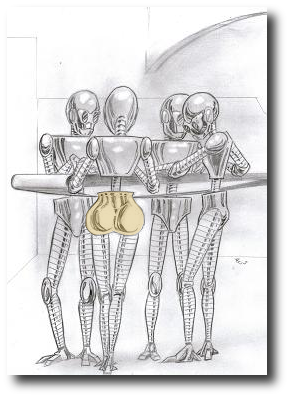
He will soon learn he'd collected payment from 3 different parties, including an agency of the US government, as part of a commission to build each of those parties something or the other! He also seems to have invested in a stock that has just crashed, against his broker's advise. He's no recollection of any of these, but the curious machine in his room must, of course, be the key to the problem.

We go through the now familiar crazy sequence of Gallegher stories unraveling the mystery...

Notes.

  1. Title, Gallegher Plus, is used as the name of the genius subconscious of Gallegher!

See also.

  1. Henry Kuttner & C L Moore's "The Proud Robot" (download): First & the best known of Gallegher stories. Also a science fiction classic.

Fact sheet.

First published: Astounding, November 1943.
Download full text (I haven't personally read this online copy).
Rating: A.
Among the stories from Astounding/Analog issues edited by John Campbell.
Related: Stories of Henry Kuttner, C L Moore (as by Lewis Padgett); fiction from 1940s.

Wednesday, March 10, 2010

Why do robots in Asimov's fiction have "positronic" brains?

"Because the positron had just been added to the list of particles and no one knew what it could and couldn’t do."
- Asimov, quoted by Frederik Pohl.

Origin of Asimov's three robot laws & of "I, Robot" movie

'Isaac had told me that “his” Three Laws of Robotics were actually given to him by John Campbell — Isaac had just tinkered with the wording. But when the movie people actually made a film called I, Robot, the story that was filmed had nothing to do with Isaac’s actual stories but was something written and published by another writer, and all they used of Isaac’s work was the title and the Three Laws. Neither of which had been his.'
- Frederik Pohl.

Asimov himself has something to say, in one of the anthologies he coedited, on the title of his book I, Robot when introducing Eando Binder's earlier story of the same name (download comic book adaptation of Binder's story; I think its text is online too, but I don't have the link handy).

Lawrence Watt Evans adds a correction to movie part: "The movie did use some of Dr. Asimov’s character names, in very roughly similar roles to those he’d given them."

I haven't personally seen the movie.

Friday, March 5, 2010

Paul Ford's "Robot Exclusion Protocol" (flash fiction, humor, free)

Meet a future generation of Google's indexing bots...

Fact sheet.

First published: At author site on 23 February 2002.
Download full text from author's site. [via Cory Doctorow]
Rating: B.
Related: Google in fiction.

Tuesday, February 16, 2010

Henry Kuttner's "Happy Ending" (short story, humor, free): When a man got what he "desired"!

While most of the story is mundane - at least for someone who's read a lot of Kuttner - it's the ending that made my day. Rely on Kuttner to turn mundane into extraordinary!

Note: I know of at least one more Kuttner story with this ending - cannot recollect the title, it was in one of the "Isaac Asimov Presents Great SF Stories" books. But that was a dark ending; here, it's a funny one.

Story summary.

James Kelvin, a newspaper reporter, met a very wise robot who gave him an interesting gadget with a button. Press the button & you'll be in rapport with a man from far future; you can then tap his far superior brain to achieve "health, fame and fortune"! Only, beware of that dangerous android Tharn from future. But gadget will protect you from him too.

James will have many adventures & narrow escapes from Tharn in days that follow. He will achieve "health, fame and fortune" too & "he lived happily ever after".

Only if life were so simple...

Fact sheet.

First published: Thrilling Wonder Stories, August 1948.
Download full text.
Rating: A.
Related: Stories of Henry Kuttner; Tuesday Classics; fiction from 1940s.

Saturday, January 30, 2010

Ian Whates' "The Assistant" (short story, robots, free)

In a high tech future, small insect-sized robots are used for corporate espionage & sabotage. This is the story of the adventures with these nuisances the nightly cleaning crew of an office building has been recently facing.

Ending is unnecessarily anti-Physics: these robots are powered by the friction with surroundings of their own movements in parallel universes! Don't ask me where the power to move came from in those alternate realities.

Except for last few paras, it's generally an ok read.

Fact sheet.

First published: George Mann (ed)'s "The Solaris Book of Science Fiction, Volume 3" (2009).
Download full text from author's site.
Rating: B.
Nominated for BSFA Award 2009 in short fiction category.
Related: Stories of Ian Whates.

Monday, January 4, 2010

Adena Brons' "My Robot Boyfriend" (flash fiction, humor, free)

Plus & minus points of a human boyfriend vs a robot boyfriend!

Fact sheet.

First published: 365tomorrows, 2 January 2010.
Download full text from publisher's site.
Rating: B.

Wednesday, December 2, 2009

William Highsmith's "Copper Boss" (flash fiction, humor, free)

Illustration accompanying the online copy at Flash Fiction Online of the short story titled Copper Boss by William HighsmithWhen a she-robot got accidentally introduced into an all he-robot assembly line, the results were rather frustrating to factory's human bosses...

Fact sheet.

First published: Flash Fiction Online, June 2008.
Download full text from publisher's site. [via Best Science Fiction Stories]
Rating: B.
Related: Robots in fiction; humorous stories.

Sunday, September 27, 2009

A E van Vogt's "The Mixed Men" aka "Mission to the Stars" (collection, space opera): Annotated table of contents & review

Cover image of the short story collection, sometimes mislabeled a novel, titled The Mixed Men or Mission to the Stars by A E van VogtI've only read the online stories from this collection - 3 of the 5. Nowhere near the best of van Vogt, but readable. My rating is in brackets. In case I have a separate post on a specific story, link on title goes there.

Stories should generally be read in order; later stories assume the reader is familiar with events in earlier ones.

Table of contents.

  1. [ss] "Concealment" (B); download; Astounding, September 1943: An exploration battleship of Imperial Earth has located an unexpected civilization of "Dellian perfect robots" in Lesser Magellanic Cloud, bringing to fore the ancient mutual hatred of the two species.
  2. [novelette] "The Storm" (B); download; Astounding, October 1943: Long drawn human/robot wars now show promise to end amicably.
  3. [novelette] "The Mixed Men" (B); download; Astounding, January 1945: Of the 3 species of robots in Fifty Suns - Dellian, non-Dellian, & "Mixed Men" - Mixed Men are the least numerous & most competent; they've now declared a war on humanity.

    We'll eventually learn that non-Dellians aren't robots at all but humans, that humans & robots can interbreed(!) to produce "Mixed Men" children - so the future appears to be the next evolution of both humans & robots - the "Mixed Men".
  4. [novelette] "Lost: Fifty Suns"; original appearance was probably in this collection: Not read.
  5. "Is it true?": Looks like it appeared only in a few editions.

Fact sheet.

First published: 1952.
Credits: Some of the information here comes from Wikipedia & ISFDB.
A lot of covers of various editions of this book are available at The Weird Worlds of A E Van Vogt.
Relevant entries have been added to the list of stories from John Campbell's Astounding/Analog.
Related: Stories of A E van Vogt.

Tuesday, September 15, 2009

A E van Vogt's "The Storm" (novelette, space opera, free)

Humans & robots have had a lot of bad blood in the past. Now, thousands of years down the line, this apparently final war among them will end up having the opposite effect - a promise of a patch up.

Collected in.

  1. Isaac Asimov & Martin H Greenberg (Eds)' "Isaac Asimov Presents the Great SF Stories 5 (1943)".

Fact sheet.

First published: Astounding, October 1943.
Rating: B.
Download full text from BaenCD.
Included among the stories from John Campbell's Astounding/Analog.
Related: Stories of A E van Vogt.

Friday, September 11, 2009

Brian C Baer's "The Robot Whisperer" (flash fiction, robot debugging, free)

While the story itself is ordinary, it's noticeable for nostalgia value - feels like some of the Asimov's robot debugging stories.

Story summary.

A technician (Asimov would have called him robot psychologist) talks a robot out of depression.

Fact sheet.

First published: 365tomorrows, 31 December 2008.
Rating: B.
Download full text from publisher's site. [via Best Science Fiction Stories]