Showing posts with label 1978. Show all posts

Tuesday, October 15, 2013

Alice Munro's "The Moons of Jupiter" (short story, non-genre)

I'd not heard the name of the author until a few days back - when the announcement that she'd won this year's Literature Nobel Prize came. When I looked around for her works, a short story collection with the title "The Moons of Jupiter" sounded like sf - so I picked it up. But at least this title story is not sf.

Story summary.

Story is mostly about a woman's relationship with her father & her two grown up daughters, but mostly father who's about to undergo heart surgery. Nice language & some very interesting observations on everyday life.

Title comes from some small talk she's having with her father in hospital about her visit to a local planetarium, a game where dad is going to name the moons of Jupiter.

Fact sheet.

First published: The New Yorker, 22 May 1978?
Rating: A.

Saturday, December 3, 2011

"The Best of L Sprague de Camp" (collection): Annotated table of contents & review

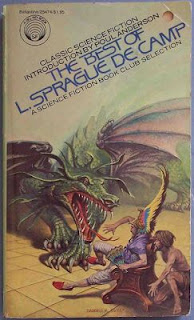
Cover of the short story collection The Best of L Sprague de Camp. Image shows a scene from short story Emperors Fan.
Book collects short stories, poems, & some non-fiction of de Camp. This post is only about short stories; I've dropped poems & non-fiction from ToC below.

Table of contents (only fiction, best first, unread last).

Link on title goes to my post on the story, if there is one. Where I'm aware of an online copy, I provide a separate download link. Links on publisher, editor or year fetch more matching fiction. My rating for individual stories is in brackets.

While there are not many really exceptional stories here, most are quite decent. Only a couple of stories near the end of this list didn't work for me as well.

Most stories are light hearted fun read, often with a cool idea. There are only two dark stories - "The Gnarly Man" & "Judgement Day".
  1. [novelette] "Two Yards of Dragon" (A); Lin Carter (ed)'s "Flashing Swords! #3:Warriors & Wizards" (1976): Adventures dragon hunting.
  2. [novelette] "A Gun for Dinosaur" (A); download; Galaxy, March 1956: Description of flora & fauna of Cretaceous period.
  3.  [ss] "Hyperpilocity" (A); Astounding, April 1938; humor: What if humans started growing hairy pelts?
  4. [novelette] "Employment" (B); Astounding, May 1939: Recreating prehistoric animals from their fossils... 
  5. [ss] "The Command" (B); Astounding, October 1938: An aspiring world dictator is infecting the world with his free will killing mold spores. It's now up to the intelligent laboratory bear to locate the antidote & give it to someone in his lab so the world can be saved... 
  6. [ss] "The Merman" (B); Astounding, December 1938; humor When a man became a fish... 
  7. [novelette] "The Hardwood Pile" (B); Unknown, September 1940: Never pick a fight with a "Norway maple" sprite!
  8. [novelette] "Nothing in the Rules" (B); Unknown, July 1939: What if mermaids were allowed in women's swimming competitions? 
  9. [novelette] "The Guided Man" (B); Startling Stories, October 1952; humor: Call center to help the socially awkward. 
  10. [ss] "The Inspector's Teeth" (B); Astounding, April 1950; humor: Life of a baby-dinosaur like alien as a student at a US university.
  11. [novelette] "The Emperor's Fan" (B); Harry Harrison (ed)'s "Astounding: John W Campbell Memorial Anthology" (1973); humor: Emperor's ultimate defense against potential assassins!
  12. [ss] "The Reluctant Shaman" (B); Thrilling Wonder Stories, April 1947; humor: Some "stone throwing" sprites normally found near some native American tribes are "helping" a businessman & his neighbors. Chaos reins.
  13. [novelette] "The Gnarly Man" (B); Unknown, June 1939: A very long lived pre-human (Neanderthal?) has survived to our times & is living among us!
  14. [ss] "Judgement Day" (B); Astounding, August 1955: A man's ultimate revenge against school bullies.

Fact sheet.

First published: 1978.
Related: Stories of L Sprague de Camp.

Wednesday, November 17, 2010

John Varley's "The Persistence of Vision" (novella, utopia, free): Physical misfits create a society where they're the norm

Quote from short story The Persistence of Vision by John Varley
While there are multiple themes here, a substantial part of the story is devoted to language & communications. Say no one had eyes & ears. How would you communicate?

Ending is very abrupt & arbitrary.

Caution: Story includes some sexually explicit scenes.

Story summary.

An epidemic ("German measles, or rubella") left some 5000 children born blind & deaf in its wake. Society is generally caring - in its own way, but they'll always be misfits, & objects of pity. On reaching adulthood, a few dozen of them set out to build a community custom-built for them; one where being deaf & blind is the natural state of being.

Story is the description of their commune, seen from the eyes of a drifter who'll be a drifter no more.

Quotes.

  1. "To protest, one must be aware of the possibility of something better. It helps to have a language, too."
  2. "nothing is moral always, & anything is moral under the right circumstances."
  3. "Why is it that once having decided what I must do, I'm afraid to reexamine my decision? Maybe because the original decision cost me so much that I didn't want to go through it again."

Fact sheet.

First published: F&SF, March 1978.
Download MP3 podcast of the story, read by Spider Robinson. [via Boing Boing]
Note: I've'nt personally heard this MP3; I've only read the original text version.
Rating: A.
Winner of Hugo Award 1979 in novella category.
Winner of Nebula Award 1978 in novella category.
Related: Stories of John Varley.

Wednesday, August 13, 2008

"The Best of Murray Leinster" (ed J J Pierce) (collection, science fiction): Annotated table of contents & review

Cover image of the 1978 short story collection titled The Best of Murray Leinster, edited by J J Pierce, and published by Del ReyOf the 13 included stories, 2 are very famous:

  1. English ordinary usage term "first contact" comes from the story with this title.
  2. Sidewise Awards, given during Worldcon, are named after the story "Sidewise in Time" - the first parallel universe story.
There is nothing totally crappy in the collection, though some stories are far more interesting than others.

My ratings are in brackets.

Table of contents (13 stories, best first).

  1. "Critical Difference" aka "Solar Constant" (A); Astounding Science Fiction, July 1956; terrafarming: When a sun goes cold during a particularly severe sunspot cycle, the life on its two inhabited worlds is threatened. The hero will figure a way out - not only to survive, but to thrive.
  2. "First Contact" (A); download MP3; Astounding Science Fiction, May 1945: When a human ship meets an alien one in a far off nebula, neither side has reason to trust the other with the location of its mother world. How to ensure both ships can safely leave for home without letting the other know its homewold location, & yet be able to keep contact?
  3. [ss] "A Logic Named Joe" (as by Will F Jenkins) (A); download text or MP3 (dramatized); Astounding Science Fiction, March 1946; humor: Exploits of a super-intelligent AI, but one without human ethics or morals.
  4. "Symbiosis" (A); Collier's Magazine, January 1947; biological warfare: A province of a small European nation is raided by a strong neighboring country. But the vanquished have an unusual & very effective weapon.
  5. "The Ethical Equations" (A); Astounding Science Fiction, June 1945; first contact: An enigmatic apparently-dead alien ship has drifted into Sol. How should humans respond? Hero has an unusual answer.

    This story appears to have inspired several Arthur Clarke stories - including "Jupiter Five", "Rendezvous with Rama", & a subplot of "Nemesis". Or may be it's the other way round.
  6. "The Fourth-Dimensional Demonstrator" (A); download; Astounding Stories, December 1935; humor, time travel: Very interesting implications of ability to pull a physical object from a different time into the present, & vice-versa.
  7. "The Lonely Planet" (A); Thrilling Wonder Stories, December 1949; first contact: When a sentient planet, kept as a draft animal by humans, showed signs of a superior intelligence, human authorities are feeling very threatened & declare war. But the planet only seeks human companionship - because it's lonely.

    Asimov's novel "Nemesis" has a similar subplot.
  8. "Proxima Centauri" (A); Astounding Stories, March 1935; first contact: If animals remained non-sentient, & some kind of carnivorous trees developed both intelligence & mobility, won't they have as much compunction eating a human as we have eating an apple!
  9. "The Strange Case of John Kingman" (A); Astounding Science Fiction, May 1948; first contact: A long time inmate of a mental asylum, suffering from superiority complex, is not human at all!
  10. "Pipeline to Pluto" (B); Astounding Science Fiction, August 1945; revenge: Corrupt officials running a racket fed by bribes meet their nemesis.
  11. "Sidewise in Time" (B); Astounding Stories, June 1934; parallel universes: What if our universe is "closed"? How will the things "outside" influence this universe?
  12. "Keyhole" (B); Thrilling Wonder Stories, December 1951; first contact: A retelling of Europeans' purge of America's natives to grab land during colonization years - but set on moon with local aliens in place of American natives. But the natives here are not as helpless.
  13. "The Power" (B); Astounding Science Fiction, September 1945; first contact: Closest Leinster comes to marrying occult with scifi. Befuddled & superstitious humans' reaction to the sole survivor of an alien spacecraft that crash landed somewhere in Europe in fifteenth century.

    Very similar in concept to last year's Hugo nominee novel - Michael Flynn's "Eifelheim".

Fact sheet.

First published: Del Rey, April 1978.
Selected & edited by: J J Pierce.
Note: There is another collection of the same title, but edited by Brian Davis (& with different contents).