Showing posts with label Frederik Pohl. Show all posts

Friday, December 13, 2013

Frederik Pohl's "The Kindly Isle" (short story, biological weapons, free)

A government agency in cold war era US is building biological weapons for possible use against Russians. One of its researchers has developed a virus that affects a part of the brain that's supposed to drive the infected person nuts, only the effect is a bit different - it makes the infected person irritable & nasty. On the day of his triumph, the scientist vanishes with all the data - so the government no longer has the weapon.

Years later, a colleague sights the scientist on an idle isle, & suspects he has been testing the virus for selling to highest bidder. But subsequent investigation with throw up a completely different direction of his research...

Fact sheet.

First published: Asimov's, November 1984.
Download full text from Baen eBooks.
Rating: A.
Related: Stories of Frederik Pohl.

Tuesday, September 3, 2013

RIP: Frederik Pohl (26 November 1919 - 2 September 2013)

Monday, July 22, 2013

Some online fiction by well known authors

Most are courtesy of Free Speculative Fiction Online. Where I have a post on a story, link on title goes there. Link labeled "download" fetches the actual story. Link on author fetches more fiction by author.

Among the ones I've read, my favorite is "Two Yards of Dragon".
  1. Arthur Clarke's "A Walk in the Dark"; download text/audio; horror: Our primeval fears...
  2. L Sprague de Camp's "Nothing in the Rules; download; humor: What if mermaids were allowed in women's swimming competitions?
  3. L Sprage de Camp's "Two Yards of Dragon" (A); download: Adventures dragon hunting...
  4. Fritz Leiber's "The Bleak Shore"; download.
  5. Murray Leinster's "Nightmare Planet"; download: I don't recollect this title but it appears to be yet another variant of "The Mad Planet".
  6. Frederik Pohl's "The Kindly Isle"; download.
  7. Manly Wade Wellman's "O Ugly Bird!"; download.
  8. Alice Sheldon's "The Man Who Walked Home" (as by James Tiptree, Jr); download.
  9. John Varley's "Air Raid"; download.

Sunday, August 5, 2012

"Galaxy Science Fiction", June 1958 (ed H L Gold) (magazine, free): Annotated table of contents

Cover image of Galaxy Science Fiction magazine, June 1958 issue, by Pederson. Showing spaceman on a small planetoid passing through Jupiters moon belt, moving away from Sun. Io, traveling to the right, will partially eclipse Jupiter.
Link on author fetches more stories of author.
  1. [novella] Frederik Pohl's "Mars by Moonlight" (as by Poul Flehr): "Certainly they were criminals -- they were in a Martian penal colony. But what were their crimes -- & how much time would they serve?"
  2. [novelet] Frederik Pohl's "The Gentlest Unpeople" aka "The Gentle Venusian": "Unswervingly considerate & ever so polite, they were helpful to a fault ... even if the fault happened to be a monster out of space!"
  3. [novelet] Robert Sheckley's "The Minimum Man": "Perceveral had a nerve asking for nothing more than his own small cubicle & a bit to eat! He'd take the whole world or else!"
  4. [ss] Fritz Leiber's "The Last Letter": "Who or what was the scoundrel that kept these couriers from the swift completion of their handsomely appointed rondos?"
  5. [ss] Robert Sheckley's "The Gun Without a Bang" (as by Finn O'Donnevan).
  6. [ss] Joseph Wesley's "Perfect Answer" (as by L J Stecher, Jr): "Getting there may be half the fun ... but it is also all of a society's chance of survival!"

Fact sheet.

The issue is labeled "Vol 16 No 2".
Download the magazine from Internet Archive (this copy is missing all stories but Flehr's, Leiber's & Stecher's).
Related: Fiction from Galaxy magazine (whole issues only), 1950s, "pulps".

Tuesday, July 19, 2011

Free fiction: A few stories of Frederik Pohl & A Bertram Chandler

At Webscription from their respective collections. [via Free Speculative Fiction Online].

From "The Early Pohl": "The Dweller in the Ice" (download) & "The King's Eye" (download).

From Chandler's "First Command": "Spartan Planet" (download).

Related: Stories of Frederik Pohl, A Bertram Chandler.

Saturday, June 26, 2010

Decoding "Dune"

Near end of this post on Frank Herbert, Frederik Pohl tells us how to maps some real world places & people to imaginary ones in "Dune".

Saturday, May 15, 2010

Various pen names of Frederik Pohl

He lists them, often with reason behind each name.


Related: Stories of Frederik Pohl.

Thursday, April 15, 2010

Free fiction: Frederik Pohl's "The Tunnel Under The World"

One of the best known classics of science fiction is now online at Project Gutenberg.

It's an advertising dystopia. Mostly ... sort of ... creepy, but with a very cool ending.

Update 16 April 2010:

  1. Now Manybooks also has it.
  2. [via Free SF Reader] An old MP3 radio adaptation of this story is also online at Internet Archive.
Related: Stories of Frederik Pohl.

Wednesday, March 10, 2010

Why do robots in Asimov's fiction have "positronic" brains?

"Because the positron had just been added to the list of particles and no one knew what it could and couldn’t do."
- Asimov, quoted by Frederik Pohl.

Origin of Asimov's three robot laws & of "I, Robot" movie

'Isaac had told me that “his” Three Laws of Robotics were actually given to him by John Campbell — Isaac had just tinkered with the wording. But when the movie people actually made a film called I, Robot, the story that was filmed had nothing to do with Isaac’s actual stories but was something written and published by another writer, and all they used of Isaac’s work was the title and the Three Laws. Neither of which had been his.'
- Frederik Pohl.

Asimov himself has something to say, in one of the anthologies he coedited, on the title of his book I, Robot when introducing Eando Binder's earlier story of the same name (download comic book adaptation of Binder's story; I think its text is online too, but I don't have the link handy).

Lawrence Watt Evans adds a correction to movie part: "The movie did use some of Dr. Asimov’s character names, in very roughly similar roles to those he’d given them."

I haven't personally seen the movie.

Isaac Asimov's "thiotimoline" vs Ted Chiang's "What's Expected on Us"

In his reminiscences about Asimov, Frederik Pohl tells us of an imaginary substance called "thiotimoline" invented by Asimov for "a non-fact article" in Astounding: it "had the curious property of beginning to dissolve before it was added to a solvent."

Makes me wonder if the central idea of Ted Chiang's philosophical story "What's Expected of Us" (download) came from here. This story features a gadget with a button & a light. Light lights up a set time before the button is pressed!

Sunday, February 14, 2010

Frederik Pohl on some stories of William Tenn

Link.

I'd not even heard of Tenn's brother, Morton Klass, who wrote "a few quite good stories".

Related: Stories of William Tenn, Frederik Pohl.

Saturday, December 26, 2009

Frederik Pohl on the last days of Arthur Clarke, & their joint novel "The Last Theorem"

Link.

PS: I finished "The Last Theorem" last week; should have a post soon - whenever "soon" happens. It's the fourth or fifth novel waiting a post - in company with one by Jack Vance & another by Hal Clement!

Related: Stories of Arthur Clarke, Frederik Pohl.

Frederik Pohl has been telling a history of Astounding magazine

Four parts have been posted so far:

  1. 1930-1933: Clayton Magazines.
  2. 1933-1937: Street & Smith.
  3. The Campbell Years - part 1 & part 2.

Related.

  1. Astounding fiction from Clayton Magazine years (all issues are online), & Campbell years.
  2. Stories of John W Campbell, Jr, Frederik Pohl.

Thursday, October 15, 2009

A discussion of "The Best of Frederik Pohl"

At rasfw.

Friday, January 30, 2009

Frederik Pohl on his life & editing, plus a short bibliography

At Locus.

Wednesday, January 21, 2009

Frederik Pohl now has a blog

It's called "The Way the Future Blogs": "A big part of this will be talk about sf writers I have known — as clients when I was a literary agent, as contributors when I was editing books or magazines, as collaborators, as traveling companions over a big part of the world — which is basically all of the writers anyone has ever heard of over the last many years."

[via File 770]

Tuesday, January 20, 2009

Recommended stories from Frederik Pohl's Galaxy & If magazines during 1962-1967

adamosf lists some of favorites from Galaxy & If magazines edited by Pohl from the said period at Visions of Paradise.

List includes some very famous stories, & others I'd not even heard of. He doesn't give online links, but I suspect at least some of them have some version online. Try using search button near top of this page - I might've linked a couple of stories from the list sometime. There must be others online that I never linked.

Tastes, however, differ. Of the half dozen odd very well known stories I've read from the list, I can recommend only Heinlein's "Moon is a Harsh Mistress". Others, while usually not bad, won't be on my all time best list - may be because they represent tastes of a different era, or are best read at a certain stage in life, or may be just personal preferences. Stories I've read from the list (besides Heinlein's above): Jack Vance’s “The Moon Moth”, Cordwainer Smith’s “The Ballad of Lost C’Mell”, Harlan Ellison’s “‘Repent, Harlequin’ Said the Ticktockman” & “I Have No Mouth And I Must Scream”.

But I would still like to hunt down the unread ones. Going by his familiar selections, at the very least, remaining ones are likely to be education about the history of science fiction.

Thursday, August 7, 2008

Audio of Frederik Pohl's "Day Million" is online

Narrated by Spider Robinson. This MP3 apparently includes another of his stories too - "We Purchased People". I've not read this other story.

In my book, "Day Million" is not really an entertaining story, though probably influential.

[Via SF Signal]

Friday, June 13, 2008

Frederik Pohl's "The Midas Plague" (novella, science fiction, humor): What if you were REQUIRED to regularly meet a consumption quota?

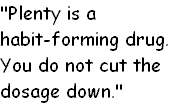
Quote from short story titled The Midas Plague by Frederik PohlI liked it when I read it a few days back. I seem to think less highly of it now because the premise seems so contrived. Except that it's not - exaggerated, but not entirely contrived.

If you are lucky enough to have decent self-earned income, remember the first time you noticed your normal spending was only a fraction of your income tax outgo? I know many people go through it. Sleepless nights wondering why the hell can I not spend at least as much as I pay the government, until peace is made with the situation - often with some lifestyle changes. This story is a far more drastic version of it.

Story summary.

It's set in a post-scarcity society in the US. But to create tension, it adds constraints that are way too contrived.

Society, with primarily robot labor, produces so much that anyone can have anything. Fine. But to keep robot factories busy, the government produces far more than society can consume! So you get quotas. Everyone must consume a certain amount of this & that!

Currency is in the form of "ration stamps". You pay these stamps not to buy food in a restaurant, but to notify the government that you have consumed a certain amount! Since the quotas are far more than people can consume, there is fraud & elaborate bureaucracy to catch fraudsters!

Your status in society is determined by how much you are required to consume. Poor have to consume more; as you rise up the social ladder, your consumption requirements reduce. This social promotion is done by government bureaucracy - often in recognition of you consistently meeting or exceeding your consumption quota, or helping others do it.

In their leisure time, people undertake activities that we normally call productive - like designing a machine! But lower strata of society is so busy consuming, they've no leisure time. Lower middle classes can afford no more than a few hours of such leisure time each week - they've to spend so much time consuming!

When you are rich & get sick, you can afford a doctor. If you are poor, you must suffer a team of doctors!

This is the story of Morey, a young man still way down in social hierarchy. He spends a day's leisure each week at Bradmoor Amusements Company designing gambling machines that help society consume more! During the course of the story, he will invent a new "K-50 Spin-a-Game" gambling machine.

He's just married Cherry - Judge Eton's daughter. She's from a much "richer" family. After marriage, this relentless consumption requirement is driving Cherry crazy - because she's from a background with less consumption pressure. So poor Morey is basically going to consume for two!

There is much unhappiness & warnings from government about not meeting his consumption quota. In a drunken moment, Morey will do something that will eventually turn out to be a winning idea: move his robots to a basement room, & make them consume things like furniture, cloths, shoes, etc - wear shoes, then keep moving around the room till they are worn, etc! He will be contrite when he discovers this in a sober moment, but it's helping solve a problem. He has already been not only meeting his consumption quota, but exceeding it; he's now got social status promotion too.

In a weak moment, he hands out his secret to someone he should not have shared it with. So it's going to spread. Panicky, he tells his shocked family. Judge father-in-law consults his robot clerk: "No precedent. No laws prohibiting. Therefore no crime." But he should confess to "Ration Board".

Goes to meet government official. Finds they already know about it. We learn the robots don't have a local brain, but share a big central one ("Master Control") over a radio communications network; so government has known about his robot-based consumption all along.

But they are actually happy! He's found a way to cut down the social pain. He'll be taken to Washington to meet bigwigs. When officials are congratulating him, he drops a dilemma: it's immoral to waste stuff!

But he has a way out. Install the "adjustable" "satisfaction circuits" in a robot, & you can configure the robot to want to wear a hat; with another config, gloves; etc! Moral dilemma gone. People can henceforth consume what they can; when something is being overproduced, robots will be configured to want to consume it!

In the end, we see the beginning of this social change. Individual quotas are not gone, but people get consumption robots to help consume stuff!

See also.

  1. Peter Sasdy's movie "Out of the Unknown" is an adaptation of this story. I've not seen the movie.

Collected in.

  1. Ben Bova (Ed)'s "The Science Fiction Hall of Fame, Volume Two B".

Fact sheet.

First published: Galaxy Science Fiction, April 1954.
Rating: B
Related: Stories of Frederik Pohl; stories about consumerism.

Friday, May 2, 2008

* Frederik Pohl's "Day Million" (short story, science fiction)

Sort of early cyberpunk. In distant starfaring future, humans have genetically tweaked themselves so much, they don't quite look familiar. We see the "marriage" of a mermaid human to a starfarer male human - marriage is the only time they ever meet, & the ceremony is essentially an exchange of their simulation data - then each goes its own separate way, never to meet again. Whenever you want the company of another, you just interface with a machine & load the partner's data - experience all you can together, including sex! Of course, you will usually have married many times - so you have many partners' data!

Collected in.

  1. David Hartwell & Kathryn Cramer (Ed)'s "The Ascent of Wonder: The Evolution of Hard SF".

Fact sheet.

First published: Rogue, February/March 1966.
Rating: C

Note: Why is this post so short?

Tuesday, October 30, 2007

Frederik Pohl's "Gateway" (novel): Survivor's guilt of a reluctant hero

Quote from the novel titled Gateway by Frederik PohlWhile there are sf elements galore like aliens, space travel, & AI, this story is primarily a character study (of hero).

While I generally liked this story, there are three negatives worth noting:

  1. Its main plot element is looting of other peoples property when they are not home!
  2. Another major plot element used for building up tension - 65% chance of death on voyage on untried routes - is utterly contrived & unconvincing. This job of checking the safety & fruitfulness of routes could have been easily been done by fitting additional instrumentation to the ship. Using it as primary device to built tension appeared very phony.
  3. This is not an exceptionally entertaining story. I found it easy to put the book away whenever I wanted, though it didn't really bored me. I finally finished it over may be 20 or more sittings.

Story threads.

There are three parallel but related threads in the story:
  1. A government controlled gold rush to loot the property of aliens known as Heechee.
  2. Narrator's many sittings with his AI psychiatrist, Sigfrid von Shrink. This AI is less sophisticated than you find in many genre stories - it's closer to what is normally called an "expert system", though it is a sophisticated one.
  3. Minor & very interesting nuggets in the form of bulletins describing events at Gateway. Gateway is "An asteroid. Or perhaps the nucleus of a comet. About ten kilometers through, the longest way. Pear shaped... an orbital body that came inside the perihelion Mercury and outside the orbit of Venus, tipped ninety degrees out of the plane of the ecliptic so that it never came very close to either". Originally prepared by Heechee half a million years ago as a spaceport, but abandoned for some reason. This is the administrative headquarters of the prospectors.
I didn't generally enjoy the psychiatrist sessions - they were ok read but not great. Narrator, Robinette Stetley Broadhead, got rich during the gold rush, but is harboring guilt related to the event that really made him rich. So he is seeking treatment to leave those demons behind.

What is the gold rush about?

Looks like a long time back, aliens called Heechee had a presence within Sol, among a lot of places - not only in Milky Way but in other galaxies too. Initially, their presence was found on Venus in the form of tunnels that were part of their habitat - along with some artifacts.

Sylvester Macklen, "just another tunnel rat on Venus - found a Heechee ship and got himself to Gateway, and died there. But he managed to let people know where he was by cleverly blowing up his ship. So a NASA probe was diverted from the chromosphere of the sun, and Gateway was reached and opened up by man." That was 18 years before the timeline of this story.

Later investigations revealed Gateway was a Heechee spaceport. Gateway also has an intricate tunnel system. And it has 924 Heechee spacecraft docked! These are 1-, 3-, & 5-seater starships - some armored against dangers men cannot guess. These ships are paired - main ship normally carries a lander part you use to go down to the surface of a planet.

Gateway Enterprises, Inc, '(usually referred to as "the Corporation")', under joint military control of US, USSR, China, & Brazil who also hold a share, manages its commercial exploitation. It's a very profitable venture for shareholders - "In the fiscal year ending February 30 last, the total revenues of the Corporation exceeded" US $3.7 trillion.

While some Heechee artifacts were found at Gateway, the real charm lies in starships docked there. Or rather, using them to go to other places in space where Heechee have been, & loot what you can of their property. This is risky business - not only could the owners be home (though that has not yet happened), but because so little is known about these ships.

The alien ships at Gateway.

These ships are an enigma, though humans have been able to figure out a way of using them - sort of.

No one has been able to figure out how they work, "what the fuel is, or how much there is, or how to tell when a ship is about to run out", etc.

"We're going to get into a ship that we don't know if it's going to get where it's supposed to go, and we don't even know where it's supposed to go. We go faster than light, nobody knows how. We don't know how long we'll be gone, even if we knew where we were going. So we could be traveling the rest of our lives and die before we got there, even if we didn't run into something that would kill us in two seconds."

In fact, the number of successful missions is rather low. '2355 launches ... 841 successful returns ... That was defining "successful" very loosely. It meant that the ship had come back. It didn't say anything about how many of the crew were alive and well.'

The art of piloting these ships.

What is known about the ships is: they "could go anywhere. Anywhere!"

It is thought that the destination is set by tinkering with a kind of dial with 12 numbers. No one knows how to correlate these numbers with real destinations in space; so setting the destination number has become an art!

"You would think that three numbers would be enough to describe any position anywhere in the universe... But it took the Heechee five. Does that mean there were five dimensions that were perceptible to the Heechee?"

"What you usually do ... is pick four numbers at random. Then you cycle the fifth digit until you get a kind of warning pink glow. Sometimes it's faint, sometimes it's bright. If you stop there and press the flat oval part under the teat, the other numbers begin to creep around, just a couple of millimeters one way or another, and the pink glow gets brighter. When they stop it's shocking pink and shockingly bright. Metchnikov says that's an automatic fine tuning device. The machine allows for human error - sorry, I mean for Heechee error - so when you get close to a real, valid target setting, it makes the final adjustments for you automatically."

"Sometimes you can cycle all the way through your fifth digit and get nothing at all. So what you do is, you swear. Then you reset one of the other four and go again. It only takes a few seconds to cycle, but check pilots have run up a hundred hours of new settings before they got good color."

Apart from target position, you also specify some minor settings: "Once you get a lock on the first five numbers, the other seven can be turned to quite arbitrary settings" - they probably offer some control over the path to get there.

Any attempt to tinker the dial, while in transit, appears to kill the ship.

And there is a single-click control to bring you back to Gateway.

Story summery.

So we get a tension filled plot - phony tension, since tension will evaporate if you flew them unmanned during first voyage to a specific destination.

One or more prospectors take a ship of an appropriate type. Wherever the ship takes them, they do local prospecting, & dig out whatever Heechee things they can haul back. Gateway administration has a way of valuing Heechee artifacts, & any other information they can gather. Any profits from exploits will entitle prospectors to a royalty.

While many have got rich, far more have died. Many mishaps can happen - ship runs out of fuel, ship ends up "in the photosphere of a star", ship is going so far the riders run out of food, ...

Robinette has a menial job on earth, wins a lottery, & uses this money to buy a ticket to Gateway. He will take 3 prospecting trips - first about 40% of the way through the story, & last that makes him rich.

After two unsuccessful missions, Robinette will strike it rich. He was part of a 10 member expedition that included his girlfriend Gelle-Klara Moynlin - in 2 armoured 5-ships. At the end of their voyage, both ships ended up "almost inside the event horizon" of a black hole!

He was supposed to be the only one stuck there when they attempted to get out through means that sound utterly implausible to me; instead he turned out to be the sole survivor. So he collects others' profit too. Now, 16 years later & aged 45, he is still carrying the survivor's guilt among sundry other demons of his past, but would like to outgrow it.

Quotes.

Normally in the order they appear in the story.
  1. "Sigfrid is extremely smart, considering how stupid he is."
  2. Q: "Didn't they have some system of storing knowledge, like writing?"
    A: "think about our own storage methods and how they would have been received in pretechnological times. If we'd given, say, Euclid a book, he could have figured out what it was, even if he couldn't understand what it was saying. But what if we'd given him a tape cassette? He wouldn't have known what to do with it. I have a suspicion, no, a conviction, that we have some Heechee "books" we just don't recognize... we may not have the instrument we need to detect the messages."
  3. "Maybe maturity is wanting what you want, instead of what somebody else tells you you should want... but what it feels like is mature is dead."
  4. "You don't have to accept any responsibility you don't want to."
  5. "The first step when you have a problem is to know you have it... second step is to make a decision: Do you want to keep the problem, or do you want to do something about it?"
  6. "Most of the methane in the Earth's air is cow farts."
  7. "Guilt? It is a painful thing; but because it is painful it is a behavior modifier. It can influence you to avoid guilt-inducing actions, and this is a valuable thing for you and for society. But you cannot use it if you do not feel it."

Trivia.

  1. The novel has a reference, unrelated to main story, to Robert Silverberg's "Lost Race of Mars".

Fact sheet.

"Gateway", novel, review
First published: 1977
Rating: Time well spent A
Winner of Hugo Award 1978 in novel category
Winner of Nebula Award 1977 in novel category
Alternate but less common search term: "1976-77 nebula award winner frederik"