Showing posts with label C M Kornbluth. Show all posts

Saturday, December 1, 2012

"Astounding Science Fiction", July 1950 (ed John W Campbell, Jr) (magazine, free): Annotated table of contents & review

Cover of Astounding Science Fiction magazine, July 1950 edition
Link on author fetches more fiction by author. Where I have a separate post on a story, link on story title goes there. For stories I've read, my rating appears in brackets.

I've not read Heinlein's non-fiction piece, "Destination Moon", noted on cover.

Table of contents (best first).

  1. [ss] Eric Frank Russell's "Exposure" (A): Bad luck dooms alien invasion of earth.
  2. [novelette] C M Kornbluth's "The Little Black Bag" (A): A bum finds purpose in life...

    Collected in SF Hall of Fame, #1
  3. [ss] James E Gunn's "Private Enterprise" (as by Edwin James) (A): Taking charge of a country by overtaking its economy...
  4. [ss] Ford McCormack's "Skin Deep" (B): A human party, aided by a member of an elder alien race, are investigating another alien race. So they kidnap a local for examination in lab, only the local was a beauty queen about to give a major stage performance. So the kidnapping became a major issue. 
  5. [novelette] Henry Kuttner & C L Moore's "Heir Apparent" (as by Lawrence O'Donnell) (B): Hero helps contain a political rebellion plot. It's a complex story with elements of cyborgs, swarm intelligence & waves that can make an island invisible!

Fact sheet.

Labeled: Vol XLV, No 5.
Download scans as a cbr file. [via David T @pulpscans]
Related: Stories from Astounding/Analog, only issues edited by John Campbell, only whole issues; old "pulps"; 1950s.

Sunday, October 30, 2011

C M Kornbluth's "The Rocket of 1955" (as by Cecil Corwin) (flash fiction, free): Swindlers get their due

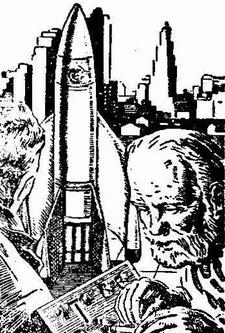
Illustration accompanying the reprint in Worlds Beyond, February 1951, of short story The Rocket of 1955 by C M Kornbluth
Fein has enlisted the narrator & some others to spin a swindling racket - they'll build a rocket to go to Mars with a man. Idea is to raise money from all sorts of sources for the project, but the project will be a fake one.

During the scheduled rocket launch, the rocket will explode a little up in air - killing pilot & some others (as planned!) Only the fate will soon catch up with the swindlers...

Fact sheet.

First published: Escape, August 1939.
Download full text from this unnamed site [via Free SF Reader].
Download full text as part of the scans of Worlds Beyond, February 1951 where it was reprinted.
Rating: B.
Related: Stories of C M Kornbluth.

Saturday, November 27, 2010

"Worlds Beyond", Vol 1 No 3 (February 1951) (ed Damon Knight) (magazine, free): Annotated table of contents

Cover by Van Dongen of Worlds Beyond magazine, February 1951 issue
Scans of this magazine in CBR format are online as part of a larger package, or as a standalone copy.

At least some of the stories are reprints.

Table of contents. 

Links on author or year fetch more matching fiction. Where I have a separate post on a story, link on story title goes there. My rating for read stories is in brackets.
  1. [novelette] Jack Vance's "Brain of the Galaxy" aka "The New Prime" (A): "It was the most brutal examination system ever devised--a system in which one wrong answer meant insanity, & another might mean death!"
  2. [novelette] [reprint] Halliday Sutherland's "Valley of Doom"; 1939 (where?): "The calculations of the Total State included everything--even a measured dose of beauty."
  3. [ss] Lester del Rey's "The Deadliest Female" (B): "Angered or thwarted, the normal female of the species can be deadly enough, Lord knows ... & Lee was no ordinary female--in fact, she belonged to no ordinary species!"
  4. [ss] H B Hickey's "Like a Bird, Like a Fish": "Against the incredible complexity of the alien ship from yesterday, Earth had only the faith of Father Vincent--& the devious simplicity of Pablo..."
  5. [ss] [reprint] Lord Dunsany's "The Old Brown Coat"; 1919 (where?): "The thing was immensely valuable; but why--& how?"
  6. [ss] Poul Anderson's "The Acolytes": "Beyond the green, smiling face that Nerthus showed to men was the dark other--the alien face that is death to see!"
  7. [ss] [reprint] C M Kornbluth's "Forgotten Tongue" (as by Walter C Davies); 1941 (where?): "A brief, apparently meaningless message--but once you'd read it, your mind wasn't your own!"
  8. [ss] Richard Matheson's "Clothes Make the Man": "Which is really the stronger--yourself, or the carefully composed image you present to the world?"
  9. [ss] [reprint] C M Kornbluth's "The Rocket of 1955"; 1939 (where?).
  10. [ss] Harry Harrison's "Rock Diver": "If an undersea diver's equipment failed, he still had a slim chance to live. But between Pete & the surface was the crushing weight of a half-mile of stone..."

See also.

  1. Fiction from old "pulp" magazines.
  2. Fiction from 1950s.
Credits: Some of the information here comes from ISFDB.

Friday, September 4, 2009

C M Kornbluth's "Gomez" (novelette, humor): Tale of a variant of Shrinivasa Ramanujan

Quote from short story titled Gomez by C M KornbluthSometimes hilarious story of how the US nuclear weapons establishment found & grabbed the teenage theoretical physics genius Julio Gomez (of an impoverished background), & how the young man won back his freedom.

Collected in.

  1. David Hartwell & Kathryn Cramer (Ed)'s "The Ascent of Wonder: The Evolution of Hard SF".

Fact sheet.

First published: C M Kornbluth's "The Explorers" (1954) (coll).
Rating: A.
Related: Stories of C M Kornbluth.

Saturday, August 22, 2009

C M Kornbluth's "The Silly Season" (short story, satire): How Martians invaded earth

This is a variation of the boy cries wolf too often & villagers get weary & won't come to help when the wolf really arrives.

Satire is on the mass media. Mysterious phenomena are observed every July/August in various parts of US over several years - transparent domes that kill anyone who touches them but vanish by the time news reporters reach, mysterious spheres floating around that are seen by one group but cannot be verified later, ...

First year, the media milks it to the hilt with silly jokes of incredulity. Next year, fewer people are attracted towards the news, & media is forced to not play along far. Forth year, no one believes in the phenomenon but this time it's the real Martian invaders!

Notes.

  1. Title, "silly season", refers to summer of US; author specifically mentions July & August. This apparently is the season for baseball (or was in 1940s) - apparently a counterpart of India's domestic Twenty20 cricket season. This is supposed to be the time of the year when few newsworthy things happen; hence the media grabbed the news during first year.

    Looks like summer months differ across latitudes, even in the northern hemisphere. India's summer, e.g., ends in June.

Collected in.

  1. Isaac Asimov & Martin H Greenberg (Eds)' "Isaac Asimov Presents Great SF Stories 12 (1950)".

Fact sheet.

First published: F&SF, Fall 1950.
Rating: B.
Related: Stories of C M Kornbluth.

Saturday, August 1, 2009

C M Kornbluth's "The Last Man Left in the Bar" (short story)

Cannot make out the head or tail of it.

An ordinary man & two mysterious individuals; the two seem to have some sort of magical powers & aren't from our world or universe or ... something.

The man had stolen "the Seal" that the two visitors want. They eventually get it, & "The Century of Flame" (whatever the heck that is) begins!

Through most of the story, we see the man getting drunk in a bar & watching trivia going on around the place.

Collected in.

  1. Isaac Asimov & Martin H Greenberg (Eds)' "Isaac Asimov Presents the Great SF Stories 19 (1957)".

Fact sheet.

First published: Infinity Science Fiction, October 1957.
Rating: C.
Related: Stories of C M Kornbluth.

Friday, July 31, 2009

C M Kornbluth's "The Education of Tigress McCardle" (short story, humor): An unusual population control program

This is a frame story. Frame is of an unarmed unopposed leisurely US invasion by China; a wily Chinese man has sold the US government an unusual & all too effective population control idea!

But the really interesting & very funny story is the one within the frame - the population control story. Very beautiful.

Story summary.

In this era of "Parental Qualifications Program" ("PQP"), George McCardle & his wife Tigress have decided to have a baby.

PQP regulations require them to get a breeding permit from government. To get the permit, they need to care for the "Toddler", a robot baby the government gave them on application, for 3 months.

Looks easy enough; prove that you can live with the demands of a baby. Only this is a super-cranky baby, designed to ensure the aspiring parents will give up the idea in days...

Notes.

  1. I suspect frame part satirizes a specific US President of the period. But I'm not familiar with issues locals had with their Presidents to figure it out.

Collected in.

  1. Isaac Asimov & Martin H Greenberg (Eds)' "Isaac Asimov Presents the Great SF Stories 19 (1957)".

Fact sheet.

First published: Venture Science Fiction, July 1957.
Rating: A.
Related: Stories of C M Kornbluth.

Monday, February 2, 2009

Bud Webster's "Past Masters" series moves to Jim Baen's Universe

From now closed Helix SF. And remains accessible without login at new location.

His is one of the more interesting columns appearing in online sf world - introduction to the works of one forgotten master in each column for those who were not reading sf a generation back.

I tend to look only for recommended readings - so his columns tends to appear too long. But they often do contain good recommendations.

Unfortunately, my featured posts feed cannot pick his columns up automatically since the JBU Columns feed is buggy. I guess Past Masters should be appearing once every two months at JBU.

His February 2009 post is about C M Kornbluth. Not many recommended readings I didn't know about (only "The Remorseful"), but he gives a long Kornbluth bibliography at end.

Sunday, November 23, 2008

Free fiction: Eando Binder, Gordon Dickson, Christopher Anvil, Ray Bradbury, Stephen King, Pierre Boulle, James P Hogan, John Campbell, C M Kornbluth

Via QuasarDragon: Comic book version of Eando Binder's excellent story "I, Robot" at Grantbridge Street & other misadventures. Apart from being a great story, this was the story that bootstrapped Isaac Asimov's robot stories. Based on reading of the first page, this illustrated version appears to be a faithful & close adaptation of the original story text.

Original story is from Amazing Stories, January 1939. Why does Grantbridge attribute it to Weird Fantasy, #11?

Via Free SF Reader: 3 stories from Gordon R Dickson's collection "The Human Edge" at Webscription:
  1. "Danger—Human"; download; Astounding, December 1957.
  2. "Sleight of Wit"; download; Analog, December 1961.
  3. "In the Bone"; download; If,, October 1966.
Via Free SF Reader: 8 stories at Webscription from Christopher Anvil's collection "War Games":
  1. "Truce By Boomerang"; download; Astounding, December 1957.
  2. "A Rose By Any Other Name ..."; download; Astounding, January 1960.
  3. "The New Member"; download; Galaxy, April 1967.
  4. "Babel II"; download; Analog, August 1967.
  5. "The Trojan Bombardment"; download; Galaxy, February 1967.
  6. "Problem of Command"; download; Analog, November 1963.
  7. "Uncalculated Risk"; download; Analog, March 1962.
  8. "Torch"; download; Astounding, April 1957.
Via Free SF Reader: 5 stories at Webscription from Christopher Anvil's collection "The Trouble With Aliens" (Ed Eric Flint):
  1. "The Prisoner"; download; Astounding, February 1956
  2. "Seller's Market"; download; Astounding, December 1958
  3. "Top Rung"; download; Astounding, July 1958
  4. "Symbols"; download; Analog, September 1966
  5. "Foghead"; download; Astounding, September 1958
Via Free SF Reader: MP3 audio versions of 5 stories of Ray Bradbury from The Zombie Astronaut Digest:
  1. "The Whole Town's Sleeping"; download MP3.
  2. "The Fruit at the Bottom of the Bowl"; download MP3.
  3. "The Flying Machine"; download MP3.
  4. "Hail & Farewell"; download MP3.
  5. "The Golden Apples of the Sun"; download MP3.
Via Free SF Reader: 2 stories of Stephen King from z0mbieastronaut:
  1. "Jerusalem's Lot"; download.
  2. "Children of the Corn"; download.
Via Dark Worlds: An audio version of the "Planet of the Apes" from BrokenSea. "an audio dramatization of the 1968 film". "Based on the novel by Pierre Boulle and original screenplay by Michael Wilson and Rod Serling, this new audio series features additional scenes, original sound design". "Written, directed and produced by Bill Hollweg."

Via Free SF Reader: 2 stories of James P Hogan at Webscription:
  1. "The Tree of Dreams"; download.
  2. "Jailhouse Rock"; download.
Via QuasarDragon: "SF Signal is streaming The Thing (1982) from Hulu... Watch it HERE. (It is also available directly at Hulu Here, but you have to register to watch it there.)"

This movie is an adaptation of John W Campbell's excellent first contact story "Who Goes There?" Text of original story was already online.

Caution: The movie is DRMed - accessible only within US. Very likely connections anonymized with Tor will also have trouble accessing.

This QD link is actually a month old. I wanted to watch it before linking, but I'm not motivated enough to watch it via a US based proxy.

Via QuasarDragon: Downloadable video in multiple formats at Internet Archive of C M Kornbluth's story "The Little Black Bag".

I haven't seen the video, but this is among the better stories of Kornbluth - similar in spirit to several Henry Kuttner/C L Moore stories about mysterious gadgets.

Note: Relevant entries have been added to the list of stories from John Campbell's Astounding.

Wednesday, October 22, 2008

Free fiction: Some stories by well known authors from "Imperial Stars" anthology series edited by Jerry Pournelle

Free SF Reader links Imperial Stars 3: The Crash of Empire at Webscripton. 3 stories are free:

  1. Gregory Benford's "Pebble Among The Stars"; download.
  2. Christopher Anvil's "The Claw And The Clock"; download.
  3. Cyril Kornbluth's "The Only Thing We Learn"; download: This has already been online as part of David Drake, Jim Baen, & Eric Flint (Ed)'s "The World Turned Upside Down" anthology: Frontiersmen always return as raiders of their ancient homes...
The series at Webscription has some more free fiction from "Imperial Stars 2: Republic & Empire":
  1. Norman Spinrad's "Outward Bound"; download.
  2. Wayne Wightman's "In The Realm Of The Heart, In The World Of The Knife"; download.
  3. Hayford Pierce's "Doing Well While Doing Good"; download.

Saturday, May 3, 2008

** C M Kornbluth's "The Marching Morons" (novelette, satire)

A variation on "selling ice to Eskimos" theme. A no-morals man from our time ends up in a future where average IQ is 45, & there is an exclusive breed of smarter people confined to Antarctica. In a deal that promises to make him the ultimate dictator, this man helps the smart ones kill off rest of humanity by selling them a story that makes them want to march off to their death.

Collected in.

  1. Ben Bova (Ed)'s "The Science Fiction Hall of Fame, Volume Two A".

Fact sheet.

First published: Galaxy, April 1951.
Rating: A

Note: Why is this post so short?

Friday, April 18, 2008

C M Kornbluth's "The Little Black Bag" (novelette, science fiction): A bum finds purpose in life

Quote from short story titled The Little Black Bag by C M KornbluthPlot is familiar: a gadget from an advanced civilization ends up with humans of current times, causing fun & later chaos. Not quite in the class of Kuttner/Moor's "The Twonky" & "Mimsy Were the Borogoves", but still very good.

Both gadget sending & receiving civilizations are human. Receivers are from mid-twentieth-century, senders are from twenty-fifth century. The magical gadget is a doctor's (general practitioner's) black bag; story gets its title from that.

Sending side story summary.

The advanced civilization of twenty-fifth century has been doing something to make humans smarter for "twenty generations" (about the time from receiver's time to sender's?). This society comprises of mental subnormals, normals & supernormals. Subnormals have been out-breeding others. Supernormals are only a "handful".

There are 4 characters that play a role:
  1. Dr "John Hemingway, B Sc, MD" - "a general practitioner". It's his medical bag that gets sent to past.
  2. Dr "Gillis, B Sc, M Sc , Ph D", a physicist & a close friend of Dr Hemingway. He's the one who causes the bag to be sent to past. He was just demonstrating a time machine, & the "ordinary" bag just happened to be close at hand. And this time machine can only send things; it cannot recover them back! First case of sending a little time machine without a human occupant to otherwhen where it will be unrecoverable is somewhere in first two chapters of H G Wells' "The Time Machine" - as far as I'm aware.
  3. Mike - a supernormal genius with "an IQ six times that of Dr Gillis". Mike works as "a bottle washer" somewhere!!! He gave Dr Gillis "these here tube numbers and says, 'Series circuit... Build your time machine, sit down at it & turn on the switch." That's how Dr Gillis built the time machine. Of course it works. It never occurred to apparently only "normal" Dr Gillis to ask Mike for the return-trip design too.
  4. Al - either a service technician or maker of the medical bags of the kind that got sent to the past. He has a switch that can be used to remotely destroy the medical bag. In case the bag's instruments are used for bad things like someone's murder, he gets a signal from bag; bag also lets him talk to local cops - in case of such emergencies!! But normally, when a bag is lost, he leaves it on. It's magical instruments almost operate themselves; let them do some good where ever they are!
Dr Gillis gave the demonstration when some friends were chatting. When it became clear that machine only sends things one way, 'There was wholesale condemnation of "Mike"' by this group!!!

Receiving side story summary.

Recipient is old Dr Bayard Full. Once a medical practitioner, years ago ("on July 18, 1941") he was barred from practicing the profession by the "Committee on Ethics of the County Medical Society" on charges of "milking several patients suffering from trivial complaints". He's now living the life of a bum in a slum. He will find the mysterious bag in his room when he wakes up one morning after a drunken sleep.

Bag is easy to open & close - just touch the lock. It contains a lot of wonderful instruments, medications, & a rather easy to follow user's guide. Dr Full will quickly cure his old broken bones, & quickly fix up a neighbor's 3 year old girl Teresa who's badly cut herself with glass.

Only, the little girl's elder sister Angie Aquella is too smart. She quickly figures the bag is not Dr Full's. Threatens Dr Full, & makes him agree to give her 50% after selling it for hopefully $20-30. Only there is no buyer - even among those regularly dealing in stolen goods!

Dejected, they accidentally notice some writing on one of the instruments in bag: "Made in USA... Patent Applied for July 2450"!!! Without understanding how it landed here, they begin to wonder where the magic came from.

We next meet the duo - Dr Full & Angie - much later. They're now successful - thanks to magical bag, prosperous, & run a sanitarium. We learn about them via "Edna Flannery, Herald Staff Writer" - a newspaper reporter suspecting them to be quacks, but coming back convinced after her investigation that she's met super genius of a doctor - never mind what County Medical Society says.

Dr Full wants to donate the bag to the "College of Surgeons"; many people should benefit from the magical box than just the two current owners. Angie wants to make maximum profits for herself - world's welfare be dammed.

It's during one of these altercations that Angie realizes Dr Full is serious about donating. She kills Dr Full using an instrument from the bag. She will later cut up his body into many small pieces, & dispose it off using an incinerator that is part of the bag - this incinerator makes stuff vanish.

Only one little thing she missed about the bag - the built in safety features. Al got notified (in his time!) of the killing via smart bag. He informs local police (in Angie's time - presumably via bag) that someone has been murdered. And he kills the bag - instruments quickly lose their magic & rust away, medicines rot, etc.

The final scene is an accident coinciding with kill signal from future for the bag. Angie is trying to milk rich Mrs Coleman for some cosmetic surgery. Woman is scared looking at Angie's unfamiliar instruments. So Angie is demonstrating one of the instruments that can be moved through flesh & won't cut anything except programmed type of tisse. Only, by this time, bag has received the kill signal, & Angie will actually end up cutting her own throat!

Collected in.

  1. Robert Silverberg (Ed)'s "The Science Fiction Hall of Fame: Volume One, 1929-1964".

Fact sheet.

First published: Astounding Science Fiction, July 1950.
Rating: A
Winner of Retro Hugo Award 2001 in novelette category.