Showing posts with label 1941. Show all posts

Sunday, February 10, 2013

Harry Walton's "Subcruiser" (short story, action, free): Foiling a warship hijack

Illustration by Schneeman accompanying the original publication in Astounding magazine of short story Subcruiser by Harry Walton. Image shows a scene on board the space ship where the story happens.
This is a "spy aboard a warship" story. Earth & Venus are at war, earth has a new type of space ship whose sample Venusians want for reverse engineering, & they've recruited an officer of earth to help get the ship. Hero, will, of course, foil the conspiracy.

Fact sheet.

First published: Astounding, May 1941.
Download full text as part of the scans of the magazine it originally appeared in.
Rating: B.
Among the stories from Astounding/Analog issues edited by John Campbell.

Friday, February 8, 2013

Vic Phillips & Scott Roberts' "Fish Story" (short story, fishing adventure, free)

Illustration by Schnecmen accompanying the original publication in Astounding magazine of short story Fish Story by Vic Phillips and Scott Roberts. Image shows human hunters fishing a Porgill in a lake on Venus.
It's hunting adventure in the jungles of Venus, told by an unreliable narrator. I completely missed the details of the scientific technique in the story - a chemical process (something about crystallization of salt) to entomb "fish" wholesale in a lake, fish that cannot be caught by normal methods. And the sensibilities here are disturbing, though probable - hunting an animal species nearly to extinction in one shot, over a couple of days, rather than over hundreds of years that has been the norm!

"Fish" in the story are "Porgill", larvae stage of "Nordiff" - a land animal that lays eggs in the lake.

Fact sheet.

First published: Astounding, May 1941.
Download full text as part of the scans of the magazine it originally appeared in.
Rating: B.
Among the stories from Astounding/Analog issues edited by John Campbell.

Monday, February 4, 2013

"Astounding Science-Fiction", May 1941 (ed John Campbell) (magazine, free): Annotated table of contents & review

Cover by Rogers of Astounding Science-Fiction magazine, May 1941 issue.
I've read stories of Heinlein, Asimov & Russell elsewhere; am posting this only for the two unread shorts - "Fish Story" & "Subcruiser".

Links on author fetch more stories of author. Where I've a separate post on a story, link on story title goes there. My rating for stories I've read & still remember appears in brackets.

Table of contents.

  1. [novelette] Robert Heinlein's "Universe"; MP3 of radio adaptation: "an unique & fascinating civilization in a spaceship that missed its goal!"

    Collected in "The Science Fiction Hall of Fame, Volume Two A" (ed Ben Bova).

    See also: its sequel, "Common Sense", in Astounding, October 1941.
  2. [novelette] Robert Heinlein's "Solution Unsatisfactory" (as by Anson MacDonald): "a story of the very near & grimly probably future. Man's apt to have that irresistible weapon soon--& no method of control!"
  3. [ss] Isaac Asimov's "Lier!": "Herbie was a robot; he was also a mistake. Somewhere in the assembly, an accident made him telepathic, with inevitable & disturbing consequences!"
  4. [ss] Eric Frank Russell's "Jay Score" (A): A passenger ship on earth to Venus voyage is hit by a meteor, & is now headed for Sun! 
  5. [ss] Vic Phillips & Scott Roberts' "Fish Story" (B): A "fishing" adventure on Venus.
  6. [ss] Harry Walton's "Subcruiser" (B): Foiling a warship hijack.
  7. [serial - 2/2] L Sprague de Camp's "The Stolen Dormouse": "In a slightly delirious world of the future where noble Sir Businessman feuds, & the times are more than a little out of joint."

Fact sheet.

Labeled: "Vol XXVII No 3".
Download scans as a CBR file. [via Bob@pulpscans]
Related: Stories from the Astounding/Analog issues edited by John Campbell, old "pulps", 1940s.

Friday, January 11, 2013

William Morrison's "Bad Medicine" (short story, humor, free)

Part of the illustration accompanying the original publication in Thrilling Wonder Stories magazine of short story Bad Medicine by William Morrison. Image shows two human conmen on Saturn, selling what they think is colored water as a brain-enhancement drug to locals.
Don't look for logic, & it's a light fun read.

Story summary.

A couple of human conmen running their "Gigantic Medicine Show" have landed on Saturn, attracting curious Saturnians to crowd around their ship. So they open shop - selling "The Red Mans' Old-Fashioned Radioactive Herb Remedy, fortified with vitamins A to R inclusive, the latter made with the most recently discovered carbon isotope", with the promise it will "increase your intelligence a thousandfold!" But payment should be in the form of red bead necklaces Saturnians wear - dirt cheap there, very pricey on earth.

Well, both sides will successfully trade what they desire ... to the horror of the sellers...

Fact sheet.

First published:  Thrilling Wonder Stories, February 1941.
Download full text from Pulpgen. [via QuasarDragon]
Rating: B.
Related: Stories of William Morrison.

Saturday, May 19, 2012

Henry Kuttner's "Hercules Muscles In" (as by Kelvin Kent) (novelette, time travel, humor, free)

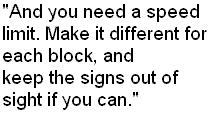
Quote from short story Hercules Muscles In by Henry Kuttner
Two friends in New York end up time traveling to "city of Tiryns ... in the Peloponnesos" in Greece of "Beyond 700 BC. Maybe 800 BC", to possess the body of two locals - one of them Hercules of the legend, other a run-away slave. They must use their wits to survive, & end up bringing bits of American life to Greece & helping write some of the Herculean legends...

Fact sheet.

First published: Thrilling Wonder Stories, February 1941.
Note: ISFDB describes this as an essay, but it's clearly a story.
Download full text from this unnamed site.
Rating: B.
Related: Stories of Henry Kuttner.

Friday, March 23, 2012

Eric Frank Russell's "Seat of Oblivion" (novelette, body snatching)

This is an action packed story, but the premise didn't really work for me. There is a machine, variously called "automatic psyche-liberator", "mechanical body-snatcher", or "life-force projector". Say you set it up near a window on a higher floor. Link one end to you, & aim its "projector" at that man walking down the street. Click a button, & a moment later your body is dead here, & your "life force" is in that man you aimed at. What happens to the "life force" of the stranger is not mentioned, except that it loses the body it was so far occupying.

Machine's inventor created it with a pious aim: to reuse the body of executed criminals to host the life force of a dying surgeon, e.g. Niven's "The Jigsaw Man" was yet to be written, so the implications of mining executed criminals' bodies wasn't considered.

In any case, an escaped death row convict gets hold of the machine & has a merry-go-round robbing banks etc, discarding bodies as necessary. Until the inventor traps him...

See also.

  1. Murray Leinster's "The Mole Pirate": While the device is different, dilemma is the same. A man invents a locomotive that, at the press of a button, transforms into a machine that can move through solid matter like walls & interior of earth. So a criminal grabs it & has fun. Until the inventor traps him...

Collected in.

  1. Eric Frank Russell's "Somewhere a Voice".

Fact sheet.

First published: Astounding, November 1941.
Rating: B.
Among the stories edited by John Campbell for Astounding/Analog.
Related: Stories of Eric Frank Russell.

Thursday, March 8, 2012

Eric Frank Russell's "Somewhere a Voice" (collection): Annotated table of contents & review

Cover image of short story collection Somewhere a Voice by Eric Frank Russell
I've not read all stories yet. Will fill up entries as I read.

"Dear Devil" is one of the most loved stories of the genre.

ToC below is in order of my preference, best first. Where I have a separate post on a story, link on title goes there. Where I'm aware of an online copy of the story, I include the link. Links on publisher or year fetch more matching fiction.
  1. [novelette] "Dear Devil" (A); download scans as part of a larger package; Other Worlds, May 1950: Humanity rises from post-nuclear-war apocalypse - with some external help.
  2. [ss] "U-Turn" (as by Duncan H Munro) (B); Astounding, April 1950: State helps a bored man commit "suicide"...  
  3. [novelette] "I Am Nothing" (B); Astounding, July 1952: A ruthless dictator has a change of heart...
  4. [novella] "Somewhere a Voice" (B); Other Worlds, January 1953: Unsuccessful hike to rescue by the stranded.
  5. [ss] "Tieline" (as by Duncan H Munro) (B); Astounding, July 1955: A man alone on an entire planet that houses a space lighthouse is very lonely.
  6. [novelette] "Seat of Oblivion" (B); Astounding, November 1941: What's the best place to hide for a runaway death row convict? In another man's body! 
  7. [ss] "Displaced Person" (B); Weird Tales, September 1948; religion: Some revolutionaries aren't welcome anywhere.

Fact sheet.

First published: 1965.
Related: Stories of Eric Frank Russell.

Friday, August 20, 2010

"Astounding Science-Fiction", Vol XXVIII No 2 (October 1941) (ed John W Campbell, Jr) (magazine, free): Annotated table of contents

Cover by Rogers of Astounding Science-Fiction magazine, October 1941 issue
Scans of this magazine in CBR format are online as part of a larger package.

"By His Bootstraps" & "Universe" (download MP3 of radio adaptation) are among Heinlein's best known stories. Though not among his best stories, in my opinion. Former appears in "The Adventures in Time & Space"; later in "The Science Fiction Hall of Fame, Volume Two A".

Table of contents. 

Links on author fetch more fiction by author. Where I'm aware of other online copies of a story, I include them too.

  1. [novella] Robert Heinlein's "By His Bootstraps" (as by Anson MacDonald) (B); download MP3 of radio adaptation; grandfather paradox: "Bob Wilson met himself--in a highly redundant sort of way. He met himself several times in fact, & became inextricably tangled in Time--"
  2. [novelette] Robert Heinlein's "Common Sense": 'The sequel to "Universe", a tale of a civilization that developed aboard a giant spaceship lost in interstellar space for 4,000 years--"
  3. [ss] Isaac Asimov's "Not Final!": "The Jovians wanted to get out & destroy every other living thing in the Solar System. They would--if they could find a way to retain their terrific atmosphere in a spaceship--"
  4. [ss] Winston K Marks' "Manic Perverse": "Only mechanical violence could bring death in that era--& the force field kept men from committing suicide. And that alone was enough to make some mad--"
  5. [ss] Theodore Sturgeon's "Two Percent Inspiration": "A Martian might be as good as any Earthman in most things--but when it came to a short hike on Mercury--"

See also.

  1. Fiction from Analog/Astounding (only issues edited by Harry Bates, John Campbell).
  2. Stories written by John Campbell.
  3. Fiction from old "pulp" magazines.
  4. Fiction from 1940s.
Note: I could not find any mention of editor's name either on cover or on ToC page or with signature at the end of editor's column. ISFDB, however, note that the editor is John W Campbell, Jr.

Wednesday, April 7, 2010

Jack Williamson's "Gateway to Paradise" (novel, doomsday, free): A British invasion of US in future

Illustration accompanying the novel Gateway to Paradise by Jack Williamson in 1953 anthology Wonder Story Annual, Vol 2 No 1, edited by Samuel MinesI'll call it a "time pass" story - to use a colloquial term popular in India. Leave your brains somewhere, & enjoy the generally mindless adventure. I actually started liking it once the adventure really began, but it's a mindless story anyway.

Story summary.

A passing Dwarf sometime in 1940s sucked away earth's atmosphere, oceans & moon, leaving earth sterile of life. Everywhere except in US, where someone with forethought to cover in some kind of a force field ("Ring", "Barrier") that bars any kind of material transfer. So now, 200 years later, US continues to live happily in its transparent cocoon, but there is no life anywhere else.

OK - there is life elsewhere. Some British survivors built domed cities of New Britain somewhere on the now dry Atlantic bed - some 3000 miles from US eastern shore.

And these Britishers are angry at US - for having survived. So they're out to destroy the machine that keeps the US screen. And they've found a way to cross the Barrier.

Of course, a US hero will save the motherland. And because the enemy is Britain (rather than Russia - see similar Murray Leinster stories, e.g.), US continues to have friendly feelings towards attackers. And of course, we later discover the British aren't all evil - only some are extremists (& they too are finally converted).

Happy ending for all, as the lost moon returns now - on an impact course with earth! Which makes both sides join hands to shift its trajectory - Britain for its rockets, US for its force field that can be made to even stop gravity transfer across the screen! Earth will get some of its atmosphere & water back, & become habitable again as moon breaks up on near approach. You see, moon was hoarding part of earth's atmosphere sucked away earlier! And didn't you know moon is mostly ice?

See also.

H G Wells' "The Star" (download as part of a Wells' collection at Project Gutenberg) is probably the most widely read story of a large cosmic body passing near earth & wrecking havoc here due to gravitational interference.

A transparent force-field barrier covering a part of space is a very common trope. Some stories that immediately come to mind:
  1. Arthur Clarke's "The Sentinel" & "What Goes Up": Former has a barrier aliens erected around one of their artifacts on moon. Later has a spherical barrier created by a nuclear accident in Australia.
  2. James Blish's "Cities in Flight" series of stories has whole cities covered in a barrier that keeps atmosphere etc & then plucked off ground, to wander through space! Most stories are told from the point of view of this avatar of Manhattan part of the New York city.
  3. Murray Leinster's "Invasion": A single invader immobilizes most of US air force using such a barrier.

Collected in.

  1. Samuel Mines (ed)'s "Wonder Story Annual, Vol 2 No 1 (1953 Edition)".

Fact sheet.

First published: Startling Stories, July 1941.
Download full text as part of a larger package.
Rating: B.
Related: Stories of Jack Williamson.

Free fiction: Cosmic Stories, March 1941 (ed Donald A Wollheim)

At Internet Archive in multiple formats. [via Marooned]

  1. This is the inaugural issue of the magazine.
  2. Part of the cover that includes magazine name is missing.
  3. Includes a "complete novel".
  4. Among the authors: Isaac Asimov & Damon Knight.

Related.

  1. Old "pulp" magazines.
  2. Works of Donald A Wollheim (as editor or as author).
  3. Fiction from 1940s.

Friday, March 19, 2010

Free fiction: A year's worth of "Weird Tales"

Scans in 12 issues in CBR format in 6 RAR files at Crosseyed Cyclops. Two Canadian editions; all others are apparently US editions.

I'd actually downloaded them a couple of months back, but forgot posting.

Note RAR files are generally large - about 150 MB for most files, though a couple of them are smaller. Can be downloading only one file at a time, & must manually download - there is a no-robot verification step. Means some human time will be needed.

  1. "Weird Tales 1 rar": May 1950, November 1952. Among the authors: Robert Bloch.
  2. "Weird Tales 2 rar": October 1936, October 1937. Among the authors: Robert Bloch, C L Moore, Robert E Howard, Henry Kuttner, Arthur Conan Doyle, H P Lovecraft, Edmond Hamilton.
  3. "Weird Tales 3 rar": December 1937, March 1938. Among the authors: Robert Bloch, Edmond Hamilton, Robert E Howard, H P Lovecraft, Jack Williamson, Henry Kuttner.
  4. "Weird Tales 4 rar": July 1938, November 1941. Among the authors: Henry Kuttner, H P Lovecraft, Edmond Hamilton, Clark Ashton Smith, Paul Ernst, Robert Bloch, Robert E Howard.
  5. "Weird Tales 5 rar": September 1945 (Canadian Edition), July 1944. Among the authors: Robert Bloch, P Schuyler Miller, Ray Bradbury, Edmond Hamilton.
  6. "Weird Tales 6 rar": January 1946 (Canadian Edition), May 1947. Among the authors: Edmond Hamilton, Robert Bloch, Eric Frank Russell, Theodore Sturgeon.
Related: Fiction from Weird Tales; old pulps.

Monday, January 4, 2010

Free fiction: A few pulp magazines

All at Internet Archive in multiple formats:

  1. Dynamic Science Fiction: January 1954 (download).
  2. Wonder Stories: August 1934 (download).
  3. Planet Stories: Summer 1949 (download), November 1950 (download), Spring 1955 (download).

    November 1950 issue includes a Mitky Mouse story of Fredric Brown. Not the lovely original, though - it appears to be a sequel.
  4. Super Science Stories: May 1940 (download), January 1941 (download).

    January 1941 issue has PDF of nearly 100 MB; I've not checked other formats. All other issues have PDF of reasonable size.
Related: "Pulp" magazines.

Wednesday, April 8, 2009

"Amazing Stories", February 1941 (magazine, free): Table of contents & download link

Front cover image of Amazing Stories magazine, February 1941 issue. A painting by Leo Morey, depicting a scene from the novel Battering Rams of Space by Don Wilcox.Scans of this magazine are available online as part of a larger package.

Table of contents.

  1. [novel] Don Wilcox's "Battering Rams of Space": "Lester Allison & June O'Neil match battering rams against deadly explosive gas in total space war."
  2. [ss] John York Cabot's "The Last Analysis": "Forbes & Barton had the discovery of the century; a machine that could foretell a crminal's acts!"
  3. [novelet] Eando Binder's "Adam Link in the Past": '"Thor could only have been a robot!" exclaimed Adam Link - & set out in a time ship to find him."
  4. [ss] Robert Moore Williams' "The accidental Murders": "A shoestring breaks, you miss a train, the one you catch is wrecked. Was the shoestring an accident?"

    I haven't read it, but this description sounds like Henry Kuttner & C L Moore's "What You Need".
  5. [ss] Charles R Tanner's "The Stillwell Degravitator": "Stillwell saw only good in his machine that overcame gravity - until he put it to practical use!"
  6. [ss] Gordan A Giles' "The Winking Lights of Mars": "Communication between two worlds, space travel to Mars - & it all depended on the Winking Lights."

Thursday, April 2, 2009

"Amazing Stories", June 1941 (magazine, free): Table of contents & download link

Front cover image of Amazing Stories magazine, June 1941 issue. A painting by J Allen St John, illustrating a scene from the novel Black Pirates of Barsoom by Edgar Rice Burroughs.Scans of this magazine are available online as part of a larger package.

Table of contents.

  1. [novel] Edgar Rice Burroughs' "Black Pirates of Barsoom"; download author's collection "Llana of Gathol" from Project Gutenberg of Australia (this link via Blue Tyson): "John Carter had to hide the magic in his sword arm, & yet he had to fight Barsoom's best blades -"
  2. [novelet] James Norman's "Lost Treasure of Angkor": "Back into time they hurled - straight into the catastrophe that blotted [...?] out of history!"
  3. [novelet] David V Reed's "The Girl from Venus": "Merrill was a romancing patrolman on penalty duty, just the wrong man to [meet?] a princess in distress."
  4. [ss] William P McGivern's "The Quandary of Quintus Quaggle": "A heck of a time to turn to stone - just when your job, your future, & [?] depend on action!"
  5. [ss] Duncan Farnsworth's "Pepper Pot Planet": "There was something funny about this revolution, but Tonya believed in it, & Tonya was beautiful".
  6. [ss] Milton Kaletsky's "Homer Higginbottom, Rain Maker": "They laughed at Homer & tossed him out on his ear, but they stopped laughing when it began to rain".

Wednesday, April 1, 2009

"Amazing Stories", September 1941 (magazine, free): Table of contents & download link

Front cover image of Amazing Stories magazine, September 1941 issue. A painting by Robert Fuqua, illustrating a scene in the novel Enchantress of Lemuria by Stanton A Coblentz.Scans of this magazine are available online as part of a larger package.

Table of contents.

  1. [novel] Stanton A Coblentz's "Enchantress of Lemuria": "Miles down in the earth was an amazing city in a giant cavern; & a lovely girl; & a hideous war".
  2. [ss] Jep Powell's "Mutiny in Space": "This desert rat didn't know much about space ships - but he did know which end of a mule kicked!"
  3. [novelet] David Wright O'Brian's "Ferdinand Finknodle's Perfect Day": "Finknodle was perfect - & he knew how to make the world perfect. So he set out to create Utopia."
  4. [novelet] Arthur T Harris' "The Throne of Valhalla": "Nazi hero, Tommy ace (?) - a challenge to an air duel. But they didn't expect Valhalla to be on the scene!"
  5. [ss] P F Costello's "Yellow Mud for Cowards": "No shame could be worse than receiving this tiny box of yellow clay from your fellow space fighters."
  6. [ss] Duncan H Farnsworth's "Myster of the Mummy": "Why should Richardson be so drawn to the mummy at the alter in the future? Was it someone he knew?"
  7. [ss] Alexander Blade's "Dr Loudon's Armageddon": "Dr Loudon's son fought with the enemy; yet the scientist gave him a weapon that could win the war -"
Legend: ss = short story.

Tuesday, March 31, 2009

"Amazing Stories", November 1941 (magazine, free): Table of contents & download link

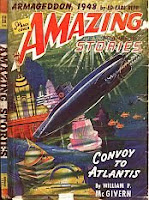
Front cover image of Amazing Stories magazine, November 1941 issue. A painting by Robert Fuqua, illustrating a scene from the novel Convoy to Atlantis by William P McGivern.Scans of this magazine are available online as part of a larger package.

Table of contents.

  1. [novel] William P McGivern's "Convoy to Atlantis": "A torpedo blasted from Vulcun, & Brick Harrinton went down into an amazing, grim, sunken city."
  2. [ss] John York Cabot's "Nicolbee's Nightmare": "Nicolbee was a dreamer. He dreamed so much that reality became confused. Which life was a dream?"
  3. [ss] Don Wilcox's "The Stevedor of Jupiter": "On Jupiter weight means everything. And Jupe could calculate how much death there was in an ounce."
  4. [ss] Robert Moore Williams' "Death Desert": "A horrible thing, a Martian desert. But more horrible in the code of honor of its savage tribesmen."
  5. [novelet] Robert Leslie Bellem's "The Short-wave Superman": "What would you think if you suddenly found able to squeeze metal in your fingers like putty?"
  6. [novelet] Ed Earl Repp's "Armageddon, 1948": "This wasn't a man's war; it was a battle against giant worms. How could one girl beat them back?"
Legend: ss = short story.

Saturday, May 3, 2008

** Robert A. Heinlein's "Universe" (novella, science fiction)

A very well written variation of a technology civilization falling on primitive times, & eventually a hero who sees the possibility of a different future. Story is set on a huge slower-than-light spaceship - originally headed for Centauri on a 60 year journey but now adrift in space for unknown reasons for hundreds of years; descendants of crew form this primitive society & a religion around the ship's documents they've inherited.

Collected in.

  1. Ben Bova (Ed)'s "The Science Fiction Hall of Fame, Volume Two A".

Fact sheet.

First published: Astounding, May 1941.
Rating: A

Note: Why is this post so short?

** Isaac Asimov's "Nightfall" (novelette, science fiction)

My not so good reaction to this original is probably because I'd read & loved its novelization years back. This shorter version mercifully kills the later half of the novel that was utter bore. What we are left with is great stuff, but I prefer corresponding novel version that is better developed (first half of novel).

Story is about a world with many suns & where there is always at least one sun in the sky. Local beings are so unfamiliar with the idea of darkness that it drives them physically mad. This is the reason the civilization is destroyed every 2,000 years or so - that's when the sole sun in the sky on that occasion is eclipsed by a sister world long enough to bring out a night all over this world. This short story follows the last hours of current civilization - for the eclipse is only a few hours away.

Collected in.

  1. Robert Silverberg (Ed)'s "The Science Fiction Hall of Fame: Volume One, 1929-1964".
  2. Raymond J Healy & J Francis McComas (Eds)' "Adventures in Time and Space".

Fact sheet.

First published: Astounding, September 1941.
Rating: A

Note: Why is this post so short?

** Theodore Sturgeon's "Microcosmic God" (novelette, science fiction)

A genius inventor has concluded that even the most prolific inventors rely on slowly gathered insights of many men. To speed up progress, he's created a fast evolving new life form - far far smarter than humans in that they can solve impossible problems that will take humans forever, & for the moment they are contained in a closed habitat in an island. But who can say how long they will remain there? What will mankind do when they decide to come out?

Collected in.

  1. Robert Silverberg (Ed)'s "The Science Fiction Hall of Fame: Volume One, 1929-1964".

Fact sheet.

First published: Astounding, April 1941.
Rating: A
Related: All stories of Theodore Sturgeon.

Note: Why is this post so short?

* Henry Kuttner's "A Gnome There Was" (short story, fantasy)

A children's horror story, if there is such a genre. Adventures of a man who fell into under-earth world of gnomes, was made a gnome & made to live among them, & his daring escape with not so pleasant consequences. Has elements of humor & horror; all parents may not be comfortable handing this story out to their kids.

Fact sheet.

First published: Unknown, October 1941.
Rating: C

Note: Why is this post so short?

Friday, March 7, 2008

Robert A. Heinlein's "...And He Built a Crooked House" (novelette, humor, free)

Quote from short story titled And He Built a Crooked House by Robert A. HeinleinNon-stop action, & non-stop smiles. Moral of the story: if you ever find an architect who will build your 4 dimensional house, make sure it's anchored securely in the accessible dimensions!

Story summary.

Quintus Teal is the main protagonist. A great architect with post modern tastes. During a drinking session with his friend Homer Bailey, he decides to build a 4D house! You get far more space than you can get in accessible dimensions - ideal for crowded places.

Since Homer is anyway going to build a new house, he bullies his friend into signing the contract & pay the advance. Friend is proceeding on a vacation; he will have the magical home ready & will be able to surprise his wife Matilda on return. Whole episode has parallels with Howard Roark's contract for building Stoddard Temple in Ayn Rand's "Fountainhead".

Friend returns. Quintus takes him & his puzzled wife to a tour of their new house. First shock of future owners - it appears far tinier than contracted! Oh - there was an earthquake yesterday night. While the 4D house is earthquake proof, it ended up "folding" to its *normal* shape. Don't worry about what is "folding"; it just makes the house more magical.

From outside, it's just single room on ground floor! Major disappointment for owners, until a fancy staircase appears inside this room & seems to go ... where? Never mind, just go ahead. Ah - you reach the second story (invisible when you entered!) with 6 large & well appointed rooms. There is also another floor with one room - invisible from our normal world.

Much of the story is the party's adventures moving through the home. Because of "folding", even architect cannot predict what will lead to where. To add to complications, there is a further earthquake when they are inside; no damage because it's quake proof, but its geometry is further changed!

For a while, you find Quintus chase his own backside visible some doors ahead, thinking it's a mugger! Try getting out of ground floor room, & end up on a higher floor. One window opens to ocean, another to desert, yet another to probably a place not on earth, ...

Finally, the panicky trio will jump off a first floor window overlooking some forbidding place, only to find there is no house where they landed! They'll find they are some tens or hundreds of miles from the home they were in! Take a lift, eventually reach the site of house - where they originally entered. Only there is no house there now - thanks to quake when they were inside!

Of course, the great architect is still bubbling with the possibilities of new architecture.

Fact sheet.

First published: Astounding, February 1941.
Download full text from Internet Archive.
Rating: A
Listed among the stories from John Campbell's Astounding/Analog.
Related: Stories of Robert Heinlein.

Monday, November 5, 2007

Alfred Bester's "Adam and No Eve": Earth can withstand the worst human follies

Fantastic ending covered up all faults of this otherwise ordinary, depressing, & sometimes illogical story.

There is a resonance of its theme in some of the dialogs in Michael Crichton's "Jurassic Park": worst the humans can do to earth is to get themselves destroyed & also most other current life forms. But earth is resurgent. It might take it a while, but there will be life again here & earth won't miss us. Only reason we need to guard against very environment-unfriendly actions is our own survival.

Story summary.

Stephen Crane is an inventor. He has found "a catalyst that would induce atomic disintegration of iron", & the process gives out an enormous amount of energy - kind of substitute for nuclear reactions.

He is building a rocket powered by this reaction to make a trip to moon. Only, his associate, Hallmyer, doesn't think that is a good idea. Because some catalyst is bound to leak from rocket exhaust - even after all precautions are taken. Even minute traces leaking into atmosphere will eventually settle on ground. And much of earth is iron!

Crane is not listening. Hallmyer burns the facility holding the rocket ready to go off. After some drama, Crane makes it to ship - with his dog, Umber. And launches the ship - still in good enough shape. But he is too exhausted by the last minute drama, & goes unconscious after launch.

By the time he wakes up, he realizes the ship shot up "perhaps almost to Roche's zone, to the limit of the Earth's gravitational attraction, but then without guiding hands at the controls to continue its flight, had turned and was dropping back toward Earth"! And earth below is an inferno - Hallmyer was right, he has ended up destroying earth! After hours of fall, he finally exits rocket via his parachute & lands. By now, he & his dog are the only surviving creatures on earth.

Over the following weeks, as he is moving towards death on meagre rations he was taking to moon, dog attacks him for food; he ends up killing dog.

Now he has reached the sea after weeks of walk & then crawl - or what remains of the sea. The last life form earth is ever going to see.

Er, is it the last life form? Realization hits on how earth will recover - there is a way yet for earth to rebuilt life from Adam alone, without any Eve! Great ending.

Collected in.

  1. Raymond J Healy & J Francis McComas (Eds)' "Adventures in Time and Space".

Fact sheet.

First published: Astounding Science Fiction, September 1941.
Rating: A.
Listed among the stories from John Campbell's Astounding/Analog.
There are at least 2 comic book adaptations of this story online: as one of the stories in Unknown Worlds of Science Fiction, March 1975 issue in CBR format (but downloadable only as part of a larger RAR pack at Crosseyed Cyclops); JPEG files of only this story from this magazine at Grantbridge Street & Other Misadventures.

Tuesday, September 4, 2007

Eric Frank Russell & Maurice G Hugi's "Mechanical Mice": An inventor doesn't know what he has invented!

Quote from the short story titled Mechanical Mice by Eric Frank Russell and Maurice G HugiEven this most fantastic story from Russell is so easy to follow & absorbing. A lot of modern sf'ish fantasy authors can take useful lessons.

Story summary.

Dan Burman, 40, is a very rich inventor. 12 years ago, he had invented "Burman Bullfrog Battery" - the greatest known power source for small portable devices. Now he has invented a new thing - after spending many years & huge sums of money; only he doesn't know what the little device he has invented is supposed to do!

He seeks help of Bill - the narrator, a press reporter & a friend of Dan. During this discussion, Dan reveals that he is not the real inventor either of his famous battery or this new device that does god knows what. He stole the design from future!

His only genuine invention is a kind of crystal ball he calls "psychophone" - a virtual-reality time-travel machine that can take you to future - within your mind; not physically. And not very precisely either - say to an accuracy worse than a decade. Since it is impossible to go back to same time & place, a single session is all you have to learn what you can about anything specific.

This is how the battery came into being. And the new machine.

That is when the new machine - sitting in the same room - automatically comes into action. Arms stretch out to pick expensive precision machinery like Dan's wrist watch. Machine appears to be doing something inside, but what! Eventually, they lock the lab, & go home for the night.

That is the night the terror begins in the neighborhood. Burglery in a big jewelery shop, & a precision instrument maker. Several cats dead in the streets - ruthlessly butchered.

Dan will discover later next day what he has manufactured: a robot programmed to survive above all else, & capable of giving birth to children! The brood has been snatching food, & killing whatever comes in the way.

Great action, & ultimate destruction of the robots.

Collected in.

  1. Raymond J Healy & J Francis McComas (Eds)' "Adventures in Time and Space".

See also.

  1. Other stories on essentially the same theme - a "minor toy" from an advanced civilization somehow ends up in human space, causing puzzlement & chaos: Henry Kuttner & C L Moore's "The Twonky" & "Mimsy Were the Borogoves"; & C M Kornbluth's "The Little Black Bag".
  2. Pat Forde's "In Spirit": A very different story, but uses a time travel device similar in concept to psychophone. And uses it to move to past - something psychophone cannot do.

Fact sheet.

First published: Astounding Science Fiction, January 1941
Rating: A
Authorship of this story is complex; see this note.
Related: All stories of Eric Frank Russell.
Listed among the stories from John Campbell's Astounding/Analog.

Monday, September 3, 2007

Eric Frank Russell's "Jay Score": A passenger spaceship is on its way to fall into the Sun!

Quote from the story titled Jay Score by Eric Frank RussellThis thriller is a very good variant of Arthur Clarke's "Breaking Strain": a spaceship on earth to Venus voyage is hit with a tiny meteor. In Clarke's version, it's a cargo ship, & air is limited - making that a survival problem. In Russell's version, it's a passenger ship, & loses machines that control propulsion system - so the ship is about to be sucked into the Sun.

Story summary.
Space ship Upskadaska City aka Upsydaisy is headed for a human settlement on Venus with 8 passengers. And a crew drawn from at least 4 races:
  1. "white Terrestrials to tend the engines".
  2. Black terrestrials as medics "because for some reason no one can explain why no Negro gets gravity bends or space nausea."
  3. Ten-tentacled martians. "Every outside repair gang is composed of Martians who use very little air, are tiptop metal workers and fairly immune to cosmic ray burn."
  4. Emergency pilot Jay Score, a terrestrial who is neither black nor white.
Story is narrated by ship's Seargent-at-Arms. The accident described happens in the year 2270, & will eventually be known as "McNulty's Miracle Move"; McNulty is captain.

Jay Score is fairly new to the job, but quickly becomes known as competent & reliable crew member. But there are two specific actions that put him in a class of his own.

First is when the meteor hits. A part of the ship loses air, trapping an engineer beyond hope. It's Jay's heroics that save the engineer. The hit also damaged the ship's propulsion system that actually precipitates the crisis - the ship is headed for the Sun.

Propulsion system is quickly fixed, but how to get out of Sun's gravitational drag? I didn't quite catch the technicalities: "The idea is to build up all the velocity that can be got and at the same time to angle into the path of an elongated, elliptical orbit resembling that of a comet. In theory, the vessel might then skim close to the Sun so supremely fast that it would swing pendulum like far out to the opposite side of the orbit whence it came... The only point about which we have serious doubts is that of whether we can survive at our nearest to the Sun."

Tension in story is provided by this nearness to Sun - for four dangerous hours. Everyone will hide in the ship's "cold room", but someone needs to be in the cockpit! Jay Score, of course. When the time is past, everyone in the cold room has passed out but not fatally.

When Jay is retrieved, he is blind & mute, but alive in cockpit that has lost its air.

We will learn the secret of Jay's survival late in the story. Very good ending.

Collected in.

  1. "Major Ingredients" (ed Rick Katze). 
Fact sheet.
First published: Astounding Science Fiction, May 1941
Rating: A
Series: Jay Score (A), Mechanistria (B), Symbiotica (B), Mesmerica (B)
Related: All stories of Eric Frank Russell.
Listed among the stories from John Campbell's Astounding/Analog.

See Also.
  1. Robert Heinlein's "Gentlemen, Be Seated". Shared plot element is: to survive an accident in space, protagonists must expose their body physically to elements guaranteed to kill them. Protagonists survive in both stories.
  2. Heinlein's "The Green Hills of Earth": A spaceman loses eye sight & later life when performing valiant action during an accident in space.