Showing posts with label H G Wells. Show all posts

Sunday, August 25, 2013

H G Wells' "The Red Room" (short story, gothic horror, free)

This is a haunted house story. A large abandoned palace with three old caretakers has a "Red Room" that is haunted & feared. Narrator, apparently a traveler, will insist on staying there saying he doesn't fear ghosts, & will discover the fear first hand.

Notes.

Much of story is about setting the mood, but the key part went over my head. In the end, narrator tells us "there is no ghost there at all, but worse, far worse, something impalpable— ... The worst of all the things that haunt poor mortal men, ... and that is, in all its nakedness—'Fear!' Fear that will not have light nor sound, that will not bear with reason, that deafens and darkens and overwhelms." And yet the mysterious events of the
night before don't quite fit this conclusion.

Fact sheet.

First published: The Idler, March 1896.
Download full text from Project Gutenberg or eBooks@Adelaide.
Rating: B.
Related: Stories of H G Wells.

Free fiction: New at Project Gutenberg (24 August 2013)

  1. John Russell Russell's "Adventures in the Moon, and Other Worlds"; download.
  2. [ss] H G Wells' "The Red Room" (1896); download.

Wednesday, October 17, 2012

H G Wells' "The Chronic Argonauts" (novelette, time travel, free)

This is supposed to be the first time machine story of science fiction, predating author's own "The Time Machine" (download) by 7 years. Time machine in this story is called "the Chronic Argo, the ship that sails through time".

Story summary.

An ordinary Welsh village of Llyddwdd gets a lot of excitement as a mysterious stranger suddenly begins occupying the village's haunted house. A stranger with a strange taste in things mechanical.

Made me smile several times.

Fact sheet.

First published: The Science Schools Journal (1888) (published by the Royal College of Science).
Download full text from Gaslight. [via James W Harris @ClassicScienceFiction]
Rating: A. 
Related: Stories of H G Wells; fiction from 19th century.

Thursday, February 16, 2012

H G Wells' "In the Abyss" (short story, hard sf, free): Exploring the bottom of the ocean

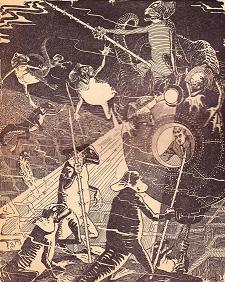
Illustration accompanying the republication in Amazing Stories magazine, September 1926 issue, of short story In the Abyss by H G Wells. Picture shows the native inhabitants of ocean bottom taking the human exploration submarine to their city.
An early description of a submarine for exploring the sea surface 5 miles below the water surface. I've'nt read Jules Verne's "20000 Leagues under the Sea"; so no idea if there is any similarity.

Story summary.

Lt Elstead of British navy will be going down in a spherical cabin made of heavy steel that's mostly air & would naturally float. Cabin is padded inside, because passenger is likely to be thrown around in the device that lacks any controls its human occupant exercise. The cabin has two windows of thick glass.

It's tied with a 5 mile rope of some kind of a floatable material to a massive deadweight of lead. At the interface of dead weight & rope is a "clockwork", an automatic mechanism that steers the human cabin up & down as follows:
  1. After the deadweight reaches the sea bottom, clockwork triggers the winding of a winch that pulls the rope down, with it bringing the human floating cabin to sea bottom. I don't recall how the deadweight determines that it has reached the bottom; may be a timer.
  2. 30 minutes after bringing the cabin down, the clockwork automatically activates a knife that cuts the rope that connects it to cabin; so cabin rises to surface by its buoyancy where it will be retrieved by a waiting ship. Ship is also used for initial lowering of the contraption into the sea. (Why not rewind the winch & let buoyancy raise the cabin? Saving the rope?)
Of course, things don't go as planned. Our explorer meets the intelligent denizens of sea bottom & ends up visiting their city.

See also.

  1. H G Wells' "The Land Ironclads" (download): Another hard sf story by author, now describing an early version of a battle tank.

Fact sheet.

First published: Pearson's Magazine, August 1896.
Download full text from Project Gutenberg of Australia.
Download full text as part of the scans of Amazing Stories, September 1926 (about 80GB, with this as the sole complete story!)
Download audio as part of this collection from Internet Archive.
Rating: B.
Related: Stories of H G Wells.

Wednesday, June 30, 2010

Brief summaries of several short stories of H G Wells

By StevenLP at Asimov's Forum.

"The Star" (download as part of a larger package) & "The Man Who Could Work Miracles" (download) are among the most reprinted stories of science fiction. Former describes an apocalypse brought about by gravitational perturbations due to passage through inner Sol of an alien celestial body. Later is closer to fantasy: a young man whose wishes the physical world seems to grant, often in drastic ways.

"The Land Ironclads" (download) features in "The Ascent of Wonder", & is a hard sf description of what in Wells' future would be military tanks.

Related: Stories of H G Wells.

Sunday, May 30, 2010

Microfiction: H G Wells distilled

At Thaumatrope.

Related: Stories of H G Wells.

Friday, April 2, 2010

H G Wells unhappy with localization of "The War of the Worlds"

Marooned reproduces a letter he "wrote to the editors of The Critic, a British literary periodical, in January 1898".

'my story The War of the Worlds “as applied to New England, showing how the strange voyagers from Mars visited Boston and vicinity,” is now appearing in the Post. This adaptation is a serious infringement of my copyright and has been made altogether without my participation or consent. I feel bound to protest in the most emphatic way against this manipulation of my work in order to fit it to the requirements of the local geography.'

Related: Stories of H G Wells.

Sunday, January 24, 2010

Free fiction: Several versions of H G Wells' "The Invisible Man"

All at Crosseyed Cyclops:

  1. Video: 13+13=26 black & while half-hour episodes of one of the TV series based on it, produced by Incorporated Television Programme company Ltd in 1958.
  2. Audiobook: Two versions.
  3. Text.
Related: Stories of H G Wells.

Monday, December 14, 2009

Free movie: Don Taylor's 1977 adaptation of H G Wells' novel "The Island of Dr Moreau"

At SF Signal.

Related.

  1. Movie details at IMDB.
  2. Stories of H G Wells.
  3. Buy the novel "The Island of Dr Moreau" from Amazon.

Friday, December 4, 2009

Free movie: George Pal's 1960 adaptation of H G Wells' "The Time Machine"

At SF Signal. I had previously linked a different 10-part YouTube copy too.

Based on H G Wells' novel of the same name.

Friday, June 19, 2009

Free fiction: Audio: Huffduffer

Link. [via Free SF Reader]

Many desperate things, but a few interesting ones too. Audio links below are probably all radio adaptations.

  1. Arthur Clarke's "Rendezvous With Rama"; download MP3 - part 01, 02: I'm not sure the two parts cover the whole novel, but if they do, it's a big catch.

    One of the most important novels of the genre, but only for readers with a taste for hard sf (that would be very small percentage of sf readers, though).

    There is also a very good 3 minute movie online, showing the approach & landing of human spacecraft on Rama, & entry of human explorers through airlock into the ship. Or was, when I last played it over a year ago.
  2. Philip K Dick's "Beyond Lies The Wub"; download MP3: Not read. I think its text version is already online, probably at Project Gutenberg.
  3. Murray Leinster's "A Logic Named Joe"; download text/MP3: Fun early story about interconnected computers. I've linked both versions in the past.
  4. Orson Welles' famous radio show inspired by H G Wells' "War of the Worlds" that caused panic in the US when first broadcast in 1938.

    Arthur Clarke's humorous apocalypse story, "Publicity Campaign", is apparently a reaction to the panic this broadcast caused.

Saturday, January 17, 2009

Online movie: George Pal's "The Time Machine" (1960)

Based on H G Wells' novel of the same name.

Divers & Sundry links the online copy in 10 parts at YouTube: 01, 02, 03, 04, 05, 06, 07, 08, 09, & 10. I've'nt watched the movie yet.

[via QuasarDragon]

Wednesday, June 11, 2008

H G Wells' "The Star" (short story, science fiction, free): Precursor to Arthur Clarke's "The Hammer of God" & Hollywood movie "Armageddon"

Quote from short story titled The Star by H G WellsMost obvious difference with Clarke's "The Hammer of God" & "Armageddon" is: there is no attempt in this story to deflect the heavenly body that is about to destroy earth; there is much less time too. May be space travel wasn't seen as optimistically in Wells' time.

I was unclear whether the impacting body is really a star. Once he calls it "a great white star", another time "strange planet from outer space". And he's probably relying on telescopes less powerful than now available.

Also, at the time the story was written, Solar System probably ended at Neptune.

Clarke's story titled "The Star" is different & unrelated to this one.

Story summary.

On "the first day of the New Year" sometime "early in the twentieth century", 3 different observatories simultaneously announced having noticed unexplainable perturbations in the motion of planet Neptune. It will be soon be found that this is due to a foreign star - a "strange wanderer ... a great white star" from outside Sol has been captured by Sun, & is now on its fall towards Sun.

On the way, it will take down Neptune by direct impact - the two merging into one body headed for merger with the Sun. On their way down, the very hot body will be deflected by Jupiter so earth also is now in the way of fall! It will eventually pass close enough to earth/moon system to destroy most life on earth & making earth a much harsher place to live. Only a few humans will survive. And "the moon, shrunk to a third of its former size, took now fourscore days between its new and new." Entire story happens over just a few days - the heavenly body seems to be moving rather fast.

Much of the story is about the masses' reaction to the knowledge of the impending event. Initially unconcern - why should I worry about some fireworks near Neptune. Slowly, two suns in the sky forces it to be noticed. Then heat, earthquakes, tidal waves, impossible weather - panic.

Story ends on a sobering note that will resonate in some Ray Bradbury stories later: 'The Martian astronomers -- for there are astronomers on Mars, although they are very different beings from men -- were naturally profoundly interested by these things. They saw them from their own standpoint of course. "Considering the mass and temperature of the missile that was flung through our solar system into the sun," one wrote, "it is astonishing what a little damage the earth, which it missed so narrowly, has sustained. All the familiar continental markings and the masses of the seas remain intact, and indeed the only difference seems to be a shrinkage of the white discoloration (supposed to be frozen water) round either pole." Which only shows how small the vastest of human catastrophes may seem, at a distance of a few million miles.'

Collected in.

  1. H G Wells' "The Door in the Wall and Other Stories", download collection.

Fact sheet.

First published: The Graphic, December 1897.
Rating: A
Download full text: See "Collected in" section above.
Listed in "William G Contento's Top Ten Most Reprinted Stories".

Note: This file is a filled up version of the tiny post created during the flood of posts during early May 2008.

Saturday, May 3, 2008

* H G Wells' "The Man Who Could Work Miracles" (short story, fantasy)

A man who can will miracles - essentially the same in spirit as Hogbens stories of Henry Kuttner & C L Moore, but less humorous. He will eventually will his capability to make miracles happen, after disastrous miracle to stop earth's rotation so it won't be daylight for a while longer!

Fact sheet.

First published: ...
Rating: B
Download full text.
Listed in "William G Contento's Top Ten Most Reprinted Stories".

Note: Why is this post so short?

Friday, May 2, 2008

** H G Wells' "The Land Ironclads" (short story, hard sf)

Very readable description of a battle that is evenly matched - till one side produces a super-weapon. The super-weapon is a tank-like device - but in a battle that otherwise uses horses & cyclists.

Collected in.

  1. David Hartwell & Kathryn Cramer (Ed)'s "The Ascent of Wonder: The Evolution of Hard SF".

Fact sheet.

First published: The Strand, December 1903.
Rating: A
Download full text.

Note: Why is this post so short?

Saturday, April 26, 2008

H G Wells' "The Time Machine" (novel, science fiction): Speculations on last days of humanity & of earth

Quote from novel titled The Time Machine by H G WellsIt's convenient to look at this novel - of 12 chapters & an epilogue - as 4 related but separate stories: preparation (ch 1-2); twilight of humanity (ch 3-10); twilight of earth (ch 11); & second journey (ch 12 & epilogue). These are my titles, not Mr Wells'.

Narrator is unnamed. Hero is simply called Time Traveller.

I've collected some interesting quotes from this novel in a separate post.

Full text of this story is available for download at Project Gutenberg - as both text & human-read audiobook. I've not read or heard either of these online versions, however.

Story summary: Preparation (Chapter 1-2).

This part is probably the most entertaining single time travel story I've yet read - though there is not much actual time travel involved.

Story is mostly told via evening idle talk among a few friends - at home of Time Traveller. Time Traveller himself appears to be some kind of English aristocrat - servants summoned by ringing the bell, etc.

He has his laboratory at home, & has made two time machines - a small demonstration machine he will use in these sessions, & a bigger one in the lab that will be used in rest of the story.

Demonstration involves sending the small machine to future by pressing a lever. "It will vanish, pass into future Time, & disappear." Or rather, "Into the future or the past - I don't, for certain, know which"!

This demonstration machine seems to be well imitated in sf literature. Several Kuttner/Moore stories feature its variants. It's also featured in C M Cornbluth's "The Little Black Bag" - also included in Hall of Fame series.

Story summary: Twilight of humanity (Chapter 3-10).

This is most of the novel, & usually not a kind of story I would have liked. But Wells gives the much written about theme an interesting twist: taking the political antagonism of haves & have-nots to an extreme.

Just when I was starting to get bored, there came a statement that hooked me to the story & made me see it in a different light: something to the effect - how much of land is off-limits to you in your own society if you are an ordinary citizen? I see a lot of it in Bombay. Is your city much different?

Anyway, this differentiation of haves & have-nots has led to humanity splitting into two separate species (Time Traveller went there in the year 8,02,701 AD - "date the little dials of my machine recorded"). Both are mentally far inferior to current humans:
  1. Eloi living in the open, always happy, at the physical & "intellectual level of one of our five-year-old children", don't do anything productive except engage in physical pleasures, vegetarian, & very fearful of dark & of members of the other division of humanity, Morlocks.
  2. Morlocks - nocturnal, live in underground caverns & tunnels where all factories had moved long back, cannot stand even a little light, run & maintain machines still underground but without understanding why, slightly smarter than Eloi, & they treat Eloi as cattle raised for meat - they actually pick members of Eloi off often enough for food, reason Eloi are so fearful of them them.
These appear to be the last days of humanity. All dangerous animals & pests have long been made extinct, along with "horses, cattle, sheep, dogs". And humans are simply not intellectually competent anymore - cannot even form coherent sentences of any complexity, let along grasp abstractions.

Story is in the form of Time Traveller's adventures through this world. And his just-in-time escape - he was trapped by Morlocks & was about to become food.

There is another story in Hall of Fame series - John W Campbell, Jr's "Twilight" - that is almost a straight lift off this story! I suppose that got included only because of author's name.

There is another theme touched upon in this part which I've seen in many other stories - not of time travel, but of traveling to alternate earths. The possibility that the physical space your body is currently occupying is already occupied by something else at destination! There was a novella among last year's Hugo nominees - Paul Melko's "The Walls of the Universe" - that described more than one such adventures in detail.

In Wells' version, you are continuously traveling - so you are bound to pass through other material some time or other if you travel far enough in time. "The peculiar risk lay in the possibility of my finding some substance in the space which I, or the machine, occupied. So long as I travelled at a high velocity through time, this scarcely mattered".

Story summary: Twilight of earth (Chapter 11).

When escaping Morlocks, Time Traveller ran in opposite time direction in panic, & eventually stopped when earth is in its last days - story is essentially author's description of this world. You've probably read several variations of it.

Story summary: Second journey (Chapter 12 & epilogue).

After returning to his normal time - a few hours after he started, but after several days of adventures in future - badly battered because of his adventures, Time Traveller has got a travel itch. So he's off to a second journey. And there is speculation that he's probably met a serious accident - for it's 3 years since he left, & there is no word yet.

Collected in.

  1. Ben Bova (Ed)'s "The Science Fiction Hall of Fame, Volume Two A".

Fact sheet.

First published: According to ISFDB, 'Initially serialized in 1888 as "The Chronic Argonauts", but discontinued after three installments. First serialized in its present form in The New Review, in 4 parts beginning Jan, 1895. '
Rating: A

Quotes from H G Wells' "The Time Machine" (novel)

Quote from the novel titled The Time Machine by H G WellsMain post about this novel is here. Quotes below are in order they appear in the novel.

Quotes.

  1. "if Time is really only a fourth dimension of Space, why is it, and why has it always been, regarded as something different? And why cannot we move in Time as we move about in the other dimensions of Space?"

    "Are you sure we can move freely in Space? Right & left we can go, backward & forward freely enough, & men always have done so. I admit we move freely in two dimensions. But how about up and down? Gravitation limits us there."

    "There are balloons."

    "But before the balloons, save for spasmodic jumping & the inequalities of the surface, man had no freedom of vertical movement."

    ...

    "We are always getting away from the present movement... Just as we should travel down if we began our existence fifty miles above the earth's surface."

    ...

    "a savage or an animal has" no way "of staying six feet above the ground. But a civilized man is better off than the savage in this respect. He can go up against gravitation in a balloon, & why should he not hope that ultimately he may be able to stop or accelerate his drift along the Time-Dimension, or even turn about & travel the other way?"
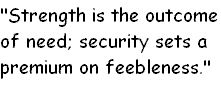
  2. "Strength is the outcome of need; security sets a premium on feebleness."
  3. "What, unless biological science is a mass of errors, is the cause of human intelligence and vigour? Hardship & freedom: conditions under which the active, strong, & subtle survive & the weaker go to the wall".
  4. "Humanity had been strong, energetic, & intelligent, & had used all its abundant vitality to alter the conditions under which it lived. And now came the reaction of the altered conditions.
    ...
    For countless years ... there had been no danger of war or solitary violence, no danger from wild beasts, no wasting disease to require strength of constitution, no need of toil. For such a life, what we should call the weak are as well equipped as the strong, are indeed no longer weak. Better equipped indeed they are, for the strong would be fretted by an energy for which there was no outlet... This has ever been the fate of energy in security; it takes to art & to eroticism, & then come languor & decay."
  5. "I learned very little of drains & bells & modes of conveyance, & the like conveniences, during my time in this real future... Conceive the tale of London which a negro, fresh from Central Africa, would take back to his tribe! What would he know of railway companies, of social movements, of telephone & telegraph wires, of the Parcels Delivery Company, & postal orders & the like? ... think how narrow the gap between a negro & a white man of our own times, & how wide the interval between myself & these".
  6. "It is usual to assume that the sun will go on cooling steadily in the future. But people ... forget that the planets must ultimately fall back one by one into the parent body. As these catastrophes occur, the sun will blaze with renewed energy".
  7. "There is a tendency to utilize underground space for the less ornamental purposes of civilization; there is the Metropolitan Railway in London, for instance, there are new electric railways, there are subways, there are underground workrooms & restaurants, & they increase & multiply. Evidently ... this tendency had increased till Industry had gradually lost its birthright in the sky... it had gone deeper & deeper into larger & ever larger underground factories, spending a still-increasing amount of its time therein... Even now, does not an East-end worker live in such artificial conditions as practically to be cut off from the natural surface of the earth?

    ... the exclusive tendency of richer people ... is already leading to the closing, in their interest, of considerable portions of the surface of the land. About London, for instance, perhaps half the prettier country is shut in against intrusion. And this same widening gulf ... will make that exchange between class & class, that promotion by intermarriage which at present retards the splitting of our species along lines of social stratification, less & less frequent. So, in the end, above ground you must have the Haves, pursuing pleasure & comfort & beauty, & below ground the Have-nots, the workers getting continually adapted to the conditions of their labour... Such of them as were so constituted as to be miserable & rebellious would die; &, in the end ... the survivors would become as well adapted to the conditions of underground life, & as happy in their way, as the Upper-world people were to theirs."
  8. "I understood now what all the beauty of the Over-world people covered. Very pleasant was their day, as pleasant as the day of the cattle in the field. Like the cattle, they knew of no enemies & provided against no needs. And their end was the same."
  9. "intellectual versatility is the compensation for change, danger, & trouble. An animal perfectly in harmony with its environment is a perfect mechanism. Nature never appeals to intelligence until habit & instinct are useless. There is no intelligence where there is no change & no need of change. Only those animals partake of intelligence that have to meet a huge variety of needs & dangers."