Showing posts with label 1990s. Show all posts

Tuesday, October 22, 2013

Alice Munro's "The Bear Came Over the Mountain" (novelette, senility, non-genre, free)

It's a decently readable story, but I find the subject of senility depressing.

Story summary.

An old woman who's losing her wits is put in some kind of old age care home by her husband of 50 years. It's mostly about his depressing visits to see her periodically, her growing fondness for another man at the place, & the complicated relations that develop between the two couples.

Fact sheet.

First published: The New Yorker, 27 December 1999.
Download full text from publisher's site.
Rating: B.
Related: Stories of Alice Munro.

Tuesday, August 13, 2013

Neal Stephenson's "The Great Simoleon Caper" (short story, anarchy, free): Anticipating BitCoin in mid 1990s!

This is my first story of Stephenson, though I have Diamond Age lying around somewhere (unread). And if this is typical Stephenson, he just won a new fan.

Its appeal to me might have been both because I'm a programmer, & because I'm fed up with my fiscally irresponsible government. Your leverage will likely vary depending on how excited you get about these things. As a narrative, I'll say it's just about ok; it's the content that I found interesting.

Story summary.

An internet company has invented a new online currency called "Simoleons". With the promise that it will be better managed than the official government issue currency. And, of course, government wants to nip it in the bud.

This is the story of anarchist hackers rescuing the baby currency from government villains.

Fact sheet.

First published: "TIME Domestic SPECIAL ISSUE, Spring 1995 Volume 145, No. 12 (March 1, 1995)".
Download full text from Mark Damon Hughes or Internet Archive. [via Best Science Fiction Stories]
Caution: Later is the badly formatted original from Time magazine; you'll have to endlessly click "next page" that once would have generated more clicks for Time. Former link is much easier to read.
Rating: A.

Wednesday, April 17, 2013

Amitav Ghosh's "The Calcutta Chromosome" (novel, immortality)

Cover of the novel The Calcutta Chromosome by Amitav Ghosh. Image shows a fish, perhaps referring to a rotten fish in the story that sets a woman journalist protagonist on her strange quest.This was disappointing in a way that many bestsellers are - quick page turner, great mystery build up, some interesting characters, but a dull ending. Ending was very confusing, & for a story that is mostly quite logical, there is an ghost story as one of the chapters!

A note for Indian readers: I picked up the story seeing an Indian author's name on cover. But while reading, I kept getting the impression that it's primarily targeted at western audiences, even though much of the story is set in Calcutta.

Story summary.

Story starts off with a historical fact - Ronald Ross, an Englishman born in India who made a medical discovery that won him a Nobel prize: that malaria is transmitted to humans via mosquitoes. Most of his research was done as a colonial officer in India, last part of it in Calcutta.

The story treats this medical discovery as part of a conspiracy. There is a secret sect of "Silence" worshipers in India who've already discovered some things about malaria & mosquitoes. But their main interest is immortality: there is a generally unknown human chromosome, the "Calcutta chromosome", that is found only in brain cells & that encodes whatever makes you you.

And these guys are trying to figure out a way of transmitting this identity so you can continue living in another body by consciously infecting that body (with a variant of malaria). And they kept nudging Ross in the right direction at critical points because, unknowingly, he was solving one of their immortality problems.

Fact sheet.

First published: 1995.
Rating: B.

Sunday, November 6, 2011

Jack Williamson's "Terraforming Terra" (novelette, post-apocalypse): Gods "blaspheming" themselves!

A rock bigger than the dinosaur killer hit earth, destroying most life, including all of humanity, & poisoned the atmosphere.

A few survivalist, however, had prepared for precisely this eventually. They could escape to moon, & they have a plan to make earth inhabitable again & reestablish human civilization.

Plan will be executed over geological time - using frozen human cells to clone 5 men & women, advanced robots, seeds, etc. Every few hundred thousand years, robots remake clones of 5 survivors, teach them special skills, & send them off to earth to do the next step. Trips rarely go as planned, because natural evolution has been happening on earth too - there were animals, insects & bacteria in specific niches that survived the cataclysm.

Eventually, such a group of 5 is stranded on earth. No fuel to go back to moon, under attack by a vast hoard of hungry insects.

When the next group of 5 clones arrives from moon 1000 years later, they're astonished with the progress. A flourishing human city, where the 5 previous clones are gods. Only the real new arrivals get an unexpected treatment...

See also.

  1. Henry Kuttner's "The Creature from Beyond Infinity" (download): An alien got stranded on primordial earth, & is hibernating over geological time - periodically awakening to check if intelligent life has yet evolved.
  2. Arthur Clarke's "If I Forget Thee, Oh Earth...": A few survivors on moon, longingly looking at earth destroyed by nuclear war. Scenes are similar to early parts of Williamson's story.

Fact sheet.

First published: Science Fiction Age, November 1998.
Rating: B.
Related: Stories of Jack Williamson.

Wednesday, October 19, 2011

Stephen Baxter's "Gossamer" (short story, free)

This is for readers interested in description of yet another exotic alien life form. I didn't seen any entertainment value, however.

Collected in.

  1. David G Hartwell (Ed)'s "Year's Best SF" (1996) (Volume 1 of his annual series).

Fact sheet.

First published: Science Fiction Age, November 1995.
Download full text from Lightspeed. [via Best Science Fiction Stories]
Rating: B.
Related: Stories of Stephen Baxter.

Friday, October 14, 2011

Terry Bisson's "Bears Discover Fire" (short story, non-genre, free)

I don't really get what makes this story so famous. May be it touches some US specific cord, & has local appeal there.

It's not a bad story, though. A non-genre story about the life of a family with dying mother, with some interesting observations.

There is an attempt to make the clearly non-genre story genre that didn't really work for me. We're told in parts of US countryside, bears have discovered the secret of fire, & make campfires at night.

Fact sheet.

First published: Asimov's, August 1990.
Read full text at Scribd.
Rating: B.
Winner of 1991 Hugo Award in short story category.
Winner of 1990 Nebula Award in short story category.
Related: Stories of Terry Bisson.

Saturday, October 1, 2011

Ursula K Le Guin's "The Island of the Immortals" (short story, free): Immortality considered a disease

Like many immortality stories, immortality here too comes with a rider: major damage to body won't repair, & you might have to live an eternity lame, e.g. And immortality here is an infectious disease - spread by flies, & most people take elaborate precautions to escape being bitten.

Fact sheet.

First published: Amazing Stories, Fall 1998.
Download full text from Lightspeed. [via QuasarDragon]
Rating: B.
Related: Stories of Ursula K Le Guin; about immortality.

Monday, September 19, 2011

Joe Haldeman's "None So Blind" (short story, superman, free): Redeploying the human visual cortex

This very amusing story has its technological parts premised on this: if more than a third of human brain is devoted to dealing with visual signals from the eyes, why aren't the blind people geniuses as a rule (since this much brain capacity is lying "unused" in them)?

That leads to actual technology that lets a surgeon tinker with the optic nerves to help brain rewire itself - so we get intellectual supermen off the operating table!

See also.

  1. John Wyndham's "The Day of the Triffids": Is based on the antithesis: however big a brain, without eyes, it's not much use. If most of the world were to go blind suddenly, our large brains won't save us from even small-brained menaces.

Fact sheet.

First published: Asimov's, November 1994.
Download full text from one of the author's sites. [via an anonymous visitor of Variety SF]
Rating: A.
Winner of Hugo Award 1995 in short story category.
Nominated for Nebula Award 1995 in short story category.
Related: Stories of Joe Haldeman.

Sunday, January 23, 2011

Ursula K Le Guin's "The Silence of the Asonu" aka "The Wisdom of the Asonu" (short story, free): Some glimpses of human nature

Bits of it are very funny.

Story summary.

Asonu of title are both a world & aliens who live there. They have a curious trait: after the age of 6 or 7, they stop speaking; an adult would perhaps utter a dozen monosyllables in as many years; yet they are able to live perfectly normal lives in their community. These are pastoral nomads, going wherever their "flocks of anamanu" take them.

Humans find this lack of speech very interesting, & often interpret it as something deeply spritual. Here we learn of the methods men employ to try figuring out the aliens' "wisdom" & what they've learnt.

Fact sheet.

First published: 1998. (Where? Links all over the web mention Orion, but that's a publisher. I would have assumed it was in some collection of author published by Orion, but author's ISFDB page doesn't list any collection published in 1998.)
Download full text from Lightspeed.
Rating: A.
Related: Stories of Ursula K Le Guin.

Thursday, November 4, 2010

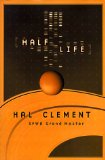
Hal Clement's "Half Life" (novel, hard sf): Looking for prelife on Titan

Cover image of the 1999 novel Half Life by Hal Clement
A story primarily about diseases & the very sick. Sound boring? It might be, in the hands of anyone but Clement. This one is, instead, a fast moving adventure & a very good read.

Story summary.

Life on earth has been failing for 2 centuries. More new diseases are springing up faster than cures can be found. And it's not restricted to humans - a lot of (all?) earth-life seems to be affected. Human population is far below its twentieth century levels, & pretty much everyone is badly sick.

In an ultimately disparate move, a project is launched to understand pre-life: "Fill the information gaps between the mineral & biological worlds." To this end, a group of 50 individuals is sent to Titan - almost certainly a one way trip since most are terminally sick, as is much of the general population. It's hoped that Titan might harbor the beginnings of life, & we just might figure something about the chemical basis of life to have hope in future.

Of the 50 adventurers, less than 2 dozen will survive till their station in orbit around Titan is set up. A few more will die through the story.

Most of the story is the various individuals' adventures on Titan, a good part dealing with not uncommon local surface structures that are clearly not alive but that can sense "food" (in some sense), can slowly move towards it, & eventually "consume" it. By the end of the story, the group will have a promising hypothesis for future research that just might hold hope for the mankind's future...

Notes.

  1. "An earlier version of Half Life was originally published in four installments in the fine SF magazine Harsh Mistress/Absolute Magnitude in 1994 and 1995".

See also.

  1. Arthur Clarke's "Before Eden": Discovery of a far more advanced but still prelife in high altitudes of Venus.

Fact sheet.

First published: 1999.
Buy from Amazon.com.
Rating: A.
Related: Stories of Hal Clement (annotated selection of some of his good stories).

Wednesday, August 11, 2010

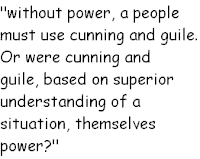
Derrick Bell's "The Space Traders" (novelette, racism, free): US sells its black citizens to aliens!

Quote from short story The Space Traders by Derrick Bell
This appears to be a very famous story, though I'd not heard of it so far.

While I cannot read it with the meaning it will have for US readers, because of background differences, I do see some parallels with caste politics in India.

Story summary.

On 1 January 2000, US government gets an offer from aliens: sell us your black citizens! Offer is good for 15 days, & aliens are willing to pay enormous sums of money.

Resulting public debate provides much of the content of the story.

Fact sheet.

First published: Derrick Bell's "Faces at the Bottom of the Well: The Permanence of Racism" (collection) (1992).
Download full text. [via Torque Control]
Rating: B.
Related: Fiction on racism.

Sunday, June 20, 2010

William Tenn's "The Ghost Standard" (short story, farce): Defining what is "human"

This is probably the last published story of Tenn.

Story summary.

This is set as legal dilemma resulting from a case of cannibalism aboard a lifeboat: Juan Kydd, a human, & Tuezuzim, "a sapient lobstermorph" alien, both equally skilled computer programmers, are stranded on a lifeboat after a deep space shipwreck. Without food. Only one of them can survive to rescue by eating the other.

To decide, they play the word game "Ghost", with ship's computer acting as referee & executor. Juan wins, & during trial later, the galactic legalese gets a new definition of when an intelligence - alien, machine, whatever - is legally "human": "Intelligence has always been extremely difficult to define precisely, but it will be here & henceforth understood to involve the capacity to understand & play the terrestrial game of Ghost."

See also.

  1. Arthur Clarke's "Breaking Strain": Meteor hit has drained most oxygen off a spaceship, so only one of its two passengers (or is it 2 of 3?) can survive to rescue. Who is to die?

Fact sheet.

First published: Playboy, December 1994.
Rating: B.
Related: Stories of William Tenn.

Saturday, April 3, 2010

Tony Daniel's "A Dry, Quiet War" (novelette, time travel, free)

Basically a simple story. Some war deserters are terrorizing a town. A real war hero, originally from the town, returns. He watches their terror quietly, disinterestedly ... till they go after his girl. Of course, the goons stand no chance against the hero.

But the story is told in an utterly contrived way. Enormous amount of meaningless jargon. Town in question is a human colony in some world away from Sol. War in question is the one fought at the end of time billions of years hence, & the actors involved were not only from different galaxies but from different dimensions as well!

Collected in.

  1. Gardner Dozois (Ed)'s "Best of the Best: 20 Years of the Year's Best Science Fiction".

Fact sheet.

First published: Asimov's, June 1996.
Download full text from Infinity Plus.
Rating: B.

Wednesday, January 20, 2010

Marc Laidlaw's "Dankden" (novelette, fantasy, racism, free)

A swampy town called Dankden, peopled by amphibians called "phibs". Humans come, hunting phibs for their hides. Overtime, there is a group of half-breeds too - partly human, partly phib. And some humans hunt the half-breeds' children too. So we have a conflict, eventually resulting in division among humans & burning of a half-breeds' township.

Not exactly my kind of story, but not boring either.

Fact sheet.

First published: F&SF, October/November 1995.
Download full text from publisher's site (I think this link won't work after a month or so).
Rating: B.
Related: Stories about racism.

Sunday, November 8, 2009

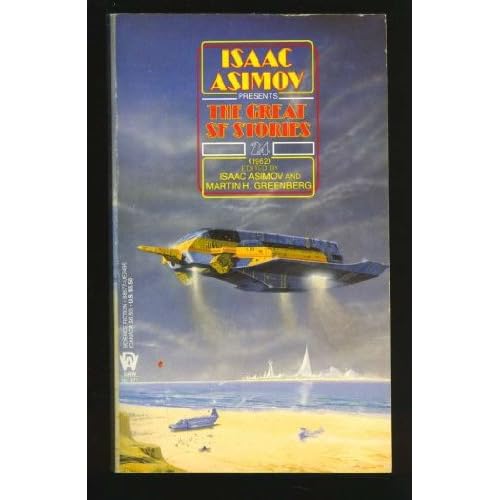
Isaac Asimov & Martin H Greenberg (Eds)' "Isaac Asimov Presents the Great SF Stories 24 (1962)" (anthology): Annotated table of contents & review

Cover image of anthology titled Isaac Asimov Presents the Great SF Stories 24 1962, edited by Isaac Asimov and Martin H GreenbergThis is #24 of a series of 25 anthologies by these editors. This book collects stories first published during the year 1962.

Where I'm aware of online copies, I provide download links. My rating is in brackets. Where I've a separate post on a the story, link on story title goes there. Link on author or publisher yields more of stories from the source.

Table of contents (13 stories, best first, unread last).

  1. [novelette] James White's "Christmas Treason" (A); F&SF, January 1962; humor: When little kids brought about global nuclear disarmament!
  2. [ss] Harry Harrison's "The Streets of Ashkelon" aka "An Alien Agony" (A); download; New Worlds Science Fiction, September 1962; religion: Religion creates sinners!
  3. [ss] Christopher Anvil's "Gadget vs Trend" (A); download; Analog, October 1962: Little Brother gets a weapon to fight the Big Brother.
  4. [novelette] Cordwainer Smith's "The Ballad of Lost C'Mell" (B); Galaxy, October 1962; politics: This society's underprivileged are fighting for civil liberties.

    It's been a while since I read it. I've a feeling US readers might see more here than I could see. Probably inspired by some episodes of US history - I'm not sure.
  5. [ss] J G Ballard's "The Insane Ones"; Amazing Stories, January 1962: Not read.
  6. [ss] R A Lafferty's "Seven-Day Terror"; If, March 1962: Not read.
  7. [novelette] Poul Anderson's "Kings Who Die"; If, March 1962: Not read.
  8. [ss] Fritz Leiber's "The Man Who Made Friends with Electricity"; F&SF, March 1962: Not read.
  9. [ss] Mark Clifton's "Hang Head, Vandal!"; Amazing Stories, April 1962: Not read.
  10. [novella] Theodore L Thomas' "The Weather Man"; Analog, June 1962: Not read.
  11. [ss] Mack Reynolds' "Earthlings Go Home!"; Rogue, August 1962: Not read.
  12. [novella] Theodore Sturgeon's "When You Care, When You Love"; F&SF, September 1962: Not read.
  13. [novelette] Gordon R Dickson's "Roofs of Silver"; F&SF, December 1962: Not read.

Fact sheet.

First published: 1992 (DAW).
Relevant entries have been added to the list of stories from John Campbell's Astounding/Analog.
Some of the bibliographical information here comes from ISFDB.
Legend: ss = short story.

Monday, July 13, 2009

Kurt Vonnegut, Jr's "Next Door" (flash fiction, free): Sometimes, "being helpful" is extremely inadvisable!

8 year old Paul was home alone, & extremely agitated by loud domestic quarrel next door. So he called up DJ on radio show currently on in quarreling home, with a message from man next door to his wife requesting patch up.

Only the quarrel next door wasn't just between man & wife, & the dedication on radio had an extremely unpleasant consequence...

Fact sheet.

First published: 1991. Where?
Rating: A.
Read full text at Scribd.
David Cooperman has a play adapted from this story & with the same title. Limited preview of play is available at Google Books.
Andrew Silver has done a 24 minute movie adaptation with the same title. Sample (but not whole video) available here.
BBC seems to have done a radio adaptation of the story too. But this doesn't appear to be online.
Related: Stories of Kurt Vonnegut.

Saturday, May 2, 2009

Free fiction: J G Ballard's "The Dying Fall" (ss)

At The Guardian/UK. From Interzone, April 1996 issue.

[via Ansible, May 2009]

Monday, March 30, 2009

Anil Aggarwal's "The Mystery of the Dead Infant" (short story, recessive genes, free): Was the newborn murdered, or was he stillborn?

A little unnamed town somewhere in lower Himalayas in India. A woman gives birth in a local hospital, & passes out. Outside the delivery room, her husband & father hear the infant's first cry.

Circumstances conspire to leave the newborn alone in the room for 5 minutes during the first 15 minutes of his life - at the end of which, he's found dead. Doctor & nurse on duty claim the boy was stillborn.

During those 5 minutes, there was a man around the delivery room who had a motive for murder. He's arrested, particularly because autopsy finds signs of strangulation around the baby's neck & the signs that the child did breath at least once after being born.

Accused claims innocence & moves mountains to ensure that there is a second autopsy. This is the story of the second autopsy & what it uncovers.

Caution: Story includes bits about human biology & related infodumps.

Fact sheet.

First published: ? Probably sometime in 1990s. Where?
Rating: B.
Download full text from author's site.
Related: Stories of Anil Aggarwal.

Monday, February 16, 2009

Free Fiction: Christopher Anvil

These are 2 or 3 months old links that were lost in my bookmarks.

Via Free SF Reader: 4 stories from Christopher Anvil's collection "The Trouble with Humans" (ed Eric Flint) at Webscription:

  1. "We From Arcturus"; download; Worlds of Tomorrow, August 1964.
  2. "The Underhandler"; download; Analog, November 1990.
  3. "Duel to the Death"; download; Analog, June 1965.
  4. "Shotgun Wedding"; download; Astounding, March 1960.

Saturday, February 14, 2009

Free fiction: Isaac Asimov, Cordwainer Smith, Geoffrey Landis

These are 2 or 3 months old links that were lost in my bookmarks.

Via Free Speculative Fiction Online: 2 stories from Gregory Benford (Ed)'s "The New Hugo Winners-Volume IV" at Webscription:

  1. Geoffrey A Landis' "A Walk In The Sun"; download.
  2. Isaac Asimov's "Gold"; download; Analog, September 1991
Two stories from Cordwainer Smith's collection "We the Underpeople" (ed Hank Davis) at Webscription:
  1. "The Dead Lady of Clown Town"; download; Galaxy, August 1964
  2. "Under Old Earth"; download; Galaxy, February 1966.

Sunday, February 8, 2009

Anil Aggarwal's "The Mystery of the Burnt Bride" (short story, environment, free): Could air pollution be affecting human evolution?

A much better variation of author's "The Mystery of the Drowned Man".

Some years back, there were two events in India that attracted a lot of media attention:

  1. A series of murders - mostly in the North - of young recently married women. Suspects were in-laws. Cause - dowry. And with similar methods of killing - a staged fire accident in kitchen. Over the years, I've sometimes heard of convictions, but they inevitably get less media attention than gruesome murders.
  2. Some citizen groups in Delhi took the government to courts over the quality of air in the city. I doubt Delhi still has great air quality, but virtually all (half-hearted) air quality norms of municipal corporations in India happened after this. Or such is the impression I'm carrying.
I don't recall the dates of the two events, but I've a feeling both must have been current events at the time this story was written - which would place them sometime in mid-1990s. Both have influenced the plot.

Story makes a reference to a law that in certain crimes, it's accused who has to show innocence in court rather than prosecution proving his guilt. I'm no lawyer, but I think the author is extending imagination here. Even the anti-terror laws discussed in parliament in the wake of Bombay terror attacks in November 2008 threw out proposals that would have placed the onus of proving innocence on accused; it's always prosecution's job. Of course, there are cases where cops are biased.

Story summary.

Sarita, a recently married woman, has died in a fire accident in kitchen at home, & the police officer has formed the opinion that it's a dowry murder.

Doctor doing the postmortem (narrator) has to find out weather she was dead at the time she came into contact with fire - which will be conclusive proof of murder. Or if she was still alive at the time, which kind of leaves the possibility of a genuine accident open.

Normally a straight-forward autopsy procedure, some events complicate it. But result is a new medical discovery - the dead woman was carrying a genetic mutation that made her better cope with carbon monoxide pollution in the air.

Fact sheet.

First published: Spandan, 1996-97.
Rating: A.
Download full text from author's website.
Related: Stories of Anil Aggarwal.

Tuesday, January 13, 2009

Anil Aggarwal's "The Mystery of the Drowned Man" (short story, free): Biological basis of drug addiction

Quote from short story titled The Mystery of the Drowned Man by Anil AggarwalThis is as original as most of Anil's fiction, but is probably his longest story I've seen so far (most of his work appears to be flash fiction length). It also has a lot of info dumping. Read it for the idea rather than entertainment.

Government propaganda tells us that drug addiction is a bad, in fact criminal, thing. What if people differ sufficiently in their metabolism that what is poison to one is sugar to another? That's the basic idea of this story.

Story summary.

There was "some rather dubious evidence that Ramlal had been killed by Jagga and then thrown in the Indian Ocean, off the coast of Gujrat." It's also known that he was a drug addict & might have drowned. How to prove if he was killed & then thrown into ocean, or entered water on his own & drowned?

This is the story of doctors piecing together the evidence from postmortem, & finding something new about human biology.

Fact sheet.

First published: Spandan, 1995-96.
Rating: B.
Download full text from author's website.

Friday, December 19, 2008

Richard Stallman's "The Right to Read" (flash fiction, copyrights, free)

Quote from short story titled The Right to Read by Richard StallmanScience fiction can be found in mmm... unexpected places. Yes, the author is the Richard Stallman, man behind GNU. And don't even try guessing the place of original publication - Communications of the ACM!!

This is an activists' story - the kind that now-a-days is associated with Cory Doctorow. A copyright dystopia where each reading of an ebook on a computer may requires a small payment, & only pre-authenticated people can read it!

Story is of the dilemma of Dan Halbert, a university student, who needs to respond to his girlfriend's request to lend her his computer because hers has broken down.

Fact sheet.

First published: Communications of the ACM, Volume 40, No 2 (February 1997).
Rating: A.
Download full text from GNU. [via Swapnil Bhartiya at indiansciencefiction Yahoo group]
Related: Stories dealing with copyrights & patents.

Monday, December 8, 2008

Isaac Asimov's "Gold" (novelette, free): Asimov's own fanfic!

This story is actually about two other stories: William Shakespeare's play "King Lear", & Asimov's own novel "The Gods Themselves". About half the text devoted to each. Jonas Willard is the director filming them (makes "compu-drama" - some sort of computer animation). An author named Gregory Laborian fills in the role of Asimov.

Reader's familiarity with those stories will likely affect reaction.

I'd not read "King Lear"; found this part boring.

While "The Gods Themselves" is among the better novels of Asimov, it's an unusual one. I'd read it years ago, & found this part the story easy to follow. Not boring, but not great either.

Fact sheet.

First published: Analog, September 1991.
Rating: B.
Download full text from Webscription. [via Free Speculative Fiction Online & Best Science Fiction Stories].
Winner of Hugo Award 1992 in novelette category.

Related.

  1. Stories/feed of Asimov.
  2. Stories/feed of Analog/Astounding.
  3. Hugo Award winning stories/feed.

Sunday, November 9, 2008

Anil Aggarwal's "The New Antibiotic" (flash fiction, weird physics, free): Don't flip! (when transporting goods through fourth dimension)

Neat story concept based on a familiar trope, but with hand-wavy astronomy & very ordinary story telling.

Idea is: a familiar object moves through fourth dimension, but gets flipped before returning back to 3D space - so it's now a sort of "mirror image" of its original self! In Arthur Clarke's "Technical Error", a man gets flipped, & can no longer eat normal unflipped food! Here it's the other way round - a drug transported through 4D space got flipped, & the mirror image that came out is no longer effective!

Cool thing I liked was: if transport via fourth dimension is popular, you need one more label for goods transported - "Don't flip" - like "This side up" currently used on many packages!

Fact sheet.

First published: In Hindi as "Black Hole ke us paar" in Aaj newspaper, 3 February 1996. English translation is probably by author himself.
Rating: B
Download full text of English translation from Author's site.

Wednesday, November 5, 2008

Larry Niven's "The Color of Sunfire" (short story, space opera, free): Location & physical characteristics of puppeteer home world, before they moved

This one is for those already familiar with Niven's Known Space universe; others will probably find it too jargon filled. And it's an unusual space opera - entire tale told inside someone's drawing room (on the world called "Silvereyes"), recounting events that happened 40 years ago!

It's the story of Richard Harvey Schultz-Mann - the man who found out the location of puppeteers' home world, & intended to blackmail them by exposing its location. Only Mann's luck ran out. Puppeteers have learned of galactic core explosion, & have taken their world elsewhere.

I suppose that places it before Ringworld; if I recall correctly, it was at their new location that they saw evidence of Ringworld.

Some curious "facts" about this original puppeteer home world:

  1. It's located in the system of a red giant that "probably was a yellow dwarf a million or two years ago." That's why they could have "walked in Earth's gravity, breathed terrestrial air, and never wore protective clothing against the ultraviolet waves in sunlight."
  2. While their sun was still a yellow dwarf, they'd moved their world far out to extreme colder regions - "two light-weeks out from its primary. The sun was no more than a blurred pink dot." Because of their enormous population & high per-capita energy consumption, their world needed to efficiently radiate heat!!

    Because of this movement out, "When the sun blew up like a big red balloon, the chances are they hardly noticed."

    I didn't quite gather why all this energy didn't cook them. Mann's description: "way it blazed against the stars. Not like a planet. The continents flamed like yellow-star sunlight. I could have read a book in the light that came through my windows" in the ship. In Ringworld, even humans visit their world without being inconvenienced.

Fact sheet.

First published: Larry Niven's "Bridging the Galaxies" (November 1993). "This is the Guest of Honor book for ConFrancisco. "
Rating: B
Download full text.
Related: All stories of Larry Niven.

Wednesday, June 11, 2008

Terry Bisson's "They're Made Out of Meat" (flash fiction, science fiction, humor, free): Reason these aliens won't contact humans

In this much milder & humorous variant of Arthur Clarke's "Crusade", an alien survey ship has chosen to simply not make a record of humanity's existence because they find the idea of meat-based intelligence disgusting!

Rusty has saved me trouble of writing anymore; his post on it is detailed enough.

Fact sheet.

First published: Omni, April 1991.
Rating: A
Download full text.
Nebula Award 1991 nominee in short story category.

Friday, May 23, 2008

Ted Chiang's "Tower of Babylon" (novelette, science fiction): Knocking at the doors of God's abode!

Quote from short story titled Tower of Babylon by Ted ChiangAmong the best of Chiang. First half is hard sf; second half is a curious mix of hard sf & a view of the universe several thousands of years old - so I guess you could call it fantasy too.

Story is set in Babylon, several thousand years ago; hence uses technology of that era.

View of the universe in the story is: Heaven is a physical structure in the sky. Heavenly bodies like moon, Sun, & stars move about the sky - each at its own level. As you go up towards heaven, you first pass the level of moon, then of Sun (at this level, Sun's "heat was enough to roast barley"), then of stars ("They were not all set at the same height, but instead occupied the next few leagues above"). Above the level of Sun, you see the Sun shining on you from below rather than above! And lower parts of the structure that is heaven has massive water reservoirs from which the rains come.

It's useful to know the ancient Tower of Babel story before reading this one. For those from non-Biblical faiths, here is how my ancient dead-tree Collier's Encyclopedia explains it: Once upon a time, men decided to erect a massive tower to physically reach out to heavens. This made God unhappy. He punished them by making them speak many tongues - thus confusing them & bringing the project to a halt. Since then, humans have been speaking many languages.

First half of the story has a feel somewhat like parts of Arthur Clarke's "The Fountains of Paradise". In Clarke's version, the tower ("space elevator") will make space travel cheaper; here you will enter the abode of Gods. In both versions, tower is huge - but definition of huge depends on times: Clarke's tower is more than perimeter of earth; in this story, "Were the tower to be laid down across the plain of Shinar, it would be two days' journey to walk from one end to the other."

Story summary.

Story is set in Shinar, Babylon, where the project of building the Tower has been going on for centuries, & is now pretty much done. What remains is cutting into the lower surface of heavens - which appears to be some kind of a stone - to physically enter heavens ("Yahweh's dwelling place").

Two teams of experts have been called for this cutting job: miners from Elam, & granite workers from Egypt. Story traces the experiences of Hillalum, one of the Elamite miners, as the teams go about riding up the tower & set about cutting into the floor of heavens. Hillalum will be the only person to actually enter heavens, to a surprising view.

We see the general upbeat mood in the town. Tower itself is described in meticulous detail - ground terminal, up & down ramps, method of construction, method of transporting supplies & food, brick making & providing for all the wood needed to cook bricks, camping places, villages that have grown up mid-way through the tower, agriculture at those mid-levels, crossing the levels of moon & more interestingly of Sun. While the tower itself is two days horizontal walk, vertical climb with load via ramps is a 4 month affair.

Later half concerns with cutting through the featureless stone floor of heaven, & precautions in case you end up cutting into the water reservoirs. There is elaborate engineering care taken to ensure world will not have to face a Deluge if they end up cutting the reservoir floor.

Eventually, many years of cutting later with elaborate multi-level tunnel-work in heaven's floor, they will really hit a reservoir. Planned systems work, saving earth from Deluge, but a lot of workers are trapped & die.

Hillalum is the only survivor among the trapped who will actually end up entering the heaven - in a badly battered state. And what does he find? Something very surprising - something that illuminates him on the nature of space.

Collected in.

  1. Ted Chiang's "Stories of Your Life and Others".

Fact sheet.

First published: Omni, November 1990.
Rating: A
Winner of Nebula Award 1990 in novelette category.
Nominated for Hugo Award 1991 in novelette category.
Related: All stories of Ted Chiang.
Note: Arthur Clarke's "I Remember Babylon" is completely unrelated.

Saturday, May 10, 2008

Kim Stanley Robinson's "A History of the Twentieth Century, with Illustrations" (novelette, non-genre, free): The worst that is human

Quote from short story titled A History of the Twentieth Century, with Illustrations by Kim Stanley RobinsonI should have disliked a story on this depressing a subject - wars of twentieth century, but it's gripping. May be I'll now have courage to pick up Vonnegut's "Slaughterhouse-Five".

Second half is a travelogue - an American on a drive in north England. This part is OK, but the meat is in the first half.

During the closing years of twentieth century, Frank Churchill - an author - is hired by a publisher to do a history of the century. This story is mostly about author's researches on some wars, & occasionally acts of terrorism, during the century. Horrific numbers, & some perspective. I've no idea of accuracy of data, but it did sound plausible.

One of the very few stories dealing with the horrors of war that I've actually liked.

Quotes.

  1. "common citizen at home, ecstatic in the streets at the outbreak of general war? That seemed more likely to be just another manifestation of the hatred of the other. All my problems are your fault! He and Andrea had said that to each other a lot."
  2. "Perhaps it was a simple pleasure in destruction. What is the primal response to an edifice? Knock it down. What is the primal response to a stranger? Attack him."
  3. 'on the Somme the British put a gun every twenty yards along a fourteen-mile front, and fired a million and a half shells. In April 1917 the French fired six million shells... Verdun was a "battle" that lasted ten months, and killed almost a million men.'
  4. 'The British section of the front was ninety miles long. Every day of the war, about seven thousand men along that front were killed or wounded - not in any battle in particular, but just as the result of incidental sniper fire or bombardment. It was called "wastage."
    ...
    at the end of every month or two of the Great War, the British had had a whole Vietnam Memorial's worth of dead. Every month or two, for fifty-one months.'
  5. "in a world where people still held the notion that in war armies fought armies and soldiers killed soldiers, while civilians suffered privation and perhaps got killed accidentally, but were never deliberately targeted.
    ...
    In 1939, this changed.
    ...
    Hiroshima and Nagasaki were in that sense a kind of exclamation point, at the end of a sentence which the war had been saying all along: we will kill your families at home. War is war, as Sherman said; if you want peace, surrender.
    ...
    Nagasaki was bombed three days after Hiroshima, before the Japanese had time to understand the damage and respond... Truman and his advisors did it ... to ... show Stalin that they would use the bomb even as a threat or warning only, as Nagasaki demonstrated. A Vietnam Memorial's worth of civilians in an instantaneous flash, just so Stalin would take Truman seriously."
  6. "designers of the death camps, the architects, engineers, builders. Were these functionaries less or more obscene than the mad doctors, the sadistic guards?"
  7. "At first 1989 had looked like a break away from that. But now, just seven years later, the Cold War losers all looked like Germany in 1922, their money worthless, their shelves empty".
  8. 'Japanese concentration camps in Manchuria had killed as many Chinese as the Germans had killed Jews. These deaths included thousands in the style of Mengele and the Nazi doctors, caused by "scientific" medical torture.'
  9. "motivations would be stronger than ever; with populations rising and resources depleted, people were going to be fighting not to rule, but to survive. Some little country threatened with defeat could unleash an epidemic against its rival and accidentally kill off a continent, or everyone, it was entirely possible. The twenty-first century might make the twentieth look like nothing at all."

Fact sheet.

First published: Asimov's Science Fiction, April 1991.
Rating: A
Download full text (via Free SF Reader).

Friday, May 2, 2008

* David Brin's "What Continues, What Fails..." (short story, science fiction)

Rather muddled story with a lot of jargon about black holes. A pair of women researchers of far future have figured a way of looking inside a black hole, & have seen a separate universe there! Plus a parallel track of one of the pair bearing a child (clone in her own womb) - highly wanted because her "tenaciousness" genes are in high demand. Plus description of the many wonders of this far future.

Collected in.

  1. David Hartwell & Kathryn Cramer (Ed)'s "The Ascent of Wonder: The Evolution of Hard SF".

Fact sheet.

First published: Interzone, December 1991.
Rating: C

Note: Why is this post so short?

Thursday, May 1, 2008

* Gregory Benford's "The Voice" (short story)

Dark story about a future society where people have forgotten reading, writing, & books, & access all information via the Voice, a wireless audio interface to an all-knowing AI. Cops go after any foolish enough to rediscover the art of reading; their brains are forcibly treated so they forget their reading habits! Looks like the controlling AI is hiding something or have a design of its own, but we don't know for sure till end - where the protagonist's brain gets the treatment.

Collected in.

  1. David Hartwell (Ed)'s "Year's Best SF 3" (1998).

Fact sheet.

First published: Science Fiction Age, May 1997.
Rating: B

Note: Why is this post so short?

Saturday, April 26, 2008

Ted Chiang's "Division by Zero" (short story, non-genre): Tale of an extreme obsession

This story is divided into 9 parts, all except last into 3 subparts (opener, a & b).

Opener is mathematical wisdom - like Godel's Theorem. It uses factual language in all nine parts, but I'm not really sure it's talking facts - I wasn't paying attention to these subparts. If they are related in any way to the story, I could not see the relation - except that the woman at the heart of the story is a mathematician.

This is the story of Renee & her husband Carl. "a" subpart are from Renee's perspective; "b" from Carl's. And it was an uninteresting story, at least to me.

Renee was a great mathematician, now past her professional prime. Her latest discovery is that arithmetic is "inconsistent" - any number can be proved to be equal to any other! Showing her proof to colleagues doesn't help; no one is able to find a flaw.

This inconsistent arithmetic discovery shatters her balance, & she ends up in a mental asylum.

Just after she gets out of asylum, Carl has discovered that he only feels a sense of duty towards her - he can no longer see the woman he married. So the marriage is headed towards breakup.

Full text of this story is available for download.

Collected in.

  1. Ted Chiang's "Stories of Your Life and Others".

Fact sheet.

First published: Lou Aronica, Amy Stout & Betsy Mitchell (Eds)' "Full Spectrum 3", 1991.
Rating: C
Related: All stories of Ted Chiang.

Monday, December 17, 2007

Bruce Sterling's "Homo Sapiens Declared Extinct": AIs have taken over from humans!

Another hopeless dystopic story on why AIs are so much superior to wetware. In this story, humans go extinct in 2380 AD. And are not missed by AIs that have taken over & that behave remarkably like normal humans.

Full text of the story is available online.

Fact sheet.

"Homo Sapiens Declared Extinct", short story, review
First published: Nature magazine, 11 November 1999.
Rating: C

Friday, December 14, 2007

David Hartwell & Kathryn Cramer (Ed)'s "The Ascent of Wonder: The Evolution of Hard SF": Annotated table of contents & review

ToC below lists only the stories (not essays) included in the book - 67 in all.

A note on editors' choice.

Editors' definition of "hard sf" is rather liberal. Not only will I not call some stories merely science fiction, there are ones that are clear fantasies! I am aware different individuals define this differently - so take even my classifications with a punch of salt. I tag stories as "science fiction", "hard science fiction", "fantasy", & "non-genre".

Table of contents (67 stories, best first, unread last).

Where I'm aware of an online copy, I provide download links. Links on author, editor, publisher, or year fetch more matching fiction. Where I've a separate post on a story, link on story title goes there. My rating (ABC; A => worth the time, C => don't bother) is in brackets.
  1. Tom Godwin's "The Cold Equations" (A); download text or MP3; Astounding, August 1954; science fiction: Officially, the story makes the point that the nature's laws have no concern for human rules or values. Reading the story feels like it's a tragedy brought about by uncaring human administration. Intensely emotional.
  2. Henry Kuttner & C L Moore's "Mimsy Were the Borogoves" (A); download HTML, or read online at scribd; Astounding, February 1943; science fiction: This story was originally published under the pseudonym Lewis Padgett - joint pseudonym of spouses Henry Kuttner and C L Moore. Cognitive processes impossible to human adults can be taught to very young children.
  3. Edgar Allan Poe's "A Descent into the Maelström" (A); download; Graham's Lady's & Gentleman's Magazine, May 1841; hard science fiction: A man survives by staying cool in the face of nightmare. Arthur Clarke's "Maelstrom II" is a sort of space age sequel to this original by Poe.
  4. James P Hogan's "Making Light" (A); Judy-Lynn del Rey (Ed)'s "Stellar #7: Science Fiction Stories", August, 1981; fantasy, humor: GOD's problems dealing with heavenly bureaucracy!
  5. Isaac Asimov's "The Last Question" (A); download; Science Fiction Quarterly, November, 1956; science fiction: An AI is given a rather fundamental problem - figure out a way to reverse entropy without expanding energy! Very entertaining.
  6. Arthur Clarke's "The Star" aka "Star of Bethlehem" (A); download text/MP3; Infinity Science Fiction, November 1955; science fiction: Humans discover alien artifacts on an extra-Sol world.
  7. Nathaniel Hawthorne's "Rappaccini's Daughter" (A); United States Magazine & Democratic Review, December 1844; also included in the collection "Mosses from an Old Manse and other stories" - download collection; fantasy: A western adaptation of Indian folk tale of "vish kanya" ("poisonous girl"). Very well told, but with tragic ending.
  8. James Blish's "Surface Tension" aka "Lavon" (A); download MP3; Galaxy, August, 1952; science fiction: When a stellar colonization ship crashed on an uninhabitable water world with no chance of anyone surviving more than a few weeks, the colonists do the next best thing - create microscopic water-borne life forms adapted to local world that are essentially human! Now these microscopic "men" are ready to discover who their ancestors were.
  9. Philip K Dick's "The Indefatigable Frog" (A); Fantastic Story Magazine, July 1953; hard science fiction, humor: A parody of the ancient "Dichotomy paradox" of Zeno.
  10. H G Wells' "The Land Ironclads" (A); download; The Strand, December 1903; hard science fiction: Very readable description of battle that is evenly matched - till one side produces a super-weapon. The super-weapon is a tank-like device - but in a battle that otherwise uses horses & cyclists.
  11. Jules Verne & Michel Verne's "In the Year 2889" (A); download; The Forum, February 1889; science fiction: Description of a day in the life of a rich man 1000 years from the date of story's publication. Many predictions of this future history are already common place.
  12. [novelette] C M Kornbluth's "Gomez" (A); C M Kornbluth's "The Explorers" (1954) (coll); humor: An alternate version of the tale of Shrinivasa Ramanujan.
  13. [ss] Bob Shaw's "Light of Other Days" aka "Slow Glass" (A); download; my url; Analog, August 1966; science fiction: A glass that slows down light so much it takes years to pass through! Leave a newly made glass next to a lake for a year; then install it on your window in a city - & you get to see real lake scene for a year. And not a static one - everything that happened there over the year will be replayed, before you see your local surroundings.
  14. Arthur Clarke's "Transit of Earth" (A); Playboy, January 1971; hard science fiction: A man watches the transit of earth & moon across the disk of sun from the surface of mars. As the last act of his life.
  15. Larry Niven's "The Hole Man" (B); Analog, January 1974; science fiction: A space age take on ancient children's story of naughty monkey - poking your nose at certain places can be harmful! Humans have found a gravitational wave generator on Mars of alien origin, abandoned for eons. At its heart is a "quantum black hole" - device vibrates it to generate gravity waves. Careless poking around has released it into the mars' interior - mars will soon be a black hole!
  16. Robert Heinlein's "It's Great to Be Back" (B); The Saturday Evening Post, 26 July 1947; hard science fiction: A couple discovers that home is where the heart is.
  17. Gordon R Dickson's "Dolphin's Way" (B); Analog, June 1964; science fiction: Main theme is - communications with aliens are likely to be far tougher than assumed, because we live in different environments, & environments affect the kind of signals we exchange. In a less important thread, a human is disappointed after first contact with aliens, because aliens have chosen dolphins over humans as the species they want to communicate with.
  18. Anne McCaffrey's "Weyr Search" (B); Analog, October 1967; fantasy: Description of human society on an extra-Sol world that has lost contact with mother world, & has fallen to barbarism. Quite readable. If you are into dragons, feudal lords, & some magic, you will probably enjoy it more than I did.
  19. James Blish's "Beep" (B); Galaxy, February 1954; science fiction: Rather complicated story about a future viewing device, & how benign security agencies wield it for the good of the society. The only saving grace is readable language; I found the plot uninteresting, though it is revealed after a lot of suspense.
  20. Rudyard Kipling's "With the Night Mail" (B); McClure's, November 1905; hard science fiction: This story is also included in Kipling's collection "Actions and Reactions"; download collection. Description of a perilous trans-atlantic journey in a kind of aircraft. Most interesting part of the story is the various aircraft accessory ads that appear after the main story ends.
  21. Clifford D Simak's "Desertion" (B); Astounding, November 1944; science fiction: A rather imaginative story. Humans have research setup on the hard "surface" deep inside Jupiter! They live in domes. To move around, they must transform their physique to become suitable. A machine can take an earth animal & produce a Jovian life form, & vice versa!! But each time a human is sent to explore Jupiter in the open using this method, he vanishes! After several incidents, the man in charge decides to go himself with his dog. Of course, he will also desert; living the Jovian way is so much more interesting than living in a human or dog body!
  22. Alfred Bester's "The Pi Man" (B); F&SF, October 1959: Circadian rhythms may not be the only way cosmic radiation affects us - at least some of us!
  23. Ian Watson's "The Very Slow Time Machine" (B); Christopher Priest (Ed)'s "Anticipations" (1978): It's been a while since I read it. If I recall correctly, a time machine has arrived in a current lab with a single passanger who can be talked to via written placards via machine's window but not verbally, & his responses are so slow it takes generations of humans to get meningful information. We eventually learn that the visitor is god, ... or something.
  24. Edward Bryant's "giANTS" (C); Analog, August 1979; science fiction: To protect US from army ants advancing from south, a man has devised a chemical that will turn each ant into a horse-sized giant - so gravity will kill them! Never mind if the world will have space to hold all these horse-sized ants.
  25. Frederik Pohl's "Day Million" (C); download audio as part of a larger package; Rogue, February/March 1966; science fiction: Sort of early cyberpunk. In distant starfaring future, humans have genetically tweaked themselves so much, they don't quite look familiar. We see the "marriage" of a mermaid human to a starfarer male human - marriage is the only time they ever meet, & the ceremony is essentially an exchange of their simulation data - then each goes its own separate way, never to meet again. Whenever you want the company of another, you just interface with a machine & load the partner's data - experience all you can together, including sex! Of course, you will usually have married many times - so you have many partners' data!
  26. Kate Wilhelm's "The Planners" (C); Damon Knight (Ed)'s "Orbit 3" (1968); science fiction: I didn't quite get the point of this story. Human experimenters have been raising colonies of monkeys & apes in an effort to make them smarter. They've figured out a way to extract some substance from a smart animal's body & inject into the dumb one - so dumb one will become smarter! There is a separate thread of curing a mentally deficient human child. And tangents about protagonist's family problems.
  27. Greg Bear's "Tangents" (C); Omni, January 1986; science fiction: A very gifted boy, under tutelage of mathematician dealing in multi-dimensional space can see in the forth dimension! He sees creatures & life there. Rigs up a musical instrument to attract their attention. The two will eventually go with them traveling in 4D space - off our limited 3D space!
  28. David Brin's "What Continues, What Fails..." (C); Interzone, December 1991; science fiction: Rather muddled story with a lot of jargon about black holes. A pair of women researchers of far future have figured a way of looking inside a black hole, & have seen a separate universe there! Plus a parallel track of one of the pair bearing a child (clone in her own womb) - highly wanted because her "tenaciousness" genes are in high demand. Plus description of the many wonders of this far future.
  29. William Gibson's "Johnny Mnemonic" aka "Molly Millions" (C); download; Omni, May 1981; science fiction: A criminal gang is out to get a man. Jargon filled, in ghetto settings, & utterly unreadable. Downloadable version contains a lot of spelling errors.
  30. Arthur Clarke's "The Longest Science-Fiction Story Ever Told" aka "A Recursion in Metastories" (C); Galaxy, October 1966; non-genre: A recursive rejection letter from an editor to an author. I actually am wondering about the editors' rationale for including this story!
  31. Isaac Asimov's "Waterclap"; If, Apr 1970: I'd read it rather long back to recall many details of the plot. An experimental human habitat at the bottom of ocean, & someone's attempt to sabotage it. Title refers to the name given to sound of water rushing in when the airlock is opened to allow interior flooding.
  32. Isaac Asimov's "The Life and Times of Multivac"; The New York Times, Jan 1975: I read it so long back, I don't recall any details.
  33. Cordwainer Smith's "No, No, Not Rogov!"; download; If, February 1959: It's been a while since I read it. If I recall correctly (but am not sure), it's about a Russian scientist developing some sort of weapon who ends up tuning to a music program from future.
  34. Ursula K Le Guin's "Nine Lives"; originally Playboy, November 1969; this revised version is from Donald Wollheim & Terry Carr (Ed)'s "World's Best Science Fiction: 1970": not read.
  35. Hal Clement's "Proof"; Astounding, June 1942: not read.
  36. Gene Wolfe's "Procreation"; Ellen Datlow (Ed)s "The Omni Book of Science Fiction #4" (1985): not read.
  37. Raymond Z Gallun's "Davy Jones' Ambassador"; Astounding December 1935: not read.
  38. Robert L Forward's "The Singing Diamond"; Omni, February 1979: not read.
  39. Dean Ing's "Down & Out on Ellfive Prime"; Omni, March 1979: not read.
  40. Hilbert Schenck's "Send Me a Kiss by Wire"; F&SF, April 1985: not read.
  41. Philip Latham's "The Xi Effect"; Astounding, January 1950: not read.
  42. Gregory Benford's "Exposures"; IASFM, 6 Jul 1981: not read.
  43. Richard Grant's "Drode's Equations"; Marta Randall & Robert Silverberg (Ed)'s "New Dimensions 12" (1981): not read.
  44. Theodore L Thomas' "The Weather Man"; Analog, June 1962: not read.
  45. J G Ballard's "Prima Belladonna" aka "Vermillion Sands"; Science-Fantasy #20, 1956: not read.
  46. Donald M Kingsbury's "To Bring in the Steel"; Analog, July 1978: not read.
  47. Rudy Rucker's 'Message Found in a Copy of "Flatland"'; The 57th Franz Kafka (1983) (Is it a collection?): not read.
  48. John W Campbell, Jr's "Atomic Power" (as by Don A Stuart); Astounding, December 1934: Note the author is John W Campbell, writing under a pseudonym. Not read.
  49. John T Sladek's "Stop Evolution in Its Tracks"; Interzone #26, 1988: not read.
  50. Miles J Breuer's "The Hungry Guinea Pig"; Amazing, January 1930: not read.
  51. Bruce Sterling's "The Beautiful & the Sublime"; IASFM, June 1986: not read.
  52. Ursula K Le Guin's "The Author of the Acacia Seeds"; Terry Carr (Ed)'s "Fellowship of the Stars" (1974): not read.
  53. John M Ford's "Heat of Fusion"; IASFM, September 1984: not read.
  54. Gene Wolfe's "All the Hues of Hell"; Byron Preiss (Ed)'s "Universe" (1987): not read.
  55. Theodore Sturgeon's "Occam's Scalpel"; If, August 1971: not read.
  56. Randall Garrett's "Time Fuze"; If, March 1954: not read.
  57. Poul Anderson's "Kyrie"; Joseph Elder (Ed)'s "The Farthest Reaches" (1968): not read.
  58. Raymond F Jones' "The Person from Porlock"; Astounding, August 1947: not read.
  59. J G Ballard's "The Cage of Sand"; New Worlds, June 1962: not read.
  60. Alice Sheldon's "The Psychologist Who Wouldn't Do Awful Things to Rats" (as by James Tiptree, Jr); Robert Silverberg (Ed)'s "New Dimensions 6" (1976): not read.
  61. George Turner's "In a Petri Dish Upstairs"; Lee Harding (Ed)'s "Rooms of Paradise" (1978): not read.
  62. Gregory Benford's "Relativistic Effects"; Alan Ryan (Ed)'s "Perpetual Light" (1982): not read.
  63. John M Ford's "Chromatic Aberration": not read.
  64. Katherine MacLean's "The Snowball Effect"; Galaxy, September 1952: not read.
  65. Hilbert Schenck's "The Morphology of the Kirkham Wreck"; F&SF, September 1978: not read.
  66. Michael F Flynn's "Mammy Morgan Played the Organ, Her Daddy Beat the Drum"; Analog, November 1990: Not read. Based on my experience with Flynn's other stories, I don't think I'll bother with it.
  67. Vernor Vinge's "Bookworm, Run!"; Analog, March 1966: not read.

Fact sheet.

First published: June 1994.
Related: Works of David Hartwell, Kathryn Cramer.