Showing posts with label 1960s. Show all posts

Friday, September 27, 2013

Robert F Young's "The Servant Problem" (novelette, first contact, free): When servants thought they were masters!

Illustration by Schoenherr accompanying the original publication in Analog magazine of short story The Servant Problem by Robert F Young. Image shows the puzzled village idiot looking at his statue not know why he is a celebrity.Village idiot is also the village inventor. When he mysteriously received plans for a knot-tying machine on an April Fool's Day, he had to build that machine. And what kind of knots did it tie!

Fact sheet.

First published: Analog, November 1962.
Download full text from Project Gutenberg.
Download audio from LibriVox.
Rating: B.
Among the stories from Astounding/Analog issues edited by John Campbell.
Related: Stories of Robert F Young.

Friday, August 23, 2013

H B Fyfe's "The Wedge" (short story, first contact, free)

A sole human exploring a far away world in his scout-ship is captured by local aliens. Aliens are interested in learning about the capabilities of humans, so our hero plays a dumb animal...

Fact sheet.

First published: If, September 1960.
Download full text from Project Gutenberg, Manybooks, Feedbooks. [via Becky@ClassicScienceFiction]
Rating: B.
Related: Stories of H B Fyfe.

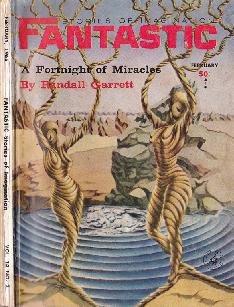
"Fantastic Stories of Imagination", February 1965 (ed Cele G Lalli) (magazine): Annotated table of contents

Cover by Heidi Coquette of Fantastic Stories of Imagination magazine, February 1965 issue, illustrating the story A Fortnight of Miracles by Randall Garrett
Another one whose download link I seem to have lost.

While I haven't read any of the stories yet, descriptions suggest these are mostly fantasy.

Table of contents.

  1. [novelet] Randall Garrett's "A Fortnight of Miracles": "It is hard on a man to have not one ... nor two ... but three vexish spells upon him. Such a man has need of a worthy mage & a goodly goblin ... & an author like this one who can get him out of black magic trouble without leaving any loose ends about."
  2. [ss] Roger Zelazny's "Passage to Dilfar": "A day & a night had Dilvish ridden to warn of the coming slaughter, for all hope now rested with Dilfar--& with the horse that carried him there."
  3. [ss] Ron Goulart's "Winterness": "When dealing with the spirit world, you can do things three ways: rarely, well-done, or medium. When a vanished judge & a buxom columnist are involved, it is perhaps better to settle for the medium."
  4. [ss] Thomas M Disch's "The Vamp": "Once you marry a Transylvanian count, things are never what they used to be. Not even a good steak."
  5. [serial - 2/2] John Brunner's "The Repairman of Cyclops".

Fact sheet.

Labeled: Vol 14 No 2.
Related: Fiction from old pulps; 1960s.

Thursday, August 1, 2013

Christopher Anvil's "Positive Feedback" (short story, humor, free): How inflation works, & a remedy

This is hilarious stuff. And while the story is about car repair rather than programming, if you are a programmer who grew up writing C code in vi & handcrafting makefiles, & lived through the transition to Visual Studio, you'll likely find bits of it very familiar.

Story summary.

A company called Superdee Equipment has invented a new "Automated Car Service Handling Machine" but is unable to sell it to garages. So the managers figure out a way to push the machines through...

Fact sheet.

First published: Analog, August 1965.
Download full text from an archived copy of what used to be Baen Free Library. [via Stephen Harker @rasfw]
Rating: A.
Among the stories from Astounding/Analog issues edited by John Campbell.
Related: Stories of Christopher Anvil.

Sunday, July 21, 2013

Murray Leinster's "Planet of Dread" (novelette, free): Adventure on a world of giant insects & fungi

One of the illustrations by Adkins accompanying the original publication in Fantastic Stories magazine of the short story Planet of Dread by Murray Leinster. Image shows adventurers fighting a giant ant on a far off world.How many variants of the excellent "The Mad Planet" (download) did Leinster pen? I know of at least two novelette or novella length sequels, plus a fix-up novel, besides the current one.

May be I've read too much of the series. It's readable & fast moving - among my faster finishes of a story of this length. But it's very pulpy & with sensibilities of a different era.

Story summary.

With mankind spanning the galaxy, a group of revolutionaries escape their world, & intend to lie low elsewhere for a while. During a port, their ship is hijacked by a local fugitive - the hero of the story who's eventually overpowered. For complicated reasons, they land of an uninhabited world to maroon the hijacker - only this world turns out to be a forgotten & unfinished terraforming job of mankind, & a nightmare world now.

They'll have adventure there, & strike treasure left by a shipwreck 150 years old, & finally all will end well.

Fact sheet.

First published: Fantastic Stories of Imagination, May 1962.
Download full text from Project Gutenberg.
Download audio read by Phil Chenevert from LibriVox. [via QuasarDragon]
Rating: B.

Saturday, June 29, 2013

Jack Sharkey's "Double or Nothing" (short story, mad scientist, humor, free)

Illustration accompanying the original publication in Fantastic Stories of Imagination magazine of short story Double or Nothing by Jack Sharkey. Image shows the two bewildered inventors bombarded with breakfast items their invention has unexpectedly produced.
This is silly. And funny.

A crazy serial inventor is onto his new invention - an anti-gravity machine.

After many bugs, the machine flies but with a crazy side effect...

Fact sheet.

First published: Fantastic Stories of Imagination, May 1962.
Download full text from Project Gutenberg. [via QuasarDragon]
Rating: B.

Monday, May 27, 2013

Free fiction: Murray Leinster's "Creatures of the Abyss" (novel, 1961)

@Internet Archive. [via Greg Weeks @pbscans]

Related: Stories of Murray Leinster.

Monday, February 25, 2013

Fred Hoyle & John Elliot's "Andromeda Breakthrough" (novel): A shadowy European trading syndicate dreams of creating another East India Company

Cover of Andromeda Breakthrough, a novel by Fred Hoyle and John Elliot.
This is a sequel to the authors' excellent novel "A for Andromeda". While this too is a fast moving adventure, it's much less interesting than original:
  1. It appears to be penned mostly by Elliot. None of Hoyle's characteristic humor, leg pulling of politicians, or a central cool idea here.
  2. It appears to be an unplanned for sequel. Characters that died or were otherwise removed at the end of the first book are resurrected, in rather questionable ways, so they can be part of this adventure.
A shadowy European multinational trading outfit ("Intel") working towards world control, an imaginary non-functional middle eastern country ("Azaran"), synthetic fast-breeding sea-based bacteria that suck up nitrogen from atmosphere leading to disastrous weather, are all part of the canvas. Plus some characters from first book, including the hero.

Intel now controls, or thinks it does, the "alien in the computer" & intends world domination via stuff the alien will invent. Hero, will, of course, save the world from them.

Fact sheet.

First published: 1965.
Rating: B.
Related: Stories of Fred Hoyle, John Elliot.

Wednesday, February 13, 2013

Fritz Leiber's "The Creature from Cleveland Depths" aka "The Lone Wolf" (novella, gadgets, free): Who could imagine mobile phones would be so evil?

One of the illustrations by Wally Wood accompanying the original publication in Galaxy magazine of short story The Creature from Cleveland Depths by Fritz Leiber. Image shows a man wearing an early version of Tickler on his shoulder.
Well, the story is from long before mobile phones were around, so the gadget (the "tickler") here looks different & works differently.

It begins as an organizer - you tell it to remind you of certain events, & it will at the right time. Reminding is by telling about the event in your ear via an in-ear headphone, plus an insistent "tickling" using two rollers mounted on your shoulder. It runs a very long (audio) magnetic tape - one run lasts a week, with buttons to forward quickly to a certain time. To set an event, you move it specific date/time next week, then speak of the event into it. After you've set the events, the device runs the tape continuously. But most of it is blank, so you don't hear anything till an event is due.

Soon improvements in upgraded versions give it a life all its own, threatening the very human existence...

Very funny early parts & ending, but I thought it was draggy in the middle as the mood begin to set for impending disaster.

Notes.

  1. "Depths" of the title has cold war linkage - "Free World" vs Soviet Union. Because of bomb scare most people live in massive underground caverns that double as bomb shelters. Only a few "outers" live on the surface.
  2. "Creature" of the title is an advanced form of the tickler gadget.

See also.

  1. L Sprague de Camp's "Alanias" (download as part of a larger package): Another story where a voice whispers propaganda into your ear without your conscious self realizing you are being manipulated.

Fact sheet.

First published: Galaxy, December 1962.
Download full text from Project Gutenberg, Manybooks, Feedbooks. [via Becky@ClassicScienceFiction]
Download audio version read by Gregg Margarite from LibriVox.
Alternate audio link at Internet Archive.
Rating: A.
Related: Stories of Fritz Leiber.

Saturday, November 17, 2012

Isaac Asimov's "Playboy and the Slime God" aka "What Is This Thing Called Love?" (short story, parody)

One of the illustrations by Summers accompany the short story Playboy and the Slime God by Isaac Asimov in Great Science Fiction from Amazing, #1. Image shows the alien coaxing the woman it has kidnapped into removing her cloths.
Skip it if the discussion of sex embarrasses you.

The moment I read the first line, I knew I'd read the story before. But it's been some years, so I read it again. And wasn't disappointed.

This is a hilarious parody of bug-eyed monsters from outer spaces coming to earth to kidnap girls to satisfy their sexual urges. Plus there is a ... sort of critique of Playboy magazine.

Story summary.

Slimy alien scientist from far off part of galaxy kidnaps a man & a woman to demonstrate to his boss that earth is a major danger to galaxy & must be destroyed. Danger because its creatures don't "bud" singly to produce the young as is the norm everywhere, but reproduce by combining genes from two separate individuals, thus significantly accelerating the evolution. Only problem is: his knowledge of human reproduction & anatomy is limited to Playboy magazine & bug-eyed monster kind of sf literature.

Hilarity ensues as the two aliens coax the man & the woman to couple & produce a child...

Notes.

From editor's introduction to this story in "Great Science Fiction from Amazing", #1:

'Several months ago a magazine named Playboy, which concentrates editorially on girls, books, girls, art, music, fashion, girls & girls, published an article about old-time science-fiction. Called "Girls for the Slime God," it was illustrated with synthetic covers of non-existent sf magazines, each replete with bug-eyed monster, mad scientist, & partially naked, nubile girl.'

'We commissioned one of sf's most sex-appealing writers to create a story especially for the insatiable Playboy, & to prove to him that sf has not forgotten that S-X is the most important thing in the Universe.'

Fact sheet.

First published: Amazing Stories, March 1961.
Rating: A.
Related: Stories of Isaac Asimov.

Thursday, October 11, 2012

Mack Reynolds' "Computer War" (novel, war): Fighting a full scale war with guerrilla tactics

Cover of the novel Computer War by Mack Reynolds
While mostly a good read, it kept putting me off because of totally illogical references: a far future world away from earth, when thousands of worlds have been colonized by man. And the only examples characters talking to each other can come up with are those someone living in US or Europe during mid-1900s might be familiar with!

Story is about an unusual war. This unnamed world has many countries, among them two big powers - Alphaland & Betastan. Former is a dictatorship with better military hardware, & it is now starting a war to conquer Betastan. Betastan refuses to fight by the rules...

Fact sheet.

First published: Analog, June/July 1967.
Among the stories from Astounding/Analog issues edited by John Campbell.
Rating: B.
Related: Stories of Mack Reynolds.

Sunday, October 7, 2012

Frank Herbert's "Dune" (novel): Life on a parched desert world

Cover of the novel Dune by Frank Herbert
This was my third attempt at reading this book. I distinctly remember that on each of the two earlier occasions, I gave up within first few dozen pages -  because I found names in the story impossible to spell! This time I had no such difficulty. Only difference between then & now is: I now have some experience reading sf; then I was new to the genre. So if you are a genre novice who discovered sf relatively late in life & cannot relate to the book everyone praises, may be try it a few years down the line. This also makes me wonder if I'll still like the stories I then loved!

While the story has a couple of scenes I found very silly (a completely unnecessary knife duel near the end, a 3-4 year old supremely endowed girl happily fighting on the battlefront of a dirty war), I generally liked the book.

While there are a lot of issues this book of epic scope deals with, one of the most memorable, if macabre, part for me was: the water is so precious & scarce on this desert world of Arrakis that a part of the funeral rituals for the dead involves extracting the water from the dead body for later community use!

There are any number of summaries of this book on the net; so I'll skip that part.

Fact sheet.

First published: (as novel) 1965.
This is a fix up novel, based on author's 2 earlier works: "Dune World" (Analog, December 1963 - February 1964 in 3 parts) & "The Prophet of Dune" (Analog, January-May 1965 in 5 parts).
Rating: A. 
Winner of Hugo Award 1966 in novel category.
Winner of Nebula Award 1965 in novel category.
Among the stories from Astounding/Analog issues edited by John Campbell.
Related: Stories of Frank Herbert.

Wednesday, August 29, 2012

Miriam Allen deFord's "The Malley System" (short story, crime)

This is a story about an unusual punishment for hardened criminals: In a world where technology exists to make me replay any desired memories of you, the jailer forces the criminal to repeatedly experience his most heinous crimes - until he gets bored to death & is driven to insanity!

Early parts of the story are descriptions of wanton murders & torture of innocents by a psycho killer.

Malley of title is the name of the "penologist" who invented this system of punishment.

See also.

  1. Pat Forde's "In Spirit": Some jailed 9/11 perpetrators are forced to experience the event from the perspectives of various victims.

Fact sheet.

First published: Harlan Ellison (ed)'s "Dangerous Visions" (1967).
Rating: B.

Thursday, August 23, 2012

Frederik Pohl's "The Day After the Day the Martians Came" (short story)

This story might make better sense to readers familiar with the US of 1960s.

Story summary.

A crowd of media personnel is assembled in a motel, in anticipation of a NASA announcement tomorrow regarding Martians brought by their Mars mission. I missed the point of the story, but the author clarifies that the existence of Martians could unite us & ease white/black tensions of US.

Fact sheet.

First published: Harlan Ellison (ed)'s "Dangerous Visions" (1967).
Download a comic book adaptation from The Bronze Age of Blogs. [via Marooned]
Rating: B.
Related: Stories of Frederik Pohl.

Wednesday, August 8, 2012

Ursula K Le Guin's "Nine Lives" (novelette): A feeling of loneliness

10-clones, 5 men & 5 women, all derived from the same man, act as a single individual, mutually dependent, but not noticing others. Even sex is within the group.

9 die in an earthquake. Story is of the survivor discovering life as an individual.

Collected in.

  1. David Hartwell & Kathryn Cramer (Ed)'s "The Ascent of Wonder: The Evolution of Hard SF".

Fact sheet.

First published: Playboy, November 1969.
Nominated for Nebula Award 1970 in novelette category.
Rating: B.
Related: Stories of Ursula K Le Guin.

Wednesday, July 25, 2012

Jack Vance's "Emphyrio" (novel, dystopia): Hero brings happy change to a dystopic society

Cover image of the novel Emphyrio by Jack Vance
While I didn't dislike it, I found it easy to put it down often. But surprising ending changed the book for me; beautiful. I think it will read much better on a reread, knowing the ending.

There are a lot of places where I could  identify with the stupidities of current India.

Story summary.

First half is a coming of age story - (Recepient) Ghyl Tarvoke growing up in an oppressive welfare state where state ensures you have minimum necessities of existence but where you can never be rich. Where duplication is an extreme offense, inviting extreme punishment (there is a moving scene when Ghyl's gentle father is killed by the state for producing multiple copies of political banners with the same text!) - state apparently thrives on the reputation elsewhere of the originality of its artisans. There is also a curious religion that involves ritualized "leaping". Then there are "lords" (elites outside of welfare state), & "noncups" (few ordinary citizens who chose to live outside the welfare state, mostly by criminal means).

Later part is a faster moving adventure where Ghyl will discover the true nature of his society, & will end up overturning the current political establishment. There is a detective story here the clues for which were all over, but I didn't see them until suddenly the story turned in a totally unexpected direction near end.

Fact sheet.

First published: 1969.
Rating: A.
Related: Stories of Jack Vance.

Saturday, June 30, 2012

Robert Silverberg's "Flies" (short story, horror, free)

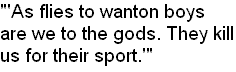
Quote from short story Flies by Robert Silverberg. Story attributes the quote to Lear by Shakespeare.
Rather well hashed theme here - vampire variants that feed not on the blood of the victim but something else. C L Moore wrote a lot of stories of the kind; others too have done their bit. Setup in early parts is strikingly similar to Arthur Clarke's "Playback".

Story summary.

Sole shipwreck survivor in outer solar system is rescued by aliens, & his damaged body regenerated. Aliens also edited his mind - turning him into a pathological killer with a mind capable of transmitting the horror of victim to aliens, thus feeding one of their needs!

We'll see some episodes of the resulting terror unleashed on earth.

Fact sheet.

First published: Harlan Ellison (ed)'s "Dangerous Visions" (1967).
Download full text.
Rating: B.
Related: Stories of Robert Silverberg.

Friday, June 29, 2012

Lester del Rey's "Evensong" (short story, Chritianity, free): God unwanted after 7 days of Creation!

Someone is being chased by men all over the galaxy - someone who once helped uplift Man from savagehood. He is finally cornered by a man in a walled garden on earth. And the being cornered is...

Fact sheet.

First published: Harlan Ellison (ed)'s "Dangerous Visions" (1967).
Download full text from hermiene.net.
Rating: B.
Related: Stories of Lester del Rey.

Monday, June 11, 2012

Norman Spinrad's "Outward Bound" (novelette, free)

This is a classic "technology as an enabler of freedom" story: government is hell bent to bury a newly developing technology because it cuts into some of its power - think decade old debates & controls on encryption, e.g.

In the story, it's the "Overdrive" - an FTL drive. Earth has a kingdom spanning a few stars, maintained with slower than light ships. These outworlds are always behind earth in technology because ships bringing them earth's information take decades or centuries. (Why don't the outworlds develop their own tech?)

Now someone is onto a theory that can lead to FTL, ending earth's hegemony. So earth has sent a military to nip the technology in the bud...

Fact sheet.

First published: Analog, March 1964.
Download full text from Baen Books.
Rating: B.
Among the stories from Astounding/Analog issues edited by John Campbell.
Related: Stories of Norman Spinrad.

Wednesday, May 30, 2012

James H Schmitz's "Undercurrents" (novella, property dispute, free): Foiling a murder plot

Close family & friends own a firm, with rules of incorporation such that holding will remain within the group, even in the event of death of one of them. One of them a greedy evil member. Over the years, she gets various other members killed, grabbing their share on the cheap.

Now she's after the last significant share holder other than her. To kill her in a way that won't be traceable to culprit. Telzey Amberdon, with help & a lot of telepathic handwave, will help foil the plan.

Fact sheet.

First published: Analog, May/June 1964 (as a 2-part serial).
Download full text from Baen Books.
Rating: B. 
Among the stories from Astounding/Analog issues edited by John Campebell.
Related: Stories of James H Schmitz.

Sunday, May 27, 2012

Christopher Anvil's "The Troublemaker" (short story, free): How a bad mole corrodes a team's morale

There are really two things here:
  1. A portrait of a team, or rather, how it is poisoned by a corrosive new member. Think Ellsworth Monkton Toohey from Ayn Rand's Fountainhead.
  2. Empathy implants - implants mandated for entire ruling elite of a world that force the rulers to empathize with the population & its troubles.
In the story, the later holds the solution to the problem of the former.

Fact sheet.

First published: Astounding, July 1960.
Download full text from Baen CD.
Rating: B. 
Among the stories from Astounding/Analog issues edited by John Campebell.
Related: Stories of Christopher Anvil.

Friday, May 18, 2012

James H Schmitz's "The Star Hyacinths" (novelette, space opera, free): A detective solves a robbery case

An illustration by Finlay, accompanying the original publication in Amazing Stories magazine of short story The Star Hyacinths by James H Schmitz
The title is the name of a kind of very precious gem, the kind that the robbers took from Dosey Asteroids Shipping Station after killing everyone there with ... well, no one could figure out with what kind of weapon. 6 years down the line, the case still lies unsolved.

But detective Wellan Dasinger of "Kyth detective agency in Orado" is now on the tail of a bunch of crooks that will eventually help solve the case.

Fact sheet.

First published: Amazing Stories, December 1961.
Download full text from Project Gutenberg, Manybooks, Baen Books.
Rating: B.
Related: Stories of James H Schmitz.

Wednesday, May 9, 2012

Clifford D Simak's "Final Gentleman" (novelette, illusion)

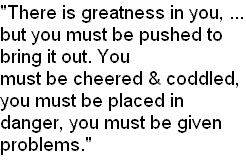
Quote from short story Final Gentleman by Clifford D Simak
This is the kind of plot normally associated with PKD now-a-days: which of the two equally vivid realities experienced by a man is the real one?

I didn't really like it, though I didn't find it boring either.

Story summary.

A very successful writer suddenly has a feeling there is no more writing left in him. And the world he knew all his life is no longer there: university he went to has no record of him; the house his mother lives in & he frequently visits no longer houses his mother & never has; the grave of the woman he once loved & now often visits exists but is someone else's grave; the fancy restaurant in the neighborhood he frequented is a very ordinary dump; ...

Story is of him slowly unraveling the puzzle.

Collected in.

  1. Groff Conklin (ed)'s "Six Great Short Science Fiction Novels".

Fact sheet.

First published: F&SF, January 1960.
Rating: B.   
Related: Stories of Clifford D Simak.

Tuesday, April 24, 2012

My "best of the year" picks: 1963

For the background of this list, see opening remarks of my best of 1961 list. List below is in order of publication - earliest first, unknown dated last. All stories, of course, were first published in 1963. Download links are included where I'm aware of an online copy.
  1. [ss] Rick Raphael's "Sonny"; download; Analog, April: US Army got too lucky with this draftee!
  2. [novella] Rick Raphael's "The Thirst Quenchers"; download; Analog, September: Managing fresh water in an energy-rich but overpopulated world. I think the main reason I liked this story is: it's a water dystopia that focuses on engineering to actually solve the problem, unlike innumerable others that focus on showing human pain in a world that has adjusted to the situation.
  3. [novelette] Murray Leinster's "Med Ship Man"; download; Galaxy, October: A gang of land sharks playing dirty games to reduce the local real estate prices...
  4. [novel] Pierre Boulle's "Planet of the Apes": Story is both similar to & different from the movie. What if apes ruled a world that had moronic humans treated as animals by ruling apes...
Related: "Best of" lists; fiction from 1963, 1960s.

Monday, April 16, 2012

My "best of the year" picks: 1962

For background of this list, see opening remarks of my best of 1961 list. List below is in order of publication - earliest first, unknown dated last. All stories, of course, were first published in 1962. Download links are included where I'm aware of an online copy.
  1. [novelette] James White's "Christmas Treason"; F&SF, January: When little kids brought about global nuclear disarmament! Very funny.
  2. [ss] Kurt Vonnegut's "2 B R 0 2 B"; download; If, January: Drastic population control in a society of long lived people.
  3. [ss] Arthur Clarke's "Maelstrom II"; Playboy, April: Totally crazy but effective rescue operation...
  4. [novella] Jack Vance's "The Dragon Masters"; Galaxy, August: Masters are also the slaves!
  5. [novel] Fred Hoyle & John Elliot's "A For Andromeda": One of the most gripping alien invasion stories I've seen.
Related: "Best of" lists; fiction from 1962, 1960s.

Sunday, April 15, 2012

Murray Leinster's "Operation Terror" (novel, alien invasion, free)

Cover of the novel Operation Terror by Murray Leinster
Good paced action adventure, but with a farcical & utterly unbelievable ending.

It features a softer version of a death ray, & a ray to explode gunpowder at a distance.

Story summary.

An alien ship has landed in a lake at the heart of a what is being developed as a national park in the US. Creatures come out of it, explore around. They have a "terror beam" weapon: a searchlight like thing. Whenever the beam touches anyone, it excites all sorts of nerve endings in a way so confusing the person eventually paralyzes - temporarily, till the beam is shut off. Immediate vicinity of landing is evacuated; military cordons off the region.

But among the trapped are a man named Lockley rescuing a stranded girl Jill. Story unfolds from Lockley's perspective, as the couple try getting out of region & make guesses about the nature of aliens & their weapons.

See also.

  1. Arthur Clarke & Michael Kube-McDowell's "The Trigger": What would the society be like if we had a weapon that could remotely trigger gunpowder explosion?
  2. Murray Leinster's "Invasion" (download): Another similar "Martian" invasion of US.

Fact sheet.

First published: 1962.
Download full text from Project Gutenberg, Feedbooks.
Download audiobook from LibriVox.
Rating: B.
Related: Stories of Murray Leinster.

Saturday, April 14, 2012

Alice Sheldon's "Beam Us Home" (as by James Tiptree, Jr) (short story, Star Trek fanfic, free): A US soldier's life, & death

Mostly beautifully done, it describes the life story of Hobie. Scenes from different life stages of him, with vague hints that he may be an alien...

Later parts, I suppose are a criticism of some US war or the other; US readers with '60s political background should be better able to see the point.

Fact sheet.

First published: Galaxy, April 1969.
Download full text from Internet Archive, Lexal.
Rating: B.
Among the classics of Sci Fiction, edited by Ellen Datlow.
Related: Stories of Alice Sheldon (as by James Tiptree, Jr).

Thursday, April 12, 2012

My "best of the year" picks: 1961

Going over Joachim Boaz's list of his "Top 11" novels from 1960s, I thought I'll produce my own. But with some differences.
  1. It won't have a "Top 11" or any numerical limit. If I liked a story, or find it noteworthy, it gets included.
  2. It's not restricted to novels & includes short fiction too.
  3. It's a mix of online & offline stuff; links included for online stories.
When compiling the list, I ran into two problems:
  1. It's taking too long. I've spent over an hour, & am still just covered 1963.
  2. List itself is growing too big. Small bites will probably be more palatable.
I hope to update this list as & when I find more entries, but I often get lazy updating such lists. This list was last updated: 12 April 2012.

List below is in order of publication - earliest first, unknown dated last. All stories originally published during 1961.
  1. [ss] Arthur Clarke's "Death & the Senator"; Analog, May: Certain heart ailments may be best treated in a zero gravity environment.
  2. [novelette] Lloyd Biggle, Jr's "Monument"; download; Analog, June: Non-violent, non-Gandhian, resistance against colonialism.
  3. [ss] Arthur Clarke's  "Before Eden"; Amazing Stories, June: A human expedition to Venus finds something that could be prelife - but its chances of survival are ruined by innocently careless actions of man, in spite of all precautions of the expedition...
  4. [ss] Kurt Vonnegut's "Harrison Bergeron"; download; F&SF, October: An extreme version of the idea of "equal opportunity" 
  5. [novel] Arthur Clarke's "A Fall of Moondust": Shipwreck & rescue set in an extremely exotic locale - neither land nor water, neither air nor space!
Related: "Best of" lists; fiction from 1961, 1960s.

Tuesday, April 3, 2012

Pauline Whitby's "The Lost Kafoozalum" (as by Pauline Ashwell) (novella, free): To stop war, introduce a common menace

One of the illustrations by Schoenherr accompanying the original publication in Analog of the story The Lost Kafoozalum by Pauline Ashwell
Bits of it are very good, particularly in the middle. But it starts off in a very tangent way & parts near end get draggy. Presentation is unusual for the period & refreshing.

Story summary.

An isolated human world somewhere has two factions near a war, so earth decides to help - in an indirect way. By faking a common menace so the two warring sides will be forced to join hands...

Fact sheet.

First published: Analog, October 1960.
Download full text from Project Gutenberg, Feedbooks, Internet Archive.
Rating: B.
Nominated for Hugo award 1961 in short fiction category.
Among the stories in Astounding/Analog issues edited John Campbell

Saturday, March 24, 2012

Tom Godwin's "The Space Barbarians" (novel, space opera): Teaching slave takers a lesson

Cover of the novel The Space Barbarians by Tom Godwin
This a sequel to author's excellent novel, "Space Prison" (download). Not quite in the class of original, but still a very good read. This is not a survival story, however; it's a pure space opera, & not always entirely logical.

Story summary.

Three human worlds - Ragnarok, Athena, & Earth. Ragnarokans are the hardy survivors & Athenans the enslaved people of the first book. And three alien races: Gerns, Shomarians, & Kilvar.

Gerns are the slave takers of first book. Now, 3 years after the first book's end, Gern empire is destroyed by humans - led by Ragnarokans.

Action starts with mysterious aliens raiding Ragnarok; they take a 100 women & young men, stun the remaining population of the only town here, & poison the air that blinds all exposed to it. Earth & Athena refuse to help Ragnarok find the culprits & avenge the raid; so Ragnarokans are all alone in their revenge.

Most of the story is Ragnarokans locating the real culprits & taking their revenge, in spite of enemy's far superior strength. Most of kidnapped human will die a horrible death before end. There will be a lot of confusion on who the real culprits are - hominid Shomarians who're related to Gerns, or cat-like telepathic Kilvar.

Fact sheet.

First published: 1960.
Rating: A.
Related: Stories of Tom Godwin.

Saturday, March 17, 2012

James H Schmitz's "Legacy" aka "A Tale of Two Clocks" (novel, space opera, free): Many groups are after the ancient treasures

Cover of the novel Legacy by James H Schmitz.
One of the more mundane works of Schmitz, though an action packed one.

Story summary.

A star-traveling humanity has discovered a treasure left on some world by long gone "Old Galactics". Treasure comprises of a number of "plasmoids" - a kind of artificial-life agricultural robots. They can produce so much food, we'll never have to worry about it, etc. But the process of human acquisition of them had shut them off, & no one knows how to turn them on again.

Currently they're in custody of the government, but sundry other groups want them too. And what will happen when varied groups begin doing their own underground tinkering to revive these ancient living machines...

See also.

  1. James H Schmitz's "Harvest Time" (download): The story where "plasmoids" were first discovered.

Fact sheet.

First published: 1962.
Download full text from Baen Books, Project Gutenberg, Manybooks.
Download audiobook from Internet Archive, LibriVox.
Rating: B.
Related: Stories of James H Schmitz.

Wednesday, March 14, 2012

Piers Anthony's "Possible To Rue" (short story, humor)

A single dad's difficulty finding a birthday present to the satisfaction of his 6 year old...

Quite funny. And it's the first published story of the author.

Fact sheet.

First published: Fantastic Stories of Imagination, April 1963.
Rating: B.
Related: Stories of Piers Anthony.

Wednesday, March 7, 2012

Murray Leinster's "The Greks Bring Gifts" (novel, alien invasion): "Helpful" aliens with a nasty secret agenda

Cover of the novel The Greks Bring Gifts by Murray Leinster
Earth has recently received an alien ship with two kinds of very helpful aliens - Greks & Aldarians, Greks the senior of the two. They're offering great new technology, & are willing to train human scientists in Grek science. They don't claim to have any expectations from humanity, apart from giving the gifts.

But Jim Hackett is noticing some anomalies in their behavior. While Aldarians are genuinely helpful, Greks' gifting feels like contempt, Grek ship is far too big compared to their declared numbers, his suspicion during his training in Grek science that they're being taught nonsense, ... His investigations, with the help of a small band of helpers, will unravel the aliens' nasty designs as well as a weapon to beat them at their own game.

See also.

  1. Damon Knight's "To Serve Man" (download text scans as part of a larger package): Similar concept at short story length.

Fact sheet.

First published: 1964.
Rating: B.
Included in "grubthrower"'s "Top 10 obscure but superb science fiction novels".
Related: Stories of Murray Leinster.

Tuesday, March 6, 2012

James H Schmitz's "Forget It" aka "Planet of Forgetting" (novelette, free): An unusual animal defense against predators

An intelligence agent, carrying a secret coded (paper?) file to another world, is captured by the enemy on the way. Story is of him outwitting the entire enemy ship taking him to their world. Features telepathic plants capable of moving around.

Fact sheet.

First published: Galaxy, February 1965.
Note: "this cover story was mistakenly listed as "Planet of Forge" on Galaxy's TOC."
Eric Flint on online version I've linked in download link below: 'we changed the name of the hero, did some rearranging of paragraphs in the early sections of the story, somewhat modified a few paragraphs of background material to make it fit the Hub setting, and cut a short "trick ending" that wasn't really part of the story itself and wouldn't fit the Hub setting.'
Download full text from BaenCD.
Rating: B.
Nominated for Nebula Award 1966 in novelette category.
Related: Stories of James H Schmitz.

Friday, March 2, 2012

Jack Vance's "The Dragon Masters" (novella, alien invasion): Masters are also the slaves!

border:none
This is a fast-paced very-readable action story. I have a couple of nits, though:
  1. Why would aliens bother to make interstellar raids to carry off a few humans each time as slaves? Particularly when they already have a large stock of human slaves, bred as beasts for specific desirable traits.
  2. Aliens travel interstellar distances & have death rays, but bring with them beasts of burden for local land transport, rather than powered machinery!

Story summary.

Most of the story is about three human communities, living in close proximity, on a world called Aerlith. This world has long since lost all contact with rest of humanity. In fact, they may be the last remnants of humanity.

Two of the three communities are feudal: Banbeck Vale is ruled by Joaz Banbeck, & Happy Valley is ruled by Ervis Carcolo. Former is smart, progressive, & technically savvy. Later is a barbarian, never looking beyond the immediate. They also have a variety of pet "dragons" - used as beasts of burden & war animals.

Third community is "sacerdotes", mysterious hermits living in subterranean caves below the two feudals' lands. They appear to be technologically very competent, but they're secretive.

Much of the story is about interactions of these 3 communities. In the background of periodic raids, every few generations, of lizard-like aliens called "Basics" or "grephs". Joaz has recently discovered that these raids occur whenever a star called Coralyne of their local cluster makes the nearest approach. And it's approaching now...; alien slave takers could be
arriving any time.

Later parts are, of course, arrival of aliens. Only they'll meet resistance this time - all 3 human communities coming together will beat them.

See also.

  1. Eric Frank Russell's "Diabologic": Only thing I remember about this story is that it's about carefully using language to drive other people nuts, & using it as a political tool. One of the interviews of Joaz & a sacerdote had this feel too.

Fact sheet.

First published: Galaxy, August 1962.
Rating: A.
Winner of Hugo award 1963 in short fiction category.
Related: Stories of Jack Vance.

Thursday, February 23, 2012

Norman Spinrad's "Agent of Chaos" (novel): Autocracy vs democracy vs "chaos"

Cover image of the novel Agent of Chaos by Norman Spinrad
I'm not sure I understand the point of the book, though I loved the later parts:
  1. "Freedom from" (hunger, disease, ...) is a less desirable goal for a population than "freedom to" (do what you want, e.g.). Author uses them in the sense where former is a white list of specific freedoms that can be granted by the rulers, while the later is open ended. That it's impossible to list down the freedoms you should have; an evolving universe constantly offers new opportunities, & the society's default should be that you can go pursue any if you are so inclined.
  2. It's not just the universe that has a tendency to become more chaotic with time (increasing entropy), but societies too. To maintain order in a society requires "social energy". But tendency towards chaos is the natural, hence more desirable, state. In the context of story, I could not disagree; proponents of chaos are opposing a despicable tyranny. But as a general principle?
Story itself pits 3 antagonists against each other:
  1. "Hegemony" runs the government. Descended from former US, Soviet Union, & their allies, it runs a sort of world government that spawns several inhabited planets & moons of Sol, besides earth. At the top of the government is a 10-member oligarchy, partly elected. While there is no hunger or disease in this society, citizens are really treated as cattle: do an "Unpermitted Act" & the punishment is immediate death, citizens are killed at every tiny provocation (& non-provacation too), you need a pass to travel anywhere, ...
  2. "Democratic League" is a rebel group that primarily uses terror to make its point, & is working towards a "free" society. But its ideologues are not very clear on the idea of freedom.
  3. "Brotherhood of Assassins" is a mislabeled group that believes in chaos. To them also, killing innocents is no big deal - so long as it achieves whatever goal. They've been introducing random acts in orderly Hegemony, because ... chaos is good!
First two thirds, or more, has a lot of killings & random acts of terror. Things really start falling in place near end.

Fact sheet.

First published: 1967.
Rating: B.
Included in "grubthrower"'s "Top 10 obscure but superb science fiction novels".
Related: Stories of Norman Spinrad.

Ed M Clinton's "Untechnological Employment" (flash fiction, humor, free)

How the political considerations affect engineering decisions...

Fact sheet.

First published: Analog, November 1962.
Download full text from Project Gutenberg.
Rating: B.
Among the stories from Astounding/Analog issues edited by John Campbell.

Tuesday, January 31, 2012

James H Schmitz's "The Hub: Dangerous Territory" (ed Eric Flint) (collection, free): Annotated table of contents & review

Cover image of fiction collection The Hub, Dangerous Territory by James H Schmitz, edited by Eric Flint. Image shows a scene from the novel The Demon Breed - heroine with her two otter helpers, planning next action against invading aliens.
Whole book is online at Baen Books. Includes one novel & nine short stories.

Table of contents (10 stories, best first).

  1. [novel] "The Demon Breed" aka "The Tuvela" (A); download; Analog, September/October 1968: Humanity has secret super-human rulers!
  2. [novelette] "Grandpa" (A); download; Analog, February 1955: A group of early explorers on a newly opened world is trapped by a local lifeform. Only the ingenuity of our teenage hero can save the group's life...
  3. [novelette] "Trouble Tide" (A); download; Analog, May 1965: Detectives burst a smuggling operation.
  4. [novella] "The Searcher" (B); download; Analog, February 1966: Human heroes fight off an evil alien.
  5. [ss] "Balanced Ecology" (B); download; Analog, March 1965: A jungle world knows how to defend itself against greedy humans.
  6. "The Other Likeness" (B); download; Analog, July 1962: A small band of humans thinks redesigned, human-looking, aliens have penetrated the human worlds - to destroy the human civilization. So they're doing what they can to catch the aliens...
  7. "Attitudes" (B); download; F&SF, February 1969: Sole survivor of an accidentally destroyed human world has has come to civilization seeking help - he's carrying brain dumps of a lot of his dead compatriots. He wants Federation to supply him with many artificially created human bodies which he will animate with his dead friends. He also wants help colonizing a new world with this crowd. Federation helps, but someone is wondering...
  8. "The Machmen" (B); download; Analog, September 1964: "Machmen" are machine-men, some medically-induced transformation that turns them into "Homo
    Superior". Only, it's illegal & unsafe. One of the would-be victims being chased for forcible transformation into machman turns out to be someone more capable than strongmen expected.
  9. [novelette] "The Winds of Time" (B); download; Analog, September 1962: A man & a woman are trapped, kidnapped, & ... harassed ... by ... aliens.
  10. [ss] "A Nice Day for Screaming" (B); download; Analog, January 1965: One of the early exploration ships in "pseudospace", a kind of parallel space, is chased by ... something.
Related: Stories of James H Schmitz.

Wednesday, January 25, 2012

3 stories

None particularly strong. I liked "The Beautiful People" best among this lot.
  1. Robert Bloch's "The Beautiful People" (B); download; Best-Seller Mystery Magazine, July 1960; non-genre: An "ugly" but rich woman with serious inferiority complex contrives to get a handsome playboy & childhood love in marriage. But the man cannot stop looking at other women, eventually bringing in the wife's wrath...

    A lot of story text is devoted to the beauty of a human face, & social advantage or disadvantage it brings.

    Among the stories in the classics section of Ellen Datlow's Sci Fiction.
  2. [ss] L Sprague de Camp's "The Reluctant Shaman" (B); Thrilling Wonder Stories, April 1947; humor: Some "stone throwing" sprites normally found near some native American tribes are "helping" a businessman & his neighbors. Chaos reins.

    Collected in: "The Best of L Sprague de Camp".
  3. [novelette] Seth Dickinson's "The Immaculate Conception of Private Ritter" (B); download; Asimov's web site (2012?): A human army unit, on a genocide mission to other human inhabited worlds, comprises of confused zombies. This is the story of one of the zombies, Private Keshaun Ritter, learning some of her personal history.

Friday, January 20, 2012

James H Schmitz's "Trouble Tide" (novelette, smuggling, free)

Last third is action packed, but first two thirds is a much better read - a detective story that pieces together several apparently disjointed data sets on a human settled non-earth world:
  1. A sea animal herd ("frayas") suddenly dies during its annual migration.
  2. A coastal sea animal herd ("sea beefs") is behaving in a very weird way - a lot of animals have simply vanished; others that need to come up to surface for breathing every few minutes now seem to have developed some equivalent of gills.
  3. Flow rate of a sea current somehow ties up the relative times of the two events.
  4. ... 

Collected in.

  1. James H Schmitz's "The Hub: Dangerous Territory".

See also.

  1. L Sprague de Camp's "The Merman": Another story where mammals transform into fish.

Fact sheet.

First published: Analog, May 1965.
Download full text from Baen Books.
Caution: This is a long novelette - nearly novella length.
Rating: A.
Among the stories from Astounding/Analog issues edited by John Campbell.
Related: Stories of James H Schmitz.

Friday, January 6, 2012

3 stories of James H Schmitz

All are colorful in their own way (but "Balanced Ecology" is more colorful than others). List is in order of my preference, best first.
  1. [ss] "Balanced Ecology" (B); download; Analog, March 1965: A jungle world knows how to defend itself against greedy humans.
    Nominated for Nebula Award 1966 in short story category.
  2. [novelette] "The Winds of Time" (B); download; Analog, September 1962: A man & a woman are trapped, kidnapped, & ... harassed ... by ... aliens.
  3. [ss] "A Nice Day for Screaming" (B); download; Analog, January 1965: One of the early exploration ships in "pseudospace", a kind of parallel space, is chased by ... something.
Among the stories from Astounding/Analog issues edited by John Campbell.
Related: Stories of James H Schmitz.

Tuesday, January 3, 2012

Piers Anthony's "Macroscope" (novel, space opera): Snakes & ladders for star travel

Cover image of novel Macroscope by Piers Anthony
Going by the amount of praise it has received, you'll have to take my views with a pinch of salt. I found the later parts extremely tedious to wade through. Primarily because of many jarring diversions, most of which seem to be here to simply add pages rather than further the story. Early parts - about half the book or more - however, is very readable.

Story employs a variety of stock tropes, as you would expect in a space opera. There are a few things, however, that were new to me:
  1. To be able to take shock of 10g acceleration during interplanetary travel, you "liquify" the human traveler! For star travel, you further "gassify" the protoplasm to better prepare for bigger shocks. And for inter-galactic travel, you further transform the gas into a living radiation being (radiation idea is, of course, quite old.)
  2. An alien signal that hypnotizes the human receiver to use him as a zombie or interacts with him in an individual-specific way is quite old. Author, however, puts it to novel uses I'd not seen before.

Story summary.

A "macroscope" is two devices in one: a sort of infinite-resolution telescope with range across the galaxy; & a receiver of (alien) "broadcast" signals on various "macroscopic" bands. There are a variety of broadcasts available in aether, but two play a key role in the story:
  1. "Destroyer" fries the brains of anyone smart enough to comprehend the broadcast!
  2. "Traveler" seems to provide a lot of extremely useful information, provided you can get past "destroyer" (because "destroyer" signal is far too strong).
This story is of a quest - 4 individuals travel all over the galaxy, with the help of information provided by Traveler, to locate & disable the destroyer source. They'll eventually find the purposes of both destroyer & traveler, & get some enlightenment in the psychology of sentient beings.

Fact sheet.

First published: 1969.
Rating: B.
Nominated for Hugo Award 1970 in novels category.
Related: Stories of Piers Anthony.

Monday, December 26, 2011

Murray Leinster's "Checkpoint Lambda" aka "Stopover in Space" (novel): Young hero foils a major robbery attempt

Cover of the novel Checkpoint Lambda by Murray Leinster
This is one of the more mundane stories of the author. Fast moving action, yes, but irritating repetitions, & at least one major event is resolved by convenient last-minute arrangement of circumstances.

Title is the name of a space station in orbit around a star called Canis Lambda. The station is located at the intersection of major space lanes of a star-faring humanity, & serves both as a lighthouse & a way station. This is where most of action happens.

Story summary.

The Golconda Ship, with its fabulous but unspecified treasures, is expected to dock with Checkpoint Lambda. So a gang of robbers have taken control of the Checkpoint ahead of arrival - killing all crew & transit passengers at station.

That's when Scott, a newly minted Space Patrol officer, arrives to take charge of the station. Of course, 2 dozen robbers already in control of station don't stand a chance against a Space Patrol officer.

A substantial part of the story is devoted to surviving a disaster - cores of 4 comets will soon impact the station, & few available maneuver options are frustrated by robbers' chief who doesn't believe there is a danger here.

Fact sheet.

First published: Amazing Stories, June & August 1966.
Rating: B.
Related: Stories of Murray Leinster.