Editor of the site where I found it calls it "the original SF short story". I've read at least one Sanskrit short story from about 200 BC that I would call proper science fiction; so it's not original. But it certainly is the oldest first contact story I've yet read, & generally a fun read.
Wikipedia says it was one of the "probable influences" on H G Wells. And it is obviously influenced by Jonathan Swift's "Gulliver's Travels".
Science part is very flimsy. Philosophical parts fall in two categories: some universal truths still relevant, others relevant only to someone interested in Voltaire's era France.
Story summary.
Assume many worlds have human-like creatures. But their size (& also the number of "senses", & life expectancy) depends on the world they're from. Bigger the world, bigger & taller its inhabitants!
Hal Clement would advise otherwise, but you have to ignore gravity (& much else) to enjoy this story.
Unnamed human narrator is telling us of a visit to earth of a Sirian "eight leagues, or 24,000 geometrical paces of five feet each, or 120,000 statute feet" tall, along with a Saturnian companion merely "a thousand fathoms high"! Micromegas is the name of Sirian.

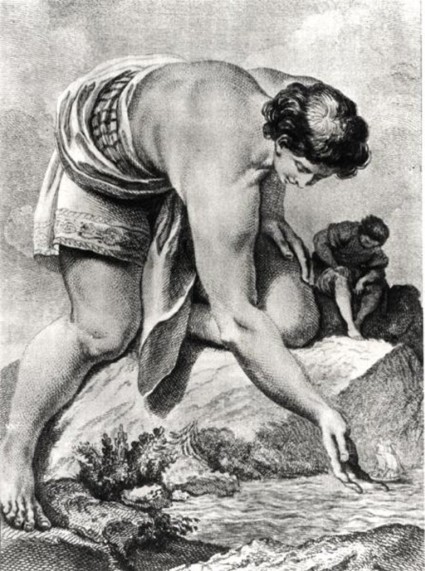
Visitors will have much difficulty finding anything alive on earth. Given their size, they need special optical equipment to see the microscopic humans ("animalcule", "Invisible insects", "intelligent atoms", "being encumbered with so little matter, and seeming to be all spirit, you must pass your lives in love and meditation")! Ultimately the contact is made - in a funny manner. Picture alongside illustrates the manner of contact; click image for original size.
Story talks of politics of Micromegas world & narrow-mindedness of certain people. Some bits on being tolerant of differences. Religion. And some things no longer relevant (or at least uninteresting to me).
Size of Micromegas, deductions about his world's size, & his mode of travel.
Micromegas' height is "eight leagues, or 24,000 geometrical paces of five feet each, or 120,000 statute feet"!
"his waist should, proportionally, be about 50,000 feet around. His nose being one third the length of his handsome face, and his handsome face being one seventh the height of his handsome body, it follows that the Sirian's nose is some 5,714 statute feet long."
"When Micromegas was about 450 years old, and already passing out of childhood, he dissected, with the aid of powerful microscopes, many little insects less than 100 feet in diameter".
His kind are equipped with "nearly a thousand senses".
From visitor's size, narrator is deducing the size of his world! - "a circumference 24,000 times greater than our little Earth."
He traveled through space "sometimes by means of a sunbeam, and sometimes with the help of a comet".
Quotes.
- "I have seen mortals far below us, and others greatly superior; but I have seen none who have not more desires than real wants, and more wants than they can satisfy."
- "I have been in countries where life is a thousand times longer than with us, and yet have heard murmurs of its brevity even there. But people of good sense exist everywhere, who know how to make the most of what they have, and to thank the Author of nature."
- "I see differences everywhere, but everywhere also a due proportion. Your globe is small; you who inhabit it are small likewise; you have few senses; the matter comprising your world has few properties".
- "we should judge nothing by its apparent importance."
- "at this very moment there are 100,000 fools of our species who wear hats, slaying 100,000 fellow creatures who wear turbans, or being massacred by them... The dispute concerns a lump of clay ... no bigger than your heel. Not that a single one of those millions of men who get their throats cut has the slightest interest in this clod of earth. The only point in question is whether it shall belong to a certain man who is called Sultan, or another who, I know not why, is called Caesar. Neither has seen, or is ever likely to see, the little corner of ground which is the bone of contention; and hardly one of those animals, who are cutting each other's throats has ever seen the animal for whom they fight so desperately."
- "Since you belong to the small number of wise men, and apparently do not kill anyone for money, tell me, pray, how you occupy yourselves."
"We dissect flies, ... measure distances, calculate numbers, agree upon two or three points we understand, and dispute two or three thousand points of which we know nothing." - "what do you mean by spirit?"
"I have no idea of its meaning, except that it is said to be independent of matter."
Fact sheet.
First published:
1752. There seems to be some
dispute on this.
Rating: A
Download full text from
The Wondersmith.
Caution: This download link points to text that has been edited by site owner to "correct" some of its "many mathematical blunders, factual errors, and implausibilities". I personally prefer unadulterated originals, but I realized the edited bit only after reading it (I normally read editorial introductions after reading the story). A little web search should, however, be able to locate an original version.
Related:
All stories of Voltaire.