Showing posts with label Hal Clement. Show all posts

Friday, November 29, 2013

Hal Clement's "The Nitrogen Fix" (novel, apocalypse)

Cover of the novel The Nitrogen Fix by Hal ClementThis is an action packed adventure. Like many other stories of author, it's set on a world with atmosphere toxic to humans but not to their alien friends, only the world is earth! And unlike vast majority of stories of author, this one has real villains, in addition to his standard "nature is adversary enough".

This also has an apocalypse setting common to many modern stories: "a closed human habitat has limited oxygen & if you have a third child, someone from family will have to be thrown out ('nomaded')". Only it's far more readable than almost everything I've seen with this setting.

Story summary.

A couple of thousands years into future, much of the oxygen has vanished from earth's atmosphere, all large animals except humans are dead, even humans are very few & dwindling, nitric acid pollutes all open water sources, & there are violent nitrate based plants prone to explosion.

People live in "closed" cities, with water-pool based airlocks. There also are some hardy nomads, folks who were thrown out of cities because of overpopulation but survived. You cannot venture outside without breathing mask & oxygen tank.

There are also "natives" or "Invadors" or "Observers" - curious galaxy-traveling aliens well suited to this earth atmosphere.

This is the story of a nomad couple, their 5 year old daughter, & their alien friend, who arrive at a city somewhere near Boston coast with supplies of salvaged glass & copper nuggets produced from ocean by "pseudu-life" that still survives. Only the customers have some deadly ideas & all hell breaks loose soon after their arrival...

Fact sheet.

First published: 1980.
Rating: A.
Related: Stories of Hal Clement.

Tuesday, April 30, 2013

"Astounding Science Fiction" (British edition), August 1958 (magazine, free) (ed John W Campbell): Annotated table of contents

Cover by Van Dongen of Astounding Science Fiction magazine, British edition, August 1958 issue. Image illustrate the novel Close to Critical by Hal Clement.Links on author fetch more fiction by author. Where I've read the story, my rating appears in brackets. If I have a separate post on a story, link on its title goes there.

Table of contents (best first, unread last).

  1. [novel - 1/3] Hal Clement's "Close to Critical" (A): "Meet Tenebra, the planet where raindrops are fifty feet through ... & hard quartz rocks dissolve away like salt. Under three gravities, & a monstrously deep atmosphere, with oily seas of sulphuric acid, two children touch off a political situation that is ... close to critical".
  2. [ss] Frank Herbert's "You Take the High Road" (A); detective: Is this village really of peaceful people?
  3. [ss] Stanley Mullen's "Fool Killer" (A): What if law allowed you one murder!
  4. [ss] John Rackham's "One-Eye" (B): A man has an unusual gift - he "sees" bad things happen just before they do happen. And figuring out the nature of this "gift" gets him in trouble.

    Title is from the story about a one-eyed man among the blind ones. As is the man with the gift among the ordinary humans.
  5. [novelette] Charles V de Vet's "Special Feature": "What constitutes public entertainment changes with the mores of a society. The Romans liked the circuses ... but the feline devil loose in their city might have been a bit too stimulating for them..."
  6. [ss] Gordon R Dickson's "The Question": "It wasn't too surprising that aliens couldn't answer the Question. After all, we've been trying for millenia ourselves!"

Fact sheet.

Labeled: Vol XIV No 8.
Download scans as a CBR file. [via Bob@pulpscans]
Note: Link points to a RAR file that contains target CBR, probably to work around some hosting service file naming constraints.
Related: Stories from the Astounding/Analog issues edited by John Campbell, old "pulps", 1950s.

Saturday, February 16, 2013

Hal Clement's "Impediment" (novelette, communications): Telepathy considered impossible among humans

I must have read the "Best of Hal Clement" earlier. I don't remember many of its stories' titles, but as I begin reading a story, I discover I'd read it before. This one too is a reread, but one I'd forgotten so thoroughly I ended up finishing again.

Story summary.

This is a first contact story that focuses on possible difficulties in communicating with aliens. In this case, aliens are telepathic & can read imagery in your brain. And while they cannot speak audibly, they are not deaf; they can hear sounds of our speech.

And yet the communications are so hard as to be impossible. The difficulty lies in human comfort, rather need, to communicate in code - what our brain thinks, we must mostly code in symbols of speech. It's ok if the actual brainwaves generated by two individuals with the same thought differ, since they'll both render it in common code. Aliens don't understand this idea of translating to code, since they're used to direct communication of thoughts.

Giant insect-like alien visitors themselves are space pirates out of ammunition, & want arsenic here to make poison gas. A human insect researcher doing some field work north of Arctic Circle runs into them.

Fact sheet.

First published: Astounding, August 1942.
Among the stories from Astounding/Analog issues edited by John Campbell.
Rating: A.
Related: Stories of Hal Clement; fiction about language issues.

Wednesday, January 11, 2012

Hal Clement's "Planetfall" (novella, first contact): A hard-sf look at the problem of first contact

Note there are at least 2 versions of this story: original novella Hal Clement wrote, & longer "novel" that's the original story extensively padded by Sam Mervin. This post is based on Clement's solo novella.

This may be among the most weird first contact stories I've seen so far. With sufficiently different body chemistry & evolutionary environment, how hard can it get to recognize alien life & communicate with it, even if you notice there is (alien) intelligence somewhere around? This is actually a failed contact story, in spite of much effort from both sides.

Story summary.

A sessile, long-lived, technologically far in advance of us, star faring race of aliens extensively mines metals off all sorts of worlds. A "Conservationist", a sort of policeman to prevent unauthorized mining, has noticed some "poachers" attempting to steal metals off earth. His approach makes them run away, but they've left behind "mole robots", bombs that will cause much upheaval in earth's crust to turn its metals-denuded surface into a metals-rich surface again in a few million years. Which means death for much of local life.

He'll land here, & notice obvious signs of intelligence. But all through his attempts to communicate with humans, he won't even realize they're the ones he's trying to help.

Fact sheet.

First published: As a novel with additional material by Sam Merwin in Satellite Science Fiction, February 1957 as "Planet for Plunder". I'm not sure when the pure original novella version first saw the light of the day - probably 1972 in Robert Hoskins's anthology "Strange Tomorrows".
Rating: A. 
Related: Stories of Hal Clement.

Tuesday, February 22, 2011

Hal Clement's "Raindrop" (novella, farming): Exploring a weird artificial world

Background is an over populated earth; even the seas are mostly occupied by floating artificial cities. So little sunlight reaches the surface - even at sea. Too many people, too few farms. So, why not build farms in the sky! Raindrop, of title, is the first such experimental farm in the earth orbit.

Farm itself is a huge globe of water, collected from ... asteroids? ... I forget; one of those heavenly bodies. Initially contained in an artificial skin; later replaced with genetically engineered algae that love the sunny surface & quickly heal any tears created by micro-meteors.

A lot of genetically engineered weeds & microbes have been introduced here; & they keep quickly evolving. A little station exists just below surface, entered through an airlock, that also has entry into water below. Silbert is the only permanently resident employee, & he tries to spend most of his time up in a space station in a geosynchronous orbit a half mile above Raindrop.

Adventure in the story is provided by Aino Weisanen, one of the private owners of the Company that recently purchased Raindrop from government, & wants to convert it into a city from original farm. He's here with his pregnant wife Brenda, & an assistant Bresnahan.

These 3, accompanied by Silbert, will go exploring the dark interior of Raindrop in a specially built vehicle; that's where they intend to build their home. An altercation & we have stranded people in core & a hopeless rescue effort. Of course, all ends well.

Notes.

Story features two curious gadgets I've not seen in fiction before:
  1. Adventurers are stranded deep inside the dark Raindrop interior, with no clue of direction towards surface. How to they go? They throw a bubble; because of low gravity, it moves slowly, but still surely towards to surface where pressure is less!
  2. Transport from Raindrop to orbiting station is unusual. While going from station to raindrop, they just jump (I think, but am not sure). While returning, jump is still possible because of very low gravity, but station presents a very tiny target; if you miss it, you'll go out to empty space. So men on surface can ask the station to deploy a sort of foldable net-cum-ladder; you jump towards the net, & then do some gymnastics to reach the station.

Fact sheet.

First published: If, May 1965.
Rating: A. 
Related: Stories of Hal Clement.

Monday, January 17, 2011

Hal Clement's "Whirligig World" (essay)

Author describes the rigorous process, including consultations with Isaac Asimov & others, he went through in designing Mesklin, the world at the heart of "Mission of Gravity".

He also tells us: "I hereby give official permission to anyone who so desires to lay scenes there." "there" is Mesklin; according to the article, you can set a story there without worrying about copyright violations, provided that you "maintain reasonable scientific standards, & that's certainly an elastic requirement in the field of science fiction."

First published: Astounding, June 1953.
Related: Stories of Hal Clement.

Sunday, December 19, 2010

Hal Clement's "Proof" (short story, weird life): Solarians baffled by strange earth-matter!

This is the first published story of Hal Clement.

Story summary.

Imagine that life evolved inside the Sun's core - life made of densely packed elementary particles to which that is the normal temperature. Some of these beings evolved enough to have cities floating in higher reaches of sun & to have space travel in their "neutronium" hulled ships.

They've found life in many stars' cores; even contact with intelligent beings. A Sirian scientist is currently on sun, testing a weird & totally crazy hypothesis: that matter like iron & calcium can potentially exist in a solid state!

That's when Kron, his Solarian host & a veteran star traveler, tells him the story of an unlikely & impossible shipwreck he was a witness to - one of the neutronium ships crashed in a "trapping field" of hypothesized solid matter that is Earth.

Collected in.

  1. David Hartwell & Kathryn Cramer (ed)'s "The Ascent of Wonder: The Evolution of Hard SF".

See also.

  1. Arthur Clarke's "Castaway": Another story of a Sun-being accidentally landing on earth.
  2. Hal Clement's "Iceworld": Human first contact with high temperature aliens.
  3. Hal Clement's "Longline": Another weird physics story of author that's among the weirdest I've seen - what if speed of light is only a divider rather than a barrier? So we have first contact of humans with beings comprising of matter that cannot move slower than light!

Fact sheet.

First published: Astounding, June 1942.
Rating: B.
Among the stories edited by John Campbell for Astounding/Analog.
Related: Stories of Hal Clement (some of his "good" stories); shipwreck fiction.

Thursday, November 4, 2010

Hal Clement's "Half Life" (novel, hard sf): Looking for prelife on Titan

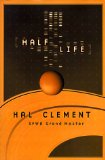
Cover image of the 1999 novel Half Life by Hal Clement
A story primarily about diseases & the very sick. Sound boring? It might be, in the hands of anyone but Clement. This one is, instead, a fast moving adventure & a very good read.

Story summary.

Life on earth has been failing for 2 centuries. More new diseases are springing up faster than cures can be found. And it's not restricted to humans - a lot of (all?) earth-life seems to be affected. Human population is far below its twentieth century levels, & pretty much everyone is badly sick.

In an ultimately disparate move, a project is launched to understand pre-life: "Fill the information gaps between the mineral & biological worlds." To this end, a group of 50 individuals is sent to Titan - almost certainly a one way trip since most are terminally sick, as is much of the general population. It's hoped that Titan might harbor the beginnings of life, & we just might figure something about the chemical basis of life to have hope in future.

Of the 50 adventurers, less than 2 dozen will survive till their station in orbit around Titan is set up. A few more will die through the story.

Most of the story is the various individuals' adventures on Titan, a good part dealing with not uncommon local surface structures that are clearly not alive but that can sense "food" (in some sense), can slowly move towards it, & eventually "consume" it. By the end of the story, the group will have a promising hypothesis for future research that just might hold hope for the mankind's future...

Notes.

  1. "An earlier version of Half Life was originally published in four installments in the fine SF magazine Harsh Mistress/Absolute Magnitude in 1994 and 1995".

See also.

  1. Arthur Clarke's "Before Eden": Discovery of a far more advanced but still prelife in high altitudes of Venus.

Fact sheet.

First published: 1999.
Buy from Amazon.com.
Rating: A.
Related: Stories of Hal Clement (annotated selection of some of his good stories).

Wednesday, August 25, 2010

A few good stories of Hal Clement

Another post that is best not buried in a comment thread.

Most of his fiction is still under copyright. I know of only one or two of his online short stories, as part of some of the magazine scans I've linked; will get to their ToC sometime.

Pretty much everything of him is worth reading, but not continuously; need to leave a few weeks between different stories of his - many of them need time absorbing. His work has some of the craziest science fiction ideas, presented in a plausible way.

Some of his now rarely quoted short stories are among the science fiction's very best: try locating "Dust Rag", "Longline", "Bulge", & "A Question of Guilt".
Caution: Last one is very dark - his only dark story I've seen so far.

"Needle" is probably his easiest-to-read novel. "Mission of Gravity" is very famous, but isn't really for everyone. I don't think I've seen any of his novel I won't rate A, & the only short story of his that didn't work for me was "The Foundling Stars" (but I got the idea sometime later; had read it when I wasn't very experienced at reading sf).

Related: Stories of Hal Clement.

Hal Clement's "Blot" (novelette, first contact): When Asimovian robots failed to distinguish "human" from "robot"

Quote from short story Blot by Hal Clement
While there are many stories featuring robots that don't follow any "laws", the ones that feature "laws" seem to be almost exclusively about Asimov's 3 laws. Besides "Blot", I can off-hand recall only 2 stories that have laws-following robots but laws aren't Asimov's:
  1. One of Asimov's own Spacer novels where robots are tweaked to recognize only some people as human - I think by recognizing the accent of their voice.
  2. Jack Williamson's "With Folded Hands" (download MP3): A single law is enough!
This story has a twist on Asimov's laws: "Human" is defined as anything sentient & biological. In fact, some of the robots are of alien origin. It's their confusion on first contact with humanity that makes them label women as "human" & men as "robots" (or was it based on dress color? It's been some months since I read this.) So killing men is fair game.

Story summary.

First human expedition to Miranda, one of the moons of Uranus, comes across alien artifacts & alien (but humanoid-looking) robots guarding/handling them. Humans' curiosity trying to figure out artifacts & nature of robots provides some excitement in the story, & near death of a crew member at the hands of a robot. But all ends well.

Fact sheet.

First published: Martin Greenberg (ed)'s "Stories in Honor of Isaac Asimov: Foundation's Friends" (anthology, 1989).
Rating: A.
Related: Stories of Hal Clement.

Sunday, June 6, 2010

Bud Webster's tribute to Hal Clement

At Grantville Gazette.

Article itself is undated, but I think it's relatively new; Webster's series was to move to GG after JBU shut shop last month.

He spends quite some time on "Mission of Gravity", perhaps the best known work of Clement. But he doesn't even mention my favorite Clement short fiction, from among the 2 dozen odd I've read: "Dust Rag", "Longline", & "Bulge" - among the coolest science fiction you'll ever see by anyone (assuming you're Clement type reader).

For less than well known fiction publishers: he has an interesting anecdote regarding "Half Life" about how to get the best talent writing for you.
PS: Last week has seen some reporting of new speculation about possibility of life on Titan, based presumably on new data. "Half-Life" is precisely about that - looking for "pre-life" on Titan.

Related: Stories of Hal Clement.

Tuesday, November 3, 2009

"What are the best endings in science fiction/fantasy novels?"

John Ottinger collects answers to this question from several bloggers at Grasping for the Wind, among them my brief note on Hal Clement's "Half-Life".

Friday, August 14, 2009

Hal Clement's "Star Light" (novel): Exploring a high gravity world with weird atmosphere & hydrosphere

Cover image of the novel titled Star Light by Hal ClementThis is often listed as one of the two sequels to "Mission of Gravity". Other book, "Close to Critical", didn't really read like a sequel to me, but this one has a much better claim to being the sequel to the legendary original (& a very worthy sequel). The story is generally independent of "Mission of Gravity"; so should be comprehensible even to readers who haven't read the better known book.

Caution: Hal Clement is not for everyone (with the exception of "Needle", which should be quite accessible to anyone used to sf). His stories often require a science background at least to the level of 10+2 school, & then some taste for a certain kind of story - in this case, essentially a description of the weird world.

Story summary.

Dhrawn has a weird hydrosphere - rather than mostly water on earth, it's a mixture of water & ammonia. And phase transitions of the mixture are apparently very weird - like when ambient temperature is nearly fixed or is slightly rising, a flowing river can freeze based on evaporation or condensation of ammonia! We see a lot of weird behavior like this.

Action happens primarily in 3 theaters:
  1. Main & the most interesting thread is aboard Kwembly, a huge land based research vehicle with a 100 staff of Mesklinites (from "Mission of Gravity"). Dondragmer, #2 aboard the local ship in "Mission of Gravity", is the captain. Another key character here is Beetchermarlf, a young apprentice.

    Why Mesklinites? This is a huge 40g world & very cold; so they're recruited for surface investigation.

    This vehicle keeps getting in trouble because of the weird atmosphere: frozen ground suddenly turns into liquid after some precipitation, vehicle gets deposited by a flood at a large angle in a flowing river that promises to become far nastier, river suddenly freezes trapping vehicle & maintenance crew underneath, ...
  2. Aboard a space station in geosynchronous orbit is the human team. They operate a bunch of low-orbit remote sensing satellites, & remotely guide Mesklinites on ground.

    Communications with Mesklenites get somewhat complicated because the geosynchronous orbit for this very slow rotation world is 6 million miles from surface - means 64 seconds round trip signal travel time.

    Key characters from among the large staff are: Alan Aucoin, the administrator of project; Elise Hoffman (aka Easy), main non-technical communications contact with Mesklenites on ground & an expert in Stennish, the Mesklinite language; Benj, Easy's teenage son doing apprenticeship who gets deeply involved in some disaster rescues; & Ib, Easy's super smart husband who speaks little & understands a lot.

    We are told two alien species - Drommian & Paneshk - have joined hands with humans in these investigations, but we never meet them. Drommian also appeared in "Close to Critical", but I don't recall Paneshk mentioned in another Clement story.
  3. In Mesklinite "Settlement" on ground - the main local research facility headed by Barlennan, the captain of the ship in "Mission of Gravity". He has an agenda of his own, but as a reader, I found his hidden agenda here as uninteresting as similar one was in "Mission of Gravity".

    50 years have passed since "Mission of Gravity". No humans from the period survive, but we're told Mesklinite have much longer life expectancy. Hence two Mesklinites from old story, but all humans are new.

Fact sheet.

First published: Analog, June/July/August/September 1970 as a 4-part serial.
Rating: A.
Listed among the stories from John Campbell's Astounding/Analog.
Related: Stories of Hal Clement.

Friday, June 26, 2009

Hal Clement's "A Question of Guilt" (novelette, medical research): Dark underbelly of healing profession

Quote from the short story titled A Question of Guilt by Hal ClementThis is noteworthy among Clement's stories for 2 reasons:
  1. It has the darkest ending among all his stories I've read so far. Should be among the darkest by anyone.
  2. It's set in the past - during the time of Roman empire - rather than future. Of course, that doesn't come in the way of it being Clement's hallmark hard sf.

Story summary.

Having lost 3 of his sons to a genetic disorder that made their blood very slow to coagulate (meaning lot of blood loss on minor cuts), Marc of Bistrita is desperate to do whatever it takes to fix the problem that is also affecting his fourth & sole 5 year old surviving son Kyros.

He has tried everywhere & no healer in Roman empire seems to have an idea. During his own efforts to discover a cure, Marc will end up kidnapping & killing a little child from neighboring village.

By the end of the story, his son & wife Judith would be dead. And he would be determined to continue with research, with the support of his slave/maid Elitha - no matter how many more children need to be kidnapped & killed as guinea pigs!!

A curious gadget.

Main idea Marc pursues during the story is a gadget for blood transfusion. Both he & his wife are willing to donate as much blood as necessary to save the bleeding child, but how to transfer this blood?

He cooks up a funnel. Here is how he makes it:
  1. Boil the head of a viper. Then carefully extract a fang. Nature has made its end small enough to enter a human vein!
  2. It's larger end will be connected to the hollow of the stem of a chicken's wing. (I didn't know the stems of birds' wings were hollow!)
  3. A cup of gold will be attacked to the top of the stem. Gold itself is easily available in the form of local currency (gold coins), & is easy enough to melt at home! He will use a clay vessel to shape it.
  4. Joints of cup & feather, & feather & fang - are sealed with some sort of readily available sticky material.
Idea is to make a cut in the arm of donor, pour the blood in the cup with fang end connected to child's vein!

Contraption won't work because both parents have normal blood & it quickly coagulates in the hollow of the fang.

His own son will die when his wife tried donating the blood to bleeding child. Faced with coagulation problem in fang, she simply inserts feather into child's vein - bleeding the child even more. Guilt will make her kill herself.

Fact sheet.

First published: Gerald W Page (Ed)'s "The Year's Best Horror Stories: Series IV" (1976). DAW Books.
Rating: A.
Related: Stories of Hal Clement.

Thursday, June 4, 2009

Hal Clement's "Bulge" (novelette, negative gravity): An old man handles a gang of robbers

Quote from short story titled Bulge by Hal ClementWith the exception of "Longline" (what if we share our universe with matter than cannot move slower than light?), this probably has the craziest technical premise of all Clement fiction I've read: negative gravity. Rather than staying on the surface of your world, you are actually sucked out to space!!

This also is unusual among Clement fiction in that it has actual human villains. Nature, rather than being an antagonist, makes a friendly pact with the hero.

Story makes many references to Shakespeare's work, none of which was familiar to me. Final resolution is apparently inspired by some action of a character called Brutus in Julius Caesar.

Title is used with two meanings, both of which really escaped me:

  1. "I have the bulge on you" is apparently US slang to say I have something to blackmail you with.
  2. It's also used in the context of local gravitational field that apparently bulges outwards during close-to-earth passage that causes local negative gravity.

Story summary.

An old & frail man, Mac Hoerwitz, is the sole human aboard a mile-wide asteroid that has been
converted into a nuclear fuel making factory. Factory can take any kind of matter, & turn it into nuclear fuel in a variety of grades - Class IV being the most lethal. On earth, its output is used to power all sorts of devices.

Asteroid itself, originally hauled from asteroid belt, is in a very highly elliptical orbit about earth. At its closest approach, earth's gravity dominates & begins pulling things off the surface of asteroid - inducing local negative gravity. This fact will play a key role in story resolution.

One fine day, the factory is raided by 4 armed robbers. They'll cut a finger of the old man, to convince him they mean business. They want him to manufacture 6,000 tonnes of Class IV nuclear material. They've arranged enough distractions among the owners of the factory on earth that silence from that side won't be noticed for a while.

After going through much anguish & abuse, old man will finally beat the robbers - using the negative gravity induced by close-earth approach as a weapon.

Fact sheet.

First published: If, September 1968.
Rating: A.
Related: Stories of Hal Clement.

Saturday, February 7, 2009

Hal Clement's "Dust Rag" (short story, lunar atmosphere)

An illustration accompanying the 2005 NASA paper titled Moon Fountains that compares observed properties and current theories of lunar atmosphere vis-a-vis those suggested by the 1956 short story titled Dust Rag by Hal ClementThis may be among the most important hard sf stories by anyone. Unfortunately, it doesn't appear to be among the widely read ones.

Story describes the phenomenon of lunar haze - a thin constantly renewed atmosphere of dust on moon. What constantly kicks up this dust? Why doesn't it immediately fall down rather than remain suspended? A 2005 NASA paper discusses this story vis-a-vis actual observed phenomenon & currently accepted theories.

Story also has some things to say on the design of space suites.

Plot is classic Clement: a couple of men get into a life & death situation. Only reasoning based on elementary physics or chemistry (in this case, physics) will get them out of jam.

An aside: This story made me see a plot pattern that seems to be common across many Clement stories, & which appears to be the same as one in ancient Sanskrit story of "Enchanted Pool" in Mahabharata. More on it in a separate post.

Story summary.

Ridging & Shandara are two from a research station on moon - it's still early days of lunar exploration. Expedition had discovered a local magnetic field; "the south magnetic pole - or a south magnetic pole - lay a few hundred miles away." Duo are going there to set up some instruments.

The pole lies on the a peak at the rim of something called Pluto crater. Previous telescopic observations from earth had observed periodic obscuring of its surface that lasts varying lengths of time. They make a trek into crater see if they can find anything.

They're puzzled by what is obviously a local atmosphere! They rule out presence of gases for reasons I didn't catch. So it must be super-fine dust. What could be causing its ejection, & what could be keeping it suspended?

Life & death situation happens when they instinctively wipe their transparent space suit plastic in front of their eyes, as the vision begins getting unexpectedly blurred by haze. Only, the wiping with space suit sleeve seems to stick the dust to surface in front of their eyes rather than remove it! They are quickly blinded. And no hope of rescue: "there isn't enough fuel on the Moon to get a rescue tractor out here, even if anyone knew we were in trouble & could make the trip in time."

One will eventually reason the atmosphere & why wiping is not helping.

"we have reason to believe there's a magnetic storm going on, which strongly suggests charged particles from the Sun. We are standing, for practical purposes, on the Moon's south magnetic pole." "There are, at a guess, protons coming from the sun. They are reaching the Moon's surface here - virtually all of them, since the Moon has a magnetic field but no atmosphere. The surface material is one of the lousiest imaginable electrical conductors, so the dust normally on the surface picks up & keeps charge. And what, dear student, happens to particles carrying like electrical charges?"

"They are repelled from each other."

"And if a hundred-kilometer circle with a rim a couple of kilos high is charged all over, what happens to the dust lying on it?"

That's the reason for dust atmosphere, also favored by NASA now: moondust electrically charged because of interaction with solar wind levitates.

But why cannot they wipe their faceplates? "Whenever two materials rub against each other, electrons come loose... Unless the materials are of identical electronic makeup, which for practical purposes means unless they are the same substance, one of them will hang onto the electrons a little - or a lot - better than the other, so one will have a negative net charge & the other a positive one. It's our misfortune that the difference between the plastic in our faceplates & that in the rest of the suits is the wrong way; when we rubbed the two, the faceplates picked up a charge opposite to that of the surrounding dust - probably negative, since I suppose the dust is positive & a transparent material should have a good grip on its electrons."

They'll try several things, none very helpful. Eventually, what saves them is the rubbing of their faceplates against each other. One of the two will lose dust ("one of them was bound to go positive") & gain vision, & lead the way out of haze.

Fact sheet.

First published: Astounding Science Fiction, September 1956.
Rating: A.
Listed among the stories from John Campbell's Astounding/Analog.

Related.

  1. Stories of Hal Clement.
  2. Stories from Astounding/Analog.
  3. Arthur Clarke's novel "A Fall of Moondust": Far more widely read than this Clement story. But according to this NASA paper, Clarke's description of moondust is wrong & Clement's is right.

Wednesday, October 15, 2008

Hal Clement's "Longline" (novelette, first contact): What if speed of light is not a limit but a divider?

What if we share space with a different kind of matter - stuff that cannot move slower than light! This is the story of human first contact with "tachyon people" made up of this alternate stuff.

Story summary.

Early part of the story is dedicated to establish alienness of "these tachyon people". They are supposed to be incomprehensible to us, as we are incomprehensible to them; this part is generally in the same spirit as Terry Carr's "The Dance of the Changer and the Three" (included in SciFiction's selected online classics).

There are parts in this section I found completely incomprehensible. These aliens cannot move slower than light, yet they can sort-of reverse direction of their movement, & can, in fact, stop in the sense that we understand the term (or the way I understood it!).
  1. To them, "direction" is "as abstract a notion as I've ever heard of, and I can't put it into ordinary words."
  2. "momentum is naturally as meaningless as direction, kinetic energy almost equally so, & the interactions between forces & the various fundamental particles follow very different rules."
  3. These aliens don't have a "shape" in the sense we understand the term. They cannot perceive most of the matter we perceive - even most stars!
  4. They're comfortable "Inside a neutron star"!
  5. Their "time is not really commensurable with that in the Einstein-matter universe."
  6. Their travel between two points comprises of a series of "casts" - move for a certain time (usually overshooting the target), then move the other way (except that other way is not exactly reverse!) decreasing the error, then repeat this process; humans perceive these movements as confined to some sort of a hemisphere centered at target location (if I recall correctly).
  7. There is other weirdness.
To help us comprehend the weirdness, author offers this association: "just as a man groups the patterns of electrons & other force fields around him into perceived objects, so did Wattimlan & Feroxtant. A pattern capable of identity maintenance, growth, & duplication, which maintained its existence by ingesting & restructuring other such patterns, might be called a lion or a shark by a human being; such an entity would also possess an identification symbol in the minds of the explorers".

Experienced Feroxtant & young Wattimlan form the crew of the alien expedition to Sirius system - from someplace. A large human expedition also arrives at Sirius system about the same time. There is no way the two sides can perceive each other - except for neutrino discharge that accompanies the movement of both alien ship & human ship. "Longline", of title, is the name of the ship aliens have traveled in.

Both sides are puzzled by unexplained neutrino source, until Jeb Garabed of human expedition gets the wild idea. And generates first few integers & their squares in the form neutrino pulses by controlled movement of a small lifeboat; & gets responses with next higher numbers & their squares - thus beginning the process of contact.

See also.

  1. A Bertram Chandler's "Chance Encounter": Another first contact story where aliens are made up of weird matter.

Fact sheet.

First published: Jack Dann & George Zebrowski (Ed)'s anthology Faster Than Light (1976).
Rating: A
Related: All stories of Hal Clement.

Friday, September 26, 2008

Quote: Villains in hard sf

"the Universe is antagonist enough and ... that in the end we are all dead."
- Hal Clement, quoted by Kathryn Cramer at Tor [via SF Signal]

Saturday, June 28, 2008

Hal Clement's "Halo" (short story, science fiction): Good & bad of the heavy micro-meteor density in space around earth

Quote from short story titled Halo by Hal ClementKey premise is: space within the orbit of asteroid belt has a far greater concentration of micro-meteors than is normally typical of space. I didn't know this; I assume it's a fact because the reliable Mr Clement is saying so. But it's a story from 1952; "facts" then might not be the same as today's "facts". Title refers to light reflected by all these particles that can sometimes be picked up by telescopes from earth.
At least the premise of the story makes it sound like this heavy meteor density occupies a spherical volume around sun rather than just the plane of planets!

Plot of the story is the most fanciful I've yet seen from Clement.

It also has a thread of slavery running through it - slaves employed as farm labor, & treated as lowly animals. I wonder if it's modeled after the US' slavery days; my familiarity is limited to Alex Haily's "Roots", & there is some level of similarity in the attitude of masters (though it's much less graphic than "Roots").

Story summary.

Most of the story - may be 90% or more - is an aliens' story; humans make a short appearance near end, long after aliens are gone, just to put things in perspective - particularly the idea of heavy concentration of micro-meteors in space around earth.

Aliens involved are massive beings of very cold - each about the size of a small celestial body, with "a body composed largely of methane, oxygen, & similar solids", normally comfortable at temperatures "of about half a degree absolute", talking to each other by "radiating speech", & with an "analytical sense that was his equivalent of both taste & smell". In fact, the comets we see today are what remains of some of these long dead aliens! They're used to travel interstellar space with their own bodies without any external contraption.

This also is the story of the creation of Sol, earth, planets, etc. They didn't evolve naturally from interstellar dust in a nebula.

These aliens own farmlands in far flung area of the galaxy. Sol is one such farm. Sun is the apparently artificial "radiator" whose heat output can be regulated based on farmer's needs. Planets are individual plots that can be moved around, fertilized, harvested, etc.

Sol was such an unimportant farm that its setup was delegated to a young & inexperienced student. Along with his complement of slaves, he will get some time to work the farm. The boy did some experimenting the result of which was blowing up of the fifth planet - what we now call asteroid belt. Heavy density of micro-meteors inside the orbit of asteroid belt is a result of this.

That is when he asked for advice, & now a supervisor is here, & the supervisor is not happy. We learn many of the facts of the story as interrogation of apprentice & a dying slave by supervisor.

Third plot, earth, turned out a particularly good harvest (life) - only it's completely inaccessible. Turns out - while these aliens are great at traveling interstellar space & can easily avoid normal complement of meteors, they're no good at avoiding the heavy concentration here.

Many a slaves sent earthward to harvest have died of severe wounds received - of these micro-meteors & also heavier hits in asteroid belt. Supervisor himself will nearly die of this before being rescued by apprentice.

So now we know why we are here. Because our remote ancestors could not be consumed as food by these aliens!

Fact sheet.

First published: Galaxy, October 1952.
Rating: A
Related: All stories of Hal Clement.

Monday, May 19, 2008

Hal Clement's "Sunspot" (novelette, hard sf): How about taking a trip to the Sun?

Quote from short story titled Sunspot by Hal ClementThis is the second story I've read yet of a human spaceship approaching Sun: this story is about conscious travel to "within one hundred fifty thousand miles" of photosphere of Sun for scientific observations; Eric Frank Russell's "Jay Score" involved an accident that plunged the ship Sunward, to be heroically rescued eventually.

At some level, at least parts of this story can be contrasted against the novel "Mission of Gravity". Novel involved dealing with a planet with supermassive gravity; this story has not insubstantial parts dealing with super-low gravity of a heavenly body where "a mass of two hundred fifty pounds weighed something like a quarter of an ounce".

This is the first Clement story I've seen that doesn't have any aliens.

At some level, it's an adventure story. Many problems need to be overcome, some unforeseen & apparently unsurmountable.

Story summary.

An unnamed comet "over two miles in diameter" & containing "over thirty billion tons of ice" is making its closest approach to Sun. Ice it comprises of is mostly water, ammonia, & methane.

Human explorers - Commander Welland & may be a dozen scientific crew - have embedded their rocket deep inside this iceberg, & plunged it on its current Sun approach path by fitting rockets into it (using its own frozen material for reaction mass). This will be their home as they cut through Solar corona & approach Sun's photosphere (conceptually, the "surface" of Sun, if there is such a thing) to within "within one hundred fifty thousand miles - less than its own diameter by a healthy factor" at perihelion (closest approach).

There are instruments planted in the cometary surface in ways that keep them working even as the cometary surface boils away as it approaches Sun; also a few tunnels have been cut into the iceberg at strategic locations.

Among the various technical issues discussed are:
  1. An overview of the physics of cometary tail formation.
  2. Technical solutions to deal with extremely low gravity on the surface (jump carelessly, & off you go into space!).
  3. Unforeseen problem of going to cometary surface when very near Sun - to fix instruments. Someone will whip up a shield made up of aluminum "foil, made in two layers a couple of inches apart, the space between them stuffed with pulverized ice from the" surrounding iceberg material.
  4. Very basic view of a solar flare.
  5. Special spacesuit constraints for near-Sun work.
  6. Effects of massive temperature difference on exposed instrument surfaces on side facing the Sun & the one buried in cold iceberg.
  7. Continuing in the aftermath of a massive magnetic storm that killed much instrumentation.
  8. Why the hero, "Grumpy" Ries, got frostbite when working outside the ship at perihelion!! "a man spends two hours or so swimming around among sacks of frozen methane, which melts at about a hundred & eighty-five degrees centigrade below zero - that's about two hundred & ninety below Fahrenheit, doctor - & the doctor wants to use burn ointment. Break out the frostbite remedy, will you, please?"
  9. ...

Quotes.

  1. "The suits were excellent reflectors, but as a necessary consequence they were very poor radiators. Their temperature climbed more slowly than that of the proverbial black body, but it would climb much higher if given time. There would be perhaps thirty minutes before the suits would be too hot for life".
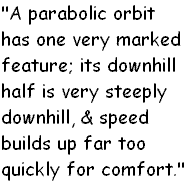
  2. "A parabolic orbit has one very marked feature; its downhill half is very steeply downhill, & speed builds up far too quickly for comfort."
  3. "there is, of course, a school of thought that considers the corona as extending well past the earth's orbit."
  4. "They were hurtling, at some three hundred ten miles per second, into a region where the spectroscope claimed temperatures above two million degrees to exist, where ions of iron & nickel & calcium wandered about with a dozen & more of their electrons stripped away, & where the electrons themselves formed almost a gas in their own right, albeit a highly tenuous one.

    It was that lack of density on which the men were counting. A single ion at a "temperature" of two million degrees means nothing; there isn't a human being alive who hasn't been struck by vast numbers of far more energetic particles. No one expected to pick up any serious amount of heat from the corona itself."
  5. "The comet, of course, was not a black body - and did not retain even the heat which it failed to reflect. The moment a portion of its surface was warmed seriously, that portion evaporated, taking the newly acquired heat energy with it. A new layer, still only a few degrees above absolute zero, was exposed in its turn to the flood of radiation."
  6. "If they could have seen a sunspot at all, it would have been as blinding as the rest of the photosphere - human eyes couldn't discriminate between the two orders of overload."
  7. "parabolic velocity at a distance of five hundred eighty thousand miles from Sol's center is just about three hundred thirty miles per second, & that produced noticeable relative motion even against a background a hundred & fifty thousand miles away. Features were disappearing below the solar horizon, sometimes, before Donegan could get around to them."

Fact sheet.

First published: Analog, November 1960.
Rating: A
Related: All stories of Hal Clement.

Saturday, March 29, 2008

Hal Clement's "The Foundling Stars" (short story, science fiction): Unexpected side-effect of a test to determine how nebulae give birth to stars

One of the less interesting stories of Clement. Part of the reason is - I'm astronomy illiterate; a good understanding of that is needed to follow this story.

Story summary.

How does a nebula give birth to a new star?

'It has been widely supposed for several decades that random variations in the density of the interstellar medium are the key factor - that the law of chance is the father... the random "winds" of space must at times produce a gas concentration so dense that its gravity would override the disruptive tidal force of the rest of the galaxy - override it enough to produce a local potential well able to trap at least the lower energy particles of the cloud.' That's the view Dick Ledermann, younger of the two researchers, subscribes to.

It's opposed by Elvin Toner, his 20 years senior. Toner "doubted seriously that the random motions of interstellar gas could set up the appropriate conditions often enough to account for the number of observed stars, even allowing for the fairly impressive lifetime of a star. He felt sure ... that some specific, widespread, underlying process was operating to improve the chance of protostar formation." This is "Toner hypothesis".

An experiment is underway to verify the hypothesis - in the "Orion Spur", "one of the cradles of the galaxy." Toner "had computed many combinations of electric and magnetic fields which should have such an effect, and which might reasonably - or at least conceivably - exist along the arms of the Milky Way." If the experiment "showed that such fields would, or could, produce the results Toner expected, he would have little trouble financing such a search" at expected places in galaxy.

Experiment comprises of a mothership - "Holiad" aka "Big Boy" - where the two researcher are camping & controlling the experimental apparatus. Plus two smaller ships, each manned by a single individual: "Anfforddus" piloted by Hoey, & "Ymyrgar" piloted by Rocco Luisi. These two ships are "about a light-hour apart" & must be absolutely still relative each other; in actual setup, their relative speed is "somewhat less than five centimeters a year".

For some reason, the smaller ships could not be robotic; they must be manned. And the setup requires that once they are still relative each other, the two pilot must stay absolutely still for several hours - lest center of gravity of their ships change even by microns!

Experiment involves setting up some kind of a web of electromagnetic 'standing waves which was to serve as the "framework" of the battery of measuring instruments, which were themselves force fields.'

Part way through the experiment, the two smaller ships suddenly vanish! Later investigations noticed "slightly high count of aluminum atoms in that particular volume of space", but no further evidence. The two pilots were never found.

In a separate thread, we are told there were alien soldiers - obviously in no form we would recognize as anything living - camping there. The electromagnetic field setup by the experiment was felt by one of these alien soldiers as "Something bit me... I couldn't help giving a little yelp -". It's this little yelp that apparently destroyed the two ships!

And these aliens live so slow lives that by the time a couple of sentences worth of conversation among them ended, "both Elvin Toner and Dick Ledermann were dead of old age."

Fact sheet.

"The Foundling Stars", short story, review
First published: "Worlds of If", August 1966.
Rating: B

Saturday, February 9, 2008

Hal Clement's "Needle" aka "From Outer Space" (novel, science fiction): Life on an idyll corral island in tropical Pacific

Quote from the novel titled Needle by Hal ClementThis book marks a departure from all Clement stories I've read:

  1. It's likely to be accessible to a broad range of readers - not just those with science background in school. Caveat: I have science background, & may not be the best person to judge this accessibility!
  2. It's not set on an exotic world. Much of the story is set on an island in the Pacific - somewhere not far from Tahiti.
Ostensibly, it's a detective story - a criminal on the run is to be nabbed by a cop. But that part of the plot is rather lame. It's better looked at as a general interest story about life on a tropical island.

I suppose you could call this story a juvenile, since much of the plot involves activities of a teenager.

I found the middle third rather slow moving. Not boring while I was reading, but I had to make an effort to pick up the book. After that the story picked up.

Certainly not the best of Clement, but not bad either.

The island.

I don't recall if the name of the island is mentioned.

Author doesn't say it, but it sounded like the island is under US administrative jurisdiction. Very low population - less than 150 families. Main occupation - bio-fuel making; they grow the shrubs, & extract oil from them.

It's a very small island. Dimensions only a few miles along any direction.

The cop & the fugitive.

Now this part is colorful, but it only complicated the story for me.

Cop is called "Hunter"; fugitive is unnamed. Both are parasitic shape-shifting aliens.

They are from an unnamed world where they have been living in symbiotic relationship with another race of intelligent beings. A host lets them live inside his body; in return, they protect the host from harmful microbes, sometimes from accidents, & they also serve as kind of first aid kit for the host in case of physical injury.

Over the course of evolution, they've grown an instinct that is almost sacred scripture - "Do nothing that can harm your host!" Criminal on the run apparently did this; that is why Hunter is chasing him.

They crash on earth - in shallow waters near this island, & in the vicinity of each other. Their ships are damaged beyond repair, but both of them escaped unharmed. At least Hunter was traveling inside its not-normal host - a kind of dog creature of his world called "perit". This host will die on crash. We don't know anything about the traveling host of fugitive.

They figure earth is a lot like their home; they can even eat local food & infect local animals with themselves. Hunter will invade a shark to reach shore & end up killing the shark. Its preferred host is an intelligent creature - since that offers the best chance of survival. After some drama, it will infest 14 year old Robert Kinnaird when he is sleeping on the beach.

Robert/Hunter duo are effectively the heroes of the story.

By themselves, each of these aliens look like a blob of jelly slightly bigger than the size of an average adult human's brain. Yet each is at least as intellectually competent as a human. And their tissue is multi-purpose; e.g., they can create a tentacle & construct an eye at the other end of it at will!

We are given a lot of details about them. The important thing is - they can enter a human through normal pores in our skin, distribute themselves throughout the body in the form of thin tentacles, take whatever food or oxygen they need from host, modify human sensory organs or tap them - so they can sense the world, etc. And, of course, they can communicate with host via normal senses as well as by signaling via specific muscles.

Story summary.

After infecting Robert with himself, Hunter is lying dormant for a while - just studying the insides of the host. Unfortunately for Hunter, Robert studies in a boarding school in far off Massachusetts, & will actually leave the island the next day. Hunter will discover this during the long flight.

During the half term in school, Hunter will quietly learn all it can about human body chemistry, English language, & about our world. Then it will slowly reveal itself to host - initially making the boy panic; they will slowly become friendly. They will conspire to get Robert sent home immediately rather than waiting for remaining half term to end; & will succeed in an unexpected way. That's may be first quarter or a third of the story.

They go back to island. About half year has lapsed since landing, & fugitive could have been anywhere on earth, inside any animal. This hunt is the lame part - they will not only find the fugitive on the island & kill it, they'll find it in a rather obvious host for this kind of story!

Title of the story comes from this hunt - even identifying the animal that is host to fugitive is like looking for a needle in a haystack.

The interesting parts of narrative are where Robert with his many friends go through their daily boyish routines - we are shown the island, places around it, boat repair, boating around the island, ...

Related.

  1. All stories by Hal Clement.

Fact sheet.

"Needle", novel, review
Alternative title: "From Outer Space"
First published: Astounding Science Fiction, May/June 1949.
Rating: B

Monday, February 4, 2008

Hal Clement's "Close to Critical" (novel, science fiction): Having fun with water/steam phase change!

Quote from the novel titled Close to Critical by Hal ClementThe most curious feature of the world dissected in this book is: the temperature at its surface & extremely dense nearby atmosphere varies in a very very narrow band - around the boiling point of water.

This almost fixed temperature is about 370ºC, just a little below the 374ºC that is the "critical temperature" of water (the reason for the title). The most interesting aspects of the story are about water/steam transition when temperature varies even slightly, & that density of water here is scarcely more than that of steam.

The consequences include: complete boiling away of oceans in the morning, & getting refilled each evening; frequent earthquakes; evening "raindrops" several tens of feet in diameter with scarcely higher density than water that lazily drift down & can be boiled away while still high in the air by barely increasing their temperature by holding a torch several meters underneath, ...

A tribe looking for a new home, or a traveler looking for a camping site, has to be very very wary - or the ocean will take you at night even if you chose a rather high elevation place in the evening!

This is not a book to pick up when you want light reading. And some science background will help. If you haven't read Hal Clement before, this note can give you an idea if he is likely to be your kind of author; it provides some caveats to reading Clement.

Table of contents.

  1. Executive summary.
  2. Tenebra, the fictional world.
  3. The various aliens.
  4. Tenebrites, the natives.
  5. Drommians, the other aliens.
  6. Story summary, thread 1: Human exploration of this world.
  7. Story summary, thread 2: Children stranded on Tenebra.
  8. Story summary, thread 3: Rescue of the kids.
  9. Characters & things.
  10. Related.
  11. Fact sheet.

Executive summary.

Humans are exploring this world via a robot, controlled from a spaceship in orbit. Robot needed assistants to explore the big world. Their recruitment involved stealing several eggs of the egg-laying intelligent natives at the level of human stone age, raising them, & then using them to explore! In time, this band of human assistants will come in conflict with a native tribe.

Via a separate thread, in circumstances that can only be called fantastic, two kids left alone in a space vehicle drift down to planetary surface near the location of robot! So there is a rescue drama with a happy ending - with the help of natives.

The most interesting aspects of the story are not actors or plot, but the world & its non-intuitive behavior.

Tenebra, the fictional world.

The story is set on a planet called "Tenebra", 16 light years from earth. "Altair" is the name of its sun.

Here are the key characteristics of this world:
  1. Tenebra is 3 times the diameter of earth, with surface gravity 3 times that of earth.
  2. It has a very dense atmosphere near the surface - its pressure at surface is about 800 times earth value. To human eye, the place is always rather dark. Local life, however, is well adapted to this level of light.
  3. It rotates about its axis in about 100 hours. Means one Tenebra day is about 4 earth days.
  4. Lower atmosphere is mostly steam, with a lot of oxygen & sulfur as impurities. Means chemically extremely volatile. You need especially engineered materials to make a lander; most normal materials humans use will quickly corrode there. Local animals breath oxygen.
  5. Almost constant surface temperature is 370ºC. Very minor difference between day & night temperatures results in precipitation of a part of lower atmosphere every evening that fills up the oceans for night; these oceans then boil away in the morning!
Small earthquakes are common - several times each day. "The area is not very well mapped, and what there is doesn't stay mapped very well... the question is not whether it will rain tomorrow but whether your pasture will start to grow into a hill... the atmosphere is mostly water near its critical temperature, and silicate rocks dissolve fairly rapidly under those circumstances. The place cools off just enough each night to let a little of the atmosphere turn liquid, so for the best part of two Earth days you have the crust washing down to the oceans... With three Earth gravities trying to make themselves felt, it's hardly surprising that the crust is readjusting all the time."

About the only surface liquid during day time is in oleum lakes - "oily liquid", "principally sulphuric acid with a heavy lacing of metal ions from the surrounding rocks which had been dissolved in the nightly rain, and an equilibrium amount of the atmospheric gases."

Nightly precipitation turns these oleum lakes into oceans. This "ocean decreases enormously in density" due to evening precipitation. A boat that will float well in day time will likely sink in the evening! "the sea had already been heavily diluted by the rain. That meant there was no point in expecting the raft to float. Its air-filled sacks were nearly half as dense as the straight acid; with this diluted stuff their buoyancy would be negligible... as the water began to boil back out of the sea, the latter's density increased, and the raft began to float".

Also, near shore where a river empties, there is more water content. Means the density increases as you move towards deeper seas. Adds some complications to the raft's travel, if I recall correctly.

Daily precipitation not only spontaneously forms raging rivers at night, their location keeps changing due to constant remaking of the planetary crust - but in ways that natives can intuitively predict.

Wind is almost unknown (explanation below). "Three knots is a wild hurricane on Tenebra" & "Tenebra is about the calmest place you'll find inside any atmosphere in the galaxy." A volcano eruption near the end of story will start winds that will play a role in the story.

One of the craziest aspects I could not fully fathom is the size of "raindrops". Evening precipitation doesn't lead to rains we are familiar with. It leads to huge spheres of water - several tens of feet in diameter - to drift down! These are not big bubbles with air filled in - these are water! "The pressure's so high that the atmosphere doesn't even come close to obeying the classical gas laws ... and the small percentage changes in temperature that do occur result in even smaller changes in volume, and therefore in density, and therefore in pressure. Little pressure difference means little wind. Even changing phase, from gas to liquid, makes so little change in density that the big raindrops just drift down like bubbles, in spite of the gravity."

So you really can physically run around to avoid them - "It's not too hard to dodge raindrops if you have enough light to see them coming". In one scene, a native uses one of these drops for camouflage - let yourself get enveloped in a drop & run at the expected speed of drop's movement while still inside!

There is a peculiar interaction of these big raindrops & the fires human have taught the natives. Nightly fires add just enough heat to a falling raindrop to evaporate it again - so those camping around can stay dry!! But occasionally, a raindrop will get a fire - so the fires need to be tended often.

There is another effect the nightly precipitation has. Early precipitation has a lot of oxygen bubbles suspended within the raindrop. Later ones come from relatively higher atmosphere, & their drift has allowed these bubble to leave their cage - so if you vaporize it, what you get is unbreathable steam without any oxygen. Means a traveler must find a place away from falling raindrops, particularly of later no-oxygen variety.

A variant effect of these no-oxygen raindrops is: if you immediately rush to a fire that has just been claimed by a raindrop, you will suffocate - oxygen near that place takes a while to replenish. "Several times ... human-educated natives had to make a rescue as someone ran blithely into the dead-air zone of a boiled-away raindrop to relight a fire. When they finally realized that a newly destroyed raindrop was like a newly boiled lake in the early morning, some of them took to waiting a long time before venturing near the extinguished fires, so that the fuel cooled too far to let the blaze spring back at the mere touch of a torch."

Frequent earthquakes & daily water cycle make any kind of useful map making very hard.

The various aliens.

Story features two races of intelligent aliens - Tenebrites are natives of Tenebra at a stone age stage of development; Drommian are space farers that are about peers of humans in technology development. Former are key to plot; introduction of later just complicates the story without adding value.

Among the natives featured are two different tribes - one raised by humans & an independent native tribe.

All aliens can speak to humans via their normal vocal/auditory apparatus.

Tenebrites, the natives.

Like other stories by Clement, the local life is as abundant as earth - plants, animals; vegetable eaters & predators. Among the flying animals, only "floater" is mentioned; it will play a key part near end of the story.

Plus, of course, there are intelligent natives. By & large, indistinguishable from humans except in physical appearance, but at a level of technology where they live in caves & don't even make fire (but can work with basic stone tools).

There is one aspect of the natives' behavior that is key to the story, & I could not accept as reasonable; it's there only because the author says so. These natives with near human intelligence are egg-layers, but leave their eggs unguarded in a communal nursery on a world that has predators!!

On physical appearance, we are told they are "fir-cone shaped beings", have scales, & have eight limbs. First adult the human robot saw after landing was "fully nine feet in height, and on that planet must have weighed well over a ton. It conformed to the local custom as regarded scales and number of limbs, but it walked erect on two of the appendages, seemed not to be using the next two, and used the upper four for pretension."

OK - so our counterparts use 4 hands, walk erect on 2 legs, & have 2 unused limbs.

Drommians, the other aliens.

Apparentlyfrom planet "Dromm". Evolved apparently from carnivores.

Adults are "nearly ten feet tall" when "standing on their hind legs". "Their general build was that of a weasel - or better, an otter, since the slender digits which terminated their five pairs of limbs were webbed. The limbs themselves were short and powerful, and the webs on the first two pairs reduced to fringes of membrane along the fingers - a perfectly normal evolutionary development for intelligent amphibious beings living on a planet with a surface gravity nearly four times that of the earth". Their limbs are "ten-clawed", & they normally "walked on all ten limbs, even those whose webs were modified to permit prehension".

Story features one adult - a diplomat named Councilor Aminadabarlee, & his little son Aminadorneldo aka 'Mina - "four years old, about the social equivalent of a human being of seven".

Adult is extremely hot tempered. Child is far more reasonable, but still violent.

Story summary, thread 1: Human exploration of this world.

The plot has some similarity with "Mission of Gravity" - in that human explorers in an orbiting ship use natives' help to explore their world & will later seek their help in locating & recovering something precious.

A big human ship, "Vindemiatrix", is in orbit around Tenebra, & has sent down a robotic explorer. By the end of the story, some 16 earth years would have lapsed since this landing.

Ship is 160 thousand miles above the surface - so communications with robot has a 2-second round-trip delay. This delay makes humans helpless in helping their proteges defend themselves during a violent fight - because fight needs instant reaction time. This delay also plays a part elsewhere in the story.

We don't know much about the robot except that,
  1. It can move around on the planetary surface, even in liquid parts of it. But more slowly than natives. It cannot fly.
  2. It either has a built in power source that can last very long, or is somehow able to recharge. I don't recall any mention of what powers it, but it's still going strong 16 years after landing.
  3. Its parts normally exposed to local atmosphere are made from some kind of plastic that can withstand local atmosphere.
  4. It has appendages that can act like arms & manipulate the environment. But they are of material that corrodes easily in local atmosphere. So it avoids using them except when absolutely necessary.
  5. It has a built in video phone. So humans orbiting the planet can see what the robot sees, or make it move around to explore the place. Robot is also is fitted with floodlights that can be remotely switched on or off - when low light local conditions aren't good enough. It can also pick up local sounds, including natives' language, for humans; or enable humans to speak to natives.
Robot will be known as Fagin to natives who will consider it alive. Only in later parts of the story do they learn that speech coming out from it is being relayed from elsewhere. To one group of locals, robot will be "the Teacher" - it has been teaching the life skills & technology way beyond the local knowledge.

Story begins with robot's landing. A year into its exploration, it will identify one kind of native animals as intelligent, discover that they lay eggs & leave the nursery unguarded in the open, steal some eggs & hatch them. These hatchlings will be his pupils. Idea is to teach the life skills & technology to these raised natives, & use them for exploring the world - for how much exploring can a single expensive robot do? I'm sure you can find some holes with this way of exploring, but that's the story - so let's continue.

16 years have lapsed since landing. Hatchlings are adults, live in a village, know how to make fire, raise cattle, speak English, etc. And they have began mapping the neighborhood for humans, via the Teacher. Nick Chopper is the leader of this group.

One fine day, Nick is on an exploration mission where he is attacked by an animal & saved by another of his kind. Nick grew up speaking English; other one speaks his own language. Nick follows him to his cave. This tribe of cavemen is led by someone called "Swift" - an autocratic but very able leader. Nick will spend a while with this tribe.

On seeing & hearing about the wondrous things Nick can do like making "fire and keeping herds of animals and raising plants for food", the leader wants to learn too. Nick innocently tells him about the Teacher but regrets it - for Swift now wants Teacher for exclusive use of his own people. Nick will be placed under guard, but will escape in dangerous conditions.

But Nick is an amateur at escape; Swift is an expert tracker. Nick reaches his village, & wants to leave since Swift might arrive. Teacher agrees to the danger, but says escape is futile - since they will be quickly tracked to new home too.

Attack from Swift's tribe happens at night. Two of Nick's people will be killed, & the Teacher "kidnapped".

Nick & the remaining crowd leave their village looking for a safer location; they will then work out a rescue plan for Teacher. This is where we learn what the nightly precipitation can do. They find home on a hill protected by a lake of oleum & connected to mainland by a narrow passage. Nightly precipitation will turn the lake into ocean that reaches near the top of the hill. They won't lose a group member, but will lose several cattle to predators of the sea.

Anyway, they'll later find safer home near this lake/sea, & Nick will effect a daring rescue of Teacher. Only, they will be quickly tracked down again by Swift's gang. But the rest of the story is best described as third thread - where this first thread meets the second to eventual climax.

Story summary, thread 2: Children stranded on Tenebra.

This part of the story is best described as fantastic - in its realism. But it will make the story progress - in the next part involving rescue.

Humans have made some progress developing a vehicle that can take them down to the surface of Tenebra. Ordinary rockets cannot work - "booster that will unload its exhaust against eight hundred atmospheres hasn't been built yet. They melt down - they don't blow up because the pressure's too high." So the plan is to go down in a "bathyscaphe", an aerial version of the old undersea vehicle that will lift via a balloon. High up where the pressure allows a rocket to function, bathyscaphe will be mated with a rocket-powered shuttle that will ferry the duo to orbiting Vindemiatrix. But the contraption is still in last stages of testing - not quite ready to go down.

Vindemiatrix has had two diplomat visitors - Councilor Rich (a human), & Councilor Aminadabarlee (a Drommian). Rich is accompanied with his 12 year old daughter Easy Rich, & Aminadabarlee has brought an even younger son Aminadorneldo (aka 'Mina).

While the adults are talking, someone is giving a tour of the ship to kids. As part of this tour, they will visit the bathyscaphe. Something goes wrong, leaving only the two kids in the vehicle while it drifts away from mothership. Later the vehicle has been captured by Tenebra's gravity & is hurtling down. Only thing the controllers on spaceship can do is guide it to land near the robot - so a rescue with the help of natives can be mounted. Landing is on on liquid rather than ground surface.

Problem with the stranded vehicle is some kind of external damage that comes in the way of inflating the balloons to take it up to a height where shuttle can pick it up. Kids inside cannot get out because "their space suits won't stand the pressure". So, the hope is: the natives will be able to repair the external damage based on instructions from humans in the ship, relayed via robot. As it turns out, a different solution will actually work near the end.

Story summary, thread 3: Rescue of the kids.

Something that struck me as abnormal was the supersmart human kid, Easy. She is not only composed most of the time she's stranded (several weeks), she seems to be far smarter than adults.

Anyway, Nick's people are mobilized for rescue via the robot. Before Swift's gang is upon them, they capture one of Swift's spies. Some discussion, & humans make an offer to Swift via this spy - join the search & rescue, in return for not only human knowledge but physical goodies that can be traded via future missions. But Swift seems to have other ideas. In any case, Nick & Swift's people will individually search for the stranded vehicle, but Swift will locate it first.

In the mean time, there is a volcanic eruption nearby - a very unusual event on Tenebra. Temperature difference near the volcanic vent & elsewhere will trigger wind - another unusual phenomenon. This wind will play a role near the climax, but otherwise, a part of volcano related adventures is simply about examining the effects of such temperature differences on surface & local life - it doesn't really advance the rescue drama.

One drastic effect of this wind is a hurricane-like effect on the lake/sea on whose coast Nick's group has been camping. I didn't quite follow the argument on how volcano-induced wind inundated the high lands: "With the sea not much denser than the air, the way it is late at night," "the two-mile hurricane had changed from gas to scarcely denser liquid".

Nick's group will lose a lot of their belongings & some members will be nearly killed by the event.

We also see some of the effects of nightly precipitation. New rivers that often come into being. For a while, the vehicle kids are stranded in will be dragged at the bottom of a newly formed river.

Part of the rescue effort involves building a boat - a raft-like structure fitted with balloon-type things underneath - balloons made from water-tight leather. "it was a rectangle of some fifteen by twenty feet, made of about three dozen rods of wood which an Earthman would probably have described as saplings, lashed at right angles to each other to form a reasonably solid grillwork." This part illustrates the effects of changing sea density due to daily water precipitation & evaporation.

Since Swift's people are first to locate the vehicle, Easy sees hope in them. She quickly learns local language & gets on good terms with him. She also tells him the story of Nick's people - how the eggs stolen by robot were probably of Swift's own people - so the two communities are kin. This will soften Swift, & aid reconciliation later when Nick's people reach the place.

Rescue eventually happens with the ship stranded a bit from shore - with both Nick's & Swift's people to help. Plus Nick's raft. They'll eventually drag the vehicle to shore, but won't actually fix whatever is wrong with machinery. Since the idea is to fill up the balloons with hydrogen, kids will find another method with the help of Swift & engineers aboard the orbiting ship.

I didn't quite follow how the procedure worked, but here it is. Catch some "floaters", local flying animals. They probably float because they have hydrogen pouches inside. Use them to fill the vehicle's tanks - by somehow connecting the animals' pouches to tubes leading to tanks.

Actual lift will be aided by volcano: "When the ship lifted, it naturally rode the wind toward the volcano; and it rose so slowly at first that the children had a good look at the terrifying sight. They dipped frighteningly toward the glowing mountain as it entered warmer air, but recovered in ample time as the hydrogen in its cells also warmed up. Gradually the glow faded out below them, and Easy and her friend waited happily to meet the shuttle" in upper atmosphere.

Characters & things.

  1. Fagin: Natives' name for human exploration robot.
  2. Nick Chopper: Leader of the group Fagin raised from stolen eggs. He & his group is a about 15 (earth) years old at the time most of the story unfolds. Fagin has been around a little over 16 years, but it took may be a year to locate the intelligent natives.
  3. John Doolittle aka Johnny; Alice; Tom; Jim; Dorothy; Nancy, Betsey: Some of the other members of Nick's group. Alice & Tom will be killed during the first attack of Swift on Nick's village.
  4. Swift: Leader of the natives' tribe that wants to claim Fagin from Nick's people.
  5. Dr Helven Raeker: Human biologist on board the spaceship. He is the main person we see interacting with & teaching the natives via robot.
  6. Vindemiatrix: Big human space ship from which the robot Fagin is being controlled.
  7. Councillor Aminadabarlee: The visiting Drommian diplomat. Very short tempered, & with a very big ego. Managing him will be a big headache for human all through the rescue drama.
  8. Aminadorneldo aka 'Mina: Little son of visiting Drommian diplomat, & one of the two kids who will be stranded on the planet. "four years old, about the social equivalent of a human being of seven".
  9. Councillor Rich: Visiting human diplomat whose daugher is among the two children stranded.
  10. Easy Rich: 12 year old daughter of Councillor Rich who will be stranded with Aminadorneldo. Supersmart & very cool headed. Not only does she behave way beyond her years, she seems to be very competent with technical stuff!
  11. "Crystal Mechanic Second Class Flanagan": The man showing the kids around on spaceship who left them alone in "bathyscaphe", leading to their eventual stranding. Has a very small role in the story.
  12. "bathyscaphe" aka 'scaphe: "a dirigible balloon". The vehicles designed to take humans to surface from upper atmosphere; trip from upper atmosphere to spaceship is via a rocket-powered shuttle (also called "tender"). Stranded kids are in a vehicle of this type. I don't think their vehicle is actually named. "a two-hundred-foot-long, cigar-like shell, and the only really heavy part was the forty-foot sphere in the center which held the habitable portion".

Related.

  1. All stories by Hal Clement.

Fact sheet.

"Close to Critical", novel, review
First published: As a 3 part serial in Astounding Science Fiction, May/June/July 1958.
Rating: A
Series: "Mission of Gravity" (A), "Close to Critical" (A), "Star Light" (A).