Showing posts with label 1956. Show all posts

Tuesday, December 10, 2013

Robert A Heinlein's "Double Star" (novel, politics): When an imposter became the ruler

Cover of the novel Double Star by Robert A HeinleinThis is a fast paced action story with a lot of election politics. I didn't like it as much as I wanted to because at some places the world view is too provincially Western; the thing that irritated me most was a small passage on the classification of world's languages - confidently told & totally bogus.

Story summary.

Here is a solar Empire spanning many worlds, dominated by humans though there are aliens on other worlds. It's a monarchy similar to British one - emperor is supreme but is a rubberstamp, & sits in a city on the moon. The parliament has the power & is elected; aliens can vote but must choose a human representative. Head of government is the "Supreme Minister", probably majority leader in Parliament.

Current ruling party has arranged the kidnapping of the leader of opposition at a time where he's absolutely required to be present at a Martian ceremony. So his underlings will recruit an actor, Lawrence Smith aka Lorenzo Smythe, to act as an imposter at the function. One thing will lead to another & new situations will keep coming up & the imposter will end up becoming the politician he's impersonating.

The story is, first & foremost, the character study of this actor, & evolution of his personality.

Fact sheet.

First published: Astounding, Feb/Mar/Apr 1956.
Rating: A.
Among the stories from Astounding/Analog issues edited by John Campbell.
Winner of Hugo Award 1957 in novel category.
Related: Stories of Robert Heinlein.

Friday, August 16, 2013

Robert F Young's "Collector's Item" (short story, free)

Hmmm... so even Galactic Historian can make minor omissions...

Fact sheet.

First published: Fantastic Universe, September 1956.
Download full text from Project Gutenberg or Manybooks. [via Becky@ClassicScienceFiction]
Rating: B.
Related: Stories of Robert F Young.

Tuesday, June 11, 2013

William Tenn's "Time in Advance" (novelette, free): 50% discount on pre-murder conviction!

One of the illustrations by Dick Francis accompanying the original publication in Galaxy magazine of short story Time in Advance by William Tenn. Image shows the videophone with the protagonists ex-wife making a confession on display screen.I'd recently read a story from Astounding, August 1958 (British ed) where I liked the concept: Stanley Mullen's "Fool Killer". Looks like that was an imitation of this excellent original.

Story summary.

On this future earth, you get a 50% discount on a murder sentence, provided you seek conviction before committing the murder! 7 years on deadly prison planets. You can, of course, change your mind part way through the sentence & return without prejudice, but then you forfeit the served sentence. But on successful completion of the sentence, you've earned the right to murder one human being!

One such precriminal, just returned after serving the pre-murder sentence, will actually get some completely unexpected enlightenment...

Collected in.

  1.  William Tenn's "Time in Advance".

Fact sheet.

First published: Galaxy, August 1956.
Note: I'd read this in an anthology, but scans of the issue where this story originally appeared is online.
Rating: A.
Related: Stories of William Tenn.

Sunday, June 9, 2013

Evelyn E Smith's "The Venus Trap" (short story, free): Man brings hope to a dying alien species

One of the illustrations by Dick Francis accompanying the original publication in Galaxy magazine of short story The Venus Trap by Evelyn E Smith. Image shows the jealous human woman trying to cut down the intelligent alien tree woman while her husband restrains her.Man has just began colonizing an alien world called Elysium, a world full of intelligent native plants. But most males of these plants died out of a disease; the world is now full of female intelligent plants, with no hope of a future generation.

One of the colonists men will develop a special relationship with Magnolia, one of these female plants, leading to much acrimony & jealousy on the part of his wife. But things turn hopeful near end, with a new arrival from earth...

See also.

  1. Eric Frank Russell's "P.S."; download as part of a larger package: A man has had an alien as a pen-pal for a number of decades. Now, old & alone, he learns that his life long pen friend is actually a tree & a rather smelly one at that! How should he react to the news?

Fact sheet.

First published: Galaxy, June 1956.
Download full text from Project Gutenberg, Manybooks, Feedbooks. [via John Grayshaw @ClassicScienceFiction]
Rating: B.
Related: Stories of Evelyn E Smith; Vegetable SF.

Monday, March 4, 2013

Robert Silverberg's "To Be Continued" (short story, immortality, free): Slow life is frustrating!

One of the illustrations by Emsh accompanying the publication in Astounding Science Fiction, British edition, April 1957, of short story To Be Continued by Robert Silverberg. Image shows the 2000 year old hero with 2 personas of his 300 year old lady love.
Immortality here is of a curious kind - your growth slows down. Like you'll develop physically & psychologically by a year when actual time lapsed in say 100 years! Author didn't elaborate how the hero survived infancy since parents aren't normally immortals & the immortals exist without society knowing about them; that's a weak point of the story.

The only immortals we meet in the story also have a curious super ability - they can morph into a different individual, in all observable ways. So, e.g., you can simultaneously romance two girls using your different personas, & no trouble even if one of them spots you with another.

This is the story of a 2000 year old man, Gaius Titus Menenius, who's now finally reached puberty! Story is mostly his search for a mate, with a funny ending.

See also.

  1. Mohsen H Darabi's "Loyalty beyond seasons" (download): Another kind of biological impediment to romance...
  2. Eric Frank Russell's "The Waitabits" (download as part of a larger package): When a fast life encounters a much slower one...

Fact sheet.

First published: Astounding, May 1956.
Download full text as part of the scans of Astounding (British ed), April 1957.
Rating: A.
Among the stories from Astounding/Analog issues edited by John Campbell.
Related: Stories of Robert Silverberg.

Tuesday, February 19, 2013

Algis Budrys' "Look On My Works" (short story, post apocalypse, free): Guides milking tourists...

Illustration by Freas accompanying the publication in Astounding Science Fiction, British edition, of short story Look On My Works by Algis Budrys. Image shows a human tourist from Centaurus in far-future flooded New York city, with a fake gargoyle decorating the roof of an old building in background.
For a post apocalypse story, it's a very light read; even had me smiling many times.

Story summary.

About 600 years into future, New York city is flooded to near roofs of some of the tallest current buildings, & local civilization has regressed to simpler times. But some hardy local conmen are happily milking the visiting human tourists from prosperous space colonies (established before the floods), offering the visitors the almost mythical authentic Terran fare...

Fact sheet.

First published: Astounding, December 1956.
Download full text as part of the scans of Astounding (British ed), April 1957.
Rating: B.
Among the stories from Astounding/Analog issues edited by John Campbell.
Related: Stories of Algis Budrys.

Saturday, January 26, 2013

Algis Budrys' "Man in the Sky" (short story, free): Cold engineering vs public opinion

Illustration by van Dongen accompanying the publication in Astounding Science Fiction, British edition, August 1956 issue of short story Man in the Sky by Algis Budrys. Image shows the dead pilot of first space flight in earth orbit.
It's dated in that it's a pre-spaceflight story, imagining early space flight in ways that we now know were different. But it's readable.

Story summary.

US, as part of a very long running program to put man on moon, has put the first satellite in orbit around earth. A (solo) manned satellite, because technology for precise automatic steering up in orbit is not available.

As soon as the satellite goes in orbit, the pilot dies of heart attack. No mystery there, just an ordinary bad coincidence.

Dilemma faced by bosses down: The dead pilot up there is worth more to the ground than a live one, because now satellite can stay up there & continue bringing in telemetry data! But public opinion will force them to bring the body down, a project involving building a new identical machine, work that inevitably kills a few workers as part of construction accidents!

Fact sheet.

First published: Astounding, March 1956.
Download full text as part of the scans of Astounding (British edition), August 1956.
Rating: B.
Among the stories from Astounding/Analog issues edited by John Campbell.
Related: Stories of Algis Budrys.

Thursday, January 24, 2013

Herbert L Cooper's "A Nice Little Niche" (short story, ecology, free): When vitamin K craving alien bacteria infected human guts

One of the illustrations by van Dongen accompanying the publication in Astounding Science Fiction, British Edition, August 1956, of short story A Nice Little Niche by Herbert L Cooper. Picture shows an alien cave painting illustrating how aliens got weak over a period of time and eventually died out.
Someone thinks the author might be a pseudonym of Edmond Cooper, based on the story style. And as far as I can find, this is the only published story of "Herbert L Cooper", a story that has never been reprinted.

Story summary.

This is a classic Campbell puzzle story. Human explorers have arrived on a very desirable world. Only there is evidence that there once were mammalian animals here that died out a few hundred thousand years ago.

A doctor on board will puzzle things out, & barely save the humans on board...

Fact sheet.

First published: Astounding, March 1956.
Download full text as part of the scans of Astounding (British edition), August 1956.
Rating: B.
Among the stories from Astounding/Analog issues edited by John Campbell.

Wednesday, January 23, 2013

"Astounding Science Fiction" (British Edition), August 1956 (ed John Campbell) (magazine, free): Annotated table of contents

Cover by Ed Emshwiller of Astounding Science Fiction magazine, August 1956 issue, British edition. Cover illustrates the story Exploration Team by Murray Leinster.
I've read "Exploration Team" & "Minor Ingradient" elsewhere before, but don't recall much of them now.

Links on author fetch more fiction by author. Where I have a separate post on a story, link on story title goes there. For read stories, my rating appears in brackets.

Table of contents (best first, unread last).

  1. [ss] Herbert L Cooper's "A Nice Little Niche" (B): When vitamin K craving alien bacteria invaded human guts...
  2. [ss] Algis Budrys' "Man in the Sky" (B): Cold engineering vs public opinion.

    It's a story about early spaceflight, before there was space flight.
  3. [novelette] Murray Leinster's "Exploration Team": "The perfect machine for exploring a new plant would, of course, be self-repairing, self-maintaining, able to construct its own repair parts from local materials, & even able to replace itself with a new unit..."
  4. [ss] Eric Frank Russell's "Minor Ingradient": "A critically necessary lesson any true officer must learn is the crushing burden it is to be Master of a slave..."
  5. [serial - 2/3] Robert Heinlein's "Double Star": "Lorenzo, the conceited pipsqueak, was stretched & inflated to fill a mold. But Lorenzo, while conceited beyond question--was not a fool!"

Fact sheet.

Labeled: "Vol XII No 8 (British Edition)".
Download scans as a CBR file. [via Bob@pulpscans]
Note: Link points to a RAR file that contains target CBR, probably to work around some hosting service file naming constraints.
Related: Stories from the Astounding/Analog issues edited by John Campbell, old "pulps", 1950s.

Sunday, December 23, 2012

Robert Silverberg & Randall Garrett's "The Chosen People" (as by Robert Randall) (novelette, communications, free): Teaching the scientific method to deeply tradition bound

One of the illustrations by van Dongen accompanying the publication in British edition of Astounding Science Fiction magazine of short story The Chosen People by Robert Silverberg and Randall Garrett. Image shows a human teacher with his alien student.
This rarely reprinted story would be among my all time favorite science fiction. It's a study in how to win friends & influence people!

Story summary.

There is a deeply religious & tradition-bound alien society on a world called Nidor. Humans came a few decades back, & seem to be wise & religious beyond question; so they're respected & have been allowed to run a local school that teaches the familiar to youngsters, sometimes in new ways. And what a revolution it is brewing!

Story is told via a massive local disaster that can only be averted with the new ways of thinking: "Hugl", small insect-sized pests, travel in vast swarms & destroy everything in their path. Only "Edris powder", the traditional insecticide, is not working this year...

Fact sheet.

First published: Astounding, June 1956.
According to ISFDB, it's first of the 3 stories that make up the fix-up novel "The Shrouded Planet".
Download full text as part of scans of Astounding (British Edition), November 1956.
Rating: A.
Among the stories from Astounding/Analog issues edited by John Campbell.
Related: Stories of Robert Silverberg, Randall Garrett.

Saturday, December 22, 2012

Poul Anderson's "The Live Coward" (short story, intrigue, free): Cop catches a fugitive

One of the illustrations by Freas accompanying the publication in British edition of Astounding Science Fiction magazine of short story The Live Coward by Poul Anderson. Image illustrates the public duel between policeman and the fugitive in front of the alien temple.
One of the minor stories with a colorful background that is generally quite readable.

Story summary.

A policeman needs to flush out a fugitive who's hidden himself among the rulers of a tribe. But he must do this without any collateral damage to those around the fugitive.

Set in a galaxy spanning human empire. The tribe hiding the fugitive is part of a backwaters planet with medieval Europe type ruling clique with constant clashes between nominal rulers & powerful priests.

Fact sheet.

First published: Astounding, June 1956.
Download full text as part of scans of Astounding (British Edition), November 1956.
Rating: B.
Among the stories from Astounding/Analog issues edited by John Campbell.
Related: Stories of Poul Anderson.

Wednesday, December 19, 2012

Algis Budrys' "The Peasant Girl" (as by Paul Janvier) (short story, free)

One of the illustration accompanying the publication in Astounding magazine, British edition, of short story The Peasant Girl by Algis Budrys. Image shows the central character receiving at his home his estranged & married sister with her baby boy, her husbad, and her father in law.
Not sure why I liked it - I would like to say the plot didn't do much for me, but it sure kept my attention & I finished it in a single sitting.

Story summary.

Mankind has split into two races - ordinary humans, & a new apparently far superior race of supermen - telepathic, able to change shape of things by thought, able to move by thought, etc. They seem to control ordinary humans' lives.

One day, Dorothy, the little sister of Henry Spar, a small town "cabinetmaker", vanished. Apparently kidnapped by one of the supermen, something that seems to happen fairly regularly, with ordinary men resigned to this fate. But Henry goes looking for his sister...

I found the ending too antithetical to rest of the story, supermen to whom ordinary men are supermen, in some sense...

Fact sheet.

First published: Astounding, June 1956.
Download full text as part of scans of Astounding (British Edition), November 1956.
Rating: B.
Among the stories from Astounding/Analog issues edited by John Campbell.
Related: Stories of Algis Budrys.

Monday, November 12, 2012

"Astounding Science Fiction" (British Edition), November 1956 (ed John W Campbell) (magazine, free): Annotated table of contents & review

Cover by Freas of the British edition of Astounding Science Fiction magazine, November 1956. Cover illustrates the story Plus X by Eric Frank Russell.
I'd read "Next of Kin", the novelization of "Plus X" (another longer variant of the story is "The Space Willis"), when I went through a Russell phase some years ago, & just loved it. Now, reading the original novelette in this issue, I had a milder reaction, but it still made me laugh at many places. It's a funny jailbreak story - a human smart alec vs his dimwitted alien captors.

Table of contents.

  1. [novelette] Eric Frank Russell's "Plus X" (A); humor: Didn't you know that humans can only exist in pairs?
  2. [novelette]  Robert Silverberg & Randall Garrett's "The Chosen People" (as by Robert Randall) (A): Teaching the scientific method to deeply tradition bound.
  3. [ss] Poul Anderson's "The Live Coward" (B): Cop catches a fugitive in colorful circumstances.
  4. [ss] Algis Budrys's "The Peasant Girl" (as by Paul Janvier) (B): Humans are supermen to supermen!
  5. [ss] Thomas N Scortia's "Sea Change": 'Of course, everybody knows what "being human" means--it's just that they can't define it, but of course they know what it means..."

Fact sheet.

Labeled: Vol XII, No 11.
Download scans as a CBR file. [via Bob@pulpscans]
Note: Link points to a RAR file that contains target CBR, probably to work around some hosting service file naming constraints.
Related: Stories from the Astounding/Analog issues edited by John Campbell, old "pulps", 1950s.

Tuesday, September 4, 2012

Philip K Dick's "The Minority Report" (novelette, conspiracy, free): Don't invite death; it might oblige!

Quotation from the short story The Minority Report by Philip K Dick
A country whose administration was once dominated by military, but military had its wings clipped after a devastating war. What was then military's turf is now divided up with police.

And police here aren't the kind you're familiar with. These guys prosecute people for "precrimes" - crimes they're yet to commit! But it's sure that if left free, they will commit these crimes! This prediction is done using 3 "precog mutants" & some complicated machinery.

Now a band of military veterans have decided to get back their former glory...

Fact sheet.

First published: Fantastic Universe, January 1956.
Download full text from C. W. Aanderson (dot) org, or read online at Google cache.
Rating: A. 
Related: Stories of Philip K Dick.

Friday, June 29, 2012

Eric Frank Russell's "Legwork" (novelette, alien invasion): Solving a weird bank robbery

Most of the story is a detective work - as cops trace the culprit of an extremely weird bank robbery.

But as readers, we already know the culprit: an alien scout who's here to prepare the groundwork for invasion. And he has an unusual ability: within a mile of him, he can make anything with some brains, animal or human, see whatever he wishes them to see.

How do you track someone who could look like anyone or anything? Or nab one who could make you handcuff yourself instead of him!

See also.

  1. "Spiro" (download scans as part of a larger package): Another Russell story with similar theme - catching an alien spy that can masquerade as anything to humans around him.

Fact sheet.

First published: Astounding, April 1956.
Rating: A.
Among the stories from Astounding/Analog issues edited by John Campbell.
Related: Stories of Eric Frank Russell (annotated list).

Thursday, March 22, 2012

James H Schmitz's "Sour Note on Palayata" (novelette, mystery, free): An unusual evolution of brain

Quote from short story Sour Note on Palayata by James H Schmitz
I'm not sure of the factual accuracy of the thesis of this story - I know little about psychology. Central idea here is: of the two minds we have - conscious & unconscious - conscious is the smarter one; unconscious is relatively dumb.

Aliens in this story have the opposite: conscious is intelligent but relatively dumb; real smart alien lives in the unconscious - leading to curious behavior. And author gives us a good reason why evolution chose to structure these aliens like this.

Plot itself is structured as a mystery: there seems to be more to Palayatans than meets the eye, something far smarter, an unknown factor - call it X. Investigators need to figure out if X indeed exits, & whether it is a threat to humanity.

Fact sheet.

First published: Astounding, November 1956.
Download full text from Baen CD.
Rating: B.
Among the stories edited by John Campbell for Astounding/Analog.
Related: Stories of James H Schmitz.

Friday, January 13, 2012

Lester del Rey's "Dead Ringer" (short story, creepy, free)

Illustration by Dick Francis accompanying the original publication in Galaxy magazine of the short story Dead Ringer by Lester del Rey

Plot idea is rather common;  I've seen more than one story like this of Kuttner alone.

Story summary.

Most of the story is a creepy one - a man has convinced himself that there are aliens among us, aliens in the shape of humans, aliens who intend to take over earth. And that these aliens cannot be killed; they get resurrected. Of course, he's unable to convince anyone.

There is a surprise ending, but may be I've already spoiled it.

Fact sheet.

First published: Galaxy, November 1956.
Download full text from Project Gutenberg, Manybooks, Feedbooks.
Rating: B. 
Related: Stories of Lester del Rey.

Tuesday, November 29, 2011

Christopher Anvil's "Pandora's Planet" (novelette, humor, free): Earth's alien invaders are harassed

Gets more & more unrealistic near end, but most of it is a very funny description of troubles with humanity of humanoid alien colonists of earth who want the mankind integrated into some sort of stellar community of intelligent beings.

Fact sheet.

First published: Astounding, September 1956.
Download full text from Webscription. [via Bill Garthright @ ClassicScienceFiction]
Rating: A.
Among the stories from Astounding/Analog issues edited by John Campbell.
Related: Stories of Christopher Anvil, alien invasion.

Sunday, October 2, 2011

Robert Sheckley's "Bad Medicine" (as by Finn O'Donnevan) (short story, humor, free): A neurotic gets the wrong treatment

Elwood Caswell has strong homicidal urge towards his friend Magnessen. Recognizing his own problem, he goes out & buys "the Rex Regenerator, built by General Motors" - a "mechanotherapist". Only there was a problem in delivery - the model he was delivered is meant to cure Martians.

So the machine will treat Elwood strangely...

Fact sheet.

First published: Galaxy, July 1956.
Download full text from Project Gutenberg, Manybooks, Feedbooks. [via John@ClassicScienceFiction]
Download audio from Project Gutenberg.
Rating: A.
Related: Stories of Robert Sheckley.

Sunday, August 21, 2011

Some short fiction

I haven't been posting often recently because there haven't been too many good stories I've read recently. Here are 3 I read this week:
  1. [ss] Mike Resnick's "Treasure Island" (B); download; Subterranean Online, Spring 2011; non-genre, humor: Conman priest, Lucifer Jones, "helps" sea pirates recover treasure hidden on a Pacific island by one of their own.
  2. [novelette] Winston K Marks' "Backlash" (B); download; Galaxy, January 1954: A rather contrived alien invasion.
  3. [ss] Alan Cogan's "In the Cards" (B); download; Galaxy, June 1956: Future-viewer kill free will.

Wednesday, September 15, 2010

Milton Lesser's "Prison of a Billion Years" (as by C H Thames) (short story, evolution, free): All life on earth is ultimately descended from...

Illustration, by H W McCauley, accompanying the original publication in Imagination magazine of short story Prison of a Billion Years by Milton Lesser
Central idea is very similar to Alfred Bester's "Adam and No Eve" (download comic book adaptation), but I found it much less interesting.

Story is set on primordial earth - long before there is life here. I've a feeling the descriptions aren't quite accurate & time is certainly inaccurate, but that could be because the story is from 1950s.

Story summary.

There is an ultimate jail - set on earth of a billion years ago, back when there was no life, seas were not yet salty, you never saw sun because of mist, etc.

And there is a condemned prisoner - Adam Slade, where "Adam" is significant, in Biblical sense. Hours before his execution time, he killed a guard, took a woman hostage, & escaped out in the wilds where no one can survive because there is no food. He has a desperate plan to take charge of the local time machine, & escape back to livelier times.

Story is mostly his travelogue on this primordial earth. He will be eventually killed by lightning near the sea coast, & claimed by sea. Of course, we're all descended from the bacteria & microbes that inhabited his body!

Fact sheet.

First published: Imagination, April 1956.
Download full text from Project Gutenberg, Manybooks, Feedbooks.
Download audio from LibriVox (read by Mark Nelson).
Caution: Main Project Gutenberg page lists author as "Stephen Marlowe", but text has "C H Thames". I wonder if "Stephen Marlowe" is also one of author's pseudonyms?
Rating: B.

Friday, June 11, 2010

New at Project Gutenberg (10 June 2010)

Links on author, publisher, or year fetch more matching fiction.

  1. Robert E Howard's "Red Nails"; download; Weird Tales, July-October 1936: "a barbarian adventurer, a woman pirate, and a weird roofed city inhabited by the most peculiar race of men ever spawned".
  2. Leroy Yerxa's "One-Way Ticket to Nowhere"; download; Amazing Stories, December 1942: "Like a ghost in the night a whole Mono train vanished. And it was up to Jeff Blake to find out where it had gone..."
  3. Chester S Geier's "The Sphere of Sleep"; download; Amazing Stories, December 1942: "Brad Nelson had a perfect way to kill Big Tim without any danger of being accused. Then his foot slipped and he was hurled into an unknown world."
  4. Mari Wolf's "The First Day of Spring"; download; If, June 1954: "a love story of two young people who met under the magic of festival time. One was Trina, whose world was a gentle make-believe Earth. The other was Max, handsome spaceman, whose world was the infinite universe of space..."
  5. Jack Taylor's "The Moralist"; download; Galaxy, June 1956: "Aye, 'tis a difficult thing to be a lady on a far world--but who needs them there?"
Related: Fiction from old "pulp" magazines.

Tuesday, June 1, 2010

Free fiction: Fantastic Universe, March 1956

At Internet Archive in multiple formats.
Note: The description on IA page wrongly mentions March 1952; actual downloaded file's ToC page has March 1956.

Among the authors: Marion Zimmer Bradley, Robert Sheckley.

Tuesday, May 25, 2010

Judith Merril's "Exile from Space" (novelette, first contact, free): Human girl, raised by aliens, returns home

A very well done story, though with a familiar trope: lone, nearly human looking, alien stranded on earth. One of the better known stories of the kind is Murray Leinster's "The Strange Case of John Kingman".

Story summary.

Strictly speaking, it's not a first contact story; it's about the adventures of a human girl who's returned to earth for the first time since she was taken away by aliens as a baby. And raised lovingly by them. Aliens who'd accidentally killed her parents.

It's also commentary on our society - by using the device of seeing it through the girl with alien outlook. Sometimes quite humorous.

And there is a love story too. She falling in love with a normal man here, & their ambiguous happy ending.

Quotes.

  1. On typical drivers on a crowded road: "You'd think anybody who could build an automobile—let alone an atom bomb--could drive one easily enough. Especially with a lifetime to learn in. Maybe they just like to live dangerously."
  2. "a true metropolitan area" "means--on Earth--that it is dirtier, more crowded, far less pleasant to look at or live in, and a great deal more convenient and efficient to do business in."
  3. "when dealing with humans, one must always allow for waste time."
  4. Her problem with contraceptives: "The idea of pursuing a course of action whose sole motivation was the procreative urge, and simultaneously to decide by an act of will to refuse to procreate."

Fact sheet.

First published: Fantastic Universe, November 1956.
Download full text from Project Gutenberg, Manybooks, Feedbooks.
Rating: A.
Related: Stories of Judith Merril; First contact fiction; Fiction from 1950s.

Monday, May 24, 2010

New at Project Gutenberg (23 May 2010)

Links on author, publisher, or year fetch more matching fiction.

  1. Geoff St Reynard's "The Giants From Outer Space"; download; Imagination, May 1954: "Grim terror lurked in the void many light years from Earth. But Pinkham and his men were unaware of it--until suddenly they discovered--The Giants From Outer Space".
  2. Fox B Holden's "A Gift For Terra"; download; If, September 1954: 'The good Martian Samaritans rescued Johnny Love and offered him "the stars". Now, maybe, Johnny didn't look closely enough into the "gift horse's" mouth, but there were others who did ... and found therein the answer to life...'
  3. Edmond Hamilton's "The Legion of Lazarus"; download; Imagination, April 1956: "Being expelled from an air lock into deep space was the legal method of execution. But it was also the only way a man could qualify for--The Legion Of Lazarus".
  4. G L Vandenburg's "Moon Glow"; download; Amazing Stories, November 1958: "That first trip to the moon has been the subject of many stories. Mr. Vandenburg has come up with as novel a twist as we've ever read. And it could happen."
Also, at Internet Archive today: Benjamin Lumley's utopian novel, "Another world; or, Fragments from the star city of Montalluyah" (as by Hermes) (1873).

Related: Fiction from onld "pulp" magazines.

Saturday, May 22, 2010

New at Project Gutenberg (22 May 2010)

Links on author, publisher, or year fetch more matching fiction.

  1. Lloyd Arthur Eshbach's "Isle of the Undead"; download; Weird Tales, October 1936: "the frightful fate that befell a yachting party on the dreadful island of living dead men".
  2. H W Guernsey's "Here Lies"; download; Weird Tales, October 1937: "a practical communist who taught his friend when to take him seriously".
  3. H Sivia's "The Last of Mrs DeBrugh"; download; Weird Tales, October 1937: "Mr DeBrugh was dead, but he still regarded his promise as a sacred duty to be carried out."
  4. Geoff St Reynard's "The Buttoned Sky"; download; Imagination, August 1953: "Legends spoke of Earth's glorious past, of freedom and greatness. But this was the future, ruled by god-globes, as men gazed fearfully at--THE BUTTONED SKY".
Related: Fiction from old "pulp" magazines.

Monday, May 17, 2010

New at Project Gutenberg (17 May 2010)

Links on author, publisher, or year yield more matching fiction.

  1. [novel] Charles Willard Diffin's "Brood of the Dark Moon"; download; Astounding Stories, August/November 1931: "Once more Chet, Walt and Diane are united in a wild ride to the Dark Moon--but this time they go as prisoners of their deadly enemy Schwartzmann."
  2. Berkeley Livingston's "Oogie Finds Love"; download; Amazing Stories, November 1948: "It took a fierce battle with the prehistoric Cro-Magnons, and a modern wrestling match with the Russian Bear, before Oogie, the Caveman, finally won beautiful Sala for his woman".
  3. Lester del Rey's "No Strings Attached"; download; If, June 1954: "Poor Henry was an unhappy husband whose wife had a habit of using bad clichès. Alféar was a genii who was, quite like most humans, a creature of habit. Their murder compact was absolutely perfect, with--"
  4. Raymond F Jones' "Human Error"; download; If, April 1956: "The government was spending a billion dollars to convince the human race that men ought to be ashamed to be men--instead of errorless, cybernetics machines. But they forgot that an errorless man is a dead man..."
Related: Fiction from old "pulps".

Tuesday, April 13, 2010

Everett B Cole's "Indirection" (short story, first contact, free): A method to keep state secrets

An illustration accompanying the original appearance in Astounding Science Fiction magazine, January 1956 issue, of short story Indirection by Everett B ColeWhile there are any number of stories that tell the story of a fiction author, or movies that tell about movie makers, this is by far the most engaging I've seen of the kind: science fiction authors as agents enrolled to keep state secrets!

Story summary.

Super-advanced galactic races have had their observers forever on earth, their memories now preserved in legends. To make things more interesting, humans were among the advanced races that somehow faced a long forgotten doomsday, & fell to primitive times; but they do retain something from this ancient glory.

Now one of these alien observers, masquerading as a human scholar in a remote rural community, has his cover exposed due to a naughty native servant. So what should the aliens do to ensure humanity is prepared for an eventual contact with them...

See also.

  1. Arthur Clarke & James Blish's "Guardian Angel": Another story where humanity needs a long time preparing for contact with aliens, known so far via legends. Specifics, however, are very different.

Fact sheet.

First published: Astounding, January 1956.
Download full text as part of Astounding issue it appeared in.
Rating: B.
Among the stories from Astounding/Analog issues edited by John Campbell.
Related: First contact fiction; Fiction from 1950s.

Friday, April 2, 2010

"Astounding Science Fiction", January 1956 (ed John W Campbell, Jr) (magazine, free): Annotated table of contents

Cover image by Van Dongen of Astounding Science Fiction magazine, January 1956 issueAvailable online at Internet Archive in multiple formats.
Note: I'd posted this link, sans ToC, sometime back. Regulars might already have it on their disk.

Has a lot of pages missing, among them at least two of the stories - "The Executioner" & "Won't You Walk-". Means the only complete story is "Indirection".

Table of contents (4 stories).

Links on author fetch more matching fiction.
  1. [novelette] Algis Budrys' "The Executioner": Not available in online copy linked above.

    Not read.
  2. [novelette] Theodore Sturgeon's "Won't You Walk-": Not available in online copy linked above.

    Not read.
  3. [ss] Everett B Cole's "Indirection" (B): "The best way to keep a secret is to publish it in a quite unbelievable form—and insist that it is the truth."
  4. [serial - conclusion (probably part 3/3] Frank Herbert's "Under Pressure": "There was a factor present that held the men together under that grinding, unendurable pressure ... that wouldn't fit into the psychodynamic equations. Essentially, they weren't machines, and the dynamics of machines didn't apply!"

    Not read.

See also.

  1. Fiction from Analog/Astounding (only issues edited by Harry Bates, John Campbell).
  2. Stories written by John Campbell.
  3. Fiction from 1950s.
  4. Old "pulp" magazines.

Monday, November 9, 2009

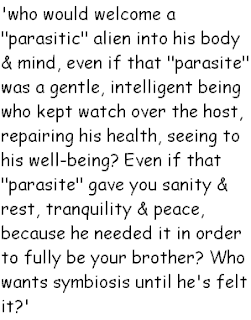
Algis Budrys' "Silent Brother" (as by Paul Janvier) (short story, symbiosis)

Quote from short story titled Silent Brother by Algis BudrysThis one is a good read, from among the many stories that share its main trope: sentient alien parasites find an initially reluctant & then willing host in humans because of the ... sort of ... rent aliens are willing to pay.

Story summary.

Four men comprising the first human expedition to Alpha Centauri have returned after their 6 months (?) long trip - with an unusual gift. A gift government considers so dangerous it has them quarantined.

Meanwhile, Harvey Cable, the inventor of the stardrive & now a cripple living some 20 miles from the site of expedition's landing, is finding his uneventful life changed in unexplainable ways.

Of course, there is a link between the returned expedition & the curious events now happening in Harvey's life...

See also.

  1. Larry Niven's "Smut Talk" (download) & Hal Clement's "Needle" are similar in that they too feature sentient alien parasites that use humans as hosts.
  2. Howard L Myers' "Partner" (download) has a plot somewhat akin to curious events in Harvey's life. And the general style of this part has been a favorite of Henry Kuttner & C L Moore - their fantastic story "The Prisoner in the Skull" immediately comes to mind. May be Robert Louis Stevenson's "The Strange Case of Dr Jekyll and Mr Hyde" is the canonical story about this trope (but I haven't read Stevenson's version).

Collected in.

  1. Isaac Asimov & Martin H Greenberg (Eds)' "Isaac Asimov Presents the Great SF Stories 18 (1956)".

Fact sheet.

First published: Astounding, February 1956.
Rating: A.
Listed among the stories from John Campbell's Astounding/Analog.
Related: Stories of Algis Budrys.

Monday, October 26, 2009

James Blish's "Tomb Tapper" (novelette, war, free)

It reminded me of Arthur Clarke's "Hate". In both stories, the victim is an innocent young Russian girl. In this story, she's killed by evil Soviet government that could not care less about its citizens; Clarke's version is stronger, & has the girl killed by a man from another European country who has a personal grudge against Russia & Russians. Near end, both evoke sentiments somewhat like Tom Godwin's "The Cold Equations", though neither comes anywhere close to Godwin's classic in emotional power.

Story summary.

During US/Russia war, a very unusual flying vehicle seems to have entered a railway tunnel in US with great precision, getting stuck half way through the tunnel. US officials examining what they believe is a wreck discover something unusual...

Notes.

Story features a device that can pick memories from the brains of the recently dead, & is used as an espionage aid. This is I think the first story I've seen with such a device, though Isaac Asimov's novel "Fantastic Voyage II: Destination Brain" tried to achieve a similar effect with a man not quite dead yet.

Fact sheet.

First published: Astounding, July 1956.
Rating: B.
Download full text from Internet Archive.
Included in Ellen Datlow's SciFiction's Classics section.
Listed among the stories from John Campbell's Astounding/Analog.
Related: Stories of James Blish.

Thursday, August 6, 2009

Harry Harrison's "The Velvet Glove" (novelette, free)

An out of job robot, in society where robots can live as legally independent individuals but as second class citizens with humans hating them, earns admiration & work - because of bravery forced by circumstances.

Fact sheet.

First published: Fantastic Universe, November 1956.
Rating: B.
Download full text from Project Gutenberg or Manybooks. Or download MP3 from The Time Traveler Show. [PG link via QuasarDragon; MP3 link via SFFAudio which also has more details of podcast]
Related: Stories of Harry Harrison.

Monday, March 16, 2009

Isaac Asimov & Martin H Greenberg (Eds)' "Isaac Asimov Presents the Great SF Stories 18 (1956)" (anthology): Annotated table of contents & review

This is #18 of a series of 25 anthologies by these editors. This book collects stories first published during the year 1956.

I haven't read many stories yet; will update as I move through the book. Where I'm aware of online copies of stories, I provide download links. My rating is in brackets. Where I've a separate post on a the story, link on story title goes there. Link on a noun yields more of related stories.

Table of contents (15 stories, best first, unread last).

  1. [ss] Isaac Asimov's "The Last Question" (A); download; Science Fiction Quarterly, November 1956: An AI is given a rather fundamental problem - figure out a way to reverse entropy without expanding energy!
  2. [novelette] Mark Clifton's "Clerical Error" (A); download; Astounding, February 1956: In a society that doesn't value innovation, a man inflicted with demons formed by an understanding of the nature of his society & his upbringing is cured by a kind psychiatrist.
  3. [novelette] Murray Leinster's "Exploration Team" aka "Combat Team" (A); download; Astounding, March 1956; adventure: A rebel helps tame a dangerous world. Winner of Hugo Award 1957 in novelette category.
  4. [ss] Algis Budrys' "Silent Brother" (A); Astounding, February 1956; symbiosis: First human expedition to Alpha Centauri has returned with an unusual gift...
  5. [novelette] Alan E Nourse's "Brightside Crossing" (A); Galaxy, January 1956; adventure: An unsuccessful trek over the "sun-facing" side of Mercury at the time that planet is closest to Sun.
    PS: It's now known that Mercury is not tidally locked to Sun. But it's a good adventure anyway.
  6. [ss] Damon Knight's "The Country of the Kind" (C); F&SF, February 1956; fantasy: A peaceful society boycotts a man prone to violence.
  7. [novelette] Henry Kuttner & C L Moore's "Rite of Passage"; F&SF, May 1956: Not read.
  8. [novelette] Poul Anderson's "The Man Who Came Early"; F&SF, June 1956: Not read.
  9. [novelette] James Blish's "A Work of Art"; Science Fiction Stories, July 1956: Not read.
  10. [ss] Margaret St Clair's "Horrer Howce"; Galaxy, July 1956: Not read.
  11. [ss] Mack Reynolds' "Compounded Interest"; F&SF, August 1956: Not read.
  12. [ss] Reginald Bretnor's "The Doorstop"; Astounding, November 1956: Not read.
  13. [novelette] Damon Knight's "Stranger Station"; F&SF, December 1956: Not read.
  14. [ss] Michael Shaara's "2066: Election Day"; Astounding, December 1956: Not read.
  15. [novelette] Theodore Sturgeon's "And Now the News..."; F&SF, December 1956: Not read.
    PS: I recall having seen it online, & probably have it saved on hard disk. But don't have URL off hand. Try a Google search.

Fact sheet.

First published: August 1988 (DAW).
Relevant entries have been added to the list of stories from John Campbell's Astounding.
Some of the bibliographical information here comes from ISFDB.

Saturday, February 7, 2009

Hal Clement's "Dust Rag" (short story, lunar atmosphere)

An illustration accompanying the 2005 NASA paper titled Moon Fountains that compares observed properties and current theories of lunar atmosphere vis-a-vis those suggested by the 1956 short story titled Dust Rag by Hal ClementThis may be among the most important hard sf stories by anyone. Unfortunately, it doesn't appear to be among the widely read ones.

Story describes the phenomenon of lunar haze - a thin constantly renewed atmosphere of dust on moon. What constantly kicks up this dust? Why doesn't it immediately fall down rather than remain suspended? A 2005 NASA paper discusses this story vis-a-vis actual observed phenomenon & currently accepted theories.

Story also has some things to say on the design of space suites.

Plot is classic Clement: a couple of men get into a life & death situation. Only reasoning based on elementary physics or chemistry (in this case, physics) will get them out of jam.

An aside: This story made me see a plot pattern that seems to be common across many Clement stories, & which appears to be the same as one in ancient Sanskrit story of "Enchanted Pool" in Mahabharata. More on it in a separate post.

Story summary.

Ridging & Shandara are two from a research station on moon - it's still early days of lunar exploration. Expedition had discovered a local magnetic field; "the south magnetic pole - or a south magnetic pole - lay a few hundred miles away." Duo are going there to set up some instruments.

The pole lies on the a peak at the rim of something called Pluto crater. Previous telescopic observations from earth had observed periodic obscuring of its surface that lasts varying lengths of time. They make a trek into crater see if they can find anything.

They're puzzled by what is obviously a local atmosphere! They rule out presence of gases for reasons I didn't catch. So it must be super-fine dust. What could be causing its ejection, & what could be keeping it suspended?

Life & death situation happens when they instinctively wipe their transparent space suit plastic in front of their eyes, as the vision begins getting unexpectedly blurred by haze. Only, the wiping with space suit sleeve seems to stick the dust to surface in front of their eyes rather than remove it! They are quickly blinded. And no hope of rescue: "there isn't enough fuel on the Moon to get a rescue tractor out here, even if anyone knew we were in trouble & could make the trip in time."

One will eventually reason the atmosphere & why wiping is not helping.

"we have reason to believe there's a magnetic storm going on, which strongly suggests charged particles from the Sun. We are standing, for practical purposes, on the Moon's south magnetic pole." "There are, at a guess, protons coming from the sun. They are reaching the Moon's surface here - virtually all of them, since the Moon has a magnetic field but no atmosphere. The surface material is one of the lousiest imaginable electrical conductors, so the dust normally on the surface picks up & keeps charge. And what, dear student, happens to particles carrying like electrical charges?"

"They are repelled from each other."

"And if a hundred-kilometer circle with a rim a couple of kilos high is charged all over, what happens to the dust lying on it?"

That's the reason for dust atmosphere, also favored by NASA now: moondust electrically charged because of interaction with solar wind levitates.

But why cannot they wipe their faceplates? "Whenever two materials rub against each other, electrons come loose... Unless the materials are of identical electronic makeup, which for practical purposes means unless they are the same substance, one of them will hang onto the electrons a little - or a lot - better than the other, so one will have a negative net charge & the other a positive one. It's our misfortune that the difference between the plastic in our faceplates & that in the rest of the suits is the wrong way; when we rubbed the two, the faceplates picked up a charge opposite to that of the surrounding dust - probably negative, since I suppose the dust is positive & a transparent material should have a good grip on its electrons."

They'll try several things, none very helpful. Eventually, what saves them is the rubbing of their faceplates against each other. One of the two will lose dust ("one of them was bound to go positive") & gain vision, & lead the way out of haze.

Fact sheet.

First published: Astounding Science Fiction, September 1956.
Rating: A.
Listed among the stories from John Campbell's Astounding/Analog.

Related.

  1. Stories of Hal Clement.
  2. Stories from Astounding/Analog.
  3. Arthur Clarke's novel "A Fall of Moondust": Far more widely read than this Clement story. But according to this NASA paper, Clarke's description of moondust is wrong & Clement's is right.

Thursday, November 6, 2008

Murray Leinster's "The Swamp Was Upside Down" (novelette, problem solving, free): How to stop landslides?

Quote from short story titled The Swamp Was Upside Down by Murray LeinsterWhile there are parts dealing with soil mechanics & other stuff I didn't follow, main story is very cool.

Story summary.

Canna III is a watery world with a single habitable island. And the island is sort of inclined - big cliff on one side, & gently sloping towards the other side. Intensive & irresponsible agriculture has made a lot of water collect where soil meets bedrock - turning the land into a sort of a swamp turned upside down! And this swamp is now sliding towards the sea - taking land with it! Even minor vibrations - triggered by waves hitting the cliff side, or a motor boat approaching - tend to trigger landslides.

To complicate matter further, there has been a big leakage of "ship-fuel" - some sort of synthetic liquid fuel that is safe when refrigerated but very explosive at a little above normal temperature. This has seeped from underground tanks at bedrock level - so now just the right conditions, & island goes puff!

Bordman is the specialist called. He will work out an ingenious method that uses seeped fuel to simply evaporate the trapped water near bedrock - turning the place habitable again.

Fact sheet.

First published: Astounding Science Fiction, September 1956.
Rating: A
Download full text from Webscription.
Listed among the stories from John Campbell's Astounding/Analog.
Related: All stories from Analog/Astounding; Harry Bates' Astounding.
Related: All stories of Murray Leinster.

Tuesday, July 15, 2008

L Sprague de Camp's "A Gun for Dinosaur" (novelette, time travel, free): Description of flora & fauna of Cretaceous period

Quote from short story titled A Gun for Dinosaur by L Sprague de CampWhen introducing this story, David Drake tells us that "Men-against-dinosaur stories are as old as magazine SF... de Camp turned what had been occasional subjects for stories into defined subgenres." Well, there is an earlier Arthur Clarke's "Time's Arrow", but it's still an interesting story.

Story summary.

It's a frame story - main dinosaur hunting story described in the small outer frame. Mr Rivers, a hunter who's partner in the time travel safari outfit named "Rivers and Aiyar", is giving an anecdote to Mr Seligman, a prospective client Rivers is refusing to take because he weighs too little. Rest of this post is about the main story.

Main story is of a hunt. Human time travelers go to "April twenty-fourth, eight-five million B.C." in Cretaceous period. To hunt dinosaurs for fun! They will spend several days there. There is also a short thread of an accident after their return - but I won't get into that.

Critique.

The most interesting thing for me was meticulous attention to detail when describing local environment during a certain part of Cretaceous: local terrain; animals, insects & flying creatures; weak points of different kinds of dinosaurs from a hunter's perspective; best strategy to escape when a dinosaur is after you; ... I've no idea if these descriptions are based on known facts, or solely the author's imagination; but they put life into the story.

The story has it flaws, some of them due to my personal biases:
  1. I grew up in a family where consciously killing any kind of life is taboo. Hunting stories are not really the kind I go for.
  2. There is colonial era here - "sahibs", interactions among the characters, their biases & value systems, ... It's not very often that I can like stories set in that period.
  3. It's not always a logical story. You take an expensive trip to cretaceous & won't do your own work; you carry with you a staff like cook & helpers!
  4. Some rather obnoxious characters. Courtney James, one of the clients on safari, will kill anything that moves for the shear thrill of using his gun! August Holtzinger, the other client, is out hunting so he can hang the stuffed head of the killed animal in his drawing room!

    Note: Holtzinger is killed by a tyrannosaur during safari when trying to save life of a cornered James. James dies by the end of the story because, well, because bad boys die in good stories!
But for me, the details of local environment made up for all its flaws. Beautiful story.

See also.

I've posted on at least 3 other stories on similar themes:
  1. Ray Bradbury's "A Sound of Thunder" is a far less rigorous version of the same plot.
  2. Arthur Clarke's "Time's Arrow" is an interesting variant.
  3. Michael Crichton's "Jurassic Park", of course, puts things upside down - by bringing dinosaurs to our time rather than humans going to their time.

Collected in.

  1. David Drake, Jim Baen, & Eric Flint (Ed)'s "The World Turned Upside Down".
  2. "The Best of L Sprague de Camp".

Fact sheet.

First published: Galaxy Science Fiction, March 1956.
Rating: A
Download full text or MP3. This post is based on text version; I've not heard the audio.