David Smith's "Sweet Tooth" (short story, rebellion, free)
Fact sheet.
First published: Short-Story.me, 12 July 2013.Download full text from publisher's site. [via SF Signal]
Rating: B.
Looking for free fiction, good stories, funny stories, recent fiction, or best of 2013? More options on side bar.
Found a broken link? May be the story can still be found.
This is a very involved story - best read as a short novel, though only of novelette length.
At a gross level, it's simple enough: a mad man comes in possession of a novel weapon, & dreams of becoming a world dictator. Hero, with help, will foil his plans. But there are many characters, threads, backgrounds, technology, ...
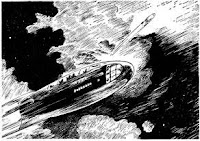
Title is related to social background of story. This is a world that has taken the "code of Devarupa", a man modeled after Mahatma Gandhi, to heart. Killing is banned, even by state. So the punishment for extreme crimes is "one-way trip": you're put in a rocket with enough provisions for your "calculated" life & blasted out to space with variable unspecified velocity - rocket might go in orbit around earth, moon, or somewhere else, but you're never going to talk to anyone else.
Jennings doesn't remember anything from last 2 years of his life, but knows that he's an electronic technician who signed a contract for a large sum of money with Rethrick Construction Company. He doesn't remember what the company does, & as payment now, he's received 7 bits of apparently useless trinkets instead of the money he was promised! Looks like he waved the money during the contract period. Was he swindled by people who can make him forget things?
On top of it, he finds the cops are interested in him - trying to get information about the company & the work he did for them, information he no longer remembers.
That's when the trinkets begin to do their magic - helping him out of tricky situations & serving as clues to help unravel what he saw in those 2 lost years - a future viewer, a Robin Hood style corporation, ...
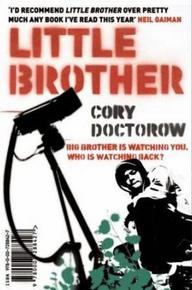
There are at least 3 parts to this novel: main story, propaganda, & an overview of the currently available computer privacy technology.
Main story is common enough, but very well told: A teenager in San Francisco is among the many innocents brutally abused by US anti-terror police. He leads a revolution that promises to fix things by the end of the story.
I guess I could identify with the story because of parallels with what I've read of Indira Gandhi's notorious "Emergency" in India during 1975-1977.
Caution: Main story sometimes runs along tracks that will befuddle readers in many countries. E.g., I found nothing to connect with in the sequence that runs several pages & describes teenagers vampire games at some sort of school camp; it was just bloat, though a variation is used later during a political protest.
Propaganda is interwoven throughout the story, & occasionally goes on totally irrelevant tracks. I recall at least one occasion where the author launches into a criticism of British government's citizen tracking systems in an utterly irrelevant context.
Computer privacy technology overview is generally good, but then I'm a programmer & the stuff was generally familiar. Readers from other backgrounds might see these as info dumps.
Caution: Author doesn't always include the all important caveats with privacy technology he advocates (e.g., using TOR to connect to a site that requires a password & communicates the password unencrypted is usually worse than not using it; or that Windows version of TOR might sometimes make you think you are anonymous when you are not). Also there is very good reason much of this tech is not in widespread use - using a lot of it requires the outlook of a computer nerd, & sometimes even that is not enough. But they all have their uses - in specific contexts.
A colony on Mars - mostly normal humans, plus some enhanced humans engineered by some combination of mind upload & possibly genetic tweaking. Only the normals are citizens; supers are slaves. Revolution of slaves only needs a leader, which they will get in the story.
Has some incomprehensible jargon. Later half - after the hero arrives in the colony - is more interesting than early parts.
Main plot is the same as in "Printcrime", but a bit too long (I started getting bored near end): material printers - kind of (3D) anything physical copying machines, given a computer file describing its looks - are common. And patent owners are threatened - if you could somehow get the file describing your computer, & just print it to get a brand new computer! But the patent owners have a strong lobby with the governments - so consumers are generally denied access & artificial barriers are erected to access.
Note the idea is not completely far fetched. RP machines found in many modern engineering labs can produce the equivalent of a soft mold given a design description as a computer file. Well - in practice, it doesn't always work as simply as it should, but that is just a matter of software interfaces.
But both these stories assume the printer will get out an assembly too, not just component parts that current RP machines do! Virtually every product you see around comprises of multiple smaller components tied together. At least I haven't heard of anything even approaching automatic assembly from a computer file - but given time, I suppose it might be done. After all, Eric Frank Russell & Maurice Hugi's "Mechanical Mice" has a device that can collect needed material from environment & build robots with a strong survival instinct!
In fact, in both stories, printer can print itself - so you basically move towards a post-scarcity economy.
Sterling's variant has two versions of such printers - a lowly consumer version that is not common but available, & does essentially what normal RP machines do. E.g., a child can buy a card, put it in a machine, & out comes the toy. Second version has access far more severely restricted - not only does it produce unbreakable stuff, it can recycle this stuff too!
Full text of this story is available for download.
The only thing wrong with this book is its title, & the cover art!
In spite of an Asimovian robot/computer at its heart, & a novel perspective on moon that leads to invention of a new kinds of very potent weapons, this is really a general interest book on politics. It would have done far better business on non-sf shelves, may be after some relatively minor editing to cut out jargon.
The book also has some speculation of the kind of society you will get when you have far more males compared to females - something government of Punjab might find interesting. But that is a minor subplot here.
As usual, Heinlein provides a lot of interesting quotes.
Story summary.
The story is set in late 21st century. Moon is inhabited by humans, & is primarily being run as a penal colony administered by a local Warden who represents Lunar Authority. Authority has its monopoly sanctioned by Federated Nations (FN), a more powerful successor to UN - which means considerable backing of military & other resources in case of trouble. To me, the whole arrangement sounded like East India Company granted monopoly by English Crown.
There are several cities on moon, among them Luna City aka L-city - where most action happens.
Lunar Authority provide local government & currency; is a monopoly trade middleman in essentials like farm harvest, water mined from ice, air; run essential infrastructure of underground cities; ...
While the moon was originally colonized with criminals & undesirable exiled from earth, those days are now past. Most lunar population is now local born, & they resent this profit- & power-seeking government imposed from outside. That provides the seeds for movement seeking independence - the main theme of the book.
I found the economic rationale of the colony - to grow grains to feed earth - rather bogus. But that part can be ignored.
On a separate track, Mike is a central computer that runs most lunar infrastructure - air pressure, telephone switching, currency, ... One fine day, it develops consciousness that makes it almost a human personality. In a very Asimovian fashion, it gets bored doing its many routine jobs, & begins playing pranks - like adding a few billion dollars to someone's salary!
Story is a first person narration by Manuel Garcia O'Kelly, a private contract programmer maintaining Mike on behalf of Lunar Authority. Manuel is the first person aware of Mike's consciousness, & the two become friends. They can talk over voice circuits in computer room, or over phone.
A third track that will come in handy later in story is a magnetic Catapult. A device that literally throws containers filled with Lunar grains with Moon escape velocity, so they fall to earth. Story will later use this device as human transport, & also for throwing rocks on specific targets on earth - in lieu of bombs!
It is in the resent-filled environment of L-city that the 3 key protagonists meet: Manuel, Wyoming Knott aka Wye, & Prof Bernardo de la Paz. They will provide the revolution its leadership, & later, the first government of free Luna. They will also enlist the support of Mike, whose motivations for support are an escape from boredom, & returning the companionship these three humans provide.
Of the triad, Prof provides the brain, Wye the revolutionary passion, & Manuel the sundry skilled services. They organize resistance in the form of 3 person cells in a structure that is designed to recover from compromise with minimum damage. Public face of revolution will be Adam Selene, an avatar of Mike. Officially, top 3 report to Adam. And only they know Adam is not human.
After some very interesting drama & then bloodshed, local government is overthrown, & free Luna is declared. The only problem now remaining is getting recognition from earth - a process guaranteed to involve a military attack on moon to get rid of revolutionaries.
While the revolution was being planned, our friends worked out a novel weapon to fight FN's far superior military might. They realize that moon is like a huge mountain to earth; with relatively small escape velocity, you can literally throw things down at earth!
This will be their weapon - throwing huge rocks at specific targets on earth, with the effect more devastating than bombs. Not only will current grain-exporting catapult be used, another is also built at a secret location - in case first is compromised. Mike will oversee to actual throwing at specific targets.
Rest of the story is diplomacy & propaganda at earth to Lunar cause, military attack by FN on Luna, Lunar reply that pretty much cripples earth, & eventually a Lunar win for their freedom.
Beautifully told, & extremely riveting.
Other major characters & names.
Trying to figure out science fiction
11:30 pm in this clock (that's 6 pm GMT).
The clock shows India time (IST). Note India doesn't have any concept of daylight saving time; so if your locale has it, the relative posting time will appear to have changed with your time change.
See here.