Showing posts with label 19th century. Show all posts

Monday, October 27, 2014

Jules Verne's "Ticket No '9672'" aka "The Lottery Ticket" (novel, non-genre, free): Introducing idyllic Norwegian countryside

Cover of novel Ticket No 9672 by Jules VerneI actually picked it up expecting an adventure, & got disappointed. It's readable enough, if you are in mood for a slow moving story in scenic locations with far too much descriptions & far too little dialogs or action.

Story summary.

Story is mostly set in Dal, a small town in Norway. A family of 3 Hansens - mother, daughter, & son, running an inn. Daughter's fiance has gone on a fishing expedition to Newfoundland, & the marriage is expected on his return; only his ship gets wrecked at sea, with all presumed dead.

Eventually, a bottle is found at sea, containing a lottery ticket bearing the number of story's title, & a farewell message at its back for the girl from fiance. News spreads, people get superstitious about the number, & begin sending bids to buy it. Add an influential man who'll get fond of the family & will move mountains to get positive proof of the sailor's death.

Eventually happy ending.

Fact sheet.

First published: 1886.
Download full text from Project Gutenberg, Feedbooks.
Rating: B.
Related: Stories of Jules Verne.

Sunday, April 6, 2014

Edgar Allan Poe's "The Tell-Tale Heart" (short story, horror, free)

This is not science fiction. It's creepy horror. A mad man is telling us how he murdered an old man because the victim had blue eyes of a vulture!

Fact sheet.

First published: 1843.
Download full text.
Download MP3 from Internet Archive.
See a movie adaptation at YouTube.
Rating: B.
Related: Stories of Edgar Allan Poe; from 19th century.

Sunday, August 25, 2013

H G Wells' "The Red Room" (short story, gothic horror, free)

This is a haunted house story. A large abandoned palace with three old caretakers has a "Red Room" that is haunted & feared. Narrator, apparently a traveler, will insist on staying there saying he doesn't fear ghosts, & will discover the fear first hand.

Notes.

Much of story is about setting the mood, but the key part went over my head. In the end, narrator tells us "there is no ghost there at all, but worse, far worse, something impalpable— ... The worst of all the things that haunt poor mortal men, ... and that is, in all its nakedness—'Fear!' Fear that will not have light nor sound, that will not bear with reason, that deafens and darkens and overwhelms." And yet the mysterious events of the
night before don't quite fit this conclusion.

Fact sheet.

First published: The Idler, March 1896.
Download full text from Project Gutenberg or eBooks@Adelaide.
Rating: B.
Related: Stories of H G Wells.

Friday, August 23, 2013

Free fiction: Two novelette scans from Frank Reade Library (1890s)

Both via Pulpshmoo@pbscans. Both links fetch rar files that need to be renamed as cbr. Both are by an anonymous author using the pen name "Noname".
  1. "Six Weeks in the Great Wirlpool; or, Strange Adventures in a Submarine Boat"; download; Frank Reade Library, No 46 Vol 2, 5 August 1893.
  2. "Lost in a Comet's Tail; or, Frank Reade, Jr's Strange Adventure With His New Air-Ship"; download; Frank Reade Library, Vol 122 No V, 13 December 1895.
Related: 19th century fiction.

Wednesday, October 17, 2012

H G Wells' "The Chronic Argonauts" (novelette, time travel, free)

This is supposed to be the first time machine story of science fiction, predating author's own "The Time Machine" (download) by 7 years. Time machine in this story is called "the Chronic Argo, the ship that sails through time".

Story summary.

An ordinary Welsh village of Llyddwdd gets a lot of excitement as a mysterious stranger suddenly begins occupying the village's haunted house. A stranger with a strange taste in things mechanical.

Made me smile several times.

Fact sheet.

First published: The Science Schools Journal (1888) (published by the Royal College of Science).
Download full text from Gaslight. [via James W Harris @ClassicScienceFiction]
Rating: A. 
Related: Stories of H G Wells; fiction from 19th century.

Thursday, February 16, 2012

H G Wells' "In the Abyss" (short story, hard sf, free): Exploring the bottom of the ocean

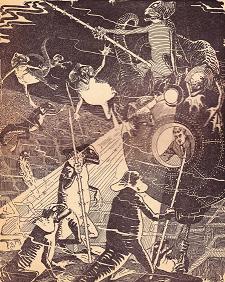
Illustration accompanying the republication in Amazing Stories magazine, September 1926 issue, of short story In the Abyss by H G Wells. Picture shows the native inhabitants of ocean bottom taking the human exploration submarine to their city.
An early description of a submarine for exploring the sea surface 5 miles below the water surface. I've'nt read Jules Verne's "20000 Leagues under the Sea"; so no idea if there is any similarity.

Story summary.

Lt Elstead of British navy will be going down in a spherical cabin made of heavy steel that's mostly air & would naturally float. Cabin is padded inside, because passenger is likely to be thrown around in the device that lacks any controls its human occupant exercise. The cabin has two windows of thick glass.

It's tied with a 5 mile rope of some kind of a floatable material to a massive deadweight of lead. At the interface of dead weight & rope is a "clockwork", an automatic mechanism that steers the human cabin up & down as follows:
  1. After the deadweight reaches the sea bottom, clockwork triggers the winding of a winch that pulls the rope down, with it bringing the human floating cabin to sea bottom. I don't recall how the deadweight determines that it has reached the bottom; may be a timer.
  2. 30 minutes after bringing the cabin down, the clockwork automatically activates a knife that cuts the rope that connects it to cabin; so cabin rises to surface by its buoyancy where it will be retrieved by a waiting ship. Ship is also used for initial lowering of the contraption into the sea. (Why not rewind the winch & let buoyancy raise the cabin? Saving the rope?)
Of course, things don't go as planned. Our explorer meets the intelligent denizens of sea bottom & ends up visiting their city.

See also.

  1. H G Wells' "The Land Ironclads" (download): Another hard sf story by author, now describing an early version of a battle tank.

Fact sheet.

First published: Pearson's Magazine, August 1896.
Download full text from Project Gutenberg of Australia.
Download full text as part of the scans of Amazing Stories, September 1926 (about 80GB, with this as the sole complete story!)
Download audio as part of this collection from Internet Archive.
Rating: B.
Related: Stories of H G Wells.

Monday, December 12, 2011

Weatherby Chesney's "The Lizard" (as by C J Cutcliffe Hyne) (short story, free): A man wakes up a sleeping prehistoric monster

I found this via an article on some precursors to Jurassic Park.

This is not really a dinosaur story, however; the monster is a giant prehistoric lizard. At a certain level, this is of the class of stories where curious humans consciously wake up a sleeping ancient monster, not realizing it's a monster (e.g., Benson Dolling's "Amber Insect" or John Campbell's "Who Goes There?" (download))

Narrator is a "cave hunter", exploring a newly visible cave, & ends up being chased by the monster lizard sleeping there for millennia...

Fact sheet.

First published: The Strand Magazine, June 1898.
Download full text from Horror Masters.
Rating: B.
Related: Fiction from 19th century.

Tuesday, October 11, 2011

Mary Shelley's "The Invisible Girl" (short story, non-genre, love story, free)

Story itself is very simple & familiar: rich widowed man adopts an orphaned girl & raises her with his own son. Girl & boy fall in love. Dad disapproves. Lot of tears. Eventually, happy ending.

Reading it, however, required some effort. Very long paragraphs & some really old words. And while the story is clearly non-genre, presentation is ... sort of ... creepy - ghost story like.

Note: In spite of title, the story has nothing to do with invisibility, as is known to science fiction.

Fact sheet.

First published: 1832. Where?
Download full text from Horror Masters, Project Gutenberg of Australia, Manybooks, Feedbooks.
Rating: B.
Related: Stories of Mary Shelley, fiction from 19th century.

Wednesday, January 12, 2011

Crazy history of "Alice in the Wonderland"

From S Peter Davis & David A Vindiola's "6 Books Everyone (Including Your English Teacher) Got Wrong" in Cracked (via someone at ClassicScienceFiction Yahoo group):

I would never had guessed it: Lewis Carroll's "Alice's Adventures in Wonderland" is really a satire of the new mathematics that began appearing in 19th century & confused someone grounded in Euclidean maths!

And I didn't know that Lewis Carroll is actually a pen name of one Charles Lutwidge Dodgson, a mathematics professor whose familiar world was being turned upside down by crazy new concepts like imaginary numbers: '"Alice" was the sensible Euclidean mathematician trying desperately to keep herself sane and tempered, while "Wonderland" was really Christ Church College at Oxford, where Dodgson worked, and its inhabitants were just as barking mad as he thought his colleagues really were.'

Saturday, July 3, 2010

Some old novels posted to Internet Archive today

Last 3 are labeled "utopia".

  1. George Tucker's "A voyage to the moon: with some account of the manners and customs, science and philosophy, of the people of Morosofia, and other lunarians" (1827); download.
  2. John Collins' "1970: a vision of the coming age" (1870); download.
  3. Alfred Denton Cridge's "Utopia; or, The history of an extinct planet" (1884); download.
  4. Louisa Sarah Bevington's "Common-sense Country" (1890); download.
Related: Fiction from 19th century.

Sunday, June 27, 2010

New at Project Gutenberg (26 June 2010)

Links on author, publisher, or year fetch more matching fiction.

  1. [novel] Jules Verne's "Round the World in Eighty Days" (trans Henry Frith); download; 1878: "Round the World in Eighty Days (London: Routledge, 1878) was the third English translation of Jules Verne's Le tour du monde en quatre-vingts jours to be published. It has since been greatly overshadowed by the 1873 version by George Makepeace Towle".
Related: Fiction from old "pulp" magazines.

Thursday, May 13, 2010

New at Project Gutenberg (13 May 2010)

Links on author, publisher, or year yield more matching fiction.

  1. [novel] Jules Verne's "Facing the Flag"; download: This is "an anonymous translation of Face au drapeau (1896)". There exists another different English translation of the same work, "entitled For the Flag (1897) translated by Mrs. Cashel Hoey."
  2. [novel] Jackson Gregory's "Daughter of the Sun: A Tale of Adventure"; download.
  3. Walter J Sheldon's "Brink of Madness"; download; If, July 1953: "C.I.B. Agent Pell used his head, even if he did rely on hunches more than on the computer. In fact, when the game got rough, he found that to use his head, he first had to keep it..."
  4. Winston K Marks' "The Mind Digger"; download; Imagination, April 1958: "There was a reason why his scripts were smash hits--they had realism. And why not? He was reliving every scene and emotion in them!"
Related: Fiction from old "pulps".

Tuesday, January 12, 2010

Free fiction: 2 issues of "Argosy" - 8 August 1931, & 17 March 1888

Scans in CBR/CBZ formats at Crosseyed Cyclops in two RAR files.

Note that while Argosy has published some good science fiction, it was really a multi-genre magazine.

Different titles of the two included issues could be because of magazine's name change over its long life; I'm not sure.

  1. "Argosy #1 1931 rar": Contains "Argosy, 8 August 1931" issue.
  2. "Golden Argosy 1888 rar": Contains "Golden Argosy, 17 March 1888" issue.

Related.

  1. Fiction from Argosy.
  2. Old "pulp" magazines.
  3. Fiction from 1930s, 19th century.

Friday, April 3, 2009

Herman Melville's "The Bell-Tower" (short story, robot, free): Be careful around automata & be wary of "minor" defects in machines!

Quote from the short story titled The Bell-Tower by Herman MelvilleOnce upon a time, in some town in Italy, a great "mechanician" named Bannadonna was commissioned by the city to build the "Bell-Tower".

This was the time when the bell towers had great bells hanging that were rung at appointed hour by a man. But Bannadonna is too skilled & ambitious - he built a special purpose robot to ring the bell every hour!! But the creator forgot that the creature is loyal to its job, not to its creator...

Caution: Story uses archaic words & imaginary.

Fact sheet.

First published: 1855. (where?)
Rating: B.
This post is based on the version of text that appeared in JBU, #18 (April 2009). Google finds a lot of copies of this story online. Here are 3 from dowse, The Literature, & Gaslight.
Related: 19th century fiction; robot stories.

Thursday, February 5, 2009

Frank A Munsey's "Under Fire: A Tale of New England Village Life" (novel, non-genre, juvenile, free): Preaching "good conduct" to teenagers

There is only one reason for this non-genre post - the author. He's the inventor of "pulp" magazines, & the founder of Argosy. Argosy published Edgar Rice Burroughs, Murray Leinster, & P G Wodehouse, apart from a lot of forgotten ones.

It tells the story of a small town in the US before even my great-grandfather was born, but bits of it are probably still normal life in many a small town in current India (& may be elsewhere too).

Its worst negative is: it is preachy. And it's a predictable story. Plus it's targeted at those in their mid-to-late teens. But I still loved it, for reasons I cannot quite explain! Large parts of the story are about the value of reputation - what goes into making it, & the harm caused by losing it.

Story includes a rather long description of the technical aspects of a factory making woolen cloths - spread over several chapters; most of it just went over my head (video would have worked better).

Story summary.

Three main characters, apart from a lot of others: Fred Worthington (the hero); Matthew De Vere (the villain); & Nellie Dutton (girl that is the cause of conflict between hero & villain). All in their mid-teens.

Matthew is rich & used to have his way. Fred is from a humble background & a good boy. Nellie is ambivalent & wavering, though hero will win her. And she's a minor character, all considered.

Minor incidents, some started by villain, will dent hero's reputation: drugging him & leaving him in this state at the door of Nellie's house, making her family think he's a drunkard; spreading this news through the village, making everyone thing he's a drunkard; a misunderstanding that gets him fired from his job at a store, making everyone think he's a cheat; a robbery & arson that he gets wrongly blamed for.

Reparations begin when he's at his low. And, of course, he will overcome all obstacles, win back his reputation, & get both the girl & a promising career.

Fact sheet.

First published: 1897.
Rating: A.
Download full text from Project Gutenberg, or Manybooks.
Related: Stories from 19th century.

Tuesday, November 25, 2008

Mary Wollstonecraft Shelley's "Transformation" (short story, fantasy, free): Think twice before exchanging your body with an evil magician!

Illustration of Juliet, lover of protagonist in the story titled Transformation by Mary Wollstonecraft Shelley. Illustration is painted by Miss Sherpa. Click image for full sized original.I've heard variations of it in Indian folklore. Not sure if they inherit from this Shelley story, or this story is an adaptation.

Note the story uses arcane English - "thou" for "you", "art" for "are", ...

Story summary.

Guido il Cortese, a reckless young man from Genoa (Italy) & narrator, has blown up his substantial inheritance, & won't listen to sane advise of his father's friend & lover's father. After much drama, he finds himself penniless & friendless on a sea front, & is witness to a shipwreck - a ship hitting rocks in a storm. Out of the wreck comes an ugly magician with a chest full of wealth.

Having heard Guido's story & shown some magic, magician offers a deal: exchange your handsome youthful body with mine for 3 days only, & this chestful of wealth is yours!

Of course, magician has no intention of returning after 3 days. At the end of time, suspecting foul play, Guido heads to his lover's place. Magician, in Guido's body, is to marry her tomorrow - having repented Guido's past sins in front of her dad!

Some drama, & a happy ending.

Fact sheet.

First published: "[in 1831 and initially appeared in The Keepsake, an annual gift book to which she contributed several stories and poems from 1828-1838.]"
Rating: B
Download full text from Real Pulp Weekly.
Download scans along with illustration above from Webofmind.
Related: All stories of Mary Shelley; all stories from 19th century; feed that collects only posts about Mary Shelley's stories.

Monday, September 29, 2008

Arthur Conan Doyle's "The Los Amigos Fiasco" (short story, humor, free): A method to turn mere mortals into supermen!

Quote from short story titled The Los Amigos Fiasco by Arthur Conan DoyleThis sometimes hilarious, other times merely amusing, story dates from early days of electric power. And needs to be read with substantially suspended credulity.

Story summary.

A town called Los Amigos to the west of New York (state?) in the US is using electric chair for the first time for execution of a criminal. Since recent experience of NY wasn't happy - victim took a long time dying - this city will use much higher voltage.

Only the result is what the task-focused executioners see as a fiasco. This high charge has turned Duncan Warner, the condemned man, into a superman! "Electricity is life, and you have charged him with it to the utmost." "What you have done with your electricity is that you have increased this man's vitality until he can defy death for centuries... it will take the wear of hundreds of years to exhaust the enormous nervous energy with which you have drenched him."

Fact sheet.

First published: The Idler, December 1892.
Rating: A
Download full text from The Wondersmith.

Saturday, September 20, 2008

Edgar Allan Poe's "The Conversation of Eiros and Charmion" (flash fiction, apocalypse, free): Too much oxygen can be very harmful!

Illustration accompanying an online copy of the short story titled The Conversation of Eiros and Charmion by Edgar Allan PoeThis is a frame story. Told as conversation between Eiros & Charmion, names in heaven (or hell) of men who once lived on earth, were known with different names there, & are now dead in the sense we understand. Eiros is updating Charmion of how life on earth ended.

Disaster itself is of the same kind as H G Wells' "The Star", Arthur Clarke's "The Hammer of God", & the Hollywood movie "Armageddon". Only it's not a solid asteroid about to hit earth; it's a tenuous cloud of gas in the form of a comet. Even the core of this comet is not solid.

A part of the story is devoted to earthmen's reactions of approaching object - this part is far more readable & shorter than Wells' version.

End comes as earth passes through the cometary gas. Effects on atmosphere are catastrophic - nitrogen is drained & oxygen is substantially increased. People feel more vigorous. Even plants are happier (why?).

But this atmosphere is far more combustible too. The passing of cometary nucleus triggers massive fires - the reason for apocalypse.

I'm not qualified to comment on some of the premises of the story, but it was an entertaining read.

Fact sheet.

First published: Burton's Gentleman's Magazine, December 1839 (via Wikipedia).
Rating: A
Download full text from The Wondersmith.
Related: All stories of Edgar Allan Poe.

Tuesday, September 16, 2008

Mary Wollstonecraft Shelley's "The Mortal Immortal" (short story, immortality, free): It's no fun to be immortal in a society of mortals

Illustration of Bertha at a young age, a nagger later in story, that accompanies the linked online copy of the short story titled The Mortal Immortal by Mary Wollstonecraft ShelleyWhile surreptitiously drinking the "Elixir of Immortality" his guru was brewing for himself, little did Winzy realize the trouble he was getting into. His drank it mistakenly, thinking it was a love antidote - after a quarrel with his girlfriend Bertha! Guru, master alchemist Cornelius, will himself die 5 years later of old age, having been deprived of his years' effort & a failed second attempt at the brewing the potion.

Much of the story is about the jealously of the society of mortals against someone who ages very slowly.

Story is narrated by Winzy on July 16, 1833 - that's his "323rd birthday!"

Mostly a light read.

Story makes a passing reference to "The Wandering Jew". I'd first seen his reference in Walter Miller's "A Canticle for Leibowitz" (a character that appears in all 3 stories, & is may be 2000 years old by the end of the novel!), & assumed it was Miller's creation. Looks like it's some Biblical legend.

Story also makes a passing reference to human hibernation. Apparently done with "enchantments"!

Fact sheet.

First published: The Keepsake, 1834 (via Internet Book List).
Download full text from The Wondersmith.
Rating: A
Related: All stories of Mary Shelley; all stories from 19th century; feed that collects only posts about Mary Shelley's stories.

Wednesday, June 11, 2008

H G Wells' "The Star" (short story, science fiction, free): Precursor to Arthur Clarke's "The Hammer of God" & Hollywood movie "Armageddon"

Quote from short story titled The Star by H G WellsMost obvious difference with Clarke's "The Hammer of God" & "Armageddon" is: there is no attempt in this story to deflect the heavenly body that is about to destroy earth; there is much less time too. May be space travel wasn't seen as optimistically in Wells' time.

I was unclear whether the impacting body is really a star. Once he calls it "a great white star", another time "strange planet from outer space". And he's probably relying on telescopes less powerful than now available.

Also, at the time the story was written, Solar System probably ended at Neptune.

Clarke's story titled "The Star" is different & unrelated to this one.

Story summary.

On "the first day of the New Year" sometime "early in the twentieth century", 3 different observatories simultaneously announced having noticed unexplainable perturbations in the motion of planet Neptune. It will be soon be found that this is due to a foreign star - a "strange wanderer ... a great white star" from outside Sol has been captured by Sun, & is now on its fall towards Sun.

On the way, it will take down Neptune by direct impact - the two merging into one body headed for merger with the Sun. On their way down, the very hot body will be deflected by Jupiter so earth also is now in the way of fall! It will eventually pass close enough to earth/moon system to destroy most life on earth & making earth a much harsher place to live. Only a few humans will survive. And "the moon, shrunk to a third of its former size, took now fourscore days between its new and new." Entire story happens over just a few days - the heavenly body seems to be moving rather fast.

Much of the story is about the masses' reaction to the knowledge of the impending event. Initially unconcern - why should I worry about some fireworks near Neptune. Slowly, two suns in the sky forces it to be noticed. Then heat, earthquakes, tidal waves, impossible weather - panic.

Story ends on a sobering note that will resonate in some Ray Bradbury stories later: 'The Martian astronomers -- for there are astronomers on Mars, although they are very different beings from men -- were naturally profoundly interested by these things. They saw them from their own standpoint of course. "Considering the mass and temperature of the missile that was flung through our solar system into the sun," one wrote, "it is astonishing what a little damage the earth, which it missed so narrowly, has sustained. All the familiar continental markings and the masses of the seas remain intact, and indeed the only difference seems to be a shrinkage of the white discoloration (supposed to be frozen water) round either pole." Which only shows how small the vastest of human catastrophes may seem, at a distance of a few million miles.'

Collected in.

  1. H G Wells' "The Door in the Wall and Other Stories", download collection.

Fact sheet.

First published: The Graphic, December 1897.
Rating: A
Download full text: See "Collected in" section above.
Listed in "William G Contento's Top Ten Most Reprinted Stories".

Note: This file is a filled up version of the tiny post created during the flood of posts during early May 2008.

Friday, May 2, 2008

** Nathaniel Hawthorne's "Rappaccini's Daughter" (short story, fantasy)

A western adaptation of Indian folk tale of "vish kanya" ("poisonous girl"). Very well told, but with tragic ending.

Collected in.

  1. Nathaniel Hawthorne's "Mosses from an Old Manse and other stories" (collection). Download full text of collection.
  2. David Hartwell & Kathryn Cramer (Ed)'s "The Ascent of Wonder: The Evolution of Hard SF".

Fact sheet.

First published: United States Magazine & Democratic Review, December 1844.
Rating: A

Note: Why is this post so short?

Saturday, April 26, 2008

H G Wells' "The Time Machine" (novel, science fiction): Speculations on last days of humanity & of earth

Quote from novel titled The Time Machine by H G WellsIt's convenient to look at this novel - of 12 chapters & an epilogue - as 4 related but separate stories: preparation (ch 1-2); twilight of humanity (ch 3-10); twilight of earth (ch 11); & second journey (ch 12 & epilogue). These are my titles, not Mr Wells'.

Narrator is unnamed. Hero is simply called Time Traveller.

I've collected some interesting quotes from this novel in a separate post.

Full text of this story is available for download at Project Gutenberg - as both text & human-read audiobook. I've not read or heard either of these online versions, however.

Story summary: Preparation (Chapter 1-2).

This part is probably the most entertaining single time travel story I've yet read - though there is not much actual time travel involved.

Story is mostly told via evening idle talk among a few friends - at home of Time Traveller. Time Traveller himself appears to be some kind of English aristocrat - servants summoned by ringing the bell, etc.

He has his laboratory at home, & has made two time machines - a small demonstration machine he will use in these sessions, & a bigger one in the lab that will be used in rest of the story.

Demonstration involves sending the small machine to future by pressing a lever. "It will vanish, pass into future Time, & disappear." Or rather, "Into the future or the past - I don't, for certain, know which"!

This demonstration machine seems to be well imitated in sf literature. Several Kuttner/Moore stories feature its variants. It's also featured in C M Cornbluth's "The Little Black Bag" - also included in Hall of Fame series.

Story summary: Twilight of humanity (Chapter 3-10).

This is most of the novel, & usually not a kind of story I would have liked. But Wells gives the much written about theme an interesting twist: taking the political antagonism of haves & have-nots to an extreme.

Just when I was starting to get bored, there came a statement that hooked me to the story & made me see it in a different light: something to the effect - how much of land is off-limits to you in your own society if you are an ordinary citizen? I see a lot of it in Bombay. Is your city much different?

Anyway, this differentiation of haves & have-nots has led to humanity splitting into two separate species (Time Traveller went there in the year 8,02,701 AD - "date the little dials of my machine recorded"). Both are mentally far inferior to current humans:
  1. Eloi living in the open, always happy, at the physical & "intellectual level of one of our five-year-old children", don't do anything productive except engage in physical pleasures, vegetarian, & very fearful of dark & of members of the other division of humanity, Morlocks.
  2. Morlocks - nocturnal, live in underground caverns & tunnels where all factories had moved long back, cannot stand even a little light, run & maintain machines still underground but without understanding why, slightly smarter than Eloi, & they treat Eloi as cattle raised for meat - they actually pick members of Eloi off often enough for food, reason Eloi are so fearful of them them.
These appear to be the last days of humanity. All dangerous animals & pests have long been made extinct, along with "horses, cattle, sheep, dogs". And humans are simply not intellectually competent anymore - cannot even form coherent sentences of any complexity, let along grasp abstractions.

Story is in the form of Time Traveller's adventures through this world. And his just-in-time escape - he was trapped by Morlocks & was about to become food.

There is another story in Hall of Fame series - John W Campbell, Jr's "Twilight" - that is almost a straight lift off this story! I suppose that got included only because of author's name.

There is another theme touched upon in this part which I've seen in many other stories - not of time travel, but of traveling to alternate earths. The possibility that the physical space your body is currently occupying is already occupied by something else at destination! There was a novella among last year's Hugo nominees - Paul Melko's "The Walls of the Universe" - that described more than one such adventures in detail.

In Wells' version, you are continuously traveling - so you are bound to pass through other material some time or other if you travel far enough in time. "The peculiar risk lay in the possibility of my finding some substance in the space which I, or the machine, occupied. So long as I travelled at a high velocity through time, this scarcely mattered".

Story summary: Twilight of earth (Chapter 11).

When escaping Morlocks, Time Traveller ran in opposite time direction in panic, & eventually stopped when earth is in its last days - story is essentially author's description of this world. You've probably read several variations of it.

Story summary: Second journey (Chapter 12 & epilogue).

After returning to his normal time - a few hours after he started, but after several days of adventures in future - badly battered because of his adventures, Time Traveller has got a travel itch. So he's off to a second journey. And there is speculation that he's probably met a serious accident - for it's 3 years since he left, & there is no word yet.

Collected in.

  1. Ben Bova (Ed)'s "The Science Fiction Hall of Fame, Volume Two A".

Fact sheet.

First published: According to ISFDB, 'Initially serialized in 1888 as "The Chronic Argonauts", but discontinued after three installments. First serialized in its present form in The New Review, in 4 parts beginning Jan, 1895. '
Rating: A

Quotes from H G Wells' "The Time Machine" (novel)

Quote from the novel titled The Time Machine by H G WellsMain post about this novel is here. Quotes below are in order they appear in the novel.

Quotes.

  1. "if Time is really only a fourth dimension of Space, why is it, and why has it always been, regarded as something different? And why cannot we move in Time as we move about in the other dimensions of Space?"

    "Are you sure we can move freely in Space? Right & left we can go, backward & forward freely enough, & men always have done so. I admit we move freely in two dimensions. But how about up and down? Gravitation limits us there."

    "There are balloons."

    "But before the balloons, save for spasmodic jumping & the inequalities of the surface, man had no freedom of vertical movement."

    ...

    "We are always getting away from the present movement... Just as we should travel down if we began our existence fifty miles above the earth's surface."

    ...

    "a savage or an animal has" no way "of staying six feet above the ground. But a civilized man is better off than the savage in this respect. He can go up against gravitation in a balloon, & why should he not hope that ultimately he may be able to stop or accelerate his drift along the Time-Dimension, or even turn about & travel the other way?"
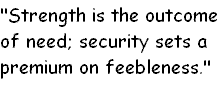
  2. "Strength is the outcome of need; security sets a premium on feebleness."
  3. "What, unless biological science is a mass of errors, is the cause of human intelligence and vigour? Hardship & freedom: conditions under which the active, strong, & subtle survive & the weaker go to the wall".
  4. "Humanity had been strong, energetic, & intelligent, & had used all its abundant vitality to alter the conditions under which it lived. And now came the reaction of the altered conditions.
    ...
    For countless years ... there had been no danger of war or solitary violence, no danger from wild beasts, no wasting disease to require strength of constitution, no need of toil. For such a life, what we should call the weak are as well equipped as the strong, are indeed no longer weak. Better equipped indeed they are, for the strong would be fretted by an energy for which there was no outlet... This has ever been the fate of energy in security; it takes to art & to eroticism, & then come languor & decay."
  5. "I learned very little of drains & bells & modes of conveyance, & the like conveniences, during my time in this real future... Conceive the tale of London which a negro, fresh from Central Africa, would take back to his tribe! What would he know of railway companies, of social movements, of telephone & telegraph wires, of the Parcels Delivery Company, & postal orders & the like? ... think how narrow the gap between a negro & a white man of our own times, & how wide the interval between myself & these".
  6. "It is usual to assume that the sun will go on cooling steadily in the future. But people ... forget that the planets must ultimately fall back one by one into the parent body. As these catastrophes occur, the sun will blaze with renewed energy".
  7. "There is a tendency to utilize underground space for the less ornamental purposes of civilization; there is the Metropolitan Railway in London, for instance, there are new electric railways, there are subways, there are underground workrooms & restaurants, & they increase & multiply. Evidently ... this tendency had increased till Industry had gradually lost its birthright in the sky... it had gone deeper & deeper into larger & ever larger underground factories, spending a still-increasing amount of its time therein... Even now, does not an East-end worker live in such artificial conditions as practically to be cut off from the natural surface of the earth?

    ... the exclusive tendency of richer people ... is already leading to the closing, in their interest, of considerable portions of the surface of the land. About London, for instance, perhaps half the prettier country is shut in against intrusion. And this same widening gulf ... will make that exchange between class & class, that promotion by intermarriage which at present retards the splitting of our species along lines of social stratification, less & less frequent. So, in the end, above ground you must have the Haves, pursuing pleasure & comfort & beauty, & below ground the Have-nots, the workers getting continually adapted to the conditions of their labour... Such of them as were so constituted as to be miserable & rebellious would die; &, in the end ... the survivors would become as well adapted to the conditions of underground life, & as happy in their way, as the Upper-world people were to theirs."
  8. "I understood now what all the beauty of the Over-world people covered. Very pleasant was their day, as pleasant as the day of the cattle in the field. Like the cattle, they knew of no enemies & provided against no needs. And their end was the same."
  9. "intellectual versatility is the compensation for change, danger, & trouble. An animal perfectly in harmony with its environment is a perfect mechanism. Nature never appeals to intelligence until habit & instinct are useless. There is no intelligence where there is no change & no need of change. Only those animals partake of intelligence that have to meet a huge variety of needs & dangers."

Tuesday, December 18, 2007

Jules Verne & Michel Verne's "In the Year 2889" (short story, science fiction): Beware! Future telling can come true!

A couple of pages into it, & my reaction was - why did Hartwell classify it as hard sf? I still won't classify it as such. It's what is sometimes called "future history" - without much attention to detail of each specific item of technology in this magical future, & yet prophetic.

And it's a very amusing story. The story is set a 1000 years after its publication date; but many of its predictions are already common place just a little over 100 years since its publication. Though often in ways different from they way author thought. The story also includes several themes now popular in science fiction.

Full text of the story is available online.

Story summary.

To tell us how this future looks like, story selects a random date - "September 25th of this present year 2889". It's a diary describing details of the day of one Fritz Napoleon Smith, "editor of the Earth Chronicle" - an influential futuristic newspaper. And one with wealth that "reaches the almost unimaginable figure of $10,000,000,000"!

I collect some quotes in the section below that highlight the elements I found interesting in the story.

Quotes.

Quotes are generally in order they appear in the story. Except occasional ones where I've merged a later quote with a similar earlier one.
  1. "modern towns, with populations amounting sometimes to 10,000,000 souls; their streets 300 feet wide, their houses 1000 feet in height; with a temperature the same in all seasons; with their lines of aerial locomotion crossing the sky in every direction".

    10 million already sounds rather low for big cities. But we still don't have sky cars or general weather control. Story doesn't talk of air conditioning inside your home, but outside as well!

    A bit more on his conception of sky car: "air-coach ... waiting for him at a window." And its driver is called "coachman".
  2. "pneumatic tubes through which today one travels at the rate of 1000 miles an hour".

    We actually have aircrafts at this speed, though surface transport is still far behind.
  3. "so early as ten centuries ago it was known that the differences between the several chemical and physical forces depend on the mode of vibration of the etheric particles, which is for each specifically different. When at last the kinship of all these forces was discovered, it is simply astounding that 500 years should still have to elapse before men could analyze and describe the several modes of vibration that constitute these differences. Above all, it is singular that the mode of reproducing these forces directly from one another, and of reproducing one without the others, should have remained undiscovered till less than a hundred years ago"

    Discussion of a research project:
    "Once the elementary bodies ... were held to be sixty-two in number; a hundred years ago they were reduced to ten; now only three remain irresolvable, as you are aware."
    ...
    "these also I will show to be composite."
    ...
    "The practical outcome? Why, that we shall be able to produce easily all bodies whatever--stone, wood, metal, fibers--"
    "And flesh and blood? ... Do you pretend that you expect to manufacture a human being out and out?"
    "Why not?"
  4. "those wonderful instruments the new accumulators. Some of these absorb and condense the living force contained in the sun's rays; others, the electricity stored in our globe; others again, the energy coming from whatever source, as a waterfall, a stream, the winds, etc... the transformer, a more wonderful contrivance still, which takes the living force from the accumulator, and, on the simple pressure of a button, gives it back to space in whatever form may be desired, whether as heat, light, electricity, or mechanical force, after having first obtained from it the work required...
    As for their applications, they are numberless. Mitigating the rigors of winter, by giving back to the atmosphere the surplus heat stored up during the summer, they have revolutionized agriculture. By supplying motive power for aerial navigation, ... the continuous production of electricity without batteries or dynamos, of light without combustion or incandescence, and for an unfailing supply of mechanical energy for all the needs of industry."
  5. "Instead of being printed, the Earth Chronicle is every morning spoken to subscribers... each subscriber owns a phonograph, and to this instrument he leaves the task of gathering the news whenever he happens not to be in a mood to listen directly himself. As for purchasers of single copies, they can at a very trifling cost learn all that is in the paper of the day at any of the innumerable phonographs set up nearly everywhere."

    The rub is - it's not computer supplying this information from other end. It's actual people - in call centers.
  6. "thanks to the progress of hygiene, which, abating all the old sources of unhealthfulness, has lifted the mean of human life from 37 up to 52 years"!
  7. Description of a video conferencing system: "The first thing that Mr. Smith does is to connect his phonotelephote... The transmission of speech is an old story; the transmission of images by means of sensitive mirrors connected by wires is a thing but of yesterday."
  8. Protagonist criticizing the work of a novelist: "Your story is not a picture of life; it lacks the elements of truth. And why? Simply because you run straight on to the end; because you do not analyze. Your heroes do this thing or that from this or that motive, which you assign without ever a thought of dissecting their mental and moral natures... In real life every act is the resultant of a hundred thoughts that come and go, and these you must study, each by itself, if you would create a living character."
  9. "Besides his telephone, each reporter ... has in front of him a set of commutators, which enable him to communicate with any desired telephotic line. Thus the subscribers not only hear the news but see the occurrences."
  10. Newspaper subscribers have access to some kind of a filter: "the hearers are free to listen only to what specially concerns them. They may at pleasure give attention to one editor and refuse it to another."
  11. "Telescopes? O no, the trouble here is about inhabitants!"
    ...
    "then, the moon is positively uninhabited?"
    ...
    "At least ... on the face which she presents to us. As for the opposite side, who knows?"
    ...
    "Ah, the opposite side! You think, then... Why, turn the moon about-face."
    "Ah, there's something in that," cried the two men at once. And indeed, so confident was their air, they seemed to have no doubt as to the possibility of success in such an undertaking.

    Wow! Cannot conceive of going to moon, but can physically turn it around!
  12. "atmospheric advertising... those enormous advertisements reflected from the clouds, so large that they may be seen by the populations of whole cities or even of entire countries... a thousand projectors are constantly engaged in displaying upon the clouds these mammoth advertisements."

    "a cloudless sky! That's too bad... Shall we produce rain? That we might do, but is it of any use? What we need is clouds, not rain."
    ...
    "go see Mr. Samuel Mark, of the meteorological division of the scientific department, and tell him for me to go to work in earnest on the question of artificial clouds. It will never do for us to be always thus at the mercy of cloudless skies!"

    Cool. If you live in India during summer, you can go completely crazy because of always overcast skies!
  13. "Is war possible in view of modern inventions - asphyxiating shells capable of being projected a distance of 60 miles, an electric spark of 90 miles, that can at one stroke annihilate a battalion; to say nothing of the plague, the cholera, the yellow fever, that the belligerents might spread among their antagonists mutually, and which would in a few days destroy the greatest armies?"
  14. "For him, instead of the endless suites of apartments of the olden time, one room fitted with ingenious mechanical contrivances is enough. Here he sleeps, takes his meals, in short, lives."

    At the press of a button, this room transforms from a bedroom to dining room to bathroom...!
  15. "he turned the tap for the first dish. For like all wealthy folk in our day, Mr. Smith has done away with the domestic kitchen and is a subscriber to the Grand Alimentation Company, which sends through a great network of tubes to subscribers' residences all sorts of dishes".
  16. "by the aid of our solar and terrestrial accumulators and transformers, we are able to make all the seasons the same. I propose to do something better still. Transform into heat a portion of the surplus energy at our disposal; send this heat to the poles; then the polar regions, relieved of their snow-cap, will become a vast territory available for man's use."

    I wonder how Mr Verne missed out figuring out that this would flood the existing coasts, apart from weather changes which is already a solved problem in this story.
  17. "Dr. Nathaniel Faithburn... being a firm believer in human hibernation--in other words, in the possibility of our suspending our vital functions and of calling them into action again after a time--resolved to subject the theory to a practical test. To this end, having first made his last will and pointed out the proper method of awakening him; having also directed that his sleep was to continue a hundred years to a day from the date of his apparent death, he unhesitatingly put the theory to the proof in his own person.

    Reduced to the condition of a mummy, Dr. Faithburn was coffined and laid in a tomb."

    During the story, we witness the attempt at his resurrection - he has completed 100 years in hibernation. Only he will be found dead already for 100 years - apparently, his experiment had failed.
  18. "touching a knob, he established communication with the Central Concert Hall, whence our greatest maestros send out to subscribers their delightful successions of accords determined by recondite algebraic formulas."

    Some kind of remote music piping service.
  19. "Thanks to the Piano Electro-Reckoner, the most complex calculations can be made in a few seconds. In two hours Mr. Smith completed his task."

    Mr Smith wanted to tally some financial transactions - where you will probably use a spreadsheet today.

Collected in.

  1. David Hartwell & Kathryn Cramer (Ed)'s "The Ascent of Wonder: The Evolution of Hard SF".

Fact sheet.

"In the Year 2889", short story, review
Alternate titles: "The Day of an American Journalist in the Year 2889", "Time Travelers".
First published in English: The Forum, New York, February 1889.
Rating: A

On authorship of this story.

  1. According to a note in Project Gutenberg's copy of this story: "Although published under the name of Jules Verne, it is now believed to be chiefly if not entirely the work of Jules' son, Michel Verne."
  2. According to another source, "This story was written by Michel Verne (Verne's son) Jules Verne later modified it and it was published in 1890 as La journée d'un journaliste américain en 2890 with the title changed so the date of publication would be 1000 years before the date of the story."
  3. Some more enlightenment is provided on the authorship & history of this story in Editor's Note (in pink at the beginning) of this online copy of the story.

Thursday, September 20, 2007

Edgar Allan Poe's "A Descent Into The Maelström": A man survives by not losing his wits

Quote from A Descent Into The Maelström by Edgar Allen PoeI picked up this very engaging story because Arthur Clarke's "Maelstrom II" (a space age sequel to Poe's original) referred to it. I am not sure how this story is normally tagged; I have no hesitation labeling it hard-sf in the best traditions of the genre.

While looking for it, I read somewhere (don't recall the source), that it is this story that introduced the word "maelstrom" into English language; original used in this story is Nordic "Moskoe-ström". Moskoe is an island in Norway - near the site in sea where a very big & cyclical maelstom (whirlpool) rages.

Full text of the story is available for download.

Story summery.

Second half is the main story; first half just prepares the ground.

Main story is narrated by the unnamed middle one of the 3 brothers, & the sole survivor of the fishing boat that was wrecked first by a hurricane, & immediately afterwards was caught in The Maelstrom. Story is told 3 years after the event.

By the time they were caught in maelstrom, the (air) sail was gone, & younger brother too (blown with the sale). Narrator is holding on to a metal protrusion on the ship; his brother is holding on to "a small empty water-cask which had been securely lashed under the coop of the counter, and was the only thing on deck that had not been swept overboard when the gale first took us".

Fear makes his brother seek out the metal hold of narrator. Since there is not space for two to hold, brother effectively forces the narrator to leave the secure handle!

So narrator goes to hold the barrel brother was previously holding. Sense of doom gives way to wonder around. That is when he makes the important discovery:

"I perceived that our boat was not the only object in the embrace of the whirl. Both above and below us were visible fragments of vessels, large masses of building timber and trunks of trees, with many smaller articles, such as pieces of house furniture, broken boxes, barrels and staves.
...
It was not a new terror that thus affected me, but the dawn of a more exciting hope... I called to mind the great variety of buoyant matter that strewed the coast of Lofoden, having been absorbed and then thrown forth by the Moskoe-ström. By far the greater number of the articles were shattered in the most extraordinary way - so chafed and roughened as to have the appearance of being stuck full of splinters - but then I distinctly recollected that there were some of them which were not disfigured at all. Now I could not account for this difference except by supposing that the roughened fragments were the only ones which had been completely absorbed - that the others had entered the whirl at so late a period of the tide, or, for some reason, had descended so slowly after entering, that they did not reach the bottom before the turn of the flood came
...
I made, also, three important observations. The first was, that, as a general rule, the larger the bodies were, the more rapid their descent - the second, that, between two masses of equal extent, the one spherical, and the other of any other shape, the superiority in speed of descent was with the sphere - the third, that, between two masses of equal size, the one cylindrical, and the other of any other shape, the cylinder was absorbed the more slowly.
...
There was one startling circumstance which went a great way in enforcing these observations, and rendering me anxious to turn them to account, and this was that, at every revolution, we passed something like a barrel, or else the yard or the mast of a vessel, while many of these things, which had been on our level when I first opened my eyes upon the wonders of the whirlpool, were now high up above us, and seemed to have moved but little from their original station.
...
I resolved to lash myself securely to the water cask upon which I now held, to cut it loose from the counter, and to throw myself with it into the water."

Brother refused to let go of the big ship that he felt more secure in. So the narrator ended up as the sole survivor.

See also.

  1. An illustration of the narrator after jumping - tied to barrel, scared, & still inside the whirlpool.

Fact sheet.

First published: Graham's Magazine, April 1841.
Rating: A
Related: All stories of Edgar Allan Poe.

Tuesday, September 11, 2007

Morley Roberts' "The Anticipator": A telepathic connection, or a coincidence?

This is not the worst story I have read, but after over 100 years of its original publication, it no longer is a new plot. I picked it up because one of the Arthur Clarke's stories - "Herbert George Morley Roberts Wells, Esq" - referenced it.

Full text of this story can be downloaded here.

Story summary.

Carter Esplan & Burford are both story writers. They know each other, but there is no love between them. Esplan can pen a plot better, but Burford always publishes original plot first.

During a discussion with Vincent, a friend & a physician, Esplan claims Burford has been stealing (anticipating) his plots somehow from his head even before he has penned the story! He has had several rejections because an editor had accepted a story with similar plot from Burford weeks ago.

Burford, of course, thinks Esplan cannot think up an original story.

During a particularly low period - with his girlfriend dead, & he a drug addict - Esplan decides to kill Burford. But ends up dying himself - with a hint by narrator that murder action was anticipated by Burford already! There is also lightening at the eleventh hour; I could not be sure from last para if end came by lightning hit, or was actually due to Burford's actions.

See also.

  1. Will McIntosh's "One Paper Airplane Graffito Love Note": A woman's thoughts keep appearing in others work. But she has a different way of taking control.

Fact sheet.

The Anticipator, short story, review
First published: 1898
Rating: C