Showing posts with label Clifford Simak. Show all posts

Sunday, July 20, 2014

Clifford D Simak's "Rule 18" (novelette, humor): How earth won it's first football match against Martians in decades

One of the illustrations accompanying the original publication in Astounding magazine of short story Rule 18 by Clifford D Simak. Image shows the victory procession through New York of Martian football team after its latest win against earth.Martians have been beating earth in annual football match for a long time. And the diagnosis is: earth-men have become soft because of too much automation here; they never get a chance to exercise their muscles. But things are about to change as a cool newly invented gadget, the earth team's coach sick of losing too long, & a betting syndicate come together...

Title comes from one of the rules of the game that requires a player of the team to not only be natives of his world, but his 9 preceding generations should have been native of this world too. Coach will twist this rule in a curious way to win.

Update 21 July 2014Marooned has a note on an Isaac Asimov connection to this story.

Fact sheet.

First published: Astounding, July 1938.
Rating: B.
Nominated for Retro Hugo Awards 1939 in novelette category.
Among the stories from Astounding/Analog issues edited by John Campbell.
Related: Stories of Clifford D Simak.

Wednesday, October 23, 2013

Clifford D Simak's "Tools" (novelette, free): Introducing very weird radioactive gaseous aliens

One of the illustrations by Kramer accompanying the original publication in Astounding magazine of short story Tools by Clifford D Simak. Image shows the human researcher, tricked by bottled gaseous alien, releasing it.Key parts of this story involve Radon-222 gas, a natural radioactive decay product of radium, & the biggest cause of lung cancer among non smokers on earth. It also is the heaviest gas on earth, though its own decay products aren't gaseous. It's highly toxic.

Story summary.

Humans have been mining radium on Venus, where it's available in vast quantities. It's a key source of energy, & this mining business is a monopoly of Radium, Inc.

Someone discovered strange life-like properties in radon gas found there. In a lab, they've succeed, via special electrical sensors, to communicate with a bottled concentration of it. They've robotic mining devices whose brains are small confined concentrations of gas.

When the bottled gas intelligence in lab that has learned a lot about the human civilization leaks, gas all across Venus learns the things we know. So we have an adventure fighting an elusive omnipresent alien with completely unfamiliar thought processes.

Fact sheet.

First published: Astounding, July 1942.
Download full text as part of the scans of the magazine it originally appeared in.
Rating: B.
Among the stories from Analog/Astounding issues edited by John Campbell.
Related: Stories of Clifford D Simak.

Sunday, August 4, 2013

Some online stories of Clifford D Simak - text & audio

Friday, September 21, 2012

"Astounding Science Fiction" (British Edition), June 1947 (magazine, free): Annotated table of contents

Cover of Astounding Science Fiction magazine, British edition, June 1947 issue.
Links on author fetch more fiction by author.

British editions used to be mostly reprints from US editions rather than original stories.

Table of contents.

  1. [novelette] Theodore Sturgeon's "Mewhu's Jet": 'Mewhu came from--somewhere. He wrecked his spaceship on landing, but the "parachute" he had was something decidedly super--an atomic jet job! The problem was to get into communication--they thought.'
  2. [novelette] Clifford D Simak's "Hobbies": "The cities were deserted, save for one. The men & women of that city had hobbies--but no accomplishments. The robots they had left behind were doing better..."
  3. [novelette] George O Smith's "Trouble": '"It takes two to make a quarrel" doesn't mean two different people, really--just two different viewpoints!"
  4. [ss] Mark Champion's "The Unforeseen": "A prison break is successful only when it employs some factor which neither foresight nor past experience has called to the attention of the guards. The key to freedom is--the unforeseen."
  5. [ss] A Bertram Chandler's "Tower of Darkness": "The planet was a deadly place--deadly not to men, but to their ambition. It seemed to be cursed by the Tower, & against the Tower neither strong will, nor the flame of human ambition succeeded. It took something quite different--& unanswerable."

Fact sheet.

Labeled: Vol V No 10 (British Edition).
Download scans as a CBZ file. [via someone@pulpscans]
Note: I could not locate editor's name, but it's probably John Campbell.
Related: Fiction from Astounding/Analog (whole issues only); old pulps; 1940s.

Wednesday, June 6, 2012

"Galaxy Science Fiction", September 1954 (ed H L Gold) (magazine, free): Annotated table of contents & review

Cover of Galaxy Science Fiction magazine, September 1954 issue
Where I've read the story, my rating appears in brackets. Links on author fetch more fiction by author.

Table of contents (6 stories, best first, unread last).

  1. [ss] Philip K Dick's "Shell Game" (B): A group of stranded spacemen somewhere is being repeatedly attacked by...
  2. [novella] F L Wallace's "The Man Who Was Six": "There is nothing at all like having a sound mind in a sound body, but Dan Merrol had too much of one--& also too much of the other!"
  3. [novelette] Clifford D Simak's "Dusty Zebra": "Who or what the trader was & where he came from, nobody knew--or cared--until one of his gadgets began to play dirty!"
  4. [novelette] Daniel F Golouye's "Satan's Shrine": "No torment that had ever been inflicted on mankind was more feindish than Satan ... for he was worse than a devil ... he was a man!"
  5. [ss] Arthur Sellings' "A Start in Life": "What a problem for a robot ... having all of the answers, but not knowing when to give them!"
  6. [ss] Robert Sheckley's "Milk Run": "What are Smags, Firgels & Queels? Cats in a bag ... & Gregor was holding the bag!"

Fact sheet.

Download whole issue from Internet Archive. [via Michael@ClassicScienceFiction]
This issue is labeled Vol 8, No 6.
Related: Fiction fro Galaxy, pulps, 1950s.
Legend: ss = short story

Wednesday, May 9, 2012

Clifford D Simak's "Final Gentleman" (novelette, illusion)

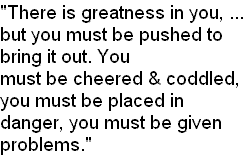
Quote from short story Final Gentleman by Clifford D Simak
This is the kind of plot normally associated with PKD now-a-days: which of the two equally vivid realities experienced by a man is the real one?

I didn't really like it, though I didn't find it boring either.

Story summary.

A very successful writer suddenly has a feeling there is no more writing left in him. And the world he knew all his life is no longer there: university he went to has no record of him; the house his mother lives in & he frequently visits no longer houses his mother & never has; the grave of the woman he once loved & now often visits exists but is someone else's grave; the fancy restaurant in the neighborhood he frequented is a very ordinary dump; ...

Story is of him slowly unraveling the puzzle.

Collected in.

  1. Groff Conklin (ed)'s "Six Great Short Science Fiction Novels".

Fact sheet.

First published: F&SF, January 1960.
Rating: B.   
Related: Stories of Clifford D Simak.

Saturday, April 28, 2012

Groff Conklin (ed)'s "Six Great Short Science Fiction Novels" (anthology): Annotated table of contents & review

Cover of short story anthology Six Great Short Science Fiction Novels, edited by Groff Conklin
Going by what I've read so far, there is less emphasis on entertainment value here & more on stories with cool ideas.

List below is in order of my preference - best first, unread last. Links on author, publisher, or year fetch more matching fiction.
  1. [novelette] Isaac Asimov's "Galley Slave" (A); Galaxy, December 1957: How to make a 3-laws obeying robot harm a human...
  2. [novella]  Damon Knight's "Rule Golden" (A); Science Fiction Adventures, May 1954: What if we had an additional empathy sense? 
  3. [novelette] Algis Budrys' "Chain Reaction" (as by John A Sentry) (B): You're free, but live my way!
  4. [novella] Judith Merril's "Project Nursemaid" (B); F&SF, October 1955: Government's difficulties recruiting unwanted babies... 
  5. [novelette] Clifford D Simak's "Final Gentleman" (B); F&SF, January 1960: Which of the 2 realities he experienced is real?
  6. [novelette] Katherine MacLean's "Incommunicado" (B); Astounding, June 1950: Creating Homo Superior by rewiring part of human brain that processes auditory inputs...
First published: 1960.
Related: Anthologies, collections, magazines.

Tuesday, June 15, 2010

Clifford D Simak's "The World That Couldn't Be" (novelette, first contact, free): Hunting an unkillable "animal"

An illustration accompanying the original publication in Galaxy, January 1958, of short story The World That Couldnt Be by Clifford D Simak
One of the human colonists, Gavin Duncan, has a farm growing a valuable medicinal herb called vua, employing humanoid natives as labor. Recently, a local animal called Cytha has been eating his crop at night. So finally, he's decided to hunt it down.

Only, the natives are very superstitious about it, & consider it unkillable. But Duncan is adamant. Three long days of tracking Cytha, & Duncan is coming around to see his query with fresh eyes...

Fact sheet.

First published: Galaxy, January 1958.
Download full text from Project Gutenberg, Manybooks, Feedbooks.
Rating: A.
Related: Stories of Clifford D Simak.

Wednesday, April 28, 2010

Very brief notes on some novels of Clifford D Simak

At rasfw.

Related: Stories of Clifford D Simak.

Saturday, January 9, 2010

"Avatar", "Call Me Joe", and "Midworld"

Many people seem to be looking for the relation of these stories with the Hollywood movie Avatar. While I've not seen the movie, here is what I know of the subject - along with download links I know of.

"Avatar" & "Call Me Joe".

Folks are finding the telepresence aspects of Avatar a lot like Poul Anderson's short story "Call Me Joe".

In Anderson's story, no human can go to the world that needs exploring. So they create an artificial animal that can thrive in that environment, but is otherwise like a baby. Mind of this artificial being is linked by a communications link to that of a man elsewhere (an invalid, a few million kilometers away). Man can become one with the artificial creation by pressing on a button.

Note there are at least two other well known short stories with similar themes: Clifford D Simak's "Desertion" & James Blish's "Surface Tension". No communications link is involved in these two stories.

In Simak's version, you put a man in a machine, & out comes a being physically adapted for the hostile world, but with the mind & memories of the man who entered. Process is reversible. So the machine can take the local being with his local experiences, & turn it into the original man but with additional memories of his experiences in this artificial body.

In Blish's story, a few human embryos need to be left on a hostile world, with no adult to take care of them. How do you ensure the babies that these embryos will become can survive on their own? You turn them into locally adapted animals but with human minds. Very colorful story - probably the best known short work of Blish.

I know of at least 2 online versions of "Call Me Joe": an audio, & a comic book adaptation.

Text of "Desertion" is included in the scans of the whole Astounding issue where the story originally appeared.

MP3 audio of "Surface Tension" is online.

"Avatar" & "Midworld".

People are finding the alien world of Avatar (& some of its creatures) rather similar to Alan Dean Foster's novel "Midworld".

"Midworld" features a jungle world - a semi-sentient jungle with huge trees that have 7 vertical levels - each level offering a unique ecological niche. Humans live in, I think, level 4 - hence the title. Moving across levels means inviting death - though humans often go through these adventure.

Note that "Midworld" itself is a rehash of Brian W Aldiss' "Hothouse". "Hothouse" has at least two versions - an original short story version, & a later novelization (I've only read first third or quarter of this novelization).

"Hothouse" is really a juvenile work - at least the novel version. "Midworld" is a work for grown ups.

A few months back, BBC had done a show or a podcast based on "Hothouse" - I'm not sure which version. I don't know if it's still available at their web site.

"Hothouse" short story version is probably old enough to have its text online somewhere, but I don't have the URL.

Saturday, April 11, 2009

Clifford D Simak's "Eternity Lost" (novelette, immortality): A lawmaker considers himself above law

Quote from short story titled Eternity Lost by Clifford D Simak, originally published in Astounding Science Fiction, July 1949.The most interesting thing about this story is the weird emotions it invoked: it made me sympathize with one of the most despicable kind of politician - one who thinks the laws (s)he makes are only for ordinary people; he himself is above law. We have just too many such in India; I guess most democracies will have their share.

Story summary.

This future earth has rejuvenation treatments called "life continuation" - a single treatment gives you youthfulness & extends your life by a century. But it cannot be widely made available, because earth doesn't have resources to support so many long lived people.

So only a few important people receive the treatment, & repeatedly - "those persons who are in the unique position of being able to materially benefit the human race." No prizes for guessing who the privileged ones are.

Officially, there are strict rules for determining who's important enough; but what are the rules for if they cannot be bent?

One of the men who has received this treatment 5 times is Senator Homer Leonard, an elected politician representing some US constituency in World House of Representatives in Geneva. He was the key legislature when current rules for determining beneficiaries of rejuvenation treatments were framed.

It's time for his next treatment. It's his (political) party that has been sponsoring him for treatment so far, declaring him important enough. Now, finally, they're not going to sponsor him. He's guessing the reasons have to do with his decreasing ability to get votes.

Because of his inside knowledge, he suspects that even immortality treatments are available. But they're not given to anyone known - limited resources on earth, etc. An (apparently) publicly funded organization called Extrasolar Research is looking for earth-like worlds among the stars - may be someday everyone will have immortality. And he has a suspicion such an alternate earth is about to be found - probably before his next rejuvenation is due. If only he could get it this one last time!

He will make pathetic (& unsuccessful) efforts at getting the treatment; in the process, we get a view of how much ordinary people resent the recipients of this treatment.

Eventually, angry with his party & to score some political points, he makes a press announcement that he go for any more rejuvenation treatment - something that no beneficiary has ever done before. But there is one little thing he'd not found in time - he wasn't really out of favor. Not only is immortality treatment available, an alternate earth has been found & he was chosen among the early colonists - only he's lost his chance, through his own stupidity.

Collected in.

  1. Isaac Asimov & Martin H Greenberg (Eds)' "Isaac Asimov Presents Great SF Stories 11 (1949)".
  2. John W Campbell, Jr (ed)'s "The Astounding Science Fiction Anthology".

Fact sheet.

First published: Astounding, July 1949.
Rating: A.
Listed among the stories from John Campbell's Astounding/Analog.
Related: Stories of Clifford D Simak; immortality/rejuvenation treatments in fiction.

Tuesday, March 3, 2009

Clifford D Simak: Is "Way Station" a novelization of "The Big Front Yard"?

This "Way Station" post by Sam Jordison at Guardian makes the story sound suspiciously like a longer version of the short story "The Big Front Yard". I've only read the shorter version. Can someone confirm if "Way Station" is indeed a novelization of this story?

Friday, June 6, 2008

Clifford D Simak's "The Big Front Yard" (novelette, science fiction): When aliens introduced humans into the cosmic community of rational beings

Quote from short story titled The Big Front Yard by Clifford D SimakFirst half of this story is a better version of Henry Kuttner's "Housing Problem" - and among the most interesting sense-of-wonder stories by anyone. Transition between the two
halves is via a plot variant of Heinlein's "- And He Built a Crooked House" - an unusual home where passing through a door leads you somewhere unexpected. Last half explains the wonders, & didn't quite click as well with me.

I sometimes wonder why so few authors have emulated so obvious & effective technique of the masters of sense-of-wonder stories - the Kuttner/Moore gestalt: don't bother explaining the wonder; just find an appropriate place to terminate the story when still in wonder mode. Explaining the wonder so often leads to disappointment in reader.

Story summary.

Story is set in a village called "Willow Bend" & has 3 main characters:
  1. Hiram Taine - a handy man, particularly at fixing home electronics; & a small time dealer in antique furniture. He lives in his ancestral home with his dog Towser.
  2. H Henry Horton - the richest man in village, & a greedy businessman always on the lookout for opportunity. He owns "a small computer plant".
  3. Beasly - a half-wit, & an abused servant in the household of Hortons. Hiram is the only one in the village who's kind to him. Part way through the story, he will quit his employment with Hortons, & come live with Hiram doing odd jobs.
First half is about the amazing things happening at Hiram household. His dog is restless, sensing something it cannot locate. Ceiling of his workshop in basement transforms into something amazingly smooth & hard. An old black-and-white TV of Horton household left for repair in workshop will not only get fixed by itself but converted into the world's most fantastic color TV! Erratic stove in his kitchen gets fixed; an old dead radio gets transformed into a fancy working one!

Dog, Beasly, & Hiram will later locate an alien spaceship buried near Hiram's home: "Twelve feet wide by twenty long & oval shaped. About the size ... of a good-size living room... & ten feet deep." He will later see the aliens: "They were four inches high or so & they went on all four feet, although it was plain to see that their front feet were really hands, not feet. They had ratlike faces that were vaguely human, with noses long & pointed. They looked as if they might have scales instead of hide, for their bodies glistened with a rippling motion as they walked. And all of them had tails that looked very much like the coiled-wire tails one finds on certain toys & the tails stuck straight up above them, quivering as they walked... sixteen of them".

These aliens seem to have taken up residence in Hiram household - "living in the space between the basement joists", & appear to be helping him in odd ways to may be pay the rent - as the "little folks" did in Kuttner's "Housing Problem".

Enter Mr Horton - sensing business opportunity after seeing the TV's transformation. He is convinced Hiram is an amazing inventor. No problem Hiram cannot explain what happened to TV; Horton has a lot of engineers at his company to do the reverse engineering. Profits from any resulting business will be split.

Horton also almost forcibly hands Hiram a big computer lying unused at his company. No obligations, but if anything interesting results, they will split profits.

While Hiram is out digging the alien ship, computer is delivered to his basement by Horton's men. By the time Hiram returns home, front door of his home no longer exists! In fact, the front architecture has changed in subtle ways - strange curves, no opening anywhere! Panicky, he'll run around & find the back door intact.

Enters home from back door, & goes to where front door should be. It's very much there! Only after getting out from there, he finds himself obviously on a different world! Front door of his home has been transformed into an inter-stellar transfer gate! To travel to that world, you just walk through the door! Some windows of his home open to night of earth, others to day light of this alien world! In part of house on this alien world "there was no back to the house." Story gets its title from this - a whole world's worth of front yard.

That's about the first half - it's happened over a period of 3-4 days. Hiram will later find Horton's computer vanished; & part of his workshop walled off in an impenetrable way. Computer apparently played a role in creation of transfer gate.

During the early exploration of this world, Hiram will find another transfer gate to yet another world - with possibility of a big network of them. He will also see his little alien guests going out - their job done. A spaceship hanger near his home with 8 ready starships will get another ship used up as the little aliens go to yet another world to build another transfer gate.

Discovery of transfer gate had made Beasly panic. While Hiram was out exploring the new world, there was a lot of excitement in the village. Horton with Sheriff Hanson will find Hiram out in the country side of new world. Horton is convinced Hiram has again used his resourcefulness with the help of his computer - he's very interested in exploiting this world.

Some hours later, as a tired Hiram is coming out of his sleep, he learns indignant that government has tried appropriating his property, & tried razing some of his walls to make equipment pass. But aliens had apparently foreseen the possibility; they'd reinforced the walls with their impenetrable material.

More excitement. Other countries involved, UN involved. Eventually, Hiram will have 3 alien visitors (of a race different from ones that were his guests - these are "humanoid, to a degree at least") at his front yard - unwilling to enter earth, but willing to trade in "ideas". This is also where Beasly will find his ultimate vocation. We learn he's a telepath. There is an alien side telepath too - "a sort of man-size woodchuck". So to talk to aliens, you go via these two telepaths - each speaking the normal language of his end.

They will exchange ideas about an alien transport vehicle, in return for "paints" from human side. More negotiations are on...

See also.

  1. Ralph Williams' "Cat and Mouse": Another story where aliens build a door on earth that you walk across to reach another world!

Collected in.

  1. Ben Bova (Ed)'s "The Science Fiction Hall of Fame, Volume Two B".

Fact sheet.

First published: Astounding Science Fiction, October 1958.
Rating: A
Winner of Hugo Award 1959 in novelette category.
Related: Stories of Clifford D Simak.

Saturday, May 3, 2008

** Clifford D Simak's "Desertion" (short story, science fiction)

To colonize the "surface" of Jupiter, humans have a machine that can transform an earth animal (including humans) into an animal similar to one of the Jovian natives (& back)! But every human sent out of research "dome" into the wild has vanished. Story is about resolving the mystery of these vanishings.

Collected in.

  1. Isaac Asimov & Martin H Greenberg (Eds)' "Isaac Asimov Presents the Great SF Stories 6 (1944)".

Fact sheet.

First published: Astounding, November 1944.
Rating: B
Listed in "William G Contento's Top Ten Most Reprinted Stories".

Note: Why is this post so short?

** Clifford D Simak's "Huddling Place" (short story, science fiction)

In a future society where people live in the countryside rather than cities, & have all creature comforts including personal robots & immersive virtual remote presence, a man has developed an extreme fear of open spaces! Through out the story, he will be living with it; he cannot even come out of it during an extreme emergency at end.

Collected in.

  1. Robert Silverberg (Ed)'s "The Science Fiction Hall of Fame: Volume One, 1929-1964".
  2. Isaac Asimov & Martin H Greenberg (Eds)' "Isaac Asimov Presents the Great SF Stories 6 (1944)".

Fact sheet.

First published: Astounding, July 1944.
Rating: B

Note: Why is this post so short?

Friday, May 2, 2008

** Clifford D Simak's "Desertion" (short story, science fiction)

A rather imaginative story. Humans have research setup on the hard "surface" deep inside Jupiter! They live in domes. To move around, they must transform their physique to become suitable. A machine can take an earth animal & produce a Jovian life form, & vice versa!! But each time a human is sent to explore Jupiter in the open using this method, he vanishes! After several incidents, the man in charge decides to go himself with his dog. Of course, he will also desert; living the Jovian way is so much more interesting than living in a human or dog body!

Collected in.

  1. David Hartwell & Kathryn Cramer (Ed)'s "The Ascent of Wonder: The Evolution of Hard SF".
  2. Isaac Asimov & Martin H Greenberg (Eds)' "Isaac Asimov Presents the Great SF Stories 6 (1944)".

Fact sheet.

First published: Astounding, November 1944.
Rating: B

Note: Why is this post so short?