Showing posts with label Algis Budrys. Show all posts

Tuesday, February 19, 2013

Algis Budrys' "Look On My Works" (short story, post apocalypse, free): Guides milking tourists...

Illustration by Freas accompanying the publication in Astounding Science Fiction, British edition, of short story Look On My Works by Algis Budrys. Image shows a human tourist from Centaurus in far-future flooded New York city, with a fake gargoyle decorating the roof of an old building in background.
For a post apocalypse story, it's a very light read; even had me smiling many times.

Story summary.

About 600 years into future, New York city is flooded to near roofs of some of the tallest current buildings, & local civilization has regressed to simpler times. But some hardy local conmen are happily milking the visiting human tourists from prosperous space colonies (established before the floods), offering the visitors the almost mythical authentic Terran fare...

Fact sheet.

First published: Astounding, December 1956.
Download full text as part of the scans of Astounding (British ed), April 1957.
Rating: B.
Among the stories from Astounding/Analog issues edited by John Campbell.
Related: Stories of Algis Budrys.

Sunday, February 17, 2013

"Astounding Science Fiction" (British edition), April 1957 (ed John Campbell) (magazine, free): Annotated table of contents

Cover by Van Dongen of British edition of Astounding Science Fiction magazine, April 1957 issue.
I think I've read "2066: Election Day" in one of the "Issac Asimov Presents Great SF Stories" books. An unusual "election" for a US President, an election where people don't vote at all, & one that was actually rigged by a small coterie. I don't think I came back happy with it, & the ending invoked in me an angry reaction - "how could the author propose this to be a good outcome?" type of reaction.

Links on author fetches more fiction by author. Where I have a separate post on a story, link on story title goes there. For stories I've read, my rating is in brackets.

Table of contents.

  1. [novelette] Robert Silverberg & Randall Garrett's "False Prophet" (as by Robert Randall): "There are times when it is exceedingly unwise to tell the truth--& the Nidorian was dedicated to truth. The Earthmen were wiser; they lied about him."
  2. [ss] Michael Shaara's "2066: Election Day": "There is a limit to any process you can name ... & sooner or later that limit will be reached. Then ... somehow you have to fumble togeather a new thing..."
  3. [ss] Algis Budrys' "Look on My Works" (B): Tourist guides milking a tourist from Centaurus with fakes, in a far future New York city...
  4. [ss] Robert Silverberg's "To Be Continued" (A): Slow life is frustrating!
  5. [serial - 3/3] Isaac Asimov's "The Naked Sun": "Lije Baley had a triple-decker problem to solve--& solved it only because a robot tried to give him a hand. And thereby taught him to define his terms with a new exactness!"

Fact sheet.

Labeled: "Vol XIII No 4 (British Edition)".
Download scans as a CBR file [via Bob@pulpscans]
Note: The link fetches a RAR file that contains the target CBR, probably to work around hosting service's file naming constraints.
Related: Stories from the Astounding/Analog issues edited by John Campbell, old "pulps", 1950s.

Saturday, January 26, 2013

Algis Budrys' "Man in the Sky" (short story, free): Cold engineering vs public opinion

Illustration by van Dongen accompanying the publication in Astounding Science Fiction, British edition, August 1956 issue of short story Man in the Sky by Algis Budrys. Image shows the dead pilot of first space flight in earth orbit.
It's dated in that it's a pre-spaceflight story, imagining early space flight in ways that we now know were different. But it's readable.

Story summary.

US, as part of a very long running program to put man on moon, has put the first satellite in orbit around earth. A (solo) manned satellite, because technology for precise automatic steering up in orbit is not available.

As soon as the satellite goes in orbit, the pilot dies of heart attack. No mystery there, just an ordinary bad coincidence.

Dilemma faced by bosses down: The dead pilot up there is worth more to the ground than a live one, because now satellite can stay up there & continue bringing in telemetry data! But public opinion will force them to bring the body down, a project involving building a new identical machine, work that inevitably kills a few workers as part of construction accidents!

Fact sheet.

First published: Astounding, March 1956.
Download full text as part of the scans of Astounding (British edition), August 1956.
Rating: B.
Among the stories from Astounding/Analog issues edited by John Campbell.
Related: Stories of Algis Budrys.

Wednesday, January 23, 2013

"Astounding Science Fiction" (British Edition), August 1956 (ed John Campbell) (magazine, free): Annotated table of contents

Cover by Ed Emshwiller of Astounding Science Fiction magazine, August 1956 issue, British edition. Cover illustrates the story Exploration Team by Murray Leinster.
I've read "Exploration Team" & "Minor Ingradient" elsewhere before, but don't recall much of them now.

Links on author fetch more fiction by author. Where I have a separate post on a story, link on story title goes there. For read stories, my rating appears in brackets.

Table of contents (best first, unread last).

  1. [ss] Herbert L Cooper's "A Nice Little Niche" (B): When vitamin K craving alien bacteria invaded human guts...
  2. [ss] Algis Budrys' "Man in the Sky" (B): Cold engineering vs public opinion.

    It's a story about early spaceflight, before there was space flight.
  3. [novelette] Murray Leinster's "Exploration Team": "The perfect machine for exploring a new plant would, of course, be self-repairing, self-maintaining, able to construct its own repair parts from local materials, & even able to replace itself with a new unit..."
  4. [ss] Eric Frank Russell's "Minor Ingradient": "A critically necessary lesson any true officer must learn is the crushing burden it is to be Master of a slave..."
  5. [serial - 2/3] Robert Heinlein's "Double Star": "Lorenzo, the conceited pipsqueak, was stretched & inflated to fill a mold. But Lorenzo, while conceited beyond question--was not a fool!"

Fact sheet.

Labeled: "Vol XII No 8 (British Edition)".
Download scans as a CBR file. [via Bob@pulpscans]
Note: Link points to a RAR file that contains target CBR, probably to work around some hosting service file naming constraints.
Related: Stories from the Astounding/Analog issues edited by John Campbell, old "pulps", 1950s.

Tuesday, December 25, 2012

"Astounding Science Fiction" (British Edition), December 1955 (ed John Campbell) (magazine, free): Annotated table of contents & review

Cover by Kelly Freas of Astounding Science Fiction magazine, December 1955, British edition.
Links on author fetch more fiction by author. Where I've read a story, my rating appears in brackets. Where I have a separate post on a story, link on story title goes there.

Table of contents (best first, unread last).

  1. [ss] Eric Frank Russell's "The Waitabits" (A): Different people run their lives at different pace. What happens when faster ones try to bring up the slower ones to their pace? 
  2. [ss] Frank Herbert's "Rat Race" (A): Rats are to men as men are to...
  3. [ss] Algis Budrys' "In Clouds of Glory": "Combat of Champions is an old method of settling disputes--but when hiring champions, there is a certain danger they aren't fighting for quite the goals you think..."
  4. [serial - conclusion] Poul Anderson's "The Long Way Home": "Sooner or later, every adult human being makes a discovery--or lives dissatisfied, unhappy. That there never was, & never will be, a way to go home ... but there is always a way to make home."

Fact sheet.

Labeled: Vol XI No 12.
Download scans as a CBR file. [via Bob@pulpscans]
Note: Download link points to a RAR file that contains the target CBR as its sole contents, probably to work around some file naming constraint of hosting service.

See also.

  1. Fiction from Analog/Astounding (only issues edited by Harry Bates, John Campbell; whole issues only).
  2. Fiction from old "pulp" magazines.
  3. Fiction from 1950s.

Wednesday, December 19, 2012

Algis Budrys' "The Peasant Girl" (as by Paul Janvier) (short story, free)

One of the illustration accompanying the publication in Astounding magazine, British edition, of short story The Peasant Girl by Algis Budrys. Image shows the central character receiving at his home his estranged & married sister with her baby boy, her husbad, and her father in law.
Not sure why I liked it - I would like to say the plot didn't do much for me, but it sure kept my attention & I finished it in a single sitting.

Story summary.

Mankind has split into two races - ordinary humans, & a new apparently far superior race of supermen - telepathic, able to change shape of things by thought, able to move by thought, etc. They seem to control ordinary humans' lives.

One day, Dorothy, the little sister of Henry Spar, a small town "cabinetmaker", vanished. Apparently kidnapped by one of the supermen, something that seems to happen fairly regularly, with ordinary men resigned to this fate. But Henry goes looking for his sister...

I found the ending too antithetical to rest of the story, supermen to whom ordinary men are supermen, in some sense...

Fact sheet.

First published: Astounding, June 1956.
Download full text as part of scans of Astounding (British Edition), November 1956.
Rating: B.
Among the stories from Astounding/Analog issues edited by John Campbell.
Related: Stories of Algis Budrys.

Monday, November 12, 2012

"Astounding Science Fiction" (British Edition), November 1956 (ed John W Campbell) (magazine, free): Annotated table of contents & review

Cover by Freas of the British edition of Astounding Science Fiction magazine, November 1956. Cover illustrates the story Plus X by Eric Frank Russell.
I'd read "Next of Kin", the novelization of "Plus X" (another longer variant of the story is "The Space Willis"), when I went through a Russell phase some years ago, & just loved it. Now, reading the original novelette in this issue, I had a milder reaction, but it still made me laugh at many places. It's a funny jailbreak story - a human smart alec vs his dimwitted alien captors.

Table of contents.

  1. [novelette] Eric Frank Russell's "Plus X" (A); humor: Didn't you know that humans can only exist in pairs?
  2. [novelette]  Robert Silverberg & Randall Garrett's "The Chosen People" (as by Robert Randall) (A): Teaching the scientific method to deeply tradition bound.
  3. [ss] Poul Anderson's "The Live Coward" (B): Cop catches a fugitive in colorful circumstances.
  4. [ss] Algis Budrys's "The Peasant Girl" (as by Paul Janvier) (B): Humans are supermen to supermen!
  5. [ss] Thomas N Scortia's "Sea Change": 'Of course, everybody knows what "being human" means--it's just that they can't define it, but of course they know what it means..."

Fact sheet.

Labeled: Vol XII, No 11.
Download scans as a CBR file. [via Bob@pulpscans]
Note: Link points to a RAR file that contains target CBR, probably to work around some hosting service file naming constraints.
Related: Stories from the Astounding/Analog issues edited by John Campbell, old "pulps", 1950s.

Friday, August 17, 2012

Algis Budrys' "Chain Reaction" (as by John A Sentry) (novelette, freedom): You're free, but live my way!

I intended to write this post on 15 August, India's Independence Day, but have been busy recently. This is an independence day story, but I found the author's idea of freedom somewhat obnoxious, even if well intended.

Story summary.

An alien world where an intelligent species is held enslaved by another with much superior technology. Slaves whose work the owners don't even need anymore; they're held enslaved out of habit, or may be of need to exercise power over others.

A passing human ship discovers the enslavement, & frees the slaves. Only the humans are treating the newly freed as children that need to be taught how to live, & natives naturally resent it.

Collected in.

  1. Groff Conklin (ed)'s "Six Great Short Science Fiction Novels".

Fact sheet.

First published: Astounding, April 1957.
Rating: B. 
Among the stories edited by John Campbell for Astounding/Analog. 
Related: Stories of Algis Budrys.

Saturday, April 28, 2012

Groff Conklin (ed)'s "Six Great Short Science Fiction Novels" (anthology): Annotated table of contents & review

Cover of short story anthology Six Great Short Science Fiction Novels, edited by Groff Conklin
Going by what I've read so far, there is less emphasis on entertainment value here & more on stories with cool ideas.

List below is in order of my preference - best first, unread last. Links on author, publisher, or year fetch more matching fiction.
  1. [novelette] Isaac Asimov's "Galley Slave" (A); Galaxy, December 1957: How to make a 3-laws obeying robot harm a human...
  2. [novella]  Damon Knight's "Rule Golden" (A); Science Fiction Adventures, May 1954: What if we had an additional empathy sense? 
  3. [novelette] Algis Budrys' "Chain Reaction" (as by John A Sentry) (B): You're free, but live my way!
  4. [novella] Judith Merril's "Project Nursemaid" (B); F&SF, October 1955: Government's difficulties recruiting unwanted babies... 
  5. [novelette] Clifford D Simak's "Final Gentleman" (B); F&SF, January 1960: Which of the 2 realities he experienced is real?
  6. [novelette] Katherine MacLean's "Incommunicado" (B); Astounding, June 1950: Creating Homo Superior by rewiring part of human brain that processes auditory inputs...
First published: 1960.
Related: Anthologies, collections, magazines.

Wednesday, January 12, 2011

Algis Budrys' "Riya's Foundling" (short story, free)

This is strange story, & I'm not sure I understand it fully. A very strange mother adopts some strange foundlings - telepathic beings, both mother & one of her adopted kids, & each probably from different parallel earths...

Fact sheet.

First published: Science Fiction Stories, #1 (1953).
Download full text from Project Gutenberg, Manybooks.
Rating: B.
Related: Stories of Algis Budrys.

Monday, November 8, 2010

Algis Budrys' "The Stoker and the Stars" (as by John A Sentry) (short story, post-war, free): Familiarity breeds trust

Illustration by van Dongen accompanying the original publication in Astounding Science Fiction magazine of short story The Stoker and the Stars by Algis Budrys
When the war-like man first started going out to stars, he went out to conquer. He was smashed as a fly by gentler but far more powerful aliens. After surrender, man was allowed to keep Sol, & to do minor trading with some aliens in some nearby star-systems.

This is the story of an unnamed human war veteran, one of the few war survivors, seen through the eyes of a colleague. One fine day, he signed up for a dull & risky job on the spaceship Serenus at a Martian landing field - Serenus was then on its way to Alpha Centauri on a trading trip.

He jumped ship during trading, & signed up as crew with the aliens. Since then, he's been jumping ships all over galaxy, going farther & farther on all sorts of alien ships. One lone harmless man just wandering around. Effect of his wanderings on the attitudes of aliens towards mankind has, however, been remarkable...

See also.

  1. Robert Heinlein's "The Green Hills of Earth" (download old radio adaptation): One of the less interesting but rather famous stories of Heinlein, with the hero behaving within the spaceship in ways very similar to one in this story.

Fact sheet.

First published: Astounding, February 1959.
Download full text from Project Gutenberg, Manybooks, Feedbooks.
Download audio from LibriVox.
Rating: A.
Among the stories from Analog/Astounding issues edited by John W Campbell, Jr.
Related: Stories of Algis Budrys.

Saturday, October 30, 2010

"Venture Science Fiction", #9 (Vol 2 No 3) (May 1958) (ed Robert P Mills) (magazine, free): Annotated table of contents

Cover of Venture Science Fiction magazine, May 1958 issue. Artist M S Dollens, showing Night on Titan from story The Comedians Children by Theodore Sturgeon
Scans of this magazine in CBR format are online as part of a larger package.

Table of contents. 

Links on authors fetch more fiction by author. Where I have a separate post on a story, link on story title goes there.

  1. Edmond Hamilton's "The Dark Backward": "In winter, on an island off New England coast, you get used to wind-lashed surf, to hardship & struggle, to the cold, lonely life. May be you get so used to it that you don't want to hear when the bright future calls..."
  2. [non fiction] Isaac Asimov's "The Big Bang": "Neutronium, as everybody knows, is heavier than anything...& doesn't exist. Dr Asimov here gives details of what it would be--& what it might actually have been!"
  3. Arthur C Clarke's "Cosmic Casanova" (A): "I was two months out on solo galaxy scouting trip, & I was ... restless. And then I contacted an unknown planet that might be one of Earth's lost colonies... Could be a date was closer than I thought."
  4. [novelet] Rog Phillips' "Ground Leave Incident": "To a young country couple on an isolated, hardship planet, a spaceship visit is a special event. There is the trip to town, new clothes, the smell of fresh food & spices... There are also the hot, demanding eyes of women-hungry crew."
  5. [non fiction] Theodore Sturgeon's "On Hand...Offhand".
  6. Gordon R Dickson's "Fleegl of Fleegl": "Fleegl was a rabbity-looking sort, with four arms, a force field, & a conviction that people were demented. He also had an extraordinary space tube a missionary's zeal, & a regrettable resistance to fission bombs & reason..."
  7. Algis Budrys' "A World Named Mary" (as by Robert Marner): "Bill & Mary found the planet, & it was beautiful. Which pleased Mary, but didn't surprise her--she was accustomed to getting what she wanted. Then Bill named the planet after her--& everything changed..."
  8. Isaac Asimov's "Buy Jupiter!": "The aliens were strong enough simply to take Jupiter, but for some reason they wanted it all legal. And the price they offered was fine. Thing was--why did they want the gassy old thing...?"
  9. [novelette] Theodore Sturgeon's "The Comedian's Children": "Everybody--almost everybody--loved unsmiling Heri Gonza, the world's funniest man. Look how he took over when that frightening children's disease was brought back from Iapetus. He gave wholly of himself, gave his money, his love, his talent... The one thing he didn't give was a cure. That seemed to be locked in the mind of Gonza's most dedicated enemy--& on the frozen surface of Saturn's eighth satellite..."
  10. [non fiction] Robert P Mills & Judith Merril's "Venturings".

See also.

  1. Fiction from old "pulp" magazines.
  2. Fiction from 1950s.

Friday, April 2, 2010

"Astounding Science Fiction", January 1956 (ed John W Campbell, Jr) (magazine, free): Annotated table of contents

Cover image by Van Dongen of Astounding Science Fiction magazine, January 1956 issueAvailable online at Internet Archive in multiple formats.
Note: I'd posted this link, sans ToC, sometime back. Regulars might already have it on their disk.

Has a lot of pages missing, among them at least two of the stories - "The Executioner" & "Won't You Walk-". Means the only complete story is "Indirection".

Table of contents (4 stories).

Links on author fetch more matching fiction.
  1. [novelette] Algis Budrys' "The Executioner": Not available in online copy linked above.

    Not read.
  2. [novelette] Theodore Sturgeon's "Won't You Walk-": Not available in online copy linked above.

    Not read.
  3. [ss] Everett B Cole's "Indirection" (B): "The best way to keep a secret is to publish it in a quite unbelievable form—and insist that it is the truth."
  4. [serial - conclusion (probably part 3/3] Frank Herbert's "Under Pressure": "There was a factor present that held the men together under that grinding, unendurable pressure ... that wouldn't fit into the psychodynamic equations. Essentially, they weren't machines, and the dynamics of machines didn't apply!"

    Not read.

See also.

  1. Fiction from Analog/Astounding (only issues edited by Harry Bates, John Campbell).
  2. Stories written by John Campbell.
  3. Fiction from 1950s.
  4. Old "pulp" magazines.

Monday, November 9, 2009

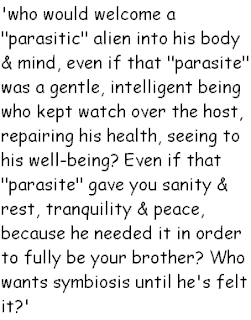
Algis Budrys' "Silent Brother" (as by Paul Janvier) (short story, symbiosis)

Quote from short story titled Silent Brother by Algis BudrysThis one is a good read, from among the many stories that share its main trope: sentient alien parasites find an initially reluctant & then willing host in humans because of the ... sort of ... rent aliens are willing to pay.

Story summary.

Four men comprising the first human expedition to Alpha Centauri have returned after their 6 months (?) long trip - with an unusual gift. A gift government considers so dangerous it has them quarantined.

Meanwhile, Harvey Cable, the inventor of the stardrive & now a cripple living some 20 miles from the site of expedition's landing, is finding his uneventful life changed in unexplainable ways.

Of course, there is a link between the returned expedition & the curious events now happening in Harvey's life...

See also.

  1. Larry Niven's "Smut Talk" (download) & Hal Clement's "Needle" are similar in that they too feature sentient alien parasites that use humans as hosts.
  2. Howard L Myers' "Partner" (download) has a plot somewhat akin to curious events in Harvey's life. And the general style of this part has been a favorite of Henry Kuttner & C L Moore - their fantastic story "The Prisoner in the Skull" immediately comes to mind. May be Robert Louis Stevenson's "The Strange Case of Dr Jekyll and Mr Hyde" is the canonical story about this trope (but I haven't read Stevenson's version).

Collected in.

  1. Isaac Asimov & Martin H Greenberg (Eds)' "Isaac Asimov Presents the Great SF Stories 18 (1956)".

Fact sheet.

First published: Astounding, February 1956.
Rating: A.
Listed among the stories from John Campbell's Astounding/Analog.
Related: Stories of Algis Budrys.

Sunday, August 23, 2009

Algis Budrys' "Rogue Moon" (novel): Experiencing violent death without actually dying!

Cover image of the 1960 novel titled Rogue Moon by Algis BudrysWhile it was a good read, I'll fall short of listing it among the genre classics - the company it often gets. I didn't get bored while reading, but something kept making me avoid picking it up from a stopped point. May be I don't enjoy reading about death; since we're all going to die someday, why prepone its consideration?

I collect some quotes from the book in a separate post.

Story summary.

There are at least 4 distinct themes here:
  1. Examining a mysterious formation on moon, apparently of intelligent non-human origins, apparently spanning more dimensions than we can perceive. If it has a purpose, we cannot comprehend that.

    Only thing known is: it kills anyone who enters it from the only known place it can be entered from. Death is usually violent, at varied distances from entry, in the act of performing innocuous acts like raising a certain arm above a height. And different human explorers see different things inside it.

    While the story revolves round this, the actual exploration occupies relatively little text. By the end of the story, first successful path from its entry to exit would have been traced where the human explorer come out alive.
  2. Complicated life stories of Dr Edward Hawks & Al Barker (more of the later).

    Hawks is the man who invented a matter transporter that can ship both living & non-living things to moon, & only non-living things from moon. He's now in charge of exploring the formation on behalf of US government. He not only manages the transport infrastructure, but also recruits volunteers for the mission that guarantees death!

    Al is a rich daredevil adventure with a wrecked personal life; considerable text is devoted to his life story. He's recruited by Hawks for exploring the hazardous formation.
  3. Examining the philosophical question: how will you react if you were to experience your own death?

    The device used involves a certain way of using the matter transmitter. You scan an individual, killing the original in the process. Then you transmit the (analog) scanned data to moon where it will be materialized into the individual as represented by scan, possibly with minor bugs like a certain trivial memory of childhood is lost! You also materialize another copy of the individual in the lab on earth - but with the delay corresponding to signal transmission delay to moon.

    Now these two individuals - M(oon) & L(ocal) - are telepathically linked for a few minutes. Since M is going to be killed examining the formation on moon, L is the way you examine what he saw (formation allows very limited, obviously gamed!, communication with outside world).

    So after materializing L, you deprive him of all local sensory inputs - so his telepathic experience will be uncorrupted.

    Problem is: everyone who's been through the process comes out insane! They cannot withstand the experience of their own death. Till Al comes along. He will experience multiple deaths during several missions, & will eventually succeed.

    In the process, we get some apparently wise sayings on death. I didn't mull over them.
  4. Examining the implications of duplicating an individual.

    Say a copy of you is sent to moon. Two of you live independent lives, after the initial few minutes of telepathic connection. After some years, the job of you moon copy is done. If he returns to earth, what kind of conflicts will your two copies have to undergo?

    This part actually occupies very little text, near end, & is actually brushed aside by saying - the copy on moon practically cannot be allowed to return to earth.

Fact sheet.

First published: 1960.
Rating: B.
Nominated for Hugo Award 1961 in novel category.

Quotes from Algis Budrys' "Rogue Moon" (novel)

I collect the quotes from the book below, separate from main post on the book.

Quotes.

  1. "There's the people who get moved out of the way or into line, & then there's the people who do the moving."
  2. About the moon formation: "It's a place. Or perhaps not. Perhaps it's an artifact - or else a living thing. But it's in a definite location, readily accessible."

    "it is roughly a hundred meters in diameter & twenty meters high, with irregularities & amorphous features we cannot accurately describe. We still know very little of its nature".

    "We don't even know what to call that place. The eye won't follow it, & photographs convey only the most fragile impression. There is reason to suspect it exists in more than three spatial dimensions. Nobody knows what it is, why it's located there, what its true purpose might be, or what created it. We don't know whether it's animal, vegetable, or mineral. We don't know whether it's somehow natural, or artificial. We know, from the geology of several meteorite craters that have heaped rubble against its sides, that it's been there for, at the very least, a million years. And we know what it does now: it kills people."

    "There's only one entrance into the thing... It is not an opening in any describable sense; it is a place where the nature of this formation permits entrance by a human being, either by design or accident. It cannot be explained in more precise terms, & it can't be encompassed by the eye or, we suspect, the human brain."

    "A man inside it can be seen, very dimly, if we know where to look. No one knows, except in the most incoherent terms, what he sees. No one has ever come out; no one has ever been able to find an exit; the entrance cannot be used for that purpose. Non-living matter, such as a photograph or a corpse, can be passed out from inside. But the act of passing it out is invariably fatal to the man doing it... The formation also does not permit electrical signals from its interior... Coughs, grunts, other noninformative mouth-noises, are permissible. An attempt to encode a message in this manner failed."

    "You will not be able to maintain communication, either by broadcast or along a cable. You will be able to make very limited hand signals to observers from the outpost, and you will make written notes on a tablet tied to a cord, which the observer team will attempt to draw back after you die. If that fails, the man on the next try will have to go in & pass the tablet out by hand, if he can, & if it is decipherable."

    "We have a chart of safe postures & motions ... as well as of fatal ones. It is, for example, fatal to kneel on one knee while facing lunar north. It is fatal to raise the left hand above shoulder height while in any position whatsoever. It is fatal past a certain point to wear armor whose air hoses loop over the shoulders. It is fatal past another point to wear armor whose air tanks feed directly into the suit without the use of hoses at all. It is crippling to wear armor whose dimensions vary greatly from the ones we are using now. It is fatal to use the hand motions required to write the English word 'yes,' with either the left or right hand."

    "We don't know why. We only know what a man can & cannot do while within that part of the formation which has been explored. Thus far, we have a charted safe path & safe motions to a distance of some twelve meters. The survival time for a man within the formation is now up to three minutes, fifty two seconds."

    "Perhaps it's the alien equivalent of a discarded tomato can. Does a beetle know why it can enter the can only from one end as it lies across the trail to the beetle's burrow? Does the beetle understand why it is harder to climb to the left or right, inside the can, than it is to follow a straight line? Would the beetle be a fool to assume the human race put the can there to torment it - or an egomaniac to believe the can was manufactured only to mystify it? It would be best for the beetle to study the can in terms of the can's logic, to the limit of the beetle's ability. In that way, at least, the beetle can proceed intelligently. It may even grasp some hint of the can's maker."

    It has "rules, & the crazy logic: Alice in Wonderland with teeth."
  3. "There are the people in this world who act, & the people who scheme. The ones who act get things done, & the ones who scheme try to take credit for it."
  4. "you won't actually have made the journey. The Barker who appears in the receiver has not one atom in his body that is an atom in your body now... It makes no functional difference ... that the Barker who appears is only an exact duplicate of the original... This new Barker has your memories, complete, & even the memory of the half completed thought that he finishes as he stands there. But the original Barker is gone, forever".

    "Barker who appears in the receiver could not be distinguished from the original in any way... it will seem to him that nothing has happened. When it happens to you, it'll seem to you that it's you who's standing there. The realization that somewhere else, once, there was a Barker who no longer exists, will be purely academic. You will know it because you'll remember my telling it to you now."
  5. "The universe has resources of death which we have barely begun to pick at.

    Death is in the nature of the universe, Barker. Death is only the operation of a mechanism. All the universe has been running down from the moment of its creation. Did you expect a machine to care what it acted upon?"
  6. "You ... were speechless at the injustice of it. You'd never thought that justice was only another human invention."
  7. On women: "here were these other intelligent organisms, in the same world with men, & there had to be a purpose for that intelligence. If all women were for was the continuance of the race, what did they need intelligence for? A simple set of instincts would have done just as well. And as a matter of fact, the instincts are there, so what was the intelligence for? There were plenty of men to take care of making the physical environment comfortable. That wasn't what women were for. At least, it wasn't what they had to have intelligence for."
  8. "Passing initiations doesn't mean a thing, if you go right back to what you were doing before; if you don't know you've changed!"

Tuesday, October 21, 2008

Profile: Algis Budrys

Mark Williams profiles Budrys in this online post "The Alien Novelist" in Technology Review, November/December 2008.