Showing posts with label Kristine Kathryn Rusch. Show all posts

Saturday, March 3, 2012

"Lightspeed", February 2012 (ed John Joseph Adams) (magazine, free): Annotated table of contents & review

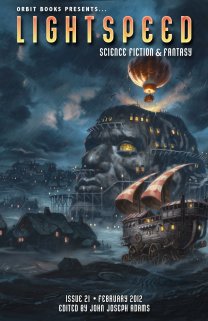
Cover of Lightspeed magazine, February 2012 issue
Whole issue.

Has 4 science fiction stories, including 2 reprints. I didn't find any really interesting, though Vaughn's is action packed.

List below is in order of my preference - best first.
  1. [reprint] [ss] Gregory Benford's "Dark Sanctuary" (B); download; Omni, May 1979: A lone asteroid miner is "attacked" & chased by an alien craft. Story is mostly deductions by miner based on very little information.
  2. [ss] Carrie Vaughn's "Harry & Marlowe & the Talisman of the Cult of Egil" (B); download; steampunk: Two Britishers, a princess & a soldier, steal an alien artifact from a temple in Iceland. Then they cross a blockade of British isles by Germans in an airship. Set in late 19th century.

    While the language is modern, the sentiments are from a century ago; not sure if it's intentional. First half could have been from an Argosy issue - "civilized" white man vs barbaric savage natives.
  3. [reprint] [ss] Kristine Kathryn Rusch's "Craters" (B); download; Future Weapons of War/Baen, March 2007: Two stories, actually, & dark - terrorists using bombs implanted in babies, & using engineered viruses to prevent wars.
  4. [ss] Keith Brook's "War 3.01" (B); download: Description of a world where geolocation-sensing augmented reality is common. We already have some of it in phones; this one adds a version of it using spectacles or contact lenses' based mobile displays.

Friday, April 3, 2009

Nonfic: Kristine Kathryn Rusch clarified "gothic novel" & its descendants

In this somewhat longish post at JBU, #18 (April 2009), she talks of "gothic novel" trope of fiction & its many avatars.

What struck me was the familiarity of the tropes with several Hindi movies. And a personal preference I didn't realize I had: I can stand only those stories of this kind that evokes the emotion of what she calls "understated unease" as opposed to outright horror feature of original form of "gothic novel", & even there I prefer local versions to English ones.
Note: One of better stories that evokes "understated unease" is Eric Frank Russell's "Rhythm of the Rats". But it clearly is not "gothic novel" class.

What she left unstated was that local folklore tends to get mixed in these tropes, & perhaps drives local tastes? In raw unadapted form, these tropes probably don't work as well across cultures.

I don't recall having heard a name attached to this trope in India - at least not at the level of granularity she talks of. Anyone would care to enlighten on local variants?

Friday, January 30, 2009

For authors: Advise from veterans

At SF Signal.

A few that caught my eye & probably apply to other endeavors too:

Robert Silverberg: A story makes quick money, & another gets collected in anthologies. Later is tougher to write & sell, but brings you money rest of your life. Former brings money one time only - when it is sold.

Mike Resnick: Believe in your product. And be flexible about both the channels that will put it in the hands of consumers & the target consumers.

Ben Bova: Go for "clarity and simplicity of style". "you've got to be able to take the most complicated things happening in the world and write it so that they can understand it."

John C Wright: "Talent is mostly sweat". He also has an interesting critique of Heinlein.

Marc Gascoigne: "GET IT DOWN, CHANGE IT LATER." Sacred words for many a programmer too, when used with a bit of brains.

Patricia Briggs: I actually liked it in a context slightly different from her. What does it take to create things? "work" - sweat. "play" - creativity. And use of competitive products to gain insight.

Alan Dean Foster: "be careful never to make your hero/heroine too powerful or too omnipotent" because "no one sympathizes with superman".

Kristine Kathryn Rusch: "going deep into the story, and not being afraid of the topics I brought up."

Matt Hughes:

  1. Be "minimalist": "the in-born human ability to take a few details (picking the right details is the author's job) and turn them into a complete picture. The more the reader puts in, I think, the greater the identification with the story."
  2. "At the heart of every story is a conflict. The conflict has a starting point. That's the thing to put on the first page".

Friday, May 23, 2008

Kristine Kathryn Rusch's "Craters" (novelette, non-genre, free): Two stories - on terrorism & war

Good prose, but first of the two unnamed stories is sooo dark - it certainly is not my idea of leisure reading.

First one - perhaps first two thirds of the text - is about a new kind of human bomb in the arsenal of terrorists. In a world where governments require chip implants on birth in the body of babies for administrative reasons, there is a flourishing industry in explosive chip implants with long duration timers. A newborn is implanted with a bomb that will go off when the child is 5 or 6 years old - on a specific date & time!

By the end of the story, there are only conjectures about who does the inhuman bomb implanting in babies - their fundamentalist parents; or other organizations without parents knowledge, in collusion with their associates in hospitals.

What we see is shunned survivors - a woman whose husband & little daughter died in a bomb implanted in the child; 3 little kids whose bombs went off in crowded places because someone gave free tickets to their families on the day bombs were to go off; a little lonely girl who was used as a bomb & is now a severe cripple & her parents are also now dead.

Second story is about a weapon to prevent wars. It's less subtle that the arsenal of Overlords in Arthur Clarke's "Childhood's End". It's sort of a somewhat saner version of David Marusek's "Osama Phone Home". A bioengineered virus, (perhaps) spreads by air, harmless to humans except for a temporary but debilitating sickness. Spread among soldiers of both the warring sides by moles planted by whoever wants to avoid war.

In this story, the warring parties are Israel & Saudi Arabia - with US refusing to side with Israel. Two private bioengineering researchers in the US - former militarymen from Israel & Saudi Arabia, respectively - will play moles & ground their own militaries on the day of attack. Resulting sickness among troops is severe enough to attract international attention - hence effectively preventing war for a couple of years, at least!

Collected in.

  1. Gardner Dozois (Ed)'s "The Year's Best Science Fiction: Twenty-Fifth Annual Collection" (2008).

Fact sheet.

First published: Future Weapons of War/Baen, March 2007.
Rating: B
Download full text.

Friday, March 28, 2008

Kristine Kathryn Rusch's "Recovering Apollo 8" (novella, science fiction): Shipwreck & wreck recovery in space

Quite readable first half, but it begins degenerating a little after half-way point towards incredulity.

Story itself is alternate history. Real Apollo 8 mission of NASA to moon & back, with crew & dates that match the ones listed in this story, was a successful one.

In this story, something goes wrong & the ship never enters lunar orbit; it instead goes away from earth & moon into deep space. Story is mostly about recovery of the ship & crew, beginning 40 years later - between 2007 & 2068. First 2 of the 4 chapters are decent enough, though I felt uncomfortable with the idea of using real survivors in a story where they die.

There are also occasional lame statements like "one of his computer visionaries, a man named Gates, had proposed selling those smaller computers to the business market" - his refers to hero of the story - one Richard J Johansenn. Plus super heroics of Richards, the billionaire mastermind - even at age 108!

This story would have been much better at half the length. It would also have been more credible if the initial recovery date was a couple of decades into future rather than 2007.

If you're into classical sf, you'll find nearly every theme in this story a rehashed one. If not, it gives a taste of a bygone era.

In spite of the flaws, I was entertained. At novella length, it's the most engaging story I've seen so far in both Nebula & Hugo Awards lists - a particularly weak category this year.

Full text of this story is available for download.

Story summary.

Story is divided into 4 parts - 2007, 2018, 2020, 2068. Hero is 108 in 2068.

Early in the story, we are told of the Apollo 8 disaster, & that both ship & crew are lost. Young Richard, then 8, will make it his lifelong obsession to recover that ship & bring it back to earth.

We then meet him at age 48, a billionaire, & with far flung space businesses. That's about our current time. This is where the lost ship gets located - it's in an elliptic orbit about sun, & approaching its nearest point to earth. And there is a mission to recover the ship. Mission will be successful, except the Apollo 8 ship is empty! No signs of the 3 crew! Turns out they jumped off the ship - to die in vast spaces rather than in cramped quarters inside their ship.

Jump to 2018. Richard had started a new project to locate & recover these 3 floating corpses in space! It's believed they are also in orbit about sun, but how to locate them?

Early in this second part, one of his employees has located one of the corpses. Looks like the spacesuit of crew included a plastic helmet with characteristic spectrum. Another mission, & the corpse is recovered - of Lovell.

We are now somewhat more than half way through the story, & really incredulous rest is about to begin. In 2020, the star researcher of Richard has left, & no one has a clue to location of other two lost spacemen. That is where we are introduced to some China/US talk - evil China wants some of US technology, etc. Anyway, Chinese government has located the second corpse, & wants some space technology as trade. Trade is made, mission launched, & corpse recovered - of Commander Borman.

Over to last part - 2068, the most incredulous. Richard, 108, has long lost interest in the project. He is on the way to Mars with his 48-year old daughter Delia. Part of the way through, he will manually locate the third corpse!!! And get off the ship in a lifeboat, & recover the corpse - of Anders!

Fact sheet.

"Recovering Apollo 8", short story, review
First published: Asimov's Science Fiction, February 2007.
Rating: A
Nominated for Hugo Award 2008 in novella category.