Showing posts with label Robert Silverberg. Show all posts

Monday, September 9, 2013

"Future Science Fiction", Fall 1957 (ed Robert A W Lowndes) (magazine, free): Annotated table of contents

Cover by Emsh of Future Science Fiction magazine, Fall 1957 issue. Picture illustrates the short story The Lonely Stars by Scott Nichols.
I haven't read any story yet. Links on author fetch more fiction by author.

Table of contents.

  1. [novelette] Gordon R Dickson's "Cloak & Stagger": "It would have been hilarious if Earth's acceptance into the Federation hadn't depended on how Torm Lindsay carried out his mission--because no one, particularly Lindsay, had the faintest notion of what he was expected to do, or not do!"
  2. [ss] Margaret St Clair's "Starobin": "They needed a hero like Starobin--but a hero like Starobin was just the kind who didn't care..."
  3. [ss] Scott Nichols' "The Lonely Stars": "Would humanity ever be able to undo that worst of blunders?"
  4. [ss] Robert Silverberg's "Force of Mortality": "The greatest boon can also be the deadliest curse..."
  5. [ss] Thomas N Scortia's "Last Meeting Place": "Garth was one of the few who understood history--but could he avoid repeating it?"
  6. [ss] Bruce Tucker & Irving Cox, Jr's "The Professor from Pyjm": 'Was Mytohell just another "crazy scientist" or ...?'
  7. [ss] F M Busby's "A Gun for Grandfather": "So you have a time machine, so you can go back in time & shoot grandpa? But why bother? Barney had a reason..."
  8. [ss] George R Hahn's "The Round Peg": "Basil Thorpe was the most bizarre of phonies..."

Fact sheet.

Labeled: "No 34". "Published quarterly".
Download scans as a cbr file. [via pulpbox@pulpscans]
Note: Link fetches a RAR file that needs to be renamed CBR.
Related: Old pulps; fiction from Future SF, 1950s.

Friday, August 16, 2013

"Imaginative Tales", July 1957 (ed William M Hamling) (magazine): Annotated table of contents

Cover painting of Imaginative Tales magazine, July 1957 issue, by Malcolm Smith, illustrating the story World of Never-Men by Edmond Hamilton
Oops. I downloaded its CBR a while back but the link seems to have gone dead now. Will post the link separately if I can find it elsewhere.

I haven't read any story yet.

Table of contents.

  1. [novella] Edmond Hamilton's "World of Never-Men": "Barker set out on a trail of vengeance that would lead him to retribution--or death. It would also, inevitably, bind him to Mars' dark secret..."
  2. [ss] Robert Moore Williams' "The Red Rash Deaths": "There wasn't a cure for the sickness that struck humans down in horrible agony. And Keeton lacked any clues to follow in his race to stop..."
  3. [ss] Randall Garrett's "Devil's World": "Every secret agent sent to Mercury turned up dead; now Courtney volunteered for the task of trapping Thurston, the man who ruled this--".
  4. [ss] Robert Silverberg & Randall Garrett's "Hot Trip for Venus" (as by Ralph Burke): (ToC lists Ralph Burke as author; story lists Randall Garrett as author!). Alex Mayne knew somebody wanted to keep him out of the spacelanes. And that could only mean someone was afreaid he'd learn about the--"
  5. [ss] Robert Silverberg & Randall Garrett's "Pirates of the Void" (as by Ivar Jorgensen): "Brant's job was to check the robot relays on tiny stations scattered through space. It was not his job to risk death after an attack from--"
  6. [ss] Robert Silverberg's "The Assassin": "Bigelow had a grand idea; he would travel more than a hundred years through time to Ford's Theatre, see the President, & warn him about--"

Fact sheet.

Related: Old pulps.; fiction from 1950s.

Monday, March 4, 2013

Robert Silverberg's "To Be Continued" (short story, immortality, free): Slow life is frustrating!

One of the illustrations by Emsh accompanying the publication in Astounding Science Fiction, British edition, April 1957, of short story To Be Continued by Robert Silverberg. Image shows the 2000 year old hero with 2 personas of his 300 year old lady love.
Immortality here is of a curious kind - your growth slows down. Like you'll develop physically & psychologically by a year when actual time lapsed in say 100 years! Author didn't elaborate how the hero survived infancy since parents aren't normally immortals & the immortals exist without society knowing about them; that's a weak point of the story.

The only immortals we meet in the story also have a curious super ability - they can morph into a different individual, in all observable ways. So, e.g., you can simultaneously romance two girls using your different personas, & no trouble even if one of them spots you with another.

This is the story of a 2000 year old man, Gaius Titus Menenius, who's now finally reached puberty! Story is mostly his search for a mate, with a funny ending.

See also.

  1. Mohsen H Darabi's "Loyalty beyond seasons" (download): Another kind of biological impediment to romance...
  2. Eric Frank Russell's "The Waitabits" (download as part of a larger package): When a fast life encounters a much slower one...

Fact sheet.

First published: Astounding, May 1956.
Download full text as part of the scans of Astounding (British ed), April 1957.
Rating: A.
Among the stories from Astounding/Analog issues edited by John Campbell.
Related: Stories of Robert Silverberg.

Sunday, February 17, 2013

"Astounding Science Fiction" (British edition), April 1957 (ed John Campbell) (magazine, free): Annotated table of contents

Cover by Van Dongen of British edition of Astounding Science Fiction magazine, April 1957 issue.
I think I've read "2066: Election Day" in one of the "Issac Asimov Presents Great SF Stories" books. An unusual "election" for a US President, an election where people don't vote at all, & one that was actually rigged by a small coterie. I don't think I came back happy with it, & the ending invoked in me an angry reaction - "how could the author propose this to be a good outcome?" type of reaction.

Links on author fetches more fiction by author. Where I have a separate post on a story, link on story title goes there. For stories I've read, my rating is in brackets.

Table of contents.

  1. [novelette] Robert Silverberg & Randall Garrett's "False Prophet" (as by Robert Randall): "There are times when it is exceedingly unwise to tell the truth--& the Nidorian was dedicated to truth. The Earthmen were wiser; they lied about him."
  2. [ss] Michael Shaara's "2066: Election Day": "There is a limit to any process you can name ... & sooner or later that limit will be reached. Then ... somehow you have to fumble togeather a new thing..."
  3. [ss] Algis Budrys' "Look on My Works" (B): Tourist guides milking a tourist from Centaurus with fakes, in a far future New York city...
  4. [ss] Robert Silverberg's "To Be Continued" (A): Slow life is frustrating!
  5. [serial - 3/3] Isaac Asimov's "The Naked Sun": "Lije Baley had a triple-decker problem to solve--& solved it only because a robot tried to give him a hand. And thereby taught him to define his terms with a new exactness!"

Fact sheet.

Labeled: "Vol XIII No 4 (British Edition)".
Download scans as a CBR file [via Bob@pulpscans]
Note: The link fetches a RAR file that contains the target CBR, probably to work around hosting service's file naming constraints.
Related: Stories from the Astounding/Analog issues edited by John Campbell, old "pulps", 1950s.

Sunday, December 23, 2012

Robert Silverberg & Randall Garrett's "The Chosen People" (as by Robert Randall) (novelette, communications, free): Teaching the scientific method to deeply tradition bound

One of the illustrations by van Dongen accompanying the publication in British edition of Astounding Science Fiction magazine of short story The Chosen People by Robert Silverberg and Randall Garrett. Image shows a human teacher with his alien student.
This rarely reprinted story would be among my all time favorite science fiction. It's a study in how to win friends & influence people!

Story summary.

There is a deeply religious & tradition-bound alien society on a world called Nidor. Humans came a few decades back, & seem to be wise & religious beyond question; so they're respected & have been allowed to run a local school that teaches the familiar to youngsters, sometimes in new ways. And what a revolution it is brewing!

Story is told via a massive local disaster that can only be averted with the new ways of thinking: "Hugl", small insect-sized pests, travel in vast swarms & destroy everything in their path. Only "Edris powder", the traditional insecticide, is not working this year...

Fact sheet.

First published: Astounding, June 1956.
According to ISFDB, it's first of the 3 stories that make up the fix-up novel "The Shrouded Planet".
Download full text as part of scans of Astounding (British Edition), November 1956.
Rating: A.
Among the stories from Astounding/Analog issues edited by John Campbell.
Related: Stories of Robert Silverberg, Randall Garrett.

Monday, November 12, 2012

"Astounding Science Fiction" (British Edition), November 1956 (ed John W Campbell) (magazine, free): Annotated table of contents & review

Cover by Freas of the British edition of Astounding Science Fiction magazine, November 1956. Cover illustrates the story Plus X by Eric Frank Russell.
I'd read "Next of Kin", the novelization of "Plus X" (another longer variant of the story is "The Space Willis"), when I went through a Russell phase some years ago, & just loved it. Now, reading the original novelette in this issue, I had a milder reaction, but it still made me laugh at many places. It's a funny jailbreak story - a human smart alec vs his dimwitted alien captors.

Table of contents.

  1. [novelette] Eric Frank Russell's "Plus X" (A); humor: Didn't you know that humans can only exist in pairs?
  2. [novelette]  Robert Silverberg & Randall Garrett's "The Chosen People" (as by Robert Randall) (A): Teaching the scientific method to deeply tradition bound.
  3. [ss] Poul Anderson's "The Live Coward" (B): Cop catches a fugitive in colorful circumstances.
  4. [ss] Algis Budrys's "The Peasant Girl" (as by Paul Janvier) (B): Humans are supermen to supermen!
  5. [ss] Thomas N Scortia's "Sea Change": 'Of course, everybody knows what "being human" means--it's just that they can't define it, but of course they know what it means..."

Fact sheet.

Labeled: Vol XII, No 11.
Download scans as a CBR file. [via Bob@pulpscans]
Note: Link points to a RAR file that contains target CBR, probably to work around some hosting service file naming constraints.
Related: Stories from the Astounding/Analog issues edited by John Campbell, old "pulps", 1950s.

Saturday, October 20, 2012

3 minor stories

All online via scans of Astounding (British Edition), May 1958. All short story length.
  1. Jon Stopa's "Hot Water" (B): This government doesn't know how to handle civil unrest; both sides are throwing atom bombs at each other!

    It deals with a subject that is often in news in India now-a-days - the "project affected people". And has an interesting quote:

    "Democracy occurs when a majority respects the rights of a minority--unfortunately the majority rarely does so except when the minority can make it listen."
  2. Christopher Anvil's "Achilles' Heel" (B); download: Starfaring humanity's military commander finally gets insight on how to defeat "Wij-Wij", aliens that look like "giant inchworms" & with whom earth is at war.
  3. Robert Silverberg's "No Way Out" (B): Chief executive of an overpopulated earth still breeding uncontrollably finally has enlightenment: to take measures to cut the breeding rate!
Related: The stories from Astounding/Analog issues edited by John Campbell.

Saturday, October 13, 2012

"Astounding Science Fiction" (British Edition), May 1958 (ed John Campbell) (magazine, free): Annotated table of contents

Cover by Van Dongen of the British edition of Astounding Science Fiction magazine, May 1958 issue
Where I have a separate post on a story, link on its title goes there. Where I'm aware of another text version of a story, I include that link too. Links on author fetch more of their works. My rating for read stories appears in brackets.

Table of contents (best first).

  1. [ss] Eric Frank Russell's "Brute Farce" (A); humor: Introducing a lateral thinker... 
  2. [novelette] L Sprague de Camp's "Aristotle and the Gun" (A): Teaching the scientific method to Aristotle... 
  3. [novel - 1 (this), 2, 3 of 3] Poul Anderson's "The Man Who Counts" (A): What if, during the creation of Israel during the 1940s, US had sided with Arabs instead of Israel? A very colorful fantasized variant of it.
  4. [article] Mark Clifton's "The Dread Tomato Addiction" (A); download; satire: How to reach wrong conclusions from the right data! 
  5. [ss] Jon Stopa's "Hot Water" (B): This government doesn't know how to handle civil unrest; both sides are throwing atom bombs at each other!
  6. [ss] Christopher Anvil's "Achilles' Heel" (B); download: Starfaring humanity's military commander finally gets insight on how to defeat "Wij-Wij", aliens that look like "giant inchworms" & with whom earth is at war. 
  7. [ss] Robert Silverberg's "No Way Out" (B): Chief executive of an overpopulated earth still breeding uncontrollably finally has enlightenment: to take measures to cut the breeding rate!

Fact sheet.

Labeled: "Vol XIV, No 5 (British Edition)".
Download scans as a CBR file. [via Bob@pulpscans]
Note: Link fetches a RAR that contains target CBR, probably to work around the file naming conventions of hosting service.

Related.

  1. Stories from Astounding/Analog (whole issues only).
  2. Fiction from 1950s, old "pulps".
  3. Stories from the Astounding/Analog issues edited by John Campbell.

Friday, August 31, 2012

"Imagination Science Fiction", April 1957 (ed William M Hamling) (magazine, free): Annotated table of contents

Cover painting by Lloyd N Rognan, of Imagination Science Fiction magazine, April 1957 issue, illustrating the story Bring Back My Brain by Dwight V Swain

Table of contents.

  1. [novel] Dwight V Swain's "Bring Back My Brain!": "A man can fight as long as he has the strength--or a mind to command his body!"
  2. [novelette] Robert Moore Williams' "Secret of the Painting": "It wasn't the painting itself men killed for, but the knowledge hidden there..."
  3. [ss] Robert Silverberg's "Harwood's Vortex": "Ever wondered what would happen if the sky fell on you? Harwood found out!"
  4. [ss] Randall Garrett's "Guardians of the Tower": "Legend demanded he guard the strange tower. Was it something worth dying for?"
  5. [ss] Robert Silverberg's "The Old Man" (as by S M Tenneshaw): "The space pilot was a man to be envied. Until the inevitable day of retirement..."
  6. [ss] Robert Silverberg & Randall Garrett's "Slaughter on Dornel IV" (as by Ivar Jorgensen): "Before the fight with the alien champ, Filmore decided to test his own skill..."

Fact sheet.

Labeled: Vol 8 No 2.
Download scans as a CBR file. [via Sea@pulpscans]
Related: Fiction from Imagination; old pulps; fiction from 1950s.

Saturday, June 30, 2012

Robert Silverberg's "Flies" (short story, horror, free)

Quote from short story Flies by Robert Silverberg. Story attributes the quote to Lear by Shakespeare.
Rather well hashed theme here - vampire variants that feed not on the blood of the victim but something else. C L Moore wrote a lot of stories of the kind; others too have done their bit. Setup in early parts is strikingly similar to Arthur Clarke's "Playback".

Story summary.

Sole shipwreck survivor in outer solar system is rescued by aliens, & his damaged body regenerated. Aliens also edited his mind - turning him into a pathological killer with a mind capable of transmitting the horror of victim to aliens, thus feeding one of their needs!

We'll see some episodes of the resulting terror unleashed on earth.

Fact sheet.

First published: Harlan Ellison (ed)'s "Dangerous Visions" (1967).
Download full text.
Rating: B.
Related: Stories of Robert Silverberg.

Wednesday, March 23, 2011

Robert Silverberg's "The Tomb of the Pontifex Dvorn" (novelette, free): Bringing history to life

I haven't read a lot of Silverberg, but what I've read so far has been grim. This, by contrast, is a very light read - latest in author's "Majipoor" series. Appears to move slowly, but actually is moving pretty fast.

Story summary.

On a world called Majipoor, colonized thousands of years ago by humans when it already had its "aboriginals", & over the years supplanted by other space faring alien colonists, two young university teachers get a job of a life time: Simmilgord, the historian, to authenticate that a mythical hero of antiquity actually lived in a certain town, & his friend Lutiel Vengifrons, an archaeologist, to excavate the artifacts allegedly associated with this hero.

We get to see the contrasting characters of the two, plus some other realistic characters.

Fact sheet.

First published: Subterranean Online, Winter 2011.
Download full text from publisher's site.
Rating: A.
Added to my "best of 2011" list.
Related: Stories of Robert Silverberg.

Sunday, January 24, 2010

Some insight into how pulp era fiction used to be produced

Robert Silverberg does some reminiscing of his experiences from the period in this short interview.

[via Boing Boing]

Wednesday, December 23, 2009

Robert Silverberg critiques Arthur Clarke's fiction

At Asimov's.

Related: Fiction from Asimov's; fiction of Robert Silverberg/Arthur Clarke.

Friday, January 30, 2009

For authors: Advise from veterans

At SF Signal.

A few that caught my eye & probably apply to other endeavors too:

Robert Silverberg: A story makes quick money, & another gets collected in anthologies. Later is tougher to write & sell, but brings you money rest of your life. Former brings money one time only - when it is sold.

Mike Resnick: Believe in your product. And be flexible about both the channels that will put it in the hands of consumers & the target consumers.

Ben Bova: Go for "clarity and simplicity of style". "you've got to be able to take the most complicated things happening in the world and write it so that they can understand it."

John C Wright: "Talent is mostly sweat". He also has an interesting critique of Heinlein.

Marc Gascoigne: "GET IT DOWN, CHANGE IT LATER." Sacred words for many a programmer too, when used with a bit of brains.

Patricia Briggs: I actually liked it in a context slightly different from her. What does it take to create things? "work" - sweat. "play" - creativity. And use of competitive products to gain insight.

Alan Dean Foster: "be careful never to make your hero/heroine too powerful or too omnipotent" because "no one sympathizes with superman".

Kristine Kathryn Rusch: "going deep into the story, and not being afraid of the topics I brought up."

Matt Hughes:

  1. Be "minimalist": "the in-born human ability to take a few details (picking the right details is the author's job) and turn them into a complete picture. The more the reader puts in, I think, the greater the identification with the story."
  2. "At the heart of every story is a conflict. The conflict has a starting point. That's the thing to put on the first page".

Sunday, November 9, 2008

Free fiction: 4 early stories of Robert Silverberg

Robert Silverberg's collection "In the Beginning: Tales from the Pulp Era" is online at Webscription, with 4 free stories from his early writing career. In Prolog, author clarifies that these stories were meant to entertain rather than enlighten.

[via Best Science Fiction Stories]

Thursday, October 23, 2008

Profile: Murray Leinster

Robert Silverberg profiles Murray Leinster in this online post titled "Reflections: A Logic Named Will" at Asimov's. A substantial part is devoted to a review of his short story "A Logic Named Joe."

[via SF Signal]

Wednesday, July 2, 2008

Robert Silverberg's "Caught in the Organ Draft" (short story, science fiction, free)

Quote from short story titled Caught in the Organ Draft by Robert SilverbergDark, plausible, & quite readable. Theme is generally the same as Larry Niven's "The Jigsaw Man": a post-modern society that has found a justification for what can justifiably be called cannibalism - legally forcing others to donate their body organs for Mr X's benefit.
In Niven's story, it was by instituting capital punishment for even minor traffic offenders, & state gets to mine the organs of the executed! In this story, it's mandatory organ draft - state can forcibly draft anyone healthy & young in an organ donation program; if you have the right pull & a dying kidney, you can force me to "donate"! OK - the mechanics are a bit more complex, but that's the essential idea.

Story is narrated first person by a young man just drafted, & his anguish at the system. By the end of the story, he would have lost one kidney to draft program.

At a very fundamental level, this is also the traditional power broker's story: If you donate an organ, you get a higher right to someone else's organs than others. Obviously there are people who benefit more than others, when compared with the situation where everyone gets to keep their organs (rather than making power-brokers decide the distribution). How often do our dear politicians try this - for some resource or the other?

Indian readers will find an echo of our caste certificate racket here: story has an elaborate classification system on who has more organ reception rights than others. In fact, this classification system divides the society into castes in a manner not too different from those recognized by India's reservation laws.

Fact sheet.

First published: Roger Elwood (Ed)'s "And Walk Now Gently Through the Fire" (1972).
Rating: A
Download full text from Internet Archive.
Included in Ellen Datlow's Sci Fiction classics.

Wednesday, April 23, 2008

The Science Fiction Hall of Fame: Series summary

According to Silverberg's introduction to Vol 1, the series was created in early days of the founding of SFWA. While Nebula Awards recognize recent stories each year, the idea of Hall of Fame series was to recognize stories before the founding of Nebula Award - sort of one time equivalent of Retro Hugo.

Process of story selection was similar to that of Nebula Awards; so it's convenient to look at the series as Nebula Awards for stories written before official annual Nebulas.

Voting was in two categories - stories up to 15,000 words (short story & novelette), & those larger in size (novelette, novella, novel). Former went into Volume 1 (1970), edited by Robert Silverberg; later into Volume 2 (1973) edited by Ben Bova. Vol 2 is in turn split into 2 books - 2A & 2B because of too much material. In the entire set, there is only one novel (in Vol 2A); everything else is short fiction.

And, with very few exceptions, the selections are from a period of about 30 years preceding Nebulas. A total of 26 stories in Vol 1, & 11 each in Vol 2A & 2B. Means less than 2 stories for each year - mostly in short fiction category.

According to Ben Bova's introduction to Vol 2A, there were two more stories of larger than 15,000 words that qualified but "were unavailable for this anthology": Walter M Miller, Jr's "A Canticle for Leibowitz", & Ray Bradbury's "The Fireman". Former is now more readily available in an edited & renamed avatar - "Fiat Homo", the first of the 3 stories included in the fix-up novel also called "A Canticle for Leibowitz". According to Wikipedia, Bradbury's novella "The Fireman" was itself an expansion of an earlier short story "Bright Phoenix"; novella was later expanded into the much better known novel "Fahrenheit 451".

Over the years, there seem to have been extensions - sort of milking the "Hall of Fame" brand as a franchise. So there have been Vol 3 (1981) edited by Arthur Clarke & Geo W Proctor, & Vol 4 (1986) edited by Terry Carr - both containing stories that have won normal Nebulas.
Note: If you landed here looking for ToCs of these two volumes, here are external links to them: Vol III & Vol IV.

There are also two Ben Bova volumes from 1975 - "Science Fiction Hall of Fame: The Novellas" - Book 1 & Book 2. I don't really know their rationale. Their contents seem to be subsets of Vol 2A & 2B.

For the moment, I'm only interested in original pre-Nebula content. Hence only 3 links below; links are to detailed reviews of the books.

The Series (3 books).

  1. Robert Silverberg (Ed)'s "The Science Fiction Hall of Fame: Volume One, 1929-1964" (1970): 26 stories, all read.
  2. Ben Bova (Ed)'s "The Science Fiction Hall of Fame: Volume Two A" (1973): 11 stories, all read.
  3. Ben Bova (Ed)'s "The Science Fiction Hall of Fame: Volume Two B" (1973): 11 stories, few read.

Sunday, February 24, 2008

Robert Silverberg (Ed)'s "The Science Fiction Hall of Fame: Volume One, 1929-1964" (1970, anthology): Annotated table of contents

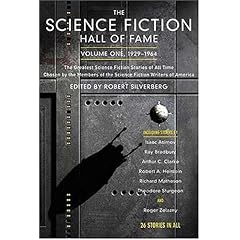
Book cover of anthology titled The Science Fiction Hall of Fame, Volume One, 1929-1964, edited by Robert SilverbergA very well regarded anthology, with several outstanding stories, but also with a lot of duds.

My rating is in brackets (ABC: A = worth the reading time; C = don't bother).

Table of contents (26 stories, best first, unread at end).

  1. [novelette] Tom Godwin's "The Cold Equations" (A); Astounding, August 1954: An innocent girl is to be executed due to apathy of administration (according to author, due to nature's laws, but that's now how it comes across in the story). Intensely emotional.
  2. [novelette] Daniel Keyes' "Flowers for Algernon" (A); F&SF, April 1959: Don't maltreat mentally retarded, please.
  3. [novelette] Murray Leinster's "First Contact" (A); Astounding, May 1945; science fiction: How do you establish trust when there is no common ground between the transacting parties, & the stakes are very high? I might have really liked this story if its solution involved exchanging some clever messages; this one involves exchanging the hardware. Very logical, under the circumstances, but programmer inside me was unhappy with the outcome.
  4. [novelette] Lewis Padgett's "Mimsy Were the Borogoves" (A); Astounding, February 1943: Cognitive processes impossible to human adults can be taught to very young children. Lewis Padgett is a joint pseudonym of spouses Henry Kuttner and C L Moore.
  5. [novelette] Robert A Heinlein's "The Roads Must Roll" (A); Astounding, June 1940: Terrorist attack on suburban transport system causes much mayhem.
  6. [novelette] Theodore Sturgeon's "Microcosmic God" (A); Astounding, April 1941; science fiction: A genius inventor has concluded that even the most prolific inventors rely on slowly gathered insights of many men. To speed up progress, he's created a fast evolving new life form - far far smarter than humans in that they can solve impossible problems that will take humans forever, & for the moment they are contained in a closed habitat in an island. But who can say how long they will remain there? What will mankind do when they decide to come out?
  7. [novelette] Isaac Asimov's "Nightfall" (A); Astounding, September 1941; science fiction: My not so good reaction to this original is probably because I'd read & loved its novelization years back. This shorter version mercifully kills the later half of the novel that was utter bore. What we are left with is great stuff, but I prefer corresponding novel version that is better developed (first half of novel). Story is about a world with many suns & where there is always at least one sun in the sky. Local beings are so unfamiliar with the idea of darkness that it drives them physically mad. This is the reason the civilization is destroyed every 2,000 years or so - that's when the sole sun in the sky on that occasion is eclipsed by a sister world long enough to bring out a night all over this world. This short story follows the last hours of current civilization - for the eclipse is only a few hours away.
  8. [novelette] C M Kombluth's "The Little Black Bag" (A); Astounding, July 1950; science fiction: A medical doctor going through a bad patch finds a magical medical kit from future that helps him find a purpose in life.
  9. [novelette] James Blish's "Surface Tension" aka "Lavon" (A); Galaxy, August, 1952; science fiction: When a stellar colonization ship crashed on an uninhabitable water world with no chance of anyone surviving more than a few weeks, the colonists do the next best thing - create microscopic water-borne life forms adapted to local world that are essentially human! Now these microscopic "men" are ready to discover who their ancestors were.
  10. [ss] Ray Bradbury's "Mars Is Heaven" aka "The Third Expedition" (A); "Planet Stories" magazine, Fall 1948: Human explorers are unwanted on Mars, & are conned by telepathic & hypnotist locals.
  11. [novelette] Stanley G Weinbaum's "A Martian Odyssey" (A); Wonder Stories, July 1934; science fiction: Description of a variety of sentient alien races. In the form of an adventure on Mars.
  12. [novelette] Roger Zelazny's "A Rose for Ecclesiastes" (A); F&SF, November 1963; science fiction: Intelligent long-lived race of Mars is dying because their men have been sterilized by a curious rain. A human visitor will offer them a way out.
  13. [ss] Judith Merril's "That Only a Mother" (A); Astounding, June 1948; science fiction: Moving story of a post nuclear apocalypse where normal child births are very rare; nearly all children born are grossly deformed. Story tracks a woman's pregnancy, birth of a daughter, & first few years (or months?) of the daughter. Mother so badly wants her child to be normal that she hasn't even noticed that her daughter lacks all limbs - even several years after birth!!
  14. [ss] Lester del Rey's "Helen O'Loy" (A); Astounding, December 1938; science fiction: A hominid robot in a female body is madly in love with "her" creator!
  15. [novelette] A E van Vogt's "The Weapon Shop" aka "Weapon Shops of Isher" (B); Astounding, December 1942; science fiction: In a future dystopia where the rulers squeeze the subject every way they can, & common people have been brainwashed with government propaganda all their life to believe in benign rulers, an organization called "The Weapon Shop" is serving the role of Robin Hood - they have power & muscle to restore government wrongs for specific individuals.
  16. [ss] Anthony Boucher's "The Quest for Saint Aquin" (B); Raymond J Healy (Ed)'s "New Tales of Space & Time" (1951); science fiction: In a future dystopia where most people have fallen back to primitive existence, the very few ruling elite are technologically advanced & planet-faring, & where Christianity is banned in the US, an underground Christian movement in California has sent an agent to confirm rumors of a messiah in a remote village. And he gets astonished after discovering the thing that makes the long dead body of this rumored messiah special.
  17. [ss] Clifford D Simak's "Huddling Place" (B); Astounding, July 1944; science fiction: In a future society where people live in the countryside rather than cities, & have all creature comforts including personal robots & immersive virtual remote presence, a man has developed an extreme fear of open spaces! Through out the story, he will be living with it; he cannot even come out of it during an extreme emergency at end.
  18. [ss] Cordwainer Smith's "Scanners Live in Vain" (C); download; Fantasy Book magazine, Vol 1, No 6 ( January 1950): A much imitated story where some men have been brainwashed to forgo their lives for the good of society. They've been surgically modified to kill their normal senses, & turn them into ruthless machines used in space. One of their kind will eventually help them get their lives back.
  19. [novelette] Alfred Bester's "Fondly Fahrenheit" (C); F&SF, August 1954: A man has the ability to unconsciously transform his own violent nature to his robots, making robots violent prone - including senseless murder & torture. Much of the story is about violent crimes of his android whose labor he has been living off on. There is a conclusion that this android behaves violently only when ambient temperature is about 90 F. Only, after this android's destruction in a police raid, his newer & simpler robot in a cold climate is also getting violent - thanks to master's mental effect.
  20. [ss] Richard Matheson's "Born of Man and Woman" (C); F&SF, Summer 1950; fantasy: A child, heavily abused because he's a giant, has decided to get back at his tormentors. Very dark story.
  21. [novelette] Fredric Brown's "Arena" (C); download; Astounding, June 1944; science fiction: In a war between humans & aliens, god-like aliens intervene to ensure a decisive conclusion.
  22. [ss] Arthur Clarke's "The Nine Billion Names of God" (C); Frederik Pohl (Ed)'s "Star Science Fiction Stories 1", 1953: A certain Buddhist sect believes that the ultimate purpose of life is to spell all the nine billion names of God.
  23. [ss] Fritz Leiber's "Coming Attraction" (C); Galaxy, November 1950; non-genre: A ghetto story that I didn't really get properly - probably because it's just a lot of babble. A British man saves a woman from assault in a public place in some degenerate US city. She wants him to take her away to Britain, later assaults her benefactor during a bar fight. We learn that she is in the habit of asking many visitors to take her away from country. In between, we keep getting talk of US/USSR military bases on moon, & how those on ground are afraid of them.
  24. [ss] Damon Knight's "The Country of the Kind" (C); F&SF, February 1956; fantasy: In a future materially very well off & non-violent society, a monster of a man is born - monster because he's prone to violence. But this kind society cannot kill him; they just boycott him. And he is looking for a child who will be his heir in violence - for he has learned a useful lesson: you can snatch anything from anyone if you are violent, & no one will oppose you.
  25. [ss] Jerome Bixby's "It's a Good Life" (C); Star Science Fiction Stories, #2 (1953); fantasy: An abnormal & telepathic child whose wishes come true is born in a village. Because of his own incoherent thoughts, he's ended up wishing a lot of people into grave! And moved his village to god knows where - on earth or elsewhere; there is extreme shortage of everything in the village because they are completely cut off from rest of humanity. And in spite of all the problems, no once must even think any thoughts near the child that will make him want to help - so they always say "It's a Good Life" near him, even when in deep trouble!
  26. [ss] John W Campbell's "Twilight" (C); Astounding, November 1934; science fiction: A muddled description of the last days of human race, as narrated by a time traveler to future. This story sounded like a restatement of the main story in H G Wells' novel "The Time Machine", & a badly told one.
First published: 1970
Book is subtitled "The Greatest Science Fiction Stories of All Time Chosen by the Members of The Science Fiction Writers of America".
Related: SFWA's entire Science Fiction Hall of Fame series.
Credits: Story size label, & first publication data, is often (but not always) picked up from this book's ISFDB entry.