Showing posts with label Ben Bova. Show all posts

Tuesday, March 24, 2009

Free fiction: Two stories from my "best of 2008" list are now online

Ben Bova's "Moon Race" (download) & David Brin's "The Smartest Mob" (download).

Hmmm...I didn't know JBU was putting up some of the fiction from back issues (as well as the current issue) is online at Webscription. This page lists them all; open an issue, then look for "Sample Chapters".
PS: When I find some time, I might make reprints feed automatically pick up new entries. For the moment, try it manually.

[via Speculative Fiction Online]

Related: My "best of the year 2008" picks.

Sunday, February 15, 2009

Ben Bova's "The Next Logical Step" (short story, virtual reality, free): Serious implications of the ability to realistically simulate war games

Quote from short story titled The Next Logical Step by Ben BovaUS military has built a great computer to simulate war games - with an immersive VR-based interface, & with ability to simulate actions of all sides of war very realistically & in great detail.

Then they run into a problem. All military men who've used the machine have either quit their job or have gone insane!

General LeRoy has an idea to fix the situation. He's called the "CIA man" for help...

Fact sheet.

First published: Analog Science Fact & Fiction, May 1962.
Rating: A.
Download full text from Project Gutenberg, or Manybooks. [via QuasarDragon]
Listed among the stories from John Campbell's Astounding/Analog.
Related: Stories of Ben Bova.

Friday, January 30, 2009

For authors: Advise from veterans

At SF Signal.

A few that caught my eye & probably apply to other endeavors too:

Robert Silverberg: A story makes quick money, & another gets collected in anthologies. Later is tougher to write & sell, but brings you money rest of your life. Former brings money one time only - when it is sold.

Mike Resnick: Believe in your product. And be flexible about both the channels that will put it in the hands of consumers & the target consumers.

Ben Bova: Go for "clarity and simplicity of style". "you've got to be able to take the most complicated things happening in the world and write it so that they can understand it."

John C Wright: "Talent is mostly sweat". He also has an interesting critique of Heinlein.

Marc Gascoigne: "GET IT DOWN, CHANGE IT LATER." Sacred words for many a programmer too, when used with a bit of brains.

Patricia Briggs: I actually liked it in a context slightly different from her. What does it take to create things? "work" - sweat. "play" - creativity. And use of competitive products to gain insight.

Alan Dean Foster: "be careful never to make your hero/heroine too powerful or too omnipotent" because "no one sympathizes with superman".

Kristine Kathryn Rusch: "going deep into the story, and not being afraid of the topics I brought up."

Matt Hughes:

  1. Be "minimalist": "the in-born human ability to take a few details (picking the right details is the author's job) and turn them into a complete picture. The more the reader puts in, I think, the greater the identification with the story."
  2. "At the heart of every story is a conflict. The conflict has a starting point. That's the thing to put on the first page".

Thursday, December 11, 2008

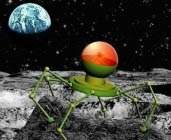
Ben Bova's "Moon Race" (short story, racing, free): Description of a legged machine to explored rugged interior of a lunar crater

Illustration by Garret WVance accompanying the short story Moon Race by Ben Bova. Click image for full sized original image.May be among the better racing stories by anyone. It's set on moon, with a hard sf telling style.

Story summary.

"Selene City is built into the base of Mt. Yeager, the tallest mountain in the ring wall of the giant crater Alphonsus. Two-thirds of the way across the crater floor lie the remains of Ranger 9, one of the early unmanned probes from back in the days before Armstrong and Aldrin landed over in the Sea of Tranquility."

6 vehicles will participate in the race - from an airlock of Selene to Ranger 9 & back - about 200 km & 10 hours journey circuiting "around the hump of rugged hills in the center of Alphonsus."

5 ordinary regular vehicles - wheeled or tracked. And 1 experimental 6-legged walker called Stomper, driven by Taylor Reed who is out to sell the idea of his legged vehicle.

Some drama as Taylor breaks the rules by taking a shortcut climbing over the intervening hills considered dangerous, & getting disqualified. But, of course, he finishes first. And, of course, there are businessmen who care about a new kind of vehicle that makes accessible places that were hitherto out of reach.

Story includes some details of lunar surface - I suppose realistic, in spite of being imaginary.

Quotes.

  1. "Behold the lowly turtle, he only makes progress when he sticks his neck out."

Fact sheet.

First published: Jim Baen's Universe, #16 (December 2008).
Rating: A.
Download full text from Webscription.
Added to my best of the year 2008 list.
Related: All works of Ben Bova.

Saturday, December 6, 2008

Ben Bova reviews the state of the art in locating aliens!

In this post titled "Where is Everybody?" at Jim Baen's Universe, #16 (December 2008).

Familiar arguments, collected in a short essay. Last few paragraphs are more interesting than rest of the essay.

Wednesday, April 23, 2008

The Science Fiction Hall of Fame: Series summary

According to Silverberg's introduction to Vol 1, the series was created in early days of the founding of SFWA. While Nebula Awards recognize recent stories each year, the idea of Hall of Fame series was to recognize stories before the founding of Nebula Award - sort of one time equivalent of Retro Hugo.

Process of story selection was similar to that of Nebula Awards; so it's convenient to look at the series as Nebula Awards for stories written before official annual Nebulas.

Voting was in two categories - stories up to 15,000 words (short story & novelette), & those larger in size (novelette, novella, novel). Former went into Volume 1 (1970), edited by Robert Silverberg; later into Volume 2 (1973) edited by Ben Bova. Vol 2 is in turn split into 2 books - 2A & 2B because of too much material. In the entire set, there is only one novel (in Vol 2A); everything else is short fiction.

And, with very few exceptions, the selections are from a period of about 30 years preceding Nebulas. A total of 26 stories in Vol 1, & 11 each in Vol 2A & 2B. Means less than 2 stories for each year - mostly in short fiction category.

According to Ben Bova's introduction to Vol 2A, there were two more stories of larger than 15,000 words that qualified but "were unavailable for this anthology": Walter M Miller, Jr's "A Canticle for Leibowitz", & Ray Bradbury's "The Fireman". Former is now more readily available in an edited & renamed avatar - "Fiat Homo", the first of the 3 stories included in the fix-up novel also called "A Canticle for Leibowitz". According to Wikipedia, Bradbury's novella "The Fireman" was itself an expansion of an earlier short story "Bright Phoenix"; novella was later expanded into the much better known novel "Fahrenheit 451".

Over the years, there seem to have been extensions - sort of milking the "Hall of Fame" brand as a franchise. So there have been Vol 3 (1981) edited by Arthur Clarke & Geo W Proctor, & Vol 4 (1986) edited by Terry Carr - both containing stories that have won normal Nebulas.
Note: If you landed here looking for ToCs of these two volumes, here are external links to them: Vol III & Vol IV.

There are also two Ben Bova volumes from 1975 - "Science Fiction Hall of Fame: The Novellas" - Book 1 & Book 2. I don't really know their rationale. Their contents seem to be subsets of Vol 2A & 2B.

For the moment, I'm only interested in original pre-Nebula content. Hence only 3 links below; links are to detailed reviews of the books.

The Series (3 books).

  1. Robert Silverberg (Ed)'s "The Science Fiction Hall of Fame: Volume One, 1929-1964" (1970): 26 stories, all read.
  2. Ben Bova (Ed)'s "The Science Fiction Hall of Fame: Volume Two A" (1973): 11 stories, all read.
  3. Ben Bova (Ed)'s "The Science Fiction Hall of Fame: Volume Two B" (1973): 11 stories, few read.

[2A] Ben Bova (Ed)'s "The Science Fiction Hall of Fame, Volume Two A": Annotated table of contents

This is actually the first part of the Volume 2 - split into A & B because it's too big, according to editor's note. I recently got it - so "annotated" part of title is rather sparse yet. But it will be filled up - eventually!

Table of contents (11 stories, best first, unread at end).

  1. [novella] Eric Frank Russell's "... And Then There Were None" (A); download; Astounding, June 1951; science fiction, humor; later expanded into the novel "The Great Explosion": A gang of imperialists is frustrated by a planetful of Gandhian natives.
  2. [novel] H G Wells' "The Time Machine" (A); download text, audiobook; 1895; science fiction: Speculations on the twilight of humanity & of earth. Two things about the novel really touched me: first 2 chapters of preparations is among the best time travel stories I've seen; & when looking at humanity's twilight, he uses as model the current social divisions of society - haves & have nots, taken to their extreme conclusion. I've also collected some quotes from this novel.
  3. [novella] Henry Kuttner & C L Moore's "Vintage Season" (as by Lawrence O'Donnell) (A); Astounding, September 1946; science fiction: Uncaring future time travelers visit our time on vacation to enjoy a major disaster!
  4. [novelette] Poul Anderson's "Call Me Joe" (A); Astounding, April 1957; cyberpunk: Help for those with sound minds but with withered bodies - whether withered by an accident, violence, old age or disease.
  5. [novella] John W Campbell, Jr's "Who Goes There?" (as by Don A Stuart) (A); download; Astounding, August 1938; science fiction, thriller: Curious figuratively & inadvertently open the bottle to let the djinn out, & all hell breaks loose.
  6. [novella] Theodore Sturgeon's "Baby Is Three"; Galaxy, October 1952: While I've not read this stand alone version, I have read the fix up novel based on it - "More Than Human". Novelization is really 3 related but independent stories, second of them titled "Baby Is Three". I don't know how closely the version included in novel corresponds to this stand alone version, but novel includes a much better story - "The Fabulous Idiot". My ranking of this story here is based on the assumption that it's close enough to this story in novel version.
  7. [novella] Robert A Heinlein's "Universe" (A); Astounding, May 1941; science fiction: A very well written variation of a technology civilization falling on primitive times, & eventually a hero who sees the possibility of a different future. Story is set on a huge slower-than-light spaceship - originally headed for Centauri on a 60 year journey but now adrift in space for unknown reasons for hundreds of years; descendants of crew form this primitive society & a religion around the ship's documents they've inherited.
  8. [novelette] C M Kornbluth's "The Marching Morons" (A); Galaxy, April 1951; satire: A variation on "selling ice to Eskimos" theme. A no-morals man from our time ends up in a future where average IQ is 45, & there is an exclusive breed of smarter people confined to Antarctica. In a deal that promises to make him the ultimate dictator, this man helps the smart ones kill off rest of humanity by selling them a story that makes them want to march off to their death.
  9. [novelette] Jack Williamson's "With Folded Hands" (A); download MP3; Astounding, July 1947: Benign robots have turned humans into worthless beings with no hope. I actually don't like it's negativity much, but rating it B would have moved it below many stories far less well written!
  10. [novella] Lester del Rey's "Nerves" (A); Astounding, September 1942; science fiction: Description of a serious accident at a facility manufacturing nuclear products - relief & containing the damage. There is a super hero too. My only gripe is - it's much too long.
  11. [novelette] Cordwainer Smith's "The Ballad of Lost C'Mell" (B) Galaxy, October 1962; science fiction: A political story - probably modeled after the slavery years in the US, but told symbolically. A society where some have normal citizen rights; others are treated as disposable animals. A man from privileged group helps the underprivileged fight for their civil liberties.
First published: 1973
Book is subtitled "The Greatest Science Fiction Novellas of All Time Chosen by the Members of The Science Fiction Writers of America".
Note: Terminology seems to have changed since publication of this book. It seems to call everything above 15,000 words "novella".
Related: SFWA's entire Science Fiction Hall of Fame series.

[2B] Ben Bova (Ed)'s "The Science Fiction Hall of Fame, Volume Two B": Annotated table of contents

This is actually the second part of the Volume 2 - split into A & B because it's too big, according to editor's note in 2A. I don't have it; adding now only for completeness' sake. But will get to it.

My rating is in brackets (ABC: A = worth your time; C = don't bother).

Table of contents (11 stories, best first, unread at end).

  1. [novella] Isaac Asimov's "The Martian Way" (A); Galaxy, November 1952: Martian colonists, to get an upper hand in a diplomatic row with earth, have worked out technology to move an iceberg from a ring of Saturn to Mars (to meet their water needs)!
  2. [novella] Clifford D Simak's "The Big Front Yard" (A); Astounding, October 1958; science fiction: When aliens introduced humans into the cosmic community of rational beings.
  3. [novelette] James H Schmitz's "The Witches of Karres" aka "Karres" (A); Astounding, December 1949; space opera: I've only read its longer novelized version; am assuming this original shorter version is similar. It's usual space opera, but features a community of supermen/women ("witches" of title) have unusual mental abilities.
  4. [novelette] Jack Vance's "The Moon Moth" (A); Galaxy, August 1961; science fiction, humor: Hunting a criminal in a society where everyone wears a mask!
  5. [novelette] Wilmar H Shiras's "In Hiding" (A); Astounding, November 1948; science fiction: A child prodigy is forced to perform at the level of his peers.
  6. [novella] Frederik Pohl's "The Midas Plague" (B); Galaxy, April 1954; science fiction, humor: What if law required you to consume at least a certain amount?
  7. [novelette] E M Forster's "The Machine Stops" (B); download; 1909: A future dystopia where intelligent machines are gods to humans.
  8. [novelette] James Blish's "Earthman, Come Home"; Astounding, November 1953: Not read.
  9. [novella] Algis Budrys' "Rogue Moon"; F&SF, December 1960: Not read.
  10. [novella] Theodore R Cogswell's "The Specter General"; Astounding, June 1952: Not read.
  11. [novelette] T L Sherred's "E for Effort"; Astounding, May 1947: Not read.
First published: 1973
Book is subtitled "The Greatest Science Fiction Novellas of All Time Chosen by the Members of The Science Fiction Writers of America".
Note: Terminology seems to have changed since publication of this book. It seems to call everything above 15,000 words "novella".
Related: SFWA's entire Science Fiction Hall of Fame series.
