Showing posts with label Jack Vance. Show all posts

Friday, November 22, 2013

Jack Vance's "Worlds of Origin" aka "Coup de Grace" (short story, murder mystery)

This is classic Vance - the kind of stories he's best remembered for. Very colorful.

Story summary.

In a private space station somewhere far away where men & aliens of many worlds pass through, a man has been murdered.

Ace detective Magnus Ridolph will help the station owner solve the crime. In the process, we meet many suspects of very colorful background each of which could have had a story dedicated to its own culture & customs.

Fact sheet.

First published: Super-Science Fiction, February 1958.
Rating: A.
Related: Stories of Jack Vance.

Monday, September 30, 2013

Jack Vance's "The Men Return" (short story, weird physics)

This is unlike anything else I've seen of Vance. And pretty near amongst the weirdest stories I've seen.

Story summary.

Earth passes through a peculiar region of space where causelty no longer holds & physics is weird. Earth is not necessarily solid & can randomly change phases. You can pick up a chunk of air & eat it, or ride it! Etc.

Most men died out. Few survivors are in two groups: organisms are thoughtless with random spur of the moment action. Relicts are rational of the old but are fast dying out - since this world has not rationality & doesn't tolerate rationality.

That's when the universe inexplicably returns back to a state where the effect follow the cause & rational men can claim the world again.

Fact sheet.

First published: Infinity Science Fiction, July 1957.
Rating: B.
Related: Stories of Jack Vance.

Saturday, June 1, 2013

Free fiction: Jack Vance's "The Moon Moth"

@RealPulp. [via QuasarDragon & SF Signal]

This is among Vance's better known stories.

Thursday, May 30, 2013

RIP: Jack Vance (28 August 1916 - 26 May 2013)

Tuesday, January 29, 2013

Jack Vance's "Potters of Firsk" (short story, free): Hero peacefully frees a tribe from oppression by its ferocious neighbors

Illustration accompanying the publication in Astounding Science Fiction, British edition, June 1951, of short story Potters of Firsk by Jack Vance. Image shows the Mi-Tunn girl at her pottery shop on the planet Firsk.
This is standard Jack Vance - colorful communities & their customs, medieval side by side with modern. But it has a macabre thread running all through. Kept me engaged all the way.

Fact sheet.

First published: Astounding, May 1950.
Download full text as part of the scans of Astounding (British ed), June 1951.
Download MP3 of a radio dramatization by Dimension X from Internet Archive.
Rating: A.
Among the stories from Astounding/Analog issues edited by John Campbell.
Related: Stories of Jack Vance.

Monday, January 28, 2013

"Astounding Science Fiction" (British Edition), June 1951 (magazine, free): Annotated table of contents & review

Cover of Astounding Science Fiction magazine, British edition, June 1951 issue.
Links on author fetch more matching fiction by author. Where I have a separate post on a story, link on story title goes there. For read stories, my rating appears in brackets. Where I'm aware of alternate availability of a story on the web, I include those links too.

Table of contents (best first, unread last).

  1. [novelette] Poul Anderson's "The Helping Hand" (A); read online: International "aid" considered harmful...
  2. [ss] Jack Vance's "The Potters of Firsk" (A); download radio adaptation: Hero peacefully frees a tribe from oppression by its ferocious neighbors.
  3. [ss] Miles M Acheson's "The Apprentice" (B): Adventure on Venus...

Fact sheet.

Labeled: "VII, No 10 (British Edition)".
Download scans as a CBR file. [via Bob@pulpscans]
Note: Link points to a RAR file that contains target CBR, probably to work around some hosting service file naming constraints.
Related: Stories from the Astounding/Analog issues edited by John Campbell, old "pulps", 1950s.

Tuesday, September 11, 2012

Jack Vance's "The Sub-Standard Sardines" (novelette, detective): Uplifted animals don't necessarily behave as uplifters wish

Quote from short story The Sub-Standard Sardines by Jack Vance
Karamor runs a sardine fishing & canning company with a partner - on a virgin water world called Chandaria with little native life. A partner who once offered to buy out his stake.

Now a batch of canned sardines has arrived from his factory to earth, but the batch is contaminated. And contamination could not have happened after the batch left the canning facility. Something fishy is going on at the factory.

He'll hire a detective, Magnus Ridolph, to figure out. And what an unusual setup he'll uncover!

Fact sheet.

First published: Startling Stories, January 1949.
Rating: A.
Related: Stories of Jack Vance.

Wednesday, July 25, 2012

Jack Vance's "Emphyrio" (novel, dystopia): Hero brings happy change to a dystopic society

Cover image of the novel Emphyrio by Jack Vance
While I didn't dislike it, I found it easy to put it down often. But surprising ending changed the book for me; beautiful. I think it will read much better on a reread, knowing the ending.

There are a lot of places where I could  identify with the stupidities of current India.

Story summary.

First half is a coming of age story - (Recepient) Ghyl Tarvoke growing up in an oppressive welfare state where state ensures you have minimum necessities of existence but where you can never be rich. Where duplication is an extreme offense, inviting extreme punishment (there is a moving scene when Ghyl's gentle father is killed by the state for producing multiple copies of political banners with the same text!) - state apparently thrives on the reputation elsewhere of the originality of its artisans. There is also a curious religion that involves ritualized "leaping". Then there are "lords" (elites outside of welfare state), & "noncups" (few ordinary citizens who chose to live outside the welfare state, mostly by criminal means).

Later part is a faster moving adventure where Ghyl will discover the true nature of his society, & will end up overturning the current political establishment. There is a detective story here the clues for which were all over, but I didn't see them until suddenly the story turned in a totally unexpected direction near end.

Fact sheet.

First published: 1969.
Rating: A.
Related: Stories of Jack Vance.

Monday, April 9, 2012

Jack Vance's "Rumfuddle" (novella, mystery): To improve human history, put would-be evildoer babies elsewhere

Quote from short story Rumfuddle by Jack Vance
Couple of caveats first, particularly for readers from the East:
  1. This is the first story of Vance where I found a para obnoxious for racist reasons - Orientals are dirt, filthy; the idiots need to have the superior western world view forced; etc. A character says it, & I understand that may or may not reflect author's views. Still...
  2. Significant parts of the story refer to figures from European history, & parts of Asian history presumably well known in the West. Mostly, but not always, to villains from history. A lot of them were unfamiliar to me; story may mean more to those better familiar with these figures.
  3. There is a sentence in the story that could cause riots in some Muslim countries. I won't quote it.
Key science fictional device in the story is a portal that can instantly convey you to:
  1. another world somewhere in galaxy or outside it, similar to Clifford D Simak's "The Big Front Yard".
  2. to a time & place in earth's past.
  3. Either of the above in a parallel universe. Actually, if I understand correctly, travel to past is always to a parallel earth rather than ours.
"Rumfuddle" is a kind of party; "Rumfuddlers" are party-goers. The origins of Rumfuddlers are pious: do-gooders who travel to the past to remove history's evil doers like Hitler, when they're still babies, to other environments, where they won't grow up to do evil. With time, the execution of the idea degenerates, & has to be eventually stopped.

Story summary.

Gilbert Duray works on earth but lives at Home, a whole world to himself, as many others do in this universe of infinite available worlds. His children go to school on earth too! Transport is easy - you step through the "passway", as you would cross a door.

One fine day, Gilbert finds the portal back home "closed" when returning from work. Checks elsewhere show all portals to his Home are closed. It means his wife & three daughters are now marooned, forever cut off from him & rest of humanity.

Story is of his work on unraveling the mystery. Happy ending, eventually.

Notes.

  1. Story uses the word "cognate" to designate "corresponding" in a parallel universe. A parallel earth is a cognate earth. Gilbert from our earth meets his wife Elizabeth's cognate in a parallel earth. Etc.
  2. Evil-doers are removed as babies, presumably from a parallel earth, to our universe, at least in some cases. Means our own history is unaltered? Only some parallel universes get a better history? Going to so much trouble changing history for betterment in a parallel world! Sounds too idealistic to me.
  3. How come time never comes in the way traveling instantly across worlds? I mean, kids go to school & papa goes to office in the morning - where morning at Home & in office world or school world is always the same?

Collected in.

  1. David G Hartwell (ed)'s "The Science Fiction Century".

Fact sheet.

First published: Robert Silverberg (ed)'s "Three Trips in Time and Space" (1973).
Rating: B.
Related: Stories of Jack Vance.

Friday, March 2, 2012

Jack Vance's "The Dragon Masters" (novella, alien invasion): Masters are also the slaves!

border:none
This is a fast-paced very-readable action story. I have a couple of nits, though:
  1. Why would aliens bother to make interstellar raids to carry off a few humans each time as slaves? Particularly when they already have a large stock of human slaves, bred as beasts for specific desirable traits.
  2. Aliens travel interstellar distances & have death rays, but bring with them beasts of burden for local land transport, rather than powered machinery!

Story summary.

Most of the story is about three human communities, living in close proximity, on a world called Aerlith. This world has long since lost all contact with rest of humanity. In fact, they may be the last remnants of humanity.

Two of the three communities are feudal: Banbeck Vale is ruled by Joaz Banbeck, & Happy Valley is ruled by Ervis Carcolo. Former is smart, progressive, & technically savvy. Later is a barbarian, never looking beyond the immediate. They also have a variety of pet "dragons" - used as beasts of burden & war animals.

Third community is "sacerdotes", mysterious hermits living in subterranean caves below the two feudals' lands. They appear to be technologically very competent, but they're secretive.

Much of the story is about interactions of these 3 communities. In the background of periodic raids, every few generations, of lizard-like aliens called "Basics" or "grephs". Joaz has recently discovered that these raids occur whenever a star called Coralyne of their local cluster makes the nearest approach. And it's approaching now...; alien slave takers could be
arriving any time.

Later parts are, of course, arrival of aliens. Only they'll meet resistance this time - all 3 human communities coming together will beat them.

See also.

  1. Eric Frank Russell's "Diabologic": Only thing I remember about this story is that it's about carefully using language to drive other people nuts, & using it as a political tool. One of the interviews of Joaz & a sacerdote had this feel too.

Fact sheet.

First published: Galaxy, August 1962.
Rating: A.
Winner of Hugo award 1963 in short fiction category.
Related: Stories of Jack Vance.

Monday, October 10, 2011

Jack Vance's "Sjambak" (short story, free)

Illustration by Virgil Finlay accompanying the original publication of short story Sjambak by Jack Vance in If magazine. Image shows the curious view of humans aboard spaceship approaching an inhabited world - a man riding a horse in space, without any vacuum gear
One of the minor stories of Vance. A TV journalist exposes a jihadi conspiracy...

Fact sheet.

First published: If, July 1953.
Download full text from Project Gutenberg, Manybooks, Feedbooks. [via John@ClassicScienceFiction]
Download audio from LibriVox.
Rating: B.
Related: Stories of Jack Vance.

Sunday, December 12, 2010

"Worlds Beyond", Vol 1 No 1 (December 1950) (ed Damon Knight) (magazine, free): Annotated table of contents

Cover by Paul Calle of inaugural issue of Worlds Beyond magazine - December 1950, edited by Damon Knight
Scans of this magazine in CBR format are online as part of a larger package, or as a standalone copy.

At least some of the stories are reprints.

Table of contents. 

Links on author or year fetch more matching fiction.
  1. [novelette] [reprint] William F Temple's "The Smile of the Sphinx": "What do cats do with their spare time? ... Rule the world, perhaps?"
  2. [ss] Mack Reynolds & Fredric Brown's "Six-legged Svengali": "All the explorer had to do was prove that he was smarter than a mud turtle--but on Venus that's not so easy!"
  3. [ss] Philip Wylie's "An Epistle to the Thessalonions": "He was incredible; ominous; indubitable; a giant one thousand miles high!"
  4. [ss] Larry Shaw's "Simworthy's Circus": "It was the genuine article--the real, 100-proof, universal elixir of love. Just the same, applied to the ugliest human in the universe, it produced some pretty dubious results..."
  5. [ss] [reprint] Graham Greene's "The End of the Party"; The London Mercury, January 1932: "The adult world is a tissue of lies, as any child knows. But what adult knows the dark truths of a child's world?"
  6. [ss] John D MacDonald's "The Big Contest": "Now, forty years after the contest, we can figure out a few things about the little guy who won it. He had a terrible task here on this Earth; he must have been very lonely..."
  7. [ss] [reprint] Franz Kafka's "The Hunter Gracchus": '"Even if all the people were commanded to help me, every door would remain shut, everybody would take to bed & draw the bedclothes over his head, the whole earth would become an inn for the night."'
  8. [ss] C M Kornbluth's "The Mindworm": "You might think of him as an ascetic, for he lived on nothing more substantial than human emotion. Or you might call him a sadist, for the deaths of other men were his life. The coal-town Slavs he despised had another, simpler name for him; & a very simple, very ancient remedy for the terror he brought."
  9. [ss] Battell Loomis' "Invasion Squad": "They were three casual travelers from Somewhere, en route to Somewhere Else. We're lucky to have this brief record of their stop-over, for it's doubtful that they'll ever return..."
  10. [ss] [reprint] William Seabrook's "Wow": '"Abolish language," said the vizier, "& man will return to primal simplicity & happiness." ...'
  11. [ss] Jack Vance's "The Loom of Darkness": "An old, an ageless tale: the story of a golden woman & a golden tapestry, & of the slender threads of darkness that bound them eternally together..."

    There is an editor's note on the back cover, along with an ad for author's well known novel "The Dying Earth", that says this story is "one episode" from "The Dying Earth".

See also.

  1. Fiction from Worlds Beyond.
  2. Fiction from old "pulp" magazines.
  3. Fiction from 1950s.

Tuesday, November 30, 2010

Jack Vance's "Brain of the Galaxy" aka "The New Prime" (novelette, leadership, free): There are many value-systems to judge a leader on

An illustration accompanying the original publication in Worlds Beyond magazine of short story Brain of the Galaxy by Jack Vance
There are several, but not too many, genre stories where candidates for a political office must pass some sort of test - not ballots - judged by an impartial computer. This story is of this class. Perhaps the best known example of the class is Michael Shaara's "2066 Election Day".

There is a Sanskrit phrase that succinctly summarizes the moral of this story: "Yatha raja, tatha praja". Literal translation - a population tends to reflect the attributes valued by its political leadership - is unsatisfactory, but that's the only one I can think up at the moment.

It got interesting only near end - where different threads come together in a context. Most of the earlier part is unsettling in that it comprises of short vignettes that each appear to be independent untitled stories & are all minor by themselves: a man finds himself naked in a social gathering & invents a way of evading moral police; a tribe finds its home destroyed by the enemy & extracts an equal revenge upon enemy home; a man, in adverse conditions, unsuccessfully looks for relics needed to save his lord; a competition where the most imaginative man wins; a soldier captured by enemy is subject to extreme torture. But plodding through these vignettes is worth the trouble, as the ending will show.

Quotes.

  1. "Obstinacy serves no purpose unless it advances a predetermined end."

Fact sheet.

First published: Worlds Beyond, February 1951.
Download full text as part of the scans of the magazine it originally appeared in.
Rating: A.
Related: Stories of Jack Vance.

Saturday, November 27, 2010

"Worlds Beyond", Vol 1 No 3 (February 1951) (ed Damon Knight) (magazine, free): Annotated table of contents

Cover by Van Dongen of Worlds Beyond magazine, February 1951 issue
Scans of this magazine in CBR format are online as part of a larger package, or as a standalone copy.

At least some of the stories are reprints.

Table of contents. 

Links on author or year fetch more matching fiction. Where I have a separate post on a story, link on story title goes there. My rating for read stories is in brackets.
  1. [novelette] Jack Vance's "Brain of the Galaxy" aka "The New Prime" (A): "It was the most brutal examination system ever devised--a system in which one wrong answer meant insanity, & another might mean death!"
  2. [novelette] [reprint] Halliday Sutherland's "Valley of Doom"; 1939 (where?): "The calculations of the Total State included everything--even a measured dose of beauty."
  3. [ss] Lester del Rey's "The Deadliest Female" (B): "Angered or thwarted, the normal female of the species can be deadly enough, Lord knows ... & Lee was no ordinary female--in fact, she belonged to no ordinary species!"
  4. [ss] H B Hickey's "Like a Bird, Like a Fish": "Against the incredible complexity of the alien ship from yesterday, Earth had only the faith of Father Vincent--& the devious simplicity of Pablo..."
  5. [ss] [reprint] Lord Dunsany's "The Old Brown Coat"; 1919 (where?): "The thing was immensely valuable; but why--& how?"
  6. [ss] Poul Anderson's "The Acolytes": "Beyond the green, smiling face that Nerthus showed to men was the dark other--the alien face that is death to see!"
  7. [ss] [reprint] C M Kornbluth's "Forgotten Tongue" (as by Walter C Davies); 1941 (where?): "A brief, apparently meaningless message--but once you'd read it, your mind wasn't your own!"
  8. [ss] Richard Matheson's "Clothes Make the Man": "Which is really the stronger--yourself, or the carefully composed image you present to the world?"
  9. [ss] [reprint] C M Kornbluth's "The Rocket of 1955"; 1939 (where?).
  10. [ss] Harry Harrison's "Rock Diver": "If an undersea diver's equipment failed, he still had a slim chance to live. But between Pete & the surface was the crushing weight of a half-mile of stone..."

See also.

  1. Fiction from old "pulp" magazines.
  2. Fiction from 1950s.
Credits: Some of the information here comes from ISFDB.

Sunday, November 21, 2010

Some recommended works of Jack Vance

This is a few days old. Several people at rasfw have been doing the recommending.

Related: Stories of Jack Vance.

Friday, September 10, 2010

Jack Vance's "The Mitr" (short story): Man is sometimes so heartless

This is the second Vance story I've read about rape; parts of "The Languages of Pao" has women in far worse position.

Story summary.

Mitr is the only human at a place full of large intelligent talking beetles; beetles who are friends, even though they sometimes suck her blood! She's living an animal existence here; apparently, she's been alone since she was a baby.

On this fine day, 3 men arrive in a spaceship - the first she's seen of her own kind. Her curiosity brings her to their notice; their reaction is to rape her!

Notes.

  1. There is a Hindi word pronounced "mitr", meaning "friend". I don't know if that is related to title of this story, but beetles use of this term for all humans suggests it might be.

Fact sheet.

First published: Vortex Science Fiction, Vol 1 No 1 (1953).
Rating: A.
Related: Stories of Jack Vance.

Saturday, August 28, 2010

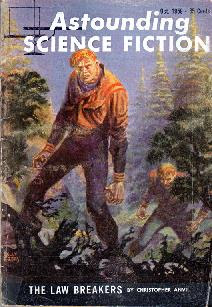
"Astounding Science Fiction", October 1959 (ed John W Campbell, Jr) (magazine, free): Annotated table of contents

Cover by Freas of Astounding Science Fiction magazine, October 1959 issue
Scans of this magazine in CBR format are online as part of a larger package.

Table of contents. 

Links on author fetch more fiction by author. Where I'm aware of other online copies of a story, I include them too. If I have a separate post on a story, link on story title goes there.

  1. [novelette] Christopher Anvil's "The Lawbreakers": "Their mission was sabotage--the destruction of critical installations. Their victims? Hah! Their victims were most eagerly awaiting their hoped-for coming..."

    I've a feeling I've seen text version of this story online somewhere, but cannot locate the URL now.
  2. [novelette] Jack Vance's "Dodkin's Job": 'The really essential question was, "Who's runnin' this shebang, anyhow?" The rough part of that question is, of course, that one man may think he is--while a quite different man does. So who do you ask?'
  3. [ss] Murray F Yaco's "Unspecialist" (A); download: "A machine can be built to do any accurately described job better than any man. The superiority of a man is that he can do an unexpected, undescribed & emergency job ... provided he hasn't been especially trained to be a machine."
  4. [serial - part 2/2] Randall Garrett & Laurence M Janifer's "That Sweet Little Old Lady" aka "Brain Twister" (as by Mark Phillips); download text/audio: "It was tough enough for the FBI men to have to hunt out a telepathic spy...but when the only known telepath-locator was a more than somewhat peculiar little old lady who had to be humored..."

    ISFDB notes that "Brain Twister" is the title of its 1962 book version.

See also.

  1. Fiction from Analog/Astounding (only issues edited by Harry Bates, John Campbell).
  2. Stories written by John Campbell.
  3. Fiction from old "pulp" magazines.
  4. Fiction from 1950s.

Saturday, May 15, 2010

Larry Shone's brief comments on some genre works

Fellow novels' blogger talks of some authors first read during 2009, & some of their works.

Couple of comments:

  1. Jack London: "never came across any of his books anywhere!"
    I've a feeling most of what he's written is now in public domain. Try places like Project Gutenberg.

    I've'nt read a lot by him, but he can be hard to read except perhaps for native English speakers. Uses a lot of colloquial words, if I recall correctly - probably North American slang.
  2. Lensman series of "doc" Smith: I've read only the first 3 books. The real classic so far has been the first half of the 3rd book ("Galactic Patrol", I think). Also, the first book in the series, "Triplanetary", is online at Project Gutenberg.
  3. Jack Vance: One of the best known novels of linguistic sf is his "The Languages of Pao". I've'nt read a lot of his novels, but what I've read of his short fiction is generally very cool.

Tuesday, March 23, 2010

Jack Vance's "The Miracle-Workers" (short novel, free): A future society gone retro rediscovers the scientific method

An illustration accompanying the original publication of the story The Miracle-Workers by Jack Vance in Astounding Science Fiction, July 1958While the story covers a wide canvas, the best parts deal with something many of us go through while growing up: you see unlimited possibility in the world around & unorthodox ways of doing things; elders keep telling you why it won't work & is impossible! This is the story of a boy facing this constant discouragement, but refusing to be dissuaded.

Story summary.

"Sixteen hundred years before, with war raging through space, a group of space captains, their home bases destroyed, had taken refuge on Pangborn. To protect themselves against vengeful enemies, they built great forts armed with weapons from the dismantled spaceships.

The wars receded; Pangborn was forgotten."

Now humanity on Pangborn is divided into feudal "Keeps", with Faide Keep, led by Lord Faide, about to trump over the last resistance to its overlordship.

Humans isolated on this world have forgotten the scientific method, science & technology, but have developed powerful telepathy practiced by "jinxmen". Telepathy is widely used as a war weapon. A skilled jinxman can manipulate the mind of someone so the victim behaves as if possessed by a "demon", or feels discomforted, etc. Jinxmen's telepathy is also the only means of long range communications. Except for telepathy, its back to swords, arrows, horses, etc.

"First Folk" (also called "autochthon"), hominid hive-beings who were the world's original inhabitants & were hunted & driven out from their habitat to jungles by initial invaders, had adopted the scientific method of invaders. So the conditions are now right for a face-off between humans & First Folk - telepathy vs scientific method.

Scientific method will trump. But this is a Campbell edited story - so humans need to win! Quick unorthodox experiments of young Sam Salzar will make humans trump over 1600 years of scientific weapon making of First Folk!

Notes.

  1. Title refers to original human colonists. Since their scientific method is now considered crude, & their gadgets miraculous & incomprehensible, they are sometimes referred to as the "miracle-workers".

Fact sheet.

First published: Astounding, July 1958.
Download full text as part of the scans of Astounding issue where it originally appeared.
Rating: A.
Among the stories from Astounding/Analog issues edited by John Campbell.
Related: Stories of Jack Vance; Tuesday Classics; fiction from 1950s.

Monday, March 22, 2010

ToC of forthcoming collection "Hard-Luck Diggings: The Early Jack Vance"

At Subterranean.

At least one of the stories, "Sjambak", is at Project Gutenberg.

Related: Stories of Jack Vance; collections.