Showing posts with label 1957. Show all posts

Sunday, October 13, 2013

"Infinity Science Fiction", April 1957 (ed Larry T Shaw) (magazine, free): Annotated table of contents

Cover by Ed Emsh of Infinity Science Fiction, April 1957 issue. Image illustrates the story The Martian Shore by Charles L Fontenay.Where I have a separate post for a story, link on story title goes there. Link on author fetches more fiction by author.

Table of contents.

  1. [novelette] Harlan Ellison's "Deeper than the Darkness": "Controlled, his weird power might have been a blessing--uncontrolled, it made his life a literal, flaming hell!"
  2. [ss] Arthur C Clarke's "The Case of the Snoring Heir" aka "Sleeping Beauty" (A): "Sigmund's problem was simply stated: no sleep, no wife; no wife, no money! But how can a man control his snores?"
  3. [ss] E C Tubb's "The Eyes of Silence": "The choice was his: a solitary cell on Earth, or a solitary cell in space--& both paths led only to madness!"
  4. [ss] Fritz Leiber's "Friends & Enemies": "In a world blasted by super-bombs & run by super-thugs, Art vs Science can be a deadly debate!"
  5. [ss] John Christopher's "The Noon's Repose": "To control genetics, you must control love--& if Cupid is human, will he enjoy slavery?"
  6. [ss] Charles L Fontenay's "The Martian Shore": "Shaan made the longest crawl in history--to avoid crawling before tyrants!"
  7. [ss] John Victor Peterson's "The Gently Orbiting Blonde": "Anti-gravity may be hard to handle--but a woman scorned is still harder!"
  8. [ss] Richard Wilson's "Deny the Slake":
           "Those couplets held
              (unless they lied)
            The reason why
              a world had died!"

Fact sheet.

Labeled: "Vol 2 No 2".
Download the scans as a CBR file. [via Alexander@pbscans]
Note: Link fetches a RAR file that needs to be renamed CBR.
Related: Stories from Infinity SF; 1950s; old "pulps".

Monday, September 30, 2013

Jack Vance's "The Men Return" (short story, weird physics)

This is unlike anything else I've seen of Vance. And pretty near amongst the weirdest stories I've seen.

Story summary.

Earth passes through a peculiar region of space where causelty no longer holds & physics is weird. Earth is not necessarily solid & can randomly change phases. You can pick up a chunk of air & eat it, or ride it! Etc.

Most men died out. Few survivors are in two groups: organisms are thoughtless with random spur of the moment action. Relicts are rational of the old but are fast dying out - since this world has not rationality & doesn't tolerate rationality.

That's when the universe inexplicably returns back to a state where the effect follow the cause & rational men can claim the world again.

Fact sheet.

First published: Infinity Science Fiction, July 1957.
Rating: B.
Related: Stories of Jack Vance.

Monday, September 9, 2013

"Future Science Fiction", Fall 1957 (ed Robert A W Lowndes) (magazine, free): Annotated table of contents

Cover by Emsh of Future Science Fiction magazine, Fall 1957 issue. Picture illustrates the short story The Lonely Stars by Scott Nichols.
I haven't read any story yet. Links on author fetch more fiction by author.

Table of contents.

  1. [novelette] Gordon R Dickson's "Cloak & Stagger": "It would have been hilarious if Earth's acceptance into the Federation hadn't depended on how Torm Lindsay carried out his mission--because no one, particularly Lindsay, had the faintest notion of what he was expected to do, or not do!"
  2. [ss] Margaret St Clair's "Starobin": "They needed a hero like Starobin--but a hero like Starobin was just the kind who didn't care..."
  3. [ss] Scott Nichols' "The Lonely Stars": "Would humanity ever be able to undo that worst of blunders?"
  4. [ss] Robert Silverberg's "Force of Mortality": "The greatest boon can also be the deadliest curse..."
  5. [ss] Thomas N Scortia's "Last Meeting Place": "Garth was one of the few who understood history--but could he avoid repeating it?"
  6. [ss] Bruce Tucker & Irving Cox, Jr's "The Professor from Pyjm": 'Was Mytohell just another "crazy scientist" or ...?'
  7. [ss] F M Busby's "A Gun for Grandfather": "So you have a time machine, so you can go back in time & shoot grandpa? But why bother? Barney had a reason..."
  8. [ss] George R Hahn's "The Round Peg": "Basil Thorpe was the most bizarre of phonies..."

Fact sheet.

Labeled: "No 34". "Published quarterly".
Download scans as a cbr file. [via pulpbox@pulpscans]
Note: Link fetches a RAR file that needs to be renamed CBR.
Related: Old pulps; fiction from Future SF, 1950s.

Friday, August 16, 2013

"Imaginative Tales", July 1957 (ed William M Hamling) (magazine): Annotated table of contents

Cover painting of Imaginative Tales magazine, July 1957 issue, by Malcolm Smith, illustrating the story World of Never-Men by Edmond Hamilton
Oops. I downloaded its CBR a while back but the link seems to have gone dead now. Will post the link separately if I can find it elsewhere.

I haven't read any story yet.

Table of contents.

  1. [novella] Edmond Hamilton's "World of Never-Men": "Barker set out on a trail of vengeance that would lead him to retribution--or death. It would also, inevitably, bind him to Mars' dark secret..."
  2. [ss] Robert Moore Williams' "The Red Rash Deaths": "There wasn't a cure for the sickness that struck humans down in horrible agony. And Keeton lacked any clues to follow in his race to stop..."
  3. [ss] Randall Garrett's "Devil's World": "Every secret agent sent to Mercury turned up dead; now Courtney volunteered for the task of trapping Thurston, the man who ruled this--".
  4. [ss] Robert Silverberg & Randall Garrett's "Hot Trip for Venus" (as by Ralph Burke): (ToC lists Ralph Burke as author; story lists Randall Garrett as author!). Alex Mayne knew somebody wanted to keep him out of the spacelanes. And that could only mean someone was afreaid he'd learn about the--"
  5. [ss] Robert Silverberg & Randall Garrett's "Pirates of the Void" (as by Ivar Jorgensen): "Brant's job was to check the robot relays on tiny stations scattered through space. It was not his job to risk death after an attack from--"
  6. [ss] Robert Silverberg's "The Assassin": "Bigelow had a grand idea; he would travel more than a hundred years through time to Ford's Theatre, see the President, & warn him about--"

Fact sheet.

Related: Old pulps.; fiction from 1950s.

Sunday, June 16, 2013

William Tenn's "Winthrop was Stubborn" aka "Time Waits for Winthrop" (novella, time travel): What will the world look like in 25th century?

This is about as colorful an adventure as you're likely to see in science fiction. And from William Tenn, of all people! Alive sidewalks that help you move & help prevent your fall, "government machine" you can order materialized out of thin air to discuss things governmental, "Shriek Field" where you can play mad (but only in nude!) to relive stress, telepathic semi-sentient food that will work all it can for your enjoyment, "Oracle Machine" that can solve any problem, floor that keeps adjusting to your needs, "jumper" - a cylindrical contraption you can materialize from thin air & get inside to instantly teleport anywhere, ...; it goes on & on!

Story summary.

A group of 5 Americans in 1958 travel to 2458, selected with great fanfare (by government?) on invitation from & with technology of 25th century. The deal is: it's an exchange; when they go to future, simultaneously 5 persons from future will materialize in now. Only way the parties can return to their time is at an appointed time & place, & only if all of them want to return; if even one of them wants to stay, all get stranded in foreign time.

And Winthrop, an old man among the visitors to future, likes it so much here that he's refusing to return, stranding everyone else! Story if of efforts of others in his party to persuade or coarse him to return.

Collected in.

  1.  William Tenn's "Time in Advance".

Fact sheet.

First published: Galaxy, August 1957.
Rating: B.
Related: Stories of William Tenn.

Sunday, February 17, 2013

"Astounding Science Fiction" (British edition), April 1957 (ed John Campbell) (magazine, free): Annotated table of contents

Cover by Van Dongen of British edition of Astounding Science Fiction magazine, April 1957 issue.
I think I've read "2066: Election Day" in one of the "Issac Asimov Presents Great SF Stories" books. An unusual "election" for a US President, an election where people don't vote at all, & one that was actually rigged by a small coterie. I don't think I came back happy with it, & the ending invoked in me an angry reaction - "how could the author propose this to be a good outcome?" type of reaction.

Links on author fetches more fiction by author. Where I have a separate post on a story, link on story title goes there. For stories I've read, my rating is in brackets.

Table of contents.

  1. [novelette] Robert Silverberg & Randall Garrett's "False Prophet" (as by Robert Randall): "There are times when it is exceedingly unwise to tell the truth--& the Nidorian was dedicated to truth. The Earthmen were wiser; they lied about him."
  2. [ss] Michael Shaara's "2066: Election Day": "There is a limit to any process you can name ... & sooner or later that limit will be reached. Then ... somehow you have to fumble togeather a new thing..."
  3. [ss] Algis Budrys' "Look on My Works" (B): Tourist guides milking a tourist from Centaurus with fakes, in a far future New York city...
  4. [ss] Robert Silverberg's "To Be Continued" (A): Slow life is frustrating!
  5. [serial - 3/3] Isaac Asimov's "The Naked Sun": "Lije Baley had a triple-decker problem to solve--& solved it only because a robot tried to give him a hand. And thereby taught him to define his terms with a new exactness!"

Fact sheet.

Labeled: "Vol XIII No 4 (British Edition)".
Download scans as a CBR file [via Bob@pulpscans]
Note: The link fetches a RAR file that contains the target CBR, probably to work around hosting service's file naming constraints.
Related: Stories from the Astounding/Analog issues edited by John Campbell, old "pulps", 1950s.

Friday, August 31, 2012

"Imagination Science Fiction", April 1957 (ed William M Hamling) (magazine, free): Annotated table of contents

Cover painting by Lloyd N Rognan, of Imagination Science Fiction magazine, April 1957 issue, illustrating the story Bring Back My Brain by Dwight V Swain

Table of contents.

  1. [novel] Dwight V Swain's "Bring Back My Brain!": "A man can fight as long as he has the strength--or a mind to command his body!"
  2. [novelette] Robert Moore Williams' "Secret of the Painting": "It wasn't the painting itself men killed for, but the knowledge hidden there..."
  3. [ss] Robert Silverberg's "Harwood's Vortex": "Ever wondered what would happen if the sky fell on you? Harwood found out!"
  4. [ss] Randall Garrett's "Guardians of the Tower": "Legend demanded he guard the strange tower. Was it something worth dying for?"
  5. [ss] Robert Silverberg's "The Old Man" (as by S M Tenneshaw): "The space pilot was a man to be envied. Until the inevitable day of retirement..."
  6. [ss] Robert Silverberg & Randall Garrett's "Slaughter on Dornel IV" (as by Ivar Jorgensen): "Before the fight with the alien champ, Filmore decided to test his own skill..."

Fact sheet.

Labeled: Vol 8 No 2.
Download scans as a CBR file. [via Sea@pulpscans]
Related: Fiction from Imagination; old pulps; fiction from 1950s.

Friday, August 17, 2012

Algis Budrys' "Chain Reaction" (as by John A Sentry) (novelette, freedom): You're free, but live my way!

I intended to write this post on 15 August, India's Independence Day, but have been busy recently. This is an independence day story, but I found the author's idea of freedom somewhat obnoxious, even if well intended.

Story summary.

An alien world where an intelligent species is held enslaved by another with much superior technology. Slaves whose work the owners don't even need anymore; they're held enslaved out of habit, or may be of need to exercise power over others.

A passing human ship discovers the enslavement, & frees the slaves. Only the humans are treating the newly freed as children that need to be taught how to live, & natives naturally resent it.

Collected in.

  1. Groff Conklin (ed)'s "Six Great Short Science Fiction Novels".

Fact sheet.

First published: Astounding, April 1957.
Rating: B. 
Among the stories edited by John Campbell for Astounding/Analog. 
Related: Stories of Algis Budrys.

Thursday, April 19, 2012

Isaac Asimov's "Galley Slave" (novelette): How to make a 3-laws obeying robot harm a human...

Quote from short story Galley Slave by Isaac Asimov
This story pits for-automation folks against those against-automation, because it will result in job losses & loss of human purpose (in remaining busy doing certain occupations?)

Most of the story is a courtroom trial. Prof Simon Ninheimer was against Robot EZ-27's employment by his university from the very beginning; the idea that a new type of robot can take over routine intellectual tasks like proofreading was totally unpalatable. So he set out to destroy the reputation of US Robots, its makers, by an unusual court case...

Collected in.

  1. Groff Conklin (ed)'s "Six Great Short Science Fiction Novels".

Fact sheet.

First published: Galaxy, December 1957.
Rating: A. 
Related: Stories of Isaac Asimov.

Sunday, February 12, 2012

Harry Harrison's "The Stainless Steel Rat" (short story, robbery, free): Crooks wanted!

Only thing that puzzles me is: was this the story that spawned the huge "Stainless Steel Rat" series? This story is decent timepass, but it's not outstanding by any standards.

Story is of a master thief, long on the run from law, the one who always give the cops a slip. Well, there is a last time, & he will be finally caught. But he'd never dreamt of the punishment he'll get...

Fact sheet.

First published: Astounding, August 1957.
Note: There also appears to be a novel of this title. I don't know if that's an expanded version.
Download full text from author's website.
Among the stories from Astounding/Analog issues edited by John Campbell.
Rating: B.
Related: Stories of Harry Harrison.

Wednesday, January 11, 2012

Hal Clement's "Planetfall" (novella, first contact): A hard-sf look at the problem of first contact

Note there are at least 2 versions of this story: original novella Hal Clement wrote, & longer "novel" that's the original story extensively padded by Sam Mervin. This post is based on Clement's solo novella.

This may be among the most weird first contact stories I've seen so far. With sufficiently different body chemistry & evolutionary environment, how hard can it get to recognize alien life & communicate with it, even if you notice there is (alien) intelligence somewhere around? This is actually a failed contact story, in spite of much effort from both sides.

Story summary.

A sessile, long-lived, technologically far in advance of us, star faring race of aliens extensively mines metals off all sorts of worlds. A "Conservationist", a sort of policeman to prevent unauthorized mining, has noticed some "poachers" attempting to steal metals off earth. His approach makes them run away, but they've left behind "mole robots", bombs that will cause much upheaval in earth's crust to turn its metals-denuded surface into a metals-rich surface again in a few million years. Which means death for much of local life.

He'll land here, & notice obvious signs of intelligence. But all through his attempts to communicate with humans, he won't even realize they're the ones he's trying to help.

Fact sheet.

First published: As a novel with additional material by Sam Merwin in Satellite Science Fiction, February 1957 as "Planet for Plunder". I'm not sure when the pure original novella version first saw the light of the day - probably 1972 in Robert Hoskins's anthology "Strange Tomorrows".
Rating: A. 
Related: Stories of Hal Clement.

Friday, July 29, 2011

Eric Frank Russell's "Love Story" (short story): It's easier giving advice than to follow it!

One of the minor stories of Russell.

A military commander is griping about how much worse the current crop of soldiers is compared to when he was young, what with men citing family obligations to avoid difficult assignments. But he himself is not quite immune to a bite of love, even if he doesn't have a family...

Fact sheet.

First published: Astounding, April 1957.
Rating: B.
Among the stories from Astounding/Analog issues edited by John Campbell.
Related: Stories of Eric Frank Russell (annotated list).

Thursday, June 24, 2010

New at Project Gutenberg (24 June 2010)

Links on author, publisher, or year fetch more matching fiction.

  1. Randall Garrett & Stephen Marlowe's "Quest of the Golden Ape"; download; Amazing Stories, January-March 1957: "How could this man awaken with no past--no childhood--no recollection except of a vague world of terror from which his mother cried out for vengeance and the slaughter of his own people stood as a monument of infamy?"
Related: Fiction from old "pulp" magazines.

Saturday, June 5, 2010

New at Project Gutenberg (5 June 2010)

Links on author, publisher, or year fetch more matching fiction.

  1. Chester S Geier's "Cold Ghost"; download; Amazing Stories, November 1948: "All Hager had to do was slow the dogsled to a walk, and his partner died. A perfect crime--no chance to get caught!"
  2. Knut Enferd's "Day of the Druid"; download; Amazing Stories, November 1948: "Be'al, all-powerful god, drank the blood of his victims. Would Gaar be able to save Marna, whom Be'al kept in eternal sleep, and avenge her people?"
  3. Alfred Coppel's "The Invader"; download; Imagination, February 1953: "Invading Earth was going to be a cinch, the Triomed scout decided. But to make certain he must study its inhabitants--as one of them!"
  4. George H Smith's "The Ordeal of Colonel Johns"; download; If, June 1954: "Colonel Johns, that famous Revolutionary War hero, had the unique--and painful--experience of meeting his great-great-great-great granddaughter. Now maybe you can't change history, but what's there to prevent a soldier from changing his mind about the gal he is going to marry?"
  5. Raymond F Jones' "The Colonists"; download; If, June 1954: 'If historical precedent be wrong--what qualities, then, must man possess to successfully colonize new worlds? Doctor Ashby said: "There is no piece of data you cannot find, provided you can devise the proper experimental procedure for turning it up." Now--about the man and the procedure...'
  6. Robert Moore Williams' "The Next Time We Die"; download; Amazing Stories, February 1957: "We journey to far places, driven on by ideals. We fight for lost causes, sacrificing our lives because the things we fight for seem worthwhile. But are we right? Are they worth being killed over? Perhaps. Then again, maybe we'll know better--The Next Time We Die".
Related: Fiction from old "pulp" magazines.

Sunday, April 11, 2010

Free fiction: Galaxy, March 1952 & April 1952, & Amazing Stories, November 1957

All at Internet Archive in multiple formats.

  1. "Galaxy Science Fiction", March 1952; download.

    "The pages for the stories 'The Year of The Jackpot' by Robert A. Heinlein, 'Catch That Martian' by Damon Knight and 'The Demolished Man' by Alfred Bester, have been deleted from the files since the Copyright was renewed".

    That leaves 3 complete stories. "The Demolished Man" was a serial of which last part appeared in this issue.
  2. "Galaxy Science Fiction", April 1952; download.

    "The pages for the story 'Ticket to Anywhere' by Damon Knight have been deleted from the files since the Copyright was renewed".

    Among the authors: Fritz Leiber.
  3. "Amazing Stories", November 1957; download.
Related: Fiction from Galaxy, Amazing, 1950s; Old pulps.

Tuesday, November 10, 2009

A E van Vogt's "Empire of the Atom" (collection, free): Annotated table of contents & review

Cover image of the short story collection titled Empire of the Atom by A E van Vogt. Cover shows Lord Clane of Linn in his temple garb to hide his mutation, symbolically managing the Atom Gods.Two things make the generally sub-par series of stories collected here noteworthy:

  1. It probably inspired Lois McMaster Bujold's "Miles Vorkosigan" series. I've read only one Vorkosigan story - "The Mountains of Mourning", but there is too much similarity in the fictional universes: feudal but space traveling society that is a remnant of old glory days of humanity, & a severely handicapped hero from ruling dynasty who must make a place for himself in a society that is unreasonably prejudiced against his handicap. But "The Mountains of Mourning" is infinitely more interesting than anything in this van Vogt original.
  2. In some sense, this series can probably be considered a precursor to steampunk. At least I'm not aware of anything older that qualifies.
This book collects all stories in "Lord Clane of Linn" series (aka "Atom Gods" series?) of author, except the novel "The Wizard of Linn" that logically follows the last story in this collection.

Background.

Humanity once traveled the stars, but those days are long gone. There was a devastating war with aliens - so now we have small human societies on many worlds of the solar system - including earth (population a few million), Mars, Venus, & "Europa, one of the moons of Jupiter". And a lot of ruins of old cities - though radioactivity on those sites is now on the wane.

Earth is now a feudal society ruled by the mean Linn family whose members are constantly assassinating or otherwise pulling down each other in never ending power struggles. But the society also has access to the remnants of ancient technology like advanced spaceships & some weapons. This old technology is used with ritual rather then understanding; priests that serve the temples dedicated to four Atom Gods handle the ancient technology.

This series is the developing story of Lord Clane, a mutant born into the Linn family. Stories describe his transformation from being a definite case for infanticide for shaming the aristocratic family by being a mutant to the ruler of the universe.

Table of contents.

List below is in order of logical progression of stories. I had a tough time going through first two stories; rest were easier - either because they're better, or because I was getting used to the curious universe of the stories.
  1. [ss] "A Son is Born"; download; Astounding, May 1946: Even Lady Tania, the mother of newborn & daughter-in-law of the current ruler ("Lord Leader"), doesn't expect her mutant son to live, & is puzzled why Scientist Joquin, a priest, is intent on saving him. Child will remain unnamed in this story; first use of his name - Clane - happens only in the next story.
  2. [novelette] "Child of the Gods"; download; Astounding, August 1946: Creg, Clane's father, is commanding the earth army raiding Mars & has been losing so far - thanks to back stabbing of Lydia, his step mother who wants her son Tews to be the next Lord Leader.

    Brilliant teenager Clane, protected & educated so far by Joquin, will help his father win the losing war by offering a valuable advise. Though his father will be later assassinated by hired killers of Tews, who will then run to exile fearing Lord Leader's punishment.
  3. [novelette] "Hand of the Gods"; download; Astounding, December 1946: Lydia manages to convince her husband Lord Leader to name her son Tews, in exile since his part in assassination of Creg, the successor before Lord Leader's death. Tews will assume the title of "Lord Adviser".

    But she has also learnt of the growing power of Clane, & will go to any length to have him assassinated. Only Clane is way too powerful, & Lydia will eventually be humbled.
  4. [novelette] "Home of the Gods"; download; Astounding, April 1947: Jerrin, Clane's elder brother, is about to win his military campaign against Venusian rebels but is being thwarted by "Lord Adviser" Tews, the current ruler of Linn. Clane will play the diplomat & military leader, & will have each of the 3 parties to war eventually obliged to him - his brother, Tews, & rebels.
  5. [novelette] "The Barbarian"; download; Astounding, December 1947: Czinczar, leader of the barbarian hoard from Europa, is finding earth easy to conquer. Lord Adviser Tews has been beheaded, & there is little resistance to Czinczar. Of course, Clane will eventually humble Czinczar, & reclaim the empire for Linn family.

Fact sheet.

First published in book form: 1957.
Stories here are also listed among the stories from John Campbell's Astounding/Analog.
Related: Stories of A E van Vogt; mutants in fiction.
Legend: ss = short story.

Sunday, September 6, 2009

Murray Leinster's "The Machine That Saved The World" (novelette, free): Human descendants from future want to help us!

Illustration accompanying the Project Gutenberg version of the short story titled The Machine That Saved The World by Murray LeinsterYear 2180 wants to discuss (via a temporal broadcast) a doom about to visit 1972: a widespread & currently harmless germ is about to mutate into something fatal. They have a plan to contain the disaster, but need two way communications to thrash out details. Hence they send out design of transmitter Now should build to talk to Future.
But one man is smelling something fishy. With the help of electronic geniuses, he will transform the received designs into functionally equivalent but visually unrecognizable alternates. And convince the Future to build this first.

Results turn out to be very interesting.

Fact sheet.

First published: Amazing Stories, December 1957.
Rating: B.
Download full text from Project Gutenberg, Manybooks, or Feedbooks.
Related: Stories of Murray Leinster.

Wednesday, August 5, 2009

Fritz Leiber's "What's He Doing in There?" (short story, humor, free)

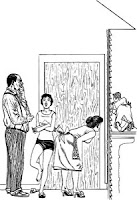
Illustration accompanying the short story titled Whats He Doing in There by Fritz Leiber. It shows anxious human family trying to find of if their Martian visitor is safe inside the bathroom.First contact the first Martian visitor to earth made was with a professor of cultural anthropology at his home. He soon asked to visit bathroom. But it's been hours since he's been there, & the question everyone in the family is asking is: "What's he doing in there?"

Answer, when they finally discover it, is of course funny.

Fact sheet.

First published: Galaxy Science Fiction, December 1957.
Rating: B.
Download full text from Project Gutenberg, Manybooks, or Feedbooks. [via QuasarDragon]
Related: Stories of Fritz Leiber.

Saturday, August 1, 2009

Isaac Asimov & Martin H Greenberg (Eds)' "Isaac Asimov Presents the Great SF Stories 19 (1957)" (anthology): Annotated table of contents & review

This is #19 of a series of 25 anthologies by these editors. This book collects stories first published during the year 1957.

Where I'm aware of online copies, I provide download links. My rating is in brackets. Where I've a separate post on a the story, link on story title goes there. Link on author or publisher yields more of stories from the source.

Table of contents (15 stories, best first, unread last).

Among the 7 stories I've read so far, first 3 are very good. And "The Cage" has a cool idea near end.
  1. [novelette] Poul Anderson's "Call Me Joe" (A); download audio or comic book adaptation; Astounding, April 1957: Human operator (via directly linked mind-to-mind interface) of an artificial animal adapted to live on Jupiter's "surface" becomes one with him, & would rather live in that healthy body on Jupiter rather than in his own withered human body.
  2. [novelette] H Beam Piper's "Omnilingual" (A); download text from Project Gutenberg, Manybooks, or Feedbooks, or audio from LibriVox; Astounding, February 1957: A universal rosetta stone to decode the writings of a long dead civilization known to be at about our level of technological ability.
  3. [ss] C M Kornbluth's "The Education of Tigress McCardle" (A); Venture Science Fiction, July 1957; humor: An unusual population control program!
  4. [ss] Isaac Asimov's "Strikebreaker" aka "Male Strikebreaker"; Science Fiction Stories, January 1957: I'd read a long time back. Not sure, but I think it's something about a society treating sanitary workers as untouchables, who've a gone on a strike. A visitor breaks the strike by either talking to untouchables or doing their work, & himself becomes untouchable by doing this act.
  5. [ss] A Bertram Chandler's "The Cage" (A); F&SF, June 1957: A shorter version of Pierre Boulle's "Planet of the Apes".

    The Crotchety Old Fan gives a hint on how to find the audio of an (unofficial) radio adaptation of this story online.
  6. [ss] Brian W Aldiss' "Let's Be Frank" (B); download; Science-Fantasy, #23 (June 1957): How humanity became a hive intelligence.
  7. [ss] C M Kornbluth's The Last Man Left in the Bar (C); Infinity Science Fiction, October 1957: Trivia in a bar.
  8. [ss] Kate Wilhelm's "The Mile-Long Spaceship"; Astounding, April 1957: Not read.
  9. [ss] Theodore R Cogswell's "You Know Willie"; F&SF, May 1957: Not read.
  10. [ss] Carol Emshwiller's "Hunting Machine"; Science Fiction Stories, May 1957: Not read.
  11. [ss] Robert Silverberg's "World of a Thousand Colors"; Super-Science Fiction, June 1957: Not read.
  12. [novella] Lloyd Biggle, Jr's "The Tunesmith"; If, August 1957: Not read.
  13. [ss] Isaac Asimov's "A Loint of Paw"; F&SF, August 1957: Not read.
  14. [ss] Rog Phillips' "Game Preserve"; If, October 1957: Not read.
  15. [novelette] Harlan Ellison's "Soldier" aka "Soldier from Tomorrow"; Fantastic Universe, October 1957: Not read.

Fact sheet.

First published: 1989 (DAW).
Relevant entries have been added to the list of stories from John Campbell's Astounding.
Some of the bibliographical information here comes from ISFDB.
Legend: ss = short story.

C M Kornbluth's "The Last Man Left in the Bar" (short story)

Cannot make out the head or tail of it.

An ordinary man & two mysterious individuals; the two seem to have some sort of magical powers & aren't from our world or universe or ... something.

The man had stolen "the Seal" that the two visitors want. They eventually get it, & "The Century of Flame" (whatever the heck that is) begins!

Through most of the story, we see the man getting drunk in a bar & watching trivia going on around the place.

Collected in.

  1. Isaac Asimov & Martin H Greenberg (Eds)' "Isaac Asimov Presents the Great SF Stories 19 (1957)".

Fact sheet.

First published: Infinity Science Fiction, October 1957.
Rating: C.
Related: Stories of C M Kornbluth.