Showing posts with label moon. Show all posts

Tuesday, December 10, 2013

Robert A Heinlein's "Double Star" (novel, politics): When an imposter became the ruler

Cover of the novel Double Star by Robert A HeinleinThis is a fast paced action story with a lot of election politics. I didn't like it as much as I wanted to because at some places the world view is too provincially Western; the thing that irritated me most was a small passage on the classification of world's languages - confidently told & totally bogus.

Story summary.

Here is a solar Empire spanning many worlds, dominated by humans though there are aliens on other worlds. It's a monarchy similar to British one - emperor is supreme but is a rubberstamp, & sits in a city on the moon. The parliament has the power & is elected; aliens can vote but must choose a human representative. Head of government is the "Supreme Minister", probably majority leader in Parliament.

Current ruling party has arranged the kidnapping of the leader of opposition at a time where he's absolutely required to be present at a Martian ceremony. So his underlings will recruit an actor, Lawrence Smith aka Lorenzo Smythe, to act as an imposter at the function. One thing will lead to another & new situations will keep coming up & the imposter will end up becoming the politician he's impersonating.

The story is, first & foremost, the character study of this actor, & evolution of his personality.

Fact sheet.

First published: Astounding, Feb/Mar/Apr 1956.
Rating: A.
Among the stories from Astounding/Analog issues edited by John Campbell.
Winner of Hugo Award 1957 in novel category.
Related: Stories of Robert Heinlein.

Wednesday, September 18, 2013

Arthur K Barnes & Henry Kuttner's "The Energy Eaters" (novelette, monster, free): When a human city was overrun with electricity eaters!

Picture of Henry Kuttner, included with the original publication in Thrilling Wonder Stories of short story The Energy Eaters by Arthur K Barnes and Henry Kuttner.This is another "Hollywood on the Moon" story. Set mostly in the lunar city of Hollywood on the Moon, but no movie shooting here.

Image on the right is a picture of Henry Kuttner included with the original magazine publication of the story.

Story summary.

Gerry Carlyle, the interplanetary adventurer, is a headache for Nine Planet Films, Inc: whenever they release a movie featuring exotic life forms of other worlds, she goes there & brings back live animals to earth - so people prefer going to zoo rather than movie theater!

Anthony Quade of Nine Planet has an idea: to bribe her with an exotic alien animal no one has seen, in return for promise to not spoil the company's movie releases. To this end, he's captured some "Promethians", little furry-looking creatures from the "day side" of Mercury. Creatures that feed on electricity & radiation.

Before anyone can do anything, the cute little creatures overrun the city of Hollywood on the Moon, threatening the lives of everyone...

See also.

  1. Fredric Brown's "The Waveries": Electricity eating alien invaders make use of electricity impossible on earth.

Fact sheet.

First published: Thrilling Wonder Stories, October 1939.
Read online at UNZ.
Rating: B.
Related: Stories of Henry Kuttner.

Saturday, September 14, 2013

Henry Kuttner "Doom World" (novelette, adventure, free): A precursor to Jurassic Park!

This is a sequel to author's "Hollywood on the Moon", & is completely set on moon.

There is too much similarity to Jurassic Park that was still many decades into future. Artificially engineered dangerous beasts at a place that is not their natural habitat. Nature takes over, safeguards break down, & mayhem results.

Story summary.

The story happens on the sets of a movie named "Doom World". Set is in the caverns under the city of "Hollywood on the Moon" on the far side of moon. Set is supposed to model the jungles of radioactive Pluto, with its many dangers!

Beasts on the set are biologically engineered, with radio-controlled electronic implants in their brains to control them. Story calls them robots, but they're not like any robots you've read about.

In the course of the story, nature takes over & the electronic implants serve little more than to irritate the animals. Hell breaks loose in the artificial jungle of the set, & the heroes & the film crew will have to face it...

Fact sheet.

First published: Thrilling Wonder Stories, August 1938.
Read online at UNZ.
Note: I read it on an Android tablet with Firefox, & the document was a rather badly behaved one. Each page would allow only partial reading... until I move tablet to landscape orientation, & then back to portrait! On PC, it seems to display ok.
Rating: B.
Related: Stories of Henry Kuttner.

Friday, January 4, 2013

Jerry Oltion's "In the Moment" (short story): Romance in the backdrop of a celestial event

A comet is about to hit moon & many amateur astronomers with their telescopes have gathered a few miles from the city to watch the event. Story is of the impact event observed by two teenagers in love.

Fact sheet.

First published: Analog, January/February 2013.
Rating: B.
Related: Stories of Jerry Oltion.

Tuesday, January 1, 2013

Brian Trent's "Titans of Camp Four" (short story, moon travel, free)

Illustration by Jamie Tufrey accompanying the original publication in Cosmos magazine of short story Titans of Camp Four by Brian Trent. Image shows a man in space suite at the lip of a lunar crater, with the crescent of earth seen in the background.
Air travel & moon travel aren't twentieth century inventions. They were already achieved by Romans!

Fact sheet.

First published: Cosmos, #47 (October 2012).
Download full text from publisher's site. [via QuasarDragon]
Rating: B.

Sunday, August 19, 2012

Eric Frank Russell's "Dreadful Sanctuary" (novel, thriller): Man must not go to space cultists vs hero who says we'll go

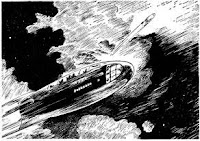
Cover of novel Dreadful Sanctuary by Eric Frank Russell. Shows a moon rocket exploding as it approaches moon.
This is one of those Fortean stories of Russell ("Sinister Barrier" is his best known of the type) - something above humanity is pulling our puppet strings.

Story summary.

Over a dozen human attempts to reach moon have all failed - rockets exploding when they're about a certain critical distance from moon. It's too much of a coincidence & there is no reason to suspect sabotage; rockets of several countries have met the same fate.

There is a man financially involved in the next rocket to go. And he's smelling conspiracy...

Notes.

  1. Title refers to earth. There is an unreliable back story: Humanity independently evolved on 4 worlds - blacks on Mercury, browns on Venus, yellows on earth, & whites on Mars (skin color depends on their distance from sun). All civilizations except earth reach maturity a long long time ago, & banished war. But they still had crazies who were not cured of need to war. They were herded on 3 worlds, & transported to earth to rid the mother worlds of them - back when earthmen were really primitive. So earth is a prison planet & all except those of yellow skin are descended from the crazies dumped here!

Fact sheet.

First published: Astounding, June/July/August 1948.
Rating: B. 
Among the stories edited by John Campbell for Astounding/Analog. 
Related: Stories of Eric Frank Russell (annotated list).

Tuesday, April 24, 2012

Judith Merril's "Project Nursemaid" (novella): Government's difficulties enrolling unwanted babies

I cannot point to any clear flaws in the story, but I kept putting it down frequently. Took me over a dozen sittings to finish it.

Story summary.

Set up is: For space exploration, babies raised in special low gravity environments are necessary, low-gravity environments not being very conducive for ordinary earth-raised adults.

So government has a program where it creates orphans to raise (on moon)! Because of moral issues involved, the program is a secret one.

So a certain military camp in the US has certain targets: so many babies to deliver (means recruiting young mothers of unwanted pregnancies), & so many "foster parents" to deliver (older women to nurse the babies).

Story is from the point of view of Colonel Edgerly whose job it is recruit both babies & their nursemaids.

Collected in.

  1. Groff Conklin (ed)'s "Six Great Short Science Fiction Novels".

Fact sheet.

First published: F&SF, October 1955.
Rating: B. 
Related: Stories of Judith Merril.

Sunday, November 6, 2011

Jack Williamson's "Terraforming Terra" (novelette, post-apocalypse): Gods "blaspheming" themselves!

A rock bigger than the dinosaur killer hit earth, destroying most life, including all of humanity, & poisoned the atmosphere.

A few survivalist, however, had prepared for precisely this eventually. They could escape to moon, & they have a plan to make earth inhabitable again & reestablish human civilization.

Plan will be executed over geological time - using frozen human cells to clone 5 men & women, advanced robots, seeds, etc. Every few hundred thousand years, robots remake clones of 5 survivors, teach them special skills, & send them off to earth to do the next step. Trips rarely go as planned, because natural evolution has been happening on earth too - there were animals, insects & bacteria in specific niches that survived the cataclysm.

Eventually, such a group of 5 is stranded on earth. No fuel to go back to moon, under attack by a vast hoard of hungry insects.

When the next group of 5 clones arrives from moon 1000 years later, they're astonished with the progress. A flourishing human city, where the 5 previous clones are gods. Only the real new arrivals get an unexpected treatment...

See also.

  1. Henry Kuttner's "The Creature from Beyond Infinity" (download): An alien got stranded on primordial earth, & is hibernating over geological time - periodically awakening to check if intelligent life has yet evolved.
  2. Arthur Clarke's "If I Forget Thee, Oh Earth...": A few survivors on moon, longingly looking at earth destroyed by nuclear war. Scenes are similar to early parts of Williamson's story.

Fact sheet.

First published: Science Fiction Age, November 1998.
Rating: B.
Related: Stories of Jack Williamson.

Wednesday, September 28, 2011

Raymond Z Gallun's "Comet's Burial" (short story, free): Terraforming moon!

This is old fashioned science fiction adventure; drop any pretense of realism, & go have fun. We also see some ancient Martian relics on moon, ride through Sol aboard a Martian ship, & eat long-preserved Martian canned meat that's probably of earth's dinosaurs!

Jess Brinker is convinced real underground cities can be built on moon if only some way were found to cut through its 200 km thick crust to reach the resources inside. So he & his apprentice Arne Copeland will move Brulow's Comet to smash into far side of moon - without informing anyone else on moon or earth!

Of course, there will be happy ending.

Fact sheet.

First published: Science Fiction Stories, #1 (1953).
Download full text from Project Gutenberg.
Rating: B.
Related: Stories of Raymond Z Gallun.

Tuesday, September 27, 2011

Murray Leinster's "Operation: Outer Space" (novel, space opera, free): Party explores 3 earth-like worlds

Cover image of the novel Operation - Outer Space by Murray Leinster
It's not a bad read. But not among the better stories of author, either. Leave logic somewhere, & enjoy the roller-coaster with a mad scientist who can put together the first-ever FTL ship in a few weeks, a super-businessman, & some others in exploring 3 earth-like worlds in far-away star systems: a glacial world, a world with large cattle herds ready to be hunted, & a world that has never known life.

Fact sheet.

First published: 1954.
Download full text from Project Gutenberg, Manybooks, Feedbooks.
Download audio from LibriVox.
Rating: B.
Related: Stories of Murray Leinster.

Monday, October 25, 2010

John Gilbey's "Corrective action" (flash fiction, fatal software bug, free)

Untested upgrade of software controlling an airlock at some sort of private facility on moon killed a government safety inspector. Administration of the facility has been covering up the incident by doctoring records.

Another safety inspector catches the administration at its act, but gets only a smirk from facility's chief; what the hell can inspector do, apart from imposing a minor fine? What the chief doesn't know is that dead inspector was the "partner" of the visitor, & visitor is not about to let the facility get away with it...

Fact sheet.

First published: Nature, #464 (22 April 2010).
Download full text from publisher's site.
Rating: B.

Monday, October 11, 2010

Clyde Brown's "First Man" (short story, humor, free): Record of the first manned trip to moon

One of the illustrations accompanying the original publication in Galaxy magazine of short story First Man by Clyde Brown. Image shows a protagonist on the surface of moon - first man to land there.
Harold Ferguson, a tinkerer who has built a spaceship to take him to moon, accidentally ended up with his neighbor Orville Close too in the ship during takeoff! A ship fashioned from junk that took off from Harold's backyard!

The two had a successful trip to moon without anyone in the world knowing about it! Even after their return, no one believes they've been to moon - since they landed in Siberia, & had to leave the ship there when finding passage home.

Fact sheet.

First published: Galaxy, April 1958.
Download full text from Project Gutenberg, Manybooks, Feedbooks.
Rating: B.

Sunday, September 5, 2010

Joe Haldeman's "More Than the Sum of His Parts" (short story, free): A man's transformation into a cyborg, then monster

Quote from short story More Than the Sum of His Parts by Joe Haldeman
This story is ... sort of ... a very abrupt attachment of John Varley's "Bagatelle" (download) to the middle of C L Moore's "No Woman Born".

A serious accident victim is saved by transforming him into a cyborg. He begins to like the new body parts. Then he starts enjoying his new found power too much, & quickly becomes a monster. Monster is easily disposed off, of course, by a techno-gimmick.

Caution: Bits of the story have explicit sex scenes, & describe male anatomy in some detail.

Fact sheet.

First published: Playboy, May 1985.
Download full text from Lightspeed.
Rating: B.

Wednesday, September 1, 2010

Robert H Wilson's "Out Around Rigel" (novelette, free): An adventure with relativity implications

Illustration accompanying the original publication in Astounding of short story Out Around Rigel by Robert H Wilson
It's not a bad read, but pick it up only on a day when you aren't in a mood to use your head.

Story summary.

There are actually multiple stories here, but woven into a single one:
  1. When man becomes capable of flying to another world, where does he go out first? You might think moon would be a logical choice. But Lunarians don't think like us! Here two Lunarian friends, one of them a super-inventor, have their maiden space fight's target as the Rigel system some 500 lightyears away!
  2. A love triangle - two men & a woman. Both men love the woman; she loves only one of them. One of the men thinks the issue should be settled with a duel. Where would the two go out to duel? A somewhat open place nearby? Wrong. Geniuses don't think like normal people!!
  3. Third main thread is about the implications of traveling at relativistic speeds - implications from people's point of view.

See also.

  1. Hal Clement's "Uncommon Sense": A variant of "duel" in a somewhat similar environment, but a much better thought out story.

Fact sheet.

First published: Astounding Stories, December 1931.
Download full text from Project Gutenberg. [via Butch Malahide @rasfw]
Rating: B.

Thursday, July 15, 2010

Real science: Moon map (1829)

Map  in multiple resolutions at Boing Boing.

Wednesday, June 23, 2010

Stanley Mullen's "Master of the Moondog" (novelette, adventure, free): Treasure hunt on moon

"Moondog" of title is hero's pet - a creature found on the moons of Saturn, one who can give out electric shocks or even damage electrical equipment - hence useful as a weapon.

Tod Denver, hero, is near witness to a murder - murder of a prospector on moon who'd found a mine once worked by Martians & presumably still with enough treasures. That's how he gets the map of the treasure mine. Cops he reports murder to are in murderer's pay; so the bad guys are now after hero too!

Of course, all ends well - & hero is richer with a girlfriend too!

Fact sheet.

First published: Planet Stories, July 1952.
Download full text from Project Gutenberg, Manybooks, or Feedbooks.
Rating: B.
Related: Fiction set on moon.

Tuesday, May 25, 2010

William Tenn's "Project Hush" (short story, satire): On military secrecy

"Project Hush" is a top-secret project of US government - to build some sort of anti-nuclear-weapons system. It involves being the first to go to moon, & to set up some sort of military base there. And doing so in complete secrecy.

All goes well with the landing. A little scouting around their base's ("dome") location reveals yet another, already existing, dome! A scout is sent to find out more, & finds something astonishing...

Fact sheet.

First published: Galaxy, February 1954.
Rating: A.
Related: Stories of William Tenn, from 1950s.

Thursday, March 18, 2010

Paul Ernst's "The World Behind the Moon" (short story, adventure, free): Did you know earth has a second, invisible, moon too?

Yes - it's called Zeud. It's about the size of moon, & moves behind moon, always staying invisible from earth! And its teeming with life - monsters, sentient tribals, jungle, ...

Super-inventor Professor Dorn Wichter & a young man named Joyce go on adventure here, traveling in professor's "water-motor" driven rocket, after they notice Zeud during their initial adventure on the far side of the moon.

Fact sheet.

First published: Astounding, April 1931.
Download full text as part of the magazine it originally appeared in from Project Gutenberg or Manybooks.
Rating: B.
Among the stories from Astounding/Analog issues edited by Harry Bates.
Related: Fiction from 1930s.

Wednesday, March 3, 2010

Real science: Large quantities of water ice on moon

This post is based on a front page story in Bombay "Late City" edition of The Indian Express newspaper today, quoting multiple ISRO & NASA sources.

"New analysis of scientific data from" a NASA instrument called "Mini-SAR" "that flew aboard India's Chandrayaan-1 spacecraft" "found more than 40 small craters (2-15 km in diameter) with sub-surface water ice located at their base. The interior of these craters is in permanent sun shadow".

These craters are all located "in the lunar north pole". "there could be more than 600 million metric tons of water ice in the craters."

While previous investigations by ISRO & NASA have detected water on moon, "this is the first time that evidence has emerged of the presence of large quantities of lunar water."

Tuesday, February 23, 2010

Anthony Boucher's "One-way Trip" (novelette, slow glass, free)

An illustration accompanying the short story One-way Trip by Anthony Boucher in its original appearance in Astounding Science Fiction, August 1943This is a very involved story - best read as a short novel, though only of novelette length.

At a gross level, it's simple enough: a mad man comes in possession of a novel weapon, & dreams of becoming a world dictator. Hero, with help, will foil his plans. But there are many characters, threads, backgrounds, technology, ...

Title is related to social background of story. This is a world that has taken the "code of Devarupa", a man modeled after Mahatma Gandhi, to heart. Killing is banned, even by state. So the punishment for extreme crimes is "one-way trip": you're put in a rocket with enough provisions for your "calculated" life & blasted out to space with variable unspecified velocity - rocket might go in orbit around earth, moon, or somewhere else, but you're never going to talk to anyone else.

"Lovestonite".

A clay found in Australia, discovered some 20 years ago. Also, the glass made from this clay. This glass has a curious property - light passes through it at about a quarter of its vacuum speed.

No one knew what to do with it, till recently. Emigdio "Mig" Valentinez, a very famous painter/tinkerer - a sort of Leonardo da Vinci, has taken up a project to paint himself. He finds mirrors unsatisfactory, & apparently still photography wasn't available.

Valentinez discovers that speed of light is not fixed in Lovestonite, but can be varied - from near 0 to near its normal (vacuum?) speed - by subjecting it to carefully controlled electromagnetic field. So he builds the gadget - combination camera & display device.

You stare at the gadget for a while while speed is set to near zero. You press a button so the light quickly goes to other side & again slows down. So you have your staring image coming out from other side for a while!

A crook finds his secret, & thinks up another use: as a weapon. Let a lot of sunlight enter it at slow speed; so glass acts as a battery, storing solar energy. Then release it at will at a specific target!

At the end of the story, hero will propose yet another use for it: as enabler for colonization of Mars because a thin sheet can store enough energy to burn a town! Made me wonder what the melting point of this glass be!

Notes.

  1. A quote from story: "the practical vigor & solemnity of the western religion with the sublime mysticism of the orient."

    I've lived all my life in India, & I haven't seen much "sublime mysticism". I wonder where the myth of mystic East originated. Or may be India is not counted in the East?
  2. Story features a "World State", centered in US (of course). And there is a "world-wide spread of Basic English".

    May be the author could have suggested a solution to India's babel of languages, & saved us many a protest & riots! Going by India's experience, I have serious doubts on the feasibility of any single "world language".

See also.

  1. Bob Shaw's "Slow Glass" (download) is a more realistic story on Valentinez's gadget.

    Caution: at the moment, download link doesn't seem to be working - apparently due to server overload. But it should work eventually. At least it did when I copied the link.
  2. L Sprague de Camp's hilarious "The Exalted" also features a similar slow-glass weapon. But de Camp uses it in passing, as one of the inventions of a genius prankster.

Fact sheet.

First published: Astounding, August 1943.
Download full text as part of the scans of Astounding issue where it originally appeared.
Rating: A.
Among the stories from John Campbell's Astounding/Analog.
Related: Works of Anthony Boucher; fiction from 1940s; Tuesday Classics.
