Showing posts with label Damon Knight. Show all posts

Saturday, September 21, 2013

Free fiction: Damon Knight

Saturday, August 18, 2012

"Galaxy Science Fiction", March 1952 (ed H L Gold) (magazine, free): Annotated table of contents

Cover by Richard Arbib, illustrating the story The Year of the Jackpot, of Galaxy Science Fiction magazine, March 1952 issue
Where I am aware of a story elsewhere, I include that link too. Where I have a separate post on a story, link on title goes there. Links on author fetch more works of author.
  1. [novelet] Robert A Heinlein's "The Year of the Jackpot".
  2. [ss] H B Fyfe's "Manners of the Age"; download: "With everyone gone elsewhere, Earth was perfect for gracious living--only there was nothing gracious about it!"
  3. [ss] Jerry Sohl's "The Seventh Order" aka "The 7th Order"; download: "History is filled with invincible conquerers. This one from space was genuinely omnipotent, but that never keeps humanity from resisting!"
  4. [ss] Damon Knight's "Catch That Martian" (B); download: A "Martian" in New York is turning people into ghosts!
  5. [serial - 3/3] Alfred Bester's "The Demolished Man".

Fact sheet.

Labeled: Vol 3 No 6.
Download whole issue from Internet Archive (does not include pages for 3 stories - "The Year of the Jackpot", "Catch That Martian", & "The Demolished Man").
Related: Fiction from Galaxy (whole issues only); old pulps.

Saturday, June 16, 2012

"Galaxy Science Fiction", April 1952 (ed H L Gold) (magazine, free): Annotated table of contents

Cover by Richard Powers of Galaxy Science Fiction magazine, April 1952 issue. Image illustrates the story Accidental Flight by F L Wallace.
Links on author fetch more fiction by author. Where I'm aware of an online copy of individual stories, I include those links too.

Table of contents.

  1. [novella] F L Wallace's "Accidental Flight"; download: "Outcasts of a society of physically perfect people, they couldn't stay & they couldn't go home again -- yet there had to be some escape for them. Oddly enough, there was!"
  2. [novelet] Damon Knight's "Ticket to Anywhere".
  3. [ss] J T M'Intosh's "Katahut Said No": "When the machine ordered any course of action, the answer was always yes. Except when---"
  4. [ss] Fritz Leiber's "The Moon is Green"; download: "Anybody who wanted to escape death could, by paying a very simple price -- denial of life!"
  5. [ss] Lucius Daniel's "Martians Never Die"; download: "It was a wonderful bodyguard: no bark, no bite, no sting ... just conversion of an enemy!"
  6. [ss] Peter Phillips' "She Who Laughs": "It's really a very simple story -- if you refuse to believe in ghosts & know that time is circular!"

Fact sheet.

Download full text from Internet Archive (does not include the text of Damon Knight's story).
Labeled: Vol 4, No 1.
Related: Fiction from Galaxy (whole issues only); fiction from "pulps".

Thursday, May 10, 2012

Damon Knight's "Rule Golden" (novella): What if we had an additional _empathy_ sense?

Quote from short story Rule Golden by Damon Knight
I loved the early parts - fast paced, quick pick up. After a while, it begins showing warts. And it's much too long. Still, I'll say time not wasted.

Story summary.

An alien from some sort of galactic federation of civilized species has arrived on earth - to civilize us, so we can join the federation. And his prescription is: stop all killing. And his device to enforce it is: a powdery chemical that spreads through air & water, infects through skin, & turns on a new sense in those infected - the sense of empathy. You step on somebody's toes; you feel the pain too. You butcher an animal; you feel the
terror of being butchered too.

By the end of the story, governments & nations would have collapsed, & aliens will be dropping food packets all over the world. We are supposed to consider this temporary pain, part of progress.

Notes.

Part way through the story, I started picking up warts - too many of them:
  1. The empathy infects all life on earth "above" insects. So lions & wolves can no longer kill & must die of starvation. How will that affect ecology? Brushed aside. Humans can no longer kill rats & other pests that can now multiply boundlessly. Oh - they can kill them, there is an empathy loophole! In fact, humans can continue butchering animals for food - so we are told when author was faced with too many contradictions.
  2. Story is ethnically insensitive at several places.
  3. There are places where it's factually incorrect. E.g., you are supposed to need a Pakistani visa to travel to Amritsar! Or jumping to conclusions when there is not enough data: e.g., anyone not wearing a turban in India must be a Hindu, even in a Muslim majority state!
Title comes from the "Golden Rule in reverse: Be done by as you do to others."

Quotes.

  1. On on options a race has on first contact:

    "You were a cannibal islander, & a missionary came along. He meant well, but you thought he wanted to steal your yam-fields & your wives, so you chopped him up & ate him for dinner.

    Or:

    You were a West Indian, & Columbus came along. You treated him as a guest, but he made a slave of you, worked you till you dropped, & finally wiped out your whole nation, to the last woman & child."
  2. "Treason is a word every man has to define for himself."
  3. On how this new empathy sense works if you act violent: "It makes you love what you destroy--as you love yourself--& it makes you hate yourself as your victim hates you."
  4. "Who's going to build the ships?"

    "Those who build them now."

    "Governments build them now."

    "No. Men build ships. Men invent ships & design ships. Government builds nothing but more government."

Collected in.

  1. Groff Conklin (ed)'s "Six Great Short Science Fiction Novels".

Fact sheet.

First published: Science Fiction Adventures, May 1954.
Rating: A.   
Related: Stories of Damon Knight.

Saturday, April 28, 2012

Groff Conklin (ed)'s "Six Great Short Science Fiction Novels" (anthology): Annotated table of contents & review

Cover of short story anthology Six Great Short Science Fiction Novels, edited by Groff Conklin
Going by what I've read so far, there is less emphasis on entertainment value here & more on stories with cool ideas.

List below is in order of my preference - best first, unread last. Links on author, publisher, or year fetch more matching fiction.
  1. [novelette] Isaac Asimov's "Galley Slave" (A); Galaxy, December 1957: How to make a 3-laws obeying robot harm a human...
  2. [novella]  Damon Knight's "Rule Golden" (A); Science Fiction Adventures, May 1954: What if we had an additional empathy sense? 
  3. [novelette] Algis Budrys' "Chain Reaction" (as by John A Sentry) (B): You're free, but live my way!
  4. [novella] Judith Merril's "Project Nursemaid" (B); F&SF, October 1955: Government's difficulties recruiting unwanted babies... 
  5. [novelette] Clifford D Simak's "Final Gentleman" (B); F&SF, January 1960: Which of the 2 realities he experienced is real?
  6. [novelette] Katherine MacLean's "Incommunicado" (B); Astounding, June 1950: Creating Homo Superior by rewiring part of human brain that processes auditory inputs...
First published: 1960.
Related: Anthologies, collections, magazines.

Wednesday, February 1, 2012

Damon Knight's "Catch that Martian" (short story, detective, free): A "Martian" in New York is turning people into ghosts

Illustration accompanying the original publication in Galaxy magazine of short story Catch that Martian by Damon Knight. Image shows the Martian, posing a human, being bugged by human crowds.
This could be a satire, on people who don't behave well in public - like speaking loudly in a theater during performance, or eating in a restaurant in a certain way, ...

Whether there is a Martian in the story is a matter of conjecture. Story is told by a police officer. Based on available information, he believes a Martian recently arrived in New York city, is posing as a human, & is finicky about manners of people around him. When he doesn't like someone's behavior, he does something to move him to another dimension, so he won't be bothered anymore! The people moved become like ghosts - they can see us & we can see them, but their voice cannot reach us, they cannot touch any physical object
here, ...

Story is of the policeman working towards catching this suspected "Martian".

Fact sheet.

First published: Galaxy, March 1952.
Download full text from Internet Archive. [via Marooned]
Rating: B.
Related: Stories of Damon Knight.

Sunday, December 12, 2010

"Worlds Beyond", Vol 1 No 1 (December 1950) (ed Damon Knight) (magazine, free): Annotated table of contents

Cover by Paul Calle of inaugural issue of Worlds Beyond magazine - December 1950, edited by Damon Knight
Scans of this magazine in CBR format are online as part of a larger package, or as a standalone copy.

At least some of the stories are reprints.

Table of contents. 

Links on author or year fetch more matching fiction.
  1. [novelette] [reprint] William F Temple's "The Smile of the Sphinx": "What do cats do with their spare time? ... Rule the world, perhaps?"
  2. [ss] Mack Reynolds & Fredric Brown's "Six-legged Svengali": "All the explorer had to do was prove that he was smarter than a mud turtle--but on Venus that's not so easy!"
  3. [ss] Philip Wylie's "An Epistle to the Thessalonions": "He was incredible; ominous; indubitable; a giant one thousand miles high!"
  4. [ss] Larry Shaw's "Simworthy's Circus": "It was the genuine article--the real, 100-proof, universal elixir of love. Just the same, applied to the ugliest human in the universe, it produced some pretty dubious results..."
  5. [ss] [reprint] Graham Greene's "The End of the Party"; The London Mercury, January 1932: "The adult world is a tissue of lies, as any child knows. But what adult knows the dark truths of a child's world?"
  6. [ss] John D MacDonald's "The Big Contest": "Now, forty years after the contest, we can figure out a few things about the little guy who won it. He had a terrible task here on this Earth; he must have been very lonely..."
  7. [ss] [reprint] Franz Kafka's "The Hunter Gracchus": '"Even if all the people were commanded to help me, every door would remain shut, everybody would take to bed & draw the bedclothes over his head, the whole earth would become an inn for the night."'
  8. [ss] C M Kornbluth's "The Mindworm": "You might think of him as an ascetic, for he lived on nothing more substantial than human emotion. Or you might call him a sadist, for the deaths of other men were his life. The coal-town Slavs he despised had another, simpler name for him; & a very simple, very ancient remedy for the terror he brought."
  9. [ss] Battell Loomis' "Invasion Squad": "They were three casual travelers from Somewhere, en route to Somewhere Else. We're lucky to have this brief record of their stop-over, for it's doubtful that they'll ever return..."
  10. [ss] [reprint] William Seabrook's "Wow": '"Abolish language," said the vizier, "& man will return to primal simplicity & happiness." ...'
  11. [ss] Jack Vance's "The Loom of Darkness": "An old, an ageless tale: the story of a golden woman & a golden tapestry, & of the slender threads of darkness that bound them eternally together..."

    There is an editor's note on the back cover, along with an ad for author's well known novel "The Dying Earth", that says this story is "one episode" from "The Dying Earth".

See also.

  1. Fiction from Worlds Beyond.
  2. Fiction from old "pulp" magazines.
  3. Fiction from 1950s.

Saturday, November 27, 2010

"Worlds Beyond", Vol 1 No 3 (February 1951) (ed Damon Knight) (magazine, free): Annotated table of contents

Cover by Van Dongen of Worlds Beyond magazine, February 1951 issue
Scans of this magazine in CBR format are online as part of a larger package, or as a standalone copy.

At least some of the stories are reprints.

Table of contents. 

Links on author or year fetch more matching fiction. Where I have a separate post on a story, link on story title goes there. My rating for read stories is in brackets.
  1. [novelette] Jack Vance's "Brain of the Galaxy" aka "The New Prime" (A): "It was the most brutal examination system ever devised--a system in which one wrong answer meant insanity, & another might mean death!"
  2. [novelette] [reprint] Halliday Sutherland's "Valley of Doom"; 1939 (where?): "The calculations of the Total State included everything--even a measured dose of beauty."
  3. [ss] Lester del Rey's "The Deadliest Female" (B): "Angered or thwarted, the normal female of the species can be deadly enough, Lord knows ... & Lee was no ordinary female--in fact, she belonged to no ordinary species!"
  4. [ss] H B Hickey's "Like a Bird, Like a Fish": "Against the incredible complexity of the alien ship from yesterday, Earth had only the faith of Father Vincent--& the devious simplicity of Pablo..."
  5. [ss] [reprint] Lord Dunsany's "The Old Brown Coat"; 1919 (where?): "The thing was immensely valuable; but why--& how?"
  6. [ss] Poul Anderson's "The Acolytes": "Beyond the green, smiling face that Nerthus showed to men was the dark other--the alien face that is death to see!"
  7. [ss] [reprint] C M Kornbluth's "Forgotten Tongue" (as by Walter C Davies); 1941 (where?): "A brief, apparently meaningless message--but once you'd read it, your mind wasn't your own!"
  8. [ss] Richard Matheson's "Clothes Make the Man": "Which is really the stronger--yourself, or the carefully composed image you present to the world?"
  9. [ss] [reprint] C M Kornbluth's "The Rocket of 1955"; 1939 (where?).
  10. [ss] Harry Harrison's "Rock Diver": "If an undersea diver's equipment failed, he still had a slim chance to live. But between Pete & the surface was the crushing weight of a half-mile of stone..."

See also.

  1. Fiction from old "pulp" magazines.
  2. Fiction from 1950s.
Credits: Some of the information here comes from ISFDB.

Friday, June 11, 2010

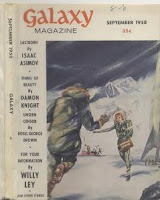
"Galaxy Magazine", Vol 16 No 5 (September 1958) (ed H L Gold) (magazine, free): Annotated table of contents & review

Cover by DEMBER showing Preparing Antarctica for Solar Conference of Galaxy Magazine, September 1958 issue
This magazine is online at Internet Archive in multiple formats.
Caution: I've linked it in the past, but without ToC. Regulars might already have a local copy.
Note: Galaxy seems to have changed its name from "Galaxy Science Fiction" to "Galaxy Magazine" some time in 1958. But the transition month listed by ISFDB is wrong.

Two very well known stories here - "The Ugly Little Boy" & "A Slight Case of Sunstroke", but both appear here under their less well known alternate titles. "Thing of Beauty" also seems to be widely anthologized, but I haven't personally read it yet.

Table of contents (6 stories, best first, unread last).

Links on author fetch more fiction by author. For read stories, my rating is in brackets. For stories that have their own post, link on story title goes there.
  1. [novella] Isaac Asimov's "Lastborn" aka "The Ugly Little Boy" (A): "A scientific experiment or not, the patient was her responsibility ... and all the more so for having died so many centuries ago!"
  2. [ss] Arthur C Clarke's "The Stroke of the Sun" aka "A Slight Case of Sunstroke" (A): '"Kill the umpire!" the audience cried—and why shouldn't they? He was on the ball, wasn't he?'
  3. [novelet] Rosel George Brown's "From an Unseen Censor": "You can't beat my Uncle Isadora—he's dead but he's quick — yet that is just what he was daring me to try and do!"
  4. [novelet] Damon Knight's "Thing of Beauty": "There was the gizmo that could put Gordon Fish in the chips — or right in the soup — and he didn't know which he was ordering!"
  5. [ss] Lloyd Biggle, Jr's "On the Double": "Failure was impossible — they had the one true formula: the victor belongs to the spoils!"
  6. [ss] H L Gold's "Personnel Problem": "Mng engnr wanted: duties it, gravity ditto, unitd opptnty advcmt—as anythg but engnr!"

Related.

  1. Fiction from Galaxy.
  2. "Pulp" magazines.
  3. Works of H L Gold.
  4. Fiction from 1950s.

Wednesday, June 9, 2010

Free fiction: Space Science Fiction, March 1953

At Internet Archive in multiple formats.

Editor: Lester del Rey.
Among the authors: Damon Knight.

Sunday, May 16, 2010

Free fiction: Galaxy, September 1958

At Internet Archive in multiple formats.

Editor: H L Gold.
Among the authors: Isaac Asimov, Damon Knight, Arthur Clarke (his funny & very well known story about the crazy football match in South America, "A Slight Case of Sunstroke", but under a different title - "The Stroke of the Sun"), H L Gold.

Related: Fiction from Galaxy, old "pulps", 1950s.

Wednesday, April 7, 2010

Free fiction: Cosmic Stories, March 1941 (ed Donald A Wollheim)

At Internet Archive in multiple formats. [via Marooned]

  1. This is the inaugural issue of the magazine.
  2. Part of the cover that includes magazine name is missing.
  3. Includes a "complete novel".
  4. Among the authors: Isaac Asimov & Damon Knight.

Related.

  1. Old "pulp" magazines.
  2. Works of Donald A Wollheim (as editor or as author).
  3. Fiction from 1940s.

Saturday, October 10, 2009

Damon Knight's "Four in One" (novelette): How about getting eaten by an animal & not only surviving but evolving!

Quote from short story titled Four in One by Damon KnightYesterday, I talked of a story about a 2-in-1 animal - 2 men living in one human body. Trope itself is not unknown; I've seen several stories of the kind, including Arthur Clarke's very creepy "The Parasite".

This one appears to be among the better known of the class - funny in spite of some gory elements.

Story summary.

"Toward the end of the twenty third century AD", four members - 2 men & 2 women - of an early human exploration party on a world had an unusual accident: while exploring as a team close to their camp on foot, they became food to a local animal. This local animal is an amoeba like creature, but huge; not smart, but can use brains of digested smarter animals; divides as amoeba to propagate & is essentially immortal.

What it did with these 4 humans is: eat their bodies, but not their brains & neural tissue. It integrated their brains with its body - so it's now a 4-human-brained animal, occasionally preserving an organ like eye! Story is the discovery of their situation by these trapped brains, their anguish & resignation, discovery that they can grow any organs they desire on this host body with practice, etc.

But most interesting aspect of the story is the conflict among the 4 that is reminiscent of some of the military satires of Eric Frank Russell. So - one animal, 4 brains, but those brains are fighting against each other (actually 2 against 2)! Eventually, for its own survival, the organism will excrete 2 brains; so it's two brains - a man & a woman - that do get along together.

Fact sheet.

First published: Galaxy, 1953.
Rating: A.
Related: Stories of Damon Knight.

Friday, July 24, 2009

Damon Knight's "To Serve Man" (short story, humor): An encounter with "altruistic" aliens!

I've seen variations of it, particularly at flash fiction length, but I guess they're all imitations of this; this story appears to have spawned a whole micro-genre of fiction!

And very funny ending.

Story summary.

Kanamit are aliens, recently arrived on earth, & have been offering great gifts to mankind without any expectation of reward: a cheap gadget to generate unlimited power almost for free; a gadget that nearly doubles agricultural yield; a gadget that ensures no explosive of any kind can detonate near it; a treatment that will make humans "taller & stronger & healthier". So we now have plenty of power & food, no war, & soon will be even healthier.

Then a suspicious man steals (& partially translates) what is apparently a handbook called How to Serve Man that all new Kanamit arrivals at their embassy receive as part of their orientation program. And we know they're not quite the altruists we thought they were...

Fact sheet.

First published: Galaxy Science Fiction, November 1950.
Rating: A.
Winner of Retro Hugo Award 2001 in short story category.
Related: Stories of Damon Knight.

Wednesday, June 10, 2009

Tony Daniel recommends some short fiction

In this chart (JPG image) as part of SF Signal's weekly panel called "MIND MELD".
Caution: Depending on browser settings, image text may be difficult to read in browser; might need to save to disk & use an image viewer.

I won't always call the stories on his list good, but they're famous ones. Includes several I haven't read but might now look up.

Of the very famous ones on the list that I personally didn't find good:

  1. Damon Knight's "The Country of the Kind"; download MP3.
  2. Fredric Brown's "Arena"; download text or comic book adaptation.
  3. Arthur Clarke's "The Nine Billion Names of God"; download text/MP3: But it's worth seeking out for those interested in ancient history of computers.
Also, many people will likely find Joseph E Kelleam's "Rust" a far better read than Ray Bradbury's much better known "There Will Come Soft Rains" (download text/MP3). Both are essentially on the same subject. Arthur Clarke too has two famous stories on the same subject (neither suitable for those seeking entertainment or for genre newbies) - "The Curse" (download text), & "If I Forget Thee, Oh Earth ...".

One story particularly worth looking out for on his list is Jack Vance's "The Moon Moth". Light fun read in a colorful setting.

Related: "best of" lists.

Saturday, May 3, 2008

** Damon Knight's "The Country of the Kind" (short story, fantasy)

In a future materially very well off & non-violent society, a monster of a man is born - monster because he's prone to violence. But this kind society cannot kill him; they just boycott him. And he is looking for a child who will be his heir in violence - for he has learned a useful lesson: you can snatch anything from anyone if you are violent, & no one will oppose you.

Collected in.

  1. Robert Silverberg (Ed)'s "The Science Fiction Hall of Fame: Volume One, 1929-1964".

Fact sheet.

First published: F&SF, February 1956.
Rating: C

Note: Why is this post so short?