Showing posts with label shipwreck. Show all posts

Saturday, March 9, 2013

Jon Bing's "A Whiter Shade of Pale" (short story, color blindness): When men refused to see colors!

The key idea is an unusual form of conjectured color blindness: humans living for generations on a cold, always snowy, world with no colors have their vision changed to the extent that they can no longer see bright colors! At least their brains don't register them anymore.

Story summary.

This is a shipwreck story. A star faring humanity, spread across many worlds. A shipwreck forces an unscheduled landing on the barren snowy world of its small crew. A world that was colonized by humans generations ago, but was forgotten.

But all attempts of the stranded travelers to get the attention of natives fail, until a man finally gets the idea...

Fact sheet.

First published: in English translation in Donald A Wollheim (ed)'s "The Best from the Rest of the World: European Science Fiction" (1976). Translated from the original the Norwegian by Steven T Murray.
Rating: B.

Sunday, March 4, 2012

Eric Frank Russell's "Somewhere a Voice" (novella, adventure): Unsuccessful hike to rescue by the stranded

One of the more mundane stories of Russell. Or may be I'm getting impatient with plots repeated a 1000 times. This one is of a hike through a jungle world, meeting & fighting local monsters.

At the start, it's a party of 7 men, 1 woman, & 1 dog - survivors of a spaceshipwreck that successfully landed on an uncolonized world. Uncolonized, but it still has a "rescue-station"! That's some 2000 miles north of landing place, no one knows how far east or west. They've no maps, no working communications gear.

So they set on a hike through the jungle to the rescue-station. All, except dog, will die on the way, one by one.

Fact sheet.

First publishedOther Worlds Science Stories, January 1953.
Rating: B.
Related: Stories of Eric Frank Russell.

Saturday, February 11, 2012

Ken Liu's "The Five Elements of the Heart Mind" (short story, free): What's better - technology assisted living or natural one?

Most of it is very good read. Bits of later parts somewhat spoiled it for me, though - evil colonists introduced into a great fantasy.

Story summary.

A spaceshipwreck survivor somehow manages to land on an unexplored world. And discovers it's not exactly unexplored...

Fact sheet.

First publishedLightspeed, January 2012.
Download full text from publisher's site.
Rating: B.
Related: Stories of Ken Liu.

Sunday, July 24, 2011

Mark Clifton's "A Woman's Place" (novelette, free): A woman & 2 men marooned on a virgin world

One of the illustrations by EMSH accompanying the original publication in Galaxy magazine of the story A Womans Place by Mark Clifton
Early parts of it sounded like a story that might have been too bold for its time. It's not, but it's still quite readable, if not always self-consistent.

Story summary.

A freighter spaceship wreck due to some sort of space "warp". Three of the survivors end up in a lifeboat - a woman & two men. On reaching earth, they find it's not their earth but a parallel one. An earth where primates never evolved - so it's a virgin earth.

A woman & two men, marooned on a virgin earth, with little hope of ever getting back home...

See also.

  1. Robert Reed's "A Billion Eves": A man, with a machine that can take a good sized volume of space around it to a parallel earth on a one way trip, takes a classful of girls for his harem. And discovers belatedly that it's not very safe to be the sole hated man in company of many women...

Fact sheet.

First published: Galaxy, May 1955.
Download full text from Project Gutenberg, Manybooks, Internet Archive.
Rating: B.
Related: Stories of Mark Clifton.

Wednesday, February 9, 2011

William J Smith's "The Last Straw" (short story, free): Investigating a plane crash

One of the illustrations, by George Schelling, accompanying the original publication in Analog magazine of short story The Last Straw by William J Smith. Picture shows an airplane beginning to crash, against night sky.Except for Niven's "Ringworld" that has someone bred to be lucky & a story of Murray Leinster that features a gadget that makes people near it lucky, I've'nt seen many stories where luck is an essential personal attribute. Here is one of the rare stories of the class.

Story summary.

A plane crash 6 months ago is one of the several where, in spite of a very thorough investigation that picked up many interesting tidbits, there is no clue to what might have caused the crash. A chance remark by the wife of Bob Kessler, the investigator of current crash, may be ... holds a clue...

Fact sheet.

First published: Analog, September 1963.
Download full text from Project Gutenberg, Manybooks.
Rating: B.
Among the stories from Astounding/Analog issues edited by John Campbell.

Sunday, December 19, 2010

Hal Clement's "Proof" (short story, weird life): Solarians baffled by strange earth-matter!

This is the first published story of Hal Clement.

Story summary.

Imagine that life evolved inside the Sun's core - life made of densely packed elementary particles to which that is the normal temperature. Some of these beings evolved enough to have cities floating in higher reaches of sun & to have space travel in their "neutronium" hulled ships.

They've found life in many stars' cores; even contact with intelligent beings. A Sirian scientist is currently on sun, testing a weird & totally crazy hypothesis: that matter like iron & calcium can potentially exist in a solid state!

That's when Kron, his Solarian host & a veteran star traveler, tells him the story of an unlikely & impossible shipwreck he was a witness to - one of the neutronium ships crashed in a "trapping field" of hypothesized solid matter that is Earth.

Collected in.

  1. David Hartwell & Kathryn Cramer (ed)'s "The Ascent of Wonder: The Evolution of Hard SF".

See also.

  1. Arthur Clarke's "Castaway": Another story of a Sun-being accidentally landing on earth.
  2. Hal Clement's "Iceworld": Human first contact with high temperature aliens.
  3. Hal Clement's "Longline": Another weird physics story of author that's among the weirdest I've seen - what if speed of light is only a divider rather than a barrier? So we have first contact of humans with beings comprising of matter that cannot move slower than light!

Fact sheet.

First published: Astounding, June 1942.
Rating: B.
Among the stories edited by John Campbell for Astounding/Analog.
Related: Stories of Hal Clement (some of his "good" stories); shipwreck fiction.

Tuesday, August 17, 2010

Lester del Rey's "Over the Top" (short story, war, free): Men go to war, unless distracted!

Illustration accompanying the original appearance in Astounding Science Fiction magazine of short story Over the Top by Lester del Rey
This is of a class of war stories that don't have an actual war - just a build up towards it. Then a wise man, or circumstances, create a distraction so people can channel their excess energies in a different direction! Probably the best I've seen of this class so far is Fritz Leiber's "Wanted--An Enemy".

Story summary.

Dave Mannen, a midget, is the sole man aboard the first human ship to Mars. He will land, but with a minor shipwreck that makes take-off impossible but life support systems intact. He has a few weeks of air, after that end. Oh, and he'll soon befriend a "Martian farmer" too.

This event - a man in distress in a dramatic situation - brings enemies together on earth. So a repurposed Soviet missile will land supplies for this US man - so he can fix the ship & return.

But the man in distress is seeing more than all humanity is seeing back on earth, & has a plan that will keep humanity distracted a little while longer...

Collected in.

  1. John W Campbell, Jr (ed)'s "The Astounding Science Fiction Anthology".

Fact sheet.

First published: Astounding, November 1949.
Download full text as part of the scans of Astounding issue it originally appeared in.
Rating: A.
Among the stories from Astounding/Analog issues edited by John Campbell.
Related: Stories of Lester del Rey; Mars in fiction; Tuesday Classics.

Sunday, June 20, 2010

William Tenn's "The Ghost Standard" (short story, farce): Defining what is "human"

This is probably the last published story of Tenn.

Story summary.

This is set as legal dilemma resulting from a case of cannibalism aboard a lifeboat: Juan Kydd, a human, & Tuezuzim, "a sapient lobstermorph" alien, both equally skilled computer programmers, are stranded on a lifeboat after a deep space shipwreck. Without food. Only one of them can survive to rescue by eating the other.

To decide, they play the word game "Ghost", with ship's computer acting as referee & executor. Juan wins, & during trial later, the galactic legalese gets a new definition of when an intelligence - alien, machine, whatever - is legally "human": "Intelligence has always been extremely difficult to define precisely, but it will be here & henceforth understood to involve the capacity to understand & play the terrestrial game of Ghost."

See also.

  1. Arthur Clarke's "Breaking Strain": Meteor hit has drained most oxygen off a spaceship, so only one of its two passengers (or is it 2 of 3?) can survive to rescue. Who is to die?

Fact sheet.

First published: Playboy, December 1994.
Rating: B.
Related: Stories of William Tenn.

Thursday, August 7, 2008

Bud Sparhawk's "The Super" (novella, non-genre): Description of an around the world sailing race

Image included by publisher with the short story titled The Super by Bud SparhawkI suppose someone could call it scifi too - there is some description of technology involved in sailing boats. I'm not familiar with sailboats - cannot say how much of it is futuristic. Title is the name of the race.

Story describes an 80-day race starting somewhere in Europe (probably France), down the Atlantic turning east in "Southern Ocean" around Antarctica, & finally turning north into Atlantic after South America.

There is a lot of description of conditions in the sea, ocean winds & storms, fighting waves, etc. None of which I'm familiar with & must take on faith. And substantial text devoted to preparations before the race.

There is also a shipwreck & rescue near Antarctica. One of the racers meets an accident, & a brave one rescues her. Plus a little bit of talk of global warming & its effects on ocean levels & Antarctica ice shelves in later half.

I found the start a bit tedious, but then it picked up.

Fact sheet.

First published: Jim Baen's Universe, #14 (August 2008).
Rating: A
Related: All stories of Bud Sparhawk.

Friday, June 27, 2008

Arthur C. Clarke's "Playback" (short story, science fiction): Reincarnation not possible with a corrupt mind dump

Quote from short story titled Playback by Arthur C ClarkeThis is not the first mind dump story I've read of Clarke - there's much better known novel "The City and the Stars". "Patent Pending" has a device that lets specific experiences of one individual to be recorded to a storage device & played back directly into the mind of someone else! Even "The Lion of Comarre" has a variation of this.

But this is the first exclusively mind dump story I've seen from Clarke that has a modern feel. Ignore a single reference to tape as a storage device & a space-based theme, & this 1966 story can be confused with a 2007 or a 2008 story! And it's among the best mind dump stories I've seen.

There is a part of the story that has the terror like in Harlan Ellison's "I Have No Mouth, and I Must Scream". But there is no sadistic external entity doing the torturing here; it's a natural part of the story.

Story summary.

40 year old William Vincent Neuberg, "a master pilot of the Galactic Survey... born in Port Lowell, Mars, on August 21, 2095", had an accident somewhere in deep space. His ship blown away, vaporizing him along with it. We don't know if there were any other crew or passengers.

But some aliens, obviously far off from the location of accident, did his mind dump during these last moments. They were competent enough to have created his body & complete with its memories from this dump, only they have no idea of what kind of body he had; nothing from the body was saved.

Story is narrated by a simulation ("playback") of William's mind dump record. He is initially trying to feel his body parts, panicky when cannot find, ... eventually realizing he's just a simulation!

He begins communicating with the aliens via the playback machine's interface, describing what his body looked like so they can reincarnate him. Only it's an incomplete recording - something vital seems to have been missed when they made the record - his memory is confused, fading...

Collected in.

  1. "The Collected Stories of Arthur C Clarke"
  2. Arthur Clarke's "More Than One Universe"
  3. Arthur Clarke's "The Wind From the Sun"

Fact sheet.

First published: Playboy, December 1966.
Rating: A

Friday, June 6, 2008

Cheyenne Warlock's "The Witches Hammer Voyages" (flash fiction, free)

I missed the punchline here.

"The Witches Hammer" is a sea-going vessel stopping by at some port for repairs. Harbourmaster cannot quite figure out the ship's log, & the sailor Boston Gantry (probably ship's Captain) is explaining. I completely missed most of their conversation - lot of jargan, place names that don't mean anything to me, ...

Captain will give a gift to Harbourmaster that is supposed to do some magic, but I completely missed the point & ending - apparently something magical.

Fact sheet.

First published: Antipodean SF, #120 (May/June 2008).
Rating: C
Download full text.

END.

Wednesday, June 4, 2008

A Bertram Chandler's "The Cage" (short story, science fiction): A shorter version of Pierre Boulle's "Planet of the Apes"

Quote from short story titled The Cage by A Bertram ChandlerWhile there are many stories with "men as zoo animals" theme, these two are the only ones I've read where this is the main theme.

Because of shorter length, this is a simpler & less nuanced story than "Planet of the Apes". But plot idea is the same: A group of humans happen to be in a condition where they are mistaken as non-sentient animals by beings that are otherwise intellectual & technological peers. The humans get hunted, caught, & put in zoo & laboratory cages.

Problem for these zoo animals is to convince their captors that they are sentient & deserve better treatment.

Story summary.

About half the story is about how this group of humans ended up in the unfortunate situation; later half is about their capture by an alien "survey ship", life as zoo animals, & eventual release.

"At least two hundred days had passed since their landing on the planet without a name" - these human "survivors from the interstellar liner Lode Star". Ship had to make emergency landing. There was something wrong with its atomic "Ehrenhaft generators"; they had landed on a world in an unexplored region of galaxy & had only chance to send SOS (but not receive acknowledgment).

50 odd passengers were parceled off to a place somewhat away from wrecked ship while Captain & a small crew tried fixing things. They failed; the explosion destroyed both the ship & crew, & left a crater where ship stood. Survivors were stranded on this unfriendly world - always hot, always drizzling, though no hostile local animals, ample local food & water, & breathable air.

They have degenerated into a primitive existence in this period. And there is very skewed sex ratio. "There are fifty-three of us here, men & women. There are ten married couples... That leaves thirty-three people, of whom twenty are men. Twenty men to thirteen ... women... What sort of marriage set-up do we have?" They choose monogamy. If two men want the same woman, they must fight it out; winner takes the woman!

It's during one such fight with the crowd cheering that 6 of them are picked up by an alien hunting helicopter; alien spaceship is parked a little distance away.

"The world to which they were taken would have been a marked improvement on the world they had left, had it not been for the mistaken kindness of their captors. The cage in which the three men were housed duplicated ... the climatic condition of the planet upon which Lode Star had been lost." So hot atmosphere & constant drizzle, & same boring fungi as food that they had adapted to on the world they were taken from!

Of the 6 humans captured, 3 men in this cage are "Hawkins, Boyle, & Fennet". In a nearby cage is "Mary Hart". Remaining two - "Clemens & Miss Taylor" - probably ended up on the vivisection table.

Their captors "aren't the same shape.. And we, were the situations reversed, would take some convincing that three six-legged beer barrels were men & brothers." They try Pythagoras's Theorem with pictures made from twigs to interest their captors, without luck.

They try showing their "manual dexterity by the weaving of baskets" from stuff within their cage. Captors think its a mating ritual - like beaver's dams! So "Mary Hart was taken from her cage and put in with the three men"!

It's during the night of her stay in men's cage that Mary made a racket - when Joe, a little local mouse-sized animal, passed over her when she was asleep. Men consider Joe a kind of friendly pet. She insists men kill Joe; they instead make a basket type cage & put Joe there after trapping it.

It's this trapping & caging of Joe that reaches out to captors. They will be recognized as sentients & gain their freedom because "Only rational beings ... put other beings in cages"!

Collected in.

  1. Isaac Asimov & Martin H Greenberg (Eds)' "Isaac Asimov Presents the Great SF Stories 19 (1957)".

Fact sheet.

First published: F&SF, June 1957.
Rating: A

Thursday, May 1, 2008

* Arthur Clarke's "Breaking Strain" (short story)

Main post. Why this dummy post?

Friday, March 28, 2008

Kristine Kathryn Rusch's "Recovering Apollo 8" (novella, science fiction): Shipwreck & wreck recovery in space

Quite readable first half, but it begins degenerating a little after half-way point towards incredulity.

Story itself is alternate history. Real Apollo 8 mission of NASA to moon & back, with crew & dates that match the ones listed in this story, was a successful one.

In this story, something goes wrong & the ship never enters lunar orbit; it instead goes away from earth & moon into deep space. Story is mostly about recovery of the ship & crew, beginning 40 years later - between 2007 & 2068. First 2 of the 4 chapters are decent enough, though I felt uncomfortable with the idea of using real survivors in a story where they die.

There are also occasional lame statements like "one of his computer visionaries, a man named Gates, had proposed selling those smaller computers to the business market" - his refers to hero of the story - one Richard J Johansenn. Plus super heroics of Richards, the billionaire mastermind - even at age 108!

This story would have been much better at half the length. It would also have been more credible if the initial recovery date was a couple of decades into future rather than 2007.

If you're into classical sf, you'll find nearly every theme in this story a rehashed one. If not, it gives a taste of a bygone era.

In spite of the flaws, I was entertained. At novella length, it's the most engaging story I've seen so far in both Nebula & Hugo Awards lists - a particularly weak category this year.

Full text of this story is available for download.

Story summary.

Story is divided into 4 parts - 2007, 2018, 2020, 2068. Hero is 108 in 2068.

Early in the story, we are told of the Apollo 8 disaster, & that both ship & crew are lost. Young Richard, then 8, will make it his lifelong obsession to recover that ship & bring it back to earth.

We then meet him at age 48, a billionaire, & with far flung space businesses. That's about our current time. This is where the lost ship gets located - it's in an elliptic orbit about sun, & approaching its nearest point to earth. And there is a mission to recover the ship. Mission will be successful, except the Apollo 8 ship is empty! No signs of the 3 crew! Turns out they jumped off the ship - to die in vast spaces rather than in cramped quarters inside their ship.

Jump to 2018. Richard had started a new project to locate & recover these 3 floating corpses in space! It's believed they are also in orbit about sun, but how to locate them?

Early in this second part, one of his employees has located one of the corpses. Looks like the spacesuit of crew included a plastic helmet with characteristic spectrum. Another mission, & the corpse is recovered - of Lovell.

We are now somewhat more than half way through the story, & really incredulous rest is about to begin. In 2020, the star researcher of Richard has left, & no one has a clue to location of other two lost spacemen. That is where we are introduced to some China/US talk - evil China wants some of US technology, etc. Anyway, Chinese government has located the second corpse, & wants some space technology as trade. Trade is made, mission launched, & corpse recovered - of Commander Borman.

Over to last part - 2068, the most incredulous. Richard, 108, has long lost interest in the project. He is on the way to Mars with his 48-year old daughter Delia. Part of the way through, he will manually locate the third corpse!!! And get off the ship in a lifeboat, & recover the corpse - of Anders!

Fact sheet.

"Recovering Apollo 8", short story, review
First published: Asimov's Science Fiction, February 2007.
Rating: A
Nominated for Hugo Award 2008 in novella category.

Friday, September 21, 2007

Arthur C. Clarke's "Summertime on Icarus": Shipwreck near the Sun

This is quite a well told shipwreck & rescue in space story. But I have read too many of the kind now - had a feeling of boredom midway through; ended up finishing this rather short story in 3 sittings!

An MP3 version of this story is available online (link via SF Signal & Free SF Reader. I haven't heard this online version.

Story summary.
"Colin Sherrard, astronics engineer", is alone on a small asteroid named Icarus - "a world of two miles in diameter" but with "fifteen square miles of fantastically rugged" surface area.

He was part of crew aboard solar research ship Prometheous - now hanging 2 miles above the asteroid in its shadow - to protect it from Sun. Colin had gone down to fix some instrument in a one-man pod, & had an accident.

Now he can neither fly, nor radio. Life control systems are intact, but they won't be any good once Sun comes up (which will be soon); he is currently at night side. He is not even carrying a space suite that will let him walk around on foot, though he can drive the pod around on surface.

Much of the story is about his terminal ruminations & how he got there. A part is about the building up of despair as Sun comes up.

But story has a happy ending. He is rescued just in time - by a rescue pod that has rigged a kind of sunscreen for this search mission.

Fact sheet.
Summertime on Icarus, short story, review
First published: Vogue, June 1960, as "The Hottest Piece of Real Estate in the Solar System"
Rating: A

See also.

  1. All shipwreck stories - part 1 & part 2.

Thursday, September 20, 2007

Edgar Allan Poe's "A Descent Into The Maelström": A man survives by not losing his wits

Quote from A Descent Into The Maelström by Edgar Allen PoeI picked up this very engaging story because Arthur Clarke's "Maelstrom II" (a space age sequel to Poe's original) referred to it. I am not sure how this story is normally tagged; I have no hesitation labeling it hard-sf in the best traditions of the genre.

While looking for it, I read somewhere (don't recall the source), that it is this story that introduced the word "maelstrom" into English language; original used in this story is Nordic "Moskoe-ström". Moskoe is an island in Norway - near the site in sea where a very big & cyclical maelstom (whirlpool) rages.

Full text of the story is available for download.

Story summery.

Second half is the main story; first half just prepares the ground.

Main story is narrated by the unnamed middle one of the 3 brothers, & the sole survivor of the fishing boat that was wrecked first by a hurricane, & immediately afterwards was caught in The Maelstrom. Story is told 3 years after the event.

By the time they were caught in maelstrom, the (air) sail was gone, & younger brother too (blown with the sale). Narrator is holding on to a metal protrusion on the ship; his brother is holding on to "a small empty water-cask which had been securely lashed under the coop of the counter, and was the only thing on deck that had not been swept overboard when the gale first took us".

Fear makes his brother seek out the metal hold of narrator. Since there is not space for two to hold, brother effectively forces the narrator to leave the secure handle!

So narrator goes to hold the barrel brother was previously holding. Sense of doom gives way to wonder around. That is when he makes the important discovery:

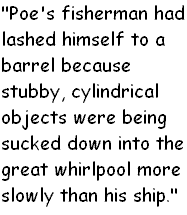
"I perceived that our boat was not the only object in the embrace of the whirl. Both above and below us were visible fragments of vessels, large masses of building timber and trunks of trees, with many smaller articles, such as pieces of house furniture, broken boxes, barrels and staves.
...
It was not a new terror that thus affected me, but the dawn of a more exciting hope... I called to mind the great variety of buoyant matter that strewed the coast of Lofoden, having been absorbed and then thrown forth by the Moskoe-ström. By far the greater number of the articles were shattered in the most extraordinary way - so chafed and roughened as to have the appearance of being stuck full of splinters - but then I distinctly recollected that there were some of them which were not disfigured at all. Now I could not account for this difference except by supposing that the roughened fragments were the only ones which had been completely absorbed - that the others had entered the whirl at so late a period of the tide, or, for some reason, had descended so slowly after entering, that they did not reach the bottom before the turn of the flood came
...
I made, also, three important observations. The first was, that, as a general rule, the larger the bodies were, the more rapid their descent - the second, that, between two masses of equal extent, the one spherical, and the other of any other shape, the superiority in speed of descent was with the sphere - the third, that, between two masses of equal size, the one cylindrical, and the other of any other shape, the cylinder was absorbed the more slowly.
...
There was one startling circumstance which went a great way in enforcing these observations, and rendering me anxious to turn them to account, and this was that, at every revolution, we passed something like a barrel, or else the yard or the mast of a vessel, while many of these things, which had been on our level when I first opened my eyes upon the wonders of the whirlpool, were now high up above us, and seemed to have moved but little from their original station.
...
I resolved to lash myself securely to the water cask upon which I now held, to cut it loose from the counter, and to throw myself with it into the water."

Brother refused to let go of the big ship that he felt more secure in. So the narrator ended up as the sole survivor.

See also.

  1. An illustration of the narrator after jumping - tied to barrel, scared, & still inside the whirlpool.

Fact sheet.

First published: Graham's Magazine, April 1841.
Rating: A
Related: All stories of Edgar Allan Poe.

Arthur C. Clarke's "Maelstrom II": A totally crazy but effective rescue operation

Quote from Maelstrom II by Arthur ClarkeThis would easily class as among Clarke's best. An outstanding shipwreck & rescue story in space.

As far as I know, there is no other Clarke story called "Maelstrom" or "Maelstrom I". "II" comes from looking at the plot as a space age variant or sequel of a very similar survival story at the sea - Edger Allen Poe's "A Descent into the Maelstrom".

Story summary.
Cliff Leyland is an African farmer trying his luck in a lunar colony, & is now returning back to earth. He buys a return ticket on an unusual flyer to save some money - a freight capsule launched by an electric catapult; he is the sole passenger on board.

Only there is a launch fault because of a 1 second electric supply failure on launch rail. Result is - his capsule doesn't get moon escape velocity. It will go to a certain height; then moon's gravitation will pull it back, & there will be a mighty crash!

There are small steering jets on capsule, but they are also destroyed. I could not follow how the accident destroyed them.

Anyway, now he is awaiting certain death. A lot of space is devoted to his ruminations on this.

Part way through his elliptic crash orbit, he gets a call from Van Kessel, Chief of Maintenance, Space Vehicles Division. Ground staff have worked out a totally crazy & frightening way to save him.

While a ship will eventually pick him up, it cannot get to him in time before impending crash. He is advised to don the space suite, & at the moment Launch Control will advice, to manually jump off the ship into space with all the force he can muster! This advice will be given when his capsule is at its highest point in orbit, & airlock is facing away from moon; hopefully, this will put him in a non-crash orbit - & give rescue ship, Callisto, time to finally fetch him.

Of course, the story has a happy ending.

Fact sheet.
Maelstrom II, short story, review
First published: Playboy, April 1962
Rating: A

See also.

  1. A 3-minute movie showing the launch, its going wrong, & realization that things have gone wrong, but not the most interesting rescue routine. I saw this version; the version at YouTube appears identical but I haven't played it. Not very good quality, but not bad either. Makers of this movie also put together this slide show that explains the essentials of the story with pictures.
  2. Arthur Clarke's novel "A Fall of Moondust": Very good shipwreck & rescue story on moon. But set on (or rather, in) lunar surface rather than in space.
  3. Robert Heinlein's short story "Searchlight": Shipwreck at an isolated place on lunar surface, & an ingenious technique to locate the stranded during rescue.
  4. Robert Heinlein's short story "Ordeal in Space": In some ways, similar to this story. A spaceman falls off ship, ends up spending sometime away from anything, & becomes a psychological wreck. Story is of his eventual rehabilitation. This same story is also found as a small subplot in Arthur Clarke's novel, "The Deep Range".
  5. Arthur Clark's novel "2001 A Space Odyssey" has a space man ejected off a deep space ship because of sabotage. Another novel, "3001 The Final Odyssey" will have him recovered in a very improbable rescue operation 1000 years later! And with his sanity intact.
  6. Robert Heinlein's novel "Moon is a Harsh Mistress" features electromagnetic catapults for normal freight delivery from moon to earth. In one episode, it also transports 2 passengers. It is also eventually used as a weapon on a war against earth.
  7. Arthur Clarke's novel "Islands in the Sky" features a short subplot where an electric catapult based on rails is used for emergency launch - I think of people, don't recall well. The mechanism is very similar to that in current story.

Monday, September 3, 2007

Eric Frank Russell's "Jay Score": A passenger spaceship is on its way to fall into the Sun!

Quote from the story titled Jay Score by Eric Frank RussellThis thriller is a very good variant of Arthur Clarke's "Breaking Strain": a spaceship on earth to Venus voyage is hit with a tiny meteor. In Clarke's version, it's a cargo ship, & air is limited - making that a survival problem. In Russell's version, it's a passenger ship, & loses machines that control propulsion system - so the ship is about to be sucked into the Sun.

Story summary.
Space ship Upskadaska City aka Upsydaisy is headed for a human settlement on Venus with 8 passengers. And a crew drawn from at least 4 races:
  1. "white Terrestrials to tend the engines".
  2. Black terrestrials as medics "because for some reason no one can explain why no Negro gets gravity bends or space nausea."
  3. Ten-tentacled martians. "Every outside repair gang is composed of Martians who use very little air, are tiptop metal workers and fairly immune to cosmic ray burn."
  4. Emergency pilot Jay Score, a terrestrial who is neither black nor white.
Story is narrated by ship's Seargent-at-Arms. The accident described happens in the year 2270, & will eventually be known as "McNulty's Miracle Move"; McNulty is captain.

Jay Score is fairly new to the job, but quickly becomes known as competent & reliable crew member. But there are two specific actions that put him in a class of his own.

First is when the meteor hits. A part of the ship loses air, trapping an engineer beyond hope. It's Jay's heroics that save the engineer. The hit also damaged the ship's propulsion system that actually precipitates the crisis - the ship is headed for the Sun.

Propulsion system is quickly fixed, but how to get out of Sun's gravitational drag? I didn't quite catch the technicalities: "The idea is to build up all the velocity that can be got and at the same time to angle into the path of an elongated, elliptical orbit resembling that of a comet. In theory, the vessel might then skim close to the Sun so supremely fast that it would swing pendulum like far out to the opposite side of the orbit whence it came... The only point about which we have serious doubts is that of whether we can survive at our nearest to the Sun."

Tension in story is provided by this nearness to Sun - for four dangerous hours. Everyone will hide in the ship's "cold room", but someone needs to be in the cockpit! Jay Score, of course. When the time is past, everyone in the cold room has passed out but not fatally.

When Jay is retrieved, he is blind & mute, but alive in cockpit that has lost its air.

We will learn the secret of Jay's survival late in the story. Very good ending.

Collected in.

  1. "Major Ingredients" (ed Rick Katze). 
Fact sheet.
First published: Astounding Science Fiction, May 1941
Rating: A
Series: Jay Score (A), Mechanistria (B), Symbiotica (B), Mesmerica (B)
Related: All stories of Eric Frank Russell.
Listed among the stories from John Campbell's Astounding/Analog.

See Also.
  1. Robert Heinlein's "Gentlemen, Be Seated". Shared plot element is: to survive an accident in space, protagonists must expose their body physically to elements guaranteed to kill them. Protagonists survive in both stories.
  2. Heinlein's "The Green Hills of Earth": A spaceman loses eye sight & later life when performing valiant action during an accident in space.

Monday, August 6, 2007

Robert Heinlein's "Searchlight": Shipwreck & rescue on moon

It's a really short & generally readable adventure drama with a happy ending.

Story summary.
Betsy Barnes is a little blind girl, & a very good piano player. She has gone to moon to to entertain men at the military bases. While going from Tycho Base to Farside Hardbase, her rocket crashes. She was the only passenger, apart from pilot - Major Peters. Major is not dead, but is indisposed enough that Betsy is essentially on her own.

When the traffic control realizes they are lost, there is a rather vast geographical area that needs searching. sf element of the story is in the rather complicated device rigged to get the wreck's approximate location; search technique is classical divide & conquer.

The search device will scan the appropriate part of lunar surface with a laser "like radar". This will be modulated into a "carrier wave in radio frequency", then modulating that "into audio frequency-and controlling that by a piano"! I have no clue to mechanics of this, but I am not an expert on the subject - so let's assume it can work.

The idea is to repeatedly transmit a message hoping she hears it via her space suite radio. The message asks here to acknowledge that she has heard it - again via her space suite radio. This acknowledgment apparently is not enough to locate her. So she will be told that the search area is being divided such that different piano tones will be heard in different areas. She will identify the tone she hears - reducing the search area. This smaller area will now be divided up, & the process repeated - till the area is small enough to manually locate the wreck.

Fact sheet.
Searchlight, short story, review
Author: Robert A Heinlein
First published: 1962
Rating: B
Bibliography.

See also.

  1. Arthur Clarke's short story, "Maelstrom II", is another shipwreck & rescue story on moon, but with a very different twist.
  2. Arthur Clarke's "A Fall of Moondust": Good novel length shipwreck-on-moon story. Some of the plot elements related to locating the victims are similar.
  3. Arthur Clarke's "The Sands of Mars": This novel has a short story length subplot of a shipwreck & rescue of Mars that again has some plot elements similar to this story. But the victims here are competent spacemen, have a powerful camera flash that they use to signal their locating to satellite involved in search.
Note: Moved here from original location on Aug 6, 2007. Reason.

Sunday, July 29, 2007

Michael Flynn's "Down, Sunset and the Colours of the Earth": Bermuda triangle retold

While the subject is well hashed - ships & things mysteriously disappearing in a well-demarcated area in the sea - prose is good. But it won't pay to read it as a single story; read it over several sittings as a collection of may be a dozen short stories on the same subject, & you will likely enjoy it.

Full text of this story is available online.

Story summary.
At an unspecified date, the ship MV Hyak on a regular ferry run from Seattle to Bremerton disappears almost as soon as it leaves the port. Ship was carrying a 1,000 passengers.

Later investigations reveal that at the time of disappearance

  1. the area had thick fog,
  2. there were strong air & water currents towards some point withing the fogged area, &
  3. readings from three different radar stations found that the ship was simultaneously at three separate locations just before its disappearance!
More investigations suggest radar anomaly had been around for a while. And that there is some point within the area that is pulling things towards it. Over a period of time, this phenomenon is observed repeatedly in the area - sometimes lasting days. Affected area is cordoned off.

There is speculation that some kind of singularity (black hole?) or wormhole periodically opens in the area. There is also speculation that it has mysteriously moved from Bermuda to this location. But nothing is proved.

This main story is perhaps 10% of the whole story. Rest is a collection of several human interest stories of the bereaved families & friends. Each is readable, but I had to split them over several sessions. Fortunately, there are clear markers identifying these smaller stories.

Fact sheet.
"Down, Sunset and the Colours of the Earth", short story, review
Rating: B
First published: Asimov's Oct/Nov 2006
Nominated for Hugo Awards 2007 in novelette category

Related: All Hugo Award stories.