Showing posts with label 1945. Show all posts

Wednesday, October 16, 2013

Henry Kuttner's "Sword of Tomorrow" (novella, adventure, free)

One of the illustrations accompanying the original publication in Thrilling Wonder Stories magazine of novella Sword of Tomorrow by Henry Kuttner
This is a complicated & very pulpish adventure in far future.

Story summary.

A US soldier is a prisoner of war of Japan near the end of WWII, held captive somewhere in China. From a fellow prisoner, he learns Tibetan "self-hypnotism", & goes into hibernation to avoid questioning.

War ends. A bombing raid destroyed his prison, & entombed him. No one finds him. There he lay hibernating for eons.

Eventually, he wakes into a future where continents don't look familiar & stars aren't familiar. Humans have since fallen to savagery, & again built a civilization, but historical trauma has made it impossible for them to conceive weapons, though they can build all other kinds of gadgets.

A would be dictator would see an opportunity when our hero comes into his time...

Fact sheet.

First published: Thrilling Wonder Stories, September 1945.
Read online at UNZ. Or download HTML from Arthur's Bookshelf or BookReader.
Rating: B.
Related: Stories of Henry Kuttner.

Monday, October 14, 2013

Henry Kuttner's "Before I Wake..." (short story, dreaming, free)

Illustration accompanying the original publication in Famous Fantastic Mysteries magazine of short story Before I Wake by Henry KuttnerWhat is more real - conscious or unconscious, waking state or dreaming state? In this story, the distinction is blurred.

Story summary.

A young boy, somewhere on Florida coast in the US, has read too many fairy tales & believes them in all innocence. He dreams of sailing to places with magical & colorful characters & things. Until his the world of imagination begins to appear far more desirable than the real world...

Fact sheet.

First published: Famous Fantastic Mysteries, March 1945.
Read online at UNZ.
Note: The text at the link above appears to end abruptly. Story appears complete, but the link has a lot more text beyond the end of the story, with no clear marker to end the story, leading to feeling of abrupt ending.
Rating: A.
Related: Stories of Henry Kuttner.

Friday, October 11, 2013

Henry Kuttner & C L Moore's "Baby Face" (novelette, body snatching, free): "Baby's Day Out", from many decades earlier

An illustration accompanying the original publication in Thrilling Wonder Stories magazine of short story Baby Face by Henry Kuttner and C L Moore. Image shows the grown up man in baby's body encouraging the gorilla to put on the mind exchange cap.
So now we know the story of the "Baby's Day Out" (1994) is at least this old!

Story summary.

To figure out why a baby is crying, a mad scientist uses his latest invention: to exchange the mind of his friend, minding the baby, with the baby - so friend in baby's mind can find out what is wrong!

That's when Nazi spies steal the brain exchange gadget. So we are left with: the grown up man is in baby's body, baby in grown up man's body, & scientist injured & unconscious. And the man in baby's body overheard the spies will pass on the gadget to a contact on circus that night.

So now it's up to the hero, in baby's body, to ensure the gadget doesn't fall in enemy hands...

Fact sheet.

First published: Thrilling Wonder Stories, March 1945.
Read online at UNZ.
Rating: B.
Related: Stories of Henry Kuttner, C L Moore.

Saturday, June 9, 2012

Eric Frank Russell's "Hell's Bells" aka "Bentley's Old London Djinn" (as by Duncan H Munro) (novelette, humor): Glad to get rid of Alladin's magic lamp!

An American tourist in Cairo picked up a souvenir - a "sistrum". A gadget with some small bells tied variously. That's the magic lamp of the story.

On a London train some months later, he'll notice the gadget again & playing around, untie a bell. Well, that's the clue for djinn to appear. We'll have fun as literal-minded djinn does the master's bidding...

See also.

  1. Murray Leinster's "Gateway to Elsewhere" (download): Adventure in an alternate reality where djinns actually exist.

Fact sheet.

First published: Short Stories, March 1945 as "Bentley's Old London Djinn".
Rating: B.
Related: Stories of Eric Frank Russell (as by Duncan H Munro) (annotated list).

Monday, February 27, 2012

Fredric Brown's "Pi in the Sky" (novelette, humor)

Very funny ending, of an apparently serious story told with a straight face.

Astronomers the worlds over suddenly start observing extremely unusual motions of far away stars. Physics seems to be up for some serious revision. And then, a few days later, they as suddenly stop moving, basically relocating to new positions, relative earth, that serve a grand end...

Fact sheet.

First published: Thrilling Wonder Stories, Winter 1945.
Rating: A.Related: Stories of Fredric Brown.

Thursday, April 14, 2011

Fredric Brown's "The Waveries" (short story, alien invasion, free)

I'd read it long ago, in one of the "Isaac Asimov Presents Great SF Stories" books (I think), but found the online copy only recently.

It's supposed to be one of the better known stories of Brown. A light-hearted "apocalypse" where it has suddenly become impossible to use electricity in any kind of application!

Fact sheet.

First published: Astounding, January 1945.
Download full text from Grey Lodge Occult Review. [via David Mitchell @rasfw]
Rating: B.
Among the stories from Astounding/Analog issues edited by John Campbell.
Nominated for Retro Hugo Award 1996 in short story category.
Related: Stories of Fredric Brown.

Wednesday, November 10, 2010

A E van Vogt's "The Purpose" (novelette, zombie, free): An attempt to spread love ends up spreading terror

Illustration accompanying the original publication in Astounding Science Fiction of the short story The Purpose by A E van Vogt
One of the less interesting stories of van Vogt. I found the magical device employed here outright illogical, rather than just utterly incomprehensible that is the case in his many other stories.

Story summary.

Dr Dorial Cranston is the ultimate pacifist: he would like more people, complete strangers, to physically touch each other. He thinks this will spread love.

Since humanity is not ready for stranger-touch, he's developed a device that does the next best thing: when two individuals pass close to each other, there is a microscopic "life force" transfer; his machine amplifies it.

Only the electronic engineer he's employed is a crook, & has sabotaged his machine to overtake the world via an organization called "Futurian Scientific Laboratories": an organization that deliberately kills people so Dr Cranston will turn them into zombies because good doctor cannot stand to see someone dying.

Villains will meet their match when they choose Virginia Mention as their victim. Her husband, Prof Norman Mention, will make sure their terrorizing ends.

See also.

  1. John Scalzi's "The President's Brain is Missing" (download): The main gimmick here is keeping the brain of a man not inside the brain case but elsewhere - at least till the suspense is revealed. In this van Vogt story, heart of a man is physically kept half-way around the world from his body!
  2. I recall a Medgadget story where kissing has become a requirement for population's physical well being. I don't recall the title though, & I don't seem to have a post on it.

Fact sheet.

First published: Astounding, May 1945.
Download full text as part of the scans of Astounding issue where it originally appeared in.
Note: One page of story text in these scans has incomplete left scans, missing first 2-3 characters of every line.
Rating: B.
Among the stories from Analog/Astounding issues edited by John W Campbell, Jr.
Related: Stories of A E van Vogt.

Thursday, July 22, 2010

Frank Belknap Long's "The Trap" (short story, first contact, free): Life can exist as pure shape too!

One of the illustrations accompanying the original publication in Astounding Science Fiction, May 1945 issue, of short story The Trap by Frank Belknap Long
A shape whose food is someone else "appreciating" it! Alien here is actually incomprehensible. And I got a feeling there is a vampire-derivation here - an alien that feeds on its victims seeking something other than their blood.

Story happens on a far off world - an interstellar refueling station, with two attendants, of a star faring humanity. An unusual alien ship has arrived with which all previous attempts to communicate have failed. But attendants of the station will "meet" the aliens.

See also.

  1. Incomprehensible aliens: Terry Carr's "The Dance of Changer & the Three" (download).
  2. Vampire-derivations: C L Moore's "Shambleau" (download) & "Black Thirst"; Eric Frank Russell's "Sinister Barrier".

Fact sheet.

First published: Astounding, May 1945.
Download full text as part of the scans of Astounding issue where it originally appeared.
Among the stories from Astounding/Analog issues edited by John W Campbell, Jr.
Rating: B.
Related: First contact fiction.

Friday, June 18, 2010

"Thrilling Wonder Stories", Spring 1945 (magazine, free): Annotated table of contents

Cover image of Thrilling Wonder Stories magazine, Spring 1945 issue. It is a painting by Earle Bergey, and depicts a scene in the story Devils from Darkonia by Jerry SheltonScans of this magazine in CBR format are available as part of a larger package.
Caution: CBR probably has a few pages missing; when I renamed it as RAR, I had to extract with WinRAR's extraction dialog's "Keep Broken Files" switch on because of errors.

Table of contents.

  1. [novel] Jerry Shelton's "Devils from Darkonia": When strange demons drive him haywire, Professor Bradley learns that if you advertise for the Devil, that worthy - or a reasonable facsimile of same - is sure to appear!"
  2. [novelette] Ross Rocklynne's "Venus Sky-Trap": "With a girl's life at stake, Reg Mason & Pirate Aarn take a chance to balk a villain!"
  3. [novelette] Henry Kuttner's "Baby Face": "When a tough sergeant reverts to infancy he just won't be weaned from fighting mankind's foes!"
  4. [ss] Arthur G Stangland's "The Plant Man": "Jefferson Smith becomes a most remarkable being".
  5. [ss] Frederic Arnold Kummer, Jr's "Delvers in Destiny": "A conquest-mad dictator flees back into the past".
  6. [ss] Polton Cross' "Mark Grayson Unlimited": " Dr Grayson's image goes marching on!"
  7. [ss] Sam Merwin, Jr's "No Greater Worlds": "Agonto Tenodin's ship roars into outer space".
Related:

Related.

  1. Fiction from Thrilling Wonder Stories.
  2. "Pulp" magazines.
  3. Fiction from 1940s.

Friday, May 21, 2010

"Astounding Science Fiction", November 1945 (ed John W Campbell, Jr) (magazine, free): Annotated table of contents

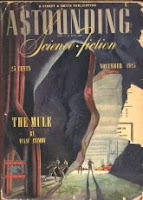
Cover by Timmings of Astounding Science Fiction magazine, November 1945 issueScans of this magazine in CBR format are online as part of a larger package., but with some pages missing.

Table of contents

  1. [serial - part 1/2] Isaac Asimov's "The Mule": "the one factor even Hari Sheldon could not predict - could not defend the Foundation against. The defenses were based on human psychology; the Mule was a mutant!"

    This is the second novel in Asimov's famous Foundation Trilogy. second part of the serial is also online somewhere.
  2. [novelette] Geoff St Reynard's "By Yon Bonnie Banks": "A fantasy of a fog, & a wrong turn that led through time - back from one war, to a battle of long ago, where the outcome was foreordained - & still unsuspected."
  3. [novelette] George O Smith's "Identity".

    Note: Initial pages of this story are missing.
  4. [ss] Henry Kuttner & C L Moore's "Line to Tomorrow" (as by Lewis Padgett): "It was a perfectly ordinary telephone, but some wires got a little crossed - & it turned out to be a party line, with one party in Tomorrow!"
  5. [ss] Frank Belknap Long's "The Critters": "The Critters from Venus simply could not be fought by all of Man's physical science - because their primary weapon wasn't physical. An old man & a cuckoo clock had part of the answer, though ..."

    Note: Many tail pages of this story are missing.

See also.

  1. Fiction from Analog/Astounding (only issues edited by Harry Bates, John Campbell).
  2. Stories written by John Campbell.
  3. Fiction from old "pulp" magazines.
  4. Fiction from 1940s.

Friday, April 30, 2010

"Astounding Science-Fiction", February 1945 (ed John W Campbell, Jr) (magazine, free): Annotated table of contents

Scans of this magazine in CBR format are online as part of a larger package, but with pages missing (including cover & ToC page). ToC below was constructed by scanning the available pages & may be incomplete.

"Wanted - An Enemy" is one of the coolest stories of the genre, though writing style is very pulp era.

Table of contents (4 stories, best first, unread last).

My rating is in brackets. Where I have a separate post on a story, link on story title goes there. Link on author fetches more fiction by author. Where I know of alternate download locations, I provide those links with specific stories.
  1. Fritz Leiber, Jr's "Wanted - An Enemy" (A): A man is trying to convince Martians to attack & vandalize earth. Yet he has the best interests of humanity in mind!
  2. Henry Kuttner & C L Moore's "The Piper's Son" (B); read online (no download): Zero tolerance for racists poisoning children's minds.

    Incomplete text (initial pages missing).
  3. Malcolm Jameson's "Lilies of Life": "There was a disease on Venus, & the natives seemed to have a cure. But the symbiosis involved was madder even than the usual madness of Venus' life-cycles -"
  4. [serial - part 3/3] Wesley Long's "Nomad": "Driven from Earth, hated by Mars to start with, driven from Mephisto, Guy Meynard turns to his last possible refuge - Ertene. The pressure is building on him, pressure maneuvered & built up to force him in one, inescapable path."

    Note: Probably tail pages are missing.

See also.

  1. Fiction from Analog/Astounding (only issues edited by Harry Bates, John Campbell).
  2. Stories written by John Campbell.
  3. Old "pulp" magazines.
  4. Fiction from 1940s.

Friday, March 19, 2010

Free fiction: A year's worth of "Weird Tales"

Scans in 12 issues in CBR format in 6 RAR files at Crosseyed Cyclops. Two Canadian editions; all others are apparently US editions.

I'd actually downloaded them a couple of months back, but forgot posting.

Note RAR files are generally large - about 150 MB for most files, though a couple of them are smaller. Can be downloading only one file at a time, & must manually download - there is a no-robot verification step. Means some human time will be needed.

  1. "Weird Tales 1 rar": May 1950, November 1952. Among the authors: Robert Bloch.
  2. "Weird Tales 2 rar": October 1936, October 1937. Among the authors: Robert Bloch, C L Moore, Robert E Howard, Henry Kuttner, Arthur Conan Doyle, H P Lovecraft, Edmond Hamilton.
  3. "Weird Tales 3 rar": December 1937, March 1938. Among the authors: Robert Bloch, Edmond Hamilton, Robert E Howard, H P Lovecraft, Jack Williamson, Henry Kuttner.
  4. "Weird Tales 4 rar": July 1938, November 1941. Among the authors: Henry Kuttner, H P Lovecraft, Edmond Hamilton, Clark Ashton Smith, Paul Ernst, Robert Bloch, Robert E Howard.
  5. "Weird Tales 5 rar": September 1945 (Canadian Edition), July 1944. Among the authors: Robert Bloch, P Schuyler Miller, Ray Bradbury, Edmond Hamilton.
  6. "Weird Tales 6 rar": January 1946 (Canadian Edition), May 1947. Among the authors: Edmond Hamilton, Robert Bloch, Eric Frank Russell, Theodore Sturgeon.
Related: Fiction from Weird Tales; old pulps.

Sunday, March 7, 2010

Free Fiction: Couple of old magazines

Both at Internet Archive in multiple formats.

  1. Amazing Science Fiction Stories, August 1958 (ed Paul W Fairman); download: Among the contents is a novel by Jack Vance & a short story by A Bertram Chandler.

    Has a few pages missing.
  2. Amazing Stories, March 1945 (ed B G Davis); download: Robert Bloch is the only author I recognize.
Related: Old "pulp" magazines.

Friday, January 15, 2010

"Astounding Science Fiction", May 1945 (ed John W Campbell, Jr) (magazine, free): Annotated table of contents & review

Cover image by Timmins of Astounding Science Fiction magazine, May 1945 issue. It illustrates the story First Contact by Murray Leinster.Scans of this magazine in CBR format are online as part of a larger package.

"First Contact" is one of the best known stories of science fiction. Besides being a good read, it gives its name to the "first contact" subgenre. Note, however, that it's not the first story of this subgenre; see, e.g., Voltaire's "Micromegas" (download).

Table of contents (5 stories, best first, unread last).

My rating is in brackets. Where I have a separate post on a story, link on story title goes there. Link on author fetches more fiction by author.
  1. [novelette] Murray Leinster's "First Contact" (A); download MP3: When a human ship meets an alien one in a far off nebula, neither side has reason to trust the other with the location of its mother world. How to ensure both ships can safely leave for home without letting the other know its home world location, & yet be able to keep contact?

    Among the most reprinted stories.

    Collected in "SF Hall of Fame, Vol 1", "Best of Murray Leinster".

    Another related story of Leinster - "The Aliens" - is much less well known, but also makes a very good read. Its text is online at Project Gutenberg, Manybooks, & Baen CD; as also is a two part podcast at Forgotten Classics.
  2. [ss] Frank Belknap Long's "The Trap" (B): "That life on other worlds might take strange forms is an old thought to science-fiction, in one sense. But that life might be a strange form -"
  3. [novelette] Wesley Long's "The Fixer": "Sandra Drake was a weak reed on which to rely - but she could bring help in their crisis. They knew the cure for their plague - the exact chemical. But they couldn't make it, because one of the essential intermediates couldn't exist. Calling Earth - for help - was a project!"

    Not read.
  4. [novelette] A E van Vogt's "The Purpose" (B): "A weak little man who sat behind a big glass store window reading magazines all day - & a woman, killed six ways at once, & her body vanished - had a place & a meaning in the strange Purpose that stemmed from a kindly man's discovery."
  5. Frank Belknap Long's "The Trap" (B): "That life on other worlds might take strange forms is an old thought to science-fiction, in one sense. But that life might be a strange form -"
  6. Philip St John's "The One-eyed Man": "A mechanical educator, a device capable of giving a twelve-year-old a complete adult education, might result in unexpected mental blindness - wherein even the one-eyed man had powers!"

    Not read.

See also.

  1. Fiction from Analog/Astounding (only issues edited by Harry Bates, John Campbell).
  2. Stories written by John Campbell.
  3. Fiction originally published in the year 1945; during 1940s.
  4. Old "pulp" magazines.
Legend: ss = short story.

Friday, August 28, 2009

Henry Kuttner & C L Moore's "Three Blind Mice" (as by Lewis Padgett) (novelette, racism, free): Racist organization needs to be nipped in the bud

Quote from short story titled Three Blind Mice by Henry Kuttner and C L Moore, under the pseudonym Lewis PadgettFor background, see "Mutant" page.

Radiation-induced mutations after "Blowout" had added 3 minority classes of hairless telepathic humans ("Baldies") to majority normals - "mad, sane, sane-paranoid":

  1. mad pose no threat to anyone & are an institutional case
  2. sane can live in normal society if they are careful not to take undue advantage of their telepathic abilities vis-a-vis normals, &
  3. paranoids who think they're homo superior & would rather live in a world without normal homo sapiens.
David Barton - a sane Baldy & a trained hunter - must destroy the infant gang of 3 "paranoids" who have discovered a telepathic communications band invisible to other Baldies & using which they intend to raise an organization whose aim is to purge the world of normals.

Collected in.

  1. Henry Kuttner & C L Moore's "Mutant" (collection).

Fact sheet.

First published: Astounding, June 1945.
Rating: B.
Read full text at WOWIO as part of Mutant collection (no download) (needs a lot of clicks to reach the story text).
This is the second story of authors' Baldy series.
Related: Stories of Henry Kuttner, C L Moore (as by Lewis Padgett).
Listed among the stories from John Campbell's Astounding/Analog.

Wednesday, August 19, 2009

Henry Kuttner & C L Moore's "The Piper's Son" (as by Lewis Padgett) (novelette, racism, free): Zero tolerance for racists poisoning children's minds

Quote from short story titled The Pipers Son by Henry Kuttner and C L Moore, writing under their joint pseudonym Lewis PadgettEd Burkhalter, of the minority community of "Baldy" telepaths that must be ever watchful against antagonizing far more numerous normal humans because retaliations would be fatal, has just learned about the "I'm of superior race" type of behavior of his 8-year old son Al.

Probing the child, he learns of a Baldy man named Venner behind the racial superiority propaganda to poison the children's mind. He & others of Baldy race must now take action against this man...

Collected in.

  1. Henry Kuttner & C L Moore's "Mutant" (collection).
  2. Isaac Asimov & Martin H Greenberg (Eds)' "Isaac Asimov Presents Great SF Stories 7 (1945)".

Fact sheet.

First published: Astounding, February 1945.
Rating: B.
Read full text at WOWIO as part of Mutant collection (no download) (needs a lot of clicks to reach the story text).
This is the first story of authors' Baldy series.
Nominated for Retro Hugo Award 1996 in novelette category.
Related: Stories of Henry Kuttner, C L Moore (as by Lewis Padgett).
Listed among the stories from John Campbell's Astounding/Analog.

Tuesday, June 9, 2009

Isaac Asimov's "Blind Alley" (novelette, humor): Bureaucrat extraordinaire in action

Quote from short story titled Blind Alley by Isaac AsimovThis is set in Asimov's Trantor-centered Galactic Empire universe.

Story summary.

This is the story of Loodun Antyok, a veteran bureaucrat of Empire & Empire's "Civilian Supervisor" for Cepheid affairs on a world called Cepheus 18. Cepheids are intelligent aliens that have recently been made subjects of Empire & who don't like the idea of being human subjects a bit.

Wily Antyok will game the officialdom as well as some people with their own agenda regarding Cepheus, including Tomor Zammo who wants to dissect them in lab as animals, to ensure they migrate to one of the Magellanic Clouds - so they will have a galaxy of their own to conquer.

Title refers to the position of aliens in human dominated galaxy. They've run across a blind alley as far as colonizing of the galaxy is concerned, since humans already own it.

Collected in.

  1. Isaac Asimov & Martin H Greenberg (Eds)' "Isaac Asimov Presents the Great SF Stories 7 (1945)"

Fact sheet.

First published: Astounding, March 1945.
Rating: A.
Listed among the stories from John Campbell's Astounding/Analog.
Related: Asimov's works; bureaucracy in fiction.

Saturday, May 3, 2008

** Murray Leinster's "First Contact" (novelette, science fiction, free)

How do you establish trust when there is no common ground between the transacting parties, & the stakes are very high? I might have really liked this story if its solution involved exchanging some clever messages; this one involves exchanging the hardware. Very logical, under the circumstances, but programmer inside me was unhappy with the outcome.

Collected in.

  1. Robert Silverberg (Ed)'s "The Science Fiction Hall of Fame: Volume One, 1929-1964".
  2. "The Best of Murray Leinster".
  3. John W Campbell, Jr (ed)'s "The Astounding Science Fiction Anthology".

Fact sheet.

First published: Astounding, May 1945.
Rating: A.
Download MP3 version. Note: This post is based on a reading of text version; I haven't heard this MP3.
Related: All stories of Murray Leinster.

Note: Why is this post so short?

Friday, May 2, 2008

** Henry Kuttner & C L Moore's "What You Need" (as by Lewis Padgett) (short story, science fiction)

Inventor of a future-viewer is silently shaping the world's future!

Fact sheet.

First published: Astounding, October 1945.
Rating: A

Note: Why is this post so short?

Sunday, December 9, 2007

Hal Clement's "Uncommon Sense": Curiosity saves a man his life on a weird world

Quote from Uncommon Sense by Hal ClementClement seems to specialize in imagining weird worlds & their weird life forms. While I find his worlds interesting, I'm not so sure of his weird life forms - consistent with the world, but... Later plays a key role in this story.

Read this with a bit of suspended credulity when you are in wild imagination mood, & it'll be an interesting story. Large parts feel like distractions, but are not - their rationale will be visible near end.

Story summary.

Laird Cunningham is a rich man with a curious hobby - he likes to travel to distant worlds in the galaxy "in search of bizarre life forms", & is an amateur collector of sorts.

On one of these trips with two assistants - one named Malmeson, & other unnamed - he overhears their plan loot the ship after they get rid of him. He forces a crash landing on a (presumably nearby) world, sabotages the drive unit of ship, & escapes in a light space suite before the villains can get him. It's local night. The crash has seriously damaged the hull, & the two companions don't yet know of sabotaged drive unit. The hull can probably be repaired - but we are not sure yet.

This is a weird world - unnamed through the story. For, its sun - Deneb - is "one of the fiercest radiating bodies in the galaxy". While planet itself "had much in common with Luna as regarded size, mass, & airlessness, its landscape was extremely different. The daily terrific heatings which it underwent, followed by abrupt & equally intense temperature drops each night, had formed an excellent substitute for weather... As on the Earth's moon, the products of the age long spalling had taken the form of fine dust, which lay in drifts everywhere. What could have drifted it, on an airless and consequently windless planet, struck Cunningham as a puzzle of the first magnitude".

He finds refuge in a cave a half mile from ship. It affords him a clear view of ship, but he himself is invisible to the two companions. They can, however, talk via suite's radio. Both Laird & the villains realize getting stuck on this planet is sure death; how does Laird outsmart the two?

Next day, we find Laird distracted by local life - plants, plant eaters, & carnivores. He spends a while observing them, even dissects a few that enter his cave. Turns out the "blood" of local animals on this super hot world is liquid metal! And they seem to have curious "eyes" - sort of small peepholes that are more akin to nose rather than eye we are familiar with. While there are no molecules to sample by nose on this world, gas released in its vacuum is apparently seen by these local life forms! Not only that - they can use it distinguish between interesting & uninteresting stuff - e.g., edible local life releases metallic stuff, the human space suit leaks small quantities of light gases. Later is not only uninteresting, but to be wary of - because of its unfamiliarity.

We learn these attributes of local life through musings & some action scenes - including a hunt inside cave that could have killed Laird. But this local anatomy will form the basis the plan that will save our hero.

In the meantime, his companions have been assessing damage to ship's hull & doing some welding. They are not yet done when night falls. They go inside for rest.

At night, Laird kills two little animals that have wandered into his cave, collecting their "blood" in a small groove in dust that is everywhere. Metallic blood immediately freezes in the cold of the night. He will take these little bars of metal & attach them to faults in the ship's hull.

Next morning, the villains have come down to weld the faults. This melts the local "blood" attached to faults - also helped by rising sun. This smell attracts many local predators, giving Laird chance to enter the ship with a sprint. His companions easily fend off predators with a "flame pistol" & welding unit. In a rather idealistic ending, Laird allows them inside the airlock, but not inside the ship - so they don't die but cannot do him harm.

He has summoned help, now on its way.

Fact sheet.

"Uncommon Sense", short story, review
First published: Astounding Science Fiction, September 1945.
Rating: A (Actually, I think it deserves a B rating rather than A. But that puts it below many stories worse than it in my big short story list by quality. Perhaps I've been more liberal with A's than I should have been. Will look into it later.)
Hugo Award 1946 awarded retrospectively in 1996 in short story category.