Showing posts with label Arthur Clarke. Show all posts

Monday, July 22, 2013

Some online fiction by well known authors

Most are courtesy of Free Speculative Fiction Online. Where I have a post on a story, link on title goes there. Link labeled "download" fetches the actual story. Link on author fetches more fiction by author.

Among the ones I've read, my favorite is "Two Yards of Dragon".
  1. Arthur Clarke's "A Walk in the Dark"; download text/audio; horror: Our primeval fears...
  2. L Sprague de Camp's "Nothing in the Rules; download; humor: What if mermaids were allowed in women's swimming competitions?
  3. L Sprage de Camp's "Two Yards of Dragon" (A); download: Adventures dragon hunting...
  4. Fritz Leiber's "The Bleak Shore"; download.
  5. Murray Leinster's "Nightmare Planet"; download: I don't recollect this title but it appears to be yet another variant of "The Mad Planet".
  6. Frederik Pohl's "The Kindly Isle"; download.
  7. Manly Wade Wellman's "O Ugly Bird!"; download.
  8. Alice Sheldon's "The Man Who Walked Home" (as by James Tiptree, Jr); download.
  9. John Varley's "Air Raid"; download.

Saturday, October 30, 2010

"Venture Science Fiction", #9 (Vol 2 No 3) (May 1958) (ed Robert P Mills) (magazine, free): Annotated table of contents

Cover of Venture Science Fiction magazine, May 1958 issue. Artist M S Dollens, showing Night on Titan from story The Comedians Children by Theodore Sturgeon
Scans of this magazine in CBR format are online as part of a larger package.

Table of contents. 

Links on authors fetch more fiction by author. Where I have a separate post on a story, link on story title goes there.

  1. Edmond Hamilton's "The Dark Backward": "In winter, on an island off New England coast, you get used to wind-lashed surf, to hardship & struggle, to the cold, lonely life. May be you get so used to it that you don't want to hear when the bright future calls..."
  2. [non fiction] Isaac Asimov's "The Big Bang": "Neutronium, as everybody knows, is heavier than anything...& doesn't exist. Dr Asimov here gives details of what it would be--& what it might actually have been!"
  3. Arthur C Clarke's "Cosmic Casanova" (A): "I was two months out on solo galaxy scouting trip, & I was ... restless. And then I contacted an unknown planet that might be one of Earth's lost colonies... Could be a date was closer than I thought."
  4. [novelet] Rog Phillips' "Ground Leave Incident": "To a young country couple on an isolated, hardship planet, a spaceship visit is a special event. There is the trip to town, new clothes, the smell of fresh food & spices... There are also the hot, demanding eyes of women-hungry crew."
  5. [non fiction] Theodore Sturgeon's "On Hand...Offhand".
  6. Gordon R Dickson's "Fleegl of Fleegl": "Fleegl was a rabbity-looking sort, with four arms, a force field, & a conviction that people were demented. He also had an extraordinary space tube a missionary's zeal, & a regrettable resistance to fission bombs & reason..."
  7. Algis Budrys' "A World Named Mary" (as by Robert Marner): "Bill & Mary found the planet, & it was beautiful. Which pleased Mary, but didn't surprise her--she was accustomed to getting what she wanted. Then Bill named the planet after her--& everything changed..."
  8. Isaac Asimov's "Buy Jupiter!": "The aliens were strong enough simply to take Jupiter, but for some reason they wanted it all legal. And the price they offered was fine. Thing was--why did they want the gassy old thing...?"
  9. [novelette] Theodore Sturgeon's "The Comedian's Children": "Everybody--almost everybody--loved unsmiling Heri Gonza, the world's funniest man. Look how he took over when that frightening children's disease was brought back from Iapetus. He gave wholly of himself, gave his money, his love, his talent... The one thing he didn't give was a cure. That seemed to be locked in the mind of Gonza's most dedicated enemy--& on the frozen surface of Saturn's eighth satellite..."
  10. [non fiction] Robert P Mills & Judith Merril's "Venturings".

See also.

  1. Fiction from old "pulp" magazines.
  2. Fiction from 1950s.

Friday, September 24, 2010

"Fantastic Universe", Vol 1 No 1 (June-July 1953) (ed Sam Merwin, Jr) (magazine, free): Annotated table of contents

Cover image by Alex Schomburg of Fantastic Universe magazine, June-July 1953 issue
Inaugural issue of the magazine. Going by sheer number of stories, this looks more like an anthology than a magazine! Its scans in CBR format are online as part of a larger package.

Table of contents. 

Links on authors fetch more fiction by author. Where I have a separate post on a story, link on story title goes there.

  1. [novella] Sam Merwin, Jr's "Nightmare Tower" (as by Jacques Jean Ferrat): "Lynne disliked the man from Mars on sight. Yet drawn by forces beyond her control she let him carry her off to the Red Planet."
  2. [novelette] A Bertram Chandler's "Vicious Circle": "It's bad to be trapped in a time warp with anyone. And when anyone is Malaprop Jenkins it can adder a man's wits peppermintly."
  3. [ss] Frank Belknap Long's "Little Men of Space": "The Children were very young--& the crisis they were called upon to face would have driven most adults into a straitjacket."
  4. [novelette] E Hoffmann Price's "The Fire and the Flesh": "Was Agni Deva flame? Or was she flesh? In either case, the woman of volcano was irresistible."

    Note: I wonder whatever made the author make "Agni Deva" female? In Hindu mythology, it's a male. Also, "Deva" (also written "Dev" in English) literally means "god" & is clearly male; "Devi" is "goddess" & female.
  5. [ss] August Derleth's "The Maugham Obsession": "All inventors seek success. Some few achieve it. And now & then, a Quintus Maugham is a bit too successful for his own health."

    From editor's introduction to story: author was the owner of Arkham press at the time the story was published.
  6. [ss] Arthur C Clarke's "The Other Tiger": "When a pair of strollers begin to ponder parallel worlds just about anything can happen. And this time about anything does."

    From Clarke's introduction to this story in his "Collected Stories": "Originally entitled 'Refutation', this story was retitled by Sam Merwin, editor of Fantastic Universe, as a nod to Frank Stockton's classic but now forgotten 'The Lady or the Tiger'".

    For me, it's among the forgettable stories of Clarke. It's very small though, probably just above the boundary of flash fiction.
  7. [ss] Gene L Henderson's "The Small Bears": "The aliens looked cute as Koalas. But there was a little matter of a graveyard of dead spaceships."
  8. [ss] Philip K Dick's "Martians Come in Clouds": "Among Man's noblest dreams is that of making friendly contact with other world creatures. But dreams may become nightmares..."
  9. [ss] Roger Dee's "The Minister Had To Wait": 'The Brass said, "Turn it on!" So Doc Maxey could but obey--which created one hell of a big mess.'
  10. [ss] Milton Lesser's "Finders Keepers": "Amhurst wanted to get married. But then an invisible ingenue moved in on his wedding day..."
  11. [ss] Ray Bradbury's "Time in Thy Flight": "The circus, Hallowe'en, the Glorious Fourth may go--yet eternal is their pull on a child's heart."
  12. [ss] Eric Frank Russell's "It's in the Blood" (B): "Space may flow in a young man's veins. But at times the laws of heredity can take tragic twists."
  13. [ss, reprint] Francis G Rayer's "Of Those Who Came" (as by George Longdon); New Worlds, November 1952: "The alien scheme was perfect--a night landing, infiltration, human disguises. Fortunately for us the Policeman was awaiting them."

See also.

  1. Fiction from Fantastic Universe.
  2. Fiction from old "pulp" magazines.
  3. Fiction from 1950s.

Friday, June 11, 2010

"Galaxy Magazine", Vol 16 No 5 (September 1958) (ed H L Gold) (magazine, free): Annotated table of contents & review

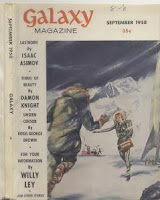
Cover by DEMBER showing Preparing Antarctica for Solar Conference of Galaxy Magazine, September 1958 issue
This magazine is online at Internet Archive in multiple formats.
Caution: I've linked it in the past, but without ToC. Regulars might already have a local copy.
Note: Galaxy seems to have changed its name from "Galaxy Science Fiction" to "Galaxy Magazine" some time in 1958. But the transition month listed by ISFDB is wrong.

Two very well known stories here - "The Ugly Little Boy" & "A Slight Case of Sunstroke", but both appear here under their less well known alternate titles. "Thing of Beauty" also seems to be widely anthologized, but I haven't personally read it yet.

Table of contents (6 stories, best first, unread last).

Links on author fetch more fiction by author. For read stories, my rating is in brackets. For stories that have their own post, link on story title goes there.
  1. [novella] Isaac Asimov's "Lastborn" aka "The Ugly Little Boy" (A): "A scientific experiment or not, the patient was her responsibility ... and all the more so for having died so many centuries ago!"
  2. [ss] Arthur C Clarke's "The Stroke of the Sun" aka "A Slight Case of Sunstroke" (A): '"Kill the umpire!" the audience cried—and why shouldn't they? He was on the ball, wasn't he?'
  3. [novelet] Rosel George Brown's "From an Unseen Censor": "You can't beat my Uncle Isadora—he's dead but he's quick — yet that is just what he was daring me to try and do!"
  4. [novelet] Damon Knight's "Thing of Beauty": "There was the gizmo that could put Gordon Fish in the chips — or right in the soup — and he didn't know which he was ordering!"
  5. [ss] Lloyd Biggle, Jr's "On the Double": "Failure was impossible — they had the one true formula: the victor belongs to the spoils!"
  6. [ss] H L Gold's "Personnel Problem": "Mng engnr wanted: duties it, gravity ditto, unitd opptnty advcmt—as anythg but engnr!"

Related.

  1. Fiction from Galaxy.
  2. "Pulp" magazines.
  3. Works of H L Gold.
  4. Fiction from 1950s.

Sunday, May 16, 2010

Free fiction: Galaxy, September 1958

At Internet Archive in multiple formats.

Editor: H L Gold.
Among the authors: Isaac Asimov, Damon Knight, Arthur Clarke (his funny & very well known story about the crazy football match in South America, "A Slight Case of Sunstroke", but under a different title - "The Stroke of the Sun"), H L Gold.

Related: Fiction from Galaxy, old "pulps", 1950s.

Sunday, March 21, 2010

Arthur Clarke's interview with Ken Kelley for Playboy, July 1986

Link. [via Free SF Reader]

Interview spanned a fortnight the interviewer spent in Lanka.

  1. From introduction to interview: "There are some places over the equator where the earth's gravity is so strong that satellites placed there don't need fuel, because they never drift out of position. It turns out that one of the most stable places on the planet is directly above the piece of property that Arthur bought in Sri Lanka. It makes you wonder where this man came from."
  2. On Neil Armstrong's statement, "That's one small step for man, one giant step for mankind"?: 'I took him up on that statement afterward, because he dropped out the "A." It was supposed to be "That's one small step for a man." He just fluffed it. When I talked with him about it later, he said, "That's what I thought I said, and that's what I meant to say."'
  3. "I write science fiction only about things I know are reasonably true, even though the extrapolations may not be known."
  4. "I like to think of the monolith as a sort of cosmic Swiss army knife—it does whatever it wants to do."
  5. On space elevators:

    "Is anything as outlandish as that even remotely possible?"

    "Almost anything you can imagine that's feasible that is likely to be done is going to happen."
  6. 'In several of your books—Childhood's End comes to mind—you bring up the idea of "nonmaterial minds"——'

    'That comes from William Olaf Stapledon's Last and First Men. He's a science-fiction writer from the Thirties who's most influenced all my writing, when you come down to it.'
  7. "One of my problems now is that I'm not just a private citizen anymore. I have to keep up certain standards, or at least pretend to, so that I don't shock too many people."
Related: Stories of Arthur Clarke; from Playboy magazine.

Sunday, February 21, 2010

Free fiction: Arthur Clarke's "Superiority", plus Eric Frank Russell, Murray Leinster, & Keith Laumer

4 old stories at Webscription, 3 of them among the most famous of science fiction: Keith Laumer's "Field Test" (download), Eric Frank Russell's "Allamagoosa" (download), Murray Leinster's "Exploration Team" (download), & Arthur Clarke's "Superiority" (download).

Two of these are among the very best of science fiction: "Superiority" & "Allamagoosa". Former is very hard to find online, & has so far been available only to US readers via Google Books. Later has been online a long time at scifi.com, but has been going on/off since they switched domain to syfy.com.

"Exploration Team" is the other very well known story.

[via Free Speculative Fiction Online]

Saturday, December 26, 2009

Frederik Pohl on the last days of Arthur Clarke, & their joint novel "The Last Theorem"

Link.

PS: I finished "The Last Theorem" last week; should have a post soon - whenever "soon" happens. It's the fourth or fifth novel waiting a post - in company with one by Jack Vance & another by Hal Clement!

Related: Stories of Arthur Clarke, Frederik Pohl.

Wednesday, December 23, 2009

Robert Silverberg critiques Arthur Clarke's fiction

At Asimov's.

Related: Fiction from Asimov's; fiction of Robert Silverberg/Arthur Clarke.

Saturday, December 12, 2009

Arthur Clarke's "Sunjammer" aka "The Wind from the Sun" (novelette, racing): Solar sail power interstellar vehicle!

Illustration accompanying a 9 November 2009 story titled _Setting Sail Into Space, Propelled by Sunshine_ by Dennis Overbye in The New York Times. Story is about a series of forthcoming launches of solar sail powered experimental spacecraft dubbed LightSail, a project of Planetary Society.About a month ago, there was a news item in The New York Times [via Brenda Clough] about a series of forthcoming experiments in solar sail powered vehicles. This story is one of the best pieces of hard sf from Clarke, & among the most exotic racing stories by anyone.

Note: Idea of a solar sail is to use the "pressure" of sunlight - not like solar energy but like particles of light that aren't quite particles though they have momentum - as the motive power. No other energy source is necessary, except for steering.

Story summary.

Seven solar sail powered vehicles of different designs from "four inhabited worlds" will compete in the race from earth to moon. Eventually, of course, it will be fight between US & Russian vehicles!

Beginning point is "twenty-two thousand miles above the [earth's] equator" where the vehicles are anchored to normal ships in a certain formation. At T0, the anchor lines are cut, & the race is on.

At moon, other vehicles will pick up the crew capsules. "the winner will be the one that first drifted past the Moon."

Story is mostly told from the point of view of US participant - John Merton, "Chief Designer of Cosmodyne Corporation", riding the sail ship Diana. He's the only one flying solo; everyone else has a crew of two. He thinks the reduced mass will work in his favor.

They will make two rounds around earth, picking speed during the "powered half of the orbit", before reaching escape velocity. We go through the maneuvers needed when vehicles
  1. pass through earth's shadow ("The shroud lines were slackening, & must be wound in lest they become entangled.")
  2. when moving the unpowered half of orbit (towards Sun) (need to sail "edge-on" to sun, or you're thrown back).
  3. when transitioning to powered part of orbit from unpowered.
We also see a competitive practice where one vehicle tries to cast shadow on another to cut its supply of sunlight, & how the victim escapes.

Participants keep falling off the race till only US & Russia are left: two to collision when passing through earth's shadow, another who could not turn the sail edge-on during unpowered half, another who could not transition from unpowered to powered half, & another where the lines rigging crew capsule to sail gave way.

Neck-to-neck half way to moon a day after reaching escape velocity, the last two participants will also have to abandon their vehicles because of a solar flare (their tiny capsules are unshielded). But Merton had rigged his machine to sail unaided too - so when he jumps, the vehicle is on its way to moon & beyond - eventually attaining solar escape velocity.

Quotes.

  1. Diana: "fifty million square feet of sail, linked to his capsule by almost a hundred miles of rigging... Yet it was little more substantial than a soap bubble; that two square miles of aluminised plastic was only a few millionths of an inch thick."
  2. How much is the pressure of sunlight on Earth? "Hold your hands out to the sun... Over the area of your hands, it comes to only about a millionth of an ounce.

    But out in space, even a pressure as small as that can be important, for it's acting all the time, hour after hour, day after day. Unlike rocket fuel, it's free & unlimited."
  3. Solar sail: "A square mile weighs only a ton, & can collect five pounds of radiation pressure. So it will start moving - & we can let it tow us along, if we attach rigging to it.

    Of course, it's acceleration would be tiny - about a thousandth of a g. That doesn't seem much, but let's see what it means.

    It means that in the first second, we'll move about a fifth of an inch. I suppose a healthy snail could do better. But after a minute, we've covered sixty feet, & will be doing just over a mile an hour. That's not bad, for something driven by pure sunlight! After an hour, we're forty miles from our starting point, & will be moving at eighty miles an hour... You'll be surprised when I tell you what our one-thousandth-of-a-g sailboat will be doing at the end of a day's run: almost two thousand miles an hour! If it starts from orbit - as it has to, of course - it can reach escape velocity in a couple of days. And all without burning a single drop of fuel!"
  4. On inertia: "another rule that was hard to learn: the very moment you had started something happening in space, it was already time to think about stopping it."
  5. Food "crumbs were a greater danger to space vehicles than meteorites; they could drift into the most unlikely places, causing short circuits, blocking vital jets, & getting into instruments that were supposed to be hermetically sealed."
  6. "Those two square miles [of sail] produce a maximum pull of just ten pounds. I can exert more force by my little finger."
  7. "It was hard to keep a good watch on that 60 million square feet of dim plastic out there in the darkness, illuminated only by his narrow spotlight & the rays of the still distant Moon."
  8. By the time of second lap around earth, while "the two square miles of plastic sheet must have been riddled by hundreds of micrometeorites, the pinhead-sized punctures had produced no falling off of thrust."
  9. Diana, after jettisoning: "Two days from now, she would flash past the Moon; but the Moon, like the Earth, could never catch her. Without his mass to slow her down, she would gain two thousand miles an hour in every day of sailing. In a month, she would be traveling faster than any ship that man had ever built.

    As the Sun's rays weakened with distance, so her acceleration would fall. But even at the orbit of Mars, should would be gaining a thousand miles an hour in a day. Long before than, she would be moving too swiftly for the Sun itself to hold her. Faster than a comet had ever streaked in from the stars, she would be heading out into the abyss."

Collected in.

  1. "The Collected Stories of Arthur C Clarke".
  2. Arthur Clarke's "The Wind from the Sun" (coll).
  3. Arthur Clarke's "The Sentinel" (coll).

Fact sheet.

First published: Boy's Life, March 1964 as "Sunjammer".
From author's note, introducing this story in Collected Stories: "The story's original title was 'Sunjammer' but as Poul Anderson had the same idea almost simultaneously, I was obliged to make a quick change of name."
Rating: A.
Related: Stories of Arthur Clarke (only his short fiction/novels).

Tuesday, December 1, 2009

Real science: A first step towards "Ambrosia Plus"!

Arthur Clarke has written a famous farce called "The Food of Gods". A reader reports a real-life lab version of the edible at the heart of this story.

Wednesday, October 28, 2009

Arthur C Clarke's "Hate" aka "At the End of Orbit" (novelette, revenge): This Hungarian man hates Russians

Quote from short story titled Hate aka At the End of Orbit by Arthur C ClarkeI've a feeling the impact this story will have on a reader will depend on opinions reader holds about Russia - story takes essentially an anti-Russia stand, particularly about some sort of Russian interference in Hungary. I'm not familiar with relevant political situation, & I grew up at a place where there was essentially no Russian propaganda - pro or anti. So I take political opinions here as just another story teller's version.


Story summary.

"Szabo Tibor, late of Budapest" is the man assigned the job of tying a rope (cable?) to a Russian space capsule that has "been round the moon a couple of times" & has now on return crashed near New Guinea in the Pacific, so pearl mining ship Arafura (of which he's crew member) can drag it to a nearby island to claim bounty. They don't report the location of find immediately to protect the location of their pearl mining patch from other miners.

But Tibor has a grudge against Russians - his brother Theo had died stepping on a Russian mine. While setting up the capsule for under sea ride, he will learn the capsule has a live occupant with 5 hours oxygen supply. He will learn this by getting in conversation where (I think) Tibor touches his helmet to hull & is heard inside, but response from inside is yes/no via taps on hull. Finally he will tell the astronaut about his revenge plan - how he will make sure the rope keeps breaking on the way so capsule won't surface for over 5 hours.

Well, eventually it will take even longer to reach for safety than planned, as the wreck gets stuck in sand near shore. And his shipmates find to their horror the nature of the wreck - none other than Tibor knew of human occupant - a tiny woman. And the dead astronaut will get her revenge too - she has prepared a spool of tape that apparently has a record of her conversations with Tibor during "rescue".

Note.

I'd read it a while back, & might have confused an occasional detail.

Collected in.

  1. "The Collected Stories of Arthur C Clarke".
  2. Arthur Clarke's "Tales of Ten Worlds".

Fact sheet.

First published: If, November 1961 as "At the End of Orbit".
Rating: B.
Author's introduction to the story in Collected Stories: "In 1960, William MacQitty (A Night to Remember) ... asked me to write a movie treatment entitled 'The Sea & the Stars'. Nothing came of the film so I turned it into a short story, entitled 'Hate'. If magazine retitled it, but I prefer the original: more punch."
Related: Stories of Arthur C Clarke.

Friday, June 19, 2009

Free fiction: Audio: Huffduffer

Link. [via Free SF Reader]

Many desperate things, but a few interesting ones too. Audio links below are probably all radio adaptations.

  1. Arthur Clarke's "Rendezvous With Rama"; download MP3 - part 01, 02: I'm not sure the two parts cover the whole novel, but if they do, it's a big catch.

    One of the most important novels of the genre, but only for readers with a taste for hard sf (that would be very small percentage of sf readers, though).

    There is also a very good 3 minute movie online, showing the approach & landing of human spacecraft on Rama, & entry of human explorers through airlock into the ship. Or was, when I last played it over a year ago.
  2. Philip K Dick's "Beyond Lies The Wub"; download MP3: Not read. I think its text version is already online, probably at Project Gutenberg.
  3. Murray Leinster's "A Logic Named Joe"; download text/MP3: Fun early story about interconnected computers. I've linked both versions in the past.
  4. Orson Welles' famous radio show inspired by H G Wells' "War of the Worlds" that caused panic in the US when first broadcast in 1938.

    Arthur Clarke's humorous apocalypse story, "Publicity Campaign", is apparently a reaction to the panic this broadcast caused.

Free fiction: Audio: Arthur Clarke's "Childhood's End" & Robert Heinlein's "Methuselah's Children"

Huge collection of desperate stuff, including science fiction, at Internet Archives' Audios, Movies, & Books collections. But even browsing to figure out interesting will be substantial effort - its very big.

Blue Tyson seems to have browsed at least part of the audio collection & has identified some things worth looking up:

  1. Robert Heinlein's "Methuselah's Children"; download audio: Not read.
  2. Arthur Clarke's "Childhood's End"; download audio: One of the most famous novels of Clarke, though I found it among his worst (its original short story version with James Blish, "Guardian Angel", is a far better read that cuts out the crap). Later parts are essentially a religious story - a retelling of one of the Hindu beliefs.

Wednesday, June 10, 2009

Tony Daniel recommends some short fiction

In this chart (JPG image) as part of SF Signal's weekly panel called "MIND MELD".
Caution: Depending on browser settings, image text may be difficult to read in browser; might need to save to disk & use an image viewer.

I won't always call the stories on his list good, but they're famous ones. Includes several I haven't read but might now look up.

Of the very famous ones on the list that I personally didn't find good:

  1. Damon Knight's "The Country of the Kind"; download MP3.
  2. Fredric Brown's "Arena"; download text or comic book adaptation.
  3. Arthur Clarke's "The Nine Billion Names of God"; download text/MP3: But it's worth seeking out for those interested in ancient history of computers.
Also, many people will likely find Joseph E Kelleam's "Rust" a far better read than Ray Bradbury's much better known "There Will Come Soft Rains" (download text/MP3). Both are essentially on the same subject. Arthur Clarke too has two famous stories on the same subject (neither suitable for those seeking entertainment or for genre newbies) - "The Curse" (download text), & "If I Forget Thee, Oh Earth ...".

One story particularly worth looking out for on his list is Jack Vance's "The Moon Moth". Light fun read in a colorful setting.

Related: "best of" lists.

Saturday, June 6, 2009

Kim Stanley Robinson recommends some Mars fiction

At IEEE Spectrum: "My 10 Favorite Mars Novels". [via SF Signal & Marooned]

It's actually 11 books - 8 novels, 2 short story collections, & 1 poetry book.

I've read only 2 from the lot:

  1. Arthur Clarke's "The Sands of Mars": First human cities on Mars, including an adventure involving a surface journey from one city to another, getting lost & rescued on the way, & picking up a native animal pet.
  2. Ray Bradbury's "The Martian Chronicles": I've read only part of it. A retelling of European colonization of Americas in a fantasy setting - read Europeans for humans & Martians for native Americans. In at least one story, "And the Moon be Still as Bright", author makes this connection explicit.

    Later stories apparently deal with nuclear dystopia, but I haven't read most of them.
Related: Fiction set on Mars or its moons; "best of" lists.

Wednesday, May 27, 2009

Free fiction: A few more short stories of Arthur Clarke (but accessible only in some countries)

Rusty reports he's able to read a few more stories from Clarke's Collected Stories at Google Book Search, but with caveats. I have some brief notes on these stories here. My Collected Stories page has alternate download links for some of the stories too, apart from more specific notes.

Among the ones I've not linked before, "Loophole" is good humor - serious consequences of bureaucratic paper shuffling, in the backdrop of a human/Martian war.

Monday, May 25, 2009

Free fiction: Audio of Arthur Clarke's "Summertime on Icarus" & "Before Eden"

Both as BBC radio dramatizations. Can only play from browser; no download. Both are included in his Collected Stories.

  1. "Before Eden"; play audio: This may be the classic story of the kind where earth bacteria infect an alien virgin world; at least it's the oldest I've read of the type. In this case, Venus is not quite virgin & has primitive native life in high elevations at certain places where temperature & pressure are relatively saner; but natives doomed because earth bacteria have arrived.

    I read a flash fiction variation of this story a few weeks back - Ian Rennie's "Eden". Far less rigorous than Clarke's, but it's text is online.
  2. "Summertime on Icarus"; play audio: Shipwreck & rescue aboard an asteroid rather close to Sun.

    Its downloadable MP3 has already been online for a while - so the BBC version may not be so interesting.
[via SF Signal]

Related: Arthur Clarke's short fiction, novels, collections.

Sunday, May 24, 2009

Free fiction: Arthur Clarke's "Superiority"

Among the very best of science fiction - how not to go about deploying new technology.

According to Best Science Fiction Stories, it can be read online at Google Book Search as part of the preview of Clarke's Collected Stories. I cannot even see the Preview tab of the book at the Google link from India, so may be its access is country-locked. Depending on your geographical location, you may be able to see it - watch for Preview tab near the top of the Google page. Good luck.

A request: In case you are able to see the preview, can you please note in comments below which individual stories have their full text (full, not partial) available in Preview (besides Superiority), so I can add this online presence information to individual stories. Thank you.

Related: Arthur Clarke's short fiction, novels, collections.

Arthur Clarke's "The Other Side of the Sky": Series of 6 linked short stories

This post is currently a placeholder; will fill it up as I read individual stories. This series originally appeared in Infinity Science Fiction Magazine, September & October 1957 - 3 stories in each of the 2 issues.

  1. "Special Delivery": Not read.
  2. "Feathered Friend": Not read.
  3. "Take a Deep Breath": Not read.
  4. "Freedom of Space": Not read.
  5. "Passer-by": Not read.
  6. "The Call of the Stars": Not read.

Series collected in.

  1. "The Collected Stories of Arthur C Clarke".
Related: Arthur Clarke's short fiction, novels, collections.