Showing posts with label C L Moore. Show all posts

Thursday, July 24, 2014

C L Moore's "Werewoman" (novelette, free)

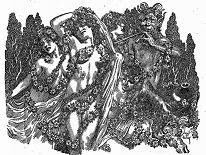
Among the most boring of author's Northwest Smith series; I completed it only because it is C L Moore.

Northwest Smith, unarmed, hurt, & being chased by unnamed adversaries, walks into the cursed ruins of a long dead city, & will free it from its curse.

Fact sheet.

First published: Leaves #2, Winter 1938.
Download full text from AlfaLib.
Rating: C.
Nominated for Retro Hugo Awards 1939 in novelette category.
Related: Stories of C L Moore.

Thursday, November 21, 2013

Henry Kuttner & C L Moore's "The Mask of Circe" (novel, supermen, free): Gods of Greek mythology are actually mutants & machines!

One of the illustrations accompanying the original publication in Startling Stories magazine of the the novel The Mask of Circe by Henry Kuttner and C L Moore.This is an adventure - a science fictional retelling of some Greek legends. But an adventure more in line with "doc" Smith's soap opera - enjoy the unbelievable fun ride but don't think much, please. I didn't enjoy first half - there is just too much unfamiliar Greek mythology, but second half was easy to follow.

Story summary.

A modern man, while playing subject for a new sedative drug, ends up importing the memories of a long dead ancestor from 3000 years ago! And through much of the story, he is magically transported back 3000 years, to the time of this ancestor - to have adventures in time of Greek legend.

Notes.

  1. Some commentators have noted that this story is a tribute to Abraham Merritt's "Ship of Ishtar". I haven't personally read this Merritt story.
  2. "Mask" of title refers to a machine that holds the brain dump of someone long dead; its wearer assumes the personality of that long dead individual. "Circe" of title is a women who fell in love with the hero, hero who won't be born for another 3000 years! "Mask" is to help her meet him when he's eventually born!

Fact sheet.

First published: Startling Stories, May 1948.
Read online at UNZ.
Rating: B.
Related: Stories of Henry Kuttner, C L Moore.

Saturday, November 9, 2013

Henry Kuttner & C L Moore's "Dream's End" (short story, recursive dreaming, free)

Illustration accompanying the original publication in Startling Stories magazine of short story Dreams End by Henry Kuttner and C L Moore. Image shows the doctor hallucinating or dreaming.It has at least one episode of recursive dreaming - dream within a dream. I'm not sure of the other episodes - they're either independent hallucinations, or even deeper dream in a dream in a dream...

I'll put it among the less interesting stories of authors.

Story summary.

A doctor in a sanatorium has found what he thinks is a cure for most forms of insanity - what he call "empathy surrogate therapy". It involves a device whose electrodes are put on the head of the sane doctor & of insane patient. And something happens involving empathy. Only the first experiment seems to have gone seriously wrong - for the doctor, at least...

See also.

  1. Henry Kuttner's "All is Illusion" (read online): A much better story about dreaming.

Fact sheet.

First published: Startling Stories, March 1947.
Read online at UNZ.
Rating: B.
Related: Stories of Henry Kuttner, C L Moore.

Friday, October 25, 2013

Henry Kuttner & C L Moore's "The Dark Angel" (short story, superman, free)

Illustration accompanying the original publication in Startling Stories of short story The Dark Angel by Henry Kuttner and C L Moore. Image shows the superwoman animating a doll to test her newly discovered supernatural abilities when her husband spied it.What happens when one member of a couple is a prodigy? In this case, the wife is superhuman - first of the new species of homo superior. Story is about the reactions of the couple to this realization.

Fact sheet.

First published: Startling Stories, March 1946.
Read online at UNZ: part 1 & part 2.
Note: Story begins several pages down on part 1; last page of part 1 is the same as first page of part 2.
Rating: B.
Related: Stories of Henry Kuttner, C L Moore.

Friday, October 11, 2013

Henry Kuttner & C L Moore's "Baby Face" (novelette, body snatching, free): "Baby's Day Out", from many decades earlier

An illustration accompanying the original publication in Thrilling Wonder Stories magazine of short story Baby Face by Henry Kuttner and C L Moore. Image shows the grown up man in baby's body encouraging the gorilla to put on the mind exchange cap.
So now we know the story of the "Baby's Day Out" (1994) is at least this old!

Story summary.

To figure out why a baby is crying, a mad scientist uses his latest invention: to exchange the mind of his friend, minding the baby, with the baby - so friend in baby's mind can find out what is wrong!

That's when Nazi spies steal the brain exchange gadget. So we are left with: the grown up man is in baby's body, baby in grown up man's body, & scientist injured & unconscious. And the man in baby's body overheard the spies will pass on the gadget to a contact on circus that night.

So now it's up to the hero, in baby's body, to ensure the gadget doesn't fall in enemy hands...

Fact sheet.

First published: Thrilling Wonder Stories, March 1945.
Read online at UNZ.
Rating: B.
Related: Stories of Henry Kuttner, C L Moore.

Friday, September 20, 2013

Henry Kuttner & C L Moore's "All is Illusion" (short story, humor, free): Never pick up a fight with a magician...

One of the illustrations by F Kramer, accompanying the original publication in Unknown magazine of short story All is Illusion by Henry Kuttner and C L Moore. Image shows the scene in the bar where the protagonist will fight with the midget magician.A man picks up a fight with a midget magician in a bar, & gets cursed: "I lay on you the curse of illusion. The blight of the five senses! I put upon you the veil of Proteus!"

And the fun begins... others sometime get a foul smell out of him but he himself cannot smell it, others hear funny noises from his stomach when he cannot, other see a duck or a horse where he is, ...

Fact sheet.

First published: Unknown, April 1940.
Read online at UNZ.
Note: If you are using an Android tablet, here is a way to pick up this file as a pdf from Google Drive: note 1 & note 2. This method doesn't, however, work at least in my Firefox on Windows XP, & Android browsers don't let me copy the URL of pdf.
Rating: A.
Related: Stories of Henry Kuttner, C L Moore.

Thursday, August 29, 2013

Henry Kuttner & C L Moore's "The World is Mine" (as by Lewis Padgett) (novelette, humor, free)

One of the illustrations by Williams accompanying the original publication in Astounding magazine of short story The World is Mine by Henry Kuttner and C L Moore. Image shows 3 rabbit-like Martians from future who want to conquer earth.This is part of authors' well known series featuring Gallagher, the mad scientist. I used to love these stories when I first encountered them; I'm no longer as much a fan, but this is still a light fun read.

Story summary.

Gallaghar wakes up from his yet another drinking bout to find a series of curiosities - 3 rabbit-like Martians ("Lybblas") from 500 years into future who want to conquer earth, a time machine focused on his backyard that cannot be turned off & that he apparently invented when his genius unconscious was in control, & a series of corpses of himself from future each with a ray gun hole through his chest.

The story is about putting the puzzle together, inventing a couple of other gadgets along the way.

Fact sheet.

First published: Astounding, June 1943.
Download full text as part of the scans of the magazine it originally appeared in.
Among the stories from Astounding/Analog issues edited by John Campbell.
Rating: B.
Related: Stories of Henry Kuttner, C L Moore (as by Lewis Padgett).

Sunday, June 2, 2013

"Astounding Science Fiction", December 1942 (ed John W Campbell, Jr) (magazine, free): Annotated table of contents

Cover by William Timmins of Astounding Science Fiction magazine, December 1942 issue"The Weapon Shop" is among the best known stories of the genre. "Piggy Bank" is among the more pulpish stories of Kuttner/Moore, but features a very curious robot.

Where I have a separate post on a story, link on its title goes there. Link on author's name fetches more fiction of author.

Note: Flash fiction pieces in this issue don't have their individual entries in table of contents, but are bunched together in a single entry called "Probability Zero".

Table of contents.

  1. [novelette] A E van Vogt's "The Weapon Shop": "The shop was small--a little place that materialized out of nowhere. Yet, though the old man didn't realize--all the power of a world empire could not break it!"
  2. [novelette] Cleve Cartmill's "Some Day We'll Find You" (B): Three groups of capitalists want to fund the commercialization of a certain invention by a broke engineer...
  3. [novelette] Henry Kuttner & C L Moore's "Piggy Bank" (as by Lewis Padgett) (B): "The robot was a rabbit--or had that psychology. He had a diamond-studded body, & was trained to be untouchable. Even his owner could not touch him--without giving information that was suicide!"
  4. [ss] A E van Vogt & E Mayne Hull's "The Flight That Failed" (as by E M Hull) (C): Making a future happen where Germany loses the WWII!
  5. [ss] Ross Rocklynne's "Interlude" (B): When a caveman freed an advanced civilization of a dictator...
  6. [ss] Frank Belknap Long's "To Follow Knowledge": "A strange tale of pluralities of worlds, of a theory based on the hypothesis that, in infinity, everything must happen not once, but many times."
  7. [ss] Robert Moore Williams' "Johny Had a Gun": "Johny was a gangster, a small-time punk. But Johny showed up with a gun one night, in an alley fight, that was not small-time stuff--"
  8. [ff] William M Danner's "True Fidelity".
  9. [ff] Stanley Woolston's "The Human Bomb".
  10. [ff] Jack Bivins' "Valadusia".
  11. [ff] T D Whitenack, Jr's "O'Ryan, the Invincible".
  12. [ff] Frank J Smythe's "My Word!".
  13. [ff] L M Jensen's "Take-Off".

Fact sheet.

Labeled: Vol XXX No 4.
Download scans as a CBR file. [via David T @pulpscans]
Related: Fiction from Astounding/Analog (only from issues edited by John Campbell) (whole issues only); old pulps; 1940s.

Tuesday, December 11, 2012

2 minor stories

Both are online via scans of Astounding, July 1950.
  1. [ss] Ford McCormack's "Skin Deep" (B): A human party, aided by a member of an elder alien race, are investigating another alien race. So they kidnap a local for examination in lab, only the local was a beauty queen about to give a major stage performance. So the kidnapping became a major issue.
  2. [novelette] Henry Kuttner & C L Moore's "Heir Apparent" (as by Lawrence O'Donnell) (B): This one has a rather complex plot.

    Computers used to solve problems of this solar system spanning humanity are so complex they need a minimum of 7 humans ("Integration Team") to operate them. A team that interacts with computer & other team members via special equipment that lets the personality of the team merge - to yield something far smarter than any ordinary
    human.

    When a member of a team was dismissed for not being fit, he joined Venusian rebels that want to split from earth. And for them, he put together another, very unusual,
    Integration Team.

    Hero will foil this rebel Integration Team.

Saturday, December 1, 2012

"Astounding Science Fiction", July 1950 (ed John W Campbell, Jr) (magazine, free): Annotated table of contents & review

Cover of Astounding Science Fiction magazine, July 1950 edition
Link on author fetches more fiction by author. Where I have a separate post on a story, link on story title goes there. For stories I've read, my rating appears in brackets.

I've not read Heinlein's non-fiction piece, "Destination Moon", noted on cover.

Table of contents (best first).

  1. [ss] Eric Frank Russell's "Exposure" (A): Bad luck dooms alien invasion of earth.
  2. [novelette] C M Kornbluth's "The Little Black Bag" (A): A bum finds purpose in life...

    Collected in SF Hall of Fame, #1. 
  3. [ss] James E Gunn's "Private Enterprise" (as by Edwin James) (A): Taking charge of a country by overtaking its economy...
  4. [ss] Ford McCormack's "Skin Deep" (B): A human party, aided by a member of an elder alien race, are investigating another alien race. So they kidnap a local for examination in lab, only the local was a beauty queen about to give a major stage performance. So the kidnapping became a major issue. 
  5. [novelette] Henry Kuttner & C L Moore's "Heir Apparent" (as by Lawrence O'Donnell) (B): Hero helps contain a political rebellion plot. It's a complex story with elements of cyborgs, swarm intelligence & waves that can make an island invisible!

Fact sheet.

Labeled: Vol XLV, No 5.
Download scans as a cbr file. [via David T @pulpscans]
Related: Stories from Astounding/Analog, only issues edited by John Campbell, only whole issues; old "pulps"; 1950s.

Saturday, March 3, 2012

Henry Kuttner & C L Moore's "A Wild Surmise" (short story, free): What's real & what's imaginary?

This is nonsense. Or may be not. But quite funny.

Story summary.

Timothy Hooten is being treated by a psychiatrist, Dr Scott, at 2 pm, & by Dr Rasp at 2 am. He's human in one, but a bug in another. Which one is "real"?

It becomes really interesting when he gets an appointment from both doctors for the same time.

See also.

  1. Rog Phillips' "The Yellow Pill" (download): Psycho patient thinks the doctor is really the patient...

Fact sheet.

First published: Star Science Fiction Stories, February 1953.
Read online at Scribd (slow page load, may need Flash enabled in browser).
Rating: A.
Related: Stories of Henry Kuttner, C L Moore.

Thursday, December 15, 2011

Henry Kuttner & C L Moore's "The Sky is Falling" (as by C H Liddell) (novelette, doomsday, free)

One of the really minor stories of authors.

Johnny Dyson is a crew member on a ship sent to Mars to mine some ore that might help prevent an almost certain apocalypse ("Blow-Up") on earth. But he loves his life too much, doesn't want to return from Mars to die.

So chase & drama on Mars. He will fail, & will be forced to return. Only it will be too late to return...

Fact sheet.

First published: Planet Stories, Fall 1950.
Download full text.
Rating: B.
Related: Stories of Henry Kuttner, C L Moore, as by C H Liddell.

Monday, November 1, 2010

C L Moore's "The Tree of Life" (novelette, monster, free): Northwest Smith, always in the service of girls in trouble!

One of the illustrations accompanying the original publication in Weird Tales of short story The Tree of Life by C L Moore
One of the forgettable stories of Moore, unless you have a taste for old-style (Gothic?) horror: horror induced by throwing a lot of adjectives to prejudice the reader (setting up the mood?) - something that bores me. A far more interesting variant of the idea here appears in one of her later stories with Kuttner - "The Children's Hour" (download).

Here we see the interplanetary adventurer Northwest Smith trapped for food by Thag, a 4-dimensional monster, in the ruins of the ancient Martian city of Illar. He will, of course, escape trivially.

Notes.

  1. Feedbooks has something labeled a parody of this story title "The Tree of Life Revisited" (download) but author name as "Cathan L Moore". I haven't read that.
  2. There is some Lovecraftian imagery & language here, but the influence might have ran in the opposite direction: "apparently Mr Lovecraft was a fan of Ms Moore's".

Fact sheet.

First published: Weird Tales, October 1936.
Download full text from Project Gutenberg.
Download audio from LibriVox.
Rating: B.
Related: Stories of C L Moore; Northwest Smith series.

Thursday, July 15, 2010

The origins of Barry N Malzberg's pseudonym "K M O'Donnell"

Rich Horton tells us at rasfw that "it's a tribute to Kuttner, Moore, and one of their best known pseudonyms, Lawrence O'Donnell."

Related: Stories of Barry N Malzberg.

Thursday, July 8, 2010

Real science: The first step towards "The Proud Robot"!

Recall Henry Kuttner & C L Moore's hilarious story, "The Proud Robot" (download).

Someone seems to have actually built a rather primitive version of Joe - a beer delivering robot for folks hard at work! Here is the 2:47 minutes video ("Beer Me, Robot") of robot in action , & the project description.

[via lal_truckee@rasfw]

Wednesday, July 7, 2010

Henry Kuttner & C L Moore's "Open Secret" (as by Lewis Padgett) (short story, free): Men have created a monster

Illustration accompanying the original appearance in Astounding Science-Fiction, April 1943, of short story Open Secret by Henry Kuttner and C L Moore
Not among the better stories of authors, & with many familiar plot elements.

Story summary.

Mike Jerrold has accidentally discovered the existence of intelligent robots - something that is not supposed to exist. As he gets deeper into the discovery, he finds that they're actually the masters of humanity - driving the world towards a destiny of their own choosing, & there is nothing anyone can do about it.

We're given a hypothesis about how they came to be: "Suppose you make a perfect solvent. What would happen? It would dissolve anything you put it in. You could make it, but you couldn't keep it. Intelligent robots are like that." The first successfully created robot "processed the scientist [its creator], so Dr Jones thought he had failed; it left another, useless robot in its place, & it went out & hid. It didn't like this world. It wanted something different. So it simply set out to change the world".

Fact sheet.

First published: Astounding, April 1943.
Download full text as part of the scans of Astounding issue where it originally appeared.
Rating: B.
Among the stories from John Campbell's Astounding/Analog.
Related: Stories of Henry Kuttner, C L Moore (as by Lewis Padgett).

Friday, June 18, 2010

New at Project Gutenberg (18 June 2010)

Links on author, publisher, or year fetch more matching fiction.

  1. [novel] Jean Ingelow's "Mopsa the Fairy"; download; 1919.
  2. C L Moore's "The Tree of Life"; download; Weird Tales, October 1936: "A gripping tale of the planet Mars and the terrible monstrosity that called its victims to it from afar--a tale of Northwest Smith".
  3. H B Hickey's "Beyond The Thunder"; download; Amazing Stories, December 1948: "What was this blinding force that came out of a hole in the sky, and was powerful enough to destroy an entire city? Case thought he knew..."
  4. Paul Orban and Con Pederson's "The Genius"; download; If, May 1954: "Sethos was a great artist, a talented man, quite possibly the most famous man of his time and world. But, alas!--there were other worlds. And is not the grass always greener...?"
  5. Richard Stockham's "Perchance to Dream"; download; If, May 1954: "If you wish to escape, if you would go to faraway places, then go to sleep and dream. For sometimes that is the only way..."
  6. William Douglas Morrison's "Bedside Manner"; download; Galaxy, May 1954: "Broken, helpless, she had to trust an alien doctor to give her back her body and mind--a doctor who had never seen a human before!"

    While I've not read this story, plot sounds a lot like Arthur Clarke's "Playback".
  7. Alan Cogan's "In the Cards"; download; Galaxy, June 1956: "It is one thing to safeguard the future ... and something else entirely to see someone you love cry in terror two years from now!"
Related: Fiction from old "pulp" magazines.

Thursday, May 20, 2010

Henry Kuttner & C L Moore's "Jesting Pilot" (as by Lewis Padgett) (short story, free): Hypnotized are looking for reality

Here is a subject where may be no one has had a good enough story. It's readable, but among the more mundane ones from these authors.

Story summary.

An impenetrable fortress where everyone is kept "sane" under permanent hypnosis! Fortress was created 600 years ago in a world gone bonkers.

Now the hypnosis is failing for one of the city's "citizens". How do the "controllers" help him?

He will eventually get help. But "controllers" are now beginning to doubt reality as well...

Fact sheet.

First published: Astounding, May 1947.
Download full text.
Rating: B.
Among the stories from Astounding/Analog issues edited by John Campbell.
Related: Stories of Henry Kuttner, C L Moore (as by Lewis Padgett); fiction from 1940s.

Thursday, May 6, 2010

Henry Kuttner & C L Moore's "The Children's Hour" (as by Lawrence O'Donnell) (novelette, love story, free): Earth as playpen for kids of super-aliens!

This is supposed to be one of the better known stories of authors, though I cannot see why. It's not a bad read, but the best works of these authors tend to be superlative.

Story summery.

A job qualification requirement made Sergeant James Lessing undergo psychoanalysis. And the good doctor, Lieutenant Dyke, discovers a major block in his mind - something that his unconscious keeps suppressing.

Slow work over many sessions with unravel what the unconscious doesn't want to see. His courtship of Clarissa - a very unusual girl, with an even more unusual "aunt"...

Fact sheet.

First published: Astounding, March 1944.
Download full text.
Rating: B.
Among the stories from Astounding/Analog issues edited by John W Campbell, Jr.
Related: Stories of Henry Kuttner, C L Moore (as by Lawrence O'Donnell); Fiction from 1940s.

Thursday, April 29, 2010

Henry Kuttner & C L Moore's "Android" (as by C H Liddell) (novelette, paranoia, free): Androids are quietly replacing humans!

The idea is not new - a conspiracy of things non-human to quietly impersonate humans, sometimes killing the originals they're replacing; see, e.g., John Campbell's "The Brain Stealers of Mars" (read online), or Philip K Dick's "The Father-Thing" (read online). Stylistically, there is some similarity with Kuttner's own "Don't Look Now" (download) about a man's paranoia that Martian imposters among humanity are driving our destiny.

We also see here a favorite theme of Kuttner: children think in ways that are fundamentally different from adults.

Story summary.

James Philips Bradley has incontrovertible evidence that his boss, Arthur Court, is an android rather than human! In fact, his work has convinced him that a sizable number of people he sees around are actually androids. And he thinks they're working towards eventually replacing humanity, though their numbers may not be that big today.

This is the story of his quest (to save humanity). And its strange climax.

Fact sheet.

First published: F&SF, June 1951,
Download full text.
Rating: B.
Related: Stories of Henry Kuttner, C L Moore (as by C H Liddell); fiction from 1950s.

Wednesday, April 7, 2010

Henry Kuttner & C L Moore's "This is the House" (as by Lawrence O'Donnell) (novelette, haunted house, free)

Quote from short story This is the House by Henry Kuttner and C L Moore, writing under their joint pseudonym Lawrence O DonnellThere are a lot of familiar themes here - I'm not sure which of them this story originated, & which it just used. But a very good read. Sort of ... spooky version of authors' "The Twonky" (download).

This also must be among the earliest stories about nano-tech.

Story summary.

Bob Melton, his wife Michaela, & his brother-in-law Phil, have recently moved into a new house. Only, they've been having weird experiences:
  1. "Red ice" in the refrigerator.
  2. Coal furnace in the basement that burns without consuming coals!
  3. Weird noises barely registering with consciousness.
  4. Occasional feeling of complete disorientation; when normalcy returns, a lot of time seems to have passed.
  5. Windows that sometimes refuse to open; other times yield easily.
  6. Door bell that Bob doesn't hear, but Michaela can feel (though not hear)!
  7. ... it goes on & on.
As the story unfolds, we will learn that the previous owner, John French, was probably not human at all. And he seems to have done some "renovating" inside the house for his own comfort, without affecting the house's exterior...

Quotes.

  1. "The previous tenant probably rewired the house."

    "Who was he? Einstein? Or a Martian?"
  2. "Machines can be so simple they're unrecognizable."
  3. "Machines in the walls".

    "Very simple and very complicated. And unrecognizable. Paint is just paint, but you can do a Mona Lisa with it."

    "So French coated the inside walls with paint that acts like a machine?"

    "Invisible and intangible—how should I know? As for those noises at night—"

    "Well?"

    "I think the house is just recharging itself".
  4. "Eventually the world of the future—I think—won't be burdened with immense, complicated gadgets. Everything will be so simple—or seem so simple—that a man from the twentieth century might find it quite homelike, except for the results."
  5. Psychiatrist: "Half of my patients are slightly nuts, and, as long as they don't know it, they get along fine."
  6. On effect of environment on human psyche: "Lock a kid up in a dark closet, and he's apt to be afraid of the dark ever after."
  7. "If you had to move into a Ubangi hut and stay there. You wouldn't have anything in common with the natives, would you?"

    "What would you do?"

    "Change the huts a bit. Especially if I wanted to pretend I was a Ubangi, too. I wouldn't alter it outside, but I'd fix it up a bit inside, for my own convenience, and I wouldn't let anybody else come in. Chairs instead of grass mats. I wonder how French had this place furnished."

    ...

    "Why would a white man live in a Ubangi village? To study ethnology or entomology, perhaps. Or for the climate. Or simply to rest—to hibernate."

See also.

  1. Ray Bradbury's "There Will Come Soft Rains" (download): One of the best known stories featuring an automated live house that keeps on serving long after the original tenants are gone.
  2. Clifford D Simak's "The Big Front Yard": Well known story where the aliens quietly renovate the house, no need to ask permission of its human owner... And the resulting house becoming something else altogether!
  3. Larry Niven's "Wait It Out": A hibernating man - alive but time seems to be moving rather slowly...

Fact sheet.

First published: Astounding, February 1946.
Download full text.
Rating: A.
Among the stories from Astounding/Analog issues edited by John W Campbell, Jr.

Related.

  1. Stories of Henry Kuttner, C L Moore (as by Lawrence O'Donnell).
  2. Tuesday Classics;
  3. Fiction from 1940s.

Thursday, March 25, 2010

Henry Kuttner & C L Moore's "Gallegher Plus" (as by Lewis Padgett) (novelette, humor, free)

Quote from short story Gallegher Plus by Henry Kuttner and C L Moore, writing under their joint pseudonym Lewis PadgettEccentric inventor, Galloway Gallegher, who's a genius only when totally drunk, has just sobered up - to find a curious looking machine of unfathomable purpose sitting in his room, & his back yard turned into a pit!

He will soon learn he'd collected payment from 3 different parties, including an agency of the US government, as part of a commission to build each of those parties something or the other! He also seems to have invested in a stock that has just crashed, against his broker's advise. He's no recollection of any of these, but the curious machine in his room must, of course, be the key to the problem.

We go through the now familiar crazy sequence of Gallegher stories unraveling the mystery...

Notes.

  1. Title, Gallegher Plus, is used as the name of the genius subconscious of Gallegher!

See also.

  1. Henry Kuttner & C L Moore's "The Proud Robot" (download): First & the best known of Gallegher stories. Also a science fiction classic.

Fact sheet.

First published: Astounding, November 1943.
Download full text (I haven't personally read this online copy).
Rating: A.
Among the stories from Astounding/Analog issues edited by John Campbell.
Related: Stories of Henry Kuttner, C L Moore (as by Lewis Padgett); fiction from 1940s.

Thursday, March 18, 2010

ToCs of 6 forthcoming collections: Henry Kuttner, C L Moore, Leigh Brackett, Edmond Hamilton, Jack Williamson

All at publisher's site - Haffner Press.

  1. Henry Kuttner & C L Moore's "Detour to Otherness"; ToC. I've read quite a few of these - "Cold War", "Call Him Demon", "The Piper's Son", "Absalom", "Nothing But Gingerbread Left", "Housing Problem", "See You Later", "The Proud Robot", "Gallegher Plus", "The Ego Machine", "Android", "Juke-Box", "Rite of Passage", & "Happy Ending".

    I'll call it a mixed collection - a few very good stories ("Call Him Demon", "Absalom", "The Proud Robot"), most merely good.
  2. Henry Kuttner's "Terror in the House: The Early Kuttner, Volume One"; ToC: I've only read the Lovecraftian "The Graveyard Rats".
  3. Leigh Brackett's "Shannach - The Last: Farewell to Mars"; ToC.
  4. Jack Williamson's "With Folded Hands ... And Searching Mind: The Collected Stories of Jack Williamson, Volume Seven"; ToC. I've only read "With Folded Hands" (download MP3), probably the best known story of Williamson.
  5. Edmond Hamilton's "The Universe Wreckers: The Collected Edmond Hamilton, Volume Three"; ToC.
  6. Edmond Hamilton's "The Collected Captain Future, Volume Two"; ToC.
[via SF Scope]

Related: "best of" lists; collections.

Thursday, March 11, 2010

Henry Kuttner & C L Moore's "Shock" (as by Lewis Padgett) (short story, time travel, free): Curiosity killed the cat!

One fine day, Manning Gregg, the physicist, was at home & saw a hole suddenly appearing in his apartment's wall - a hole from which emerged a curious-looking man! This is the man from future, & he's looking for something in our time.

As Halison, the future man, goes out on his quest, Gregg cannot curb his curiosity to check out the future - so he crawls through the hole to future, to eventually find to his horror that...

See also.

  1. Robert Heinlein's "By His Bootstraps" & Ted Chiang's "Merchant & Alchemist's Gate" (download text/MP3) both feature time travel gadgets similar to that in this story.

Fact sheet.

First published: Astounding, March 1943.
Download full text.
Rating: B.
Among the stories from John Campbell's Astounding/Analog.
Related: Stories of Henry Kuttner, C L Moore (as by Lewis Padgett); fiction from 1940s.

Tuesday, March 2, 2010

Free fiction: 2 novels selected by the editors of Galaxy Science Fiction magazine

Both at Internet Archive in multiple formats:

  1. Galaxy Science Fiction Novel #17: Henry Kuttner & C L Moore's "Well of the Worlds" (as by Lewis Padgett); download.
  2. Galaxy Science Fiction Novel #20: Murray Leinster's "The Black Galaxy"; download.
Related: Fiction from Galaxy magazine.

Monday, January 25, 2010

Free fiction: Henry Kuttner & C L Moore

All at Internet Archive.

  1. Henry Kuttner's "The Spawn Of Dagon"; download.
  2. Henry Kuttner's "The Graveyard Rats"; download.
  3. Henry Kuttner's "What Hath Me?"; download.
  4. Henry Kuttner's "The Eyes of Thar"; download.
  5. C L Moore's "Quest Of the Starstone"; download.
  6. C L Moore's "Yvala"; download.
  7. C L Moore's "Lost Paradise"; download.
  8. C L Moore's "Nymph of Darkness"; download.
  9. C L Moore's "Julhi"; download.
  10. C L Moore's "The Tree Of Life"; download.
  11. [flash fiction] C L Moore's "Song In A Minor Key"; download.; part of Northwest Smith series: Has been online awhile elsewhere.

Thursday, January 14, 2010

Henry Kuttner & C L Moore's "Time Enough" (as by Lewis Padgett) (short story, immortality, free): Sometimes the best argument is a demonstration

Quote from short story titled Time Enough by Henry Kuttner and C L Moore, writing under their joint pseudonym Lewis PadgettParts of it feel like Mary Shelley's "The Mortal Immortal" (download).

Story summary.

A nuclear catastrophe destroyed most human culture & artifacts. Among the human survivors were a few people with a mutation - they were practically immortal. Immortal, but aging in a natural way - so senility, bodily troubles, etc are norm among them.

Now, 500 years down, a new human civilization has arisen. With "Old 'Uns" isolated by the government to avoid envy among the normals.

But Sam Dyson, working with radiation in a lab, has figured out a way to achieve immortality. How do the powers-that-be convince him to give it up? Well - they do have an effective argument, but it doesn't involve speaking...

Fact sheet.

First published: Astounding, December 1946.
Download full text.
Rating: B.
Listed among the stories from John Campbell's Astounding/Analog.
Related: Stories of Henry Kuttner, C L Moore (as by Lewis Padgett); Stories involving immortality; Mutants in fiction.

Thursday, October 15, 2009

Free fiction: Lot of short fiction by many famous authors

At Leigh Brackett & Other Planetary Romancers Online (Scroll down its right bar). [via Free SF Reader]

Included in the lot is one of the most famous stories of the genre - C L Moore's "No Woman Born" (download) - said to be the first cyborg story.

Update 19 October 2009: This site seems to be down now.

Saturday, August 29, 2009

Real life version of Kuttner & Moore's "Vintage Season"

Carissa Bluestone's "See it Before it Disappears: Reconciling and Regulating Disaster Tourism" (long article) in WorldChanging. [via Bruce Sterling]

Related: Kuttner/Moore's story.

Friday, August 28, 2009

Henry Kuttner & C L Moore's "Three Blind Mice" (as by Lewis Padgett) (novelette, racism, free): Racist organization needs to be nipped in the bud

Quote from short story titled Three Blind Mice by Henry Kuttner and C L Moore, under the pseudonym Lewis PadgettFor background, see "Mutant" page.

Radiation-induced mutations after "Blowout" had added 3 minority classes of hairless telepathic humans ("Baldies") to majority normals - "mad, sane, sane-paranoid":

  1. mad pose no threat to anyone & are an institutional case
  2. sane can live in normal society if they are careful not to take undue advantage of their telepathic abilities vis-a-vis normals, &
  3. paranoids who think they're homo superior & would rather live in a world without normal homo sapiens.
David Barton - a sane Baldy & a trained hunter - must destroy the infant gang of 3 "paranoids" who have discovered a telepathic communications band invisible to other Baldies & using which they intend to raise an organization whose aim is to purge the world of normals.

Collected in.

  1. Henry Kuttner & C L Moore's "Mutant" (collection).

Fact sheet.

First published: Astounding, June 1945.
Rating: B.
Read full text at WOWIO as part of Mutant collection (no download) (needs a lot of clicks to reach the story text).
This is the second story of authors' Baldy series.
Related: Stories of Henry Kuttner, C L Moore (as by Lewis Padgett).
Listed among the stories from John Campbell's Astounding/Analog.

Wednesday, August 19, 2009

Henry Kuttner & C L Moore's "The Piper's Son" (as by Lewis Padgett) (novelette, racism, free): Zero tolerance for racists poisoning children's minds

Quote from short story titled The Pipers Son by Henry Kuttner and C L Moore, writing under their joint pseudonym Lewis PadgettEd Burkhalter, of the minority community of "Baldy" telepaths that must be ever watchful against antagonizing far more numerous normal humans because retaliations would be fatal, has just learned about the "I'm of superior race" type of behavior of his 8-year old son Al.

Probing the child, he learns of a Baldy man named Venner behind the racial superiority propaganda to poison the children's mind. He & others of Baldy race must now take action against this man...

Collected in.

  1. Henry Kuttner & C L Moore's "Mutant" (collection).
  2. Isaac Asimov & Martin H Greenberg (Eds)' "Isaac Asimov Presents Great SF Stories 7 (1945)".

Fact sheet.

First published: Astounding, February 1945.
Rating: B.
Read full text at WOWIO as part of Mutant collection (no download) (needs a lot of clicks to reach the story text).
This is the first story of authors' Baldy series.
Nominated for Retro Hugo Award 1996 in novelette category.
Related: Stories of Henry Kuttner, C L Moore (as by Lewis Padgett).
Listed among the stories from John Campbell's Astounding/Analog.

Henry Kuttner & C L Moore's "Mutant" (as by Lewis Padgett) (collection, racism): Annotated table of contents & review

Cover image of the 1953 short story collection titled Mutant by Henry Kuttner and C L Moore, writing under their pseudonym Lewis PadgettThis is the first of a series of 6 posts - remaining ones on individual stories. Hopefully over the next fortnight or so.

These are important stories. Going by the imitations I've seen, they define a useful template in which to set racism stories of the genre. These are also good reads, though not among the authors' best, & in spite of occasional feel of tediousness I got. I recall having seen at least one of the stories in one of the books of "Isaac Asimov Presents Great SF Stories" series.

All but last are from 1945, the last year of WWII. Series is a reaction to Hitler's brand of racism, though he's explicitly named only once - in "The Piper's Son".

Stories are generally novella or novelette length; nothing very short here.

Stories need to be read in order; later stories make use of ideas & situations introduced in earlier ones.

Background.

A genetic mutation has created a new parallel race of humans called "baldies" (because of their remarkable lack of body hair). This is a race of telepaths.

Baldies are numerically very few compared to normal humans. They are widely resented, or at least looked upon with suspicion, because they can potentially read normals' mind without the victim knowing. Because of numerical differences, baldies could also be wiped out if scales got really tipped against them.

So baldies are very careful in their dealings with normal humans; in fact, they wear wig to hide the visible differences, & consciously not aspire to higher social positions. That's normal baldies. There are two deviant subraces too - one are mental cases, others racial supremacists who keep plotting to wipe out non-baldies.

Stories are about the fight of normal baldies against the racial supremacist baldies. Normal baldies suspect that any precipitation of crisis with normal humans will result in complete wiping out of all baldies; normal humans don't distinguish between baldy variants.

There will be much conflict, but a happy ending in last of the stories - where there is a promise that all of humanity can become telepaths - normal ones by wearing a certain device.

The world it describes, or at least the US where the stories are set, has pretty much (administratively) independent city states where every such state maintains atom bomb piles as deterrence.

Stories are all narrated via reminiscences of an accident victim who's stuck at a location where he cannot telepathically reach rest of humanity & is feeling very lonely.

Table of contents (in original order).

Note: Will add annotations with individual stories as I post the series.
My rating is in brackets.
  1. "The Piper's Son" (B); download; Astounding, February 1945: Zero tolerance for racists poisoning children's minds.
  2. "Three Blind Mice" (B); download; Astounding, June 1945: Racist organization needs to be nipped in the bud.
  3. "The Lion and the Unicorn"; download; Astounding, July 1945.
  4. "Beggers in Velvet"; download; Astounding, December 1945.
  5. "Humpty Dumpty"; download; Astounding, September 1953.

Fact sheet.

First published: 1953.
Read full text online at WOWIO. I've not read this online version, but it appears to be the right one.
Related: Stories of Henry Kuttner, C L Moore (as by Lewis Padgett).
Individual stories also listed among the stories from John Campbell's Astounding/Analog.

Tuesday, June 2, 2009

Bud Webster on Henry Kuttner & C L Moore

At JBU, #19 (June 2009).

Whole of his post is not free access, but all the main text is; what's behind paid access is bibliography - something you can probably find at a lot of other sources.

Tragedy of their last writing days is something I only had a vague inkling of. There are some other tidbits also that I didn't know of.

Wednesday, April 22, 2009

Best women genre authors

A panel presentation at SF Signal.
Note: At the moment, link doesn't seem to work. Hopefully, should be back live sometime.

My own favorites: C L Moore, Mary Shelley, & J K Rowling. I don't recall Shelley even mentioned in above panel; her classics (at least the ones I've read), including Frankenstein, actually make a light reading in spite of being very influential.
PS: Did you know Moore's "Black God's Kiss" is sometimes regarded as the defining story of sword-&-sorcery subgenre? Few others of the subgenre I've read appear to be poor rehashes. And her "The Bright Illusion" is among the first stories where aliens appear as truly alien; I'm not sure if this came before Weinbaum's "A Martian Odyssey" or not - but both are remembered for this feature, & I've an impression both came around the same time. While her superlative works came later in life, with Henry Kuttner, she has several good solo works too from her early career (apart from, sadly, several crappy ones too). She's often very original - a dream author for those who regard sf as a genre of ideas.

On my to-read list: Ursula K Le Guin & Andre Norton. I've heard good things about both, but have read only one story from each, neither of them particularly noteworthy. SF Signal link above has some suggested readings of Le Guin.

Lois McMaster Bujold is a name I've heard often but never read. Would like to check something out, particularly any short fiction.

Two well regarded names that don't really figure in my list: Anne McCaffrey & Alice Sheldon (better known by her pseudonym James Tiptree, Jr). I've only read "Weyr Search" of McCaffery, the original story of the massive Pern series; not bad, but didn't really make me seek more. I've read 3 or 4 stories of Sheldon, & liked only one of them - Hugo & Nebula winner "The Screwfly Solution" which actually has the same identical plot as one of the Murray Leinster's Med Ship stories I cannot recollect the name of.

Friday, April 17, 2009

C L Moore's Northwest Smith series of stories

These are early stories of C L Moore, featuring a hero named Northwest Smith. Smith is an interplanetary smuggler. Among the stories I've read, he's an outwardly tough man, but with a soft corner for girls in vulnerable position.

These aren't Moore's best stories, but at least "Shambleau" is noteworthy.

Series (12 stories, best first, unread last in publication order).

List below was seeded from ISFDB, then annotated with stories I've read & with download links where available. My rating (for read stories) is in brackets.
  1. [novelette] "Shambleau" (A); download; Weird Tales, November 1933: A cocktail of a vampire story & the story of Medusa from Homer's "Odyssey" - science fictionalized.
  2. [flash fiction] "Song in a Minor Key" (C); download from Project Gutenberg/Manybooks; [1940] (where?): Description of first murder at the hands of Northwest Smith when he was still merely a boy - an event that accidentally also killed his girlfriend & destroyed much else he loved.
  3. [novelette] "Black Thirst" (C); Weird Tales, April 1934: A god-like very-long-lived alien has been selectively breeding human females for beauty in a harem on Venus since forever.
  4. [novelette] "Werewoman"; download; Leaves #2, Winter 1938: Northwest Smith, unarmed, hurt, & being chased by unnamed adversaries, walks into the cursed ruins of a long dead city, & will free it from its curse.
  5. "Scarlet Dream"; Weird Tales, May 1934: Not read.
  6. "Dust of the Gods"; Weird Tales, August 1934: Not read.
  7. "Julhi"; Weird Tales, March 1935: Not read.
  8. "Nymph of Darkness"; Fantasy Magazine, April 1935: Not read.
  9. "The Cold Gray God"; Weird Tales, October 1935: Not read.
  10. "Yvala"; Weird Tales, February 1936: Not read.
  11. "Lost Paradise"; Weird Tales, July 1936: Not read.
  12. "The Tree of Life"; Weird Tales, October 1936: Not read.
Related: Stories of C L Moore.

Wednesday, April 15, 2009

Free fiction: Some short fiction by famous authors

  1. C L Moore's "Song in a Minor Key"; download: One of the early Moore stories, & part of the interplanetary adventure series featuring the macho man Northwest Smith. I'm not as much a fan of NWS series as some others are.
  2. Theodore Sturgeon's "The Man Who Lost the Sea" (C); download; F&SF, October 1959: An apparently pioneer vehicle to Mars has crashed there, exposing its apparently lone human crew to lethal radiation doses from ship's atomic plant.

    Story is mostly the ramblings of this dying man in his delirium.
  3. A Bertram Chandler's "Last Day" (download), "Naval Engagement" aka "Left-Hand Way" (download), "Reaping Time" (download), "Two Can Play" (download), & "UFO" (download). Sidebar for each of these links shows a few more Chandler stories, but I'm not able to get their URL (they run JavaScript to generate links, but its JS doesn't run in my Firefox).
[via QuasarDragon & Free SF Reader]

Saturday, March 21, 2009

Free fiction: Klint Finley's "Evolution of the mutant in popular fiction" at Renegade Futurist links some stories

Link.

Lists some relevant works, several of them with download links.

Among the included links is one to an online copy of Henry Kuttner & C L Moore's collection "Mutant" (as by Lewis Padgett). Very readable stories involving uncomfortable living side-by-side of normal humans & a telepathic branch of humanity. These stories are a reaction to Hitler's brand of racism, & occasionally the anger of authors becomes very visible.

Monday, February 23, 2009

Henry Kuttner & C L Moore's "Private Eye" (as by Lewis Padgett) (novelette, crime)

Quote from short story titled Private Eye by Henry Kuttner and C L Moore, writing under the pseudonym Lewis PadgettA world where we have a device that can see & hear things happening anywhere in the past - upto a range of some 50 years. Cops use it in investigations. But they cannot see inside your mind - they can only observe your external actions.

How do you kill someone & get acquitted, in spite of the fact that cops will see & hear everything you did - including in your life before the crime? That's what Sam Clay will do in this story. Very good read.

Story is a bit longer than necessary, & drags on after acquittal. Parent/child relations is a theme in many stories of Kuttners'. It usually takes the form: "Children will do things that parents cannot; will go places where parents cannot. And that is the cause of much parental heartburn." It comes out most strongly in "Absalom", & is a major theme in "Mimsy Were the Borogoves" & "When the Bough Breaks".

Here we have an variation of "Absalom": Both stories feature a father acting in a way that is not in the interests of the child, though probably with good intentions (from father's point of view). In "Absalom", son is too strong, & there are tragic consequences for father. Here, child is weak, & there are tragic consequences for the child.

Notes.

  1. I think there is an Alfred Bester novel with an even more stringent constraint on getting away with murder - telepathic society can know murderer's intentions before hand. But I haven't read it beyond first few pages, & cannot recollect the name.

Fact sheet.

First published: Astounding, January 1949.
Rating: A.
Listed among the stories from John Campbell's Astounding/Analog.
Related: Stories of Henry Kuttner, C L Moore. As by Lewis Padgett.