Showing posts with label computers. Show all posts

Wednesday, April 28, 2010

W W Skupeldyckle's "The Romantic Analogue" (short story, humor, free): When a computer began making passes at its inventor!

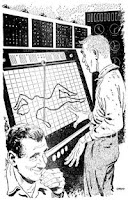
An illustration accompanying the online copy at Project Gutenberg of the short story The Romantic Analogue by The Romantic AnalogueOK - description of computers here is very old - this is a 1950s story. And for some additional fun, we're dealing with an analog computer here rather than digital one, because digital ones are "nearly as big as yachts, and cost more".

Story summary.

Norman Venner, a women-shy workaholic, has built this amazing new machine he thinks can get the company some government contracts. A machine that is very good at calculating curves. Only, during testing, the machine has began occasionally making romantic passes at him, using, you know, "curves" of the right kind...

Notes.

  1. This story packs far too much information on a single punched card. I used to think a punched card could hold just 80 7-bit numbers? Can someone familiar with them enlighten? Thank you.

Fact sheet.

First published: If, September 1953.
Download full text from Project Gutenberg, Manybooks.
Rating: B.
Related: Fiction about computers, from 1950s.

Saturday, April 10, 2010

John Wiswell's "Computer Education" (flash fiction, humor, free)

Speculating on the "evolution" of computers, during a trip through a computer museum...

Not exactly original, but good light read.

Fact sheet.

First published: Every Day Fiction, 6 April 2010.
Download full text from publisher's site.
Rating: A.

Sunday, March 7, 2010

J Ramanand's "Dropping Off" (short story, free): Since few of us use our head, why not let out the spare capacity?

This could have been hilarious satire, but that's left as an exercise for another author. Author takes the idea literally.

Story summary.

Idea is: since most of us are supposed to waste most of the potential of our brains, why not rent out the spare processing capacity? So a machine plugs into the brain & does an externally programmed job, while the owner of the brain sleeps! The story is of a man employed by a company that does brain rentals, & his later disenchantment with the job.

Two key ideas of the story - brain renting & memory retention by unconscious thinking - have both been used before, but it was still a good read.

Fact sheet.

First published: The Scientific Indian, 1 December 2009.
Download full text from publisher's site.
Rating: B.
Related: Fiction about computers.

Thursday, February 11, 2010

Henry Kuttner's "Ghost" (short story, free): Exorcising a computer center of its resident ghost!

There is a Hal Clement story in a somewhat similar vein - a "logical" explanation for existence of vampires! May be I'll dig it out one of these days.

I've an impression this is one of the better known stories of Kuttner; at least I'd heard of it long before I actually saw the story.

Story summary.

"Integrators" are thinking machines - very powerful computers, AIs, ... whatever you want to call them. They're super powerful "radioatom brains" that can solve any problem, & they don't have an ego.

Thirty of these machines are housed in a Station in Antarctica - a highly automated facility that needs manning only by a single human operator.

Recently, there has been trouble at the Station. An operator committed suicide, another had a madness attack, many quit, & current one is feeling very depressed.

Dr Elton Ford, "the greatest living psychologist", has an idea: the place is haunted. Man who committed suicide transmitted his depression telepathically ("by induction") to the Integrators; Integrators now continuously broadcast this pattern. So anyone in the facility is as good a living next to a maniac. Depression is contagious.

The psychologist will cure the machines. But this is a Kuttner story - so you know it cannot have a happy ending. Machines will get reinfected, with something even more dangerous, ...

Notes.

This is one Kuttner story that could have turned out better with a happy ending; reinfection process sounded very contrived to me. Story before that is far more interesting.

Fact sheet.

First published: Astounding, May 1943.
Download full text.
Rating: B.
Related: Stories of Henry Kuttner; fiction from 1940s.

Sunday, February 7, 2010

Tale of 2 recent Hindi movies featuring geeks: "3 idiots" & "Pyaar impossible!"

Two most recent movies I saw both feature geeks in prominent roles . But what a contrast!

"3 idiots" (@imdb) was a delight, in spite of "minor" flaws like director's fetish with toilet scenes, actors who're too old to be convincing undergraduate students, & a tendency to preach. Hero is an uber-cool tech student - a sort of John Galt (but without Galt's social agenda or anger at society). He can cook up all sort of gadgets at a moment's notice! Presentation felt quite a bit like "Munnabhai, MBBS" (@imdb) - just move the locale from a medical college to tech college, & hero from a goon in love to a real geek.

"Pyaar impossible!" (@imdb) was a complete bore, in spite of Priyanka Chopra. Hero is a very shy geek who's written (alone!) a PC operating system that can run software written for any popular operating system like Windows, Mac, even cell phones! Never mind the technical or patent issues. A crook posing as investor then steals his product - only installer, no sources - & sells it to a Singapore based company; never mind how he stole it (& at a moment's notice) from hero's notebook that probably didn't have installer, & how he managed to convince someone to sell it without access to source (they obviously didn't want any custom tweaks)! Then the crook goes after hero's girl. Of course, hero trumps eventually, by proving his ownership of product in an utterly unconvincing presentation. But these are side tracks - hero spends most of his time playing servant cum babysitter in his love's home, because he doesn't have guts to really talk to her.

Something that puzzles me: the recent trend in giving English names to Hindi movies, even the ones that have very Indian settings, like "3 idiots". These names cannot be helping locally. Do they make the movie easier to sell overseas?

Related: Hindi fiction.

Thursday, July 30, 2009

James P Hogan's "Murphy's War" (novelette, humor, free): When computer hackers rendered a nuclear war harmless!

Illustration accompanying an online copy at Webscription of the short story titled Murphys War by James P HoganUS & China have began the process of launching nuclear bomb armed missiles at each other over a silly & minor tiff. Then things begin to go wrong ... er, right! ... in a hilarious & very familiar way...

Notes.

  1. Fun really begins about half way through, in the US war room scene.
  2. Early parts will likely be more accessible to US readers; but it gets internationally accessible soon enough.
  3. Links above on country fetch more stories set in that country.

See also.

  1. Arthur Clarke's "The Pacifist" (1956): Another funny story of a naughty computer, but ... in a different way.

Fact sheet.

First published: Jim Baen's Universe, #8 (August 2007).
Rating: A.
Download full text from Webscription: Link1, or Link2.
Added to my "best of the year 2007" list.
Related: Stories of James P Hogan.

Thursday, May 21, 2009

John Varley's "Press Enter _" (novella, AI): Lifestyle of a computer hacker & criminal

Quote from short story titled Press Enter_ by John VarleyVarley seems to specialize in horror that is accessible to people who don't have a taste for the gory! How many other authors can write almost fun stories that are clearly horror?

Caution: This story has some sex scenes.

Story summary.

Charles Kluge, a recluse, appears to have committed suicide & left his property to Victor Apfel, a neighbor (& the narrator) he barely knew. Forensic investigation of the vast computer installations at his home will reveal the lifestyle of a super-programmer & a super-criminal.

Through the investigation, we'll see two more apparent suicides: of Detective Osborne, the cop investigating the case, & Lisa Foo, the woman doing the forensic investigation of Charles' machines & software. And Victor will be left an absolutely frightened & broken man.

You see, while having his hacking fun, Charles had stumbled upon a piece of software running on NSA's computers. We never learn the true nature of this software beast, but get enough indications that it's an AI run amok, that it exists without the knowledge of NSA, & that it is the real murderer of the 3!

Fact sheet.

First published: Asimov's, May 1984.
Rating: A.
Winner of Hugo Award 1985 in novella category.
Nominated for Nebula Award 1984 in novella category.
Related: Stories of John Varley.

Friday, September 19, 2008

Robots also snore!

Tom Dell Aringa's Marooned comic strip titled "Robot Snoring" & dated 18 September 2008 is both funny & familiar to users of electronic gadgets!

Saturday, August 16, 2008

Murray Leinster's "A Logic Named Joe" (short story, artificial intelligence, humor, free): Exploits of a super-intelligent but ethics-less AI

---

Fact sheet.

First published: Astounding Science Fiction, March 1946 (as by Will F Jenkins).
Rating: A
Added to the list of stories from Campbell's Astounding.
Download full text, or MP3 audio (dramatized).
Related: All stories of Murray Leinster.
---

I liked this story because it's a fun & light read - sometimes hilarious. But that's not the normally cited reason when I looked up others' posts on the story - it's the technology prophesy (see below) in the story that gets often cited.

Story summary.

It's the story of Joe, a machine with an interface somewhat akin to a modern internet-connected PC. A manufacturing defect has turned Joe into a very competent AI - but one without any sense of human morals or ethics, or of survival.

At some level, there is a similarity with Jack Williamson's "With Folded Hands". Machines in both stories are in service of humanity - though with different motives. Both lead to undesirable results.

Joe is neither malevolent not benevolent. It just wants to stay busy - so it infects every computer on the public network to offer a very useful service to their human users: ask any question, & Joe will answer it!

Chaos reins as Joe begins offering very effective advise on how to murder someone or rob a bank without getting caught, what the bank balance of your neighbor is, design of a device that will brainwash the population of a city to adopt your religion, ...!!

"Ducky", the narrator & "a maintenance man for the Logics Company" who earns his living "servicing logics", will ultimately identify Joe & take it out of system by seeking Joe's own help.

Technology prophesy.

The oft-cited distinguishing feature of this apparently very famous story is: it describes something akin to modern internet-connected PCs. The story was written when neither the word "computer" nor "software" were in widespread use. In fact, the story uses the word "logic" to describe both the computer & the software.

While there is justification for this praise, it foretells future only in the sense of Jules & Michel Verne's "In The Year 2889": wild & intelligent imagination imposed on foreseeable technology.

Computers of this story, where any details are provided, are in fact very outdated; what is up to date is the effect & the way they are used - something where even modern systems have some catching up to do.

You need to tinker with hardware to change programs - like in Arthur Clarke's "The Nine Billion Names of God". While a lot of families have one of these machines at home, they are big clunky things - except for a rather modern viewscreen/keyboard interface (no pointing device or GUI). A big "tank" holds the guts of the system, & "plates" in it store data. If you have physical access to the machine, you can switch the power on/off. When on, it's always connected to the sole big worldwide network - no way of disconnecting it from network, or connecting it to a different network! There is a notion of user identity, but apparently the machines believe you won't lie. "Censor-circuits" built into the machine filter the kind of information it will reveal (ha ha).

These prophesies may be of interest to computing historians. For me, the fun part is reason enough.

Collected in.

  1. Murray Leinster's "A Logic Named Joe" (collection).
  2. "The Best of Murray Leinster" (ed J J Pierce).

Sunday, October 28, 2007

Arthur C. Clarke's "The Steam-powered Word Processor": A spin on the life & works of Charles Babbage

This story describes the life of Reverand Charles Cabbage (1815-188?), one time vicar at St Simian's in the Parish of Far Tottering, Sussex, England. Note the trivial change of surname. According to Wikipedia, Babbage lived 1791-1871.

I am not sure if Babbage would have found the humor in good taste, though.

Story summary.

Priest Cabbage is from a family that got rich by trading in slaves. He himself got rich by killing off his siblings - so he inherits family fortune.

He is bored having to write basically the same sermons twice a week, week after week. What if he could build a machine ("Word Loom") that, when given a copy of Bible & "the whole of Cruden's Concordance", will automatically produce the sermons! Laborious entry of religious texts will be outsourced.

That is how the quest for a programmable mechanical computer begins.

"The machine's 'memory' was based ... on the punched cards of a modified Jacquard Loom: Cabbage was fond of saying that he would weave thoughts as Jacquard wove tapestries."

Machine even had a COS - Card Operating System! Note this story was published a couple of years after first IBM PCs powered by DOS appeared.

First run of the "software" will require a lot of steam power & will result in much breakage. Basically great effort, but sorry - no useful output.

Fact sheet.

"The Steam-powered Word Processor", short story, review
First published: Analog, January 1986.
Rating: B

This story appears in the following collections.

  1. "The Collected Stories of Arthur C Clarke"

Thursday, August 9, 2007

Vernor Vinge's "Rainbows End" (novel): Computer geek's utopia

Quote from the novel Rainbows End by Vernor VingeThe story begins on a promising note - biological trojans. But degenerates very quickly.

Nearly 75% of text is about a kind of technology utopia: wearable tiny computers that live in your cloths, contact lenses, etc. Ubiquitous cellphone like network connects them, but with much higher bandwidth & reliability. Display is primarily via contact lenses. Holographic displays indistinguishable from reality are the norm, as are haptic (can interact via your skin) I/O devices & dumb robots. All online identity management is via a few very big brokers using digital certificates. Government can snoop at your data at will via a mandated & heavily regulated Secure Hardware Environment that all computers & communications devices must conform to! This is the most boring part - page upon unending page of garbage.

Then there is the apparently main story - a cheap but fast moving espionage thriller. Story opens with it, but it really begins about midway through the book. Key to it is facetious, in my opinion:

  1. Infect a population with a harmless biological virus that makes them susceptible to suggestions.
  2. Now you can control their minds by sending suggestions via a TV program, email, etc!
The specific example cited was plausible enough - a virus that makes people crave a certain edible. But using it for generic mind control! Asimov at least doesn't try describing a specific technology when his characters manipulate others' emotions telepathically!

On top of that, the story is set in 2017. Author must be really optimistic!

Then there are various side tracks:
  1. Rehabilitation of old people.
  2. Digitization of libraries - a variant of Google's similar project but somewhat farcical - you digitize a library by shredding a book to little pieces - then feeding it to software that will read these pieces & correlate them! First destroy the correlation, & then try building it imperfectly from the destroyed pieces!
Story gets its name from an old age community. A character clarifies, & a chapter name too, that there is no apostrophe in the title.

This novel is available both in paper form for purchase, & free online.

Story summary.
For this story, I think it will be simpler to provide character summaries, & how they link up.

Utopia part begins about 5% through the story, is set in San Diego, & has the following main characters:
  1. Robert Gu, Sr: A very famous poet, now suffering from Alzheimer's disease at his son's home. One fine day, he is not only magically cured, but begins appearing much younger - thanks to newly discovered "Venn-Kurasawa" treatment. He has a nasty temper, hasn't quiet recovered his poetic talent & that knowledge depresses him. Part of the story deals with his rehabilitation. He is under constant threat from his son of being parceled off to an old age community.
  2. Lt Col Robert Gu, Jr: Sr's son & an officer in US Marines.
  3. Col Alice Gong Gu: Jr's wife, & an officer in some US intelligence agency.
  4. Miri Gu: Alice & Jr's 13 year old daughter. A girl with the golden heart. Has strong feelings for grand dad & keeps helping him in many ways.
  5. Lena Llewelyn Gu: Sr's estranged wife & Jr's mom. A competent psychiatrist, living in "Rainbows End" community with a room mate. After Sr's recovery, he is told she is dead; she doesn't want to meet him. Near end, he finds her existence, but there is no happy ending to their story.
  6. Xiu Xiang: 10 years Lena's senior & her room mate. She was a very competent engineer at Intel once. Is now old & undergoing rehabilitation.
  7. Juan Orozco: A young boy who becomes a friend of Sr & Miri, & plays a major role.
  8. Louise Chumlig aka Big Lizard: She helps in Sr's rehabilitation.
Epiphany is the software interface central to computers of this utopia, much like Windows is today on PCs.

Spy thriller has three main characters, all intelligence agents from Indo-European Alliance - one of the 3 big powers in the world, & includes Japan!
  1. Alfred Vaz: An Indian from Bombay, highly regarded in the intelligence community, & the main villain.
  2. Günberk Braun: A good intentioned German who detects the biological weapon, & unwittingly cooperates with Vaz for its investigation.
  3. Keiko Mitsuri: A Japanese woman cooperating with Vaz & Braun as a team.
Vaz uses characters from utopia story as pawns, via two link characters:
  1. Rabbit aka Mysterious Stranger: We never real find him, but all the evidence is that he is an Artificial Intelligence (AI) - kind of software agent that can roam the network. Problem is - he is far smarter than every other character in the story. Vaz enrolls him for some fun in the US, & he recruits local characters including Robert, Sr.
  2. Zulfikar Sharif: A literature Ph D student of University of California at San Diego. He will be interacting with Sr for his work. His Epiphany will be hacked by Rabbit & Miri for their own ends.
Fact sheet.
Rainbows End, novel, review
First published: 2006
Rating: B
Winner of Hugo Awards 2007 in novel category

Related: All Hugo Award stories.

See also.
  1. "Synthetic Serendipity": The short story that eventually became the "Rainbows End". Story doesn't have Gu family, or mind control conspiracy - only ubiquitous computing. Also see note on publisher's marketing story near end of "Synthetic Serendipity" article.
  2. "Fast Times at Fairmount High": According to a message dated 14 September 2007 from Justin Alexander on usenet (rec.arts.sf.written) (I am not able to locate the URL in Google Groups), this is another short story set in "Rainbows End" world. But I have not read it.
  3. Brian Stableford's "The Trial": I found it a better version of the small subplot in Rainbows where an Alzheimer's patient is dramatically cured. Probably because this short story is focussed only on that.