Showing posts with label language. Show all posts

Saturday, February 16, 2013

Hal Clement's "Impediment" (novelette, communications): Telepathy considered impossible among humans

I must have read the "Best of Hal Clement" earlier. I don't remember many of its stories' titles, but as I begin reading a story, I discover I'd read it before. This one too is a reread, but one I'd forgotten so thoroughly I ended up finishing again.

Story summary.

This is a first contact story that focuses on possible difficulties in communicating with aliens. In this case, aliens are telepathic & can read imagery in your brain. And while they cannot speak audibly, they are not deaf; they can hear sounds of our speech.

And yet the communications are so hard as to be impossible. The difficulty lies in human comfort, rather need, to communicate in code - what our brain thinks, we must mostly code in symbols of speech. It's ok if the actual brainwaves generated by two individuals with the same thought differ, since they'll both render it in common code. Aliens don't understand this idea of translating to code, since they're used to direct communication of thoughts.

Giant insect-like alien visitors themselves are space pirates out of ammunition, & want arsenic here to make poison gas. A human insect researcher doing some field work north of Arctic Circle runs into them.

Fact sheet.

First published: Astounding, August 1942.
Among the stories from Astounding/Analog issues edited by John Campbell.
Rating: A.
Related: Stories of Hal Clement; fiction about language issues.

Saturday, August 4, 2012

K W Lessing's "Meihem in ce Klasrum" (as by Dolton Edwards) (satire, linguistics, free)

This is not really fiction, but one of those non-fact articles that Astounding sometimes published.

It describes a funny plan to turn written English into a phonetic language. Curious title is "Mayhem in the Classroom" in this evolved English.

Collected in.

  1. John W Campbell, Jr (ed)'s "The Astounding Science Fiction Anthology".

Fact sheet.

First published: Astounding, September 1946.
Download full text from Tim's page.
Rating: A.
Among the stories edited by John Campbell for Astounding/Analog.

Wednesday, November 17, 2010

John Varley's "The Persistence of Vision" (novella, utopia, free): Physical misfits create a society where they're the norm

Quote from short story The Persistence of Vision by John Varley
While there are multiple themes here, a substantial part of the story is devoted to language & communications. Say no one had eyes & ears. How would you communicate?

Ending is very abrupt & arbitrary.

Caution: Story includes some sexually explicit scenes.

Story summary.

An epidemic ("German measles, or rubella") left some 5000 children born blind & deaf in its wake. Society is generally caring - in its own way, but they'll always be misfits, & objects of pity. On reaching adulthood, a few dozen of them set out to build a community custom-built for them; one where being deaf & blind is the natural state of being.

Story is the description of their commune, seen from the eyes of a drifter who'll be a drifter no more.

Quotes.

  1. "To protest, one must be aware of the possibility of something better. It helps to have a language, too."
  2. "nothing is moral always, & anything is moral under the right circumstances."
  3. "Why is it that once having decided what I must do, I'm afraid to reexamine my decision? Maybe because the original decision cost me so much that I didn't want to go through it again."

Fact sheet.

First published: F&SF, March 1978.
Download MP3 podcast of the story, read by Spider Robinson. [via Boing Boing]
Note: I've'nt personally heard this MP3; I've only read the original text version.
Rating: A.
Winner of Hugo Award 1979 in novella category.
Winner of Nebula Award 1978 in novella category.
Related: Stories of John Varley.

Wednesday, June 2, 2010

William Tenn's "Firewater" (novella, communications): Traders come before theorists

Quote from short story Firewater by William Tenn
The key thesis here is: well organized human knowledge often has a vast history behind. A whole lot of people over long periods of time doing routine jobs gathering bits of isolated data, until finally the accumulated lot begins to fit a pattern & is fit for generalization & theorizing.

This is also a first contact story about communication difficulties with aliens who're totally & utterly incomprehensible, & with whom we don't have anything in common - sort of, a tamer version of Stanislaw Lem's "Solaris" & Terry Carr's "The Dance of Changer & the Three" (download). Another noteworthy story of the class is Hal Clement's "Longline"; while aliens continue to remain impossible to understandable here, a method of communication is worked out.

Through the story, we see analogies with European invaders of Americas in the past & their interactions with native Americans. "Firewater" of title refers to whisky, apparantly a European product sometimes traded with native Americans for tobacco, the local product. I obviously missed nuances Americans will see here.

Story summary.

This is a complex-story-that-feels-simple, with several actors persuing their own agenda:
  1. "Aliens" who've been on earth a while, & now occupy localized places. They're so vastly superior to humans as to be god-like. They're obviously not interested in occupying earth or looting. Their presence here is giving humanity fits because of inferiority complex it breeds.
  2. "Primeys", short for "Humanity Prime": Some of the smartest humans who've achieved enough contact with aliens to get noticed have turned into these gabbing idiots, but with vast magical powers. They effectively run as errand boys for Aliens, & are best seen as a race distinct from normal humanity. Think of them as magic-weaving characters from James Schmitz's "The Witches of Karres" (download), but of incomprehensible motives.
  3. United Mankind's "Special Investigating Commission" (SIC): And organ of the "world government" ("United Mankind"), granted vast police powers & mandated to open channels of communications with Aliens. They've nothing to show, in spite of a lot of public money spent.
  4. "Humanity Firsters", or just "Firsters": A near-religious cult a man named Vandermeer Dempsey spawned & is using to further his own agenda of political power. Cultists deny that Aliens exist, & think Primeys & people who deal with them are humanity's worst enemies.
  5. Algernon Hebster, a rich businessman who's made a fortune building gadgets by picking knowledge off Primeys. He's the central character around whom the whole story is woven.
P Braganza, of SIC, wants Hebster to work for government in establishing communications with aliens. Dempsey sees Hebster as the poster boy to rouse passions among the masses that will begin a revolution for him. Running from both, Hebster will end up getting caught among the Aliens & successfully contact the trade representative of their expedition: let's begin with the profits, understanding can come centuries hence using bits of data that will be gathered while trading.

Notes.

  1. During the meeting of Hebster with Aliens, we're offered a simile: "like the girl in Greek mythology who had begged Zeus for the privilege of seeing him in the full regalia of his godhood. A few moments after her request had been granted, there had been nothing left of the inquisitive female but a fine feathery ash."

    I know of at least one other story that uses this Greek legend in a central way: Henry Kuttner & C L Moore's "The Children's Hour" (download).

Collected in.

  1.  William Tenn's "Time in Advance".

Fact sheet.

First published: Astounding, February 1952.
Rating: B.
Among the stories from Astounding/Analog issues edited by John W Campbell, Jr
Related: Stories of William Tenn.

Monday, March 29, 2010

Robert Abernathy's "The Record of Currupira" (short story, free): The origins of human speech & music

Quote from short story The Record of Currupira by Robert AbernathyI might have liked it more without its monster hunting parts, but it's still a decent enough read.
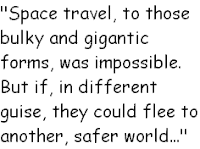
May be 2 years back, I recall a Discovery or National Geographic show in India that reconstructed an ancient predator. A predator whose hunting technique was very similar to that in this story.

Story summary.

Human explorers on Mars have found dead Martian cities. And from a museum in one of these cities, they've found earthly relics dating 50,000 years back! Apparently, Martians visited earth in that remote time, & collected specimen.

Among the specimen is a video recording & a flute. Men have rebuilt a machine that can play back the recording, minus visual parts - only sounds. Two scientists who hear it first - James Dalton, a linguist, & Dr Oliver Thwaite, an archeologist - will get nightmares for days afterward: the recording is of a human lured & eaten by an animal somewhere near equator!

"Currupira" of title is the name of this ancient predator. It makes different sounds to terrorize or sooth its prey - so the prey will come willingly to it! And some of the sounds it makes are very human; apparently, men learned the power of words from this hunter!

Thwaite has an idea the animal may not be extinct, & goes hunting it in Brazil. Dalton follows, but has a better idea of a weapon to fight the monster - the ancient flute!

We'll hear fearful accounts of locals about this monster. Of course, the heroes will eventually find it, & Thwaite will almost become its meal - until Dalton gets courage to deploy the flute as a weapon.

See also.

  1. Arthur Clarke's "History Lesson": Venusians have found a well preserved video recording of the long extinct humans, & have built a machine to play it back. We see very funny theories about what the bipeds in the pictures might be doing & the apparent purposes of their visible anatomical features.
  2. Henry Kuttner's "Nothing But Gingerbread Left" (download): Music as a weapon in WWII! Very funny story.

Fact sheet.

First published: Fantastic Universe, January 1954.
Download full text from Project Gutenberg or Manybooks.
Rating: B.
Related: Fiction from 1950s.

Saturday, February 13, 2010

Nancy Kress' "Exegesis" (flash fiction, humor, free): How language evolves...

Best single piece I've seen from author so far.

Story summary.

A harmless sentence - "Frankly, my dear, I don't give a damn.", from Margaret
Mitchell's novel Gone With the Wind, looked at every 100 years from 1950 to 2850.

Collected in.

  1. David Hartwell & Kathryn Cramer (eds)' "Year's Best SF 15" (2010).

Fact sheet.

First published: Asimov's, April/May 2009.
Download full text.
Rating: A.
Added to my "best of 2009" list.
Related: Stories of Nancy Kress; fiction about language & communications.

Tuesday, February 2, 2010

Henry Kuttner's "Beauty and the Beast" (short story, irony, free): Appearance can be deceptive. And dangerous when coupled with prejudice.

Quote from the short story titled Beauty and the Beast by Henry KuttnerTelling style is very pulp-era, but I liked the story as a whole. And there is a distinct similarity with some parts of Mary Shelley's "Frankenstein".

Story summary.

An ordinary farmer has come into possession of a hibernating alien & some seeds of pretty flowers the first human explorer to Venus (who returned dead) brought back. Farmer brought the alien to life & planted the seeds.

Pretty flowers that resulted were very popular & easy to grow, & their cultivation spread throughout earth.

The alien who emerged was actually of the now extinct Venusian dominant race. Huge dinosaur sized reptilian ("Beast" to humans), very intelligent & full of gratitude for humanity. Communicating with humans, however, is tricky because of their prejudices about his appearance, but the warning he must give them is urgent...

Very Kuttnerian ending.

Fact sheet.

First published: Thrilling Wonder Stories, Fall 1940.
Download full text.
Rating: A.
Related: Stories of Henry Kuttner; Tuesday Classics.

Friday, November 23, 2007

H Beam Piper's "Omnilingual": A technique to decode unknown written language of an industrial society

Quote from the novella titled Omnilingual by H Beam PiperImagine a replica of European culture at roughly the level of its development in early twentieth century. Assume the people of this replica had died out thousands of years ago. And archaeologists of about mid twentieth century Europe discover their long lost city.

This is a novella length story of archeology field-work of this nature. Running through the narrative is the apparently central thread about how to make sense of their books found during the digging - of which a large quantity is available. Their scripts appears to follow the general principles of European written languages, but the problem is - there is no Rosetta Stone to establish a reference for translation.

The story poses this problem in a very colorful but ridiculous way - the digging is really happening on Mars. Sentient Martians apparently died out 50,000 years ago, leaving behind buried cities at about the level of development of Europe in early twentieth century. Also, they look very human, have customs rather similar to Europeans of the era, etc.

In spite of this, I never got bored. It's action packed - something or the other is always happening.

Story summary.

Martha Dane is part of a large contingent of archaeological diggers on Mars; the team includes a lot of military staff too. Martha is spending a lot of time trying to figure out the ancients' written script, & is generally tolerated or ridiculed by others because there is no Rosetta Stone for reference.

That is when they end up digging a multi-story tower that apparently was a university. While Martha will work out a few words while looking at murals at the walls in the university, real breakthrough will come when a group that includes her comes across the equivalent of Dmitri Mendeleev's Periodic Table of elements on a chemistry classroom wall. Table includes several pieces of information about elements including their atomic weight & their name in local script.

That's the Eureka moment. To decode the text of a culture that has discovered physical sciences familiar to us, you look for their scientific tables of physical facts - properties of elements, astronomical facts, ... That is the Rosetta Stone.

Throughout the story, I was somewhat bothered with the attitude that it's ok to defile the environment in science's cause - e.g., on a planet with few animals, the moment you see one, you have to shoot it down so you can analyze its tissue in lab!!

May be it was the attitude of Piper's times, may be it is still widespread in places I've not been to. Michael Crichton discusses this attitude at some length in his "Jurassic Park". Arthur Clarke also highlighted the issue of defiling environment in the cause of "development" briefly in his "Islands in the Sky"; but he didn't seem to see anything wrong with it.

See also.

  1. Ted Chiang's "The Story of Your Life": A much more realistic example of difficulties & issues in decoding a truly alien language.

Collected in.

  1. David Drake, Jim Baen, & Eric Flint (Ed)'s "The World Turned Upside Down".
  2. Isaac Asimov & Martin H Greenberg (Eds)' "Isaac Asimov Presents the Great SF Stories 19 (1957)".

Fact sheet.

First published: Astoundin Science Fiction, February 1957.
Rating: A
Download full text from Project Gutenberg, Manybooks, or Feedbooks. Or LibriVox audio read by Mark Nelson.

Monday, October 8, 2007

Ted Chiang's "Story of Your Life": An alternate design of cognition & language

Quote from Story of Your Life by Ted ChiangThis very readable novella examines an alternative to human cognition & languages. Plot is organized as an attempt to understand very cooperative alien visitors.


Title of the story comes from a parallel thread describing the tender relationship of a woman to her daughter, with a twist near end.

I collected some quotes from this story too.

Full text of this story is available as a free download.

Story summary.
Alien ships have suddenly appeared in earth orbit. Aliens have also planted 112 artifacts around the world, 9 of them in the US. Americans dub these artifacts "looking glasses", & the aliens "heptapods".

The one artifact we will be seeing through the story is in the US, & is essentially a remote holographic communication device. You step within a certain marked surface area near the artifact; aliens presumably appear near their artifact; & the two of you could be virtually sitting in the same room. There are hints that rest of alien artifacts are also similar devices.

As we will learn through the story, aliens will stay around for a few years. The only response to reason for their visit is "to see" or "to observe". And at least during this trip, there is no hint of any malevolent intent.

A military installation has been built around the artifact where much of the story will happen. US government, as also others around the world, will spend much time trying to understand a language for communication with aliens; that is the bulk of the story. Aliens will cooperate, but don't appear to have initiative in the matter. So, it's essentially about trying to understand their language & cognition processes.

Dr Louise Banks is the narrator - a language expert & a teacher somewhere. Dr Gary Donnelly is a physicist. The two of them will be this site's team attempting to figure out aliens language & to try learning their science. They will have much success with the former, but aliens are not giving away any of their science or technology. Colonel Weber is the military man both will report to.

We will learn that aliens' spoken language has no relationship whatever with their written language. Written language is 2 dimensional rather than linear familiar to humans. Spoken language appears to have grammar utterly unfamiliar to humans - any number of clauses expressed in an arbitrary, changeable, sequence.

We will also learn that rather than thinking through things one at a time, as humans do, they simultaneously look at everything! To me, the whole process appeared a lot like the idea of "grokking" in Robert Heinlein's "Stranger in a Strange Land".

We will also be told that this facility of looking at everything simultaneously means you can tell the future as easily as past! This is where we see some discussion on free will & its relationship to predicting future events; this part appears to have been lifted from Chiang's earlier & much shorter story, "What's Expected Of Us".

Through the course of her interactions with aliens, Louise will get a facility with this simultaneous mode of thinking. That is the basis of the parallel thread running through the story - of her future marriage to Gary & later separation, & of her very tender feelings about her yet to be born daughter who will eventually die of an accident at age 25. Title comes from this thread about the life story of the daughter.

See also.

  1. Lewis Padgett's "Mimsy Were the Borogoves": Apparently friendly alien encounter that makes humans learn their ways of thinking, leading to thoughts & actions impossible to ordinary mortals.
  2. H Beam Piper's "Omnilingual": Perhaps a better known, but far more simplistic, story on how to figure out an alien language.
  3. Robert Heinlein's "Stranger in a Strange Land": The idea of simultaneously looking at the big picture rather than as linear components, & that a certain language, is very similar to the idea of "grokking" in Stranger.
  4. Ted Chiang's "What's Expected Of Us?": A part of the narrative discusses the incompatibility of a deterministic future with free will. That is the argument of What's Expected.
  5. Arthur Clarke's "2001 A Space Odyssey": Alien artifacts suddenly appearing on earth that allow visual communications with humans, & then vanishes via some kind of remote action of aliens, are also seen in the first story of 2001.
  6. Peter Watts' "Blindsight": A very different & violent technique to understand the language of aliens.
  7. Issac Asimov's "The Naked Sun": Very realistic holographic communication devices where remote parties appear within an effective area around the device, & are virtually in the same room, appears in Asimov's novel too.

Collected in.

  1. Ted Chiang's "Stories of Your Life and Others".
Fact sheet.
"Story of Your Life", short story, review
First published: Patrick Nielsen Hayden (Ed)'s "Starlight 2", October 1998.
Rating: A
Related: All stories of Ted Chiang.
Winner of Nebula Award 1999 in novella category