Showing posts with label terrorism. Show all posts

Wednesday, April 18, 2012

Richard A Lovett's "Mother's Tattoos" (novelette, counter terrorism)

While the story is ordinary enough, the thing that made it noteworthy for me was: it's the first story I've seen that has body implants that use interactive programmable tattoos that turn the whole skin into a touch screen display.
  1. Want to make a phone call. Tap your wrist in a certain way. Image of a phone with dial pad appears on your hand! Can, of course, make it disappear.
  2. Downloaded free software? You probably gave it permission to display ads on your forehead or cheeks!
There is nifty other stuff, making the computer one with your body.

Story is of an undercover agent employed by US "Homeland Services". All his life, the threats he uncovers are false alarms. And finally, when he does undercover a sleeper terrorist, he will wish he never had had this catch...

Fact sheet.

First published: Analog, March 2012.
Rating: B.

Wednesday, April 14, 2010

J Kathleen Cheney's "Afterimage" (novelette, murder mystery, free)

Illustration by Garrett W Vance, accompanying the original appearance of short story Afterimage by J Kathleen Cheney in Jim Baens Universe, April 2010 issueDeVane Michaelson, a rich lawyer, is murdered. Suspects include his secretary Veronica he's been having a love affair with, & his wife Manisone. Detective William Greene will unravel the case, with help.

Throughout the story, we see references to "Purists", a terrorist organization opposed to body implants, something common in the universe of the story. But these references are only a minor distraction; this is a proper murder mystery & an easy read.

Fact sheet.

First published: JBU, #24 (April 2010).
Download full text from Webscription.
Rating: A.

Wednesday, September 23, 2009

Christopher Feliciano Arnold's "Light, Sweet Crude" (short story): Two ways of creating wealth are contrasted

How is wealth created? By creating physical assets, or by manipulating numbers in a database? This story, obviously inspired by last year's credit freeze, contrasts the two.

Story summary.

Hunter (narrator), 32 year old millionaire financial trader speculating in future crude prices for Centaur Global Energy Resources Fund, vs his dad, a man of modest means who has spent a lifetime maintaining physical infrastructure of oil industry in Texas, US.

A specific trade of Hunter is at the heart of the story, & brings up the issues with database-based wealth creation: he will make a lot of money for his employer in this transaction (that might get him in trouble with law) because he has advance information about what the US cops will call a terrorist strike in Nigeria - a hit that will affect world's crude supply over at least the short term.

Fact sheet.

First published: Playboy (US), October 2009.
Rating: A.
Added to my "best of the year 2009" list.
Related: Stories from 2009 issues of Playboy magazine; all Playboy stories.

Tuesday, June 30, 2009

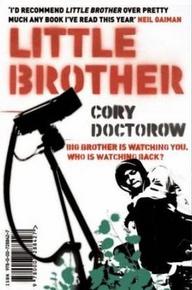
Cory Doctorow's "Little Brother" (novel, revolution, free): Anti-terror cops run amok

Cover image of the 2008 novel titled Little Brother by Cory DoctorowThere are at least 3 parts to this novel: main story, propaganda, & an overview of the currently available computer privacy technology.

Main story is common enough, but very well told: A teenager in San Francisco is among the many innocents brutally abused by US anti-terror police. He leads a revolution that promises to fix things by the end of the story.

I guess I could identify with the story because of parallels with what I've read of Indira Gandhi's notorious "Emergency" in India during 1975-1977.

Caution: Main story sometimes runs along tracks that will befuddle readers in many countries. E.g., I found nothing to connect with in the sequence that runs several pages & describes teenagers vampire games at some sort of school camp; it was just bloat, though a variation is used later during a political protest.

Propaganda is interwoven throughout the story, & occasionally goes on totally irrelevant tracks. I recall at least one occasion where the author launches into a criticism of British government's citizen tracking systems in an utterly irrelevant context.

Computer privacy technology overview is generally good, but then I'm a programmer & the stuff was generally familiar. Readers from other backgrounds might see these as info dumps.

Caution: Author doesn't always include the all important caveats with privacy technology he advocates (e.g., using TOR to connect to a site that requires a password & communicates the password unencrypted is usually worse than not using it; or that Windows version of TOR might sometimes make you think you are anonymous when you are not). Also there is very good reason much of this tech is not in widespread use - using a lot of it requires the outlook of a computer nerd, & sometimes even that is not enough. But they all have their uses - in specific contexts.

Fact sheet.

First published: 2008.
Rating: A.
Download full text in multiple formats from author's site.
Nominated for Hugo Award 2009 in novel category.
Nominated for Nebula Award 2009 in novel category.
Related: Stories of Cory Doctorow; revolution in fiction

Thursday, May 7, 2009

John Varley's "Bagatelle" (novelette, terrorism, free): Defusing a human bomb

Quote from short story titled Bagatelle by John VarleyIn spite of the subject, it's a very light read - sometimes even funny.

Story summary.

Hans Leiter has agreed to become an unusual kind of suicide bomber - a cyborg bomb. Stripped of body - just his brain & nerves leading to it will go into this bomb. And it is a nuclear bomb - capable of devastating a whole city. The cyborg that is the man + bomb + a vehicle + the sensors that let the cyborg perceive & respond to environment. The bomb has planted itself in the middle of a busy shopping area, & has announced its intention to blast in 4 hours!

This is the story of defusing this complex bomb - Chief of Municipal Police for New Dresden, Anna-Louise Bach, has hired the bomb disposal expert Roger Birkson for the job. New Dresden is a city on moon, where the action happens.

Fact sheet.

First published: Galaxy, October 1976.
Rating: A.
Download full text from Internet Archive.
An audio version of this story is included, among other things, in Aural Delights #32 podcast of StarShipSofa.
Included in Ellen Datlow's SciFiction classics.
Related: Stories about terrorism, cyborgs, or moon.

Friday, May 1, 2009

Robert Reed's "Truth" (novella, terrorism, free): "Temporal jihadists" from future are wrecking havoc

Quote from short story titled Truth by Robert ReedGreat start, but then it gets mundane.

Story summary.

Some 200 odd (Islamic) terrorists from about 140 years into future have arrived in our world with their advanced weapons, & are wrecking havoc. We get hints that recent US armed action in places like Iraq is at least partly gifts from these from-future terrorists.

One of them - Ramiro aka "Lemonade-7" - is caught & has been in a secret US detention center for over a decade & has been through much torture. And the world has seen much destruction during the period, apparently at the hands of his comrades.

Story is mostly of a psychologist's interrogation of the captured man, until she learns the nature of the weapon used by these visitors from the future & neutralizes it.

Fact sheet.

First published: Asimov's, October/November 2008.
Rating: A.
Download full text from publisher's site.
Nominated for Hugo Award 2009 in novella category.
Related: Stories of Robert Reed; terrorism stories; time travel stories.

Saturday, December 20, 2008

Barry N Malzberg's "Transfer" (short story, shape shifter, free): A parable of terrorist's mindset?

Quote from short story titled Transfer by Barry N MalzbergThis is a much darker story than I normally post.

Only 3 weeks ago, I would have rated it C & never bothered to write this post. I'm sure I'm reading more into it than author intended, but the "beast" in this story thinks too much like the terrorists involved in Bombay attacks a fortnight back; at least two of them who talked to a news channel using victim's phone during the (I think first day of the) siege.

PS: This video recording (I cannot see the video on my PC, but looks like others are able to see) is of the first of the two calls (in Hindi) that were aired by India TV; I could not locate the second one online. This was the call that convinced me we were dealing with Pakistanis - the man claims he is from Hyderabad in the South, but language, accent, & the words used are instant give away. And the content of the talk felt so much like the "beast" in this story (second call also felt like this "beast" - to my biased mind, at least).

Story summary.

Narrator is modeled after werewolves - he can transform himself into a tentacled "beast" that hunts hapless people in the city at night, & kills for no reason but that he cannot help it! He also eats some of them. And narrator seems to have some sort of split personality - beast & the man who becomes beast have distinct though related personalities.

Fact sheet.

First published: Fantastic, August 1975.
Rating: B.
Download full text from Internet Archive.
Included in Ellen Datlow's Sci Fiction classics.

Tuesday, December 16, 2008

Nagesh Upadhyaya's "Siege!" (short story, terrorism, free): Chillingly plausible near future weapons of urban warfare

Gripping story of a plot with a situation that is a much simpler version of Bombay terror attacks last month - terrorists holding hostages. It takes a rather kind view of India's ministers, contrary to evidence; but that's not the main point of the story. Highlight is the chillingly realistic fighting gadgets near end - very plausible without too far fetched technology.

Fact sheet.

First published: Indian Science Fiction & Fantasy (when? probably around the year 2000.)
Rating: A.
Download full text. [via manofsan at indiansciencefiction Yahoo group]
Related: Stories dealing with terrorism (caution: This page throws up some Bombay terror posts too. But there is fiction too - search for "Fact sheet" on linked page).

Thursday, December 4, 2008

We vs They (Off-topic: Bombay terror attacks, 26-29 November 2008)

Muslims vs others.

There seems to be a sentiment, more common in overseas reports but not unknown in India either, that these attacks highlight a muslim vs everybody else divide. They don't, & muslims as a community are not the enemy (though the attackers were muslim fanatics who thought they were on some sort of religious jihad). Here are some facts:
  1. Close to a third of the victims are muslim, according to a TV report. Someone apparently counted the number of muslim victims in the list published by the state government.
  2. Managements of muslim graveyards in Bombay are adamant none of the killed terrorists will get burial in their yard.
  3. If my personal testimonies count, I live in a place close to a muslim majority neighborhood; have never had reason to think of the community as enemy, & I often buy stuff from their shops. One of the five families on my floor is muslim. One of my closest friends in college was a muslim, & a deeply religious one at that.

Rich vs poor.

There seems to be a not uncommon view in Indian media that the reason these attacks are getting this massive attention is because they involved five star hotels & their rich patrons. I would beg to disagree.

The reason I'm not able to get these events off my mind is the 3 days of non-stop TV coverage. No other terrorist attack here has lasted this long. And more importantly, the complete helplessness of the state.

This event highlighted more than anything else that we need a complete overhaul of our public institutions. And most of the sane coverage of the event post-act is focused on this, apart from bringing the guilty to book. Of course there is sensationalism too, but that's comes with private media.

Unequal access to morgue.

This left a very bad taste.

Relatives of victims that came in early had to spend 10-12 hours, sometimes run across more than one morgue, to get the body. This time later went down to 1-2 hours & a single location.

Since most early victims were at CST (about 60 died when the automatic guns opened at the crowded railway station), & later ones from 5 star hotels, there may be an association; government servants aren't above giving differential treatment depending on the kind of cloths someone is wearing. Or may be it was simply that the systems got streamlined as time went by.

There is also at least one recorded case where a relative of someone rescued from hotel on day 2 was asked by hospital to shell out money before the treatment. I'm not sure of the extent of injuries on this victim.

Differential treatment at Taj.

While by & large, most rescued are all praise for the two hotels, I recall at least two unsavory accounts - both from Taj.

In one case, hotel was evacuating a lady described as a VIP but refusing to evacuate an ordinary journalist alongside. Journalist appealed to VIP, & VIP's intervention got her out early!

Second instance got a lot of coverage on TV - day 2 or 3. A doctor couple trapped inside were giving first aid to an injured hotel staff member. They called up someone from hotel - probably wanting to know where to find something at their current location. They were welcomed with a query about the department of the injured, interpreted by doctors as if the hotel cared more about some injured than about others.

News: A bomb apparently planted by terrorists on 26th at CST station was found & defused yesterday. No one was hurt, though it raises serious questions about the thoroughness of combing personnel. This was one of the at least 6 bombs they'd planted at the beginning of the attacks of which 2 actually went off that fateful day at different places, killing 3.
Update 5 December 2008: Cops say each terrorist was carrying an 8 kg bomb - making 10 bombs in all. All 10 have now been accounted for.

Related.

  1. All posts about Bombay terror attacks, 26-29 November 2008.
  2. Feed that collects only the posts on this subject.

Wednesday, December 3, 2008

The Defenders (Off-topic: Bombay terror attacks, 26-29 November 2008)

Almost all private discussions on the subject seems to end on an extremely uncomfortable point: Nearly 2000 troops drawn from army & navy, including 250 (later augmented to 500) odd especially trained in urban warfare. Plus innumerable city cops. They take 3 days to bring down just 8 terrorists, & have to sacrifice 2 military men in the process!!!

And these 8 were not even concentrated at one location. Only 2 were able to hold the two towers of Oberoi, 4 were able to hold 2 towers of Taj! However well trained, armed, or motivated they might have been - it just doesn't make sense.

We do know the terrorists were not invulnerable. Girgaum beach encounter happened on 26th around the time cops realized the seriousness of attack. Both terrorists approaching this roadblock were dispatched in spite of their superior arms & training - one killed by a cop with an ordinary service revolver, other overpowered by unarmed cops.
Update: Forgot mentioning. Catching the automatic gun wielding terrorist by unarmed cops did cost the life of a policeman - ASI Mr Tukaram Omble.

So how do we explain the 3 day standoff?

  1. It doesn't appear to be because of hostages welfare - most of them were killed before NSG reached the sites. Besides, a prolonged fight is guaranteed to harm more hostages.
  2. It could not have been for the safety of buildings. Prolonged fight did serious damage to all buildings, including major structural damage to at least 2 buildings.
There was a remark, I think on TV & I think by one of the NSG officers on 29th, after the end of operations. Something to the effect - if given a free hand, we could have finished this job in 15 minutes! So why did it drag on for 3 days?

Only thing that makes sense seems to be some sort of negotiations with the terrorists, which the government denies. Can someone think of another explanation? What am I missing?

Related.

  1. All posts about Bombay terror attacks, 26-29 November 2008.
  2. Feed that collects only the posts on this subject.

Mumbai terrorist attacks & Frederick Forsyth's "The Dogs of War"

At The Yorkshire Ranter, someone finds Bombay's terrorist attacks last week very similar in planning & execution to Frederick Forsyth's "The Dogs of War". Book has apparently been used in similar attacks elsewhere too. I haven't read this book, though I might now.

[via Chales Stross]

Related.

  1. All posts about Bombay terror attacks, 26-29 November 2008.
  2. Feed that collects only the posts on this subject.

Homeland of Bombay terrorists

Jason Burke at the Guardian has a report on the terrorist breeding grounds from where Kasab, the sole arrested one, came.

I actually used to have a good impression of Multan region. I've had some friends whose grandparents were partition refugees from this region. Rot must have set after partition.

[via Charles Stross]

Related.

  1. All posts about Bombay terror attacks, 26-29 November 2008.
  2. Feed that collects only the posts on this subject.

Sunday, November 30, 2008

Off-topic: Bombay terror attacks, 26-29 November 2008: Soft targets

Terrorism is said to be inevitable because of so many "soft targets". Cannot we harden some of these so called "soft" targets?

These are a layman's opinions. Men with security experience are invited to pick holes & suggest alternatives. But I'm convinced we need not be sitting ducks.

Visible security vs effective security.

CST station, Oberoi & Taj need not have been so soft targets. Oberoi didn't even have armed security (I'm not sure of Taj)! Apparently because of difficult regulations. Oberoi is now going to approach the government to be allowed armed guards, according to its chairman!

CST security men were completely ineffective. I would assume stations the size of two adjacent CST stations would be secured by electronic surveillance with armed snipers stationed (or deployable in minutes) on higher floors & in touch with surveillance control room, in addition to mobile security staff. No such thing apparently exists!

Closed circuit cameras are basically a decoration - to answer criticism on weak security! One of the first responses from someone at station on identifying killers via video footage was - it's unlikely to be possible because there are so few cameras!

Liberal access to guns.

I'm aware it's hearsay in India, but one of the things that has stayed with me from US 9/11 attacks is a comment by someone in US - something to the effect: 9/11 happened because US government insisted on disarming all passengers boarding an aircraft. A dozen armed passengers might have stopped the terrorists.

That also applies to Bombay. It was plain butchering on November 26 in Leopold Cafe, CST, open roads, Cama Hospital, ... A very few light machine gun wielding men simply switching on their guns, & people dying like hapless sheep! I know untrained normal civilians were no match for them, but they were so few in number! And they knew the crowed they were shooting at were disarmed by local government - kind of presenting them soft targets on a platter!

Incidentally, has anyone heard a criminal or terrorist ever had trouble procuring a gun? They are the ones the gun controls are supposed to stop!

Related.

  1. All posts about Bombay terror attacks, 26-29 November 2008.
  2. Feed that collects only the posts on this subject.

Off-topic: Bombay terror attacks, 26-29 November 2008: Yes, Minister

While virtually all politicians in Bombay & Delhi have been giving meaningless platitudes, one stood out of crowd - Mr Shivraj Patil, Home Minister of India.

Man in charge of country's internal security was very specific & helpful - to terrorists! He is the one who's supposed to have told media (& hence terrorists, since they were monitoring media) exactly when & in what strength NSG is going to storm the 3 buildings they were controlling - killing all surprise! NSG top brass was fuming, but I haven't heard much about it after 27th.

News: Today afternoon, the gentleman was out of union cabinet - apparently in a political move to contain damage. There have been a host of security lapses that made the attacks so successful for terrorists.

Related note: I'm puzzled by the fact that security forces allowed live TV coverage of their operations on 27th, even after realizing it was hampering the operations because terrorists inside could access media via internet. News came with a delay only on 28th.

Related.

  1. All posts about Bombay terror attacks, 26-29 November 2008.
  2. Feed that collects only the posts on this subject.

Saturday, November 29, 2008

Regulars might want to stay away this week

While I will be regularly posting, most posts this week will be off topic - about Bombay terrorist attacks. Mostly things that are being discussed with some passion privately, but not loudly enough in mass media. More information on attacks is available on almost any India centric news service.

I could not post yesterday because of a local power trouble in my building. Unrelated to attacks. Sorry.

I should return to regular subjects of this site coming weekend. Thanks for your time.

Status as of now:

  1. Taj, the most prominant landmark that has been under seize, is now being combed. 3 terrorists were killed today morning.
  2. Oberoi, the other major landmark, was cleared of terrorists yesterday evening & last I checked, it was still being combed.
  3. Nariman Bhavan, a relatively small building in a densely populated residential area that is said to have housed some sort of religious/cultural center of Jewish community & that gave the attacks their Israel dimension, was also cleared yesterday. I think its combing was finally over yesterday evening or night.

Thursday, November 27, 2008

No post today

About the only thing worth talking about today in Bombay is the continuing terrorist attacks. It's 21 hours since the attacks began - they're still holding 3 buildings - two of them major landmarks of downtown & one of these a city icon. Over 100 dead by now, more than 300 hurt, & an unspecified number still trapped inside these buildings. All by 2 dozen heavily armed 25 year olds who don't even know why they are doing it - going by phone interviews of 2 terrorists on TV!

I might do a longer post on the subject after there is some kind of closure, but there certainly will be no normal post today.

Wednesday, September 3, 2008

Murray Leinster's "Morale: A Story of the War of 1941-43" (novelette, superweapon, free): There are multiple ways of defining terrorism

Quote from short story titled Morale -- A Story of the War of 1941-43 by Murray LeinsterIn spite of title, this story is unrelated to World War II; it was written in 1931.

There are two major themes here:

  1. A version of state terrorism: During war, at least one side uses outright terrorizing of civilian population of the opponent as a matter of war strategy. That's how the story gets its title - enemy's all out effort to break the morale of local civilian population. Because this is a pre nuclear weapons story, form of terror is cruder than Hiroshima.
  2. In an otherwise equal battle, one side introduces a superweapon to completely change the war situation - in the tradition of H G Wells' "The Land Ironclads", & Robert Heinlein's "Solution Unsatisfactory".
Action packed, fast moving story.

Story summary.

US is fighting a war against an unnamed enemy, primarily along the Pacific coast. There is very minor military deployment along east coast, & primarily to tell civilian population that east is also being defended.

That's when a very tiny enemy contingent lands "in New Jersey Aug. 16, 1942" with their superweapon: a single massive supertank called "Wabbly" - "two hundred feet long" with "eight-foot-wide steel treads". It is equipped with induction weapons in a "dinkus on top" & poison gas weapons. It is supported by an unspecified number (but apparently very few) high flying supersonic aircraft capable of precision bombing. Any US aircraft attacking invading aircraft are destroyed by tank's induction weapon; any attack on Wabbly is neutralized by invading aircraft which can remotely sense "sparks from a motor", & use this information for precision bombing. Normal infantry attack on Wabbly is hopeless.

Wabbly will unleash a rein of absolute terror in many cities, completely leveling whole cities & villages killing every human in the path. Nothing the defenders have can touch Wabbly. Until the two heroes - Sergeant Walpole & Flight Cadet Ryerson - figure out a deception that will make the invading aircraft attack their own Wabbly!

See also.

  1. Two other stories that make use of induction weapons: Larry Niven's "The Warriors", & Murray Leinster's "Proxima Centauri".

Fact sheet.

First published: Astounding Stories, December 1931.
Download full text from Project Gutenberg.
Download audio from Maria Lectrix, in two parts: 01 & 02. Or direct MP3 at Internet Archive - 01 & 02.
Rating: A
Related: Stories of Murray Leinster.

Monday, September 1, 2008

Zakir Ali "Rajneesh"'s "Visfot" ("Explosion") (short story, invisibility, Hindi, free)

Note this story is in Hindi.

OK reading. A revenge story that is a sort of mix of invisibility stories with David Marusek's "Osama Phone Home".

Story summary.

Shahid is a man from Doda (JK, India) who's lost his family over the years to multiple terrorist attacks. Now it's time for his revenge.

He sets up a lab in Delhi to develop an invisibility paint. Spread it on a surface, & the surface becomes invisible because "it absorbs light"! Won't absorbing light make it black, & easily identifiable against the background? But I'm nit-picking.

Anyway, his plan is to go across the border to PoK, & plant bombs in terrorist training camps being run with Pakistan government's aid. He will be successful, but die after returning in rain because of a side effect of invisibility paint discovered too late - paint washes off in water, removing invisibility, but this solution is fatal to wearer.

I guess social mores prevented the author from stating that the man must have crossed the border naked. He had painted his body; not his clothes.

Fact sheet.

First published: indiascifiarvind.blogspot.com, 1 September 2008.
Download full text (in Hindi).
Rating: B

Tuesday, August 5, 2008

Murray Leinster's "A Matter of Importance" (novelette, psychological warfare, free): A smart cop against a planetful of military

Quote from short story titled A Matter of Importance by Murray LeinsterExcept for stylistic differences, this could have been a story by Eric Frank Russell: a single smart alec pitted against a planetload of bureaucracy with its set ways of thinking. And, of course, winning. It's not as humorous as some of the Russell stories, but there is a basic charm to the plot. I was entertained.

If you've read Greg Egan's "Glory" (one of this year's Hugo nominees), this story starts off with the journey of a similar but less fanciful (almost pragmatic) gadget called a "message-torp". But only for conveying a message over vast interstellar distances using a reasonable amount of power.

One of the "message-torp" traveling technique ("jerky fashion") - hyperspatial hop, exit to normal space, another hop - are also found in interstellar passenger ships in several of Asimov's Foundation series of novels, including the original 3.

Mentions of the "glass-lined hole a rocket leaves" in the ground is a favorite of Larry Niven & is found in many Niven stories.

Story offers a lot of worthy quotations. I collected them here.

Story summary.

Story has space faring humans & space faring aliens called "Huks". Humans have far flung interstellar empire, & had actually kicked Huks off to "far side of the galaxy" when they first came in contact more than 80 years ago (yes, just 80). There is a lame excuse given for kicking them out - they won't live peacefully with humans on human terms, or some such.

We also find mentions of "delinks", the human terrorists, spread through the story. While not exactly words of wisdom, some of the statements regarding these terrorists are very contemporary. But they are part of background, unrelated to main story.

This is a human world where both war & military has been abolished. It's civil cops that do even the job normally expected on military, but with a difference in style. It was these supercops that had actually fought Huks during early contact days.

An interstellar human passenger ship "Cerberus" has developed some trouble midway through a voyage, has sent an SoS via a message-torp to traffic control at the planet "Varenga IV", & is now limping towards the nearest world called "Procyron III". Story follows the convention where Procyron is the local sun, & "III" means third planet going outward.

Curious thing about Procyron III is: it was once an Huk world, before they were kicked out. Everyone is assuming Procyron III is uninhabited, but of course there won't be a story if that were true.

Now a fast 2-crew traffic police "squad ship 390" with Sergeant Madden & Patrolman Willis is headed towards Procyron III to make basic inquiries. "Aldeb", a slower repair ship with the crew of 15 is coming behind. Madden is the supercop that will play smart alec here - with others playing the supporting role.

What the 2 cops find after landing on Procyron III is signs that Cerberus landed there, & then took off. But Cerberus didn't have spare power for take off, it only had for landing.

They could not have taken off without help. But there is no signs of any locals or other ships.

Investigations quickly find (these are supercops!) a local uranium mine, obviously in use. And signs of landing in "an artificial shoal" near the mine door. Looks like Huks are still around, & mine here. But they don't leave equipment behind; bring it every time, do the mining, & go off.

When Cerberus landed, some human passengers that came outside apparently saw the aliens & their uranium mine. So they had to be removed in a way that human authorities will find impossible to trace.

Poor Huks. They'd not accounted for supercops. Cops quickly locate a nearby steller system called "Sirene 1432" that could have a still remaining Huks planet. Of course, they find it - on Sirene IV.

Rest is the story of psychological warfare that safely recovers the kidnapped passengers & their ship Cerberus. This is a less dramatic version of the Russell's hilarious novel "Next of Kin".

Fact sheet.

First published: Astounding Science Fiction, September 1959.
Rating: A
Download full text.
Related: All stories of Murray Leinster.

Friday, May 23, 2008

Kristine Kathryn Rusch's "Craters" (novelette, non-genre, free): Two stories - on terrorism & war

Good prose, but first of the two unnamed stories is sooo dark - it certainly is not my idea of leisure reading.

First one - perhaps first two thirds of the text - is about a new kind of human bomb in the arsenal of terrorists. In a world where governments require chip implants on birth in the body of babies for administrative reasons, there is a flourishing industry in explosive chip implants with long duration timers. A newborn is implanted with a bomb that will go off when the child is 5 or 6 years old - on a specific date & time!

By the end of the story, there are only conjectures about who does the inhuman bomb implanting in babies - their fundamentalist parents; or other organizations without parents knowledge, in collusion with their associates in hospitals.

What we see is shunned survivors - a woman whose husband & little daughter died in a bomb implanted in the child; 3 little kids whose bombs went off in crowded places because someone gave free tickets to their families on the day bombs were to go off; a little lonely girl who was used as a bomb & is now a severe cripple & her parents are also now dead.

Second story is about a weapon to prevent wars. It's less subtle that the arsenal of Overlords in Arthur Clarke's "Childhood's End". It's sort of a somewhat saner version of David Marusek's "Osama Phone Home". A bioengineered virus, (perhaps) spreads by air, harmless to humans except for a temporary but debilitating sickness. Spread among soldiers of both the warring sides by moles planted by whoever wants to avoid war.

In this story, the warring parties are Israel & Saudi Arabia - with US refusing to side with Israel. Two private bioengineering researchers in the US - former militarymen from Israel & Saudi Arabia, respectively - will play moles & ground their own militaries on the day of attack. Resulting sickness among troops is severe enough to attract international attention - hence effectively preventing war for a couple of years, at least!

Collected in.

  1. Gardner Dozois (Ed)'s "The Year's Best Science Fiction: Twenty-Fifth Annual Collection" (2008).

Fact sheet.

First published: Future Weapons of War/Baen, March 2007.
Rating: B
Download full text.

Saturday, May 17, 2008

A M Dellamonica's "Five Good Things About Meghan Sheedy" (short story, science fiction, free): Aliens now own earth!

Well written & with colorful imagery, but I just could not feel anything about its plot. It's obviously a take on US occupation of Iraq.

Story is set in Seattle, Washington, US.

Story summary.

At an unspecified time in future, aliens called Kabu have overrun humanity, & now are effectively rulers of earth - though there is resistance, guerrilla style. Current human generation has always had them - so they've been around long.

This is the story of Dinah, a woman with two kids who has lost her husband apparently to resistance fighting. She lives in Seattle with her childhood friend Meghan Sheedy, also a widow - along with her own two kids. And it's a very hard life of poverty.

Dinah works in an office of Kabu. By the end of the story, she has been enrolled by an underground group resisting Kabu via acts of terrorism; they've just bombed a school full of human kids!

Title is actually arbitrary. Role of Meghan Sheedy is minor in the story, & she is in fact called just Meg. "Five Good Things" are also arbitrary & unimportant to story.

Fact sheet.

First published: Strange Horizons, 21 & 28 April 2008 as two part serial.
Rating: B
Download full text: part 1 & part 2.

Thursday, May 1, 2008

Robert Heinlein's "The Roads Must Roll" (novelette, free)

Terrorist attack on suburban transport system causes much mayhem.

Transport system is based on rolling roads - roads move rather than you. Road comprises of many strips moving at different speeds. Speed of nearby strips differ in small enough amount that you can walk across; strips in the middle of the road move rather fast.

Collected in.

  1. Raymond J Healy & J Francis McComas (Eds)' "Adventures in Time and Space".

Fact sheet.

First published: Astounding, June 1940.
Rating: A.
Download full text as part of a larger package.
Download MP3 of radio adaptation. (this post is based on a reading of text version of the story).
Related: Stories of Robert Heinlein.

Note: Why is this post so short?

Tuesday, February 19, 2008

David Brin's "The Smartest Mob" (novella, hard sf, free): A terrorist attack is foiled, by electronically summoning a helping mob

I've probably read less than a dozen cyberpunk stories, & this one clearly is the most entertaining I've seen yet. According to a short note, currently on the main page of Brin's site & without its own URL, this story is in the process of becoming a novel (no likely publication date mentioned).

It does suffer from common cyberpunk fault - enumerating too many gadgets, irrespective of whether the story needs them or not - something that always puts me off. Actually, it needs many of them, but has its share of frivolous mentions. It also mentions some tangent stuff irrelevant to plot.

But all that is forgiven, because it's a brilliant & very entertaining story - at least the main part. It starts slowly, & for a while I wondered why I picked it up - just too many enumerations of gadgets. And end is longer than necessary. But the main part covers up all faults.

Story summary.

Story is set in the US. It's some kind of a post-apocalypse world - not the medieval feudal typical of such stories, but different from now.

This world has a new kind of long distance transport - a train of airships floating not far above ground, & connected to a big truck by a strong rope & pulled by that truck!! I suppose something to do with oil gone & nuclear energy is unpopular - I don't recall if the reason are mentioned.

Tor Pleiades is a journalist, on board such a train. She has traveled all the way from west coast to Washington DC. They are nearing destination when a casual query about expected time of arrival results in her smelling something wrong. Robot steward taking the query told her the train has reduced speed but "No cause for alarm"!

Since this world is full of wearable computing gadgets, she sniffs out info. Lot of fishy things. She eventually concludes her ship is a terrorist target - they've tinkered with the ship's hydrogen gas system to make it explode.

She will quickly assemble an online mob of amateurs & hangers ons, & they will eventually prevent the disaster. This is the main story - from the moment the realization comes, assembling & coordinating with the mob, fending off uncooperative authorities, etc.

Fact sheet.

"The Smartest Mob", short story, review
First published: Jim Baen's Universe magazine, #11 (February 2008).
Rating: A
Download full text from Webscription.
Added to my best of the year 2008 list.
Related: All stories by David Brin.

Saturday, September 8, 2007

John Schoffstall's "Bullet Dance": An unconventional way to cope with gunmen

This very lovely fantasy proposes a fantastic solution to coping with the gunman's bullets. I didn't quite like the end, but rest of it was enchanting.

Story summary.
Clio is a 7 year old girl, daughter of the US Ambassador to Egypt, & lives with her dad at embassy quarters in Cairo. She keeps getting visited by ghosts - Shi & Morir. They tell her she is destined to face bullets in her life; so they are going to prepare her to face it.

They teach her the bullet dance - a kind of acrobatics that depends on very keen perception of those around & of a potential gunman's body language - to jump out of the way of bullets! They initially train her with slow ghost bullets, then faster ones, then normal ones, until finally she is competent enough easily avoid machine gun fire!

She will eventually face gunmen at age 15, & will be saved by these tricks.

Fact sheet.
Bullet Dance, short story, review
First published: Asimov's Science Fiction, July 2007.
Rating: A