Showing posts with label 2008. Show all posts

Friday, April 2, 2010

Nebula Awards 2009 - novellas: Nominees

Official announcement & opening remarks.

I'd written this post sometime back, hoping to actually read some of the stories - so I can fill in their descriptions before posting. But going by my experience reading this year's novelette & short story nominees, I'm not feeling inclined. Posting this anyway for download links, in case someone wants to give them a try.

PS: I'd actually began reading Kress' story quite sometime back. Have read only a few initial pages - something about terrorism.

Nominees (6 stories, best first, unread last).

If I have a separate post on a story, link on story title goes there. For read stories, my rating (ABC: A = worth the time, C = don't bother) is in brackets. Links on author or publisher fetch more fiction from source.
  1. Carolyn Ives Gilman's "Arkfall" (A); download or read online; F&SF, September 2008: Adventure in an exotic waterworld.

    Added to my "best of the year 2008" list.

    Note the official SFWA list wrongly labels it as first published in September 2009; it's 2008.
  2. [winner] Kage Baker's "The Women of Nell Gwynne's"; Subterranean Press, June 2009: Not read.
  3. Nancy Kress' "Act One"; download; Asimov's, March 2009: Not read.
  4. James Morrow's "Shambling Towards Hiroshima"; Tachyon, February 2009: Not read.
  5. Jason Sanford's "Sublimation Angels"; download; Interzone, October 2009: Not read.

    Interzone? Is any work published by an SFWA member anywhere in the world eligible? I used to think Nebulas were for work published in the US.
  6. John Scalzi's "The God Engines"; Subterranean Press, December 2009: Not read.

Related.

  1. Other short fiction categories in this year's Nebula awards: short stories, novelettes.
  2. Last year's Nebula awards: short stories, novelettes, novellas.
  3. Competing awards that recognize "best" fiction originally published in 2009: Aurialis (Australian authors), BSFA (fiction published in UK), Million Writers (global, online short fiction).

    Note the scope of Nebulas is 1.5 years - later half of 2008 & all of 2009. All other awards only care about 2009.
  4. Anthologies that collect "best fiction originally published during 2009": Dozois', Hartwell/Cramer's, Horton's, Strahan's.
  5. My "best fiction originally published during 2009, 2010" lists (also list others' best of relevant year lists at bottom).
  6. "Best of" lists.
  7. Fiction originally published in 2008/2009, during 2000s.
Note: I normally update list posts like this when I read a story, find new links, etc. This post was last updated 2 April 2010.

Thursday, April 1, 2010

Daniel Gow's "APA 4000" (short story, free): A robot medic proves his worth

Quote from short story titled APA 4000 by Daniel GowIt sounds like a variation of Harry Harrison's "Arm of the Law". Title expands to "Automated Physician's Assistant, model 4000" - that's the robot assistant to a doctor; most of the story calls the robot Bob.

Clinic management has forced the robot as assistant on an unwilling doctor - so doctor does everything to get rid of the robot, until one fine day the robot really proves its worth...

Fact sheet.

First published: Medgadget, 28 November 2008.
Download full text from publisher's site (need to click "Read More..." link at bottom of page & then scroll down to see this story)
Rating: B.
Related: Robots in fiction.

Sunday, March 21, 2010

Charles Pappas' "Different Day, Same Chip" (flash fiction, chip implants, free)

What if there is a chip implanted in your body that can monitor all sorts of health data, & it's cheap enough to be widely deployed? This is the story of the resulting dystopia - or something close to it - from an individual's perspective...

Fact sheet.

First published: Medgadget, 28 November 2008.
Download full text from publisher's site (need to click "Read More..." link at bottom of page to read later parts of this story)
Rating: B.

Sunday, March 14, 2010

Niall Harrison lists "Some 2009 short fiction" worth looking up

At Strange Horizons.

5 stories, but one of them actually from 2008. Plus he mentions a bonus old story of Egan.

  1. Ian Creasey's "Erosion"; Asimov's, October/November 2009: Not read.
  2. Vandana Singh's "Infinities"; Vandana Singh's The Woman Who Thought She Was a Planet and Other Stories (coll, 2008): Not read.
  3. Rachel Swirsky's "Eros, Philia, Agape"; download; tor.com, March 2009: "one of the best, and most moving, stories I read in 2009."

    Not read.
  4. Daniel Abraham's "The Curandero and the Swede: A Tale from the 1001 American Nights"; F&SF, March 2009: "It consists of nested stories."

    Not read.
  5. [long novella] Paul Haines' "Wives"; download; Keith Stevenson (ed)'s X6; horror: Apparently about a world where men far outnumber women, & women get routinely treated & traded as sex slaves.

    Not read.
Other stories named:
  1. Greg Egan's "Reasons to be Cheerful"; 1999: Not read.

Related.

  1. Fiction originally published during 2009.
  2. "Best of 2009" lists (my list, followed by links to those of others).
  3. "Best of" lists.
Note: I normally update list posts like this when I read a story, find new online links, etc. This post was last updated 17 March 2010.

Saturday, March 13, 2010

Nebula Awards 2009 - short stories: Nominees & my ranking

Official announcement & opening remarks.

I've read 5 of the 6 nominees. All minor ones, though "Bridesicle" stands out within the group. Two other stories that might be of some interest depending on inclination & mood:

  1. Ahmed's has beautiful language that carries it through first half; later half will likely appeal only to readers interested in magical beasts. It's Arabesque descriptions sounded sort of cliched to me, however.
  2. Jemisin's. We all have some bad days - like, often during monsoon, rain starts exactly as I'm leaving for office, & seems to change time if I change mine! This is the story of a girl in New York who's permanently having a bad day. Or rather, the fear that it's a bad day.

Nominees (6 stories, best first, unread last).

Where I'm aware of an online copy, I include download link too. If I have a separate post on a story, link on story title goes there. For read stories, my rating is in brackets. Links on author or publisher fetch more fiction from source.
  1. Will McIntosh's "Bridesicle" (B); download text/audio; Asimov's, January 2009; zombie: A woman is given a choice - die, or entice a rich man enough to make him agree to marry you! How do you expect her to behave?
  2. Saladin Ahmed's "Hooves and the Hovel of Abdel Jameela" (B); download; Mike Allen (ed)'s "Clockwork Phoenix 2" (anthology), Norilana Books, July 2009; fantasy: Narrator, a "physicker" (medical doctor), gets a house call - a woman is very sick, & needs urgent help. Physicker will end up giving help, but for something he never dreamt of.

    Beautiful language & very good first half. Second half will probably appeal better to someone with a taste in magical creatures.
  3. James Patrick Kelly's "Going Deep" (C); download; Asimov's, June 2009: Mariska, a teenager clone of a woman spacer, isn't happy with the destiny she was born for - to travel hibernating to far away stars as a pioneer.

    Readers who prefer jargon-filled stories will probably like it more than I did. It's set on moon. Not unreadable, but I generally found it not very engaging.
  4. N K Jemisin's "Non-Zero Probabilities" (C); download text/audio; Clarkesworld, November 2009; non-genre: A girl in New York city is worried over improbable accidents that happen in the city with regularity, like a train coach derailing or she being hit by debris accidentally sent flying in a park, ...
  5. [winner] Kij Johnson's "Spar" (C); download text/audio; Clarkesworld, October 2009: A woman is stuck with an alien aboard an alien lifeboat - after their ships collided head on, an event that killed her male partner! Now she's constantly having sex with the alien, & nightmares.
  6. Michael A Burstein's "I Remember the Future"; I Remember the Future, Apex Publications, November 2008: Not read.

Related.

  1. Other short fiction categories in this year's Nebula awards: novelettes, [novellas].
  2. Last year's Nebula awards: short stories, novelettes, novellas.
  3. Competing awards that recognize "best" fiction originally published in 2009: Aurialis (Australian authors), BSFA (fiction published in UK), Million Writers (global, online short fiction).

    Note the scope of Nebulas is 1.5 years - later half of 2008 & all of 2009. All other awards only care about 2009.
  4. Anthologies that collect "best fiction originally published during 2009": Dozois', Hartwell/Cramer's, Horton's, Strahan's.
  5. My "best fiction originally published during 2009, 2010" lists (also list others' best of relevant year lists at bottom).
  6. "Best of" lists.
  7. Fiction originally published in 2008/2009, during 2000s.
Note: I normally update list posts like this when I read a story, find new links, etc. This post was last updated 13 March 2010.

Wednesday, March 3, 2010

John Scalzi's "After the Coup" (short story, sports, humor, free)

Illustration by John Harris accompanying the original appearance at tor.com of the short story After the Coup by John ScalziI had an impression humor in Scalzi's fiction was intended only for US readers, but this one should be broadly comprehensible. Good stuff - sort of like A Bertram Chandler rewriting Fredric Brown's "Arena" (download), with the twisted rules Ender had to fight with in Card's "Ender's Game".

Story summary.

Diplomacy with aliens called Korbans requires one of the human "CDF soldiers", one who hasn't fought for years, to fight a sort of multi-round wrestling match in an arena with a Korban. And with rules all twisted against him. And he's required to lose, but not by a large margin!

Fun ensues.

Fact sheet.

First published: tor.com, sometime in July 2008.
Download full text from publisher's site.
Rating: A.
Related: Stories of John Scalzi.

Saturday, February 27, 2010

Nebula Awards 2009 - novelettes: Nominees & my ranking

Official announcement & my opening remarks.

I gave up 3 of the 6 stories part way through. May be I'm growing impatient with stories that don't engage.

"Tragic" seems to be a common theme: one of the stories is about a major tragedy in author's personal life, another retells a Greek tragedy from an alternate perspective, third is about the tragedy of being old & sick. Even Bacigalupi's generally readable story contains elements of a tragedy, from a Western point of view, of being born in Vietnam.

If you are looking for a story that doesn't leave you in a worse mood than the one you started out with, "Divining Light" is about the only choice. But this is hard sf, & expects about 10+2 level Physics background - so it's not for everyone. On second thoughts, probably Bacigalupi's too won't leave in bad mood either, but it didn't work as well for me.

Nominees (6 stories, best first, unread last).

Where I'm aware of an online copy, I include download link too. If I have a separate post on a story, link on story title goes there. For read stories, my rating (ABC: A = worth the time, C = don't bother) is in brackets. Links on author or publisher fetch more fiction from source.
  1. Ted Kosmatka's "Divining Light" (A); download; Asimov's, August 2008; hard sf: Who else, besides humans, is special in god's scheme of things?

    Note the interesting bits are in second half. First half is quite ordinary.

    Caution: Download link above has recently been behaving erratically - sometimes fetching the file, other times giving 404. Sometimes it seems to work via this alternate longer version that resolves to same link above. File is hosted at author's site; so you might want to complain to him if neither doesn't work.

    Update 2 March 2010: Two more download links are now available at Asimov's site: text/podcast.
  2. Rachel Swirsky's "A Memory of Wind" (A); download; tor.com, November 2009: An innocent girl is murdered by her own father - as a sacrifice to please a god! A variation of a Greek legend.
  3. Paolo Bacigalupi's "The Gambler" (B); download; Lou Anders (Ed)'s "Fast Forward 2", Pyr Books, October 2008: A Vietnamese immigrant to US is working for a near-future newsroom, & is not quite cut out for the job.
  4. Michael Bishop's "Vinegar Peace, or the Wrong-Way Used-Adult Orphanage" (C); download text/audio; Asimov's, July 2008: Gave up within a couple of pages. A woman is forcibly taken to the "Vinegar Peace", an "orphanage" for people whose children have died in some sort of war.

    I later learned, at StarShipSofa audio download link above, that this story grew out of a major personal tragedy in author's life - loss of a son in a school shootout. Which probably will make me pick it up again sometime later to give a more sympathetic reading; it certainly is not for those seeking entertainment.
  5. Richard Bowes' "I Needs Must Part, The Policeman Said" (C); download; F&SF, December 2009: Cannot make out the head or tail of it. Gave up may be a third of the way through.

    A 60 year old very sick man is having strange dreams & visits from a cop!

    May be later parts of the story will reveal something profound, but I don't have patience. Nothing engaging so far.
  6. [winner] Eugie Foster's "Sinner, Baker, Fabulist, Priest; Red Mask, Black Mask, Gentleman, Beast" (C); download; Interzone, #220 (February 2009): I once tried reading it - gave up part way through. Beginning looked like something inspired by Jack Vance's funny "The Moon Moth" - a society where it's impolite to meet someone without wearing a mask. But it's nothing like Vance's classic, & I got quickly bored.

Related.

  1. Other short fiction categories in this year's Nebula awards: short stories, [novellas].
  2. Last year's Nebula awards: short stories, novelettes, novellas.
  3. Competing awards that recognize "best" fiction originally published in 2009: Aurialis (Australian authors), BSFA (fiction published in UK), Million Writers (global, online short fiction).

    Note the scope of Nebulas is 1.5 years - later half of 2008 & all of 2009. All other awards only care about 2009.
  4. Anthologies that collect "best fiction originally published during 2009": Dozois', Hartwell/Cramer's, Horton's, Strahan's.
  5. My "best fiction originally published during 2009, 2010" lists (also list others' best of relevant year lists at bottom).
  6. "Best of" lists.
  7. Fiction originally published in 2008/2009, during 2000s.
Note: I normally update list posts like this when I read a story, find new links, etc. This post was last updated 2 March 2010.

Wednesday, February 3, 2010

Rachel Swirsky on some novelettes & novellas originally published in 2008 & 2009

Short posts on 9 novellas, some with online links. Plus a "good reads" list of novelettes, again some with download links.

Going by the ones I've read from these lists, I'm not sure we share tastes.

Note: Carolyn Ives Gilman's “Arkfall” can also be read online, though Rachel doesn't link it. This is a good read.

Related.

  1. Fiction of Rachel Swirsky.
  2. "Best fiction of 2009" lists (my list, followed by others' at bottom)
  3. Fiction originally published during 2009.
  4. "Good" fiction.
  5. "Best of" lists

Friday, December 25, 2009

Robert Billing's "Harnessing the brane-deer" (flash fiction, weird physics, free): What if large masses could be made to show visible wave behavior?

When Santa Clause's sleigh developed trouble in Kent, UK on a Christmas night, a mere mortal got the opportunity to figure out what makes Santa's sleigh so magical it can deliver presents all over the world in such a short time! And an understanding of how to fix the present problem, though the presents will be delayed a few hours this Christmas...

See also.

  1. Isaac Asimov's "Fantastic Voyage II: Destination Brain": Another story that features a gadget that can turn the Planck's constant into a variable!
  2. James White's "Christmas Treason": Another (& hilarious) story involving worry about physical limitations of Santa's transport, & proactive work by some kids to ensure that at least their presents won't be missed!

Fact sheet.

First published: Nature, 25 December 2008.
Download full text from Science Fact & Science Fiction Concatenation.
Rating: B.
Related: Weird physics fiction.

Wednesday, December 2, 2009

William Highsmith's "Copper Boss" (flash fiction, humor, free)

Illustration accompanying the online copy at Flash Fiction Online of the short story titled Copper Boss by William HighsmithWhen a she-robot got accidentally introduced into an all he-robot assembly line, the results were rather frustrating to factory's human bosses...

Fact sheet.

First published: Flash Fiction Online, June 2008.
Download full text from publisher's site. [via Best Science Fiction Stories]
Rating: B.
Related: Robots in fiction; humorous stories.

Monday, November 16, 2009

Erika Cule's "Birthday Surprises" (flash fiction, genetics, free)

Elizabeth received a cool 16th birthday gift from her grandmother - her genome analysis that predicts her future susceptibility to diseases & sundry other things. But fate holds nasty surprises yet beyond the best of genome reading...

Fact sheet.

First published: The Daily Telegraph, sometime in 2008.
Download full text of a reprint in Nature magazine from The Science Fact & Science Fiction Concatenation.
Rating: B.

Friday, September 11, 2009

Brian C Baer's "The Robot Whisperer" (flash fiction, robot debugging, free)

While the story itself is ordinary, it's noticeable for nostalgia value - feels like some of the Asimov's robot debugging stories.

Story summary.

A technician (Asimov would have called him robot psychologist) talks a robot out of depression.

Fact sheet.

First published: 365tomorrows, 31 December 2008.
Rating: B.
Download full text from publisher's site. [via Best Science Fiction Stories]

Monday, August 10, 2009

Hugo Awards 2009 winners announced

Official Anticipation announcement. My congratulations to all the winners.
Update 11 August 2009: Final ballot numbers are also available now.

Links below on category fetches all nominees in category, ranked on my preference. I got only ss right, though novella nominee was my second. And novelette winner happened to be my last preference! Among the novels, I'd read only one & that's not the winner.

Link on author's, editor's, or publisher's name fetches more fiction from source. Link on story goes to my post on it, if there is one. Download links fetch the actual story.

  1. short story: Ted Chiang's "Exhalation" (A); download text/MP3; Jonathan Strahan (Ed)'s "Eclipse Two: New Science Fiction and Fantasy"; entropy: A "man"'s quest for knowledge in an unusual universe reveals something unexpected & alarming. Included in my best of the year 2008 list.
  2. Novelette: Elizabeth Bear's "Shoggoths in Bloom" (B); download text or audio; Asimov's, March 2008: In 1938, a US man has stumbled upon a still-living sea-based bioslave artificially engineered by a lost civilization dating from pre-dinosaur age!! He's going to use it against Germans in the coming war.

    Story has parts dealing with black man, white man issues that readers outside US may not find interesting. They also happen to be irrelevant to the story.
  3. Novella: Nancy Kress' "The Erdmann Nexus" (A); download; Asimov's, October/November 2008; mysticism: Next evolution in human consciousness has made some people eligible to joint some sort of cosmic uber-consciousness. Story has strong Hindu influences.
  4. Novel: Neil Gaiman's "The Graveyard Book"; video of author's reading of the book; HarperCollins, Bloomsbury UK: Not read.

Friday, July 17, 2009

Vylar Kaftan's "Pointing at the Moon" (short story, problem solving, free)

Quote from short story titled Pointing at the Moon by Vylar KaftanKey to problem solving technique in the story is:
"There is a Zen saying – part of a koan. Don't confuse the pointing finger with the Moon."
...
"It's a koan about koans themselves – about enlightenment. A teacher can point at the Moon, but that is not the same as the student seeing the Moon. Many students see the pointing finger and think it is the Moon itself."

Title too, of course, comes from this.

Story summary.

Narrator, David aka Taro-sama, faced with an intractable problem in physics, has gone to visit Jiji-san, his 98 year old grandfather - hoping his once genius grandfather will be able to help him somehow. By the time he returns, he will get an insight, but not the way he had imagined.

Fact sheet.

First published: COSMOS, December 2007/January 2008.
Rating: A.
Download full text from publisher's site. [via QuasarDragon]

Wednesday, July 15, 2009

Joseph Lachance's "Subject to Change" (flash fiction, humor, free): Could universe itself be "alive"!

This is not for everyone. But those with certain kinds of tastes can get a chuckle or two here.

Story is in the form of a string of serious-looking extracts from academic journals, slowly building up the case towards the possibility of life existing on a truly grand scale.

Fact sheet.

First published: Nature, 14 August 2008.
Rating: B.
Download full text from The Science Fact & Science Fiction Concatenation.

Monday, July 13, 2009

Jeff Vandermeer's "Fixing Hanover" (short story, steampunk)

A genius inventor builds a magic machine (an airship!). His government uses it as a superweapon its neighbors have no defense against. His country becomes an ever expanding Empire.

One fine day, he sees the destruction his creation has wrought. Filled with remorse, he escapes & finds life in a far away land.

Now, several years later, the Empire has located him & is coming to take him back.

Notes.

Each of the 3 main ideas of the story are old tropes: genius inventor, remorseful war-winner turns his back on war, & new superweapon neighbors have no defense against. Three good sf examples, all online, of the last one:
  1. Murray Leinster's "Morale" (download).
  2. Robert Heinlein's "Solution Unsatisfactory" (download).
  3. H G Wells' "The Land Ironclads" (download).

Collected in.

  1. David Hartwell & Kathryn Cramer (Ed)'s "Year's Best SF 14" (2009).

Fact sheet.

First published: Nick Gevers (Eds)'s Extraordinary Engines (2008).
Rating: B.

Paolo Bacigalupi's "Pump Six" (novelette, dystopia, free)

What if the people began becoming dumber, more of them every generation?

Story is told from the perspective of Travis Alvarez, a technical man responsible for running that sewage treatment plants of the New York City. He's among the very few smart people left, a bit over 100 years from now.

We aren't told what happened to bring in this calamity.

Collected in.

  1. David Hartwell & Kathryn Cramer (Ed)'s "Year's Best SF 14" (2009).

Fact sheet.

First published: Paolo Bacigalupi's "Pump Six and Other Stories" (2008).
Rating: B.
Download MP3.

Mary Rosenblum's "The Egg Man" (novelette, dystopia)

This will likely make more sense to readers from US & Mexico than elsewhere; it's at least partially about their countries' relations, particularly as they relate to immigration.

A future US that is no longer a big power, with parts of the country in anarchy & outside of national administration. A Mexican charity is providing medical help to some of these anarchies. Story is of such a medical help trip of a man named Zipakna, a representative of charity, to one of these anarchies - a trip that later turns into a horrific adventure.

Collected in.

  1. David Hartwell & Kathryn Cramer (Ed)'s "Year's Best SF 14" (2009).

Fact sheet.

First published: Asimov's, February 2008.
Rating: B.

Gwyneth Jones' "Cheats" (as by Ann Halam) (short story, computer games)

A cocktail of many themes, some of them the kind I avoid: description of a multi-player online game played via an immersive virtual reality interface, probably with direct plug into brain; mind dump; rebuilding a body out of this mind dump; & instantaneous "real" star travel while in this digital state! Sort of, combine Poul Anderson's "Call Me Joe", Clifford D Simak's "Desertion" with Gibson's "Neuromancer" & probably Algis Budrys' "Rogue Moon", & plus other stories.
Note: I've not read "Rogue Moon" but its descriptions talk of duplicating a human body, with a copy on moon.

Two kids playing the game get digitized by already digitized volunteers, end up traveling with them to a far off world, & getting duplicate bodies on this far off world!

Collected in.

  1. David Hartwell & Kathryn Cramer (Ed)'s "Year's Best SF 14" (2009).

Fact sheet.

First published: Jonathan Strahan (Ed)'s The Starry Rift (2008).
Rating: C.

Kathleen Ann Goonan's "Memory Dog" (novelette)

A cocktail of a story of a personal loss combined with rebellion against a repressive government. With a very large dose of jargon & magical inventions.

Title comes from the transplantation of a man's brain into a female dog, so he can stay close to his wife who no longer wants him - it was his carelessness as babysitter that let their toddler walk out the door & get killed. Since dog's brain cage doesn't have space enough, man's brain is distributed throughout the cells of the body of the dog!

In addition, there is a "removable by operation" device grafted into the body of this dog that contains memories of his personal loss after the death of the child. It's a magical memory device used elsewhere in the story too - break open the bubble containing it, & the memory spreads through the world & is automatically (almost telepathically) received by everyone!

Collected in.

  1. David Hartwell & Kathryn Cramer (Ed)'s "Year's Best SF 14" (2009).

Fact sheet.

First published: Asimov's, April/May 2008.
Rating: C.

M Rickert's "Traitor" (short story)

Could not really make sense of it.

A girl was the sole survivor of a disaster that killed a lot of people, including her dad & brother, & has lived with the stigma of survivor - hence the title.

She gets recruited by ... what? Military? Or may be some kind of terrorist organization. Where she sends innocent unknowing little girls on suicide bombing missions... or something.

Collected in.

  1. David Hartwell & Kathryn Cramer (Ed)'s "Year's Best SF 14" (2009).

Fact sheet.

First published: F&SF, May 2008.
Rating: C.

Sunday, July 12, 2009

Carolyn Ives Gilman's "Arkfall" (novella, adventure, free)

Quote from short story titled Arkfall by Carolyn Ives GilmanVery good adventure story; later parts are too much like pulp era adventure, but I didn't mind.
Going by my experience with Western stories dealing with India, I guess Japanese readers will likely find some of the treatment too much of a caricature. But rest of us can have fun in an exotic setting.
PS: Actually, Japan is nowhere explicitly named. I just ended up making the association. I wonder if author actually intended that readers make the association.

Story summary.

A Japanese frontier underwater colony called Golconda Station, on an icy waterworld call Ben. They've spent several generations terraforming this world; many more generations are still needed. It continues to be a very unfriendly world.

Circumstances will put a native Osaji, her dying & senile grandmother Mota, & a brash male visitor Jack on an "ark" - a kind of submarine vehicle that has severe navigational restrictions but can otherwise sustain its occupants forever. So off we go, on an adventure to uncharted parts of this world...

Collected in.

  1. David Hartwell & Kathryn Cramer (Ed)'s "Year's Best SF 14" (2009).

Fact sheet.

First published: F&SF, September 2008.
Read online at HarperCollins (no download).
Rating: A.
Added to my "best of the year 2008" list.
Author talks about the roots of the story with John Joseph Adams at F&SF.

Friday, July 10, 2009

Karl Schroeder & Tobias S Buckell's "Mitigation" (short story, environment): When a robbery did some good too!

"Svalbard seed vault", a library of world's plant seeds intended as defense against rapidly diminishing biodiversity, is the ultimate gold mine for folks kept out of genetic engineering business by gene patent hoarders.

A group of armed terrorists, backed by a national government, is planning on seizing the Svalbard Vault - either to threaten the governments to loosen patent controls, or to sequence rare seeds themselves. A mafia group is in knowledge of this terror plan, but is barely ahead.

Chauncie St Christie is the mafia's man - to get inside the vault, sequence a list of rare seeds (destroying seeds in the process), then transmit the resulting data wirelessly in return for good money. Things get complicated, of course, because he needs the green activist River Balleny's help entering the vault & because terrorists reach a bit before mafia planned for.

But all ends well... including for humanity, though not for terrorists.

Collected in.

  1. David Hartwell & Kathryn Cramer (Ed)'s "Year's Best SF 14" (2009).

Fact sheet.

First published: Lou Anders (Ed)'s "Fast Forward Two" (2008).
Rating: A.
Added to my "best of the year 2008" list.
Related: Green fiction.

Tuesday, July 7, 2009

Alastair Reynolds' "Fury" (novelette, space opera): Punishment for crimes committed long long ago

Among the more readable stories of Reynolds, though the plot is a familiar one.

Story summary.

32,000 years in future, humans are spread across a billion worlds & this empire is being ruled by a rather benign Emperor. That's when there is an non-attempt on emperor's life, with an intent to send a message rather than kill the emperor.

This is the story of investigation of the incident by emperor's security chief - a hominid robot modeled after Asimov's R Daneel Olivaw. It will lead the security chief to many worlds, & ultimately to Mars - at the down of the empire, where an evil deed was once committed...

Collected in.

  1. David Hartwell & Kathryn Cramer (Ed)'s "Year's Best SF 14" (2009).

Fact sheet.

First published: Jonathan Strahan (Ed)'s "Eclipse Two: New Science Fiction & Fantasy" (2008).
Rating: B.
Related: Stories of Alastair Reynolds.

Tuesday, June 30, 2009

Cory Doctorow's "Little Brother" (novel, revolution, free): Anti-terror cops run amok

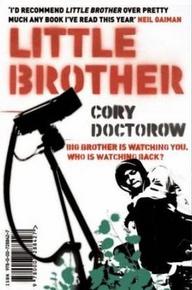
Cover image of the 2008 novel titled Little Brother by Cory DoctorowThere are at least 3 parts to this novel: main story, propaganda, & an overview of the currently available computer privacy technology.

Main story is common enough, but very well told: A teenager in San Francisco is among the many innocents brutally abused by US anti-terror police. He leads a revolution that promises to fix things by the end of the story.

I guess I could identify with the story because of parallels with what I've read of Indira Gandhi's notorious "Emergency" in India during 1975-1977.

Caution: Main story sometimes runs along tracks that will befuddle readers in many countries. E.g., I found nothing to connect with in the sequence that runs several pages & describes teenagers vampire games at some sort of school camp; it was just bloat, though a variation is used later during a political protest.

Propaganda is interwoven throughout the story, & occasionally goes on totally irrelevant tracks. I recall at least one occasion where the author launches into a criticism of British government's citizen tracking systems in an utterly irrelevant context.

Computer privacy technology overview is generally good, but then I'm a programmer & the stuff was generally familiar. Readers from other backgrounds might see these as info dumps.

Caution: Author doesn't always include the all important caveats with privacy technology he advocates (e.g., using TOR to connect to a site that requires a password & communicates the password unencrypted is usually worse than not using it; or that Windows version of TOR might sometimes make you think you are anonymous when you are not). Also there is very good reason much of this tech is not in widespread use - using a lot of it requires the outlook of a computer nerd, & sometimes even that is not enough. But they all have their uses - in specific contexts.

Fact sheet.

First published: 2008.
Rating: A.
Download full text in multiple formats from author's site.
Nominated for Hugo Award 2009 in novel category.
Nominated for Nebula Award 2009 in novel category.
Related: Stories of Cory Doctorow; revolution in fiction

Saturday, May 2, 2009

Nancy Kress' "The Erdmann Nexus" (novella, mysticism, free): Next stage in human evolution is the last one

Whether it is seen as a mystic story probably depends on where you grew up. Indian readers will see unmistakable mysticism here.

Concept is very similar to later parts of Arthur Clarke's "Childhood's End"; & both stories are essentially the same as a major religious doctrine of Hinduism. Let's compare the three:

  1. One of the major beliefs of Hinduism is: there exists some sort of omnipotent universal consciousness, & the ultimate purpose of life is for our existence to merge into this universal entity.

    Universal entity goes by many names depending on sect & locale, but brahm is a not uncommon name. The process of the merger of ... shall we say soul ... of a being with brahm is called moksha.

    Different sects preach their own ideas of good conduct that will let you achieve moksha. Sinners keep getting reincarnated - usually in a non-human body - till they ultimately attain moksha. Depending on sect, moksha can only be achieved from human body, or from incarnation as any animal.

    I've another note on the subject at the end of my "Childhood's End" post too, including a further link.
  2. Clarke's story renames brahm as "Overmind". And eligibility for merger with Overmind is not righteous conduct but a fast-spreading mutation that makes small human children eligible.
  3. Kress' story renames brahm as "the ship". Longer life spans have swelled the number of old people the world over. One fine day, the count of people over 80 years of age exceeds a critical limit, & a telepathic gestalt of these oldies is born. They're the ones whose consciousness is eligible for merger with "the ship"'s consciousness.
Title comes from the name of a central character - Henry Erdmann, one of the old people affected & among the first to recognize the birth of gestalt.

Collected in.

  1. Gardner Dozois (Ed)'s "The Year's Best Science Fiction: Twenty-Sixth Annual Collection" (2009).

Fact sheet.

First published: Asimov's, October/November 2008.
Rating: A.
Download full text from publisher's site.
Winner of Hugo Award 2009 in novella category.
Related: Stories of Nancy Kress; religious science fiction.

Friday, May 1, 2009

Robert Reed's "Truth" (novella, terrorism, free): "Temporal jihadists" from future are wrecking havoc

Quote from short story titled Truth by Robert ReedGreat start, but then it gets mundane.

Story summary.

Some 200 odd (Islamic) terrorists from about 140 years into future have arrived in our world with their advanced weapons, & are wrecking havoc. We get hints that recent US armed action in places like Iraq is at least partly gifts from these from-future terrorists.

One of them - Ramiro aka "Lemonade-7" - is caught & has been in a secret US detention center for over a decade & has been through much torture. And the world has seen much destruction during the period, apparently at the hands of his comrades.

Story is mostly of a psychologist's interrogation of the captured man, until she learns the nature of the weapon used by these visitors from the future & neutralizes it.

Fact sheet.

First published: Asimov's, October/November 2008.
Rating: A.
Download full text from publisher's site.
Nominated for Hugo Award 2009 in novella category.
Related: Stories of Robert Reed; terrorism stories; time travel stories.

Thursday, April 30, 2009

Nina Kiriki Hoffman's "Trophy Wives" (short story, free): Complicated dramatization of harem culture

While I didn't get bored, there wasn't anything to engage me here either. But it's a Nebula winner.

Story summary.

Story is of the escape of Milla, a human girl sold to a rich alien by her mother. Alien is a collector of "women" of many species, including humans, whom he marries & then exhibits in "bubbles" for the pleasure of his visitors; apparantly, this enhances his status in his culture.

In her escape, Milla will be helped by a gestalt of two telepathically-linked women, one of whom is the narrator.

Fact sheet.

First published: Martin H Greenberg & Kerrie Hughes (Eds)' Fellowship Fantastic (anthology). 2008. DAW Books.
Rating: B.
Download full text from publisher's site, or MP3 from StarShipSofa.
Nebula award 2008 winner in short story category.

Monday, April 13, 2009

Jeff Hecht's "The Neanderthal Correlation" (flash fiction, human evolution): Some truths we probably don't want to know!

A researcher is fooling around with genome data of humans & Neanderthals. She finds evidence of their interbreeding during a certain period. So she goes looking for traits humans have acquired as part of this interbreeding.

What she finds is that only a human subpopulation seems to have inherited the essentially-Neanderthal traits. And they are - "advanced mathematics skills, information processing, logic, analytical intelligence, concentration skills, obsession-compulsion & Asperger's syndrome"!

Key things that Cro-Magnons had & Neanderthals didn't were "genes linked to successful socialization & management skills."

And she's found that human genes have been asserting themselves over these acquired one! We as species are slowly but surely losing mathematical & logical reasoning, & such!

Fact sheet.

First published: Nature, 22 May 2008.
Rating: B.

Sunday, April 12, 2009

BSFA Awards 2008: Winners announced

BSFA official site doesn't yet have anything, but the winners' list is all over the net. Here is one, at Torque Control.

Short fiction winner: Ted Chiang's "Exhalation" (download text/MP3).
Related: All short fiction nominees, including download links (all are online).

PS: This award is about fiction originally published in UK during 2008.

Thursday, March 26, 2009

Ted Chiang's "Exhalation" (short story, entropy, free)

Quote from short story titled Exhalation by Ted ChiangI've a feeling this is going to get listed among the all-time best of science fiction.

Story summary.

In an unusual universe, a curious "man", who's also the narrator & an "anatomist", builds a contraption to dissect his own brain! One thing leads to another, & he learns not only how his brain works but that his universe is dying. And that every universe must eventually die.

Explaining the title will spoil some fun; so I refrain from doing it.

Notes.

  1. Couple of paragraphs in later parts of the story reminded me of Isaac Asimov's "The Gods Themselves".
  2. Hal Clement's "Answer": A man's efforts to understand how his brain works result in more success than is healthy!
    This story has been on my "to post" list for a while; might do one of these days.

Collected in.

  1. David Hartwell & Kathryn Cramer (Ed)'s "Year's Best SF 14".
  2. Jonathan Strahan (Ed)'s "Best SF and Fantasy of the Year, Volume 3".

Fact sheet.

First published: Jonathan Strahan (Ed)'s "Eclipse Two: New Science Fiction and Fantasy".
Rating: A.
Download full text in multiple formats from Night Shade Books; or MP3 audio from StarShipSofa.
Added to my "best of the year 2008" picks.
Winner of Hugo Award 2009 in short story category.
Nominated for BSFA Award 2009 in short fiction category.
Related: Stories of Ted Chiang; Apocalypse fiction.

Free fiction: A Hugo 2009 nominated webcomic

Howard Tayler's "Schlock Mercenary: The Body Politic". Download link1 & link2.

[via Boing Boing]

Friday, March 20, 2009

Hugo Awards 2009: Novelette winner, nominees & my rankings

Anticipation has posted this year's Hugo Award nominees. Fiction nominations apply to work originally published during the year 2008.
Update 10 August 2009: Winners announced.

Note: Novelette is 7.5 to 17.5 thousand words, according to Hugo Award definition, with a 20% leeway at boundaries.

Disclosure: Last year's short story, novelette, & novella official winners each happened to be the first on my rankings. In 2007, novella winner was my first preference, short story winner was my second preference, & novelette winner was my last choice! So you know I'm not the official oracle:)
Incidentally, 2007 novelette winner was a story about India, a subject where I usually have preferences very different from those of Western readers - probably because of familiarity.

All stories are online, & I include the download links. Link on author, editor, or publisher name yield more works from the source. Link on story title goes to my post on the story, if I have one. My rating is in brackets.

Novelette nominees (5 stories, best first).

  1. Mike Resnick's "Alastair Baffle's Emporium of Wonders" (A); download; Asimov's, January 2008; fantasy: An enigma is described. Included in my best of the year 2008 list.
  2. John Kessel's "Pride and Prometheus" (B); download from F&SF site, or as part of author's collection "Baum Plan for Financial Independence and Other Stories"; F&SF, January 2008; mildly science fiction: "Pride & Prejudice" meets "Frankenstein". For those who have read neither, it's mostly a description of life of the rich in England a few centuries back.
  3. Paolo Bacigalupi's "The Gambler" (B); download; Lou Anders (Ed)'s "Fast Forward 2": A Vietnamese immigrant to US is working for a near-future newsroom, & is not quite cut out for the job.
  4. James Alan Gardner's "The Ray-Gun: A Love Story" (B); download from publisher's or author's site; Asimov's, February 2008: A mysterious gadget of alien origin is affecting the lives of a young human couple, besides having a purpose of its own.
  5. [winner] Elizabeth Bear's "Shoggoths in Bloom" (B); download text or audio; Asimov's, March 2008: In 1938, a US man has stumbled upon a still-living sea-based bioslave artificially engineered by a lost civilization dating from pre-dinosaur age!! He's going to use it against Germans in the coming war.

    Story has parts dealing with black man, white man issues that readers outside US may not find interesting. They also happen to be irrelevant to the story.

Related.

  1. Hugo Awards 2009: short stories, novellas, novels.
  2. Other awards choosing "best of 2008" fiction: Nebula Awards 2008 (US); BSFA Awards 2008 (UK); Aurealis Awards 2008 (Australia); Prix Aurora 2009 (Canada).
  3. My "best of 2008" picks (includes links to more "best of 2008" lists, including various anthologies that collect last year's fiction).
  4. Last year's Hugos: short stories, novelettes, novellas.
  5. Hugo award fiction (includes past winners & nominees).
  6. Fiction by & about Hugo Gernsback, the man after whom Hugo Awards are named.
  7. "Best of" lists.

Hugo Awards 2009: Short story winner, nominees & my rankings

Anticipation has posted this year's Hugo Award nominees. Fiction nominations apply to work originally published during the year 2008.
Update 10 August 2009: Winners announced.

Note: Short story is upto 7.5 thousand words, according to Hugo Award definition, with a 20% leeway at boundary.

Disclosure: Last year's short story, novelette, & novella official winners each happened to be the first on my rankings. In 2007, novella winner was my first preference, short story winner was my second preference, & novelette winner was my last choice! So you know I'm not the official oracle:)
Incidentally, 2007 novelette winner was a story about India, a subject where I usually have preferences very different from those of Western readers - probably because of familiarity.

I include the download links for stories I know are online. Link on author, editor, or publisher name yield more works from the source. Link on story title goes to my post on the story, if I have one. My rating is in brackets.

Short story nominees (5 stories, best first, unread last).

  1. [winner] Ted Chiang's "Exhalation" (A); download text/MP3; Jonathan Strahan (Ed)'s "Eclipse Two: New Science Fiction and Fantasy"; entropy: A "man"'s quest for knowledge in an unusual universe reveals something unexpected & alarming. Included in my best of the year 2008 list.
  2. Mike Resnick's "Article of Faith" (A); download; Jim Baen's Universe, #15 (October 2008); religion: A robot wants to be accepted as member of a church. Included in my best of the year 2008 list.
  3. [flash fiction] Mary Robinette Kowal's "Evil Robot Monkey" (B); download text/MP3; George Mann (Ed)'s "The Solaris Book of New Science Fiction, Volume 2": Uneasy life of an uplifted chimpanzee among the humans.
  4. Kij Johnson's "26 Monkeys, Also the Abyss" (B); download; Asimov's, July 2008; fantasy: A bunch of monkeys can vanish at will, & later return.
  5. Michael Swanwick's "From Babel's Fall'n Glory We Fled..."; download; Asimov's, February 2008: Not read & likely will not read. I just don't seem to have Swanwick recepters.

Related.

  1. Hugo Awards 2009: novelettes, novellas, novels.
  2. Other awards choosing "best of 2008" fiction: Nebula Awards 2008 (US); BSFA Awards 2008 (UK); Aurealis Awards 2008 (Australia); Prix Aurora 2009 (Canada).
  3. My "best of 2008" picks (includes links to more "best of 2008" lists, including various anthologies that collect last year's fiction).
  4. Last year's Hugos: short stories, novelettes, novellas.
  5. Hugo award fiction (includes past winners & nominees).
  6. Fiction by & about Hugo Gernsback, the man after whom Hugo Awards are named.
  7. "Best of" lists.