Showing posts with label doomsday. Show all posts

Thursday, July 17, 2014

Lester Del Rey's "The Faithful" (short story, doomsday, free)

Uplifted dogs are taking over the civilization, as the last of the Man is dying following a war & then a plague...

Fact sheet.

First published: Astounding, April 1938.
Download full text from Chomikuj.pl (badly formatted HTML; I'd to edit it in a text editor on PC discarding entire HTML header & footer, & saving it as TXT file, before it would read correctly in Moon+ Reader on my tablet).
Rating: B.
Nominated for Retro Hugo Awards 1939 in short story category.
Among the stories from Astounding/Analog issues edited by John Campbell.
Related: Stories of Lester del Rey.

Tuesday, March 11, 2014

Fredric Brown's "Knock" (short story, alien invasion, free)

Going by the comments online, it appears to be among the better known stories of Brown. Not a very believable conclusion, but light fun read.

Story summary.

Aliens called "Zan" have raided earth. They took a few hundred animal specimen alive - among them a man & a woman, & killed off all other life on earth. These specimen, including the humans, have now been put as exhibits in a zoo on earth, & this advanced raiding party of aliens is preparing to claim earth as permanent residence.

The man will pull off a coup of sorts, scaring aliens enough with his
ingenuity to make them leave earth...

Collected in.

  1. Everett F Bleiler & T E Dikty (eds)' "The Best Science Fiction Stories: 1949".

Fact sheet.

First published: Thrilling Wonder Stories, December 1948.
Download full text.
Download audio of X Minus One radio adaptation of this story from Internet Archive. (alt MP3 link)
Rating: A.
Related: Stories of Fredric Brown.

Friday, November 29, 2013

Hal Clement's "The Nitrogen Fix" (novel, apocalypse)

Cover of the novel The Nitrogen Fix by Hal ClementThis is an action packed adventure. Like many other stories of author, it's set on a world with atmosphere toxic to humans but not to their alien friends, only the world is earth! And unlike vast majority of stories of author, this one has real villains, in addition to his standard "nature is adversary enough".

This also has an apocalypse setting common to many modern stories: "a closed human habitat has limited oxygen & if you have a third child, someone from family will have to be thrown out ('nomaded')". Only it's far more readable than almost everything I've seen with this setting.

Story summary.

A couple of thousands years into future, much of the oxygen has vanished from earth's atmosphere, all large animals except humans are dead, even humans are very few & dwindling, nitric acid pollutes all open water sources, & there are violent nitrate based plants prone to explosion.

People live in "closed" cities, with water-pool based airlocks. There also are some hardy nomads, folks who were thrown out of cities because of overpopulation but survived. You cannot venture outside without breathing mask & oxygen tank.

There are also "natives" or "Invadors" or "Observers" - curious galaxy-traveling aliens well suited to this earth atmosphere.

This is the story of a nomad couple, their 5 year old daughter, & their alien friend, who arrive at a city somewhere near Boston coast with supplies of salvaged glass & copper nuggets produced from ocean by "pseudu-life" that still survives. Only the customers have some deadly ideas & all hell breaks loose soon after their arrival...

Fact sheet.

First published: 1980.
Rating: A.
Related: Stories of Hal Clement.

Tuesday, September 10, 2013

Henry Kuttner's "When the Earth Lived" (short story, doomsday, free): When a mad scientist defeated God

This appears to be among the earliest science fiction stories of Kuttner.

Story summary.

Our universe is but an atom in a larger "super-universe". Alien scientists experimenting in one of their labs have been subjecting some matter to the "cosmic ray" generated by a device in their lab - the ray that creates life! "The power of the cosmic ray--the life ray--at first gave life to only those elements which could readily acquire it--organic entities, protoplasm, evolving to man. Now that the cosmic ray is stepped up, the mysterious life force is spreading to all things throughout the Universe."

So the universe has gone bonkers - with rock, sand, metal, & sundry artifacts acquiring a will of their own! Our mad scientist will debug the cause & build a machine to destroy the alien source of cosmic ray. Recently animated matter goes back to its animate state because it hasn't been alive long enough, so life can go on!

Fact sheet.

First published: Thrilling Wonder Stories, October 1937.
Read online at UNZ.
Rating: B.
Related: Stories of Henry Kuttner.

Monday, July 22, 2013

John Varley's "Air Raid" (short story, doomsday, free)

I found it mostly uninteresting to wade through, & you will notice that author has consciously made it difficult for you to comprehend what is going on. But nice positive ending.

Story summary.

In a future where a deadly airborne virus has made earth uninhabitable & the few survivors immune to it have a highly withered body. But a group of these men of the future, with advanced technology including time travel, seem to be up to something nasty.

Much of the story appears to be body snatching raid of an airplane in the past, an airplane about to crash. But their intentions are honorable, as we'll discover in the end...

Fact sheet.

First published: Asimov's, Spring 1977.
Download full text from Baen eBooks.
This story was later expanded into a novel, a screenplay, & a movie, all titled "Millenium".
Nominated for Hugo Award 1978 in short story category.
Nominated for Nebula Award 1978 (or was it 1977) in short story category.

Monday, March 25, 2013

Karel Capek's "War wih the Newts" (novel, satire, free): Man is the lord of Earth. Or is he?

Cover of a collection of two stories of Karel Capek - RUR and War wih the Newts. Image illustrates RUR.
I wonder why this epic doesn't get listed in many classics lists. In my book, it's among the very best of science fiction.

It's a satire on human folly, mostly from the point of view of colonial Europe. There were places that made me wince, but author appears to be only satirizing certain views. It's sometimes very funny, but is occasionally a bit draggy too.

Story summary.

Newts are prehistoric animals living in shallow salt water, unknown so far because the sole small group that survived since prehistoric times lived in a salt water lake on an isolated island. They're intellectually man's equal, but are far behind technologically.

When a group of colonials discover them, they are mercilessly hunted & killed. Only two who survived are being transported back to Europe, but escape en route.

They multiply & thrive in shallow waters near an island. So, of course, when they're rediscovered by the European man, they're fair game for hunting, slavery & worse. Tables will eventually turn, however...

Fact sheet.

First published: 1936 (original Czech).
Download full text from Project Gutenberg of Australia or eBooks@Adelaide.
Rating: A.
Related: Stories of Karel Capek.

Wednesday, February 13, 2013

Fritz Leiber's "The Creature from Cleveland Depths" aka "The Lone Wolf" (novella, gadgets, free): Who could imagine mobile phones would be so evil?

One of the illustrations by Wally Wood accompanying the original publication in Galaxy magazine of short story The Creature from Cleveland Depths by Fritz Leiber. Image shows a man wearing an early version of Tickler on his shoulder.
Well, the story is from long before mobile phones were around, so the gadget (the "tickler") here looks different & works differently.

It begins as an organizer - you tell it to remind you of certain events, & it will at the right time. Reminding is by telling about the event in your ear via an in-ear headphone, plus an insistent "tickling" using two rollers mounted on your shoulder. It runs a very long (audio) magnetic tape - one run lasts a week, with buttons to forward quickly to a certain time. To set an event, you move it specific date/time next week, then speak of the event into it. After you've set the events, the device runs the tape continuously. But most of it is blank, so you don't hear anything till an event is due.

Soon improvements in upgraded versions give it a life all its own, threatening the very human existence...

Very funny early parts & ending, but I thought it was draggy in the middle as the mood begin to set for impending disaster.

Notes.

  1. "Depths" of the title has cold war linkage - "Free World" vs Soviet Union. Because of bomb scare most people live in massive underground caverns that double as bomb shelters. Only a few "outers" live on the surface.
  2. "Creature" of the title is an advanced form of the tickler gadget.

See also.

  1. L Sprague de Camp's "Alanias" (download as part of a larger package): Another story where a voice whispers propaganda into your ear without your conscious self realizing you are being manipulated.

Fact sheet.

First published: Galaxy, December 1962.
Download full text from Project Gutenberg, Manybooks, Feedbooks. [via Becky@ClassicScienceFiction]
Download audio version read by Gregg Margarite from LibriVox.
Alternate audio link at Internet Archive.
Rating: A.
Related: Stories of Fritz Leiber.

Wednesday, September 12, 2012

Mark Trent's "Question Answered" (short story, free): Computer, save the human civilization, please

Illustration by Martin Frew accompanying the original publication in Nebula Science Fiction magazine of short story Question Answered by Mark Trent
While the story itself is minor, it's among the rare ones that require that the idea of Man - what's essential about Man - to be described to a computer (as if one could even describe it to a person)!

Story summary.

Someone has noticed cycles of human civilization - Man rises from a primitive, goes through technology evolution, & eventually falls back to primitiveness. And the cycle repeats. End of current cycle is likely to come a decade from now!

So a question is posed to the great computer: how to escape this cycle? Computer breaks down. Many iterations happen, with different ways of posing the problem. Computer always breaks down. The culprit is imprecise data defining "what is man"?

Later, a session with an expert of humanity will reveal the key to describing man - only telling this key to computer means end of humanity forever, to be succeeded by a computer civilization...

Quotes.

  1. "A machine is a tool--a tool to deal with our environment. It's maker is always beyond it's comprehension. If he's not ... it's no longer a machine."

Fact sheet.

First published: Nebula Science Fiction, #14 (November 1955).
Download full text as part of the scans of the magazine it originally appeared in.
Rating: B. 

Thursday, September 6, 2012

E C Tubb's "Quis Custodiet" (short story, nuclear war, free): Musings on the idea of a "traitor"

An illustration accompanying the original publication of short story Quis Custodiet by E C Tubb in Nebula Science Fiction magazine. The picture does not really depict any scene from the story.
On the surface, this is like any of a whole lot of similar stories - a few military men manning the facility that can trigger the ultimate annihilation of the "enemy", which everyone knows means annihilation of their own side too. And the men breaking down due to stress of so much responsibility. But there was something here that made me like the story - may be optimistic ending, but I actually liked it even before the ending became apparent.

The facility is a space station that's actually a nuclear missile site that can target any place on earth.

Notes.

  1. In real world, we don't hear much about the men with their hands on triggers of nuclear missiles because of secrecy. So I wonder if the set up of this kind of stories is in any way realistic? The story makes an interesting point about the "glorified buck passing" that seems to apply to many more contexts than potential military guilt.

Quotes.

  1. "The Romans had summed it up very nicely in a phrase both synical & apt. Quis Custodiet Ipsos Custodes? Who will watch the watchers? Or, literally, who will protect the people from their own protectors? ... Those who had power invariably abused it & were eventually replaced by others who inevitably followed the same path."
  2. "He feels no guilt at whatever he proposes doing. It's a case of glorified buck passing. He takes orders & blames the man who issues them. The man who issues them probably salves his conscience by telling himself that he won't really be the one to fire the missiles. It's easy to kill if you don't have to pull the trigger."
  3. "Traitor is a bad word--bad that is to those who give it. To others a 'traitor' could well be a savior because a traitor is merely a person who does not do as others decide. No man could ever really be a traitor to himself, not if he did what he believed to be right. And no man could possibly be a traitor if by so being he was instrumental in saving his race."
  4. "Could there be a racial instinct which took control whenever the race was in real danger of total extinction?"

Fact sheet.

First published: Nebula Science Fiction, #14 (November 1955).
Download full text as part of the scans of the magazine it originally appeared in.
Rating: A. 

Monday, May 21, 2012

Jerry Oltion's "You Say You Want a Revolution" (short story): On _creating_ apocalypse...

Quote from short story You Say You Want a Revolution by Jerry Oltion
I'm not sure what to think of it, but it sure is an amusing story that I liked.

Story summary.

Star-faring humanity has a revolution sweeping through Sol. A group of human passengers aboard a ship headed for Sol & discussing the revolution will draw in an alien, a Hronan, to the group. Alien will tell them of other revolutions elsewhere, & why the current revolution of Sol was "inevitable"...

Fact sheet.

First published: Analog, April 2012.
Rating: A.
Added to my "best of 2012" list.

Friday, April 6, 2012

L Sprague de Camp's "Judgement Day" (novelette, doomsday): A man's ultimate revenge against school bullies

Among the rare dark stories of de Camp. A lot of text describes scenes where the protagonist is being bullied by his schoolmates.

A physicist bullied throughout his school years grows up convinced everyone is a bully, or will be given half a chance. Now he's got something to take his revenge on an unkind world, a discovery that allows nuclear destruction of iron - so easy end of the world since it's so abundant in earth's crust.

Should he publish his results, so some crank somewhere will execute his revenge?

Collected in.

  1. "The Best of L Sprague de Camp".

Fact sheet.

First published: Astounding, August 1955.
Rating: B.
Among the stories in Astounding/Analog issues edited John Campbell.
Related: Stories of L Sprague de Camp.

Thursday, September 22, 2011

Don Webb's "Big Ripples Without a Splash" (short story, brain dump, free): Yet another way for humanity to go extinct

One of the illustrations by Rudy Rucker accompanying the original publication in Flurb magazine of short story Big Ripples Without a Splash by Don Webb
While the idea of humanity going extinct because everyone is happier in a brain-dumped digital world is not new, for some reason I liked the version presented here. But this is macabre stuff - so beware.

Story summary.

Let's say Mr X wants to commit suicide for whatever reason other than punishing his loved ones. His death will make the loved ones unhappy. And he has a duty towards providing for some.

So Brian Cornford invented a suicide gadget! It's surgically mated with your body. It eats up your brain after downloading its contents. It then simulates the dead person in his old body in ways that make the simulation undetectable by others!

Notes.

  1. I didn't quite find convincing the ways the invention leads to most people wanting to commit suicide this way.

Fact sheet.

First published: Flurb, #12 (Fall-Winter 2011).
Download full text from publisher's site.
Rating: A.

Tuesday, September 21, 2010

George R R Martin's "... for a single yesterday" (novelette, free): Some choices can be so hard

This is an intensely emotional story - later half of it.

Story summary.

A small group of survivors in a post-apocalypse world has a small quantity of "chronine", a memory drug that makes you remember things with vividness not otherwise possible. Keith, who missed his girlfriend so much, had taken possession of the drug - to time trip to his Sandi. No one minded, seeing his condition.

Now the group has a new, practical, leader who sees a survival value in the drug: to access possibly useful but forgotten information in the heads of the group members. Which side would you vote for - leave it with Keith who obviously needs it so badly, or put it to more practical uses?

Fact sheet.

First published: Roger Elwood & Robert Silverberg (eds)' "Epoch" (anthology, 1975).
Download full text from Lightspeed.
Rating: A.

Wednesday, September 1, 2010

Robert H Wilson's "Out Around Rigel" (novelette, free): An adventure with relativity implications

Illustration accompanying the original publication in Astounding of short story Out Around Rigel by Robert H Wilson
It's not a bad read, but pick it up only on a day when you aren't in a mood to use your head.

Story summary.

There are actually multiple stories here, but woven into a single one:
  1. When man becomes capable of flying to another world, where does he go out first? You might think moon would be a logical choice. But Lunarians don't think like us! Here two Lunarian friends, one of them a super-inventor, have their maiden space fight's target as the Rigel system some 500 lightyears away!
  2. A love triangle - two men & a woman. Both men love the woman; she loves only one of them. One of the men thinks the issue should be settled with a duel. Where would the two go out to duel? A somewhat open place nearby? Wrong. Geniuses don't think like normal people!!
  3. Third main thread is about the implications of traveling at relativistic speeds - implications from people's point of view.

See also.

  1. Hal Clement's "Uncommon Sense": A variant of "duel" in a somewhat similar environment, but a much better thought out story.

Fact sheet.

First published: Astounding Stories, December 1931.
Download full text from Project Gutenberg. [via Butch Malahide @rasfw]
Rating: B.

Saturday, July 17, 2010

Bruce W Ferguson's "Goliath" (flash fiction, humor, free)

Don't expect humanity to unite, even when faced with an extinction threat...

Fact sheet.

First published: Nature, #460 (9 July 2009).
Download full text from The Science Fact & Science Fiction Concatenation. [link via SF Signal]
Rating: A.

Tuesday, June 8, 2010

Philip K Dick's "Second Variety" (novelette, doomsday, free): Retelling Joseph Kelleam's "Rust"

While Kelleam's classic is more in the mood of Ray Bradbury's "There Will Come Soft Rains" (download text/MP3), & Arthur Clarke's "The Curse" & "If I Forget Thee, Oh Earth ...", Dick's version has more action. Kelleam's version is told a long time after humanity is gone, killed by its own war robots gone berserk, this one is told while the process is still happening. And the robots here are more resourceful.

Notes.

  1. While there is the suspense about the "second variety" of robots that is supposed to be revealed only in the end, it was actually clear about half way through the story - just a little after the idea of varieties comes up.

Fact sheet.

First published: Space Science Fiction, May 1953.
Download full text from Project Gutenberg, Manybooks, Feedbooks, Internet Archive.
Caution: HTML version of the story at Project Gutenberg contains an illustration that is a story spoiler.
Download audio from LibriVox.
Rating: A. 
Related: Stories of Philip K Dick.

Saturday, April 24, 2010

"In the Ruins"

This website is dedicated to listing post-apocalyptic literature - in movies & print. Browse by medium or disaster type.

Related.

  1. Doomsday fiction.
  2. Apocalyptic SF reading list based on The Routledge Companion to Science Fiction (2009) (mostly classics, with download links where online copy is available).
  3. "best of" lists.

Tuesday, April 20, 2010

Sydney Fowler Wright's"Automata" (short story, singularity, free)

One of the early stories about singularity, long before the term was coined. And a much better read than John Campbell's "The Last Evolution" (download), another early story on the subject.

Story summary.

Three untitled but connected stories that explore the implications of ever more capable machines - first must have read like a rant when it appeared, but now appears so prophetic; second, a funny tale of gossip among 4 women from far future, records a major milestone on the path to man's elimination by machines; last is a dark story of the end of the last man.

Notes.

  1. I find it curious that even in future so far off, "the Eastern races had been led to destroy themselves" before the presumably Western ones!

See also.

  1. The way human rebels are taken care of in "Automata" reminded me of Joseph E Kelleam's "Rust", one of the very best dystopian classics of the genre.

Fact sheet.

First published: Weird Tales, September 1929. [via Earl Kemp]
Download full text.
Rating: A.
Related: Stories of Sydney Fowler Wright; Fiction from 1920s; Tuesday Classics.

Wednesday, April 7, 2010

Jack Williamson's "Gateway to Paradise" (novel, doomsday, free): A British invasion of US in future

Illustration accompanying the novel Gateway to Paradise by Jack Williamson in 1953 anthology Wonder Story Annual, Vol 2 No 1, edited by Samuel MinesI'll call it a "time pass" story - to use a colloquial term popular in India. Leave your brains somewhere, & enjoy the generally mindless adventure. I actually started liking it once the adventure really began, but it's a mindless story anyway.

Story summary.

A passing Dwarf sometime in 1940s sucked away earth's atmosphere, oceans & moon, leaving earth sterile of life. Everywhere except in US, where someone with forethought to cover in some kind of a force field ("Ring", "Barrier") that bars any kind of material transfer. So now, 200 years later, US continues to live happily in its transparent cocoon, but there is no life anywhere else.

OK - there is life elsewhere. Some British survivors built domed cities of New Britain somewhere on the now dry Atlantic bed - some 3000 miles from US eastern shore.

And these Britishers are angry at US - for having survived. So they're out to destroy the machine that keeps the US screen. And they've found a way to cross the Barrier.

Of course, a US hero will save the motherland. And because the enemy is Britain (rather than Russia - see similar Murray Leinster stories, e.g.), US continues to have friendly feelings towards attackers. And of course, we later discover the British aren't all evil - only some are extremists (& they too are finally converted).

Happy ending for all, as the lost moon returns now - on an impact course with earth! Which makes both sides join hands to shift its trajectory - Britain for its rockets, US for its force field that can be made to even stop gravity transfer across the screen! Earth will get some of its atmosphere & water back, & become habitable again as moon breaks up on near approach. You see, moon was hoarding part of earth's atmosphere sucked away earlier! And didn't you know moon is mostly ice?

See also.

H G Wells' "The Star" (download as part of a Wells' collection at Project Gutenberg) is probably the most widely read story of a large cosmic body passing near earth & wrecking havoc here due to gravitational interference.

A transparent force-field barrier covering a part of space is a very common trope. Some stories that immediately come to mind:
  1. Arthur Clarke's "The Sentinel" & "What Goes Up": Former has a barrier aliens erected around one of their artifacts on moon. Later has a spherical barrier created by a nuclear accident in Australia.
  2. James Blish's "Cities in Flight" series of stories has whole cities covered in a barrier that keeps atmosphere etc & then plucked off ground, to wander through space! Most stories are told from the point of view of this avatar of Manhattan part of the New York city.
  3. Murray Leinster's "Invasion": A single invader immobilizes most of US air force using such a barrier.

Collected in.

  1. Samuel Mines (ed)'s "Wonder Story Annual, Vol 2 No 1 (1953 Edition)".

Fact sheet.

First published: Startling Stories, July 1941.
Download full text as part of a larger package.
Rating: B.
Related: Stories of Jack Williamson.

Tuesday, March 9, 2010

Clark Ashton Smith's "Phoenix" (short story, free): Reigniting a dead sun

Quote from short story titled Phoenix by Clark Ashton SmithSeveral millennia back, sun suddenly cooled & died - "in a term of years historic rather than geologic." Earth is now a frozen world - even the air is frozen. Descendants of the few survivors, now numbering only thousands, live in vast underground caverns.

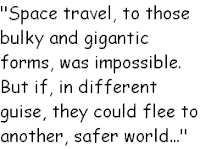
Someone gets the bright idea of reigniting the sun! Drop a few carefully chosen ancient nuclear bombs at strategic locations on the sun, hopefully restarting the old chain reactions!

Team of 6 that flies to sun to execute the project will die because of a technical error, but sun (& hence earth) are reborn.

See also.

  1. Fritz Leiber's "A Pail of Air" (download text, MP3 reading, & MP3 of dramatization): A dark sun visiting Sol has stolen the earth, turning it into a frozen world as it moves away on its own path away from Sol.
  2. Fred Hoyle & Geoffrey Hoyle's "Rockets in Ursa Major": Strategic bombing of sun so it would produce more deadly radiation to drive away the alien raiders of earth!
  3. Hal Clement's "Half-Life": All life on earth is in crisis & is dying out, as if it's the natural end - a theme that briefly appears in "Phoenix" & is the starting point for the mad project of reigniting the sun.

Fact sheet.

First published: August Derleth (ed)'s "Time to Come" (anthology, 1954).
Download full text from Eldritch Dark.
Rating: A.
Related: Tuesday Classics; fiction from 1950s.

Thursday, February 4, 2010

Real science: Rare picture of possible asteroid-asteroid collision

Image of an asteroid-asteroid collision in inner solar system taken by Hubble Telescope in January 2010Picture: Has links to image in 3 different resolutions, plus some commentary.

Details of the Hubble-photographed image & its possible interpretation at HubbleSite.

Object in photograph is called "P/2010 A2" - looks like a comet but isn't. First seen on 6 January 2010.

"If this interpretation is correct, two small and previously unknown asteroids recently collided, creating a shower of debris that is being swept back into a tail from the collision site by the pressure of sunlight".

"At the time of the Hubble observations, the object was approximately 180 million miles (300 million km) from the Sun and 90 million miles (140 million km) from Earth."

[via James Nicoll]

Related: Ross Rocklynne's "Time Wants a Skeleton": A group of adventurers unwittingly time travel to the "fifth planet" days before it is to be impacted by a large body from space - an impact that would create the current asteroid belt between Mars & Jupiter from their debris.

Non fiction: How much of modern knowledge can survive even a 50 year loss of civilization?

Tom Simonite & Michael Le Page do some well thought out, if familiar, speculation on the subject at New Scientist.

"if the power was cut off to the banks of computers that now store much of humanity's knowledge, and people stopped looking after them and the buildings housing them, and factories ceased to churn out new chips and drives, how long would all our knowledge survive? How much would the survivors of such a disaster be able to retrieve decades or centuries hence?"

[via Bruce Sterling]

See also: Fredric Brown's "The Waveries" - happy-go-lucky story where civilization goes on pretty much undisturbed after it's no longer possible to produce electricity in any form, not even as ignition to start a car engine or lightning, because invading aliens feed on it!

Tuesday, February 2, 2010

Henry Kuttner's "Beauty and the Beast" (short story, irony, free): Appearance can be deceptive. And dangerous when coupled with prejudice.

Quote from the short story titled Beauty and the Beast by Henry KuttnerTelling style is very pulp-era, but I liked the story as a whole. And there is a distinct similarity with some parts of Mary Shelley's "Frankenstein".

Story summary.

An ordinary farmer has come into possession of a hibernating alien & some seeds of pretty flowers the first human explorer to Venus (who returned dead) brought back. Farmer brought the alien to life & planted the seeds.

Pretty flowers that resulted were very popular & easy to grow, & their cultivation spread throughout earth.

The alien who emerged was actually of the now extinct Venusian dominant race. Huge dinosaur sized reptilian ("Beast" to humans), very intelligent & full of gratitude for humanity. Communicating with humans, however, is tricky because of their prejudices about his appearance, but the warning he must give them is urgent...

Very Kuttnerian ending.

Fact sheet.

First published: Thrilling Wonder Stories, Fall 1940.
Download full text.
Rating: A.
Related: Stories of Henry Kuttner; Tuesday Classics.

Thursday, January 14, 2010

Henry Kuttner & C L Moore's "Time Enough" (as by Lewis Padgett) (short story, immortality, free): Sometimes the best argument is a demonstration

Quote from short story titled Time Enough by Henry Kuttner and C L Moore, writing under their joint pseudonym Lewis PadgettParts of it feel like Mary Shelley's "The Mortal Immortal" (download).

Story summary.

A nuclear catastrophe destroyed most human culture & artifacts. Among the human survivors were a few people with a mutation - they were practically immortal. Immortal, but aging in a natural way - so senility, bodily troubles, etc are norm among them.

Now, 500 years down, a new human civilization has arisen. With "Old 'Uns" isolated by the government to avoid envy among the normals.

But Sam Dyson, working with radiation in a lab, has figured out a way to achieve immortality. How do the powers-that-be convince him to give it up? Well - they do have an effective argument, but it doesn't involve speaking...

Fact sheet.

First published: Astounding, December 1946.
Download full text.
Rating: B.
Listed among the stories from John Campbell's Astounding/Analog.
Related: Stories of Henry Kuttner, C L Moore (as by Lewis Padgett); Stories involving immortality; Mutants in fiction.

Tuesday, December 1, 2009

Stephen Baxter's "Kelvin 2.0" (flash fiction, apocalypse, free)

Via a one-sided conversation in the year 2107 between narrator & a computer simulation of Lord Kelvin (I didn't know his real name was "William Thomson", "1st Baron Kelvin"!), we learn about the serious implication of a fundamental process of the universe the Physics has now unearthed: that "Space-time itself has a half-life" & "that in a mere billion more years, nothing corporeal will survive - no atom, no star, no human."

Fact sheet.

First published: New Scientist, 16 September 2009.
Download full text from publisher's site. [via Best Science Fiction Stories]
Rating: B.
Related: Stories of Stephen Baxter; doomsday fiction; weird physics fiction.

Tuesday, November 10, 2009

"Apocalyptic Fiction"

rasfw recently did a listing of fiction with this theme.

Monday, November 2, 2009

Tom Godwin's "Mother of Invention" (novella, problem solving, free)

Quote from short story titled Mother of Invention by Tom GodwinIt's not unreadable, but I might have come back happier if the author had not complicated an already very complex problem & had solved the problem without using magic wands. In a way, it's like author's "The Survivors" - a group is marooned on a world with no apparant means of returning to civilization - but I found it far less engaging.

Story summary.

Five fortune hunters are marooned on Aurora - a hitherto unknown earth type world full of diamonds - diamond boulders, diamond encrusted rocks, diamond saturated dust, ... They'll soon find how anti-life too much diamond can be.

Their spaceship is rendered useless by explosion triggered by diamond dust, & the world they're on is due for apocalypse some 7 months down the line - to be caught in a nova as an alien sun hits this carbon rich world & then the nova absorbs the local sun.

After some preliminaries, we are presented with two choices: either they find a local source of uranium, or they must invent antigravity! Of course, our heroes are made to choose the later. And they will not only invent the antigravity in given time, but take their fortune home - their antigravity machine is powerful enough to take whole of the world they're on home!

Fact sheet.

First published: Astounding, December 1953.
Rating: B.
Download full text from Baen CD.
Listed among the stories from John Campbell's Astounding/Analog.
Related: Stories of Tom Godwin.

Tuesday, September 8, 2009

Q B Fox's "while (bDarwin) {" (flash fiction, software dystopia, free)

Very widely deployed software products can get a life all their own, affecting our lives in ways no original programmer could have suspected...

Notes.

  1. For readers who find the title incomprehensible gibberish: it's a line of programming code that could have come from many common languages - including C++. Story text, however, doesn't require any special knowledge & should be broadly accessible.

Fact sheet.

First published: 365tomorrows, 5 September 2009.
Rating: A.
Download full text from publisher's site.

Two classes of disaster stories

From Paul McAuley's "When It Changed":

  1. "disaster is so complete and overwhelming, and so sudden, that it forms a distinct and abrupt break with its past (our present)." He lists several examples.
  2. "The catastrophe is not caused by one thing but is woven from many causes. And these do not cause an abrupt change and a clean break with the past, but drive a slow and complex process of transformation with an unclear endpoint... They tends towards the satiric mode; lean towards the dystopian but don’t entirely embrace it." Examples: "Bruce Sterling’s Distraction, my own Fairyland."
Related: Stories of Paul McAuley.

Monday, August 31, 2009

Raymond Z Gallun's "Seeds of the Dusk" (novelette, biological warfare): How Martians exterminated the descendants of humanity

Quote from the short story titled Seeds of the Dusk by Raymond Z GallunWhile I could pick many holes in the story, they're irrelevant. I'll any day put this story among the very best science fiction has on offer.

Story summary.

A single seed of sentient Martian plant has reached earth - of the millions thrown from there. But that is enough.

Story is set billions of years in future, when earth is near the dusk of its habitability. But that's the time Martians find the world in its prime.

Ensuing conflict of alien with human-descended & barbaric Itorloo will end with extermination of Itorloo. Aliens' technique: trap a single Itarloo specimen, study his body chemistry, manufacture a fatal-only-to-Itorloo highly contagious germ with a long gestation period, & release the specimen back in the wilds to infect everyone else.

Collected in.

  1. Raymond J Healy & J Francis McComas (Eds)' "Adventures in Time and Space".

Fact sheet.

First published: Astounding, June 1938.
Rating: A.
Listed among the stories from John Campbell's Astounding/Analog.

Saturday, August 29, 2009

Real life version of Kuttner & Moore's "Vintage Season"

Carissa Bluestone's "See it Before it Disappears: Reconciling and Regulating Disaster Tourism" (long article) in WorldChanging. [via Bruce Sterling]

Related: Kuttner/Moore's story.

Monday, August 10, 2009

Murray Leinster's "Sidewise in Time" (novella, parallel universe): What if our universe is "closed" & subject to influenced from "outside"?

Quote from short story titled Sidewise in Time by Murray LeinsterSaid to be the first parallel universe story. And among the early alternate history stories.

"Sidewise Awards" are named after this story.

I didn't come back as impressed as the reputation of the story suggests. But that could be because

  1. I've read it three quarters of a century after publication!
  2. And alternate history parts - like most alternate history fiction - will likely have only local appeal, in these case only for US readers. Mostly adventures in parts of US where alternate universe versions have replaced normal land - like where Chinese colonized US, ...
Caution: It's been a while since I read this story. Descriptions are accurate to the extent I recall, but I'm not inclined to read it again for this post.

Story summary.

Professor Minott, "instructor in mathematics on the faculty of Robinson College in Fredericksburg, Va", is one of the few who has an idea of strange upheaval happening everywhere - like familiar sight across the road getting replaced with strange scenery. Cross the boundary, & you are in a parallel universe. With the turmoil still on, you might never be able to return to your original universe. Signs have been around a while, in the form of much stranger physical phenomena.

Professor knows exactly what he wants: take his secret lady love "Maida Hayns, daughter of the professor of Romance languages" & cross as many of these parallel universe boundaries as needed - till he is in a timeline where he can call the shots & live happily ever after.

He will also take some other students - 3 other couples - along on horses & with guns. Not only the students not take kindly to his one-sided affections for the girl, but the group have many adventures among the people populating alternate versions of US (mostly cliched versions of alternate cultures, obviously inferior to that of adventurers!)

By the end of the story, all students including Maida, will return to our universe. All but one. One of the girls, Lucy Blair, will go with Prof on his parallel universe adventures.

Collected in.

  1. J J Pierce (Ed)'s "The Best of Murray Leinster".

Fact sheet.

First published: Astounding Stories, June 1934.
Rating: B.
Related: Stories of Murray Leinster.

Wednesday, August 5, 2009

Patricia Stewart & J S Kachelries' "Phosphorousdimethylbenzaldpotassiumdicholoroethane" (flash fiction, global warming, free)

Fancy title is the name of a fictitious substance that when released in mesosphere helps breaking up much larger quantities of atmospheric carbon dioxide into component carbon & breathable oxygen.

Now, years since this program was initiated, a man has found a dangerous side effect of this reaction...

Fact sheet.

First published: 365tomorrows, 2 August 2009.
Rating: B.
Download full text from publisher's site.
Related: Stories of Patricia Stewart.

Tuesday, July 21, 2009

Murray Leinster's "The Grandfathers' War" (novella, family dispute, free): When kids won't talk to parents...

Quote from short story titled The Grandfathers War by Murray LeinsterConsider this scenario in the context of a family:

  1. Family is going through an economically bad patch; so a child goes to work at an early age.
  2. Parents begin to expect more & more from the working child.
  3. At some stage, years later, child realizes the missed fun & begins to resent.
  4. A significant event, & the child drifts away from family.
I've seen it played out more than once. This story is a drastic variation of it, & on a much larger scale.

Story summary.

Phaedra II is a human colony world, & its sun is showing signs of going nova - only it's difficult to say in how many years.

Its folks locate an alternate uninhabited world Canis III, & begin shipping the population there. Since there is not enough transport to move everyone together, & the new world needs to be prepared, they begin with shipment of young people of working age - both male & female. Then younger children - who obviously need to be cared for by original load; then even younger; then babies; ...

Original shipload have now had enough, & have decided their parents are simply exploiting them & that they don't want to deal with their parents anymore. So attempt to ship older women is blocked - kids refusing to allow them on their world so they won't have additional mouths to feed, parents getting desperate as the old sun shows of going nova any time. There is a stalemate.

An external agency, in the form of a supremely capable man named Calhoun, will finally force the beginning of a patch up process..

Fact sheet.

First published: Astounding, October 1957.
Rating: A.
Download full text from Webscription.
Listed among the stories from John Campbell's Astounding/Analog.
Related: Stories of Murray Leinster.

Thursday, June 25, 2009

Some stories about disasters

List below was seeded from written fiction mentions in Aris Mousoutzanis' non-fiction article "Apocalyptic SF" in "The Routledge Companion to Science Fiction" (2009). Presumably genre-defining works, but I've not read many. List is almost entirely of novels; short fiction is generally absent.

I wasn't paying a lot of attention to things other than fiction mentions, but here is an incomplete list of common formulae the article mentions:

  1. "Viral" sf - a plague causes apocalypse.
  2. Insensitivity of society to environment causes disaster.
  3. "Resurgence of a pre-modern, pre-industrial past".
  4. "Invasion scare".
Download links are mine, as is some commentary. Links on title go to my post on story, if there is one. Links on author or year yield more matching fiction.

List of stories.

List is not in order of mentions in the article, but by publication year.
  1. Anonymous' "Reign of King George VI"; 1763.
  2. Louis Sebastien Mercier's "The Year 2440: A Dream If Ever There Was One"; 1771: Google search lists many articles that call this story a utopia, instead!
  3. Mary Shelley's "The Last Man"; download; 1826: Original "viral" sf novel where the disaster is caused buy a plague. 'Based on Jean-Baptiste Cousin de Grainville's poem "The Last Man" (1805)'.
  4. Edgar Allan Poe's "The Masque of the Red Death"; download as part of a larger package; 1842.
  5. George Chesney's "The Battle of Dorking"; download Harvard University version or University of California Libraries version; 1871: Original "invasion scare" story.
  6. Richard Jefferies' "After London, Or, Wild England"; download; 1885: "Introduces a mode of writing that would later evolve into the post-holocaust novel of survival, as well as later narratives of natural disaster".
  7. Robert Cromie's "The Crack of Doom"; download; 1895.
  8. H G Wells' "The Time Machine"; download text/MP3, or George Pal's 1960 movie based on this; 1895: Speculating trends in human evolution based social organizations of industrial society.
  9. H G Wells' "The War of the Worlds"; download text/audio; 1898: First work with "almost sadistic fascination with representing massive destruction in minute detail."
  10. Jack London's "The Scarlet Plague"; download; 1912.
  11. H G Wells' "The World Set Free"; download; 1914: 'First novel to mention an "atomic bomb"'.
  12. Olaf Stapledon's "Last and First Men"; 1930.
  13. Olaf Stapledon's "Last Men in London"; 1932.
  14. Richard Matheson's "I Am Legend"; 1954.
  15. Nevil Shute's "On the Beach"; 1957.
  16. Walter M Miller, Jr's "A Canticle for Leibowitz"; 1959: Post nuclear apocalypse, Catholic monks preserve what little of previous knowledge they can - via a religious cult.
  17. J G Ballard's "The Drowned World"; 1962.
  18. Michael Crichton's "The Andromeda Strain"; 1969.
  19. Angela Carter's "Heroes & Villains"; 1969.
  20. John Christopher's "The Prince in Waiting"; 1970.
  21. Doris Lessing's "Memoirs of a Survivor"; 1974.
  22. Marge Piercy's "Woman on the Edge of Time"; 1976.
  23. Angela Carter's "The Passion of New Eve"; 1977.
  24. Russell Hoban's "Riddley Walker"; 1980.
  25. Greg Bear's "Blood Music"; 1983.
  26. William Gibson's "Neuromancer"; 1984: "For cyberpunks, the catastrophe had already happened, after the advent of cyberculture & consumer culture".

    I could not finish more than 20% of this obviously very influential novel about cyborgs & AIs - going by the number of stories that have copied its plot elements. I found it utterly unreadable.
  27. Kim Stanley Robinson's Three Californias trilogy; 1984-1990.
  28. Denis Johnson's "Fiskadoro"; 1985.
  29. Octavia Butler's Xenogenesis trilogy; 1987-1989.
  30. Neal Stephenson's "Snow Crash"; 1992.
  31. Margaret Atwood's "Oryx & Crake"; 2003.
  32. Kim Stanley Robinson's Science in the Capital trilogy; 2004-2007.
  33. Cormac McCarthy's "The Road"; 2006.
Related: "best of" lists.

Monday, June 8, 2009

Murray Leinster's "The Mad Planet" (novelette, adventure, free): Beginning of the Man's return to sentience after a major environmental disaster

Quote from short story titled The Mad Planet by Murray LeinsterAmong the best known stories of Leinster, & the first in a series of 3. The fix up novel, The Forgotten Planet, combines the 3 stories, moves the location away from earth, & has a silly ending. But this post is about the original & the best known story of the lot.

Story summary.

For unknown reasons, earth's interior began spewing carbon dioxide. By the time things settled down, earth had returned to carboniferous era - low oxygen, lot of carbon dioxide in atmosphere.

30,000 years later, most humans, animals & plants are dead. This is a world dominated by giant fungi & insects - insects far more dangerous than the worst mammals we know. Some tiny isolated tribes of what were once human survive; but they're physically transformed beyond recognition, have lost not only all technology including fire making but most language & indeed sentience. This is the story of man's beginning of the return to sentience & hopefully greater things.

20 year old Burl, the hero of this story & the series, is out to hunt something special to impress Saya, the girl of his tribe he has a soft spot for. The hunt will turn into a major adventure, & by the time he returns several days later, he will be a different man.

Quotes.

  1. "He was ignorant of fire, metals, or the uses of stone and wood. A single garment covered him. His language was a meager group of a few hundred labial sounds, conveying no abstractions and few concrete things."
  2. "Only a man attempting to advance in the scale of civilization tries to explain everything. A savage or child is content to observe without comment, unless he repeats legends from wise folk possessed by the itch of knowledge."
  3. "Even in the high civilization of ages before, few men had really used their brains. The great majority had depended on machines and leaders to think for them."
  4. "There is something strangely daunting in the actions of an insect. It moves so directly, with uncanny precision, utterly indifferent to anything but the end in view. Cannibalism is almost universal. The paralysis of prey, so it remains alive and fresh--though in agony--for weeks on end, is commonplace. The eating piecemeal of still-living victims is a matter of course.

    Absolute mercilessness, utter callousness, incredible inhumanity beyond anything in the animal world is the way of insects. And these vast cruelties are performed by armored, machinelike creatures with an abstraction and a routine air that suggests a horrible Nature behind them all."
  5. "30,000 years of savagery had not lessened Saya's femininity. She became aware that Burl was her slave, that these wonderful things he wore and had done meant nothing if she did not approve."

Fact sheet.

First published: The Argosy, 12 June 1920.
Rating: A.
Download full text from The Wondersmith.
Related: Stories of Murray Leinster.

Friday, June 5, 2009

H P Lovecraft's "The Colour Out of Space" (novelette, Cthulhu?, free): Alien hatchery in a human village

Quote from short story titled The Colour Out of Space by H P LovecraftMay be it was original when it first appeared nearly a century ago. I've seen its elements in so many stories that it generally left me untouched. Still, not a bad read.

Wikipedia says it's one of author's "most anthologized works".

Story summary.

A meteorite falls in a village somewhere on earth. Only it's not a meteorite - it's a cocoon containing ... sort of ... eggs of some alien life form.

Only their metabolism isn't very compatible with earth life. Or may be they're just feeding. In any case, their hatching days will wreck havoc to life in the neighborhood - dead harvests, dead animals, a whole family apparently killed as alien food, ...

Eventually, one hatchling will be big enough & strong enough to leave earth. But there is evidence that at least one is still here - may be it's not yet well fed enough...

Notes.

Alien hatchlings are described as beings perceivable to us as strange colors. This kind of description seems to be not uncommon when the idea is to convey something creepy & beyond our comprehension. E.g., God in Eric Frank Russell's "Hobbyist", & a member of ancient lost race in Abraham Merritt's "The Moon Pool"; there are other examples too.

Fact sheet.

First published: Amazing Stories, September 1927.
Rating: B.
Download full text from Dragon Bytes or Mythos Tomes. [via Best Science Fiction Stories]
Note: This post is based on Dragon Bytes version linked above (which has many spelling mistakes). BSFS links a different version that takes forever to download in my browser. I just saw Mythos Tomes version, & haven't read it. There are more versions online.
Note 2: ISFDB says this story is part of "Cthulhu Mythos" series. So I suppose the aliens depicted here are famous ones?
Movie adaptations: Daniel Haller's "Die, Monster, Die!" (1965); David Keith's "The Curse" (1987); (in Italian) Ivan Zuccon's "Colour from the Dark" (2007); (in German) "Die Farbe" (2008) (Director?).
Alternate titles associated with probably movie versions: "Monster of Terror", "The House at the End of the World", "The Farm".

Tuesday, May 19, 2009

William Tenn's "Brooklyn Project" (short story, butterfly effect, free): Governments can get away with anything in the name of security

Quote from short story titled Brooklyn Project by William TennMain idea satirizes US government around the beginning of cold war with USSR. Apparently, the security excuses got to crazy limits - enough to bug the author, in any case. But theme seems to be so universal; readers everywhere & at all times should find something familiar. And it's an interesting colorful story even without its political overtones.

Story summary.

"Brooklyn Project" is on the lines of "Manhattan Project" - developing a "chronar", a kind of time travel device, in extreme secrecy. It works as a see-saw that moves through time - something you want to send in one time direction, & another nearby counterweight that goes in the other direction for balance. Government thinks it's the ultimate weapon, since you could put one near an enemy target & move it in some time direction to ensure the whole enemy city or country moves through time in a different direction!!!

At the heart of the story is a cocky but unnamed government official, "the acting secretary to the executive assistant on press relations", whose attitude symbolizes that of the government. He is briefing a group of a dozen journalists about an experiment about to be conducted: a recording device will be sent 4 billion years into the past, & a corresponding counterweight will go appropriate distance in future. Two will see-saw, damping half the time-distance every iteration. At each stage, the device will capture vital data about the earlier earth.

Only, the minor differences the visit makes to a few molecules in these distant times begins to have crazy butterfly effects in our time. But only reader will notice that; government official is as arrogant as in the beginning since no one living can notice the difference...

See also.

  1. Ray Bradbury's "A Sound of Thunder" (1952): Very similar plot idea - minor past modification by time travelers changes now noticeably. This Bradbury story is probably far more widely read then Tenn's; but to me at least, it reads like an amateur piece (yes, I know saying this is sacrilege to some) compared to Tenn's classic. Also, Tenn's came first.

    Note: Use of the phrase "butterfly effect" to designate unexpected associations in chaotic phenomena apparently has a linkage to this Bradbury story.
  2. A E van Vogt's "Seesaw" (1941): The idea of a sort of see-saw in time travel - two counter-masses traveling simultaneous in opposite time-directions - is also found in this earlier story of Van Vogt.

    Tenn is a professed fan of Van Vogt - so idea might have been consciously borrowed.

    This Van Vogt story, incidentally, is the first of a series of variations on the same idea that probably includes a novel too. Best known titles of the series are a short story (+ novel pair?) called "The Weapon Shop" aka "The Weapon Shops of Isher". In my book, "Seesaw" is a more interesting story, even if less well known. Possibly because I've little taste for feudal societies, something the "The Weapon Shop" features but the original doesn't.

Collected in.

  1. Isaac Asimov & Martin H Greenberg (Eds)' "Isaac Asimov Presents the Great SF Stories 10 (1948)" (anthology).

Fact sheet.

First published: Planet Stories, Fall 1948.
Rating: A.
Download full text from Mindless Blather (later needs scrolling down; story begins about half way down the page).
Related: Stories of William Tenn; time travel fiction.

Monday, May 4, 2009

J G Ballard's "The Autobiography of J.G.B." aka "The Secret Autobiography of J. G. B******" (short story, apocalypse, free)

Illustration accompanying the reprint of the short story titled The Autobiography of JGB by J G Ballard in The New YorkerIt didn't really make sense to me, but well ... it's Ballard.

Story summary.

One fine morning, "B" woke up to strange quiet. Much of the story is of his discovery that the population of at least England & France (& perhaps the world) has mysteriously vanished without a trace (save himself)!

Fact sheet.

First published: First published: "in French in Etoile Mecanique, July 1981-March 1982" (under what title?) First English appearance in "Ambit, #96, Spring 1984".
This post is based on the English reprint that appeared online in The New Yorker, 11 May 2009, under the title "The Autobiography of J.G.B." This form of title seems to have been used for the first time by The New Yorker, which also doesn't acknowledge any previous publication.
Rating: C.
Download full text from The New Yorker.
Related: Stories of J G Ballard; doomsday fiction.

Thursday, April 9, 2009

Fred Hoyle's "The Black Cloud" (novel, first contact): Sol gets an unusual visitor

Cover of the 1957 novel titled The Black Cloud by Fred HoyleThere are two closely linked but generally independent stories of about equal size here - both based on very familiar plots, but very well told:

  1. A planet or star-sized galactic wanderer comes close to or inside Sol, wrecking havoc on earth. The story it most reminded me of was Edgar Allan Poe's "The Conversation of Eiros and Charmion".
  2. First contact with an alien sentient being. While there are a lot of difference, the story it most reminded me of was Voltaire's "Micromegas".
Story spends quite some time on descriptions of digital computers & radio communications networks that now are quite dated, but make a fun read. I'll hopefully collect quotes in a separate post.

Tone is hard sf, but not the dry sort. There is a lot of humor here. And for a grim hard sf plot, it makes a rather light reading.

Part 1: Celestial wanderer wrecks havoc on earth.

Circumstances & luck conspire to make two separate groups of astronomers in US & UK come together & discover that Sol has a celestial visitor: A cloud with dimensions about the size of earth's orbit around the sun, with density much higher than usual for interstellar clouds, with a mass two thirds Jupiter, currently in outer solar system, & headed straight for earth & Sun. Earth has 16 months to prepare - if it can.

Top scientific men involved inform politicians, hoping they will do the needful.

Politicians controlling the government in both US & UK do the following:
  1. Hide the facts from public.
  2. Practically arrest the men bringing in the bad news - so news cannot leak!
  3. There are hints that since only a few can be saved, it will be mostly the rulers!
But one man among the original discoverers - Chris Kingsley, 38 & a Professor of Astronomy in the University of Cambridge, who figured out the expected location, mass, etc of foreign body based on unusual observed perturbations of outer planets - knows the political class too well. He maneuvers things in such a way that he ends up being in charge of a rather well equipped lab & emergency shelter in Nortonstowe, a place in "Cotswolds, on high ground to the north-west of Cirencester", UK - while making the politicians thing they are driving him around. In days ahead, this lab will play a key part in the unfolding drama.

A substantial part of this first part is a kind of satirical look at British politicians occupying high offices.

Usual apocalypse scenario plays out eventually, with a lot of people killed all over the world - because of major weather changes as the clouds hides the Sun for a while, & because of effects of friction as earth's outer atmosphere & cloud come in contact.

Part 2: First contact.

In the post-apocalypse world, Nortonstowe is a central communications facility in the world because Kingsley had the foresight to build radio equipment with high bandwidth & able to operate over a larger range of frequencies.

Funny things were observed as the cloud neared earth: It slowed down rather than continuing acceleration because of Sun's gravity. It eventually settled in a kind of broad disk around Sun inside of earth's orbit, but at a high inclination to the plane of earth's orbit.

Then radio anomalies begin. Communications keep getting interrupted or blocked at specific frequencies, while other frequencies go through. When radio broadcasts happen at certain frequencies, stratospheric ionization increases tremendously; it goes down when broadcasts are stopped!

These & other observations lead Kingsley to infer that cloud is alive. Hypothesis is tested; communications are established. We learn that life of this kind has always existed in interstellar space, that Cloud has come here to get some food - in the form of Solar energy, how it reproduces, etc. It also learns much of earth life.

In a separate drama, trigger-happy US & USSR are insecure that UK group is in contact & they're out of loop. Nuclear missiles are launched to poison the Cloud's "brain" - using information Cloud itself provided. But the Nortonstowe group sees only disaster; even if attacks are successful, death throes of the Cloud will sterilize earth. And what about its revenge, if unsuccessful. They inform the Cloud of attack, & result is disaster for US & USSR - Cloud reroutes the missiles at places near their point of origin, annihilating whole cities.

Eventually, Cloud figures it need to move out sooner than intended because one of its brotheren seems to be dying in circumstances that promise to uncover the mystery of God, ... or something.

As parting gift, Cloud agrees to teach some of the things it knows to the contact group at Nortonstowe. A hypnosis machine is built, to Cloud's specifications. First man receiving instructions dies. Second one is Kingsley; he will die too! We will learn that Cloud is imparting so much information so fast that brain muscles of mere humans tire out.

See also.

  1. '"It might be life Jim...", physicists discover inorganic dust with life-like qualities':

    "under the right conditions, particles of inorganic dust can become organised into helical structures. These structures can then interact with each other in ways that are usually
    associated with organic compounds and life itself."

    "they also undergo changes that are normally associated with biological molecules, such as DNA and proteins, say the researchers. They can, for instance, divide, or bifurcate, to form two copies of the original structure."

    'could helical clusters formed from interstellar dust be somehow alive? "These complex, self-organized plasma structures exhibit all the necessary properties to qualify them as candidates for inorganic living matter," says Tsytovich, "they are autonomous, they reproduce and they evolve".'

    "the plasma conditions needed to form these helical structures are common in outer space."

    [via Wikipedia]

Fact sheet.

First published: 1957.
Rating: A.
Related: Stories of Fred Hoyle.